
Cardboard Box Crafts for Kids: 25 Amazing Creations from Free Materials
Discover 25 creative cardboard box crafts for kids aged 2-8, from quick binoculars to a playhouse, using mostly free materials. You'll find projects categorized by age, time, and safety, with clear guidance on adult involvement and essential supplies.
- Always check age limits and safety flags for each craft, especially for small parts and cutting.
- Plan for adult help with cutting thick cardboard and handling tools like box cutters.
- Use age-appropriate materials; avoid string under 4 and small items under 1.75 inches.
- Utilize free or low-cost materials you likely already have for most projects.
- Explore 25 diverse crafts, from 15-minute builds to multi-session projects for ages 2-8.
This post contains affiliate links. As an Amazon Associate I earn from qualifying purchases.
Our last Amazon box stayed in the living room for a week. My kid declared it a spaceship, then a car, then a very loud portal, and I gave up on recycling it.
Here are 25 cardboard box crafts for ages 2-8, from 15-minute binoculars to a big afternoon playhouse. Most use free materials you already have. Check the ages and safety flags in the table first. Many builds need an adult for the cutting, and some have small parts for kids 4 and up. For more ideas, see our recycled art projects.
In this article (11 sections)
- 25 Cardboard Box Crafts at a Glance: Ages, Time and Safety Flags
- Why Cardboard Box Crafts Work
- Essential Supplies for Cardboard Crafting
- Easy Cardboard Crafts for Toddlers and Preschoolers
- Cardboard Box Toys to Build Together
- Big Cardboard Box Builds
- Educational Cardboard Crafts for Kids
- Quick Crafts From Cardboard Scraps
- Tips for Cardboard Crafting Success
- Cardboard Box Craft FAQ
- More Craft Ideas to Try Next
25 Cardboard Box Crafts at a Glance: Ages, Time and Safety Flags
Pick a project by age and time, then check its safety flag before you start. The projects below are grouped by type: easy starters, toys to build together, big builds, learning crafts and scrap crafts.
| Craft | Time | Ages | Safety flag |
|---|---|---|---|
| 1. Binoculars | 15 min | 2+ handheld, 4+ with strap | No neck cords under 4; breakaway strap 4+ |
| 2. Cereal Box Aquarium | 30 min | 3+ | Tape or paper strips only, no string |
| 3. Shoebox Guitar | 20 min | 4+ | Rubber bands |
| 4. Crown | 20 min | 3+ | Adult cuts strip; gems and glitter 4+ only; adult-only staples |
| 5. Frames | 20 min | 3+ | Adult cuts the window |
| 6. Box Car | 45 min | 3+ | Straps 4+ only; adult cuts; no pushing or towing; flat floor |
| 7. Puppet Theater | 1 hr | 3+ | Large box, craft knife |
| 8. Cardboard Ball Maze | 45 min | 4+ | Large ball only, no marbles; keep from younger siblings |
| 9. Castle | 3-4 hrs over 2-3 sessions | 4+ | Adult cuts; tape hinges, no string |
| 10. Dollhouse | 45 min | 3+ | Adult cuts |
| 11. Playhouse | 2-3 hrs | 3+ | Entrapment, craft knife |
| 12. Spaceship | 1-2 hrs | 4+ | Battery lights optional, 6+ only and adult-handled (button batteries); no metal lids |
| 13. Kitchen Play Set | 1-2 hrs | 3+ | Cut edges; no metal or adhesive hooks |
| 14. Pinball Machine | 1-2 hrs | 4+ | Brads, ball; keep from younger siblings |
| 15. Robot Costume | 1-2 hrs | 4+ | Vision, cut edges, wire ends |
| 16. Solar System | 1 hr | 4+ | Tape or paper strips only, no string |
| 17. Puzzle | 20 min | 2+ (3 big pieces) | Small pieces |
| 18. Busy Board | 1 hr | 4+ (adult builds) | Small hardware, bolted through and taped; check before every session; short laces; hot glue (adult) |
| 19. Posting Box | 15 min | 2+ | Use large items only |
| 20. Abacus | 45 min | 4+ | Rods, beads, wire ends |
| 21. Stamping | 15 min | 3+ | Washable paint |
| 22. Weaving Loom | 20 min | 4+ | Yarn length |
| 23. Monster Heads | 30 min | 3+ | Adult cuts |
| 24. Pretend Cookies | 20 min | 3+ | Not edible |
| 25. Travel Kit | 30 min | 4+ | Small game pieces |
Why Cardboard Box Crafts Work
Cardboard is free and forgiving. Kids practice cutting, measuring and problem-solving, and a wonky build can be taped, rebuilt or recycled without tears.
Good to knowKids can cut thin cereal-box cardboard with blunt scissors while you supervise. An adult should cut everything thicker: the car, puppet theater, castle, dollhouse, playhouse, spaceship, kitchen, pinball machine, robot costume and busy board. Kids still do the decorating, taping and arranging.
Essential Supplies for Cardboard Crafting
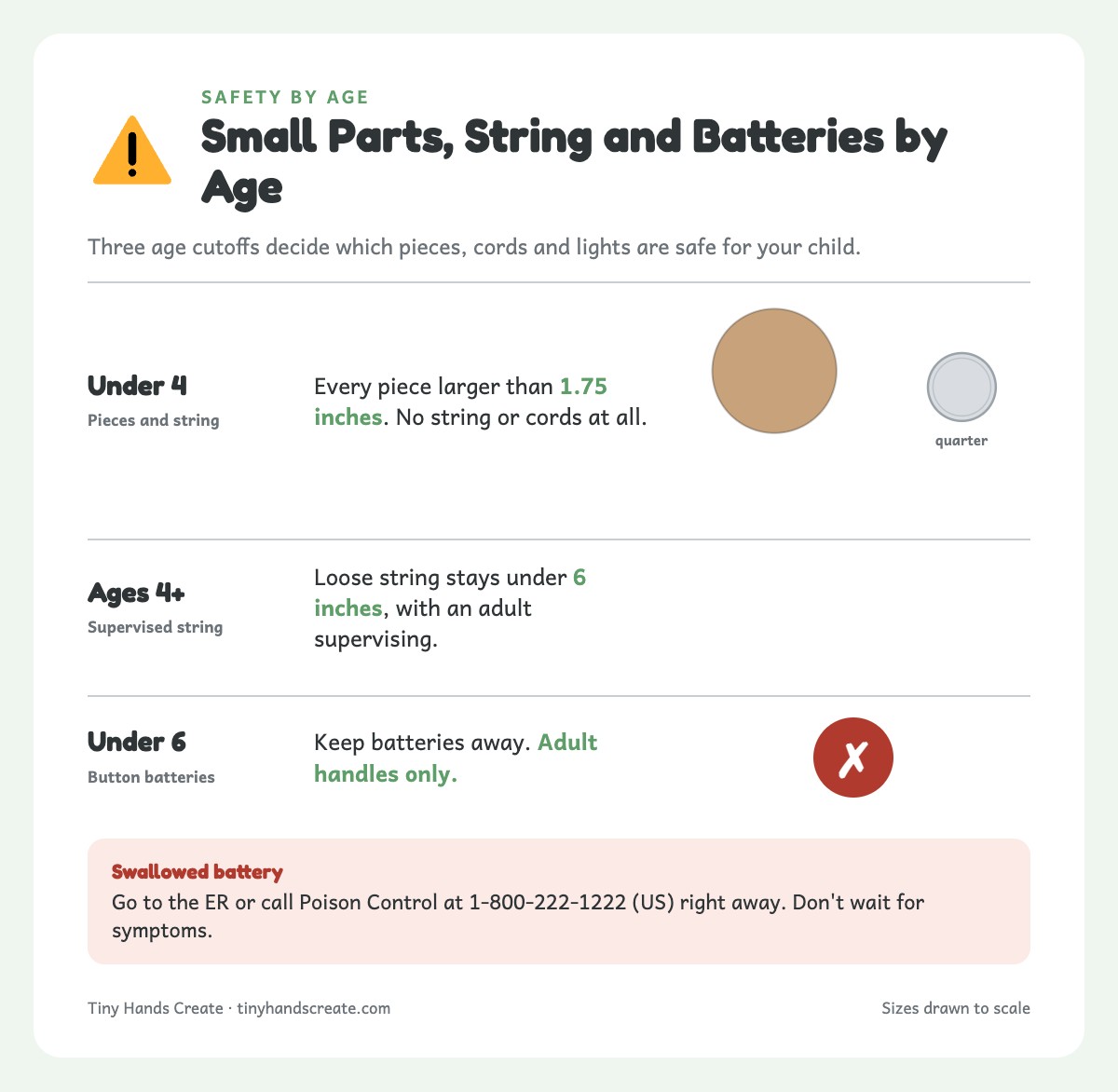
Safety firstFor kids under 4, keep every piece larger than 1.75 inches and skip string and cords entirely. Use tape or paper strips to hang things instead. For ages 4+, keep any loose string under 6 inches and supervise. Keep button batteries away from kids under 6, and let only an adult handle them.
An adult does every box cutter, brad and staple step. Use washable, non-toxic paint and glue. If a child swallows a battery, go to the ER or call Poison Control at 1-800-222-1222 (US) right away. Don’t wait for symptoms.
Most of these crafts need only basic supplies. Here is what each one is for and who handles it.
| Supply | Used for | Who handles it |
|---|---|---|
| Box cutter or craft knife | Every cut in thick or double-wall cardboard | Adult only. Store it out of reach. |
| Adult scissors | Shipping-box cardboard | Adult only. |
| Blunt-tip kid scissors | Thin cereal-box cardboard | Kids, supervised. New to cutting? Try our cutting practice sheets first. |
| Packing tape and masking tape | Joints, hinges and hanging things | Kids and adults. |
| White school glue | Paper and small cardboard pieces | Kids. Allow drying time. |
| Hot glue gun | Fast holds on big builds | Adult only. |
| Brass fasteners (brads) | Moving parts | Adult only. Fold the prongs flat and tape over them. Keep them away from under-4s. |
| Markers, crayons, washable paint and stickers | Decorating | Kids. |
| Construction paper, fabric scraps and aluminum foil | Details, curtains and a metal look | Kids. |
| Paper towel tubes and rolled paper tubes | Towers, levers and handles | Kids. |
| Dowels or chopsticks | Rods | Ages 4+ with supervision. Sand the ends and cap them with tape or a cork. |
| Pipe cleaners (chenille stems) | Rods and antennae | Ages 4+ only, supervised. Fold the wire ends back and tape over them. |
| String or yarn | Weaving and lacing | Ages 4+ only, supervised. Keep loose ends under 6 inches. |
Before you start:
- Cover the table or floor.
- Set the adult cutting tools out of reach.
- Put out washable, non-toxic paint and glue.
- Pull any staples out of the boxes.
- Pick battery-free decorations for kids under 6.
Easy Cardboard Crafts for Toddlers and Preschoolers
These five take 15-30 minutes each, which makes them good rescues for a restless afternoon. For more quick ideas, see our rainy day activities.
1. Cardboard Binoculars
My kid wore these on every walk for a week and filed reports on squirrels. Mess level: low.
What you need: 2 toilet paper tubes (about 4 inches long), tape, markers or paint, and 2 wide craft sticks with rounded ends for handles. For the youngest kids, a rolled paper strip works as a handle instead. For ages 4+, add Velcro or light tape for an optional breakaway strap.
- Decorate. Color both tubes with markers or paint, and let any paint dry.
- Join. Tape the tubes side by side with two wraps of tape.
- Add handles. Tape a wide craft stick flat along the outside of each tube, rounded end down, and wrap the tape all the way around. Check the tape holds before each use.
Safety firstSkip neck cords for under-4s. For ages 4+, use only a Velcro or light-tape strap that pulls apart easily. Never leave binoculars on an unattended child or during sleep.
Skill level: Ages 2+ for the handheld version, with an adult assembling. The breakaway strap is for ages 4+ only.
2. Cereal Box Aquarium
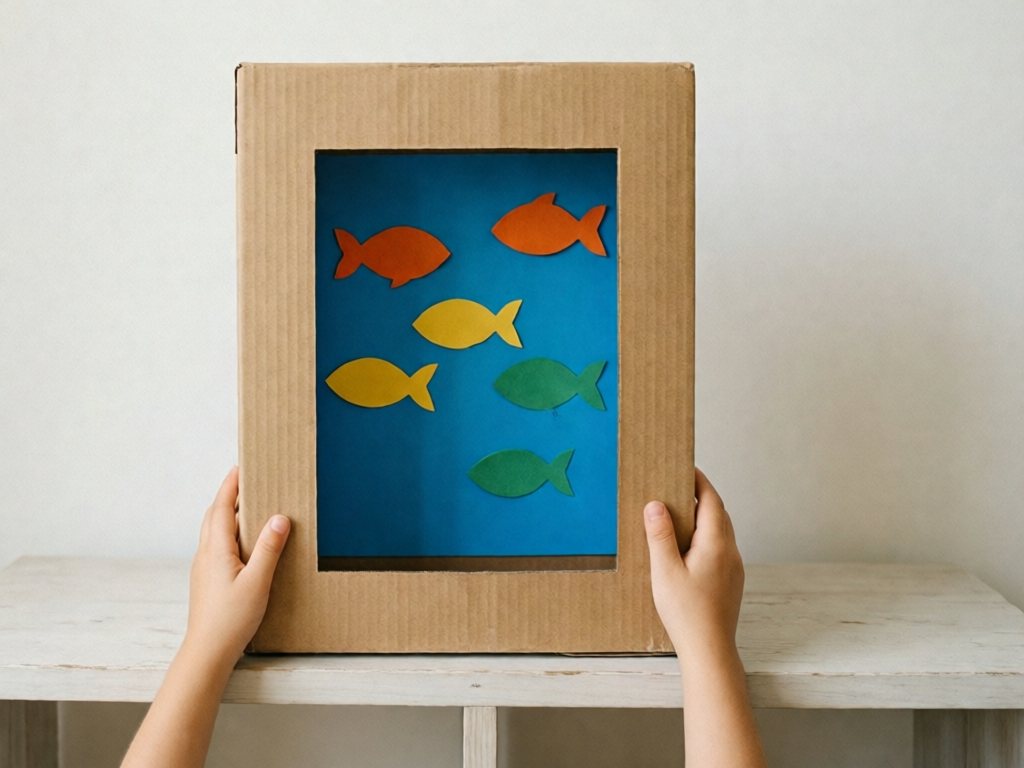
The fish are the fun part, so cut the window before your child sits down.
What you need: An empty cereal box, blue paint or paper, construction paper, tape and scissors.
- Cut the window. An adult cuts a large “window” in the front of the box, leaving a 1-inch border.
- Make the water. Line the inside with blue paper, or paint it blue and let it dry.
- Cut the fish. Cut fish about 2-3 inches long from construction paper.
- Hang them. Tape the fish to the inside back wall, or hang them from paper strips taped at the top. No string.
Extension: Add tissue paper “seaweed.” Use sand-colored paper or paint for the sea floor. Skip real sand and small rocks, which are small-parts hazards.
3. Shoebox Guitar
Fair warning: this one is loud, and the bands need re-stretching often.
What you need: A shoebox (no lid, or a lid with an oval cut out), 4-6 thick rubber bands of different thicknesses, a paper towel tube, tape and decorating supplies.
- Cut the sound hole. If you are keeping the lid on, an adult cuts an oval in it. Or skip the cut and leave the lid off.
- Decorate. Color the box with markers, stickers or paint, and let any paint dry.
- Add the strings. Stretch the rubber bands lengthwise around the box.
- Add the neck. Tape the paper towel tube to one short end as the “neck.”
Safety firstRubber bands make this one ages 4+ with supervision. Never pluck close to faces.
For more noisy fun, try our music and movement activities.
The science: Bands of different thickness make different tones. Let your child pluck each one and compare.
4. Cardboard Crown
Expect this one to be worn to dinner and on the school run.
What you need: Cereal box cardboard, scissors, tape (or an adult-only stapler) and decorating supplies.
- Cut the strip. An adult cuts a strip about 2 inches wide and 22 inches long. Tape two pieces end to end if the box is short.
- Shape the top. Cut a zigzag or shaped top edge. Older kids can cut thin cardboard with supervision.
- Decorate. Go big with markers, paper and stickers.
- Fit it. Wrap the strip around your child’s head, trim the extra and tape it closed.
Safety firstUnder 4, decorate with large stickers and paper only. Gems and glitter are for ages 4+ with supervision, glued firmly. If an adult staples the band, point the staples outward and cover them with tape.
Variations: Princess tiara, knight helmet or dinosaur spikes.
5. Simple Cardboard Frames
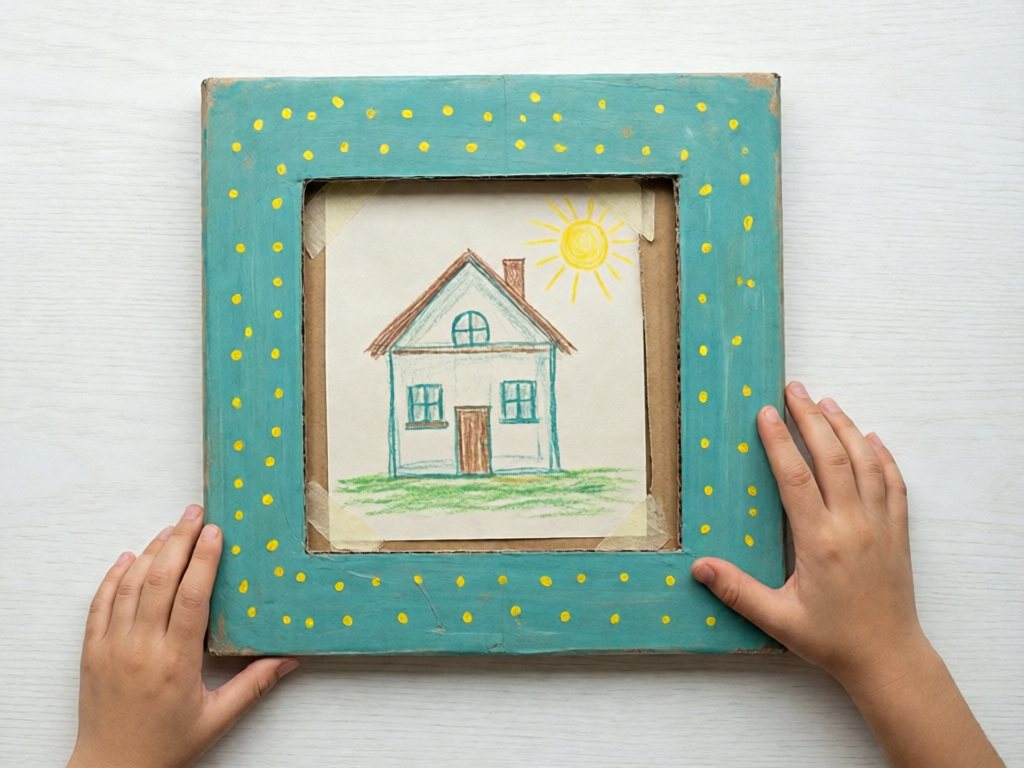
What you need: A cereal box or similar thin cardboard, scissors, tape and decorating supplies.
- Cut two rectangles. Make them identical, about 6 x 8 inches.
- Cut the window. An adult cuts a window from the center of one piece, leaving a border about 1.5 inches wide. That fits a 4 x 6 photo.
- Decorate. Your child decorates the frame piece.
- Add the art. Tape the artwork or photo between the frame and the backing.
Gift idea: These make sweet grandparent gifts with a photo inside. Thin cardboard curls a little as paint dries, so press the frame under a book overnight.
Cardboard Box Toys to Build Together
These take 45 minutes to a few sessions, and an adult does the cutting. I split the castle across a few days and the kids were happier for it.
6. Box Car
Expect the wheels to get knocked off by day two. Tape them on so they are easy to put back.
What you need: A medium box about 20 x 20 x 20 inches (big enough for a child to sit inside), four 9-inch paper plates, a paper towel tube, paint, markers and tape. An adult needs scissors or a box cutter.
- Prep the box. An adult removes the top flaps or folds them down inside.
- Cut doors. An adult cuts a “door” flap on each side that swings open (optional).
- Add a steering wheel. Tape the paper towel tube inside the front.
- Add wheels. Tape the four paper plates to the outside.
- Paint the details. Add headlights, a license plate and a hood line. Use thin paint or markers so the cardboard doesn’t warp.
Safety firstUnder 4, skip straps and let your child sit in the box or hold it. Pick a box with enough room to sit comfortably, and pull out every staple first. For ages 4+, short, wide, secure straps are fine.
Adults never push or pull a child sitting in the car. It stays on a flat floor, away from stairs and uneven ground. Supervise closely.
Variations: Fire truck, race car or monster truck. Kids who love vehicles may also like our construction activities.
7. Puppet Theater
Fair warning: the shows are long and the plots are thin.
What you need: A large box (appliance size is ideal), a craft knife for the adult, paint, a fabric scrap for the curtain and tape. For puppets, use socks, or paper shapes on craft sticks or rolled paper tubes.
- Cut the stage. An adult cuts a large rectangular “stage” window in one side, at about your child’s chest height.
- Cut the backstage door. An adult cuts a smaller “backstage” entry in the back.
- Decorate. Paint and decorate the outside together.
- Hang the curtain. Tape the fabric along the inside top of the window.
- Make puppets. Make simple sock or stick puppets and start the show.
Try this: Let siblings write a two-minute show, then perform it for a stuffed-animal audience.
Safety firstWith any box a child can climb into, always leave a door or window open and never tape it shut with a child inside. Remove all staples, supervise, keep it away from stairs and pools, and don’t stack heavy boxes.
8. Cardboard Ball Maze
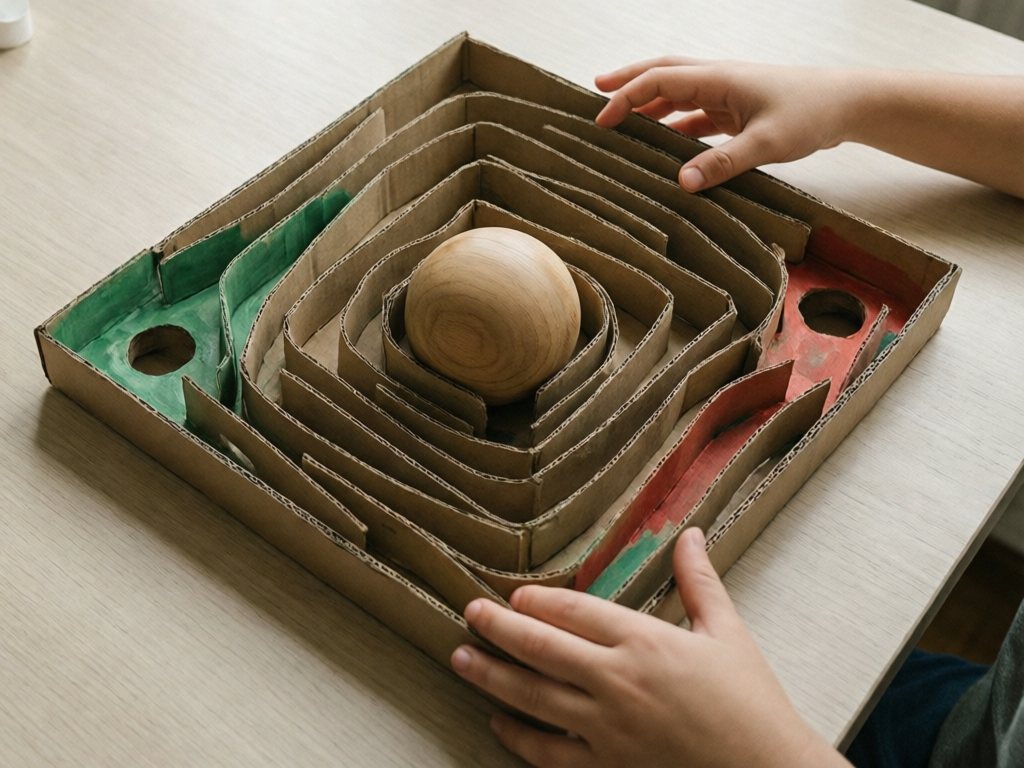
This maze uses a large, soft play ball, never a marble. Pick a ball wider than 1.75 inches. Ping-pong and golf balls are too small.
What you need: A large shallow box lid or cut-down box, cardboard strips, scissors, glue, tape and the ball.
- Cut the walls. Cut cardboard strips about 1.5-2 inches tall, in different lengths.
- Lay out the lanes. Set the strips in the box and roll the ball through. Leave every lane about an inch wider than the ball.
- Glue and tape. Glue the strips down, then tape each wall at the base.
- Mark start and finish. Draw a start point and a finish point.
- Add traps. An adult cuts one or two “trap” holes a little wider than the ball.
Mess level: low. Ours got dented within a day, so tape the walls down at the base.
Safety firstAges 4+ with supervision. Never use a marble or any ball small enough to choke on. Keep this away from younger siblings.
For a paper version, try our printable mazes.
9. Cardboard Castle
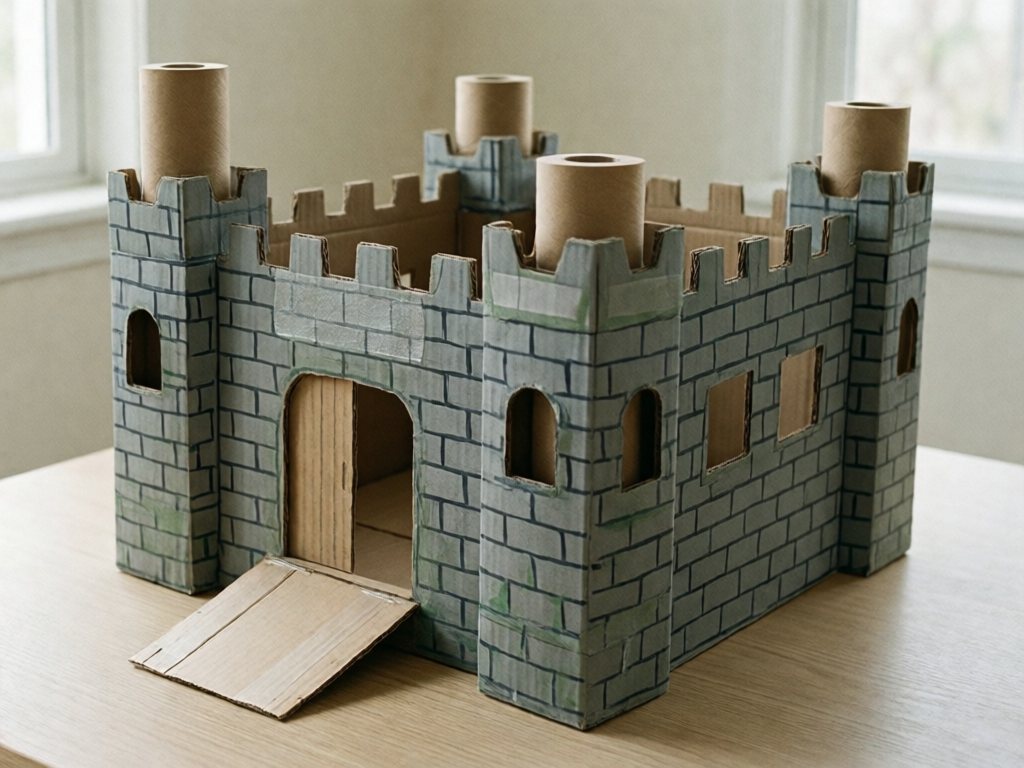
Build the walls first, add towers and doors next, and paint last.
What you need: 3-5 boxes in different sizes, paper towel tubes for towers, cardboard scraps, tape, glue, scissors and paint.
- Arrange the boxes. Set the boxes into a castle shape and tape them together.
- Cut the battlements. An adult cuts crenellations (the notched top) along the box edges.
- Add towers. Tape paper towel tubes to the corners.
- Cut a door and windows. An adult does these cuts.
- Add a drawbridge. Hinge a cardboard flap with tape. No string needed.
- Paint the stone. Use a sponge or a marker grid. If a tower wobbles, tape a cardboard brace behind it.
Time investment: About 3-4 hours in total, spread over 2-3 sessions. Ages 4+, with an adult doing the thick cuts. For more building ideas, see our building challenges.
10. Dollhouse or Action Figure Headquarters
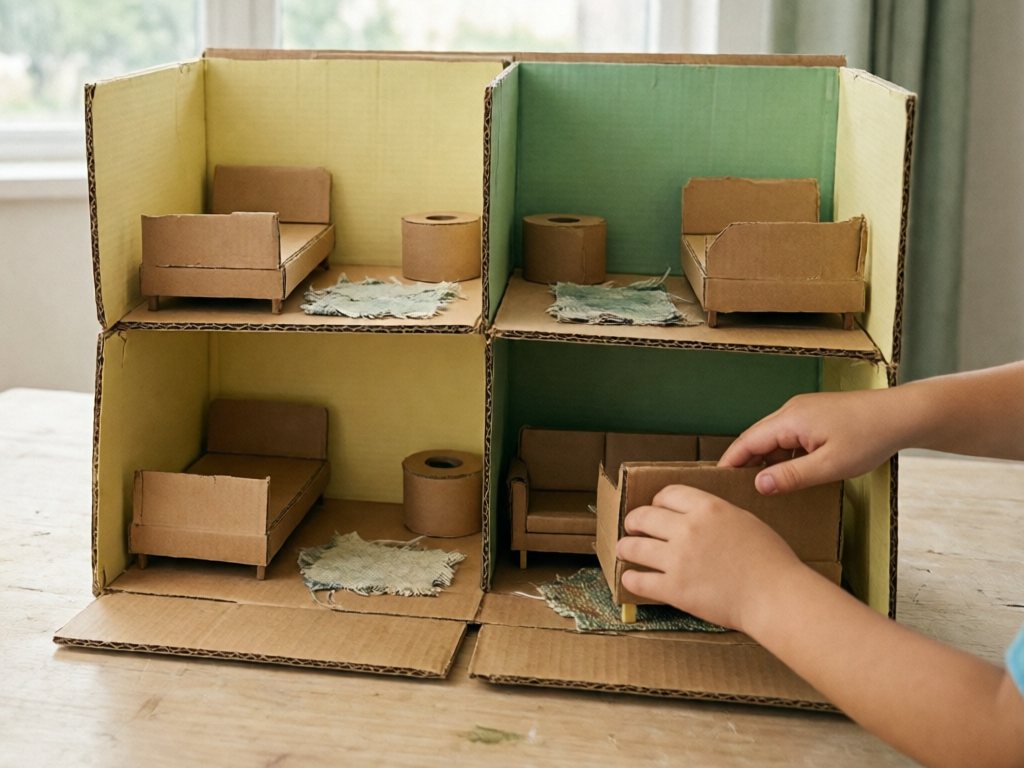
The furniture is flimsy and gets rebuilt often, which is half the fun.
What you need: A large box, flat cardboard for floors and dividers, small boxes for furniture, fabric scraps, tape and decorating supplies.
- Set up the box. Turn the large box on its side with the open side facing out.
- Add floors. An adult cuts cardboard “floors” and dividers to fit, then tapes them in to make rooms.
- Make furniture. Use empty small boxes for beds and couches, and toilet paper tubes for tables. Never use boxes that held matches.
- Decorate. Color the walls and add fabric “rugs.”
Make it collaborative: Your child decorates and arranges while you do the structural cutting. For under-4s, keep every furniture piece larger than 1.75 inches. For more open-ended setups, see our loose parts play ideas.
Big Cardboard Box Builds
Each of these takes 1-3 hours, so I’d budget a full afternoon. They get played with for weeks.
11. Playhouse
What you need: A large appliance box or several large boxes, a box cutter for the adult, packing tape, paint and decorations. Fabric scraps for curtains are optional.
- Stand it up. Keep the box assembled for the walls and roof, and tape the seams.
- Cut the door. An adult cuts a door on three sides. Leave the fourth edge attached as a hinge.
- Cut windows. An adult cuts at least one window at your child’s eye level.
- Add a roof. Tape on cardboard roof flaps if the box needs them.
- Paint. Paint the outside. Chalkboard paint on one side is fun!
- Add details. Draw or tape on window boxes, a doorbell and a house number.
Indoor vs. outdoor: Works in both places, but cardboard and rain don’t mix. Use outdoors on dry days only.
TipA refrigerator-size or appliance box gives a toddler room to stand and an older child room to sit. Honestly, it takes me two to three hours, mostly for the cutting. If the walls wobble, double the tape at the corners and add a cardboard brace inside.
Safety firstLeave the door and a window open at all times, never tape the playhouse shut with a child inside, and remove every staple. Keep it away from stairs and pools, and supervise play.
12. Spaceship Control Center
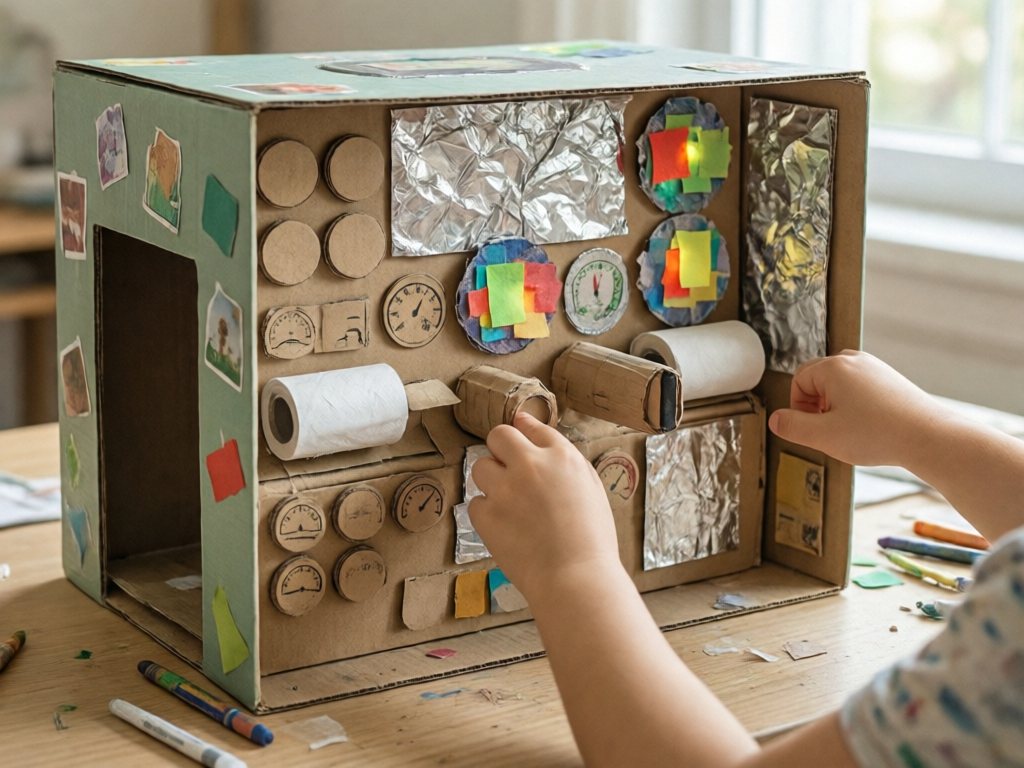
The foil tears and needs patching, so keep the roll handy.
What you need: A large box, cardboard circles or large plastic tub lids for buttons and gauges, paper towel tubes for levers, aluminum foil, colored tissue paper, stickers and glue. Skip sharp metal jar lids.
- Cut the entry. An adult cuts an opening big enough to crawl through.
- Mark the panel. Pick the inside front wall as the “control panel.”
- Add buttons. Glue on cardboard circles or large tub lids, or draw the buttons on.
- Add levers. Tape on paper towel tubes.
- Add gauges. Draw or glue on gauge circles.
- Add metal. Cover parts of the box in aluminum foil for a “metal” look.
- Add lights. Glue on foil circles, bright stickers or colored tissue paper as no-battery “lights.”
TipThe no-battery lights work for every age, and they are what I use. For ages 6+, an adult can tuck LED tea lights behind the tissue paper instead. Use only lights with a battery door that screws shut. An adult tests the door, tapes over it and handles the lights. Never use real candles.
Sound effects: Search YouTube for “spaceship cockpit sounds” for mission audio.
Safety firstMany LED lights run on button batteries, which are a serious swallowing hazard. Battery lights are for ages 6+ only, and an adult handles them. Skip any light with a slide-off or pop-off battery door. Before every play session, an adult checks that the compartment is screwed shut and taped over. Keep the lights away from younger siblings. If a battery is swallowed, go to the ER or call Poison Control at 1-800-222-1222 (US) immediately, and don’t wait for symptoms.
13. Kitchen Play Set
The oven door is the first thing to tear, so hinge it with extra tape.
What you need: A large box (refrigerator size) or several medium boxes, paper plates for burners, cardboard circles for knobs, a plastic bowl for the sink, tape and paint.
- Cut to height. An adult cuts the box to about your child’s waist height, roughly 20-24 inches for most preschoolers.
- Make the stovetop. Glue on paper plate burners and cardboard-circle knobs, or draw the knobs on.
- Cut the oven door. An adult cuts a door on three sides so it opens.
- Add the sink. An adult cuts a circle in the counter. Set the plastic bowl in it.
- Tape the edges. Cover any rough cut edges with tape.
- Add utensil holders. Tape on cardboard loops or short tubes to hold spoons.
- Paint. Paint everything and let it dry.
- Stock it. Add play food from around the house.
Safety firstThis kitchen is play-only, with no real heat. Tape over every rough cut edge. Use cardboard loops or taped-on tubes for utensils, not metal or adhesive hooks.
Bake the pretend cookies from project 24 in it, or take the cooking outside with our mud kitchen play ideas.
14. Cardboard Pinball Machine
Expect the rubber-band launcher to need re-taping a few times. Mess level: low.
What you need: A large flat box (a shipping box works), cardboard tubes and scraps, rubber bands, tape, glue and a soft ball larger than 1.75 inches. Brass fasteners are optional and adult-only.
- Tilt the box. Wedge cardboard under one end so the box sits at a slight angle.
- Build obstacles. An adult cuts holes. Then add tube tunnels and glue on cardboard bumpers, spaced wider than the ball.
- Make the launcher. Attach a thick rubber band to a cardboard strip.
- Add points. Write a point value on each obstacle.
- Add a catch. Tape a cardboard lip at the bottom to catch the ball.
Safety firstAges 4+ with supervision. Use only a soft ball larger than 1.75 inches, bigger than a ping-pong ball. Hold the launcher away from faces and never aim it at anyone. An adult handles any brass fasteners, folds the prongs flat and tapes over them. Keep this away from younger siblings.
Curious how the ramp works? Try our simple machines activities.
15. Life-Size Robot Costume
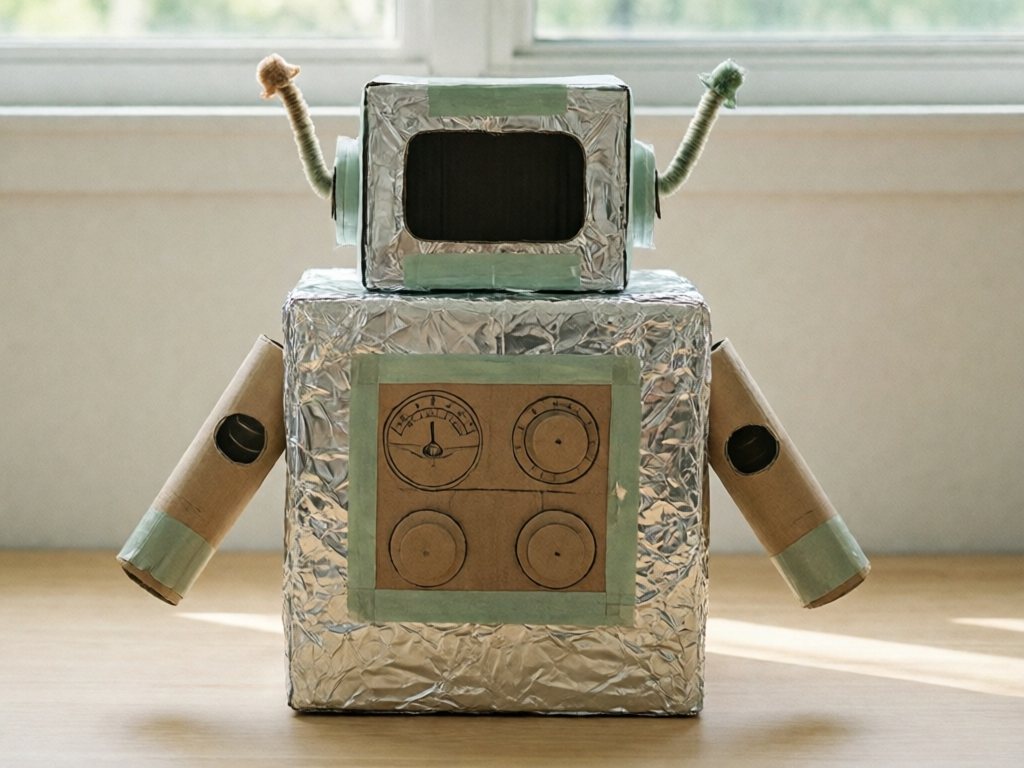
It is hard to sit down in this one, so plan on standing-up play.
What you need: A large box for the body, a medium box for the head, cardboard tubes for arms, aluminum foil, paper or cardboard circles, pipe cleaners, tape and paint.
- Cut the body. An adult cuts a head hole and two arm holes in the large box.
- Cut the face. An adult cuts a generous face hole in the head box so your child can see.
- Go silver. Cover both boxes in foil or paint them silver.
- Add a control panel. Draw dials or glue on cardboard circles.
- Add arms. Tape the tube arms on at the arm holes.
- Add antennae. Fold the wire ends of the pipe cleaners back and tape over them. Then tape the pipe cleaners to the top of the head box.
- Tape the edges. Cover every cut edge with tape.
Event-ready: Good for Halloween, dress-up play or a robot-themed party. Ages 4+, and supervise away from stairs. Need a faster costume? See our last-minute Halloween costumes.
Educational Cardboard Crafts for Kids
These five sneak in science, letters, fine motor practice, sorting and counting. Each one lists its ages and time below.
16. Solar System Model
The sizes won’t be to scale, and that’s fine. Big Jupiter and tiny Mercury get the idea across.
What you need: A large flat box, cups and lids to trace, cardboard, paint, tape and paper strips for hanging.
- Make space. Paint the inside of the box black, or cover it with black paper.
- Cut the planets. Trace and cut eight cardboard circles in roughly relative sizes, big for Jupiter and small for Mercury.
- Paint them. Paint each planet its own colors and let them dry.
- Place them. Tape the planets inside the box, or hang them from paper strips taped at the top. No string.
- Add stars. Dot on white paint or add star stickers.
Learning extension: Look up each planet together, label it and add moons.
17. Number or Letter Puzzle
Start with the first letter of your child’s name.
What you need: Cardboard, markers and scissors.
- Cut the shapes. An adult cuts large letters or numbers, each about 8 inches tall.
- Color them. Your child colors each one a different color, which makes sorting easier later.
- Cut the pieces. Cut each shape into big puzzle pieces, 3 for ages 2-3 and up to 5 for older kids. Keep every piece larger than 1.75 inches.
- Store them. Keep each puzzle in its own labeled envelope or bag.
Skill building: Letter recognition, problem-solving and fine motor skills. Pair it with our alphabet worksheets or number tracing worksheets.
18. Busy Board
This one is a build for you and a toy for them. Cardboard won’t last like a wooden board, so check it often.
What you need: A large piece of sturdy double-wall cardboard, toy locks, latches, zippers, Velcro strips, shoelaces, bolts with washers and a hot glue gun. Use non-electrical toy switches only, never real switches or outlets.
- Plan the layout. Lay the items out with space between them. Mix textures, mechanisms and challenges.
- Bolt it down. Secure each piece of hardware with through-bolts and washers, or sew or rivet it onto sturdy backing. Hot glue alone won’t hold.
- Cover the back. Tape over every bolt end on the back of the board.
- Add laces. Thread shoelaces through punched holes and trim them to under 6 inches.
- Test it. Tug every part hard before every play session. Put the board away if anything is loose.
Safety firstAn adult builds this one, and the glue gun is adult-only. Play is for ages 4+ with supervision. The bolts, washers, latches and zipper pulls are small parts, so treat them as a choking hazard. Bolt each one through the board and tape over every bolt end. Keep every lace under 6 inches. Check for loose parts before every session, and keep the board away from younger siblings.
Best for: Fine motor practice. Pick a theme, like a front door or a toolbox. For under-4s, try our fine motor activities for toddlers instead.
19. Sorting/Posting Box
This is the fastest win on the list for a 2-year-old.
What you need: A shoebox with a lid, scissors or a craft knife for the adult, and items to sort that are larger than 1.75 inches. Large cardboard shapes and big wooden blocks work well.
- Cut the holes. An adult cuts a circle, square, triangle and rectangle in the lid, each a little bigger than its item.
- Match the items. Set out one or two items for each shape.
- Post. Your child “posts” each item through its matching hole.
Level up: Color the shapes for color and shape sorting. Supervise play. For more practice, see our sorting activities for toddlers and shape recognition worksheets.
20. Cardboard Abacus
Paper-tube rings are the easiest “beads.” They slide well and cost nothing.
What you need: A shoebox, scissors, and blunt straws, chenille stems or thick dowels with capped ends for rods. For beads, use paper tubes cut into rings about 1 inch wide, or curtain rings or wooden beads larger than 1.75 inches. The tube rings are small, so keep this one for ages 4+.
- Poke the holes. An adult pokes 5 rows of matching holes through two opposite sides of the box. Space the rows a little wider than your beads.
- Load the rods. Push each rod through one side, slide on 5-6 beads, then push it through the other side. The box size limits how many fit, so use fewer if your beads are bigger and leave a couple of inches of empty rod for sliding.
- Cap the ends. Cover the rod ends with tape so nothing pokes out. Fold the wire ends of chenille stems back first, then tape over them.
Math connections: Counting, addition and subtraction you can see. Ages 4+ with adult supervision. For more number play, try our math games with household items.
Quick Crafts From Cardboard Scraps
Got offcuts from a big build? These five use flat scraps, take 15-30 minutes each and need almost nothing.
21. Cardboard Stamping
What you need: Thick cardboard, wooden blocks larger than 1.75 inches, white glue, washable paint and a paper plate. The glue needs to dry first, so make the stamps ahead. For more ideas, see painting without brushes.
- Cut shapes. An adult cuts simple shapes from thick cardboard.
- Glue to blocks. Stick each shape to a wooden block and let it dry.
- Stamp. Pour paint on a paper plate as a pad and stamp away.
22. Weaving Loom
What you need: A cardboard rectangle about 6 x 8 inches, yarn, fabric strips and scissors. Little kids may weave a few rows and call it done, and that counts. For more, see our yarn crafts.
- Cut slits. Cut matching slits along two opposite sides.
- Warp. Run yarn through the slits to make parallel lines.
- Weave. Thread fabric strips over and under the yarn. Keep lengths short and supervise.
23. Monster/Animal Heads
What you need: A large piece of cardboard, colored paper, glue and markers. Friendly monsters fit right in with our non-scary Halloween crafts.
- Cut the head. An adult cuts a big head shape.
- Add features. Glue on paper eyes, teeth and ears.
- Hang it. Tape it to the wall. Let your child pick the monster’s mood.
24. Cardboard Cookies for Pretend Play
What you need: Cardboard, washable paint, glue and paper scraps. Make each cookie at least 2 inches across so none is a small part.
- Cut cookies. Cut rounds and shapes from cardboard.
- Ice them. Paint on “icing” and glue on paper sprinkles.
- Play. Stock the play kitchen, and remind little ones these are not edible.
25. Travel Activity Kit
What you need: A shoebox, paper, cardboard scraps and markers. It is for ages 4+, since the game pieces are small. For more ideas, see our screen-free activities for car rides.
- Cover the box. Wrap it in paper and decorate it.
- Make games. Draw a tic-tac-toe grid, matching cards and blank postcards.
- Pack it. Fill the box and keep it in the car or bag.
Tips for Cardboard Crafting Success
Working with Different Cardboard Types
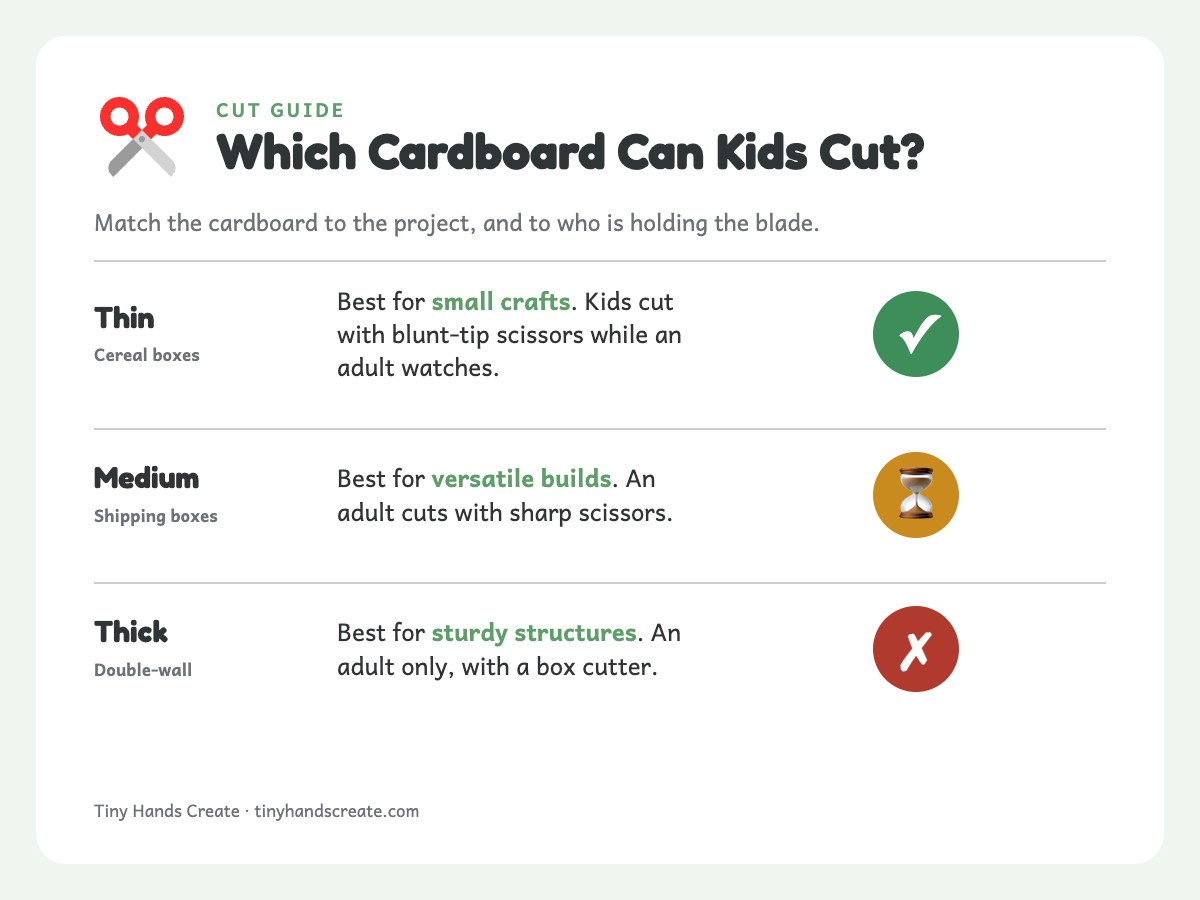
| Cardboard type | Best for | Who cuts it |
|---|---|---|
| Thin (cereal boxes) | Small crafts | Kids, with blunt-tip scissors and an adult watching. |
| Medium (shipping boxes) | Versatile builds | An adult, with sharp scissors. |
| Thick (double-wall) | Sturdy structures | An adult only, with a box cutter. |
Making Creations Last Longer
Tape and dry storage do most of the work.
- Reinforce joints with two or three layers of tape.
- Use packing tape, not masking tape, for anything structural.
- Keep builds dry. A soggy box goes in the recycling.
- Store builds flat when you can.
Tape beats glue here, because glue needs time to dry and my kids don’t wait.
Managing the Mess
Expect paint drips and paper scraps. A little setup keeps it contained.
- Lay down a drop cloth or work outside.
- Use washable paints.
- Set up a “drying station” before you start.
- Make cleanup part of the activity.
Troubleshooting Cardboard Builds
| Problem | Cause | Fix |
|---|---|---|
| Walls collapse | Single-wall cardboard, weak corners | Double the tape and add a cardboard brace. |
| Tape peels off | Dusty or painted surface | Wipe the surface and use packing tape. |
| Paint warps cardboard | Too much water | Use thin layers or markers. |
| Glue won’t hold | Too little drying time | Use tape while it dries. |
| Edges tear | Dull blade | Adult recuts with a fresh blade. |
Two more quick fixes: tape both sides of a torn flap, and flatten failed builds to reuse in the next project. Let your child call it done, even if it differs from your plan.
Crafty Mama
Crafty Mama is a former elementary art teacher turned stay-at-home parent who believes every child is creative — they just need the right invitation. She develops age-appropriate activities, crafts, and projects that spark imagination while keeping mess (and parent stress) to a minimum.
Cardboard Box Craft FAQ
What age can start cardboard crafts?
Toddlers can decorate pre-cut cardboard shapes and do the 2+ projects in the table above. By 3-4, kids can help with simple assembly. By 5-6, many can do much of the work independently, with adult cutting. Check each project’s age in the table, since some use small parts.
How do I store cardboard for future crafts?
Flatten boxes and store behind a door or under beds. Keep a “craft box box” of smaller pieces sorted by size.
My child loses interest before finishing. What should I do?
Choose simpler projects, work in sessions, and let them decide when a project is “done” (even if it’s different from your vision).
How do I make cardboard more durable?
Use multiple layers of packing tape at stress points and keep creations dry. Cardboard weakens when wet, so a soggy box goes in the recycling.
Is cardboard safe for young children?
Yes, with a few rules. Use washable, non-toxic paint and glue, and remove staples and sharp tape edges. Keep small parts (under 1.75 inches) and cords away from under-4s, and keep button batteries away from kids under 6. Adults do all knife cutting and supervise any box a child can climb into.
Can we make these crafts without paint?
Yes. Markers, stickers, colored tape and collage scraps all work. Plain brown cardboard looks good too.
What should I do with the cardboard when we’re done?
Recycle it. Remove plastic tape, foil and glitter-heavy sections first. Light paint and paper tape are fine in most programs, but check your local rules.
What is the best glue for cardboard?
Packing tape holds best for big builds. White school glue works for small pieces if you give it time to dry. Adults only for hot glue.
More Craft Ideas to Try Next
Want more ideas? Try our paper plate crafts, Earth Day crafts from recycled materials, paper bag scarecrow, air-dry clay projects or boredom busters.
Next time a box shows up, ask your kids what they see. Then hand them the tape.