Earth Day Crafts for Kids: 15 Projects Made Entirely from Recycled Materials
Discover 15 Earth Day crafts for kids aged 2-10, made mostly from recycled materials. You'll find projects with age ranges, time, mess levels, and safety notes, plus a free printable kit to help you get started.
- Find 15 Earth Day crafts for kids aged 2-10, using common recycled items.
- Review essential safety rules for each craft, especially for kids under 4.
- Download a free 6-page kit with supply lists, project cards, and planning tools.
- Start collecting items like egg cartons, plastic bottles, and cardboard tubes now.
- Each craft includes details on age, time, mess, and adult prep for easy planning.
This post contains affiliate links. As an Amazon Associate I earn from qualifying purchases.
Last April, my five-year-old held up a plastic bottle at the park and announced, “Mom, this is trash. We should make something with it.” She learned that at our kitchen table, turning cereal boxes into castles.
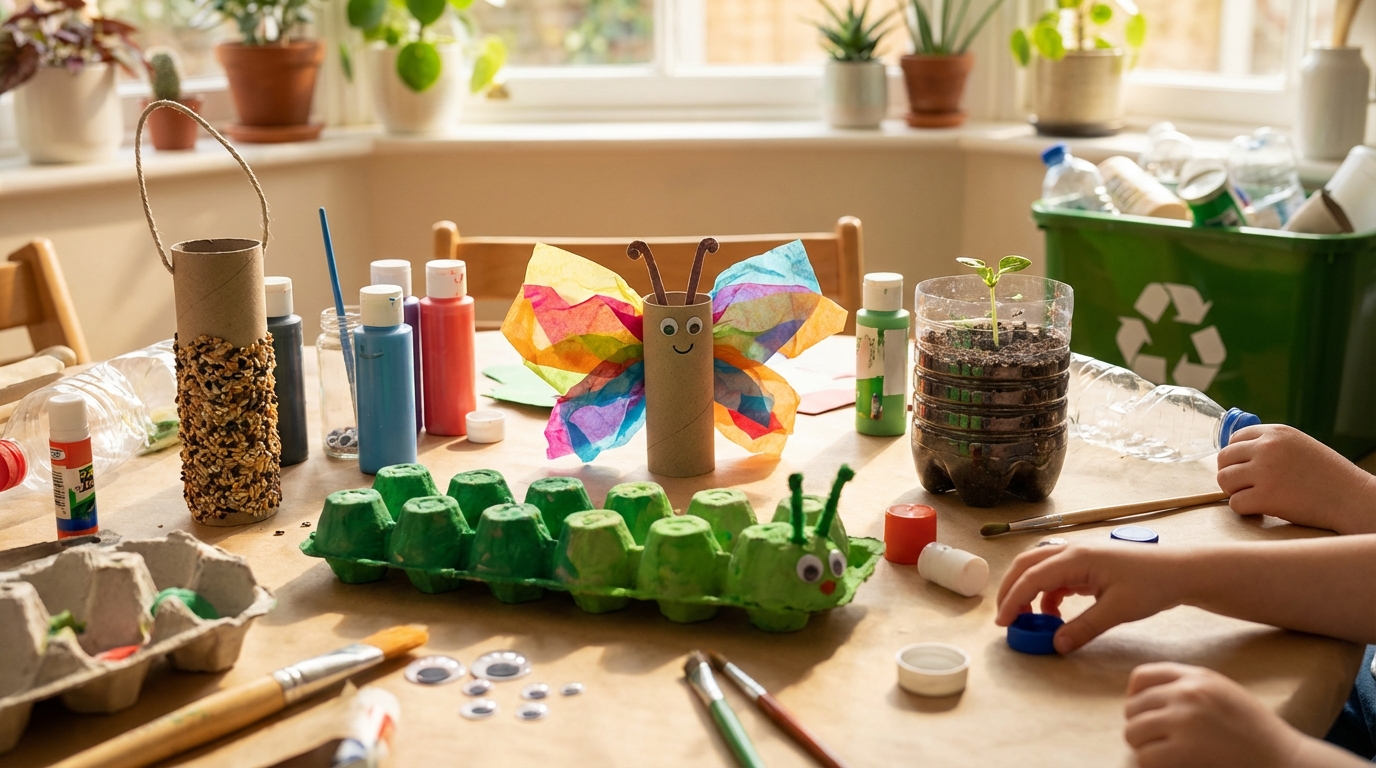
Earth Day is April 22nd. Below are 15 crafts for ages 2-10 made mostly from recycled materials, each with time, mess level, adult prep and safety notes.
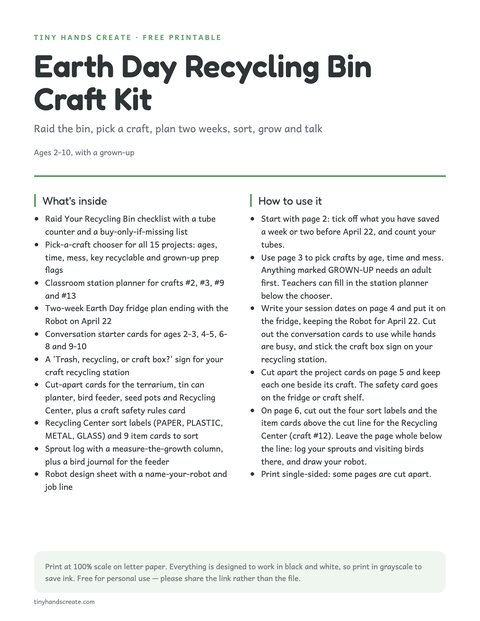
Free printable · 6 pages
Earth Day Recycling Bin Craft Kit
A recycling-bin supply checklist, a pick-a-craft chooser for all 15 projects, a two-week Earth Day plan with a classroom station planner, five cut-apart project cards plus a safety card, Recycling Center sort labels and item cards, sprout and bird trackers, a robot design sheet, and conversation cards by age.
Free. Your download link appears right here. You'll also join the Daily Printable Drop. Unsubscribe anytime. Privacy
Most of what you need comes from the recycling bin. You’ll add basic supplies like paint, glue and tape, and a few projects need soil, seeds, birdseed, wax paper or a new egg carton. Those are flagged in each project.
The free Earth Day Recycling Bin Craft Kit above pairs with craft #12.
In this article (11 sections)
- Before You Start: Safety Rules for Every Craft
- Craft Overview at a Glance
- Your Recycled Materials Supply List: What to Start Saving Now
- Easy Earth Day Crafts for Toddlers (Ages 2-4)
- Earth Day Crafts for Preschoolers (Ages 4-6)
- Earth Day Crafts for School-Age Kids (Ages 5-10)
- Earth Day Conversation Starters by Age
- Earth Day Crafts Your Family Will Actually Use
- How to Make Earth Day a Year-Round Mindset
- Earth Day Craft FAQ
- Earth Day Craft Takeaways
Before You Start: Safety Rules for Every Craft
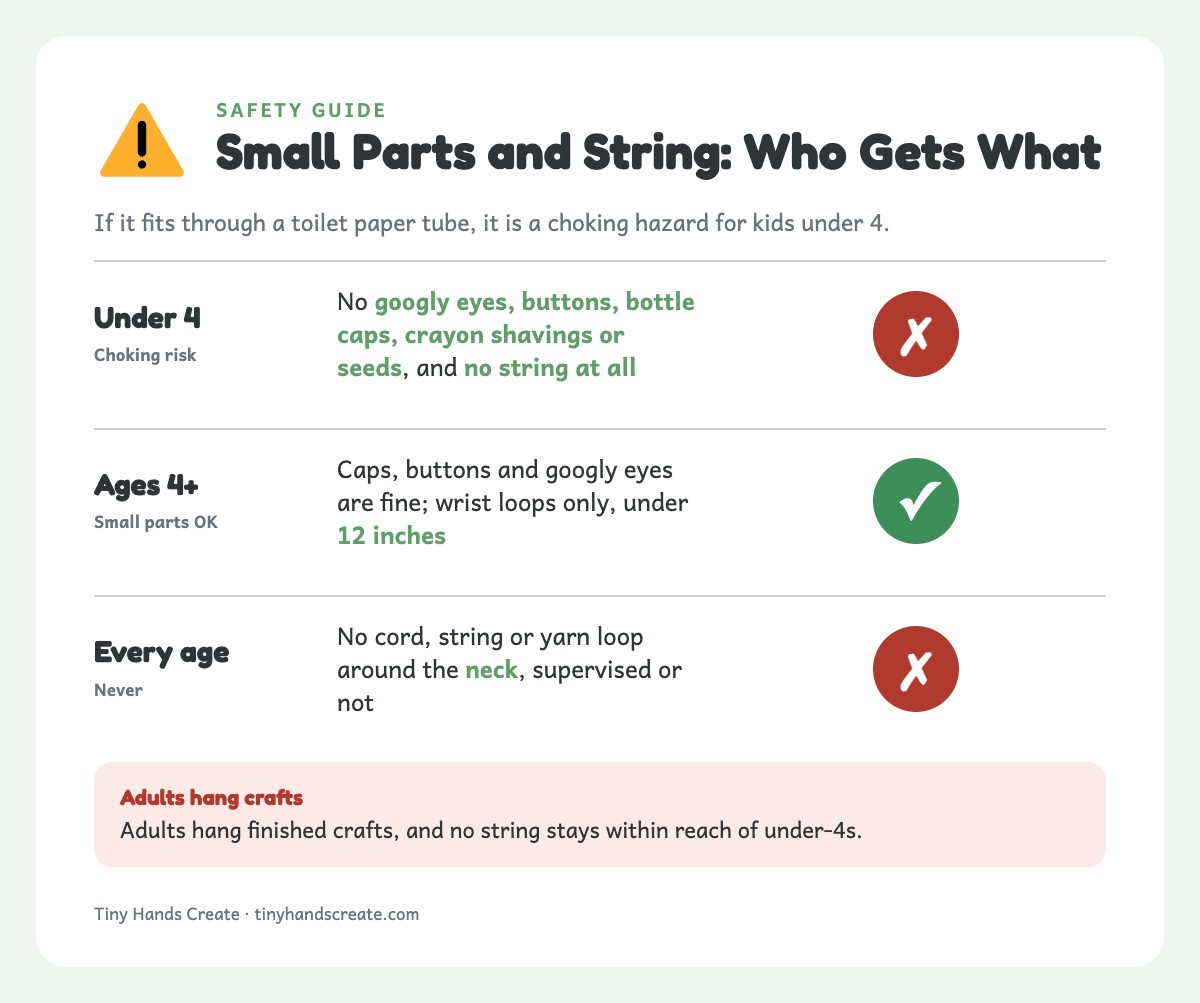
Read these once. They apply to every project below.
Safety firstAnything that fits through a toilet paper tube is a choking hazard for kids under 4: googly eyes, buttons, bottle caps, crayon shavings and seeds. Never put a cord, string or yarn loop around a child’s neck, supervised or not. Adults hang finished crafts, and no string stays within reach of under-4s. Cutting bottles and cans, and the iron in craft #14, are adult-only.
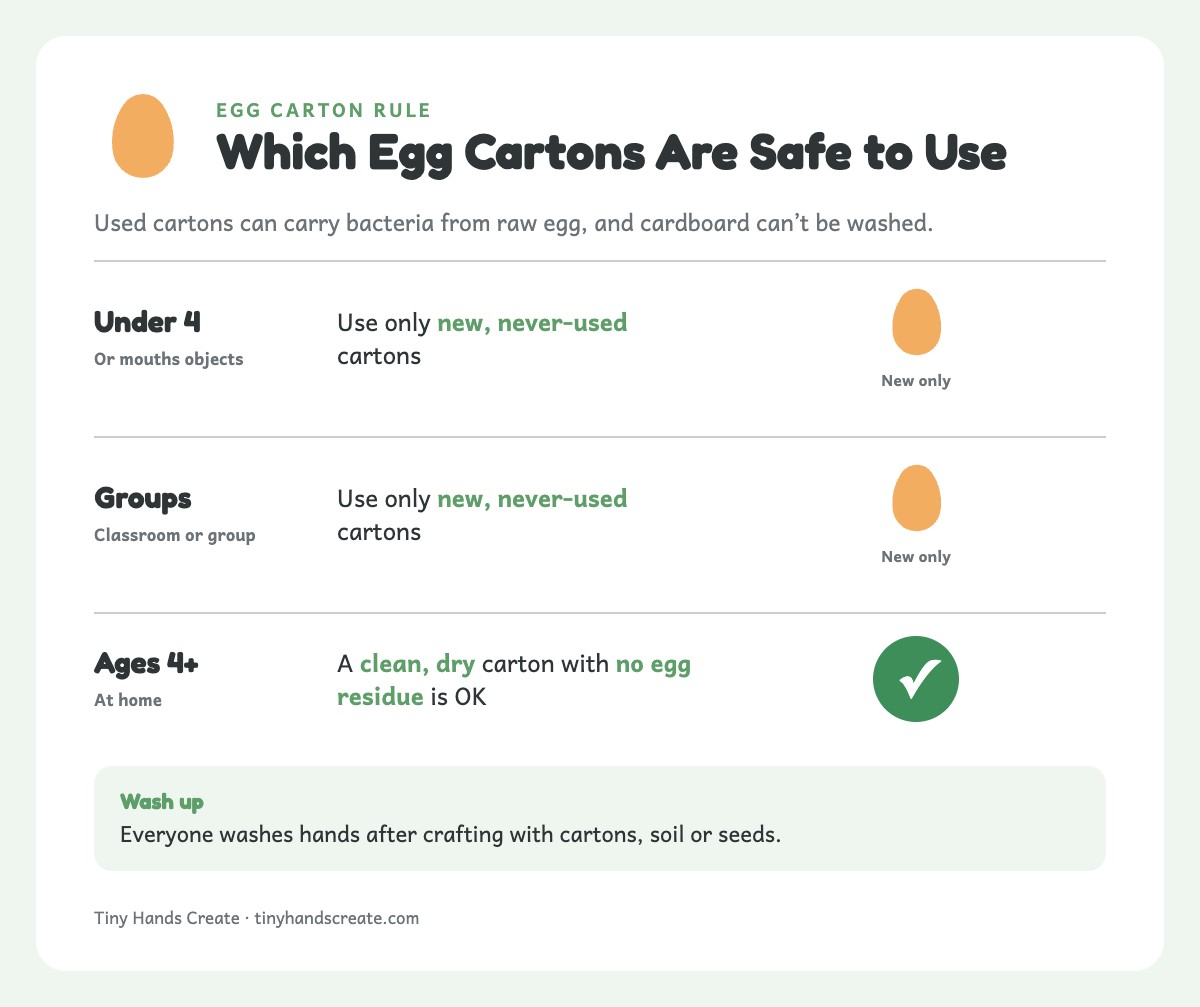
Safety firstUsed egg cartons can carry bacteria from raw egg, and cardboard can’t be washed. For kids under 4, anyone who still mouths objects, and any group or classroom, use only new, never-used cardboard cartons. Everyone washes hands after crafting with cartons, soil or seeds.
Craft Overview at a Glance
| # | Craft | Best Age | Time | Mess Level | Key Recycled Materials |
|---|---|---|---|---|---|
| 1 | Paper Bag Earth Puppet | 2-4 | 15 min | Low | Brown paper bag |
| 2 | Egg Carton Garden Bugs | 2-4 | 20 min | Medium | Egg carton |
| 3 | Tissue Paper Earth Collage | 2-4 | 15 min | Low | Old tissue paper, magazines |
| 4 | Toilet Roll Binoculars (Nature Walk) | 2-4 | 15 min | Low | 2 TP rolls |
| 5 | Cardboard Tube Tree | 2-4 | 20 min | Medium | Paper towel tube, newspaper |
| 6 | Plastic Bottle Terrarium | 4-6 | 30 min | Medium | 2-liter plastic bottle |
| 7 | Egg Carton Flower Garden | 4-6 | 25 min | Medium | Egg carton, straws or sticks |
| 8 | Cereal Box Earth Puzzle | 4-6 | 25 min | Low | Cereal box |
| 9 | Magazine Collage Earth Mosaic | 4-6 | 30 min | Low | Old magazines |
| 10 | Tin Can Planter | 5-10 | 25 min | Medium | Tin can |
| 11 | Plastic Bottle Bird Feeder | 5-10 | 30 min | Low | Plastic bottle, sticks |
| 12 | Cardboard Box Recycling Center | 5-10 | 40 min | Low | Large box + small boxes |
| 13 | Newspaper Seed Pots | 5-10 | 20 min | Low | Newspaper |
| 14 | Melted Crayon Earth Suncatcher | 5-10 | 25 min | Medium | Broken crayons, wax paper |
| 15 | Recycled Materials Robot | 4+ (under 4: stickers only) | 45 min | Low | Everything in your bin |
If you loved our St. Patrick’s Day crafts from recycled materials, you already know this. Same philosophy, new holiday, fresh projects.
Your Recycled Materials Supply List: What to Start Saving Now
Start collecting these items a week or two before Earth Day. Call it a “craft recycling station” and kids get enthusiastic about saving things.
Recycled materials work because they’re irregular, free and open-ended: hand my kids a cardboard tube, ask “what could this be?” and the options open up. Egg cartons do go soggy under heavy paint, so use thin coats and let them dry fully. If you made our St. Patrick’s Day crafts from recycled materials, your stash already has a head start.
Good to knowSmall parts (bottle caps, buttons, googly eyes) are for ages 4+ only. For younger kids, draw eyes with marker or use paper circles. Items you may need to buy: soil, untreated seeds, birdseed, wax paper, wooden sticks, and new egg cartons for under-4s or groups.
Paper and Cardboard
- Toilet paper tubes — the undisputed MVP of recycled crafts. You’ll need 6-8 for this article’s projects.
- Paper towel tubes — longer and sturdier, great for structural projects.
- Egg cartons — cardboard ones work best (styrofoam is harder to paint), in 6-count and 12-count. Save only clean, dry cartons with no egg residue, and only for kids 4+ at home. For under-4s, kids who mouth objects, and groups, use new, never-used cartons.
- Cereal boxes and cracker boxes — lightweight cardboard that’s easy for kids to cut.
- Shipping boxes — any size. Amazon boxes are perfect. See our full guide to cardboard box crafts for kids for even more ideas.
- Newspaper and magazines — especially ones with green, blue, and brown imagery.
- Brown paper bags — grocery bags or lunch bags.
- Junk mail and old calendars — surprisingly useful for collage work.
Plastic and Metal
- Plastic bottles — water bottles and soda bottles (labels removed).
- Plastic bottle caps — save in assorted sizes and colors (ages 4+ only).
- Yogurt cups and pudding cups — rinsed and dried.
- Tin cans — soup or bean cans, prepared by an adult only (see the safety box in craft #10).
- Aluminum foil — used sheets that have been smoothed out. Fold torn or cut edges under, since foil can be sharp.
Other Recyclables
- Old t-shirts or fabric scraps — for stuffing, wrapping, or painting.
- Broken crayons — we’ll melt these into something new.
- Old buttons — from the junk drawer (ages 4+ only).
Basic Craft Supplies You’ll Also Need
These aren’t recycled, but most households have them on hand:
- White school glue and/or hot glue gun (adult use only for the glue gun).
- Washable tempera paint in green, blue, brown, yellow, white, and red.
- Paintbrushes (various sizes).
- Scissors (kid-safe for younger ones, regular for adults).
- Tape — masking tape and clear tape.
- Markers, crayons, or colored pencils.
- String or yarn.
- Googly eyes (optional, ages 4+ only; draw eyes with marker for younger kids).
- Soil, untreated seeds, birdseed, wooden sticks, wax paper and an iron (for the planter, feeder and suncatcher projects).
Easy Earth Day Crafts for Toddlers (Ages 2-4)
These five crafts suit short attention spans and grabby hands. They have few steps and plenty of sensory fun, and as with process art for toddlers, the making matters more than the result. Keep small parts away from anyone who still mouths objects.
1. Paper Bag Earth Puppet
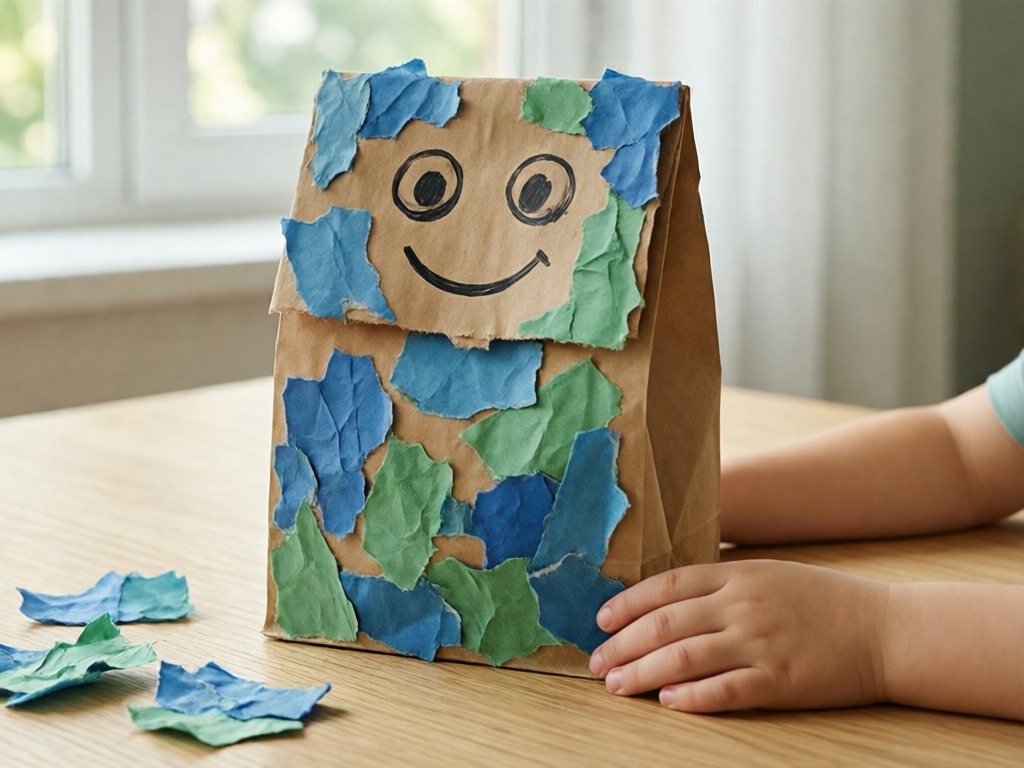
Materials: Brown paper bag, blue and green paint (or torn tissue paper in blue and green), glue stick, marker for eyes (googly eyes for ages 4+ only).
Time: 15 minutes | Mess Level: Low | Difficulty: Easy
What it teaches: Earth’s colors (blue for water, green for land), creative expression, puppet play and storytelling.
Steps:
- Lay the paper bag flat with the folded bottom flap facing up (this becomes the puppet’s face area).
- Let your toddler paint or glue blue and green tissue paper all over the bag. No need for geographical accuracy — this is toddler art, not cartography.
- If using paint, let dry for 10 minutes.
- Draw eyes on the bottom flap with marker (googly eyes only for ages 4+) — now the Earth has a face!
- Slip your hand inside and practice making the Earth “talk.” Ask your toddler: what would the Earth say to us?
TipThis is a perfect opening for a simple Earth Day conversation. “The Earth is blue because of water and green because of trees and grass. Our job is to help keep it beautiful.” That’s enough for a two-year-old. Plant the seed, don’t deliver a lecture.
2. Egg Carton Garden Bugs
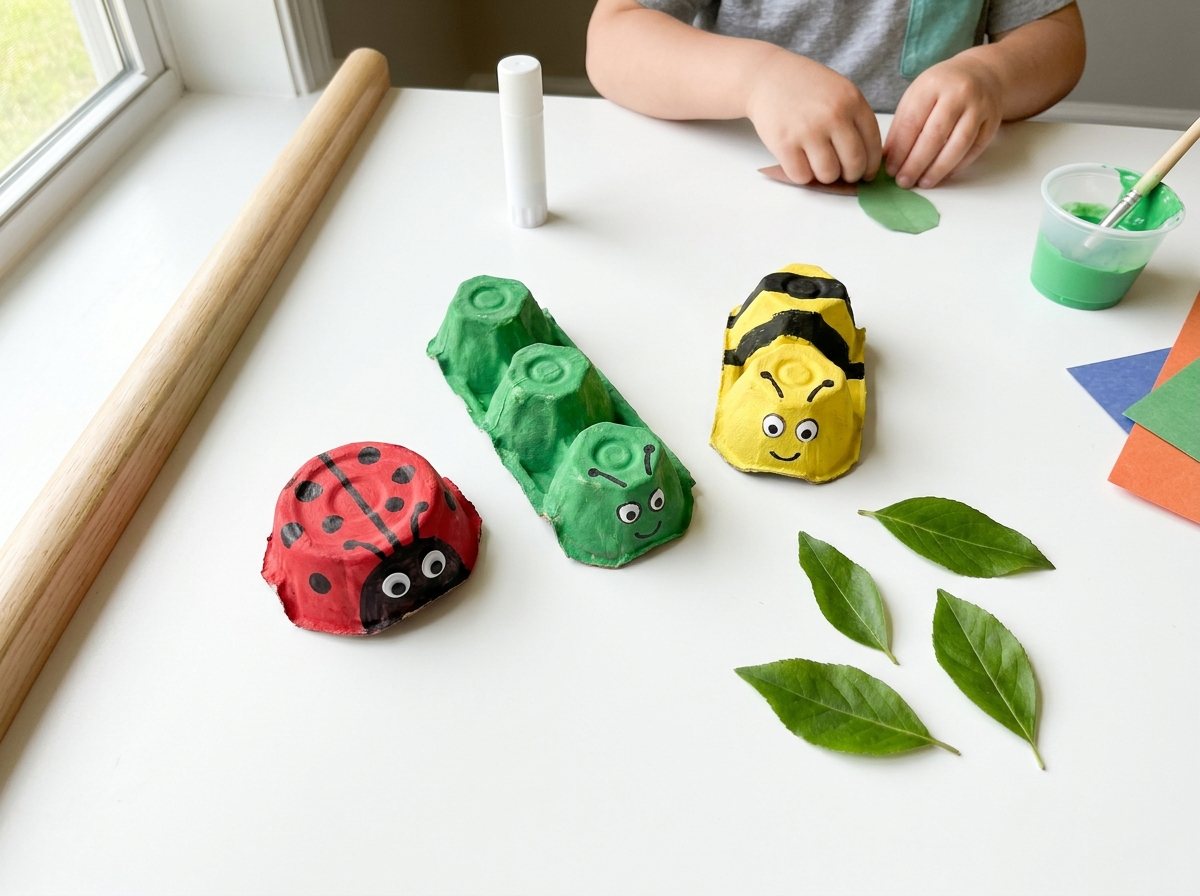
Materials: New, never-used cardboard egg carton (cut into single cups or strips of 2-3), paint, pipe cleaners, marker for eyes (googly eyes for ages 4+ only), glue.
Time: 20 minutes | Mess Level: Medium | Difficulty: Easy
What it teaches: Insect awareness, color recognition, fine motor skills (painting small objects).
Steps:
- Pre-cut the egg carton into sections: single cups for ladybugs or spiders, strips of 3 for caterpillars, strips of 2 for bees.
- Let your toddler paint them any colors they want. Red with black dots for ladybugs, green for caterpillars, yellow and black stripes for bees — or purple with orange spots, because toddlers.
- While paint dries, an adult cuts the pipe cleaners into antennae, keeping each piece longer than a toilet paper tube is wide. Fold each end back on itself or cap it with tape so no wire end shows.
- Once dry, draw on eyes with marker (or glue on googly eyes for ages 4+). An adult pokes the antennae through the top of the cups. For kids who still mouth objects, skip the pipe cleaners and draw antennae with marker.
- Wash hands, then take your bugs outside and place them in the garden. Talk about how real bugs help plants grow.
Safety firstUse a new, never-used cardboard carton for this craft. Used cartons can carry bacteria from raw egg, and cardboard can’t be washed. No new carton? Swap in cupcake liners or small paper cups. Pipe cleaner ends are wire and can poke, so an adult folds or tapes every end and pokes the antennae through. Keep pipe cleaners away from kids who mouth objects, and wash hands when you finish.
TipPair this with an actual bug hunt in the yard. Our guide to bug hunting activities for kids has ideas for turning a backyard walk into a science expedition. The crafted bugs can “join” the real ones.
3. Tissue Paper Earth Collage
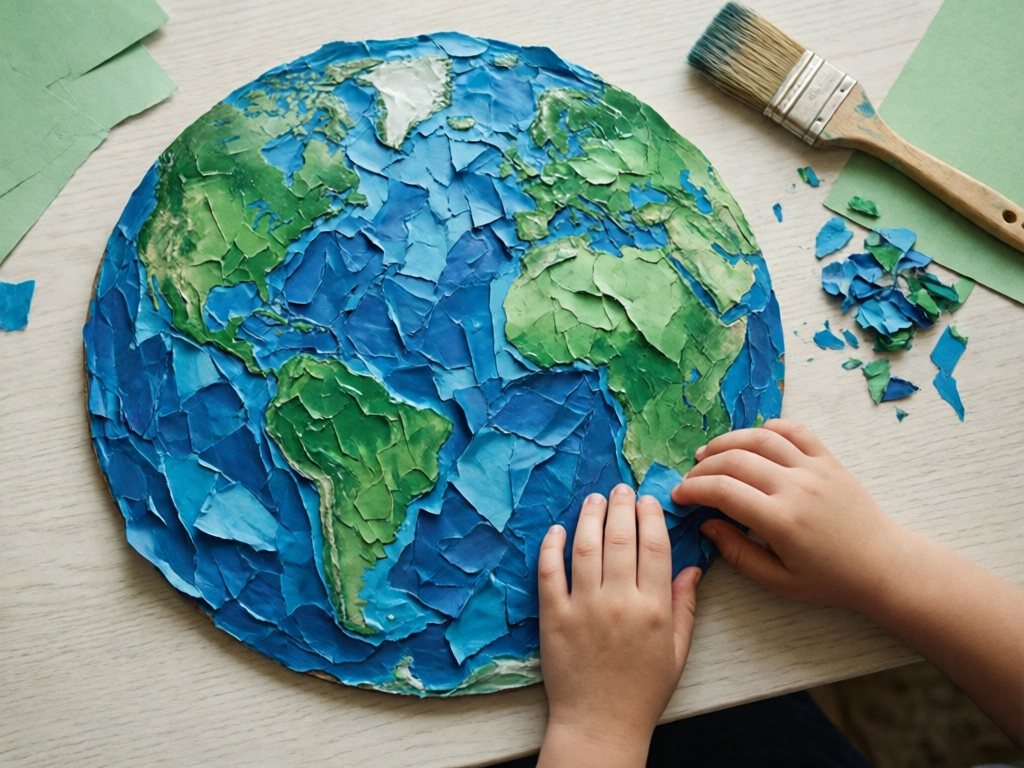
Materials: Large circle cut from cardboard (cereal box works — trace a dinner plate), blue and green tissue paper torn into pieces, white school glue thinned with water, paintbrush.
Time: 15 minutes | Mess Level: Low | Difficulty: Easy
What it teaches: Earth’s appearance from space, tearing and gluing skills, color sorting.
Steps:
- Cut a large circle (8-10 inches) from a cereal box or cardboard. This is the Earth.
- Put small piles of torn blue and green tissue paper in front of your toddler. (Pre-tear it for the youngest kids; 3-year-olds can tear their own.)
- Brush the glue-water mixture onto a section of the cardboard.
- Let your child press tissue paper pieces onto the gluey surface. Blue for oceans, green for land — but again, artistic freedom reigns.
- Keep brushing glue and pressing paper until the whole circle is covered. Let dry.
- Adult step: tape the finished Earth flat to a wall or window, with no dangling string. To hang it instead, an adult punches a hole at the top and hangs it high, well out of your child’s reach.
Safety firstDisplaying this one is an adult job. Keep string, yarn and ribbon out of reach of under-4s, the same rule as the binoculars in #4. Taping it flat is the simplest option.
TipShow your child a photo of Earth from space on your phone first. They’ll love seeing that their craft looks like the real thing. Even loosely. Even very loosely.
4. Toilet Roll Binoculars for a Nature Walk
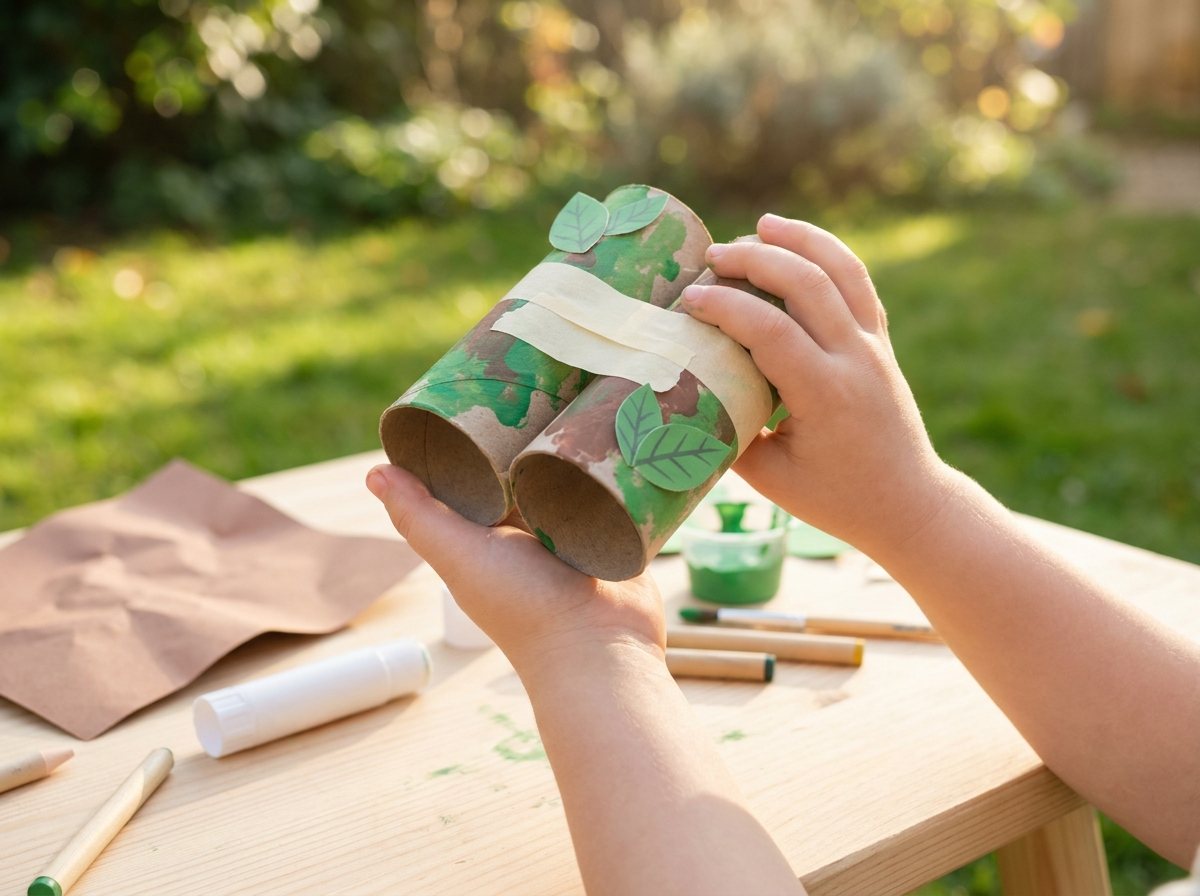
Materials: 2 toilet paper tubes, masking tape or glue, paint or markers, stickers (optional), a short yarn wrist loop for ages 4+ only.
Time: 15 minutes | Mess Level: Low | Difficulty: Easy
What it teaches: Observation skills, nature awareness, creative decoration.
Steps:
- Help your toddler paint or color both toilet paper tubes. Green and brown are “nature” colors, but any color works.
- Once dry, tape or glue the two tubes side by side.
- Keep these hand-held for ages 2-3: no neck strap. For ages 4+, an adult can tie a short loop (under 12 inches) worn on the wrist, not around the neck.
- Decorate with stickers, drawn-on leaves, or glued-on bits of tissue paper.
- Head outside for an Earth Day nature walk! Ask your toddler to “look through the binoculars” and tell you what they see.
Safety firstNever put a cord, string or yarn loop around a child’s neck, supervised or not. Wrist loops only (ages 4+), under 12 inches. Under 4, no string at all.
TipThese pair well with our outdoor nature activities for kids. Make the binoculars in the morning and use them on a walk in the afternoon. They don’t magnify anything, but looking through a frame helps my kids focus on what’s in front of them.
5. Cardboard Tube Tree
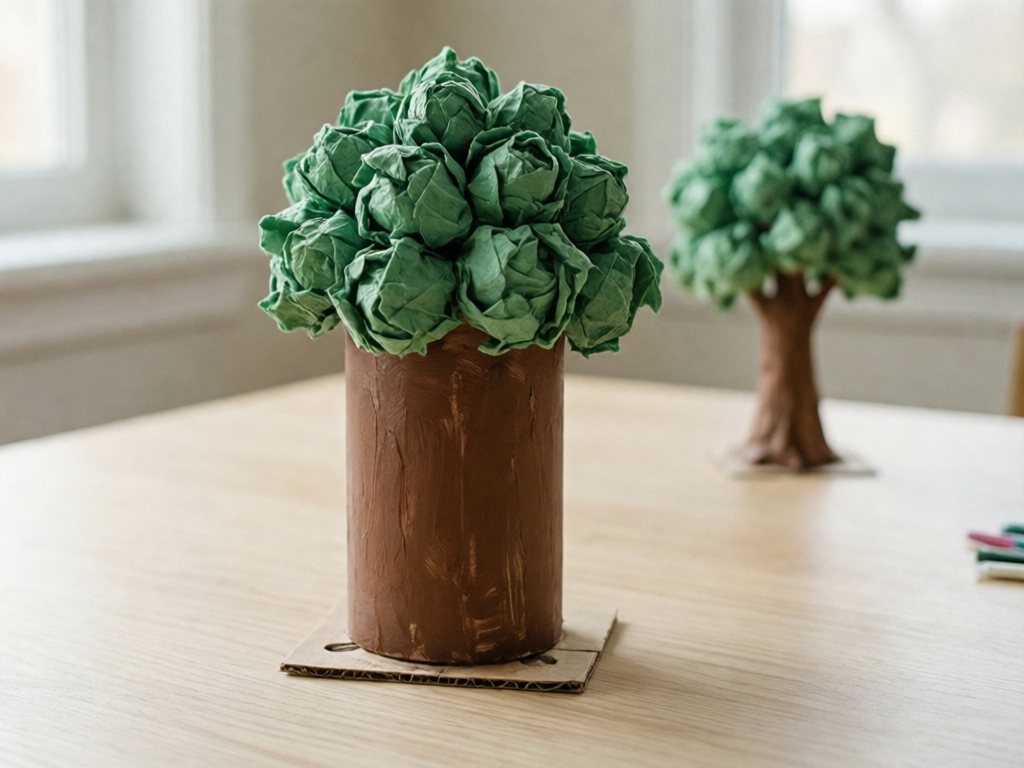
Materials: Paper towel tube (or 2 toilet rolls taped end to end), brown paint, green tissue paper or newspaper, glue, cardboard base (optional).
Time: 20 minutes | Mess Level: Medium | Difficulty: Easy
What it teaches: Tree structure (trunk and canopy), nature appreciation, 3D construction.
Steps:
- Paint the cardboard tube brown. This is the tree trunk. Let it air-dry for about 20 minutes.
- Crumple balls of green tissue paper or green-painted newspaper. Make them walnut-sized.
- Glue the green balls into and around the top of the tube to form the tree canopy. Stuff some inside the tube opening too.
- Optional adult step: cut two small slits at the bottom of the tube on opposite sides. Slide a small rectangle of cardboard through to create a base so the tree stands up.
- Make a whole forest if you’re feeling ambitious. Your toddler will want to.
TipAn adult can cut a few small slits in the trunk so your child can tuck in paper birds or tissue paper flowers.
Earth Day Crafts for Preschoolers (Ages 4-6)
Kids this age can handle more steps and use scissors with supervision. These four projects add complexity while staying easy to finish.
Safety firstAdult-only steps in this section: cutting the bottle for the terrarium (#6) and cutting cardboard puzzle pieces with a blade. Seeds and soil stay out of mouths, and hands get washed afterward. The can rim and the iron come up later, in #10 and #14.
6. Plastic Bottle Terrarium
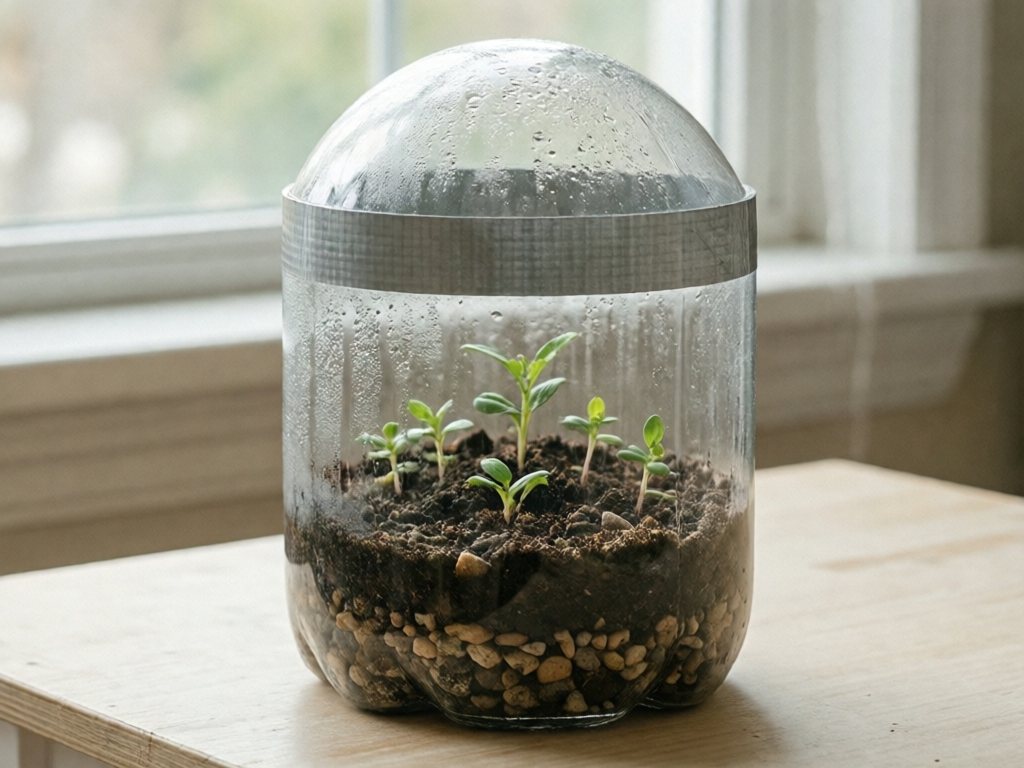
Materials: Clear 2-liter plastic bottle (cut in half by an adult), small rocks or pebbles, soil, small plants or untreated seeds, water, duct tape.
Time: 30 minutes | Mess Level: Medium | Difficulty: Medium
What it teaches: Water cycle, ecosystems, plant needs (soil, water, light), greenhouse effect basics.
Steps:
- Adult prep: with the child standing back, lay the bottle on a stable, non-slip surface. Poke a starter hole with the tip of sturdy scissors, then cut around the bottle with the scissors. If you use a craft knife for the starter hole, keep the hand holding the bottle well clear of the blade path and cut away from your body.
- Adult prep: cut plastic stays sharp, so wrap duct tape over both cut rims and press it down firmly. Run a finger around each rim to check for sharp spots before your child touches it.
- In the bottom half, have your child layer: small rocks (1 inch), then soil (3-4 inches).
- Plant small seedlings or herbs, or sprinkle untreated grass or wildflower seeds on top of the soil. Skip any seed packet labeled as treated or coated.
- Water lightly — just enough to moisten the soil, not flood it.
- Place the top half of the bottle over the bottom half like a dome. Tape the seam loosely (you want a little airflow).
- Pick the light. Place it in bright, indirect light, since direct sun can overheat the dome.
- Check it. Lift the dome for a few hours if condensation gets heavy. An adult checks for mold every few days.
- Deal with mold. If you spot fuzzy growth, an adult takes the dome off and throws out the moldy soil and plants. Kids don’t touch or sniff it, and everyone washes hands.
- Keep it clean. Use untreated seeds, wash hands after handling soil, and keep soil and seeds out of mouths.
The science conversation: “We made a tiny version of how the Earth works! The sun heats the water in the soil, the water turns into tiny drops on the walls — that’s like rain — and it falls back down to water the plants again. The Earth does the same thing, just much bigger.”
Safety firstCutting the bottle is adult-only. Keep the child back, and tape both cut rims before they touch them. Tape can lift when it gets wet, so an adult checks it before each use and re-tapes any edge that peels. Throw away loose tape scraps.
TipPut a strip of masking tape down the side and mark the soil line. Have your child check every few days and draw a line where the first sprouts appear. That turns a craft into a weeks-long observation project.
7. Egg Carton Flower Garden
Materials: Clean cardboard egg carton, paint (assorted bright colors), green pipe cleaners or green-painted sticks, scissors, glue. For flower centers, painted paper circles (buttons or bottle caps for ages 4+ only).
Time: 25 minutes | Mess Level: Medium | Difficulty: Easy-Medium
What it teaches: Flower anatomy (petals, stem, center), color mixing, fine motor cutting skills.
Steps:
- Cut the egg carton into individual cups. Each cup becomes a flower.
- Using scissors, cut 4-6 slits from the rim down toward the base of each cup to create “petals.” Gently bend them outward.
- Paint each flower a different color. Get creative — stripes, dots, two-tone petals.
- Once dry, glue a painted paper circle in the center of each flower (for ages 4+, a button or bottle cap works too).
- Poke a green pipe cleaner or painted stick through the bottom of each cup for the stem.
- Cut leaf shapes from green cardboard scraps and tape or glue to the stems.
- “Plant” your flowers by poking the stems into a ball of clay, a styrofoam block, or an upside-down egg carton half with holes poked in it.
Safety firstUse a new carton, or a clean, dry one with no egg residue. Used cartons can carry bacteria from raw egg, so toss any that are stained. Keep the pieces away from mouths and wash hands when you finish. For under-4s or a group, use a new carton only.
TipMake this a gift project. Preschoolers love giving gifts, and a bouquet of egg carton flowers for Grandma is charming. They never need water and they never wilt.
8. Cereal Box Earth Puzzle
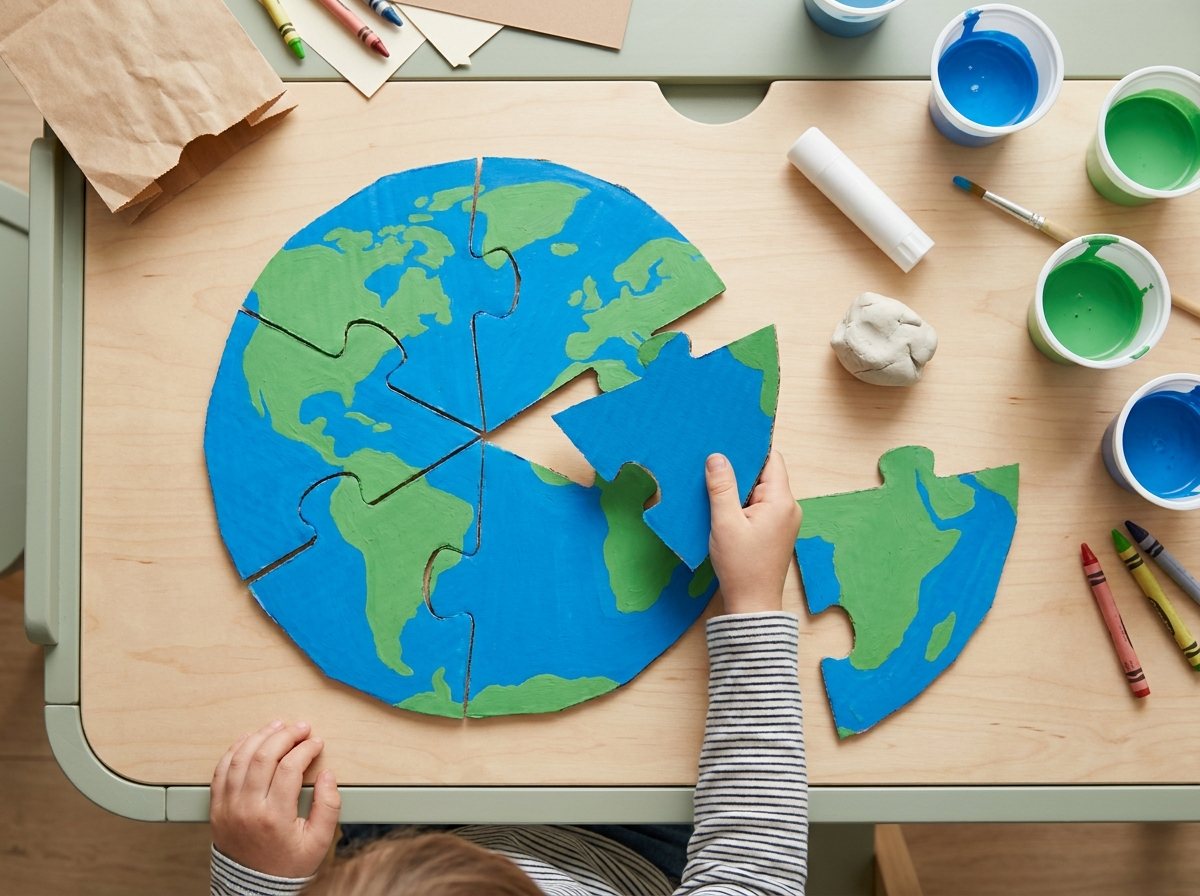
Materials: Cereal box (or any lightweight cardboard), blue and green paint or markers, scissors, pencil.
Time: 25 minutes | Mess Level: Low | Difficulty: Medium
What it teaches: Geography awareness, spatial reasoning, problem-solving.
Steps:
- Cut one large flat panel from a cereal box (the front or back).
- On the plain (inside) side, draw a large circle that fills most of the panel.
- Paint the circle to look like Earth — blue background with green land masses. It doesn’t need to be geographically precise. Blobs are fine.
- Once dry, flip the panel over and draw puzzle piece shapes on the back with pencil. For preschoolers, make 6-8 large pieces. For older kids, 12-15 smaller pieces.
- Cut along the puzzle lines.
- Mix up the pieces and let your child assemble the Earth!
- Store pieces in a ziplock bag for repeat play.
TipBefore cutting, take a photo of the painted Earth. Print it small and tape it to the ziplock bag as a “reference image,” just like real puzzles.
9. Magazine Collage Earth Mosaic
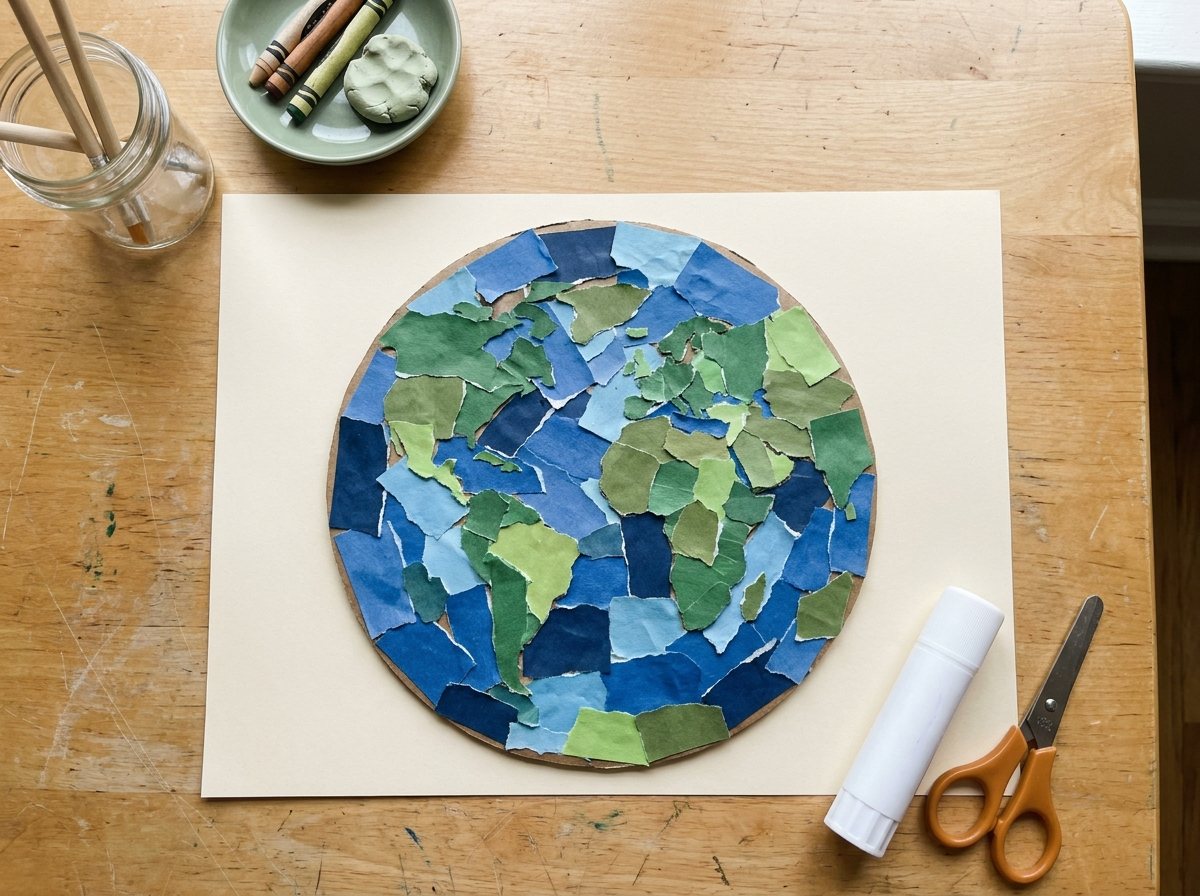
Materials: Old magazines or catalogs, large cardboard circle (trace a dinner plate), glue stick, scissors.
Time: 30 minutes | Mess Level: Low | Difficulty: Easy-Medium
What it teaches: Color sorting, composition, fine motor (cutting and tearing), environmental awareness.
Steps:
- Cut a large circle from cardboard.
- Flip through magazines and tear or cut out pieces that are blue (water, sky) and green (plants, grass, leaves).
- Sort the pieces into two piles: blue and green.
- Glue the pieces onto the cardboard circle — blue for the ocean areas, green for the land masses. Overlap pieces for a mosaic effect.
- Once the whole circle is covered, you have an Earth made from old magazines and a cereal box.
TipThis one looks lovely finished. Mount it on construction paper for a display-worthy piece. The mix of blues and greens from different magazine pages gives it real depth.
Earth Day Crafts for School-Age Kids (Ages 5-10)
These six projects have more steps, need some patience, and make things kids will actually use. Adult prep (cutting, can rims, the iron) is flagged in each one.
10. Tin Can Planter
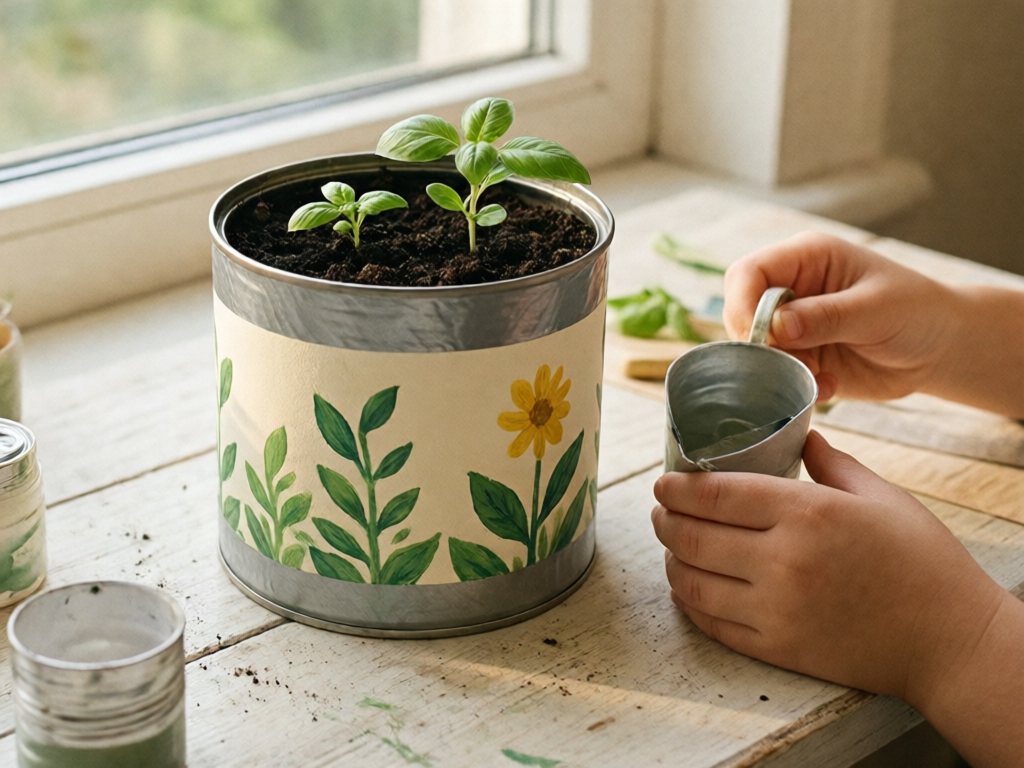
Materials: Clean tin can (label removed, rim checked and taped by an adult), paint or fabric scraps, glue, small rocks, potting soil, seeds or small plant.
Time: 25 minutes | Mess Level: Medium | Difficulty: Medium
What it teaches: Plant needs, responsibility/caretaking, reuse mindset, patience (waiting for growth).
Steps:
- Adult prep: remove the label and open the can with a side-cutting safety can opener. Fold or cover the rim with several layers of duct tape. Discard any can with dents or jagged edges, and check every can before a child touches it.
- Let your child decorate the outside of the can. Options: paint it, wrap it in fabric scraps secured with glue, or decoupage with tissue paper. Add Earth-themed decorations — painted flowers, a tree, the words “I help the Earth grow.”
- Once decoration is dry, add a layer of small rocks to the bottom (1 inch) for drainage.
- Fill with potting soil to about an inch below the rim.
- Plant seeds (herbs like basil or chives are fast growers) or transplant a small seedling.
- Water lightly and place in a sunny spot. Wash hands after handling soil, and keep soil and seeds out of mouths.
Safety firstA taped rim can still hide a sharp inner lip. An adult checks every can before a child handles it. Re-check the tape after watering, since wet tape can lift, and re-tape any edge that peels.
TipPut the planter on a windowsill your child passes daily and help them water it every other day. When the first sprout appears, you’ll see real wonder. That’s the Earth Day lesson: growing things takes care and time.
11. Plastic Bottle Bird Feeder
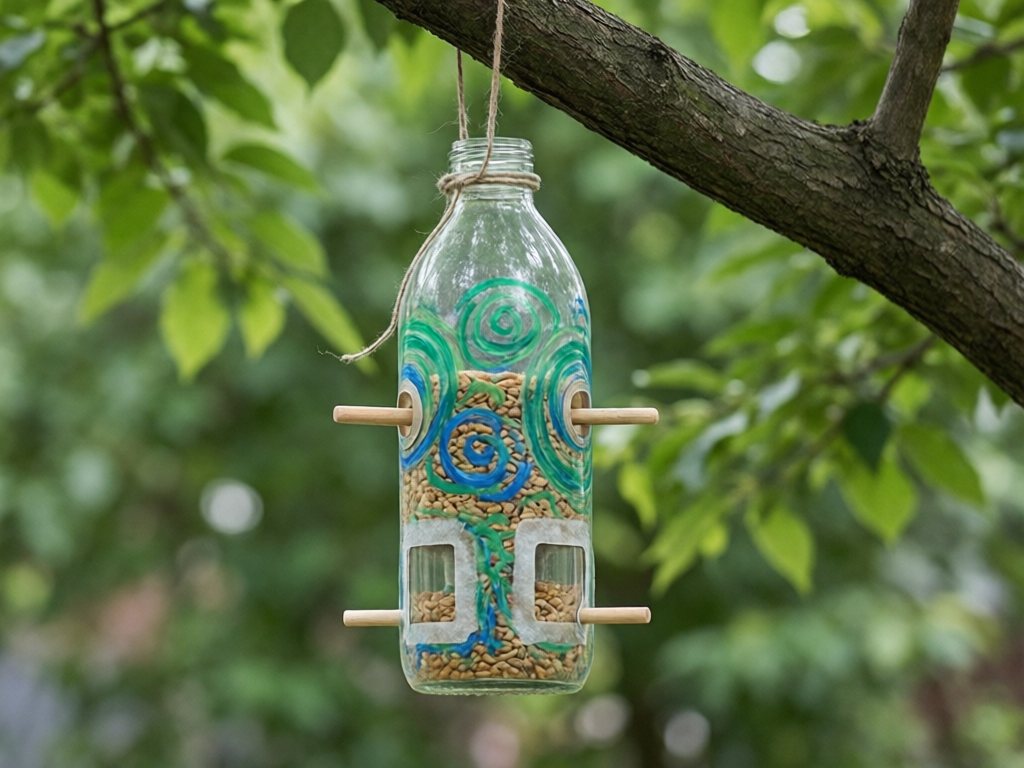
Materials: Clean plastic bottle (1-liter or 2-liter), 2 wooden sticks or chopsticks, string, sturdy scissors or craft knife (adult only), birdseed.
Time: 30 minutes | Mess Level: Low | Difficulty: Medium
What it teaches: Bird ecology, animal habitat, engineering design, cause and effect (what food attracts which birds).
Steps:
- Adult prep: set the bottle on a stable surface, keep your hand clear of the blade path, and poke a starter hole with the tip of the scissors. Then cut two small “window” openings on opposite sides, about 2 inches from the bottom, 1 inch tall by 2 inches wide. Cover the cut edges with duct tape.
- About half an inch below each window, poke a hole through both sides of the bottle. Push a stick or chopstick through so it extends a few inches on each side — these are the perches.
- Repeat at a different angle about 4 inches higher for a second set of perches and windows (optional).
- Let your child decorate the outside with permanent markers or paint (avoid covering the windows).
- Remove the cap, fill with birdseed through the top, replace the cap.
- An adult ties a short string tightly around the neck of the bottle and hangs it from a tree branch, high enough that no child can reach it. Trim the tails so no loose ends or loops hang down. Keep the string and feeder out of toddlers’ reach entirely.
- Watch and wait. Keep a “bird journal” to record which birds visit.
The science conversation: “Different birds like different food and different perch sizes. Keep watching to see who visits our feeder. If we put this near a tree, birds feel safer because they can fly to cover if a predator comes.”
Cleaning the feeder (adult job):
- Empty it. Every 1-2 weeks, and any time the seed gets wet or clumpy, tip out all the old seed and throw it away.
- Scrub it. Wash the bottle and perches with hot soapy water. For a deeper clean, soak it in 1 part bleach to 9 parts water, away from kids.
- Rinse and dry. Rinse well and let everything dry fully before refilling. Swap out wooden perches that stay damp or look moldy.
- Wash up. Wash your hands with soap and water when you finish.
Safety firstCutting, hanging and cleaning are adult jobs. Hang the feeder high on a short string, with no dangling tails or loops a child could reach. Use clean, fresh birdseed. Wash hands after handling seed, and hang the feeder where pets can’t reach it.
TipWindow collisions are a risk, so hang the feeder close to a window (within about 3 feet) or well away from it. Pair it with our nature crafts for kids collection for a full nature afternoon. A feeder made from a plastic bottle is a daily reminder that recycling is about reimagining what things can become.
12. Cardboard Box Recycling Center (Pretend Play)
Materials: 1 large cardboard box, 3-4 smaller boxes or containers, paint, markers, labels, tape.
Time: 40 minutes | Mess Level: Low | Difficulty: Medium
What it teaches: Recycling sorting, material categories, organizational thinking, pretend play.
Steps:
- Take the large box and cut the top flaps off. This is the main recycling center structure.
- Paint or decorate the outside. Add a sign: “[Your Child’s Name]’s Recycling Center” or “Earth Helper Station.”
- Place 3-4 smaller boxes or containers inside the big box. Label each one: PAPER, PLASTIC, METAL, GLASS. Color-code them if you like (blue for paper, yellow for plastic, gray for metal, green for glass).
- Gather clean, safe recyclables: junk mail, a plastic bottle, cardboard scraps, a magazine, an aluminum foil ball. For metal and glass, use pictures cut from magazines instead of real cans or jars.
- Let your child sort the items into the correct bins.
- Talk through any tricky ones together (“Is a cereal box paper or cardboard? Actually, cardboard IS paper — it goes in the paper bin!”).
TipSet this up in a corner of the kitchen and use it as your real recycling station for a week. When kids are in charge of sorting, they start recognizing materials everywhere. “Mom, this yogurt cup is plastic!” The free Earth Day Recycling Bin Craft Kit pairs nicely with this craft.
13. Newspaper Seed Pots
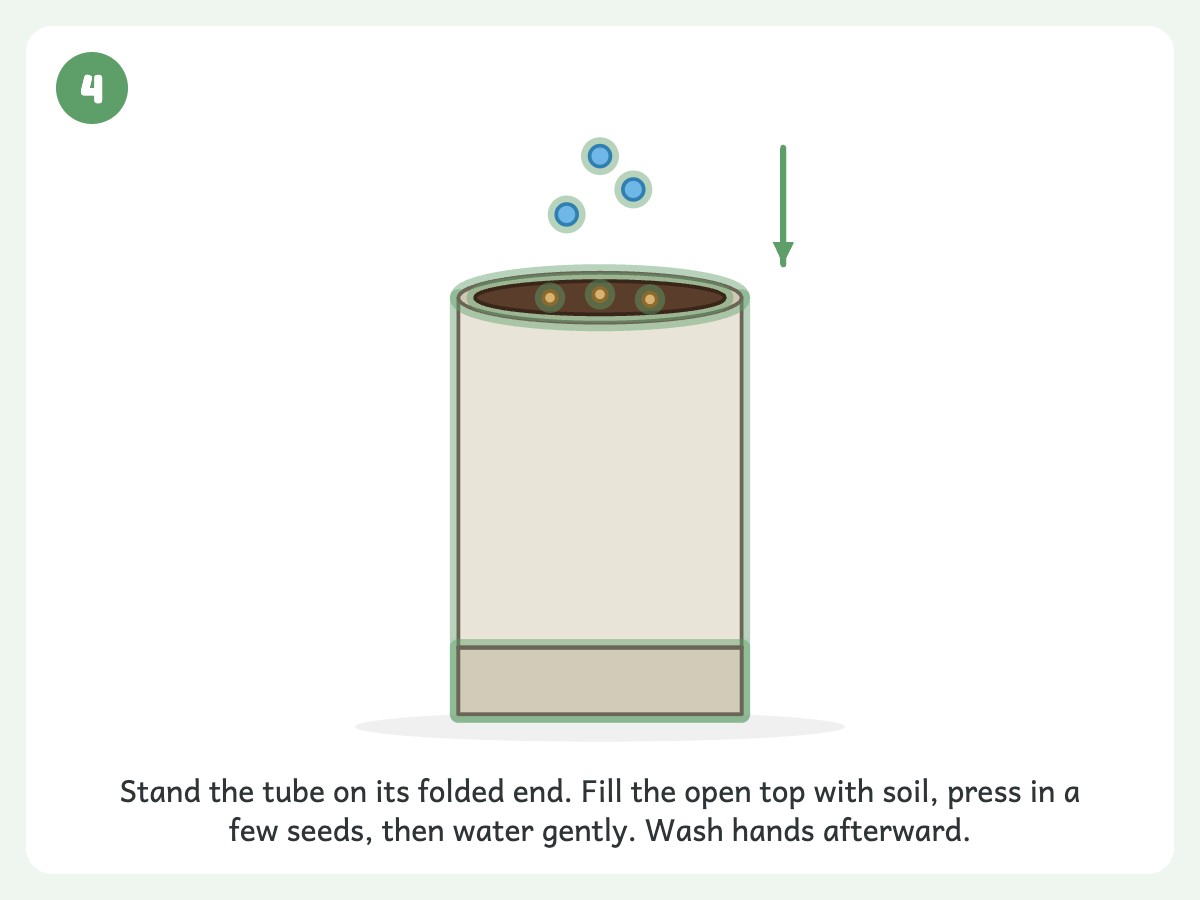
Materials: Newspaper (4-5 full sheets per pot), a plastic cup or taped-rim can to use as a mold, potting soil, untreated seeds.
Time: 20 minutes | Mess Level: Low | Difficulty: Medium
What it teaches: Biodegradable materials, germination, sustainability (zero-waste planting).
Steps:
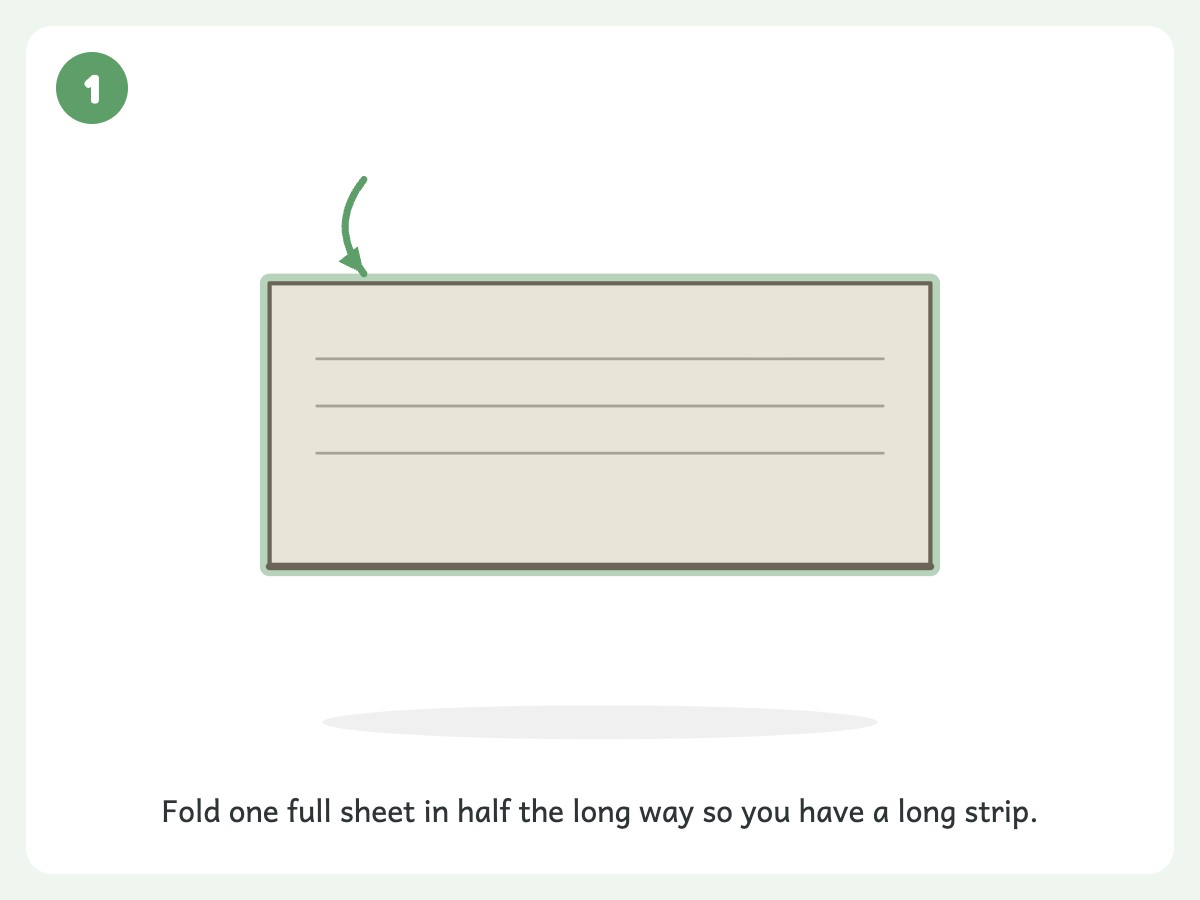
- Take a sheet of newspaper and fold it in half lengthwise.
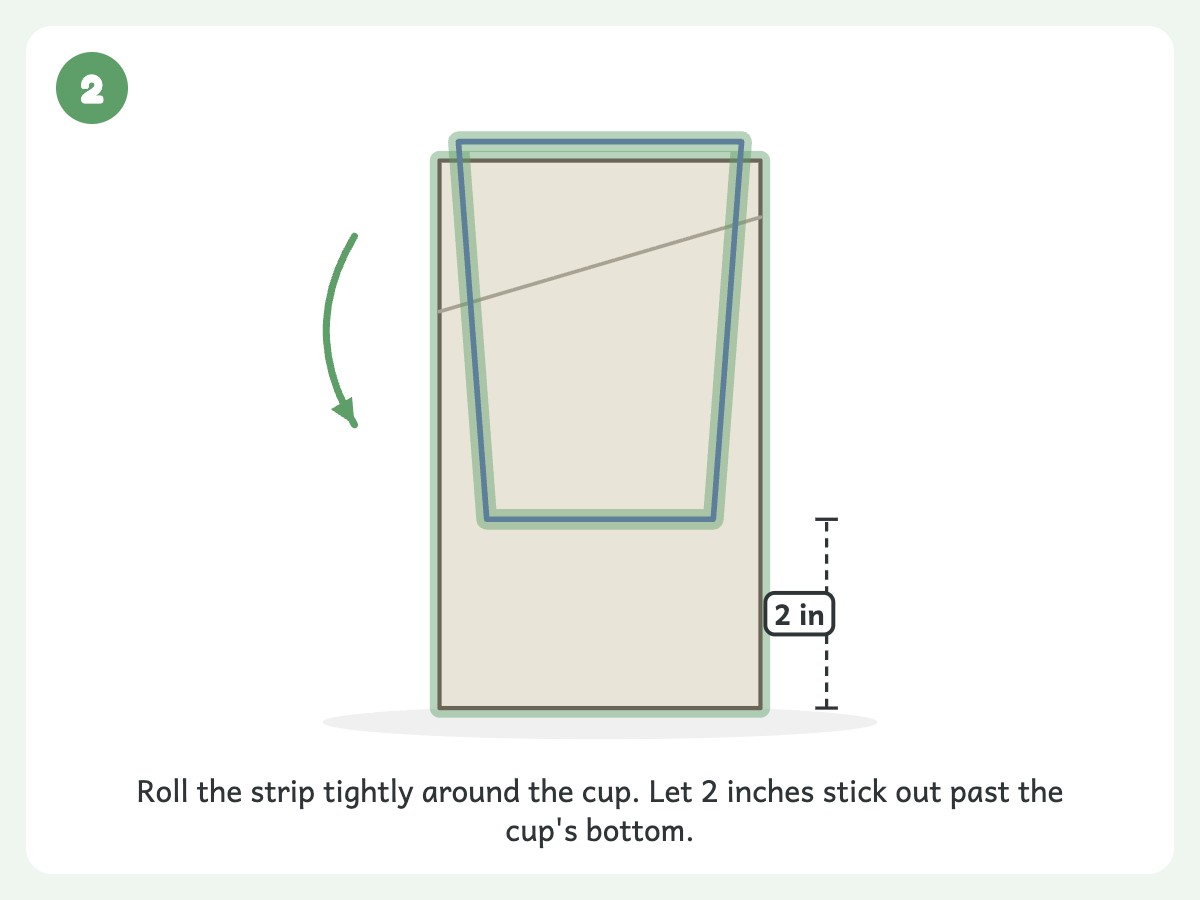
- Place a plastic cup (or a can with a taped rim) on its side at one end of the newspaper strip. Leave about 2 inches of paper extending past the bottom of the mold.
- Roll the newspaper around the mold, keeping it snug.
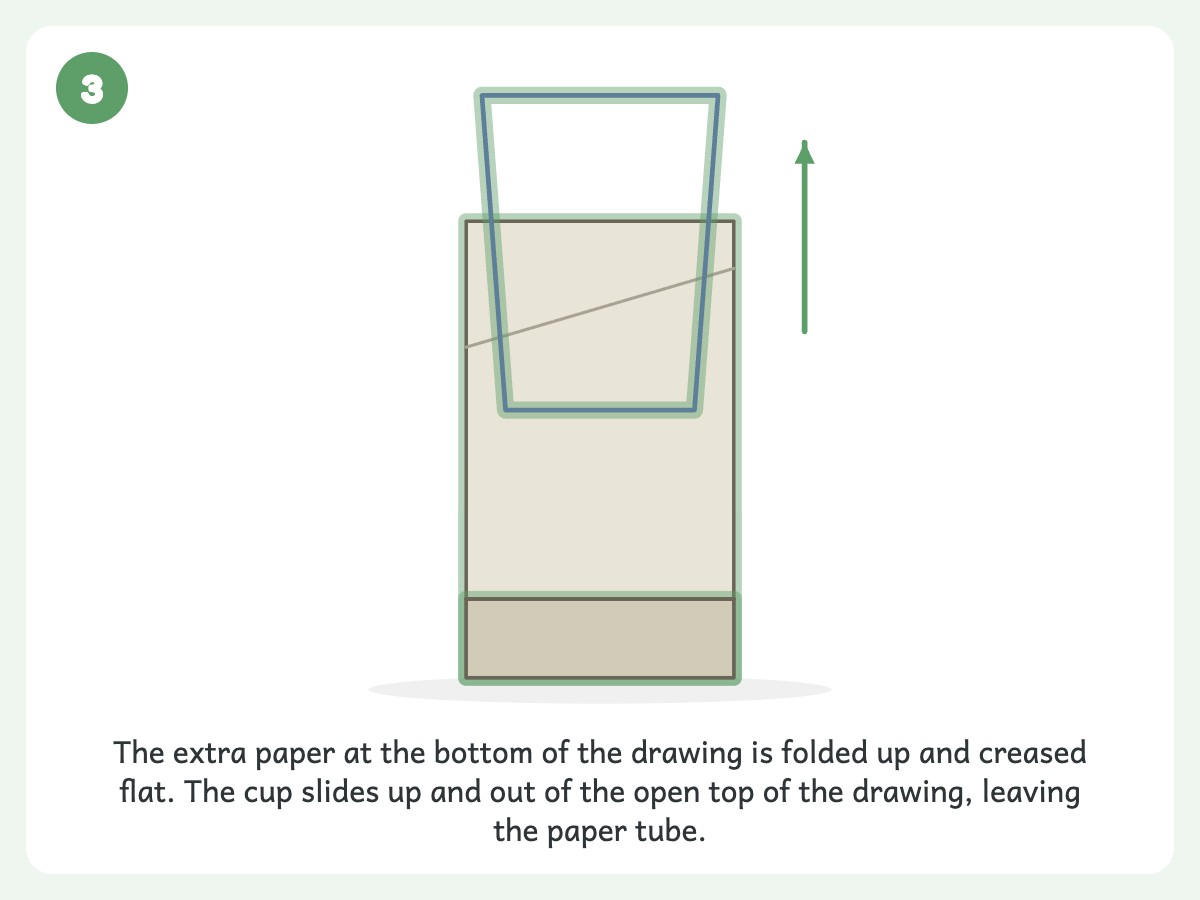
- Fold the excess paper at the bottom up and over the base of the mold, like wrapping a present. Press firmly to crease.
- Carefully slide the mold out. You now have a newspaper pot.
- Fill with potting soil, plant seeds, and water gently. Wash hands after handling soil.
- When seedlings are big enough to transplant, plant the whole pot directly in the ground — the newspaper will decompose!
The science conversation: “This pot is made from newspaper, which is made from trees, which came from the earth. When we plant this pot in the soil, it breaks down and becomes part of the earth again. It’s a cycle — just like the water cycle or the life cycle of a plant.”
TipMake 6-8 of these and start a windowsill seedling nursery. Herbs, wildflowers or vegetable seeds all work. When they’re ready to transplant, you get a second activity: gardening day!
14. Melted Crayon Earth Suncatcher
Materials: Broken crayon pieces (blues and greens), wax paper, iron and thin towel (adult use only), hole punch, string, scissors.
Time: 25 minutes | Mess Level: Medium | Difficulty: Medium
What it teaches: States of matter (solid to liquid and back), color blending, upcycling.
Steps:
- Peel any paper wrappers off broken crayon pieces. Sort into blues and greens.
- An adult makes crayon shavings with a pencil sharpener or box grater. Kids can sort the shavings by color; keep shavings away from children who mouth objects.
- Tear off two sheets of wax paper, each about 8 inches square.
- Arrange crayon shavings on one sheet of wax paper in a rough circular shape — blues around the outside, greens in patches for landmasses.
- Place the second sheet of wax paper on top.
- Cover with a thin towel. An adult presses an iron set to medium, with no steam, over the towel for 15-20 seconds, moving slowly. The crayons melt and fuse between the wax paper layers. Keep the iron and its cord out of child reach, never leave it unattended, and unplug it to cool afterward.
- An adult checks that the wax sheet is cool to the touch before the child handles it.
- Cut around the melted crayon circle, leaving a small wax paper border.
- Punch a hole at the top and thread a short string through. An adult hangs it high in a sunny window, out of reach of any under-4s in the house.
The science conversation: “We turned solid crayons into a liquid with heat, and then they cooled back into a solid — but in a completely new shape! We also took crayons that were broken and too small to use and made them into something beautiful again. That’s what recycling is all about.”
Safety firstThe iron is adult-only. Keep it and its cord out of reach, never leave it on unattended, and make sure the wax paper is cool before little hands touch it.
TipThe light streaming through these is lovely. Make several in different color combinations: sunset colors, rainbow, ocean blues. They make nice gifts too.
15. Recycled Materials Robot
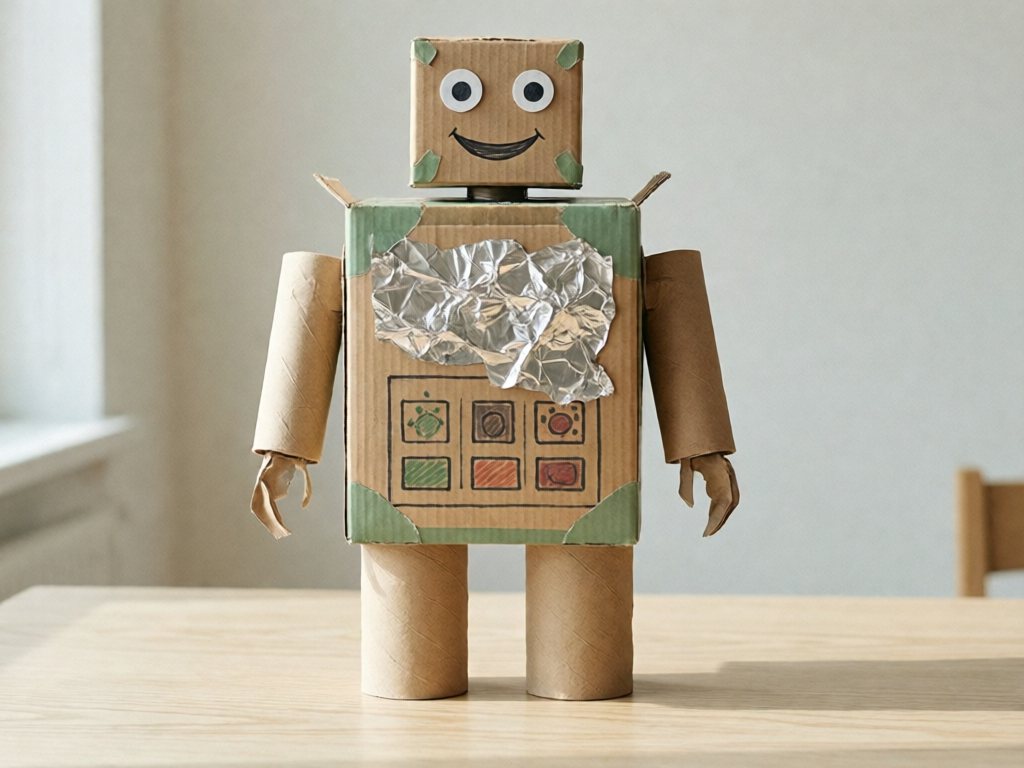
Materials: Boxes, tubes, bottles and foil from your recycling bin; caps, lids and buttons for ages 4+ only; cans only if an adult has checked and taped the rim. Plus tape, glue, and whatever else you have.
Time: 45 minutes | Mess Level: Low | Difficulty: Open-ended (ages 4+ build it; under-4s decorate)
What it teaches: Engineering, design thinking, creative problem-solving, resourcefulness.
Steps:
- Dump a selection of clean recyclables on the table. The more variety, the better.
- The challenge: build a robot using ONLY these materials (plus tape and glue to hold it together).
- Let your child design first — what will the head be? The body? The arms and legs? Encourage them to hold different pieces up and see what fits.
- Build from the bottom up. A sturdy box body first, then attach limbs, then the head.
- Add details: paper-circle eyes (bottle cap eyes for ages 4+), aluminum foil accents, cardboard tube arms, drawn-on control panels.
- Name the robot. Give it a backstory. What is its job? (Spoiler: mine always end up being “cleaning robots” or “cookie-making robots.”)
Safety firstBuilding this one on their own is for ages 4+. For under-4s, an adult builds the robot and the child adds stickers and paper shapes only. Keep caps, lids, buttons and cans off the table, and fold foil edges under.
TipThis open-ended project makes a good grand finale. No two robots look alike and there are no instructions to follow. If your child loves building, they’ll also like our cardboard box crafts for kids collection, which takes the same approach on a bigger scale.
Earth Day Conversation Starters by Age
Crafting opens the door to talking about why the Earth matters. But what you say depends on who you’re talking to. A three-year-old and a nine-year-old need very different conversations.
Ages 2-3: Keep It Sensory and Simple
At this age, abstract concepts like “the environment” don’t land. Keep it concrete and connected to their world.
- “We’re using this box again instead of throwing it away. That’s being kind to the Earth!”
- “Trees give us shade and clean air. Let’s hug a tree and say thank you.”
- “See this flower? A bee helped it grow. Bees are Earth helpers, just like us.”
- “Let’s help a grown-up pick up this trash with our gloves and grabber. The Earth likes to be clean, just like you after bath time.”
Safety firstLitter pick-up is a grown-up-led job. Kids wear gloves or use a grabber and stick to paper and wrappers. Never touch glass, needles or anything sharp; an adult handles those. Everyone washes hands afterward.
Ages 4-5: Introduce Cause and Effect
Preschoolers can start understanding that their actions have consequences — in a positive, empowering way.
- “When we recycle this bottle, it can be made into something new instead of sitting in a trash pile.”
- “Plants need clean water to grow, just like you need clean water to drink. That’s why we don’t put yucky things in rivers.”
- “If everyone threw their trash on the ground, what would the playground look like? That’s why we use trash cans.”
- “Animals live in forests and oceans. When we take care of those places, we’re taking care of the animals’ homes.”
Ages 6-8: Connect to Systems
School-age kids can grasp broader systems and their role in them.
- “Where do you think this plastic bottle goes after we put it in the recycling bin? Let’s look it up together.”
- “Our food comes from farms, which need healthy soil and clean water. Taking care of the Earth is how we take care of our food supply.”
- “What would happen if there were no bees? No butterflies? Every living thing is connected.”
- “You know how we compost our food scraps? That turns into soil that helps plants grow. It’s a cycle.”
Ages 9-10: Empower Problem-Solving
Older kids are ready to think critically and take action beyond crafts.
- “What’s one thing our family could do differently to create less waste?”
- “If you could invent something to help the Earth, what would it be?”
- “Some companies are making packaging from seaweed instead of plastic. What materials do you think we should use more of?”
- “Let’s calculate how many plastic bottles our family uses in a month. What could we replace those with?”
Earth Day Crafts Your Family Will Actually Use
Reuse is more than an art project. Five of the crafts above make things your family will keep using.
| Craft | Function | Lifespan |
|---|---|---|
| Plastic Bottle Terrarium (#6) | Living ecosystem / science observation | Weeks to months |
| Tin Can Planter (#10) | Herb or flower planter | Ongoing (plant and repot as needed) |
| Plastic Bottle Bird Feeder (#11) | Functional bird feeder | Months (refill as needed) |
| Cardboard Box Recycling Center (#12) | Actual sorting station | Weeks (until cardboard wears out) |
| Newspaper Seed Pots (#13) | Biodegradable seedling starters | Until transplanting day |
A craft with a real job drives the reuse message home. Your kid isn’t just making something pretty — they’re making something useful from something that was going in the trash. That’s the core of Earth Day in action.
How to Make Earth Day a Year-Round Mindset
April 22nd is one day. The habits you build through these crafts can last all year. Here are five ways to keep going.
Create a Permanent Craft Recycling Station
Dedicate a box, bin, or shelf in your home to craft-worthy recyclables. When your child finishes a cereal box, ask whether it goes to trash, recycling, or the craft box. Kids start choosing the craft box quickly.
Keep it stocked and within reach, and you’ll rarely be caught without craft materials. Egg cartons only go in if they’re clean and dry with no egg residue.
Monthly Recycled Craft Challenges
Pick one day a month — “Reuse Day” or “Invention Day” or whatever your family wants to call it. Dump the craft recycling station on the table and challenge everyone to make something. No rules, no templates, just materials and imagination. Time it for 30 minutes and share what everyone made. This is essentially what loose parts play looks like at its best — open-ended, materials-driven creativity.
Nature Connection as a Habit
Earth Day crafts work best when they’re paired with regular time outdoors. In our house, time outside is what makes kids care about nature. Make outdoor exploration a weekly habit — even 20 minutes in a local park counts. Our guide to outdoor nature activities for kids is packed with ideas that pair perfectly with these crafts.
Talk About Materials
Start narrating the lifecycle of everyday objects casually. “This Amazon box used to be a tree. Then it was made into cardboard. It carried our package to us, and now we’re going to make it into a robot. That tree got a lot of use!” Kids absorb this kind of thinking over time, and it becomes part of how they see the world.
Start a Family Compost
If you did the Newspaper Seed Pots or Tin Can Planter projects, you’re already thinking about soil. A simple kitchen compost bin (even just a container for food scraps that you dump in the yard) teaches kids that waste is part of a cycle, not an endpoint. Banana peels become dirt. Dirt grows plants. Plants become food. It’s recycling at its simplest, and my kids love it, especially the worm part.
Earth Day Craft FAQ
What age is best for Earth Day crafts?
Every age can participate — you just need to match the project to the child’s abilities. Toddlers (2-4) thrive with simple painting, gluing, and tearing activities like the Paper Bag Earth Puppet or Tissue Paper Collage. Ages 4-6 can handle multi-step projects with cutting and assembly. Kids 5-10 are ready for functional crafts like bird feeders and planters, plus deeper conversations about sustainability. The overview table above marks the best age for each project.
How do I explain Earth Day to a very young child?
Keep it simple and positive: “Earth Day is a special day when we say thank you to our planet for giving us trees, water, animals, and flowers. We show the Earth we care by helping a grown-up pick up trash, planting seeds, and making new things from old things instead of throwing them away.” That’s enough. You don’t need to get into climate change, pollution statistics, or anything scary. Focus on the positive actions they CAN take, not the problems they can’t solve. Empowerment, not anxiety.
What if I don’t have all the recycled materials listed?
Substitute freely. No egg carton? Use cupcake liners. No tin can? Use a yogurt cup. No newspaper? Use junk mail or old worksheets. The whole point of recycled material crafts is working with what you have. Look at your recycling bin right now and work backward from what’s in it. Every craft in this article can be adapted based on available materials.
Are these crafts safe for toddlers who put everything in their mouths?
Crafts 1-5 are the toddler picks; skip 6-14 for kids who mouth objects. The first five use mostly paper, cardboard, paint and tissue paper.
- No small parts: no buttons, bottle caps or googly eyes. Draw eyes with marker instead.
- Non-toxic, washable paint only.
- New, never-used egg cartons only for the Garden Bugs (#2), or swap in cupcake liners. Wash hands afterward.
- No pipe cleaners for kids who mouth objects; draw antennae with marker. For everyone else, an adult folds or tapes every pipe cleaner end.
For the robot (#15), an adult builds and under-4s add only stickers and paper shapes, with no caps, lids, buttons or cans on the table. When in doubt, leave it out.
Can these be done as a classroom or group activity?
Yes. The easiest group crafts are the Tissue Paper Earth Collage (#3), Magazine Collage Earth Mosaic (#9) and Newspaper Seed Pots (#13). They prep in bulk and clean up fast. Egg Carton Garden Bugs (#2) work too, with new, never-used cartons only.
Pre-cut materials, set up stations, and put one adult or older student at each. Everyone washes hands afterward. For ages 4+, the Recycled Materials Robot (#15) makes a good team challenge: give each team the same recyclables.
How do I keep these crafts from becoming more waste?
It’s a fair worry. You take recyclables, add paint and glue, and now they can’t be recycled anymore. Three things help. First, prioritize the functional crafts (planters, bird feeders, seed pots) that have ongoing use. Second, display art crafts for a period — hang them up, photograph them, appreciate them — then let them go. Third, talk about it honestly with older kids. Try: “We turned recyclables into art. When we’re done enjoying it, the materials go in the trash. But the lesson about reusing stays with us.”
My child wants to do ALL 15 crafts. How should I spread them out?
Don’t try to do them all on Earth Day itself — that’s a recipe for exhaustion (yours, not theirs). Instead, spread them across the two weeks surrounding Earth Day. Do 2-3 toddler/preschool crafts per session (they’re quick). Plan one school-age craft per session (they take longer and have more steps). Save the Recycled Materials Robot for Earth Day itself as the grand finale. This pacing also means you have time to collect different recyclables between sessions.
What’s the best Earth Day craft for a mixed-age group of siblings?
The Recycled Materials Robot (#15) works well. Kids 4+ do the building, and under-4s add stickers and paper shapes to the finished robot, with no caps, lids or buttons on the table.
For a second pick, try the Tissue Paper Earth Collage (#3). The toddler tears and presses tissue paper while an older sibling brushes on the glue-water and decides where the oceans and land go. Give the youngest the tearing and the oldest the planning, and nobody’s bored.
Save the Egg Carton Flower Garden (#7) for when the toddler isn’t at the table. Its cut petals, stems and flower centers are small enough to end up in a mouth.
Earth Day Craft Takeaways
After years of seasonal crafts with kids, I’ve learned the craft itself is never really the point. The paint will dry. The glue will set. The cardboard robot will eventually fall apart. What sticks — what actually lasts — is the conversation that happens while your hands are busy.
It’s the moment your four-year-old says, “Why do people throw things away if we can make stuff with them?” It’s your eight-year-old checking on the bird feeder every morning and reporting which birds came. It’s the whole family looking at the recycling bin differently, seeing potential instead of waste.
Earth Day isn’t really about April 22nd. It’s about building a generation of kids who instinctively think, What else could this become? You don’t need a curriculum or a special program to do that. You just need a kitchen table, a recycling bin, and the willingness to get a little glue on your hands.
Happy Earth Day, friends. Go raid your recycling bin. Your kids are waiting.