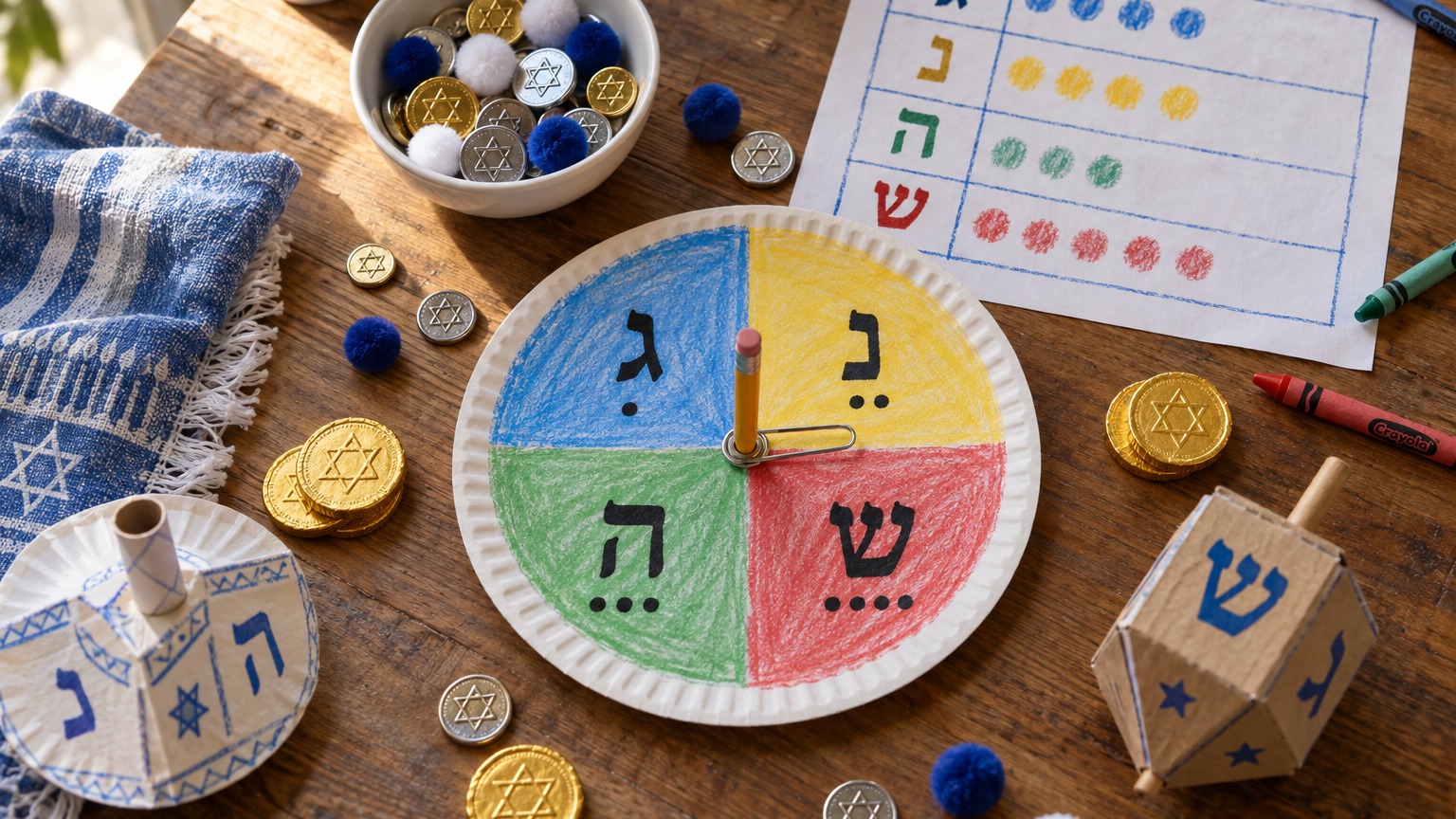
Printable Dreidel Games and Activities for Preschoolers
Discover how to adapt classic dreidel for your preschooler with simple counting rules, low-mess printables, and toddler-friendly game variations.
- Swap tricky division rules for simple, concrete counting amounts like taking 1 or 3.
- Use a large plate spinner instead of a tiny top to suit developing fine motor skills.
- Teach Hebrew letters using memorable sound-alike cues: Nothing, Get, Have, and Share.
- Adjust game rules to your child's counting ability rather than strictly by age.
This post contains affiliate links. As an Amazon Associate I earn from qualifying purchases.
Last December I spun a real wooden dreidel on the kitchen table and announced we were going to play the game. My four-year-old licked it, my three-year-old decided it was a car, and a chocolate coin ended up under the fridge.
So I built a version that fits little kids: the spinning, the four Hebrew letters, and a shared pot, with plain counting instead of betting math. Below are dreidel games for preschoolers (ages 3 to 5): a printable spinner, a counting scoreboard, five variations, four crafts, and an eight-night plan. Mess ratings are in the supply table, the craft table, and each game. Want to play right now? Jump to Printable Dreidel Spinner Template or Five Dreidel Game Variations for Preschoolers.
In this article (13 sections)
- Why the Classic Dreidel Game Is Too Much for Ages 3-5
- What the Four Letters Mean (the 60-Second Version)
- What You’ll Need
- Printable Dreidel Spinner Template (or Draw Your Own)
- The Dreidel Game Counting Scoreboard
- Five Dreidel Game Variations for Preschoolers (Ages 3 to 5)
- Easy Dreidel Crafts for Preschoolers
- Dreidel Game Upgrades for Kindergarten (Ages 5-6)
- An Eight-Night Hanukkah Plan for Preschoolers
- More Hanukkah Activities for Preschoolers
- Setting Up the Game So It Doesn’t Fall Apart
- Frequently Asked Questions
- Start With the Spinner Tonight
Why the Classic Dreidel Game Is Too Much for Ages 3-5
I love the traditional game, and I’m not suggesting you skip it forever. But a single turn asks a lot of a little brain:
- You spin a small top that moves unpredictably.
- You wait until it stops and read a symbol.
- You remember which of four symbols means what.
- You carry out a math action: take everything, take half, take nothing, or add one.
- You track how many pieces are in the middle.
That’s five steps, and step four contains division. A typical four-year-old is still working on counting past ten reliably. Half makes sense with a cookie, not with seventeen chocolate coins.
Then there is the physical piece. Spinning a small top takes a pinch-and-twist grip many preschoolers haven’t built yet, and the top often rolls off the table. So we keep the parts that make it fun (spinning, letters, a shared pot) and remove the parts that cause tears (division, losing, and unpredictable physics).
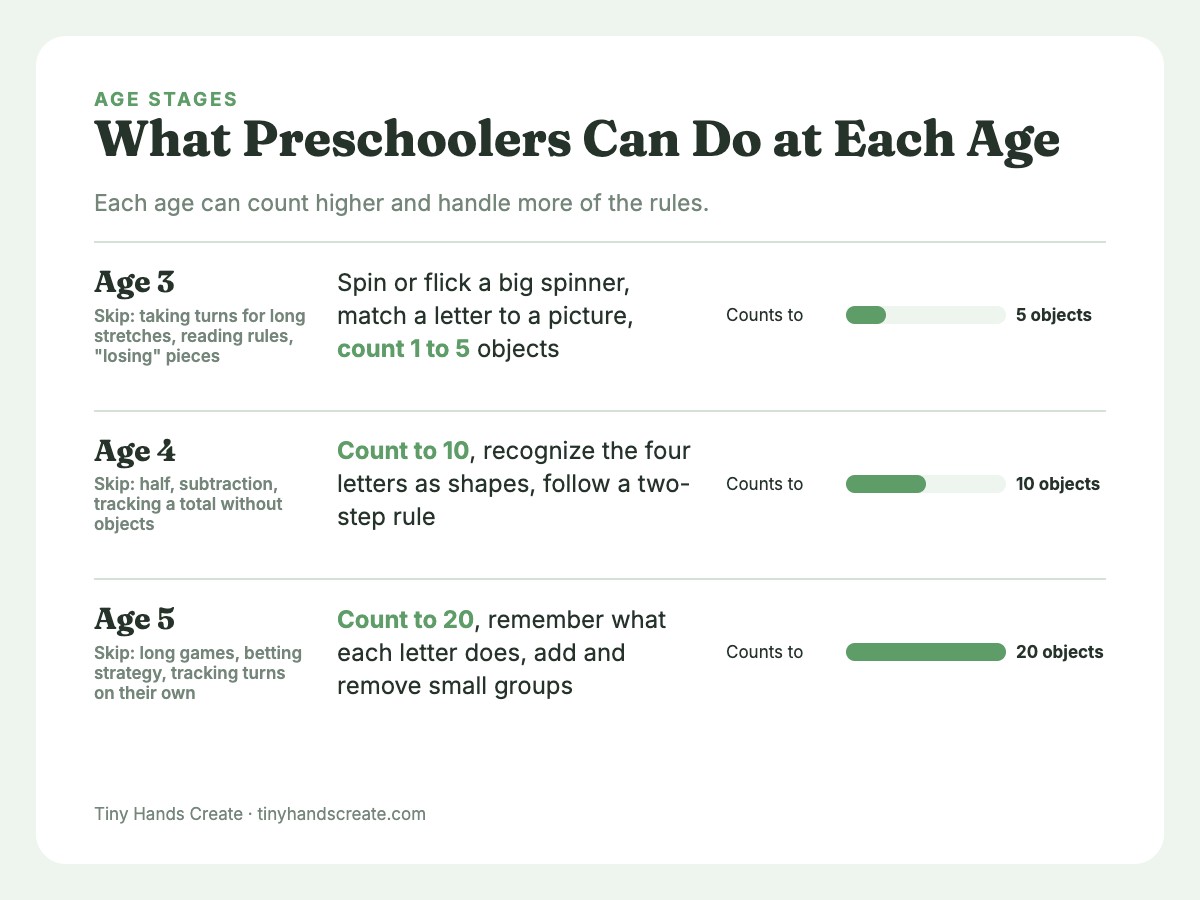
What preschoolers can handle at each age
| Age | What they can usually do | What to skip for now |
|---|---|---|
| 3 | Spin or flick a big spinner, match a letter to a picture, count 1 to 5 objects | Taking turns for long stretches, reading rules, “losing” pieces |
| 4 | Count to 10, recognize the four letters as shapes, follow a two-step rule | Half, subtraction, tracking a total without objects |
| 5 | Count to 20, remember what each letter does, add and remove small groups | Long games, betting strategy, tracking turns on their own |
If you have a mixed-age group, start with the three-year-old version for everyone, then let the older kids add a rule each round. More on that later.
What the Four Letters Mean (the 60-Second Version)
You don’t need to be an expert to do this. Kids will ask “why does it say that?” and a short, honest answer is enough.
A dreidel (in Yiddish) or sevivon (in Hebrew) has four sides. Each side has a Hebrew letter: Nun (נ), Gimel (ג), Hey (ה), and Shin (ש). Together they stand for the phrase Nes Gadol Haya Sham, which means “A great miracle happened there.” In Israel, the fourth letter is usually Pey (פ) instead of Shin. Then the phrase becomes “A great miracle happened here.”
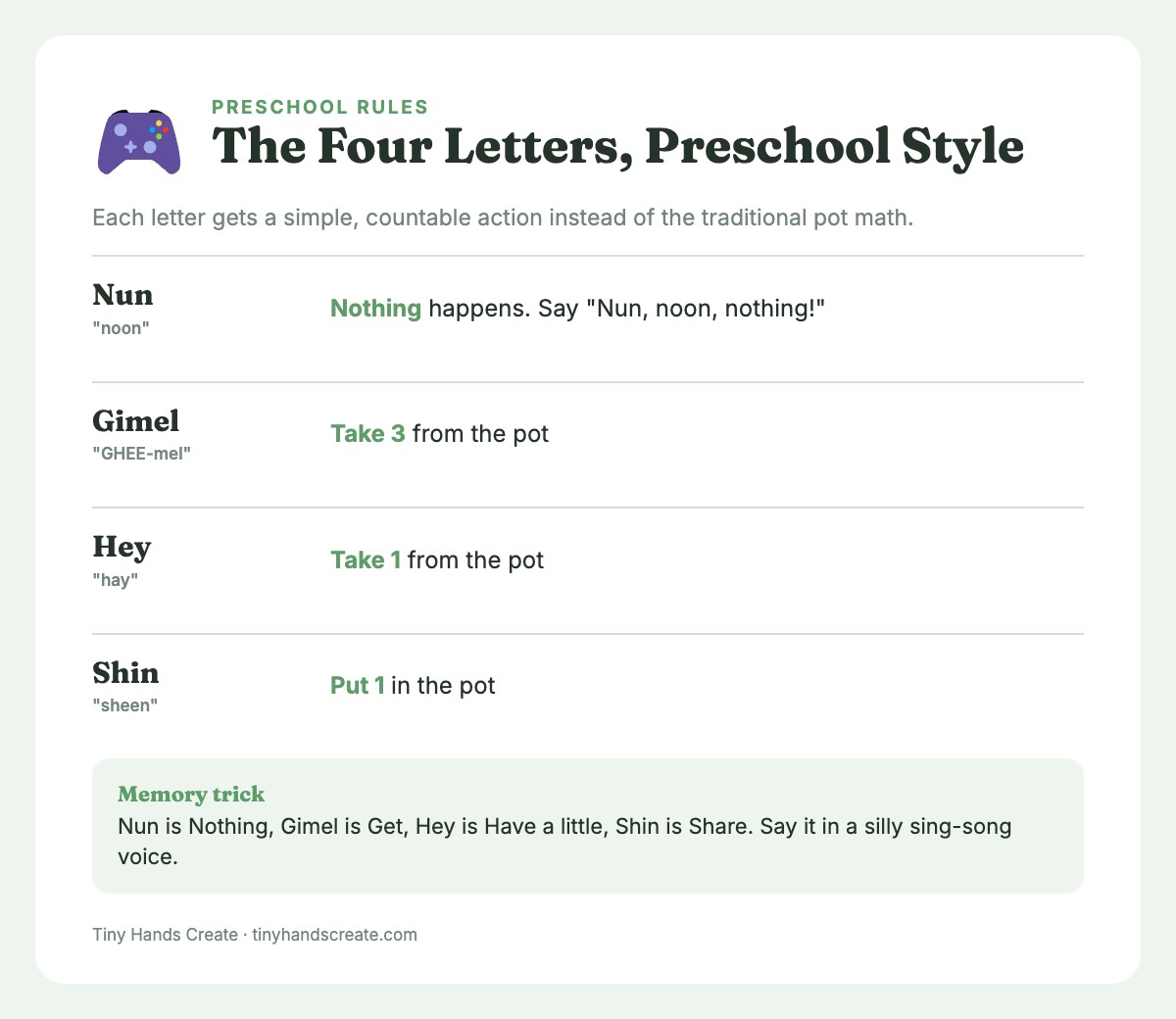
In the traditional game, each letter also tells you what to do with the pot:
| Letter | Name (how to say it) | Traditional rule | Our preschool rule |
|---|---|---|---|
| נ | Nun (“noon”) | Nothing happens | Nothing happens. Say “Nun, noon, nothing!” |
| ג | Gimel (“GHEE-mel”) | Take the whole pot | Take 3 from the pot |
| ה | Hey (“hay”) | Take half the pot | Take 1 from the pot |
| ש | Shin (“sheen”) | Put one in the pot | Put 1 in the pot |
Notice what we changed. “Take the whole pot” becomes “take 3,” a number a child can count, and an empty pot never ends the game. “Half” becomes “1,” a simple, concrete amount. Nobody has to divide anything.
A little memory trick that works for my kids: Nun is Nothing, Gimel is Get, Hey is Have a little, Shin is Share. Say it in a silly sing-song voice and they’ll have it by the third spin.
What You’ll Need
Mostly kitchen-drawer stuff. No special shopping.
| Supply | What it’s for | Mess level |
|---|---|---|
| 1 sturdy paper plate (or a square of cardboard) | The spinner base | None |
| Marker (black and blue are nice) | Drawing the letters and lines | Low (washable, please) |
| Cardboard scrap + brad (paper fastener) | Spinner arrow | None |
| Counters: jumbo pom-poms, large foam or felt discs, big wooden or cardboard coins (5 per player plus 5 for the pot, so 25 for four players) | The “gelt” in the pot | Low to medium |
| A bowl | The shared pot | None |
| Blank paper | Scoreboard | None |
| Crayons | Coloring the sections and scoreboard | Low |
| Optional: cardboard box, tape, paint | The 3D dreidel craft | Medium |
Safety firstIf it fits through a toilet-paper tube, it’s too small for children under 4. Use jumbo counters with an adult within arm’s reach. No coins, small buttons, or loose beads. Use only unsharpened or blunt pencils, and real gelt is for the end-of-game treat only.
A few practical notes from my own kitchen:
- Jumbo pom-poms are the best counters for 3-year-olds. They’re soft, easy to grab, and they don’t roll under the stove. Small pom-poms are a choking hazard for children under four, so go big and stay close.
- Chocolate gelt is fun but changes the game. The moment real chocolate is involved, preschoolers stop playing and start negotiating. Real gelt is for the end-of-game treat only, a prize everyone gets, never the playing pieces. Foil-wrapped coins are small enough to be a swallowing risk, so for children under 4 an adult unwraps the gelt and breaks it into pieces, and the child eats it seated with an adult watching. A larger chocolate bar square works too.
- Big wooden or cardboard coins make a great sound when they drop in a metal bowl. If your child loves noise, this is a plus.
Printable Dreidel Spinner Template (or Draw Your Own)
Print the Preschool Dreidel Game Pack on this page for a ready-made spinner, letter flip cards, the counting scoreboard, and the eight-night checklist. No printer today? The hand-drawn version below takes about ten minutes.
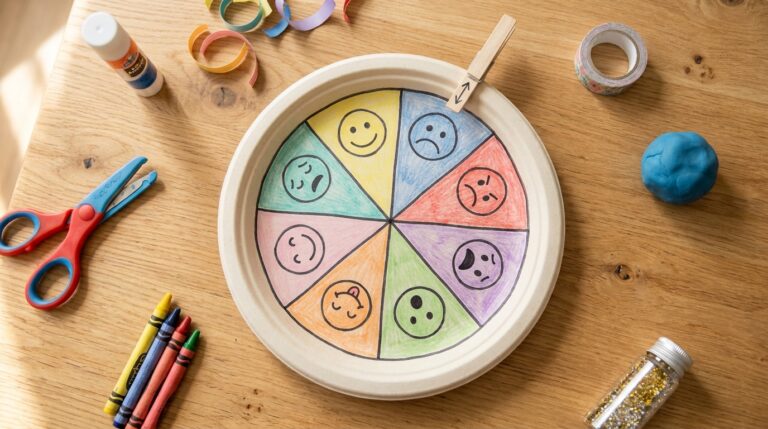
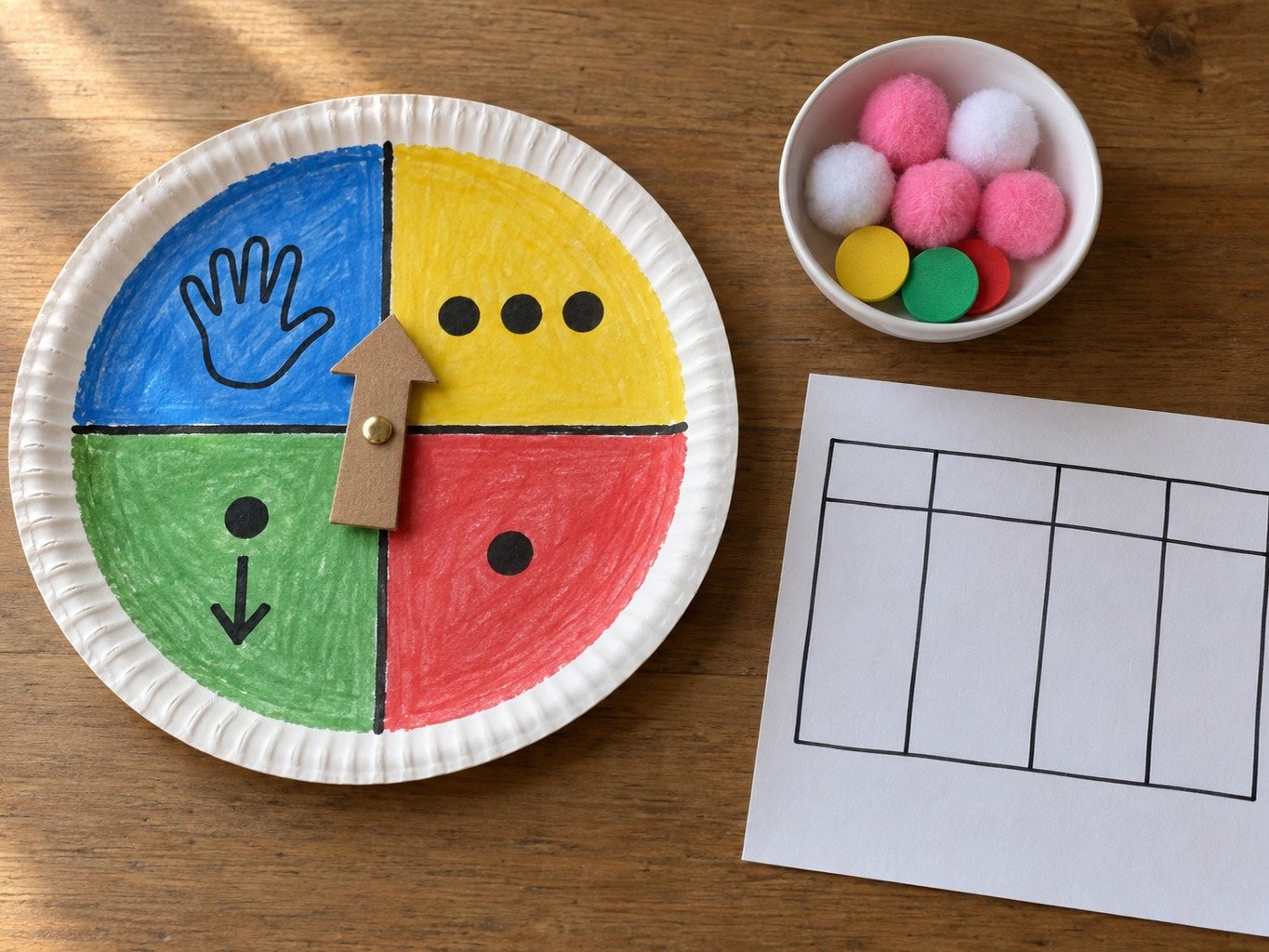
This is the heart of the whole project. A spinner is easier than a top. It doesn’t fall over, it lands cleanly on one section, and a small child can flick it with one finger. An adult can make it in about ten minutes; with a child helping, allow 20.
The layout
Draw a large circle on your paper plate (or just use the plate’s flat middle). Then draw a plus sign through the center so you have four equal wedges. Copy this layout:
| Left | Right |
|---|---|
| נ Nun (top left, color it blue) |
ג Gimel (top right, color it yellow) |
| ש Shin (bottom left, color it green) |
ה Hey (bottom right, color it red) |
In each wedge, write the Hebrew letter large, using a marker. Under each letter, draw a tiny picture clue your child can read without help:
| Wedge | Letter | Picture clue to draw | What the picture tells them |
|---|---|---|---|
| Top left | נ Nun | An empty hand (just an outline) | Nothing to take |
| Top right | ג Gimel | Three dots | Take 3 |
| Bottom right | ה Hey | One dot | Take 1 |
| Bottom left | ש Shin | One dot with an arrow pointing down | Put 1 in |
The picture clues are the secret. Three-year-olds can’t read Hebrew letters (neither can most adults I know), but they absolutely can read “three dots means three.”
How to build the spinner
- Draw the plus sign with a ruler or the edge of a book so the lines are straight enough to be useful.
- Write the four letters, one per wedge. Let your child trace over them with a crayon if they want. This doubles as a small fine-motor workout.
- Add the picture clues from the table above.
- Color the wedges with the colors listed, so a child can say “I got yellow!” before they can say “Gimel.”
- Make the arrow. Cut a cardboard arrow about as long as one wedge. An adult pokes a hole near one end and pushes a brad through the arrow and the center of the plate.
- Secure the brad. An adult bends the brad’s legs flat on the back and covers them with tape so no points are exposed. Flick the arrow with one finger. Keep the plate on a flat table, not in your lap.
Spinner troubleshooting
| Problem | Likely cause | Fix |
|---|---|---|
| The arrow won’t spin | Brad is pinched too tight | Loosen the brad so the arrow turns freely |
| The arrow lands on a line | The lines are too close to the arrow’s width | Thicken the lines and call “on the line” a re-spin |
| Child keeps flicking too hard | Excitement | Make a “gentle flick” rule: one finger, one flick |
| The plate curls up | Marker ink soaked it | Tape a second plate under it |
| Child wants to play the real top | Totally reasonable | Let them spin the wooden one first for fun, then play the spinner version |
A no-spin option for very little hands
If your three-year-old gets frustrated with flicking, make a four-sided die from a small cardboard box or a stack of four index cards. Write one letter and its picture clue on each card, shuffle, and flip one. Same game, no motor skills required.
The Dreidel Game Counting Scoreboard
This is the second half of the system, and it matters more than you’d think. The scoreboard gives the game a shape. It tells kids when it ends, and it makes counting visible instead of abstract.
Copy this table onto a sheet of blank paper. Make the boxes big enough for a crayon dot. Each round, the player who just spun checks one box to show they’ve had a turn. (If your child can’t make a checkmark yet, they can place a jumbo pom-pom on the box.) The pile count goes in the last column.
The scoreboard
| Player | Round 1 | Round 2 | Round 3 | Round 4 | Round 5 | Round 6 | My pile at the end |
|---|---|---|---|---|---|---|---|
| Player 1: ______ | ☐ | ☐ | ☐ | ☐ | ☐ | ☐ | ______ |
| Player 2: ______ | ☐ | ☐ | ☐ | ☐ | ☐ | ☐ | ______ |
| Player 3: ______ | ☐ | ☐ | ☐ | ☐ | ☐ | ☐ | ______ |
| Player 4: ______ | ☐ | ☐ | ☐ | ☐ | ☐ | ☐ | ______ |
Good to knowA round means every player has spun once. For 4 players, play 3-4 rounds. Time depends on player count, but 10-15 minutes is plenty for a preschool attention span. Use only the columns you need.
The counting rules (read these aloud)
- Everyone starts with 5 counters in their own small pile. You need 5 per player plus 5 for the pot: 15 for two players, 20 for three, 25 for four.
- The pot starts with 5 counters in a bowl in the middle. Count them out together.
- Take turns spinning. Each player spins once per round.
- Read the picture, not the letter. Empty hand: nothing. Three dots: take 3 from the pot. One dot: take 1. Dot with arrow: put 1 in.
- Count out loud. Every counter that moves gets counted: “One, two, three!”
- If the pot has fewer than you need, take what’s there. If the pot is empty, everyone puts 1 counter back from their pile and the game keeps going. Nobody ever loses.
- After the last round, everyone counts their pile and writes the number in the last column.
The “everybody wins” finish
Here is the rule that saved my sanity: there is no loser. At the end, we do a group count and cheer for everybody’s number. The player with the biggest pile says “I have the most!” and the player with the smallest pile gets to pick the Hanukkah song we sing next. Each outcome comes with something good.
For kids who are ready for a little more, add one line to the scoreboard: Who has more, me or the person next to me? This is a real math skill (comparing quantities), and it comes in naturally here, because kids care deeply about who has more.
Sample game, so you can see how it goes
Two players, Mia (age 4) and Noah (age 3), play three full rounds (six turns). Each starts with 5, and the pot has 5.
| Turn | Who | Spin | What happens | Mia’s pile | Noah’s pile | Pot |
|---|---|---|---|---|---|---|
| 1 | Mia | Hey (1 dot) | Takes 1 | 6 | 5 | 4 |
| 2 | Noah | Shin (dot + arrow) | Puts 1 in | 6 | 4 | 5 |
| 3 | Mia | Gimel (3 dots) | Takes 3 | 9 | 4 | 2 |
| 4 | Noah | Nun (empty hand) | Nothing | 9 | 4 | 2 |
| 5 | Mia | Shin | Puts 1 in | 8 | 4 | 3 |
| 6 | Noah | Gimel | Takes 3 | 8 | 7 | 0 |
After the pot empties, both put 1 back so the game continues: Mia 7, Noah 6, pot 2. At the end, Mia counts her pile aloud and Noah counts his. Notice how much counting happened in three rounds: forward, backward, comparing, and tracking change. All of it feels like a game.
Five Dreidel Game Variations for Preschoolers (Ages 3 to 5)
Once the basic spinner and scoreboard are working, rotate in these. They use the same spinner and keep the novelty fresh over eight nights.
1. Spin and Say
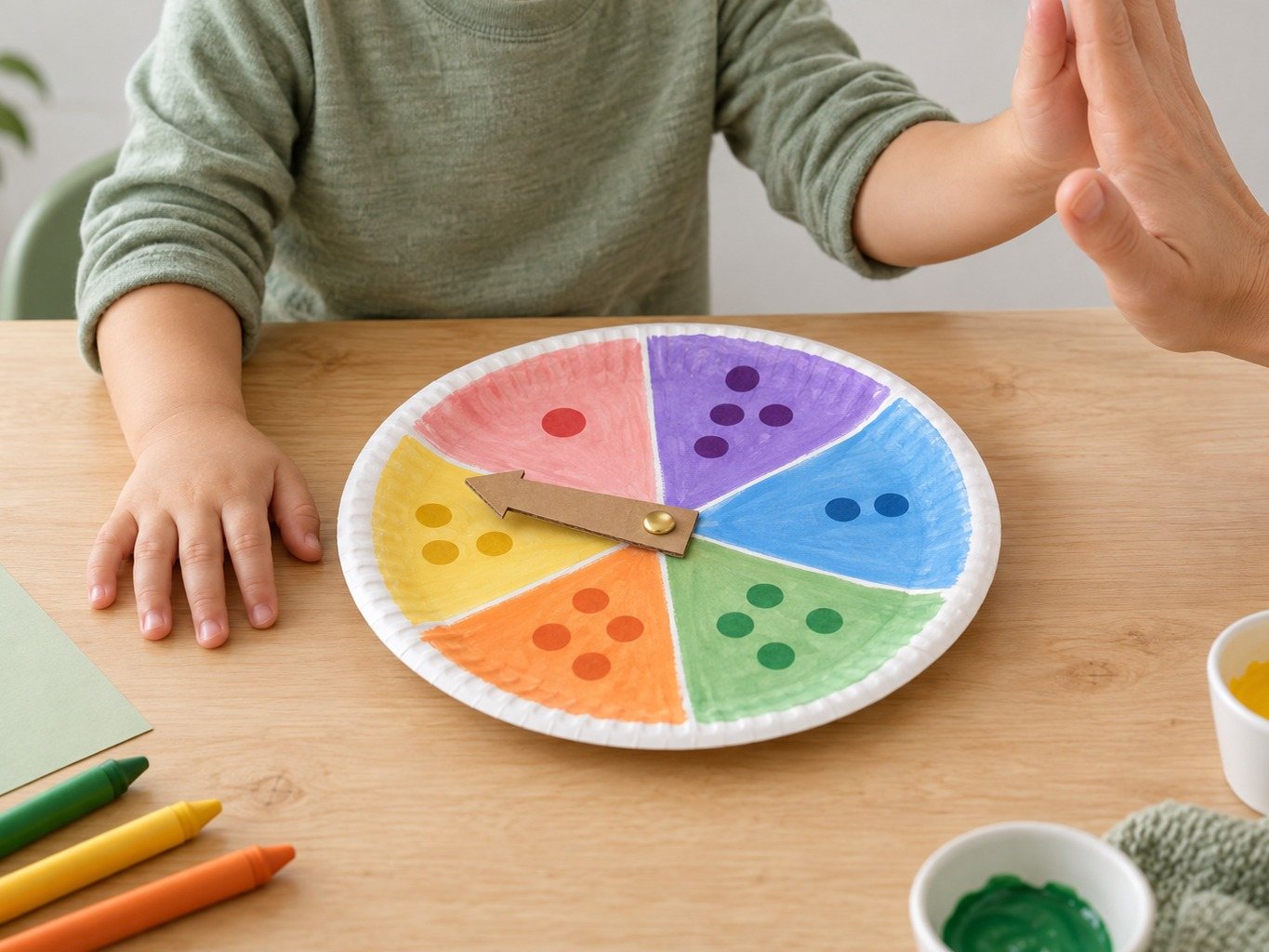
Spin the arrow and have the child say the name of the letter it lands on. Say it first, then have them echo you. No counters, no pot. Give a high five every time.
This is the easiest entry point. Do it for two minutes before bed on night two, and by night four your child will say “Gimel!” in a confident voice and surprise a grandparent.
2. Dreidel Letter Hunt
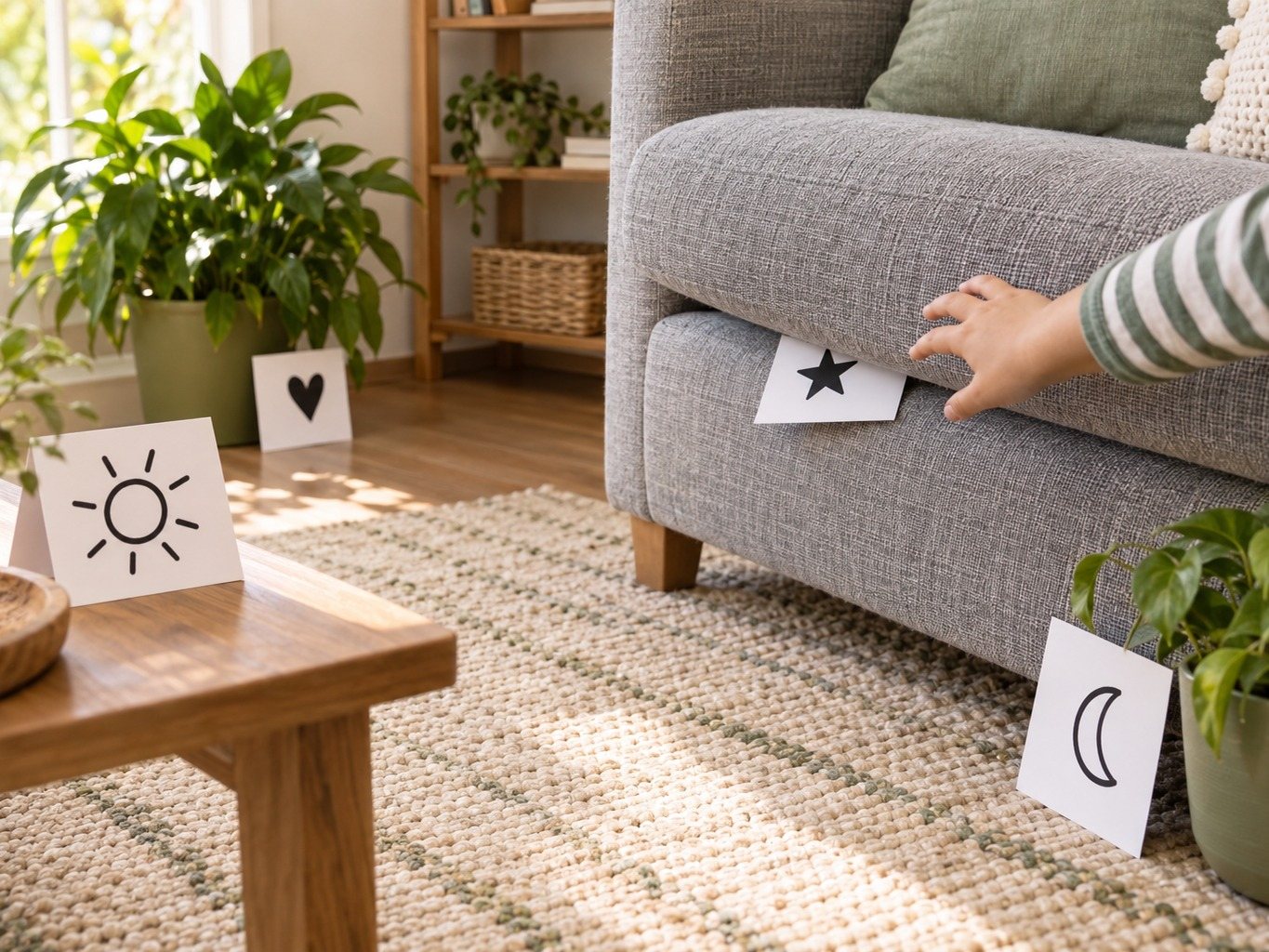
Write the four letters on index cards, and hide them around one room: under a pillow, on the couch, behind a plant. The child finds one, brings it back, and matches it to the wedge on the spinner. This turns a letter-recognition exercise into a mini scavenger hunt.
Bonus: connect it to early math. Ask, “How many cards have you found so far?” Their answer builds counting without feeling like a lesson. If your child is also working on early numerals, our number tracing worksheets pair well with this one. Have them trace a 1 and a 3 to match the dot clues on the spinner.
3. Shape Dreidel
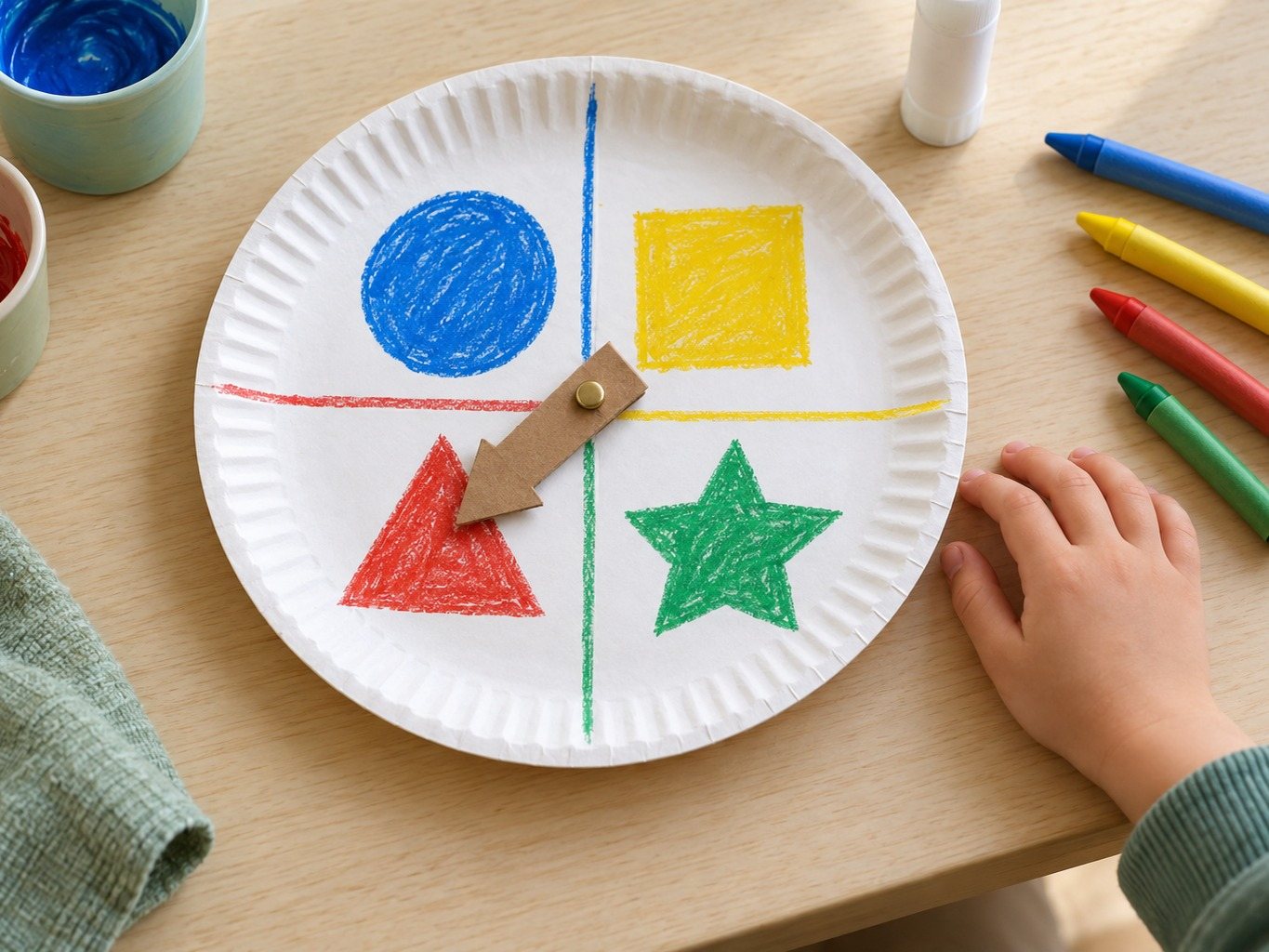
Swap the letters for shapes. Draw a circle, square, triangle, and star in the four wedges, then give each shape a job: circle means clap, square means stomp, triangle means jump, star means spin around once. Spin, name the shape, do the action.
A dreidel itself is a great shape lesson, since it’s a combination of a square-ish body, a triangle at the bottom, and a stem on top. If shapes are on your list this month, our shape recognition activities have plenty of companions for this one.
4. Pass the Pot
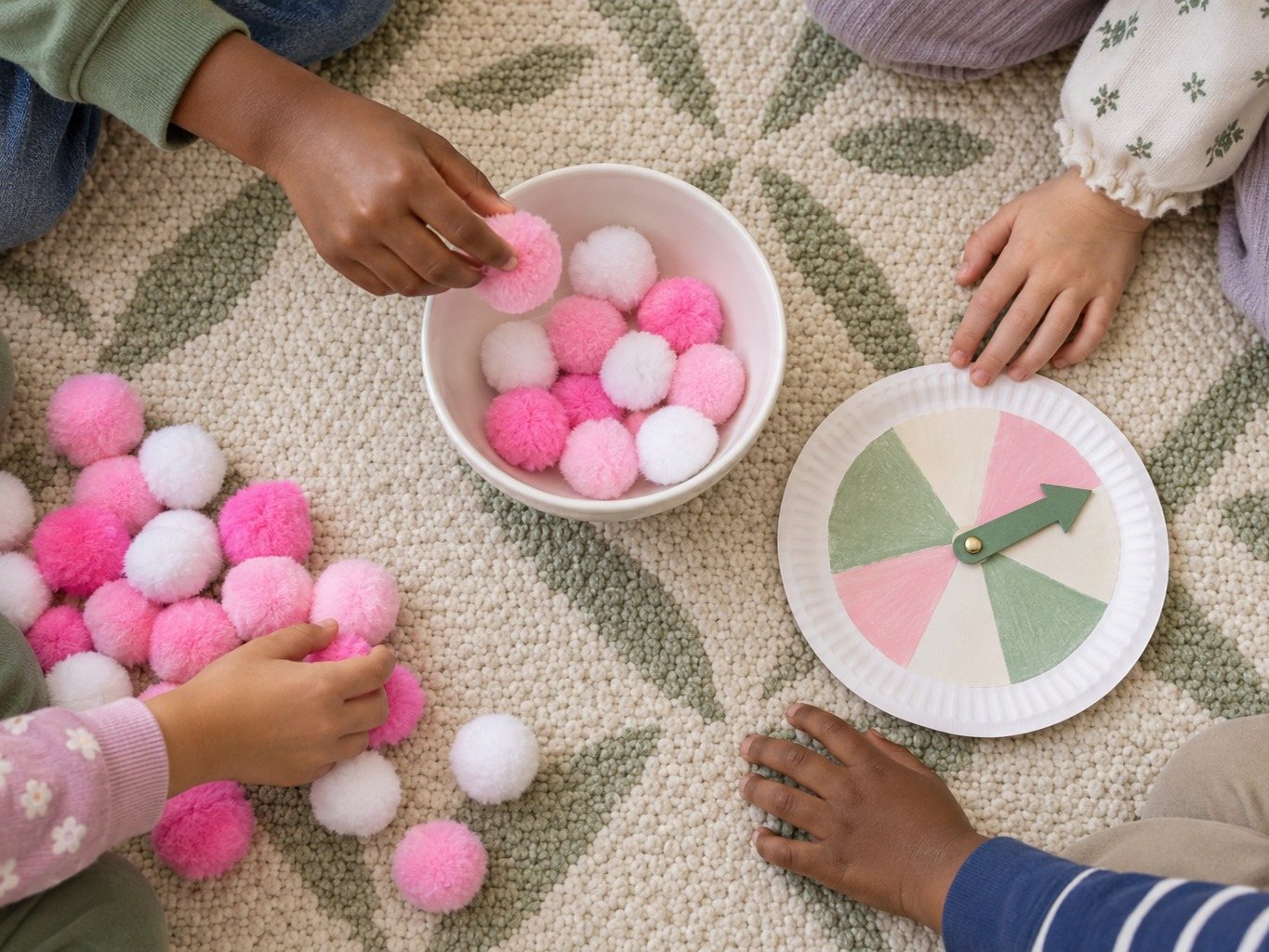
Sit in a circle with an empty bowl in the middle and a shared pile of about 12 counters beside it. Each child gets a turn on the spinner. In this version, every spin fills the pot instead of taking from it:
- Three dots (Gimel): add 3 to the bowl.
- One dot (Hey) or the dot with an arrow (Shin): add 1.
- Empty hand (Nun): add nothing.
After each spin, the group counts the bowl out loud together. When it reaches 10 or more, everybody cheers and the game ends. It’s a cooperative game, so nobody competes. This is the one I’d choose for a classroom or playgroup.
5. Freeze Dance Dreidel
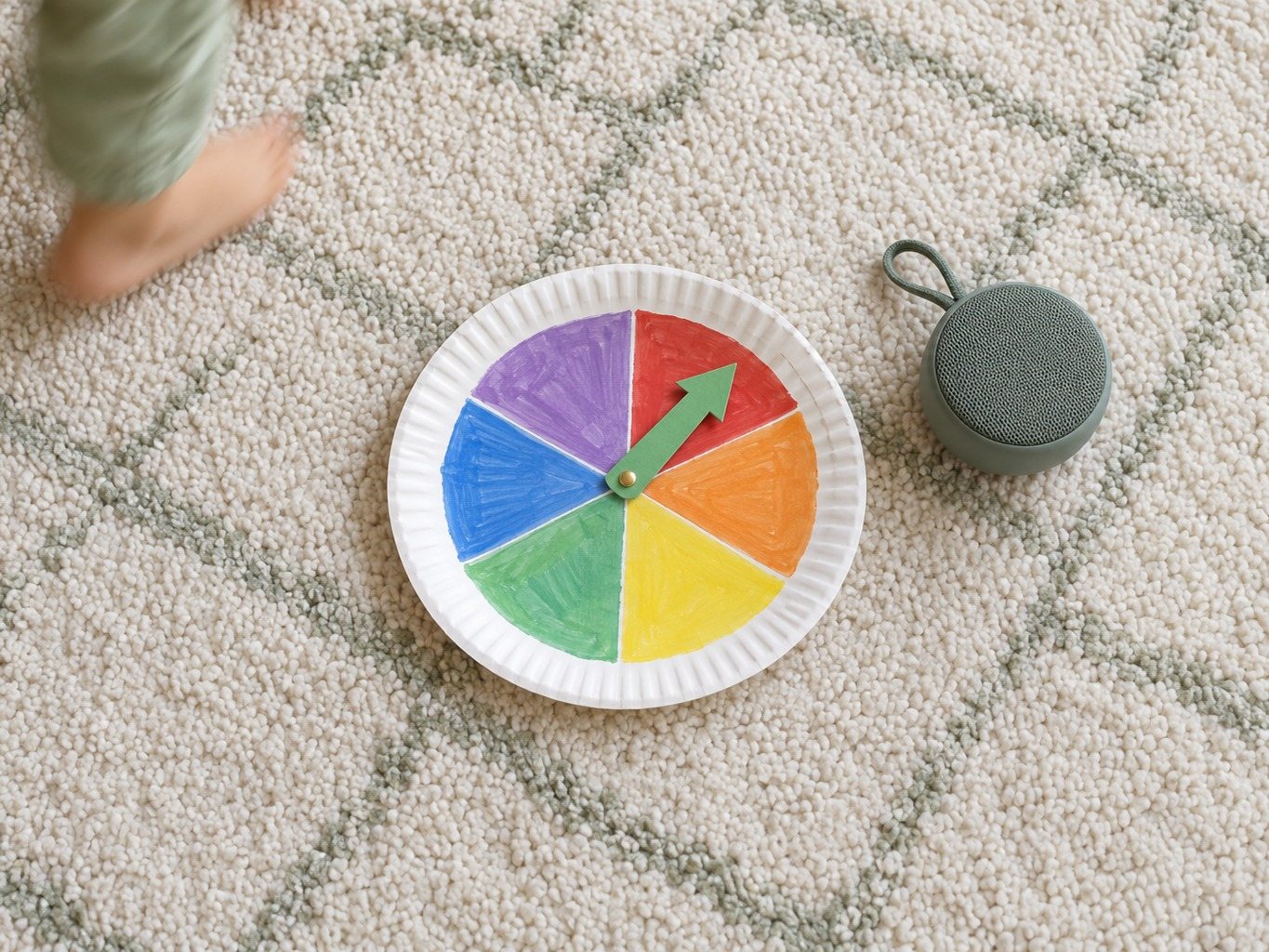
Put on any music. Kids spin like dreidels in the middle of the living room. When the music stops, they freeze, and you spin the spinner. Whatever it lands on tells them what to do. Nun means stay frozen. Gimel means three big jumps. Hey means one clap. Shin means sit down.
This is the version for the days when nobody has the patience for a table game. It burns real energy, and it ends with giggling.
Easy Dreidel Crafts for Preschoolers
Games are great, but a lot of us come to December for the crafts. Here are four dreidel crafts, ranked by how long they take and how much glitter lands in your hair.
| Craft | Age | Time | Mess rating | Notes |
|---|---|---|---|---|
| Paper plate dreidel | 3+ | 15 min | Low | Adult pre-cuts the shape; child decorates |
| Cardboard box dreidel | 4+ | 30 min | Medium | Can also be used as a game piece |
| Clay dreidel | 3+ | 30 min | Medium to high | Needs drying time, see our clay guide |
| Paper cup spinning top | 4+ | 20 min | Low | Actually spins, with help |
Safety firstUse only unsharpened or blunt pencils, and an adult does all the poking. Keep small counters away from children under 4, supervise scissors, and keep clay out of mouths.
Paper plate dreidel
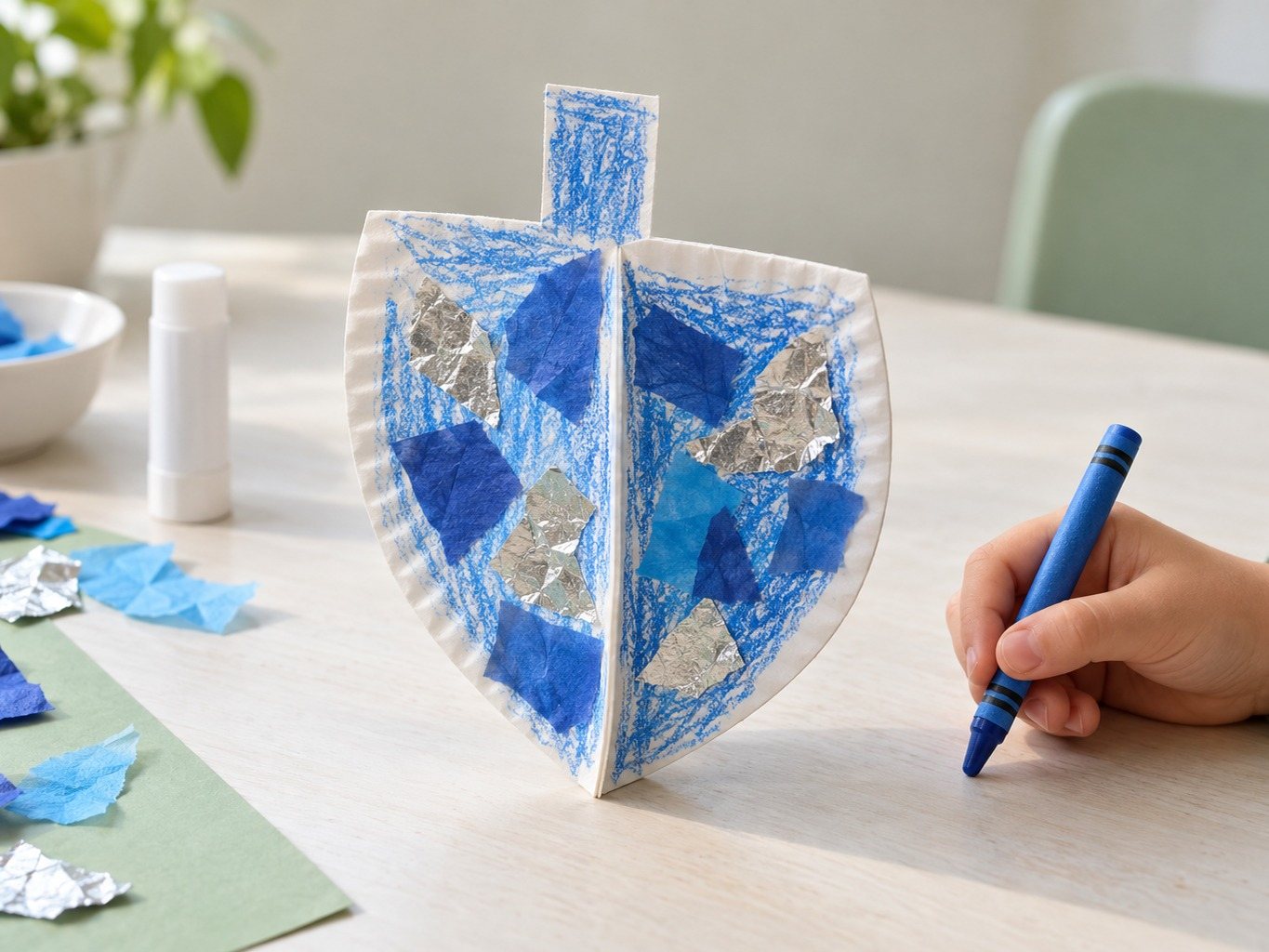
Fold a paper plate in half. Draw a dreidel shape on one side: a wide top with a pointed bottom and a little handle. An adult cuts along the line, leaving the fold intact, so the dreidel stands upright when you open it slightly. Want scissor practice for another day? Try our cutting practice sheets. Decorate with crayons, stickers, or torn tissue paper.
Why this works for 3-year-olds: the plate is sturdy, the shape is forgiving, and a messy dreidel still looks like a dreidel.
Cardboard box dreidel
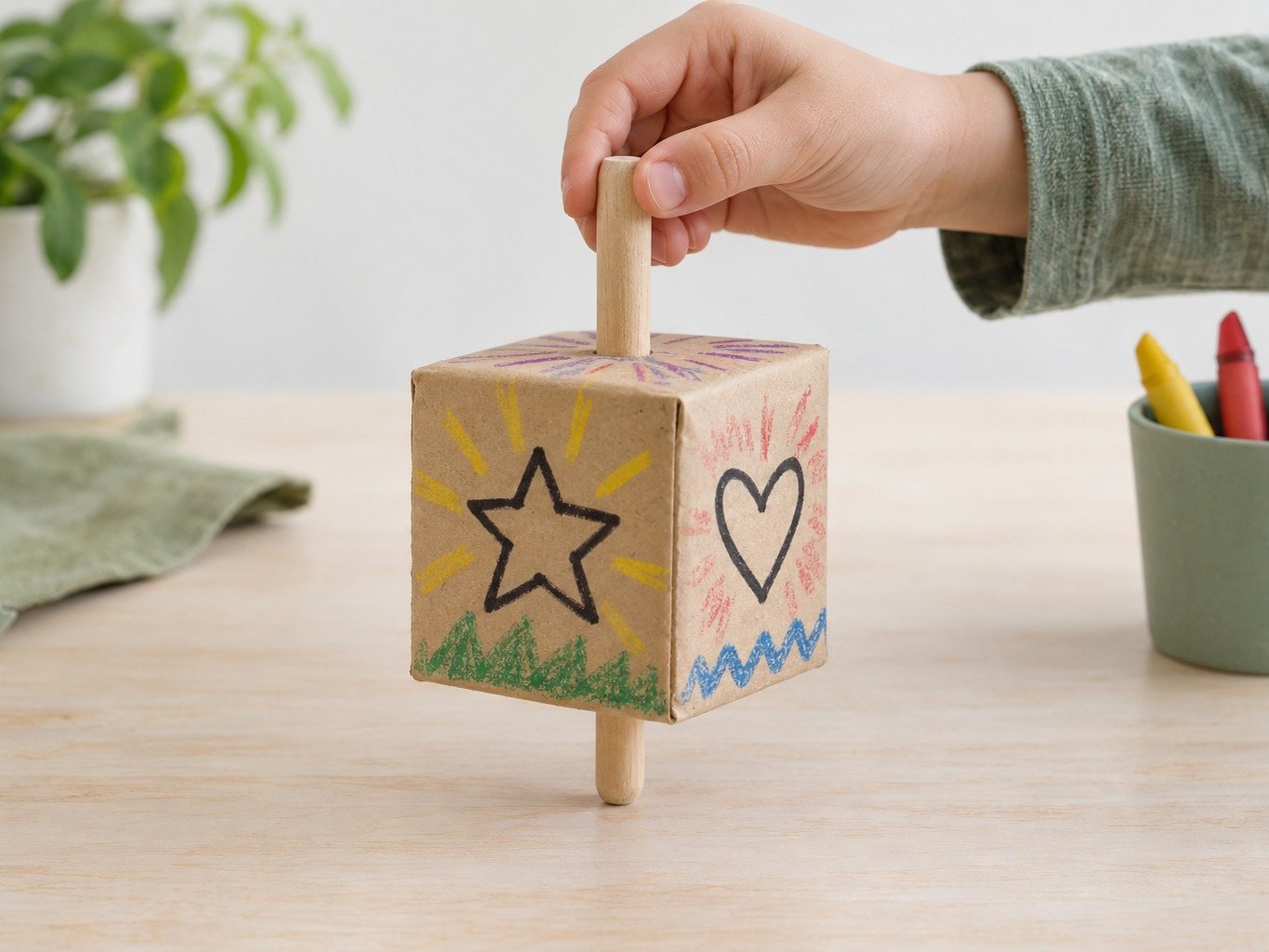
Find a small square box (tea boxes or tissue boxes work well). Wrap it in plain paper or leave it as is. On each of the four sides, draw one of the letters. An adult pushes an unsharpened pencil or a wooden dowel with a rounded end through the top and bottom to make a spinning axis. The box then spins on the blunt tip with a gentle twist.
Adults should push the pencil through. Kids can decorate everything else, including the pencil.
Don’t have a box? Our roundup of cardboard box crafts has plenty more ideas for the pile in your recycling bin.
Clay dreidel
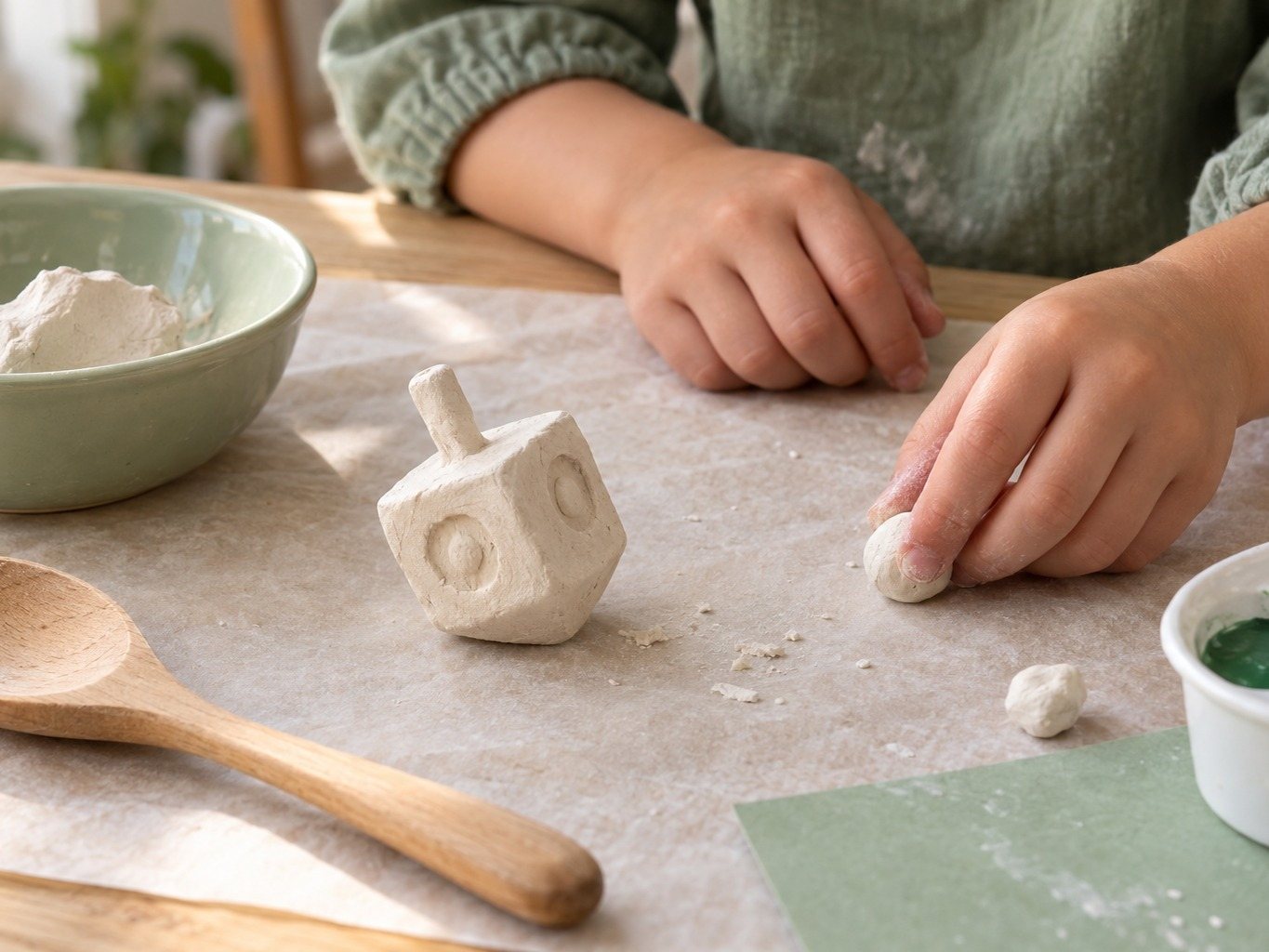
Roll a ball of air-dry clay, pinch it into a four-sided shape, and add a small stem on top. An adult presses a letter into each side with a blunt tool such as the back of a spoon handle, or kids use a cookie stamp. Let it dry for a day or two. This one is more about the process than the product. Expect clay under fingernails and a slightly wobbly dreidel.
For first-timers, air-dry clay projects for preschoolers walks through the basics, including how to keep clay from cracking.
Paper cup spinning top
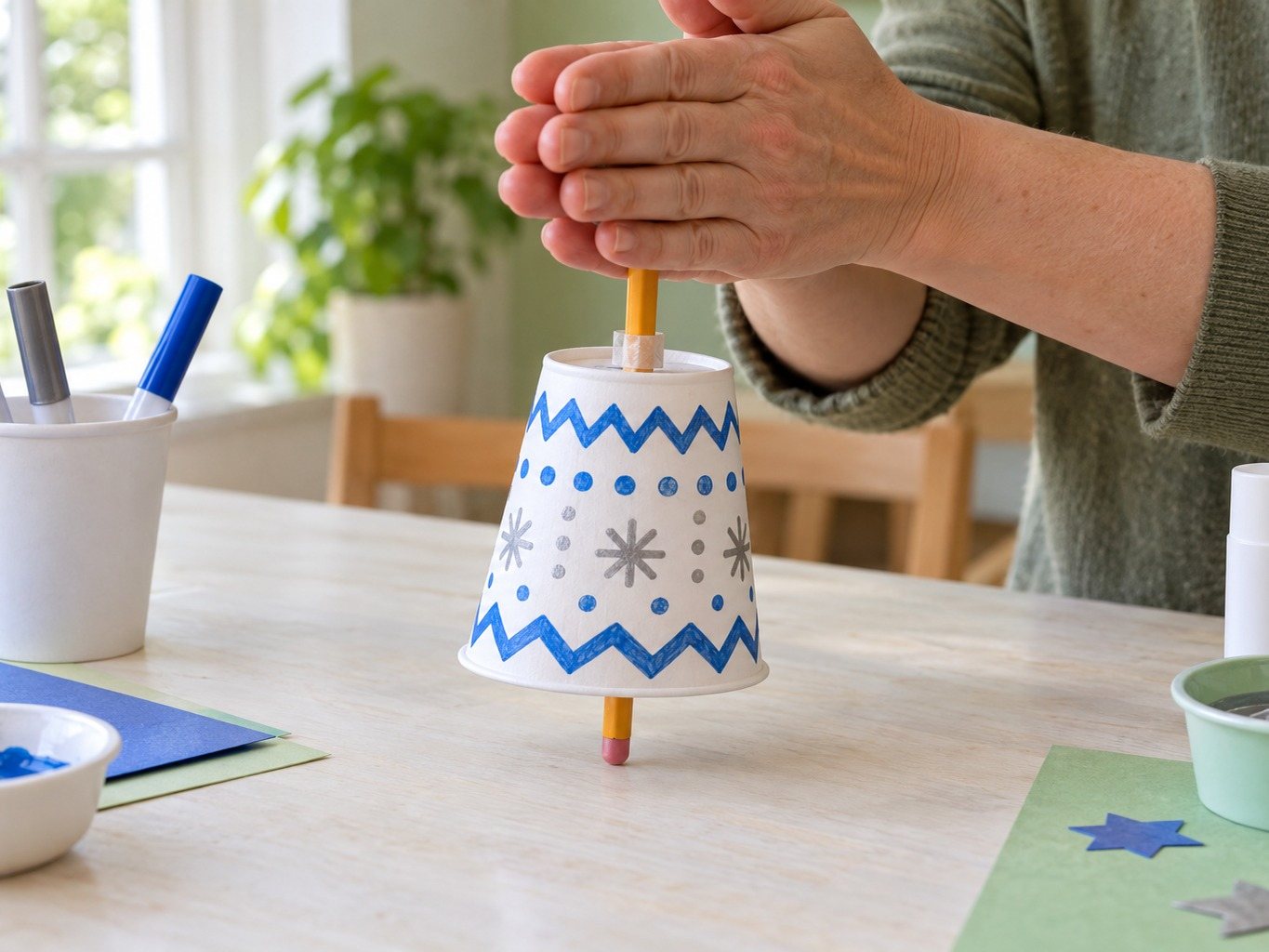
Turn a paper cup upside down. An adult pokes a small hole in the closed bottom and pushes an unsharpened pencil (or a dowel with a rounded end) through it. Let about an inch of the blunt tip stick out past the rim as the pivot, and tape the pencil in place. Decorate the cup with the four letters. An adult spins the handle between their palms and lets go. It won’t spin as long as a wooden dreidel, but it works.
More craft safety notes
- Supervise scissors, and use child-safe ones for 3-year-olds.
- Clay is not food. Keep it out of mouths, especially with 3-year-olds.
- If you use real chocolate gelt, check labels for nuts and dairy before sharing with a group. For children under 4, unwrap it and break it into pieces first.
Dreidel Game Upgrades for Kindergarten (Ages 5-6)
If your child is five or turning six, the preschool version may feel babyish. Here’s how to raise the challenge without turning it into homework.
| Preschool version | Kindergarten upgrade |
|---|---|
| Gimel takes 3, Hey takes 1 | Gimel takes the whole pot; Hey takes half (if the pot is odd, the extra one stays in) |
| Play 3-4 rounds | Play 10 rounds and total the pile at the end |
| Scoreboard dots | Write the actual numbers each round |
| Pictures on the spinner | Remove the picture clues; kids read the letter |
| One counter type | Use two kinds (large foam discs and jumbo pom-poms) and sort at the end |
Some more ideas for this age:
- Write a dreidel story. Have your child dictate a short story about a dreidel that comes to life, and illustrate it. A typical one goes: “The dreidel spun so fast it flew out the window.”
- Make a sorting mat. Draw four boxes labeled with the four letters. Kids sort large foam discs or jumbo pom-poms by color into each. Then ask, “Which box has the most?”
- Add a graphing step. After 20 spins, tally how many times each letter came up. Color a bar for each. With many spins the results tend toward even, but a short run can look lopsided. Treat that as a chance to talk about luck.
The tally idea pairs with your scoreboard. You’ve already built the table, so it’s just one more column.
An Eight-Night Hanukkah Plan for Preschoolers
Hanukkah lasts eight nights, and with young kids it helps to have something small and doable for each. Hanukkah begins on the 25th of Kislev, usually between late November and late December. Check this year’s start date and count back from there to gather supplies. Copy this checklist onto a sheet of paper and tick it off as you go.
| Night | Activity | Time | Supplies | Done |
|---|---|---|---|---|
| 1 | Build the spinner: color the four wedges and add picture clues | 20 min | Plate, markers, cardboard, brad | ☐ |
| 2 | Spin and Say with the new spinner | 10 min | Spinner | ☐ |
| 3 | Play the basic counting game (3-4 rounds) | 15 min | Counters, scoreboard | ☐ |
| 4 | Paper plate dreidel craft | 15 min | Plate, crayons | ☐ |
| 5 | Dreidel Letter Hunt | 15 min | Index cards | ☐ |
| 6 | Shape Dreidel (action version) | 10 min | Second spinner with shape wedges | ☐ |
| 7 | Cardboard box or clay dreidel | 30 min | Box or clay | ☐ |
| 8 | Family game of Pass the Pot, gelt treat for everyone (unwrapped and broken up for under-4s) | 20 min | Everything | ☐ |
Some nights you will skip, because kids get sick, grandparents call, and the candles take forever to light. That’s fine. The plan is a menu, not a contract.
Keep it simple on the busy nights
On any night when you’re low on energy, the minimum is two minutes: spin the arrow once, say the letter, and move on. A tiny ritual still counts as a tradition.
Mess management in plain English
I promised realistic mess, so here it is.
- Counters will end up everywhere. Count them before and after, and pick up what you can. Someone will find a pom-pom in a boot in February.
- Markers bleed through paper plates. Put newspaper under everything.
- Clay dries on tables. Wipe it right away, because dried clay is stubborn.
- Kids love scooping and pouring the counters. Let them for a minute at the start. It saves you from fighting it later.
If your family likes sensory play, a tray of oats with a few scoops and cups (ages 4+, with you sitting beside it) doubles as a quiet pre-game warm-up. Our guide to DIY sensory bins has fill ideas that fit a blue-and-silver theme.
More Hanukkah Activities for Preschoolers
The spinner is the star, but a few extra activities keep the week from feeling like one game on repeat.
Blue-and-silver sensory tray
For ages 4+, with an adult sitting beside the tray. Fill a baking sheet with dried white rice or oats. Add jumbo silver pom-poms, scoops, and a few cups. Skip the beads, and keep under-4s who still mouth things away from it. Let them play for as long as they like. It’s the easiest “do nothing” activity on this list.
Menorah counting
Draw a menorah on a sheet of paper with nine candle holders, the shamash in the middle and four on either side. Give your child small yellow circles of paper (flames) and have them place one on each night’s candle. On night three: “One shamash, three candles. How many flames?” It’s gentle addition, tied to something real.
Gelt sorting (gelt-free for the youngest)
Use large gold and silver cardboard or wooden coins (too big to fit through a toilet-paper tube) as pretend coins. Sort by color, then by size. For kids who can, order them smallest to biggest. Hand out real gelt only for the final count on night eight.
A simple “thank you” project
Hanukkah is a season of giving, so have your child make a card for a grandparent or neighbor. Draw a menorah or dreidel, then add a handprint flame. Kids this age love giving things away.
Quiet-time dreidel coloring
If you need a break, hand over crayons and a blank paper with a big dreidel outline you drew yourself. No directions. Let them fill it with whatever they like. Process over product, always.
Setting Up the Game So It Doesn’t Fall Apart
A few small decisions make the difference between a ten-minute game and a ten-second one.
Play at a low table. Kids on the floor around a coffee table can reach everything and spin without craning.
Sit the youngest next to you. If you’re on the same side, you can help with the flick and the counting without hovering.
Count out loud, always. Even if the child is mumbling, saying numbers together builds the habit.
Let them be the banker. One child is in charge of the pot bowl, and hands over counters when needed. It’s a job, and kids love jobs.
End the game before they want to. I stop early when I sense wiggles. Leaving them wanting more makes tomorrow’s game easy to sell.
Praise effort, not winning. “You counted so carefully!” matters more than “You won.” In this game, winning is mostly luck anyway.
What to do when someone melts down
It happens. Typical triggers and quick responses:
| Trigger | What to try |
|---|---|
| “I didn’t get Gimel!” | “Gimel is lucky. Let’s spin again, and see what you get.” |
| “It’s not fair!” | Pause the game and count both piles. Show that they’re close. |
| Pot was knocked over | Make it a game: “Quick, count them back in!” |
| Younger sibling grabbing counters | Give them their own small bowl to play with nearby |
| Tired or hungry | End the game with a snack. Gelt, if you’ve saved it. |
Frequently Asked Questions
What age can kids start playing the dreidel game?
Most children can enjoy the simplified spinner version from around age 3. At that age it is mostly about spinning, naming the letters, and counting a few objects. By age 5, many kids can handle the basic rules with picture clues, and by 6 or 7 they can move to the traditional version with taking half and keeping track of a pot. Go by your child’s counting skills more than their age. If they can count 5 objects reliably, they’re ready for the spinner game.
Do I need to know Hebrew to teach this?
No. The picture clues on the spinner mean a child doesn’t need to read the letters to play. If you want to introduce the names, Nun, Gimel, Hey, and Shin, just say them out loud each turn, and they’ll pick them up. Many families learn the names alongside their kids. If you celebrate Hanukkah, you can add the song or blessing that your family already uses. If you’re not Jewish and are exploring the holiday with your child, it helps to explain it simply and respectfully: it’s a Jewish festival of lights, and the dreidel is a traditional game played during it.
What can I use instead of chocolate gelt?
Jumbo pom-poms, large foam or felt discs, big wooden coins, or cardboard “coins” all work. Skip pennies, small buttons, and dried beans for children under 4. For group play, I prefer non-food counters because kids stop fighting over snacks. Save a few pieces of real gelt as a reward for the final count. For children under 4, an adult unwraps it and breaks it into small pieces, and the child eats it seated and watched. If food allergies are a concern in your group, check the labels on the gelt, since some contain milk, soy, or traces of nuts.
My child can’t spin the arrow. What can I do?
Switch to the four-card flip version described above. Write the four letters and picture clues on four cards, shuffle them face down, and have your child pick one. It teaches the same rules without needing a flick. You can also loosen the brad so the arrow turns more easily, or let the child tap the arrow with a whole palm instead of one finger. Smaller hands often do better with a slow push than a quick flick.
How long should a game last for a preschooler?
Ten to fifteen minutes is a good limit for 3- and 4-year-olds, and up to twenty for 5-year-olds. Three or four rounds usually fits. If they’re still engaged, play another round. If they’re drifting, end the game with a final count and a cheer, and try again tomorrow. A short game that ends happily beats a long one that ends in tears.
Can I play this with toddlers under 3 in the room?
You can, with a few adjustments. Give the toddler a separate bowl of large, safe items to scoop, like big pom-poms or soft blocks, and let them “play” alongside you. Keep all small counters, brads, and pencils out of their reach. Let the toddler watch the spinner, or hand them a big cardboard arrow with no brad or pencil, held by you. They get the colors and the fun without the rules. If you’re looking for Hanukkah-adjacent ideas for a little one, simple sensory play and color matching work well. Our list of crafts for 2-year-olds has lots more that need no special supplies.
How do I explain Hanukkah to my preschooler?
Keep it short and concrete. A version that works: “Long ago, a small group of people took back their special temple. They only had enough oil for one night, but the light lasted eight nights. Every year we light candles for eight nights to remember.” Then connect it to what they can see: the candles, the songs, the dreidel game. Young children learn through doing, so the activities themselves carry most of the meaning. If your family has its own traditions or stories, those are what your child will remember most.
Start With the Spinner Tonight
The best Hanukkah memory with a preschooler is rarely the perfect craft or the longest game. It’s the evening your three-year-old yells “Gimel!” at the dinner table, or the afternoon your four-year-old proudly counts a pile of jumbo pom-poms to eleven without help. A paper plate, a cardboard arrow, and a table of numbers are plenty to build that moment.
Make the spinner (or print it), keep the rules light, and let the counters roll where they may. When you find a stray pom-pom in the spring, you’ll remember how much fun it was.