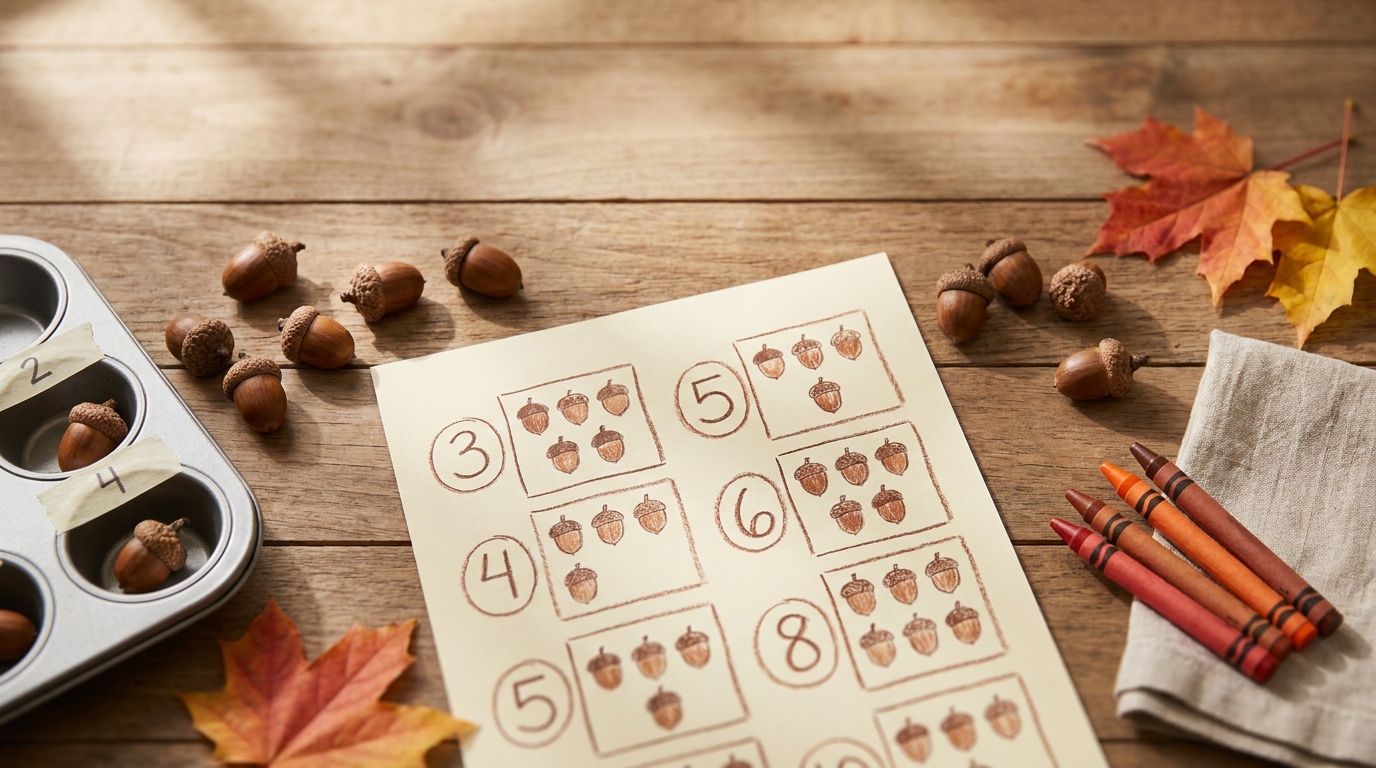
Free Fall Counting Worksheets for Preschoolers (1-10)
Get six free fall-themed counting worksheets for your preschooler (ages 3-5) to practice numbers 1-10 using acorns and leaves. You'll also receive a parent guide with age tips, a one-week plan, and solutions for common counting challenges.
- Download six free fall-themed counting worksheets for numbers 1-10.
- Help your 3-5 year old practice counting objects with acorns and leaves.
- Utilize the parent guide for age tips, a weekly plan, and counting game ideas.
- Learn how to address common counting snags your child might encounter.
- Use the worksheets to spark conversations about nature.
This post contains affiliate links. As an Amazon Associate I earn from qualifying purchases.
Last October my four-year-old marched into the kitchen with both fists full of acorns and announced, “I have a LOT.” How many? “Ten. Or twelve. Or a hundred.” Then the whole pile hit the floor and rolled under the fridge.
Counting out loud and counting objects are two different skills, and the second needs things you can point at and touch. So I made six free fall counting worksheets for numbers 1-10, built around acorns and leaves.
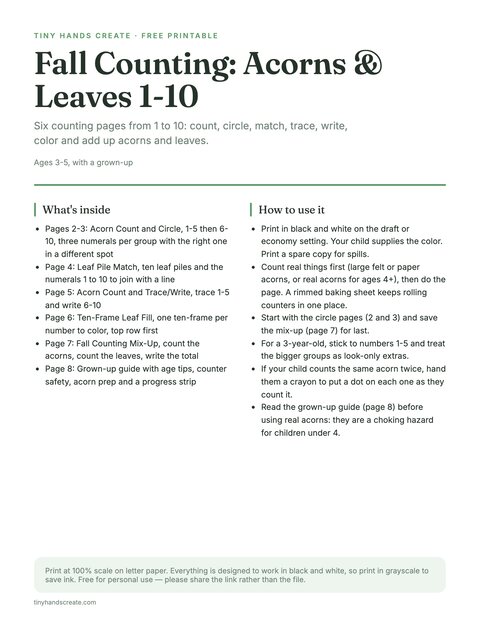
Free printable · 8 pages
Fall Counting: Acorns & Leaves 1-10
Six black-and-white acorn and leaf counting pages for 1 to 10 (count and circle, leaf pile match, trace and write, ten-frames, a mix-up with totals) plus a grown-up guide.
Free. Your download link appears right here. You'll also join the Daily Printable Drop. Unsubscribe anytime. Privacy
Inside: the free download, a page-by-page guide, age tips for 3 to 5, a one-week plan, counting games and fixes for common snags.
In this article (14 sections)
- Get the Free Printable
- What’s in the Six-Page Fall Counting Set
- Fall Counting Worksheets: Page-by-Page Guide
- What You’ll Need (Spoiler: Not Much)
- How Preschoolers Actually Learn to Count
- A Week of Fall Counting (A Sample Plan)
- Turn the Worksheets Into a Fall Unit Study
- Acorn Counting Activities and Games
- Counting Worksheets by Age (3, 4, 5)
- Troubleshooting Common Counting Hiccups
- Pair the Counting With a Fall Craft
- Fall Counting Beyond the Table
- Frequently Asked Questions
- Happy Counting, Mama
Get the Free Printable
Grab the free download card on this page and print it in black and white. Your child supplies the color. Here’s what’s inside:
- Page 1: Acorn Count and Circle (1-5)
- Page 2: Acorn Count and Circle (6-10)
- Page 3: Leaf Pile Match (1-10)
- Page 4: Acorn Count and Trace/Write (1-10), with light-trace numerals
- Page 5: Ten-Frame Leaf Fill (1-10)
- Page 6: Fall Counting Mix-Up (acorns, leaves, total)
- A one-page parent guide with age tips and a progress strip
Use the draft or economy print setting. You don’t need heavy ink for a counting page, and you’ll want a spare copy for when someone spills apple cider on the first.
What’s in the Six-Page Fall Counting Set
Here’s the whole set at a glance. Each page has one job, and the set builds from “look and count” to “count and write.” You don’t have to do all six in a week, or even in order, though the order helps.
| Page | Title | Numbers | What the child does | Fine-motor load |
|---|---|---|---|---|
| 1 | Acorn Count and Circle | 1-5 | Counts acorns in each box, circles the matching numeral | Low (circling) |
| 2 | Acorn Count and Circle | 6-10 | Same as page 1 with bigger groups | Low (circling) |
| 3 | Leaf Pile Match | 1-10 | Draws a line from each leaf group to its numeral | Medium (drawing lines) |
| 4 | Acorn Count and Trace/Write | 1-10 | Counts, then traces or writes the numeral | Medium-high (writing) |
| 5 | Ten-Frame Leaf Fill | 1-10 | Colors in leaves on a ten-frame to match the number | Medium (coloring) |
| 6 | Fall Counting Mix-Up | 1-10 | Mixed acorns and leaves: count each kind, then the total | Medium (counting plus recording) |
Why acorns and leaves instead of plain numbers
First, they’re easy to count. An acorn is chunky with its own little hat, and a maple leaf has points to touch one at a time. Both beat a cluster of tiny dots.
Second, the pictures start conversations. “Why do acorns have little hats?” and “Why did the maple leaf turn red?” are real questions my kid asks the second she sees these pages.
That turns a worksheet into a mini unit study at no extra cost. More on that below.
Fall Counting Worksheets: Page-by-Page Guide
Here’s what’s on each page and how I use it with my own kid. The sample tables show the kind of counting each page asks for.
Page 1: Acorn Count and Circle (1-5)
Five boxes in a row, each holding a group of acorns. Under each box are three numerals, and your child circles the one that matches.
| Box | Acorns in the box | Numerals offered (correct one in bold) |
|---|---|---|
| A | 🌰 | 3, 1, 5 |
| B | 🌰🌰 | 2, 4, 1 |
| C | 🌰🌰🌰 | 5, 3, 2 |
| D | 🌰🌰🌰🌰 | 3, 2, 4 |
| E | 🌰🌰🌰🌰🌰 | 5, 4, 1 |
The right answer sits in a different spot in each row, so your child has to count rather than guess. Have them touch each acorn once as they say the number.
Page 2: Acorn Count and Circle (6-10)
Same layout, bigger groups.
| Box | Acorns in the box | Numerals offered (correct one in bold) |
|---|---|---|
| A | 🌰🌰🌰🌰🌰🌰 | 5, 6, 8 |
| B | 🌰🌰🌰🌰🌰🌰🌰 | 7, 9, 6 |
| C | 🌰🌰🌰🌰🌰🌰🌰🌰 | 7, 8, 10 |
| D | 🌰🌰🌰🌰🌰🌰🌰🌰🌰 | 9, 6, 8 |
| E | 🌰🌰🌰🌰🌰🌰🌰🌰🌰🌰 | 9, 7, 10 |
This is where the “I counted the same acorn twice” problem shows up. If your kid keeps landing on 11 for a group of 10, hand them a crayon.
Have them put a small dot or X on each acorn as they count it. That one trick fixes most recount errors for us.
Page 3: Leaf Pile Match (1-10)
This one is a line-drawing page. Ten small piles of leaves run down the left side in scrambled order, and the numerals 1 through 10 run down the right, also scrambled so the lines cross a bit.
| Left side (leaf pile) | Count | Right side (numeral) |
|---|---|---|
| 🍂🍂🍂🍂🍂🍂🍂 | 7 | 4 |
| 🍂🍂 | 2 | 10 |
| 🍂🍂🍂🍂🍂🍂🍂🍂🍂🍂 | 10 | 7 |
| 🍂 | 1 | 2 |
| 🍂🍂🍂🍂 | 4 | 1 |
The table shows five of the ten rows. Piles and numerals are scrambled, so your child has to count rather than match across.
If drawing lines is hard for a 3-year-old, swap it: lay a strip of numerals on the table and have them place a real fall leaf on top of each, in the amount shown.
Page 4: Acorn Count and Trace/Write (1-10)
This is the first writing page, so go gentle. Each number gets a row of that many acorns, plus a space to trace or write the numeral.
- For 3-year-olds: stick to numbers 1-5, write the numerals in a light pencil or highlighter, and let them trace.
- For 4-year-olds: write only the first few and let them fill in the rest with a model at the top of the page.
- For 5-year-olds: leave blank boxes and let them write independently. Reversed 3s and 7s are normal. Don’t erase; just model it once and move on.
If numeral formation is the part your kid is stuck on, our number tracing worksheets go into the stroke order and the little rhymes that help. This page is about the counting; let the writing be wobbly.
Page 5: Ten-Frame Leaf Fill (1-10)
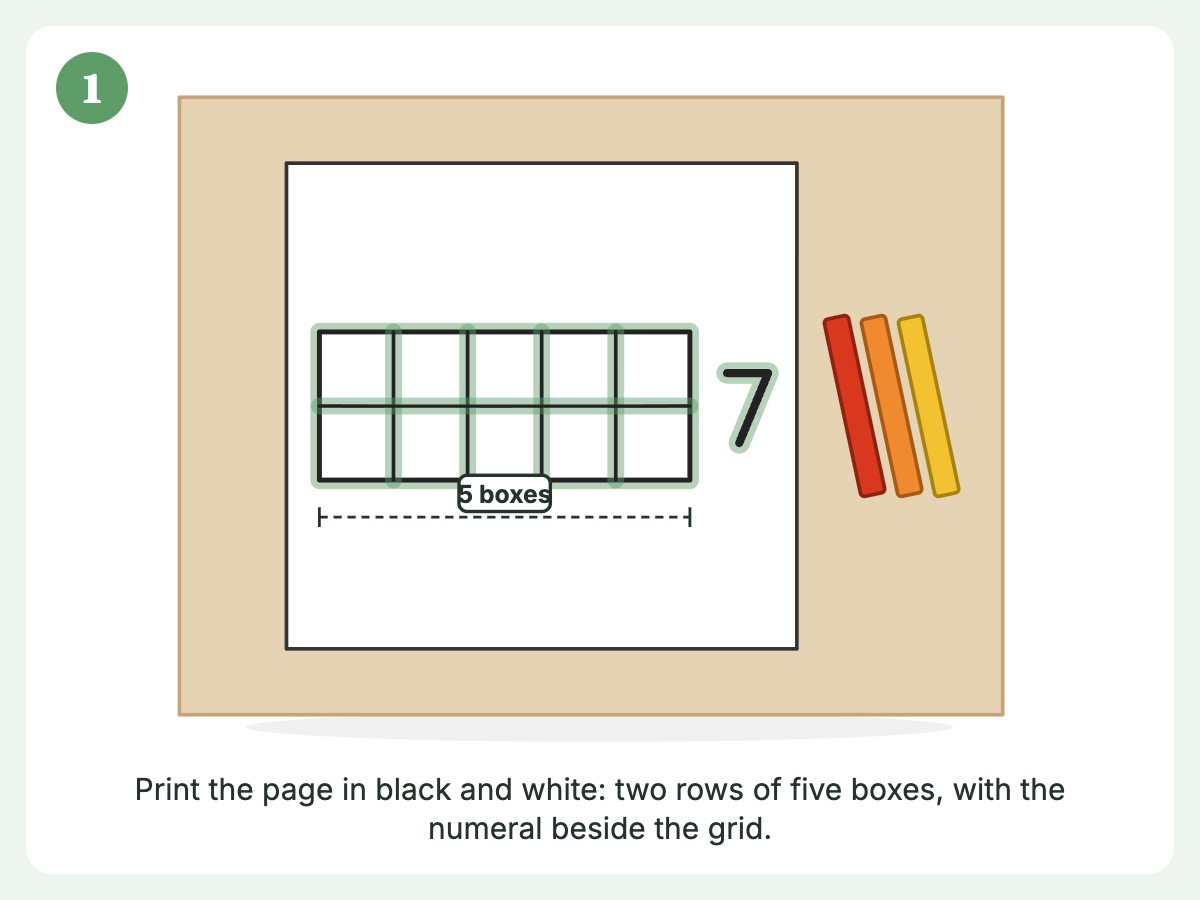
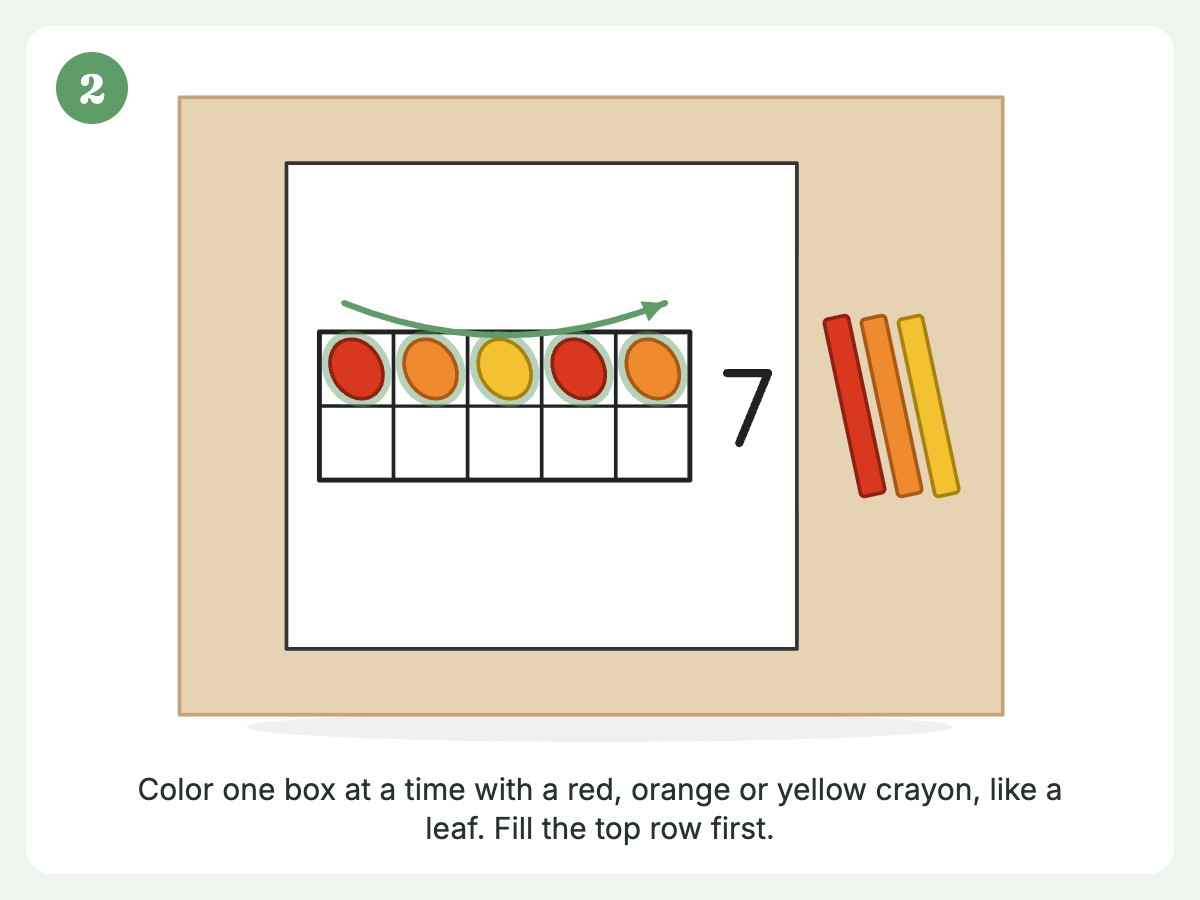
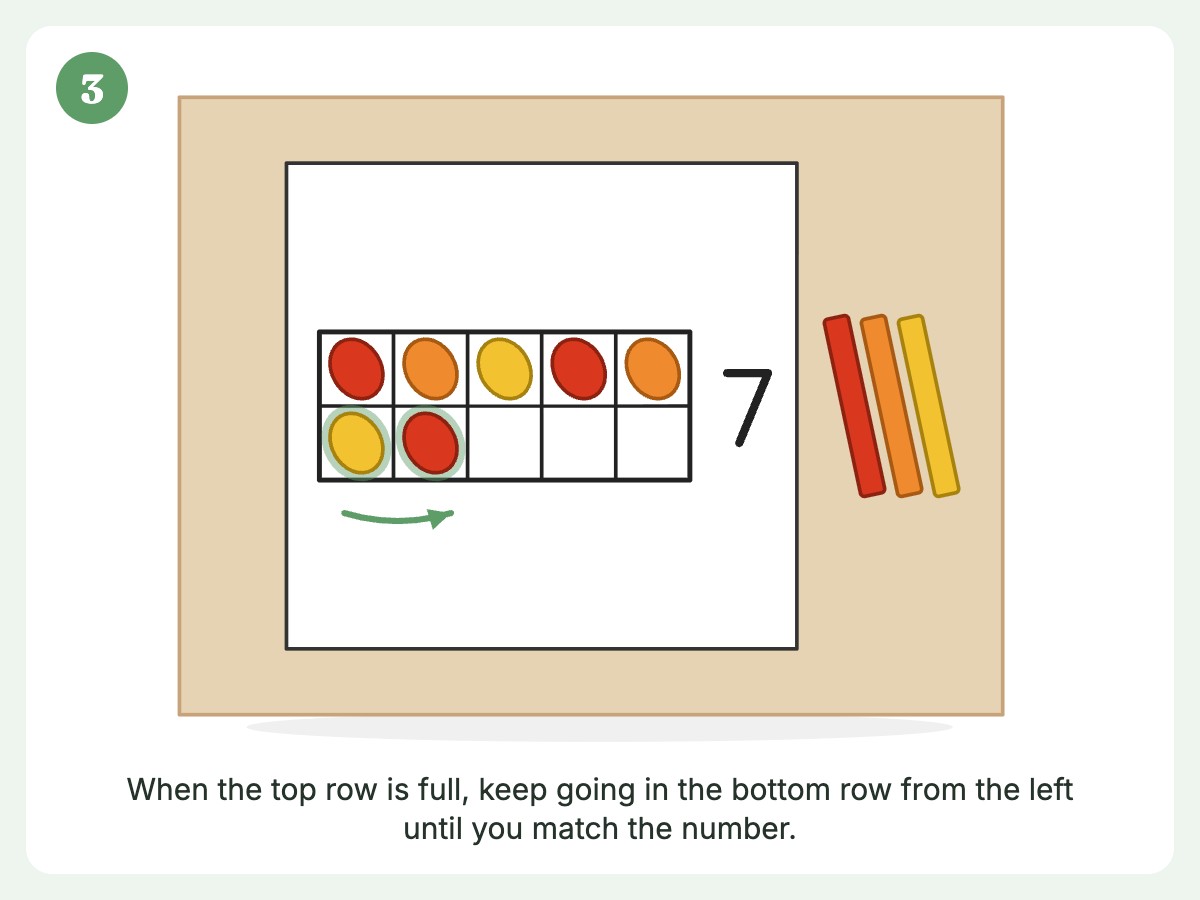
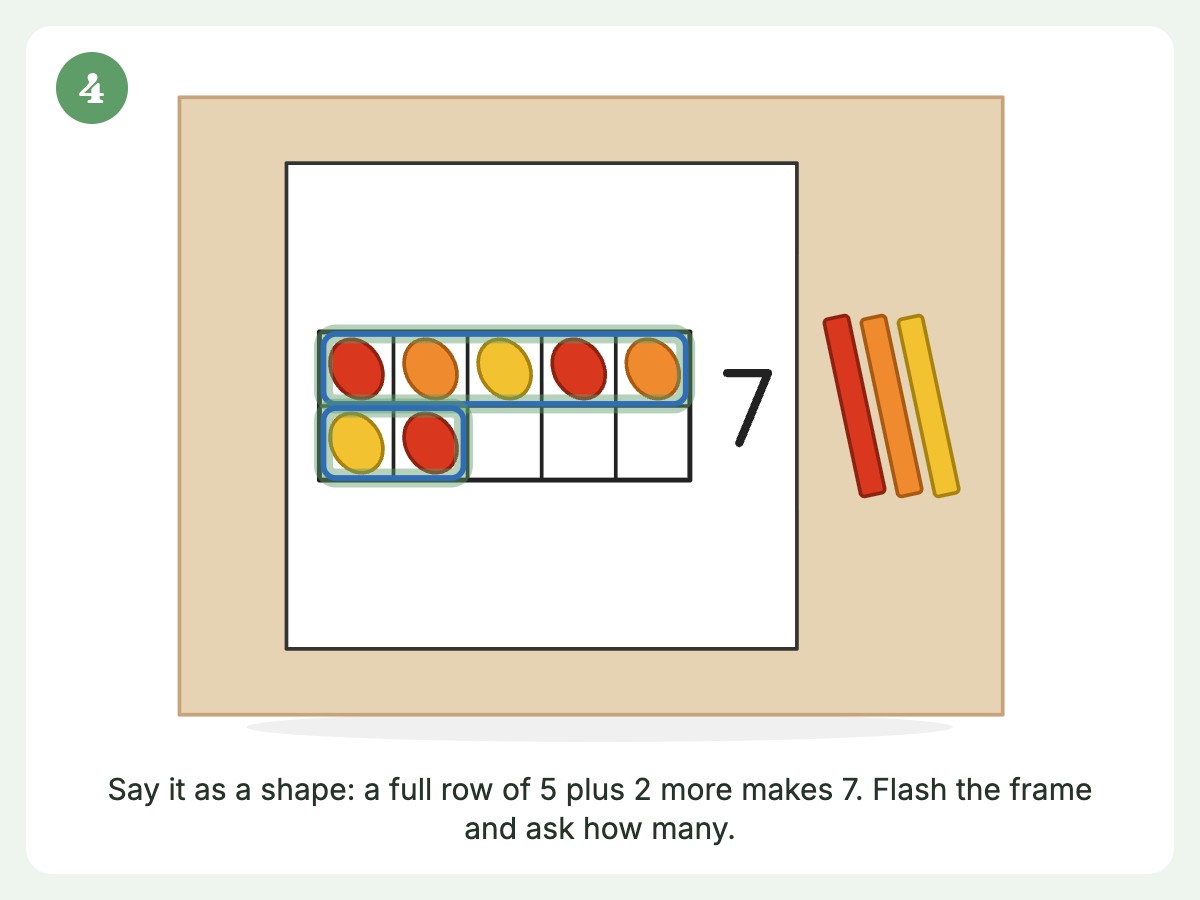
A ten-frame is a grid of two rows of five boxes. It looks boring, but it shows a number’s shape. Seven is “a full row plus two.” Nine is “one away from full.”
The page has ten ten-frames, one per number, each with its numeral beside it. The child colors in that many boxes with a red, orange, or yellow crayon, as if each box were a leaf.
| Numeral | Boxes to color | What the frame looks like |
|---|---|---|
| 3 | 3 | Three in the top row, two empty |
| 5 | 5 | Top row completely full |
| 7 | 7 | Top row full, two in the bottom row |
| 8 | 8 | Top row full, three in the bottom row |
| 10 | 10 | Everything filled |
Always fill the top row from left to right first, then the bottom row. Consistency is what builds the mental picture.
After a few weeks, flash a ten-frame for a second and ask “how many?” Your child may answer without counting. That’s called subitizing, and it supports mental math later.
Page 6: Fall Counting Mix-Up (1-10)
This is the fun challenge page. Each row mixes acorns and leaves. The child counts each kind, then the total.
| Row | Acorns | Leaves | Total |
|---|---|---|---|
| 1 | 🌰🌰 | 🍂 | 3 |
| 2 | 🌰🌰🌰 | 🍂🍂 | 5 |
| 3 | 🌰 | 🍂🍂🍂🍂 | 5 |
| 4 | 🌰🌰🌰🌰 | 🍂🍂🍂 | 7 |
| 5 | 🌰🌰🌰🌰🌰 | 🍂🍂🍂🍂🍂 | 10 |
For 3-year-olds, stop at “count the acorns, count the leaves” and skip the total. For 4- and 5-year-olds, ask for the total and watch them discover addition without anyone saying the word. “Two acorns and one leaf is… three things!” That’s the moment.
What You’ll Need (Spoiler: Not Much)
Before you sit down with your kid, set out a tiny kit. I keep ours in a shoebox so I’m not hunting for crayons at the exact moment the attention window opens.
Safety firstAcorns, buttons, pom-poms, pasta and dried corn are choking hazards for children under 4. Use them only with ages 4+, or with 3-year-olds under constant adult supervision and no mouthing. For younger kids, use large counters (bigger than a toilet-paper tube is safest) such as big felt cutouts, large leaves or paper-only counting. Raw acorns aren’t food: tell kids not to taste them, keep them away from pets (they’re toxic to dogs), and wash hands afterward.
- Crayons or chunky markers (fall colors if you want to feel festive)
- A pencil for the writing page
- A handful of real acorns for ages 4+ (or large felt or paper acorn cutouts for younger kids)
- A few real or paper fall leaves
- A small bowl or muffin tin for sorting
- A sticky dot sheet or a stamp pad (optional, for dot-counting)
- Paper towels, because it’s October and something is going to be damp
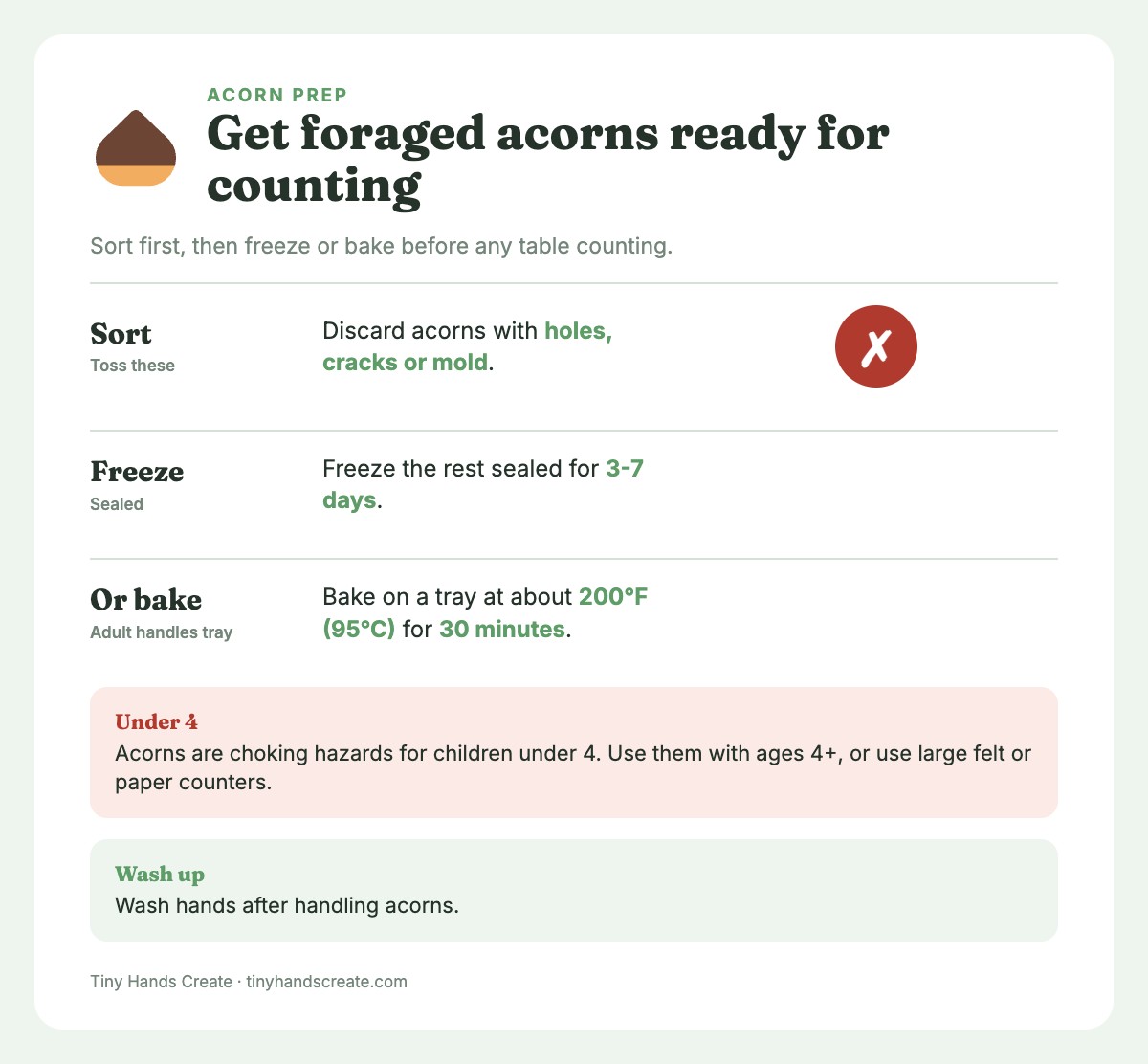
Safety firstForaged acorns can hide weevil larvae. Discard acorns with holes, cracks or mold. Freeze the rest sealed for 3-7 days, or bake them on a tray at about 200°F (95°C) for 30 minutes, with an adult handling the hot tray. Wash hands after handling.
Realistic mess expectations
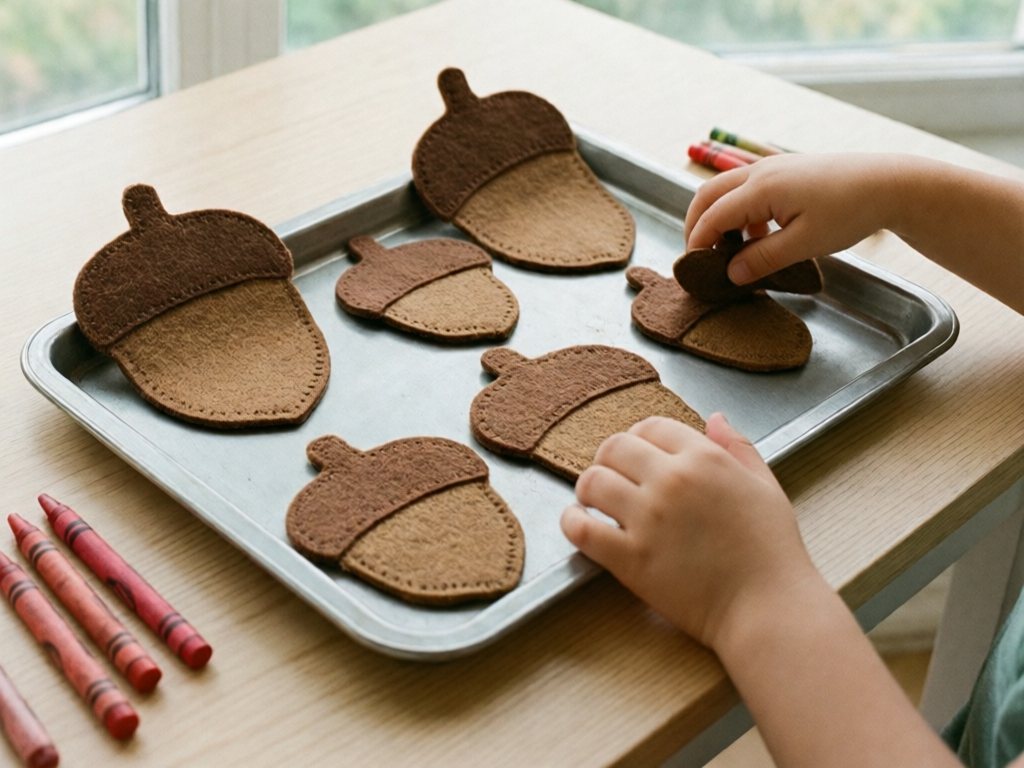
Here’s what a counting session really looks like in my house. There will be crayon on the table, and maybe on a sibling. Somebody will knock the acorn pile over.
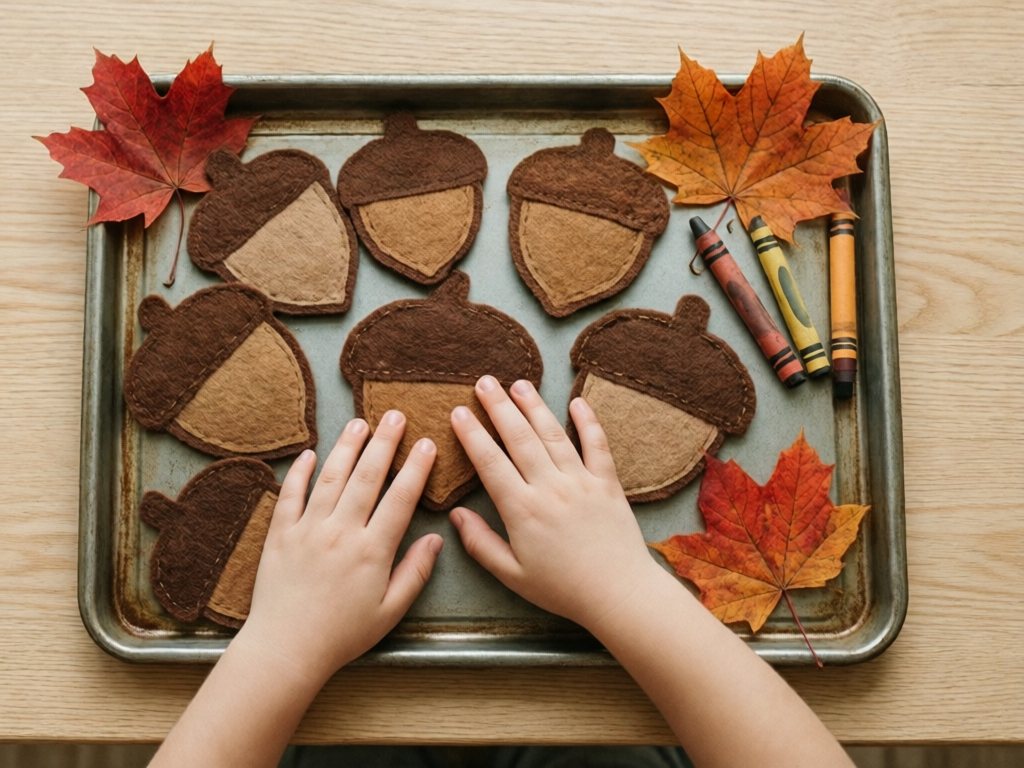
TipUse a rimmed baking sheet as the counting zone. Rolling acorns hit the edge and stop instead of disappearing under the fridge.
How Preschoolers Actually Learn to Count
Counting looks like one skill, but it’s really four. Knowing which one your child is working on helps you pick the right page.
| Skill | What it means | What it looks like |
|---|---|---|
| Rote counting | Reciting the number words in order | “One, two, three, four…” while playing |
| One-to-one correspondence | One number word per object, no skips or doubles | Touching each acorn once as they count |
| Cardinality | The last number counted tells you how many | “Five!” when you ask “how many acorns?” |
| Numeral recognition | Connecting the written symbol to the amount | Circling the 5 for five acorns |
Many 3-year-olds can recite some number words, often to 5 or so, and it varies a lot from kid to kid. The CDC milestones are a good check if you’re unsure.
Plenty are also wobbly on one-to-one correspondence, and that’s fine. The worksheets work on skills two, three and four, which is why they all use objects.
The cardinality trick
After your child counts a group, ask “So how many acorns are there?” If they start again from one, cardinality hasn’t clicked yet. That’s normal, and it’s a very common sticking point at age 3.
What helps: count together, and when you land on the last one, say the number louder and sweep your hand over the whole group. “One, two, three, four, FIVE acorns!” Do that for a week and it tends to click.
Why hands-on beats paper alone
A worksheet is a record of counting, not the counting itself. The best sequence I’ve found goes like this:
- Count real things first. Leaves and large felt cutouts for any age; acorns and buttons for ages 4+.
- Count pictures of things. That’s the worksheet.
- Match pictures to numerals. That’s circling and line-drawing.
- Write the numerals. That’s the last step, and the hardest for little hands.
If your child is struggling at step 3, back up to step 1. Don’t push forward on the paper. A few minutes with a muffin tin and a pile of acorns will do more than a stack of worksheets.
A Week of Fall Counting (A Sample Plan)
You don’t have to do all of this. But a loose plan saves me from the “what do we do now” slump at 3 p.m. Here’s a gentle one-week rhythm.
| Day | Activity | Time | Notes |
|---|---|---|---|
| Monday | Go on a look-and-count acorn and leaf hunt | 20 min | Count leaves and acorns where they lie, outdoors, and bring some leaves in. Toss acorns with holes, cracks or mold. Bake the rest that evening (adult handles the hot tray) or start freezing them for 3-7 days. Wash hands after the hunt. |
| Tuesday | Page 1: Acorn Count and Circle (1-5) | 10 min | Warm up by counting large felt or paper acorn cutouts on a tray. Use real acorns only if you baked them Monday evening, and only for ages 4+. Frozen acorns stay in the freezer until next week. |
| Wednesday | Page 2: Acorn Count and Circle (6-10) | 10 min | Use dot markers if recounting happens |
| Thursday | Page 3: Leaf Pile Match | 10 min | Pair with a leaf-sorting game |
| Friday | Page 5: Ten-Frame Leaf Fill | 10 min | Flash a frame, ask “how many?” |
| Weekend | Page 6 or a fall craft | Flexible | Let the kid pick |
Good to knowFroze your acorns on Monday? They need the full 3-7 days, so save real-acorn counting for the following week and redo Page 1 or 2 with them then. Until they’re ready, felt or paper cutouts do the same job.
For 3-year-olds, keep Pages 1, 4 and 6 to numbers 1-5 and treat Pages 2, 3 and 5 as look-only extras. Page 4, the writing page, floats. Use it on a day when your child is calm and has good energy for pencils, not when they’re hungry or fried.
For the child who wants to keep going
Some kids will blast through three pages and ask for more. Let them.
If your kid does better with structure, give them a “worksheet job” with a clear endpoint: “You do the acorn page, and then you’re all done.” A visible finish line calms a lot of preschoolers.
For the child who wants to quit after one box
Also fine. One box of real counting beats five boxes of grumpy counting. Put the page in a folder and try again tomorrow.
Turn the Worksheets Into a Fall Unit Study
Because the pictures are acorns and leaves, each page can lead somewhere. You’re already holding the page, so ask a few questions.
Acorn questions to ask
- Where do acorns come from? (Oak trees.)
- What’s the little hat called? (The cap, or cupule if you’re feeling fancy.)
- Who eats acorns? (Squirrels, jays, deer, and a lot of other woodland critters.)
- Why do squirrels bury them? (To save for winter, and they forget a few, which is how new oak trees get planted.)
That last fact has been my daughter’s favorite for two years running. “Squirrels plant trees by accident” will never stop being delightful.
Leaf questions to ask
- Why do leaves change color? (The green fades, which reveals the yellows and oranges that were hiding underneath. Reds are newly made in fall.)
- Do all leaves turn the same color? (No. Many maples go red, aspens go gold, and many oaks go brown or red.)
- How can you tell leaves apart? (Shape, edges, and veins.)
If your kid gets curious about leaves, the leaf sun print science activity is a great follow-up. It works well as a counting extension too: “Make me a sun print with three leaves.”
Cross-subject ideas
| Subject | Idea | Connects to |
|---|---|---|
| Science | Sort leaves by color and shape | Page 3 and Page 6 |
| Art | Leaf rubbings with crayons | Page 5 (coloring skills) |
| Language | Make up a story about a squirrel counting acorns | Page 1 and 2 |
| Movement | Hop once for each acorn in a group | Any counting page |
| Sensory | Count acorns buried in a bin | All of them |
| Pattern work | Make a leaf-acorn-leaf-acorn pattern | See our pattern worksheets |
Once your child counts to ten with confidence, patterns are a natural next step. Lay out “acorn, acorn, leaf, acorn, acorn, leaf” and ask what comes next.
Acorn Counting Activities and Games
Worksheets are quiet. Preschoolers are not. Here are the games I use to burn off wiggles and reinforce the same skills.
Good to knowSee the safety note in the supply list above before using acorns or other small counters.
Acorn muffin tin count
Number the cups of a muffin tin from 1 to 10 with sticky notes or masking tape. Your child puts the matching number of acorns, pom-poms or buttons in each cup. Ages 4+ only. For 3-year-olds use large felt cutouts or big leaves, with an adult close by.
It’s a tactile version of Page 4, and it’s very satisfying to hear the plink of acorns hitting metal.
Leaf toss
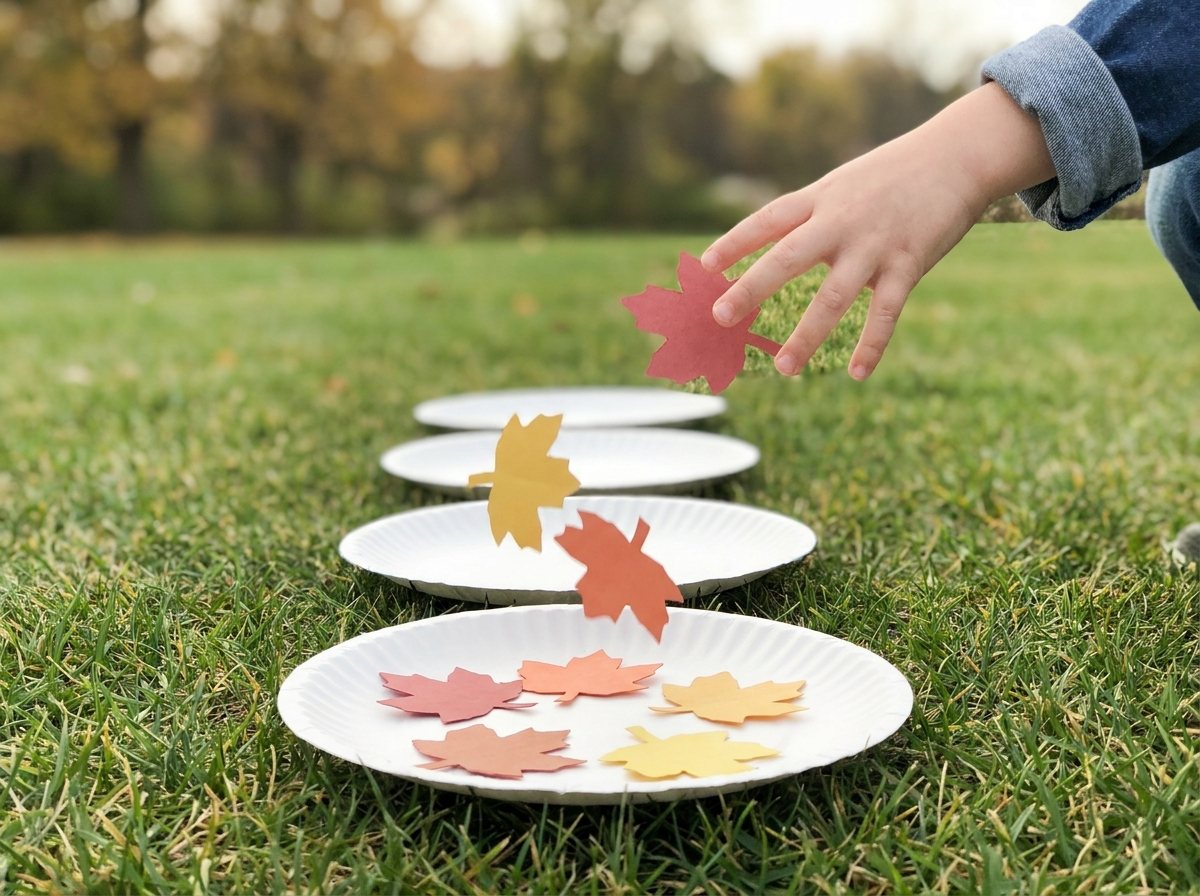
Lay out a few paper plates with numerals written on them. Your child tosses a certain number of leaves (or leaf-shaped paper) onto the plate. “Toss five leaves onto the 5 plate.” They count as they throw. This one is outdoors-friendly and gets very silly.
Squirrel says
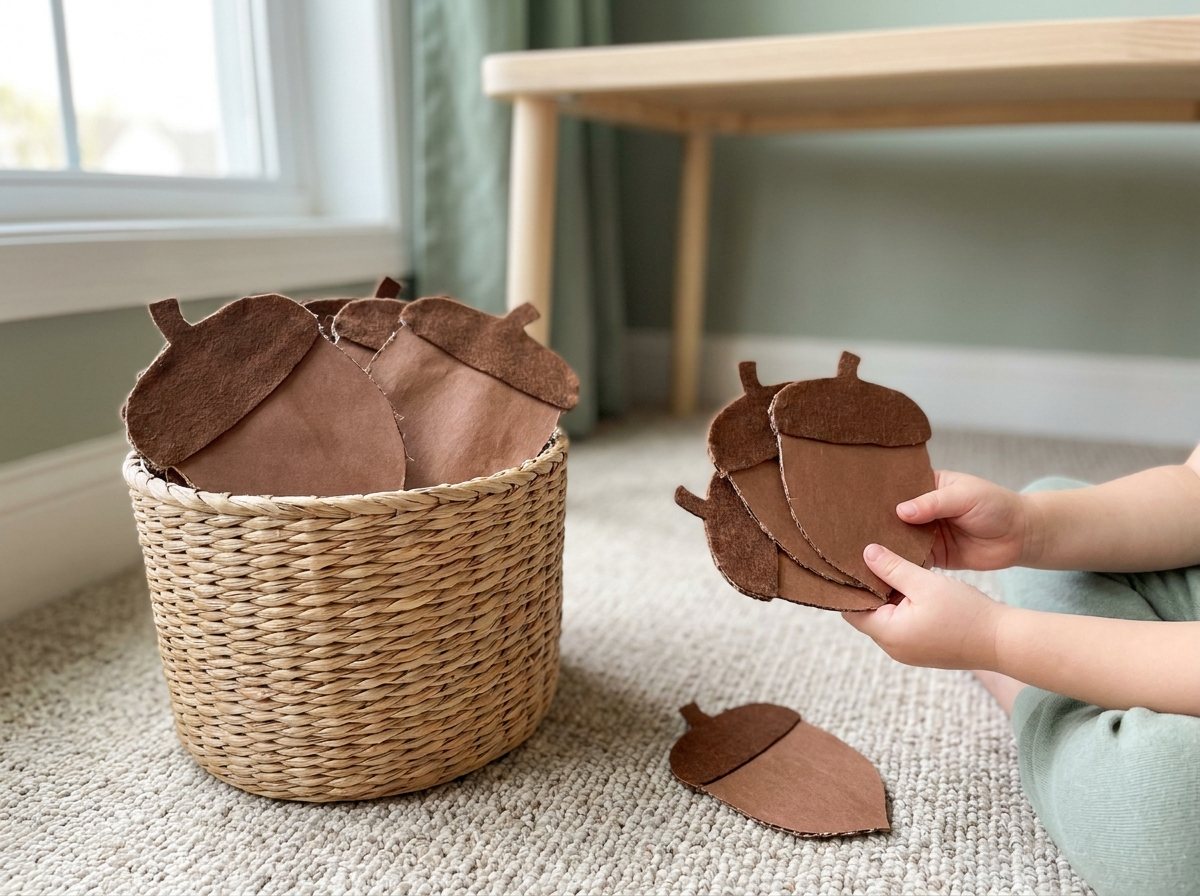
A fall twist on a classic: “Squirrel says gather four acorns!” Your child runs to a basket, grabs four, and brings them back. Swap roles so they get to be the bossy squirrel. Preschoolers love giving orders.
Acorn hide and count
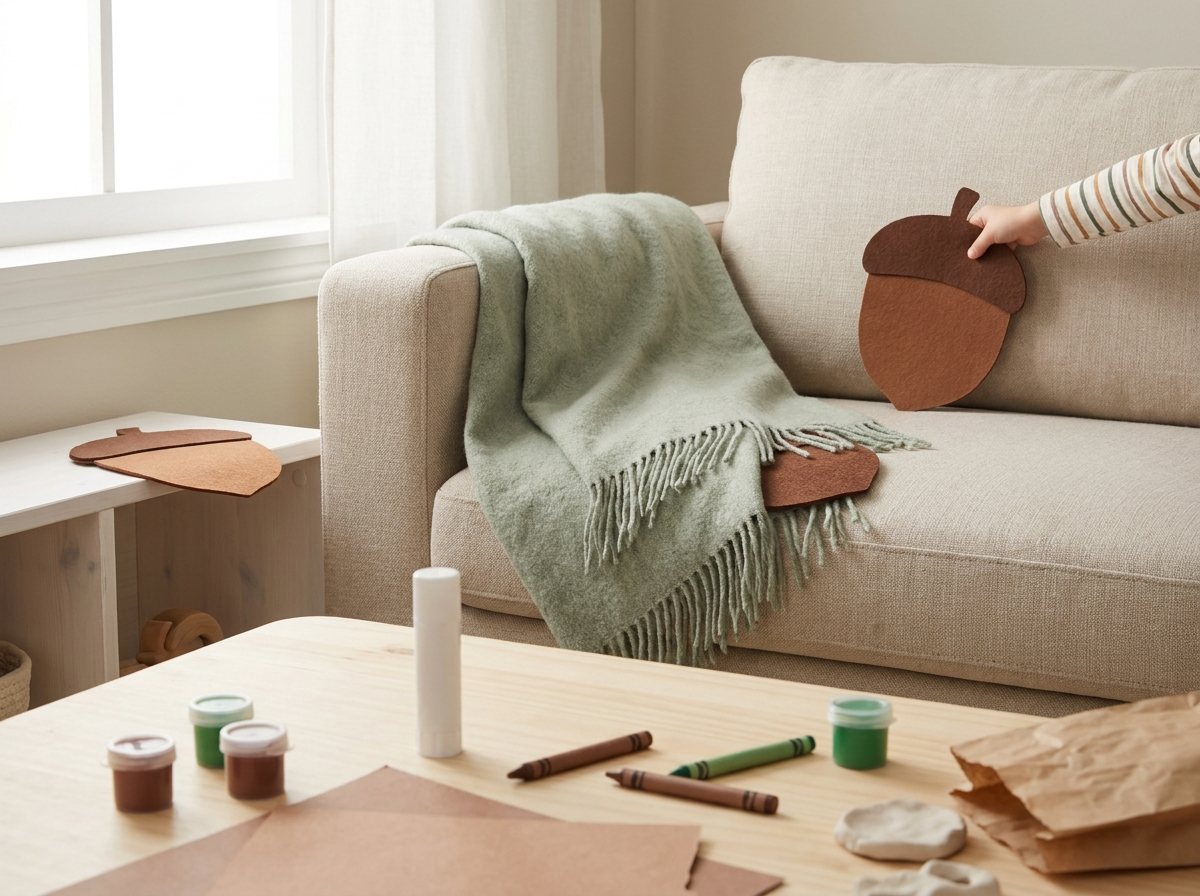
Hide ten acorns around a room. Your child finds them and keeps a running tally. At the end, ask “Did you find all ten?” If they found seven, ask “How many are still hiding?” That’s subtraction in disguise, and nobody has to hold a pencil.
Sensory bin counting
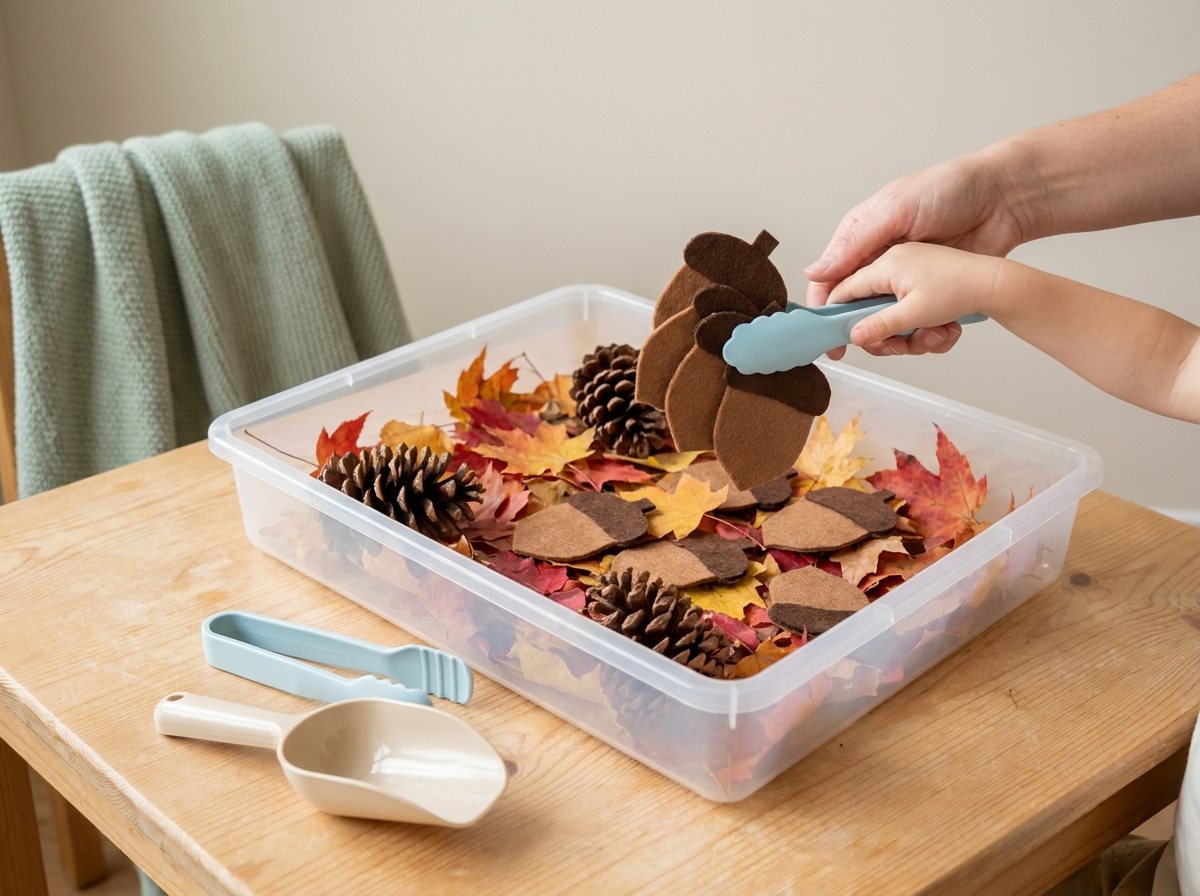
Fill a bin with leaves, big pinecones and acorns, then add tongs and scoops. Ask your child to scoop out exactly six acorns. This bin is for ages 4+, or 3-year-olds with constant supervision (see the safety note above).
For a ready-made setup, see our fall sensory bin with acorns and pinecones, or build your own from the DIY sensory bin fill ideas list. Scooping and counting at once is a fine-motor and math workout in one.
Counting Worksheets by Age (3, 4, 5)
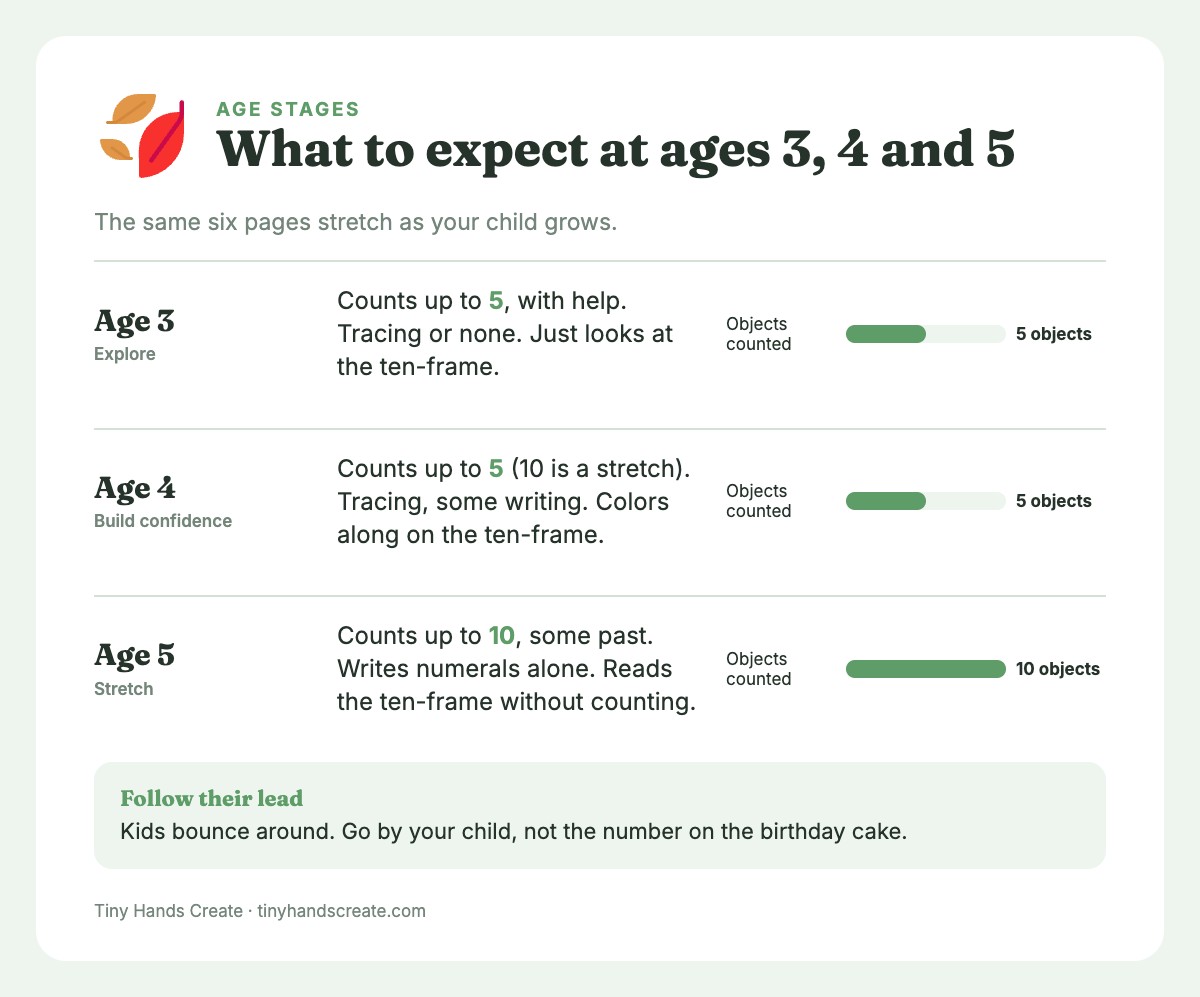
A preschool classroom has kids spread across a wide developmental range, and so does your living room if you have more than one child. Here’s how I adjust the same set for each age.
Age 3: Explore, don’t drill
At 3, the goal is comfort with quantity, not accuracy on paper.
- Focus on numbers 1-5: Pages 1, 4 and 6 only, with Pages 2, 3 and 5 as look-only extras.
- Use large safe objects first (felt cutouts, big leaves), paper second.
- Let them color or sticker the pages rather than circle.
- Count together, out loud, with lots of finger-pointing.
- Stop at the first sign of frustration.
A good 3-year-old session might be three minutes. That’s a win.
Age 4: Build confidence
At 4, many kids can count by rote toward ten, and most count objects accurately to about five, with ten as a stretch.
- Start with numbers 1-5, then stretch to 1-10 across a week or two.
- Introduce the ten-frame page.
- Encourage them to touch each object as they count.
- Start gentle numeral tracing.
- Ask “how many all together?” on the mix-up page.
Age 5: Stretch and extend
By 5, many kids can count past ten and are ready for more.
- Have them write numerals independently on Page 4.
- Ask for number sentences on Page 6 (“2 acorns plus 1 leaf equals 3”).
- Play “what’s one more?” and “what’s one less?” with the ten-frames.
- Make their own worksheet by drawing groups for a grown-up to count.
That last one is my favorite. When a kid designs the page, they find out how counting works from the other side, and they love catching you in a deliberate mistake.
| Skill | Age 3 target | Age 4 target | Age 5 target |
|---|---|---|---|
| Counting objects | Up to 5, with help | Up to 5 (10 is a stretch) | Up to 10, some past |
| Numeral recognition | 1-3 | 1-5, some to 10 | 1-10 |
| Writing numerals | Tracing, or none | Tracing, some writing | Writing independently |
| Ten-frame | Just looking | Coloring along | Reading without counting |
| Adding in context | Not yet | Beginning | “2 and 1 more is 3” |
These are rough guides, not report cards. Kids bounce around. A 4-year-old might nail the ten-frame and fumble the writing, and that’s completely normal.
Troubleshooting Common Counting Hiccups
Every kid hits a snag somewhere. Here are the ones I see most, with the fixes that actually work.
| Problem | Why it happens | Try this |
|---|---|---|
| Skips objects | Eyes move faster than the voice | Slide each acorn to one side as it’s counted |
| Counts the same one twice | No system for tracking | Put an X or dot on each acorn after counting |
| Says the wrong number word | Rote sequence isn’t solid yet | Practice the count song in the car, off the page |
| Recounts from one to answer “how many?” | Cardinality isn’t clicked | Sweep a hand over the group and say the last number louder |
| Reverses numerals (3, 5, 7) | Normal for ages 3-5 | Model it once; don’t erase or shame |
| Loses interest after a minute | Attention is developing | Shorter sessions, add a movement game |
| Guesses instead of counting | Wants to be fast or “right” | Make it a game: “Prove it. Show me how you know.” |
| Pushes the page away | It feels like a lesson | Give it a story: “The squirrel needs exactly five acorns for his winter pantry. Can you check?” |
| Rushes to be done first | Thinks fast means good | Praise care, not speed: “I love how carefully you touched every acorn.” |
When to worry (and when not to)
For most kids, none of this is a concern. Counting develops unevenly, and a 4-year-old who can’t yet count to ten is well within the normal range.
If your child is really struggling, or you’re seeing other developmental concerns, mention it to your pediatrician or preschool teacher. But a skipped acorn on a worksheet is not a red flag. It’s a Tuesday.
Pair the Counting With a Fall Craft
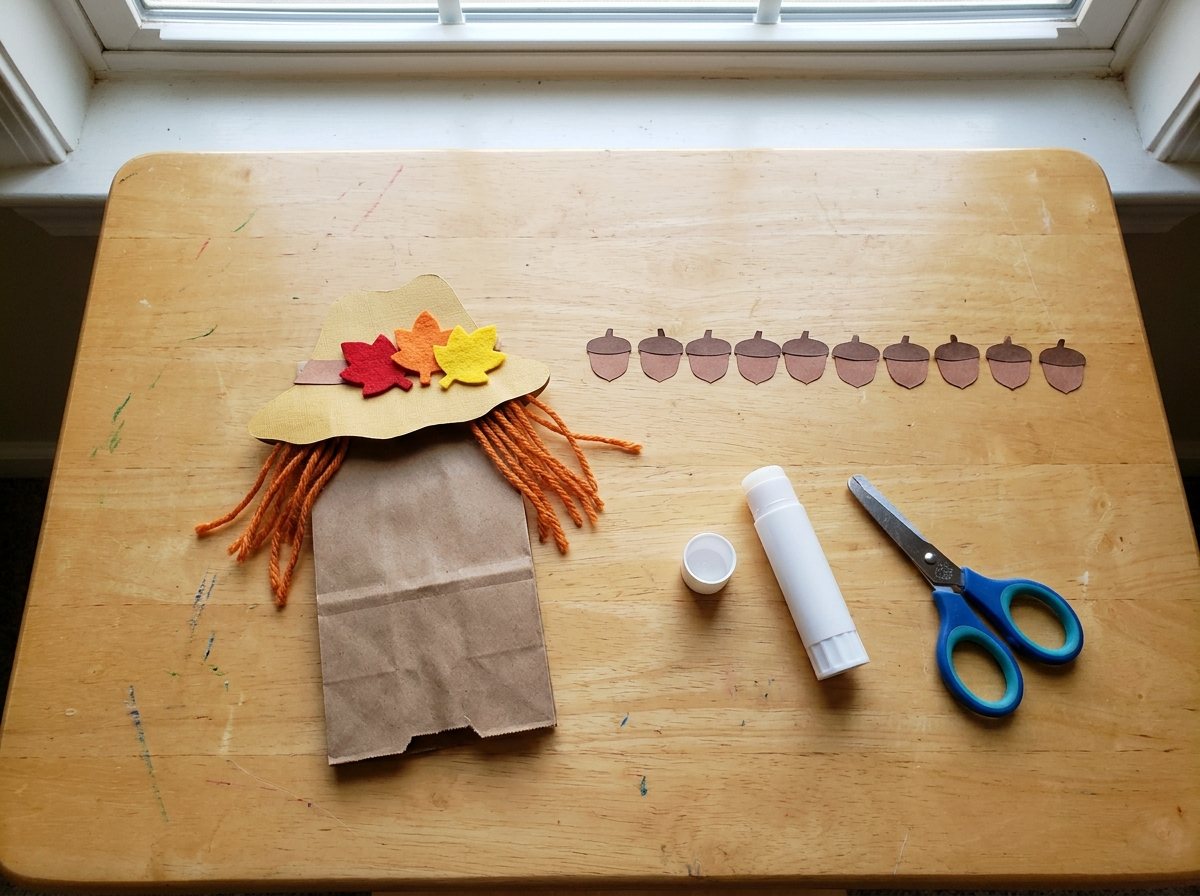
My favorite days are the ones where counting leads straight into making something. After the acorn pages, we do an acorn craft, and the counting flows right into the glue.
Our acorn crafts for toddlers and fall leaf crafts for kids round-ups are good places to start. Ask for “three leaves on the scarecrow’s hat” or “ten acorn caps glued onto a paper oak tree,” and the craft turns into a math lesson. The paper bag scarecrow is great for this.
Safety firstAcorn caps are small enough to choke on. Keep cap crafts for ages 4+, or for 3-year-olds with an adult right beside them and no mouthing. Count the caps back into the bowl when you’re done. For younger kids, glue on big paper leaves instead. And skip anything strung on a cord and worn around the neck, which is a strangulation risk.
Fall Counting Beyond the Table
Counting is everywhere in October, so you can keep practicing without printing another thing. None of these need prep. Just ask, then wait for the answer.
- How many red leaves can you find on the walk to the park?
- How many pumpkins are on that porch?
- Count the steps to the corner.
- Count the books at bedtime before choosing one.
- How many acorns did the squirrel gather today?
In the kitchen
Safety firstSnack counting happens sitting down, with a grown-up right there, at every age. Whole seeds, nuts, raisins and hard raw apple are choking risks for under-4s, so keep them off the little ones’ plates.
Ages 4+ (seated, adult nearby):
- Count very thin apple slices onto a plate. Hard apple can still catch in a small throat, so stay close.
- Count large crackers or cereal rings into a bowl.
- Ask for “seven pumpkin seeds” and watch the care that goes into getting it exactly right.
Under 4 (seated, adult supervising):
- Count soft pear pieces cut lengthwise.
- Count large cereal rings or large crackers.
- Line up cinnamon sticks to count. They’re look-and-sniff only.
Frequently Asked Questions
What age are fall counting worksheets best for?
These work best for ages 3 to 5. Three-year-olds do well with the 1-5 pages and lots of real objects. Four-year-olds often start with 1-5 and stretch to the full 1-10 range and the ten-frame page over a week or two. Five-year-olds are ready to write numerals on their own and try the mixed acorn-and-leaf page with a total. Always follow your child’s lead rather than the number on the birthday cake.
Is there a PDF to download?
Yes. Use the free download card on this page; it has all six pages plus a one-page parent guide. Print it in black and white, since your child supplies the color.
How long should a counting session last?
For most preschoolers, 5 to 10 minutes is plenty. Three-year-olds may be done in 3 minutes, and that’s perfectly normal. Short, happy sessions several times a week beat one long, grumpy one. Stop while your child still wants a little more.
My child can recite to ten but can’t count objects. Why?
Reciting numbers and counting objects are different skills. Reciting is memorizing a sequence, like a song. Counting objects needs one number word per item with no skips or repeats. Then the child has to understand that the last number means “how many.” Practice with real objects like acorns or large felt cutouts (small items are for ages 4+). Slide each one aside as you count, then sweep your hand over the group at the end.
What if I can’t find real acorns?
No problem. Large felt or paper acorn cutouts work just as well, and so do big real leaves. For toddlers who still mouth things, skip real acorns and small counters entirely and stick with those large, safe options. If you do forage, discard acorns with holes or mold, and freeze or bake the rest before using them for indoor counting.
What should we do after finishing all six pages?
Move into patterns, numeral writing, or extra hands-on play. Patterns are a natural next step, so try the pattern worksheets for preschool. If numeral formation needs work, the number tracing worksheets are a good fit. You can also have your child design a counting page for you to solve.
Do I need to do the pages in order?
Not strictly. I’d suggest starting with the circle-the-number pages (1 and 2) since they’re the most approachable, and saving the mix-up page (6) for last. Past that, mix and match based on what your child enjoys. If a page feels too hard, set it aside and come back in a few weeks. Skills tend to jump forward on their own.
Happy Counting, Mama
Here’s what I keep coming back to: that day my daughter dropped ten-or-twelve-or-a-hundred acorns on the kitchen floor, she wasn’t failing at math. She was telling me she was ready for it. She just needed something real to count and a grown-up who’d sit on the floor with her.
So grab a handful of acorns, a few crayons and a rimmed baking sheet. Count slowly, and laugh when the acorns roll away.
If your kid decides the acorns on page one need little faces, let them have faces. Math can wait thirty seconds. The fall season won’t.