Gifts for Kids Who Love Crafts: Art Supplies by Age (2 to 8)
This post contains affiliate links. As an Amazon Associate I earn from qualifying purchases.
The best gifts for kids who love crafts are consumables matched to the child’s age: paper, crayons, glue sticks, tape and paint. The table below sorts art supplies for ages 2 to 8 into what kids can use alone, what needs a grown-up, and what to skip.
Last December my niece unwrapped a gorgeous 42-piece art set and played with the cardboard tray it came in. The pieces stayed in their slots until February.
Meanwhile, the fat crayons, masking tape and cheap paper were gone by New Year’s. The tape went on the wall, the dog’s toy basket, and one very confused houseplant.
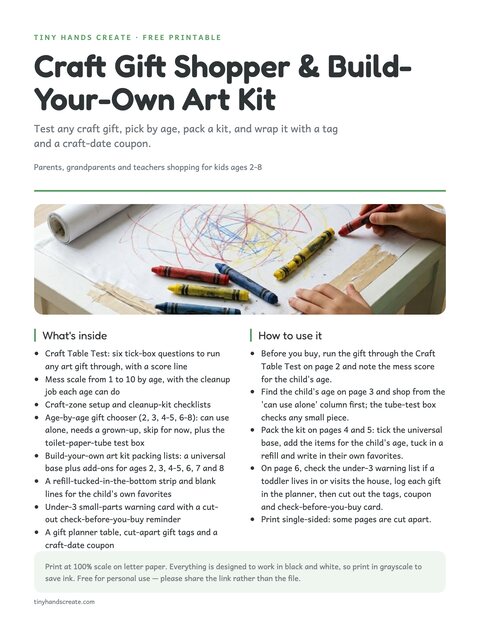
Free printable · 6 pages
Craft Gift Shopper & Build-Your-Own Art Kit
A Craft Table Test checklist, an age-by-age gift chooser for ages 2 to 8 with a tube test, build-your-own art kit packing lists, an under-3 small-parts warning card, a mess and craft-zone sheet, cut-apart gift tags, a craft-date coupon and a gift planner.
Free. Your download link appears right here. You'll also join the Daily Printable Drop. Unsubscribe anytime. Privacy
Below: my top pick for each age, then the full table, age-by-age notes, the small-parts kits to skip, and a build-your-own art kit list. No brands or prices, just types of gifts with honest mess ratings.
In this article (14 sections)
- Craft Gifts by Age: Art Supplies Table for Ages 2 to 8
- How to Choose a Craft Gift: My Six-Question Craft Table Test
- Best Craft Gifts for 2-Year-Olds: Chunky, Washable, Nothing Tiny
- Best Art Supplies for 3-Year-Olds: The “I Can Do It Myself” Stage
- Best Craft Gifts for 4- and 5-Year-Olds: The Sweet Spot
- Best Craft Gifts for 6- to 8-Year-Olds: When Crafting Becomes a Real Hobby
- Craft Gifts That Get Used Up vs. Kits That Get Abandoned
- Craft Kits to Skip for Toddlers Under 3 (and Safer Swaps)
- Build-Your-Own Art Kit for Kids: What to Pack by Age
- Craft Gift Ideas That Aren’t Supplies
- Gifts to color and mark, from our sister brands
- How Messy Are Art Supplies? Honest Mess Ratings
- Frequently Asked Questions
- Wrapping Up: Give the Gift of a Craft Table
Craft Gifts by Age: Art Supplies Table for Ages 2 to 8
Safety firstOne rule runs through this whole guide, in two steps.
Under 3: nothing that fits entirely inside a toilet paper tube, because it’s a choking hazard. That rules out beads, pom-poms, small stickers and small marker caps. The tube test is a minimum, not an all-clear.
Under 4: still skip small parts: beads, small pom-poms, small stickers, wiggle eyes. Pieces well above tube size, like large pom-poms, come out only with an adult watching. The same goes for any home with a sibling under 4. Small parts stay shut away until the little one is asleep or out of the room.
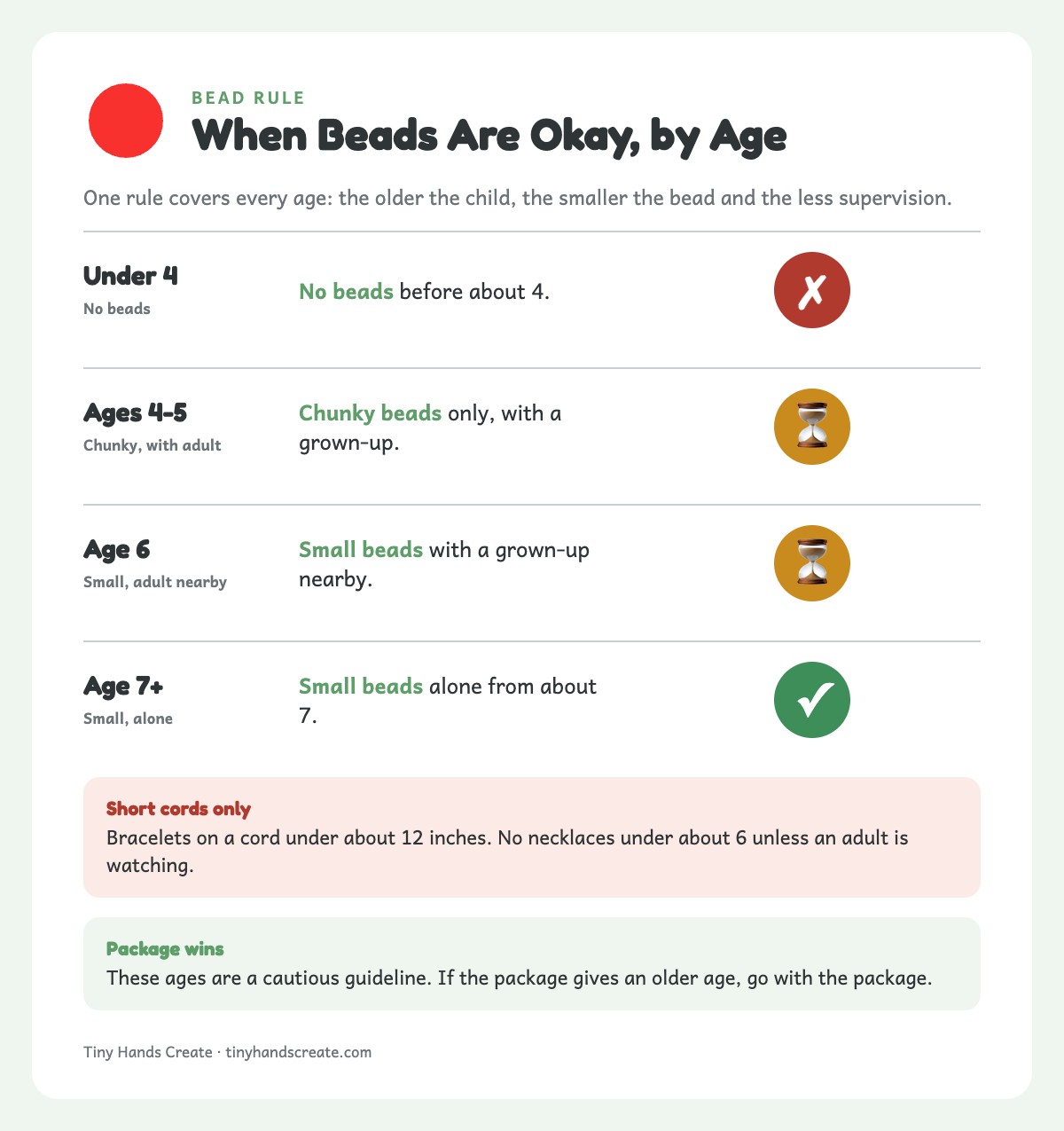
Beads: the ages here are my own cautious guideline, not an official cutoff. Chunky beads start at about 4 with a grown-up. Small beads start at about 6 with a grown-up nearby, and alone from about 7. If the package gives an older age, go with the package.
Keep loose magnets and button batteries away from every child who still mouths objects, and out of any home with a younger sibling.
If a child swallows a button battery or a magnet, or you think they might have, go to the ER right away. Don’t wait for symptoms. Call on the way: the National Battery Ingestion Hotline (US 1-800-498-8666) for a battery, or poison control (US 1-800-222-1222) for a magnet.
Don’t make the child vomit, and don’t give food or drink unless the hotline or a doctor tells you to. That includes honey for a swallowed battery: only on their advice.
Here’s the cheat sheet. Screenshot it, tuck it into your notes app, send it to the grandparents who keep asking what to buy.
| Age | Can use alone | With a grown-up nearby | Skip for now | Mess |
|---|---|---|---|---|
| 2 | Chunky crayons, washable chunky markers, big sheets of paper, non-toxic play dough. | Large stampers with a washable ink pad, big palm-sized stickers, glue sticks, paint of any kind, tape you tear for them. | Scissors, skinny crayons, glitter, and any kit with a small-parts warning: beads, buttons, googly eyes, sequins, gems, small pom-poms, magnets, battery parts. | Medium. Washable everything, wipeable floor. |
| 3 | Everything a 2-year-old uses alone, plus big stickers, large stampers, washable markers, chunky chalk, tape in a dispenser, play dough tools. | Glue sticks, big pom-poms (well above tube size, watched the whole time), safety scissors with paper strips, liquid glue, paint, projects with three or more steps. | Beads and bead kits, small stickers, wiggle-eye packs, glitter glue tubes, sewing needles of any kind, kits that bundle many tiny parts. | High. Cleanup is a team sport. |
| 4-5 | Watercolor pans and brushes, washable markers, colored pencils, safety scissors, glue sticks, stickers (small ones are fine from 4), play dough with tools, big-hole lacing cards with short laces, stampers, masking tape, collage scraps. | Chunky beads (well above tube size, bracelets only), liquid glue in bulk, tempera paint setup and cleanup, air-dry clay, hot glue (adult hands-on; even low-temp guns burn). | Complicated model kits, small-bead jewelry, sets with sharp tools, anything that expects precise tiny cutting. | Medium. Ambitions outgrow cleanup skills. |
| 6-8 | Sketchbooks, colored pencils, markers, watercolors and paint sets, craft scissors, tape, glue (stick and liquid), larger beads and string, friendship bracelet thread, air-dry clay with tools, sewing cards, simple weaving looms. Small-bead kits from about 7. | Small beads at 6. Hot glue (adult hands-on), sharp needles, polymer clay and any other clay that needs baking, cutting thick materials like cardboard. | Kits that look grown-up but need adult-level fine motor control. Mega sets with 200+ pieces. Craft knives and utility blades, which are adult-only. | Low to medium. They clean up, with reminders. |
Most of the “can use alone” column is cheap, small, and fits in a drawer, which is exactly the point. The expensive-looking gift often belongs in the “skip” column.
Beads follow one rule at every age: none before about 4, chunky ones with a grown-up at 4 and 5, small ones with a grown-up nearby at 6, and small ones alone from about 7. That’s my cautious guideline. If the age on the package is older, the package wins.
Beaded jewelry means bracelets on a short cord, under about 12 inches. No necklaces for children under about 6 unless an adult is watching. At every age, bead strings come off for unsupervised play and for sleep.
How to Choose a Craft Gift: My Six-Question Craft Table Test
This is the quick filter I run every craft gift through. It’s the same one I use when relatives ask me for ideas, and it saves a lot of unused boxes.
- Can they start alone? If a parent has to read instructions and sort pieces first, it won’t get used on a Tuesday while you’re making dinner.
- Does it get used up? Paper, tape, crayons, glue sticks and paint run out, and that’s good. Running out means they were used.
- Is it open-ended? A kit that makes one thing produces a finished craft and a shrug. Blank paper, clay and collage scraps get revisited.
- Does it fit their hands? Many 2-year-olds still use a whole-hand grip, and fine control with tools develops through ages 4-6. One stage too advanced frustrates. One stage too young is “baby stuff.”
- What’s the cleanup? Rate it honestly. Washable markers on a wipeable table are fine. Glitter in a house with carpet is a “gift of glitter forever.”
- Is it safe for the youngest in the room? This matters even when the gift is for a 6-year-old. Beads and sequins within reach of a sibling under 4 are a choking hazard.
Best Craft Gifts for 2-Year-Olds: Chunky, Washable, Nothing Tiny
Two-year-olds are not making art. They’re doing art: finding out that a hand movement leaves a mark and a harder press makes a darker line. So the gift that “makes a cute reindeer” is for you, and the gift that lets them scribble for twenty minutes is for them.
What a 2-year-old can use alone
- Chunky crayons. Fat, short, and sturdy. Skinny crayons snap and end up in mouths. Look for ones sized so a fist can grip them.
- Washable chunky markers. Look for “washable” on the label and fat barrels. Check that the cap is too big to fit inside a toilet paper tube, because marker caps are a choking hazard. A ventilated cap is a bonus, but it doesn’t make a cap safe to mouth. Keep the big-cap rule and keep an eye on where the caps go.
- Big paper. A roll of plain paper, taped to the table or floor, is one of the best gifts at this age. Two-year-olds love big arm movements.
- Non-toxic play dough. Squishing, rolling, poking. Add a rolling pin and a chunky cutter and you’ve bought yourself a half hour. To make your own for the gift basket, our DIY playdough recipes cover the ones parents actually trust.
What needs a grown-up right there
- Large stampers. Chunky foam or wooden stampers with a big handle, plus a washable ink pad that you hold steady.
- Big sticker sheets. Choose large, palm-sized stickers. Peeling is great fine-motor work, but watch that none go in the mouth.
- Paint. Two-year-olds can absolutely paint, with you there for setup and the “now it’s in my hair” moment. Pair a paint gift with a washable smock and a wipeable tray. The activities in process art for toddlers are built for exactly this stage.
- Glue sticks. Choose non-toxic, washable ones and sit with them. A 2-year-old will taste it, twist it all the way up, and lose the cap. If a child swallows a significant amount, call poison control.
What to skip at 2
Skip scissors for now. Even “toddler scissors” mostly produce frustration.
Skip anything with small parts too, even when the box says “toddler-friendly.” Check for a small-parts warning and do the tube test from the Safety first box above. The kit types to skip, with safer swaps, are in the under-3 table further down.
Want zero-cleanup ideas to go with chunky crayons and a roll of paper? Mess-free art activities for toddlers has fifteen of them. A gift plus an idea sheet is a great combo for the parent who’s secretly nervous about the whole thing.
Best Art Supplies for 3-Year-Olds: The “I Can Do It Myself” Stage
Three is where crafting gets an opinion attached. “I want the blue one.” “No, I do it.” The good news is that a 3-year-old really can do more alone, as long as the materials are set up for success.
What a 3-year-old can use alone
- Everything a 2-year-old uses alone, plus big stickers and large stampers. Now they might use them with intent.
- Washable markers in standard-but-still-chunky size. Many 3-year-olds can handle slightly thinner barrels. Stick with caps too big to fit inside the tube, same as at 2.
- Chunky chalk and a small chalkboard, or just the sidewalk.
- A tape dispenser (the heavy kind that doesn’t slide around). Three-year-olds are obsessed with tape. I’ve watched a child use an entire roll to “wrap up” a chair.
- Play dough with tools. Add a roller, cutters, and small plastic tools for slicing.
What needs a grown-up in the room
- Non-toxic glue sticks. The sweet spot for this age. Teach “a little bit goes a long way” and expect a thick paste layer anyway.
- Big pom-poms. Pick ones well above toilet-paper-tube size for gluing, sorting, and dropping into containers. Under-4s still need watching with them.
- Safety scissors. Add paper strips cut to the right width so each snip is a success. Snipping fringes is the best first scissor skill.
- Liquid glue and paint. A 3-year-old can use liquid glue with a small dish and a brush, but it goes everywhere. Paint needs setup.
- Three-step projects. Anything like “cut, then glue, then press” will need you to narrate.
What to skip at 3
The classic mistake is a “complete” kit that’s meant for a 5-year-old but labeled 3+. The labeled age is the minimum safe age, not the age at which a child will enjoy it. A 3-year-old will thread two beads, lose interest, and pour the rest on the floor. Meanwhile you’re on your knees with a flashlight.
- Beads and beading kits. Chunky beads start at about 4, with a grown-up.
- Small stickers, which can wait until 4.
- Wiggle-eye multipacks (tiny, tempting, and everywhere).
- Glitter glue tubes (glitter plus squeezing equals catastrophe).
- Sewing needles of any kind. Plastic or blunt-tip needles can wait until about 5-6, with supervision.
- Any “bundle” kit with dozens of tiny parts.
A better 3-year-old gift: a bin of big collage scraps (fabric squares, felt, big paper shapes), a big sheet of paper, a tray, and a glue stick to use with you in the room. Our loose parts play ideas pair well with it.
Best Craft Gifts for 4- and 5-Year-Olds: The Sweet Spot
This is the easiest age to buy for. Hands are strong enough for real tools, and many kids can stay with a project for 15-30 minutes (it varies a lot). They can also start to plan (“I’m going to make a castle”).
I lump 4 and 5 together because the supplies overlap, though a 5-year-old is noticeably more capable with scissors and fine detail.
What a 4- or 5-year-old can use alone
- Watercolor pans and brushes. A basic pan set with a few good round brushes is a gift that keeps giving. Expect muddy water and brown-ish paintings, and don’t take it personally. Our guide to watercolor painting for kids covers techniques that work for every age.
- Washable markers and colored pencils. Pencils at this age build the hand strength for writing, a bonus that parents love hearing.
- Safety scissors. Real scissor skills develop now: straight lines, then curves, then simple shapes.
- Glue sticks, plus a little liquid glue with a brush or a small spreader.
- Stickers, including smaller ones now. Small stickers count as small parts, so keep them away from any sibling under 4, as in the Safety first box at the top.
- Big-hole lacing cards with a short lace, under about 12 inches.
- Masking tape and paper. Never underestimate masking tape. It’s a sculpture material, a decorating tool, and a way to hang finished art.
- Play dough with tools. Now they can follow a simple “make a pizza” or “make a snake” prompt.
What needs a grown-up nearby
- Chunky beads. Pick beads well above tube size and string them as a bracelet on a short cord (under about 12 inches), never a necklace. Bigger than the tube is the minimum, not an all-clear, so stay at the table. Small-bead kits can wait until about 6, and the age on the package wins if it’s older.
- Tempera paint. Fine for this age but needs setup and cleanup.
- Air-dry clay. It’s wonderful but needs a surface cover and a plan for drying. Check the package for a non-toxic mark such as the ACMI AP seal. Non-toxic clay still isn’t food, so stay close with a child who mouths things. Wipe up dry crumbs with a damp cloth so the dust doesn’t get into the air. For a first project, 10 air-dry clay projects for preschoolers is beginner-friendly.
- Anything hot. Hot glue only with an adult’s hands on it, since even low-temp guns can burn.
Kids this age freeze when there’s too much choice. A small, curated set (maybe eight markers, a pad of paper, a glue stick) gets used more than a hundred-piece case.
Best Craft Gifts for 6- to 8-Year-Olds: When Crafting Becomes a Real Hobby
Somewhere around age 6, a kid who does crafts becomes a kid who makes things on purpose. They have a vision, and they get frustrated when the result doesn’t match the picture in their head.
That frustration is the best clue for gift buying: the right gift at this age gives them more control and better tools, not more pieces.
Safety firstA few rules cover all of ages 6 to 8. Craft knives, utility blades and power tools are adult-only and stored out of reach. Hot glue, sharp needles, and cutting thick materials like cardboard need an adult’s hands on the job. If a child under 4 lives in the home, keep beads, gems and diamond-art pieces well away from them.
Air-dry clay and polymer clay are two different materials. Air-dry clay hardens on its own, and it’s the one kids 6 and up can use alone. Polymer clay has to be baked, so it’s a with-a-grown-up material at these ages. Follow the age on the package. An adult handles all baking at the stated temperature, in a ventilated space, using cookware that will never hold food again.
For either kind, check the label for a non-toxic mark such as the ACMI AP seal. Non-toxic doesn’t mean edible: clay is not food and stays out of mouths. Don’t let kids sand dried clay or breathe in the dust. Wipe up crumbs with a damp cloth.
Craft gifts for 6-year-olds
Six-year-olds can follow simple written directions but still love open-ended play. They want to make things for people (“this is for Grandma”). All of these work alone, except where I’ve noted a grown-up nearby:
- A sketchbook with sturdy pages and a good set of colored pencils.
- Markers, now including finer tips.
- Watercolors and brushes, now with an interest in actually mixing colors.
- Craft scissors that cut real paper, plus maybe decorative-edge ones for fun.
- Glue (stick and liquid) and tape.
- Beads and string for bracelets rather than necklaces, on short cords. Larger beads work alone. For small beads, sit nearby at 6 and check the age on the package.
- Friendship bracelet thread. Our DIY friendship bracelets for kids guide has easy patterns for beginners.
- Air-dry clay with simple tools.
Craft gifts for 7-year-olds
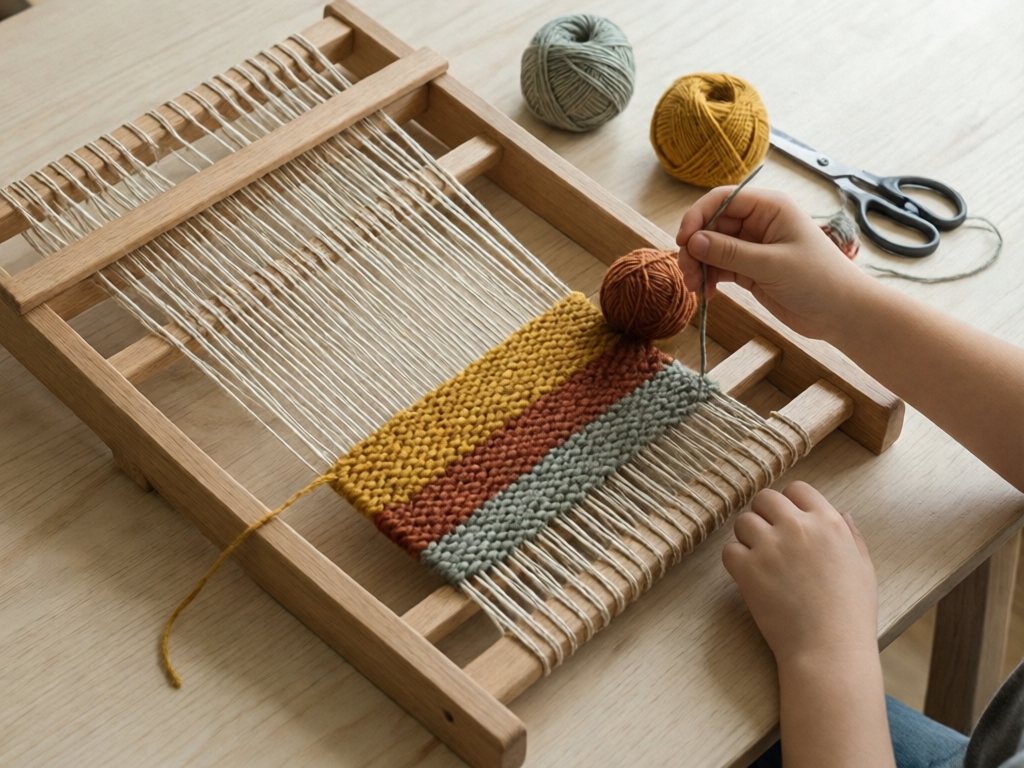
Seven is the golden age of the craft kit, with a catch: it needs to be the right kind. A 7-year-old can follow multi-step instructions, manage small pieces, and stick with a project for forty-five minutes or more. They also have strong feelings about what’s “babyish.”
These work alone, except where I’ve noted an adult nearby:
- A weaving loom (a simple frame loom) with yarn.
- Beading kits with a proper variety of beads and sturdy thread. Check the age on the box, and keep the beads away from any sibling under 4.
- Sewing cards, and later simple felt sewing with a blunt-tip needle (quick lesson first, adult nearby).
- A good set of colored pencils that blend and layer.
- Paint sets, either watercolor or washable acrylic-style.
- A stack of quality paper, including heavier stock for painting.
- Air-dry clay with sculpting tools.
- Polymer clay, as a project with a grown-up. Follow the age on the package. Baking is an adult job, as in the safety box above.
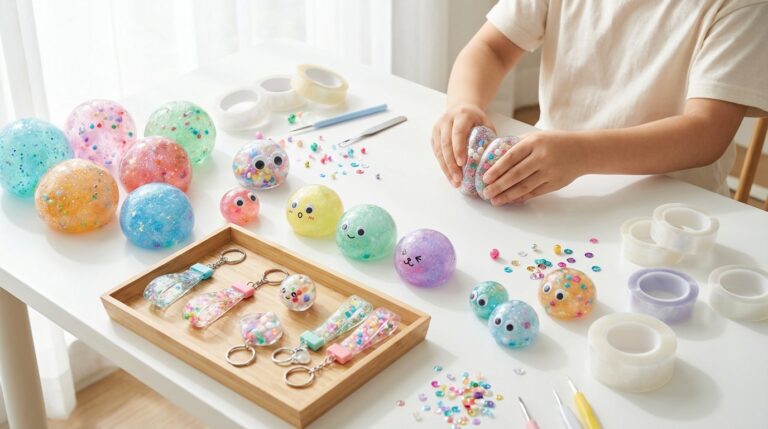
- Nano tape crafts. If your 7-year-old has seen these in a video, our guide to nano tape crafts for kids walks through squishies and bag charms.
Art gift ideas for 8-year-olds
Eight-year-olds are often ready for tools that feel real. This is the age where “my own sketchbook” or “my own paint set” feels like a status upgrade. These work alone, except where noted:
- A real sketchbook (not a coloring book) and a pencil set with a range of leads or colors.
- A blending-friendly colored pencil set, plus a sharpener.
- Watercolors with a variety of brushes, including a fine detail brush.
- Air-dry clay with a small set of tools.
- Polymer clay with an adult nearby, who also does the baking. Check the age on the package first.
- Embroidery or cross-stitch starter materials, with blunt-tip, large-eye needles, a quick demo, and an adult nearby.
- Supplies for making things to give: blank cards, envelopes, stamps, and stickers for homemade greeting cards.
- A larger, more serious project: a loom, a diamond-art-style dot kit, or a build-it-yourself notebook binding kit.
Before you buy a kit for a 7- or 8-year-old, check the “abandoned” list in the next section.
Craft Gifts That Get Used Up vs. Kits That Get Abandoned
If you take only one thing from this article, take this: consumables win. When a child uses up a supply, that’s the best review a craft gift can get.
Buy these: the “used up” checklist
- Paper, all kinds and lots of it.
- Crayons, markers, colored pencils.
- Glue sticks and liquid glue.
- Tape: masking, clear, washi.
- Stickers.
- Play dough.
- Paint: watercolor pans, tempera.
- Yarn, string, and thread.
- Cardboard and recyclables. Our cardboard box crafts for kids post has twenty-five ideas using free materials.
Skip these: the “abandoned” pile
- One-project kits. A kit that makes “a unicorn lamp” makes one unicorn lamp, and the child loves it for a week.
- Twenty-in-one bundles. Four mini-projects get done, and the other sixteen sit in a drawer with a faint air of guilt.
- Huge sets in fancy cases. Too many choices. Kids freeze, or use two colors and ignore the rest.
- Age-mismatched kits. Too hard, too babyish, or too fiddly. Seven-year-olds drop anything in pastel “little kid” packaging.
- Kits that can’t match the box. When a glossy picture takes adult-level precision to reproduce, the kit goes in the closet.
- Anything a parent has to set up every time. If you have to do the work, it only happens on weekends.
- Novelty tools and toys. A machine that makes one kind of thing is clutter after a day, especially at 8.
The gifts that stick with older kids let them get better at something: a real sketchbook, a real set of pencils, a technique to practice.
The middle ground: the “occasional kit”
I’m not anti-kit. A well-chosen kit is a lovely birthday or holiday gift, especially for ages 6 to 8. The trick is to pair it with a consumable supply.
Give the sewing kit and a bag of extra felt and thread. Give the weaving loom and a bundle of yarn in colors the child actually likes. When the kit’s contents run out, the hobby can continue.
Want non-craft gifts to pair with a craft bundle? Try our unique birthday gift ideas for kids roundup.
Craft Kits to Skip for Toddlers Under 3 (and Safer Swaps)
“Small parts” is a vague phrase until you’re crawling under the couch looking for a sequin. These are the popular types of kit I’d skip for any child under 3, even when the box says 2+.
| Kit type | Why skip it under 3 | Safer swap |
|---|---|---|
| Bead and jewelry kits | Even “large” beads often fit in a toddler’s mouth, and some can block an airway. A 2-year-old won’t thread a necklace anyway. | Chunky wooden beads from about 4, with an adult, on a short bracelet cord. Bracelets only: no necklaces under about 6 without an adult watching. |
| Tiny-sticker scene kits | Small stickers and gem stickers get eaten, stuck on faces, and stuck in hair. | Big, palm-sized stickers with you watching. |
| Googly eye and pom-pom bundles | They look harmless, but they’re small, round, and tempting. Anything that fits inside the tube is a choking hazard. | Cut paper circles now. Big pom-poms, well above tube size, with supervision from 3. |
| Glitter anything | Glue, paint or shakers: glitter gets in mouths and eyes, and it can irritate eyes and lungs at any age. | Washable markers. For older kids, non-toxic or biodegradable glitter with supervision. |
| Kits with magnets or batteries | More than one swallowed magnet, or a magnet plus metal, can pull together through the intestinal walls and cause serious injury. A swallowed button battery is an emergency. | Kits with no magnets or batteries. Later, choose a screw-secured battery compartment and lock spare batteries away. |
| Mosaic, gem, and “diamond” art kits | Hundreds of tiny pieces. Wonderful for 7- and 8-year-olds and a nightmare for toddlers. | Large stampers. Store an older sibling’s kit up high. |
| Multi-piece “build a craft” sets | Dozens of tiny precut pieces (“Includes 87 pieces!”) are designed for older kids. For a 2-year-old they become a loose parts spill. | Big paper and chunky crayons. |
Safety firstIf a magnet or button battery is swallowed, go straight to the ER and don’t wait for symptoms. Don’t make the child vomit. The hotline numbers to call on the way are in the Safety first box at the top of this guide. If glitter gets in an eye, flush it with water. Never give a toddler a toy with an easily opened battery compartment.
The simple rule: for under-3s, if it needs tiny parts to be fun, it isn’t the right gift yet. Pick something chunky and open-ended.
When a sibling under 4 is in the house, apply the same rule to the older child’s kits too. Store small-parts supplies in a closed bin that only comes out when the little one is napping.
Build-Your-Own Art Kit for Kids: What to Pack by Age
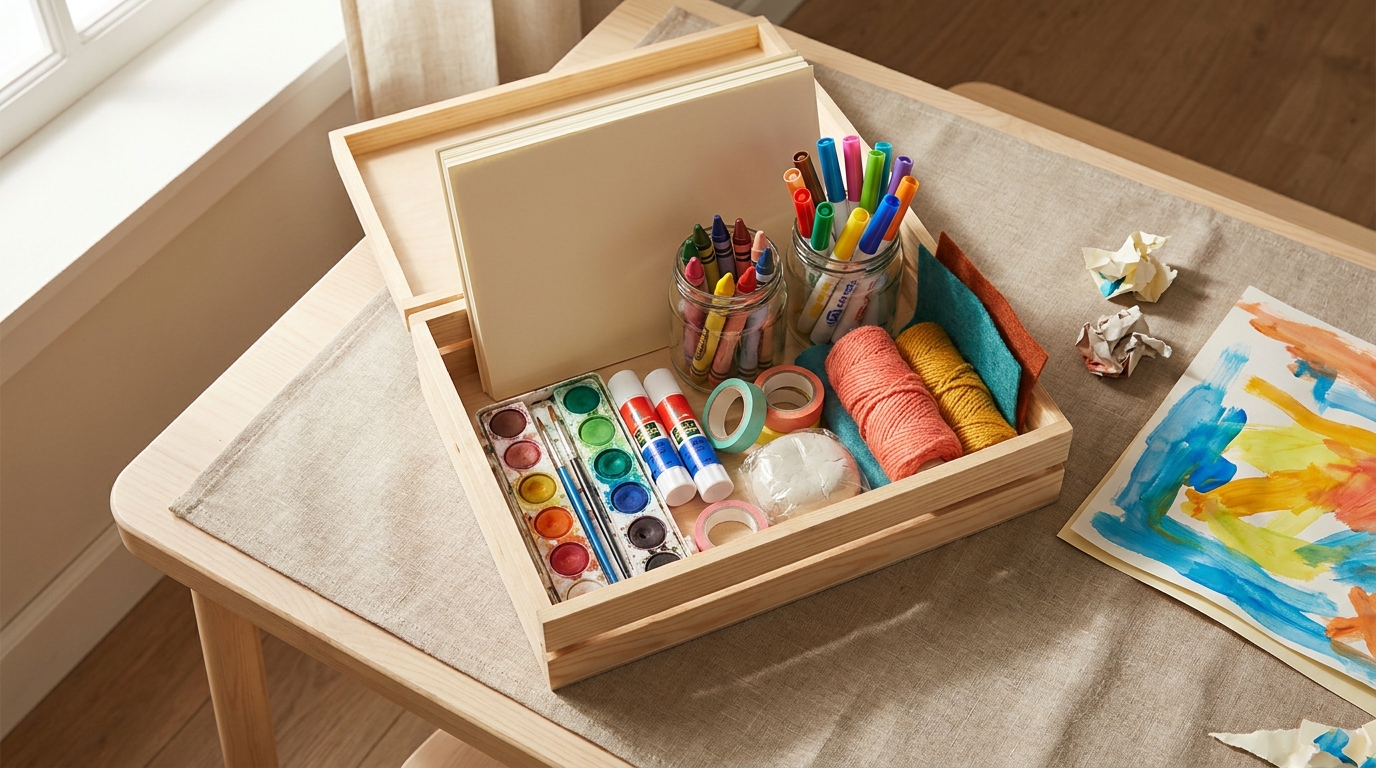
This is my favorite way to give a craft gift. A homemade kit costs whatever you decide, can be tailored to the specific child, and almost always gets used more than a pre-packaged set. Pick a container (a shoebox, a sturdy tote, a lidded bin, a tiered caddy) and fill it according to age.
The Craft Gift Shopper & Build-Your-Own Art Kit printable pack has a checklist version of this list to take shopping.
Safety firstKeep cords and laces short. My rule of thumb is under about 12 inches for bracelet cords and lacing-card laces, with no loop big enough to slip over a head. For children under 3, keep anything with a cord longer than about 7 inches out of reach.
The necklace rule is the same as at the top of this guide: bracelets only under about 6 unless an adult is watching. At every age, bead strings come off for unsupervised play and for sleep.
The universal base (every age)
Start with these and you’ve already got a good gift.
- A stack of plain paper, more than you think you need.
- Crayons or colored pencils, age-appropriate.
- Washable markers.
- A glue stick. At 2 and 3 it comes out with a grown-up around.
- Masking tape.
- A wipeable placemat or tray to define the “craft zone.”
- A smock or old t-shirt.
- A small container for scraps.
Add-ons by age
| Age | Add to the base | Grown-up nearby for | Refill to tuck in |
|---|---|---|---|
| 2 | Fat crayons. A roll of paper for taping to the table. Non-toxic play dough and a couple of chunky tools. | Large washable stampers and pad, big stickers, and optional washable finger paint in a small, spill-resistant cup. | More big paper. |
| 3 | Everything in the age 2 row, plus chunky chalk and a tape dispenser. | Safety scissors and a bag of pre-cut paper strips. Large pom-poms and a small tray for sorting. | A second glue stick. |
| 4-5 | Watercolor pan set and two or three brushes. Colored pencils and a sharpener. Safety scissors, lacing cards, play dough tools. A small pot of liquid glue with a brush. | Chunky beads, well above tube size, on a short bracelet cord. | Collage scraps: fabric, felt, wrapping paper, magazines. |
| 6 | A sketchbook and a better set of colored pencils. Larger beads with sturdy string. Friendship bracelet thread. Watercolors and a water cup. A small block of air-dry clay with tools. Craft scissors with a fun edge. | Small beads, if you add them. Hot glue stays with the adults. | Extra bracelet thread. |
| 7 | A simple weaving loom and yarn. Heavier paper for painting. Washable acrylic-style or watercolor paints. Air-dry clay and sculpting tools. A blank notebook for planning craft ideas. | A felt-sewing set with blunt needles and thread, after a quick lesson. | A bag of yarn. |
| 8 | A real sketchbook and a pencil set. A blending-friendly colored pencil set with a sharpener. A fine detail brush set. Blank cards and envelopes. A binder or box for finished work. | Embroidery or cross-stitch starter materials, after a quick demo. | More blank cards and heavier paper. |
How much to give (and how to split it between relatives)
| Gift size | What goes in | Good for |
|---|---|---|
| Small | Two or three consumables: a pad of paper, a roll of masking tape, a glue stick. | Stocking stuffers and party gifts. |
| Medium | The universal base in a shoebox or tote. | A birthday gift from a friend. |
| Big | The base, the add-ons for the child’s age, a refill, and a caddy or lidded bin. | The main gift, or one gift split between relatives. |
Splitting it up? One relative buys the container and base, one buys the age add-ons, and one buys the refills. Nobody doubles up, and the child opens one kit that works together.
Tuck a refill in the bottom
Here’s the move that makes the biggest difference: tuck a refill into the gift. Extra paper. A second glue stick. A bag of yarn. Kids who love crafts run out of paper first, always.
A gift card to an art store also works once they know what they like. But a refill in the bag keeps the craft table running past week two.
Pick a container they can open
A kit that’s easy to open, easy to see into, and easy to close gets used. A kit buried in a drawer does not. Clear lidded boxes and open caddies beat zippered cases for ages 2 to 5. For older kids, a tiered caddy with labeled sections feels grown-up and keeps pencils and brushes from rolling around.
Craft Gift Ideas That Aren’t Supplies
Sometimes the best craft gift isn’t a thing you can wrap in a box. A few ideas that have gone over well in my house:
- A craft date. Give “a Saturday afternoon of crafting with me,” with a specific project written on a card: a cardboard castle, seed bombs, painted rocks. Kids remember one-on-one time long after the plastic fades. Our rainy day indoor activities for kids list has twenty ideas for any age.
- A display option. A string of clips along a wall, a corkboard, or a simple picture ledge turns “stuff I made” into “my art gallery.” Kids who see their work displayed make more of it.
- A portfolio box. For kids 6 and up, a large flat box or portfolio folder tells the child their work is worth keeping.
- A prompt notebook. A small notebook of craft prompts (“make something from a cereal box,” “draw your pet as a superhero”) heads off the “I’m bored” wall.
- A seasonal bundle. Paper leaves, paint, and a glue stick make a small fall gift. Our fall leaf crafts for kids post has projects to match.
From our sister brands
Gifts to color and mark, from our sister brands
None of these is an art supply, but each gives a child who likes making things something to color, mark or write on.
Akoni Books and White Loft are sister brands of this site. When you buy through these links we may earn a portion of the revenue, at no additional cost to you.

Akoni Books
A Christmas storybook with coloring pages from their own story
Akoni Books draws a storybook from one photo of your child, in one of nine art styles. Every book comes with a 19-page Hero Pack of printables that includes coloring pages from their own story, a certificate and a door hanger. Order a printed copy by December 5 and most US orders arrive before Christmas.
Digital $9.99 · Softcover $29.99 · Hardcover $39.99, shipping included
First book? Code WELCOME5 takes $5 off at checkout.
Preview it free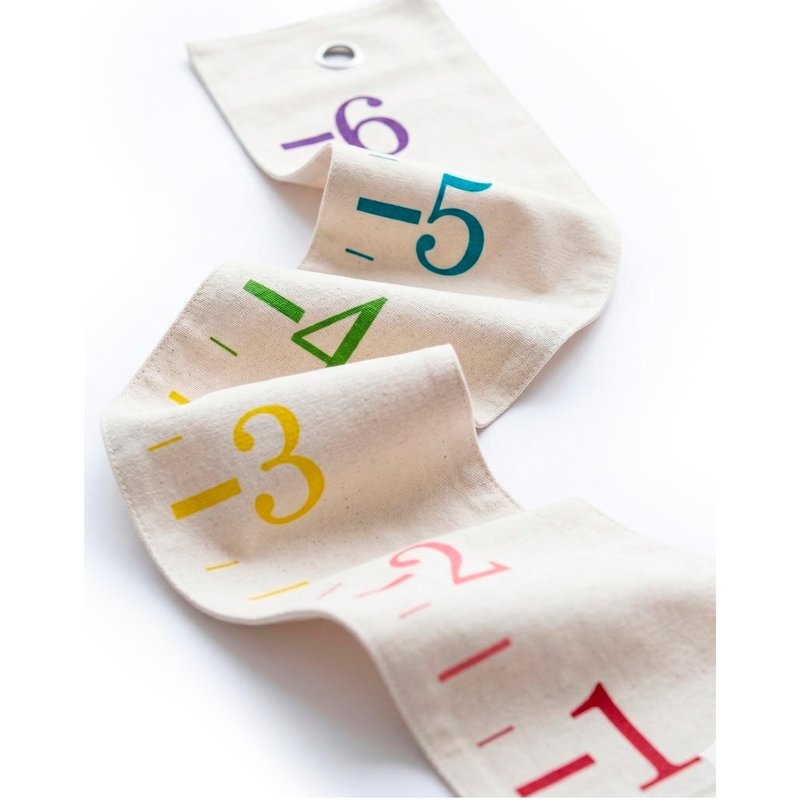
White Loft
Rainbow Canvas Growth Chart with pen
A height chart is a gift a child adds to. Every birthday there is a new line to draw and a date to write with the pen that comes with it. Cream canvas with rainbow numbers, and it rolls up when you move.
$39.99 on Amazon
See it on Amazon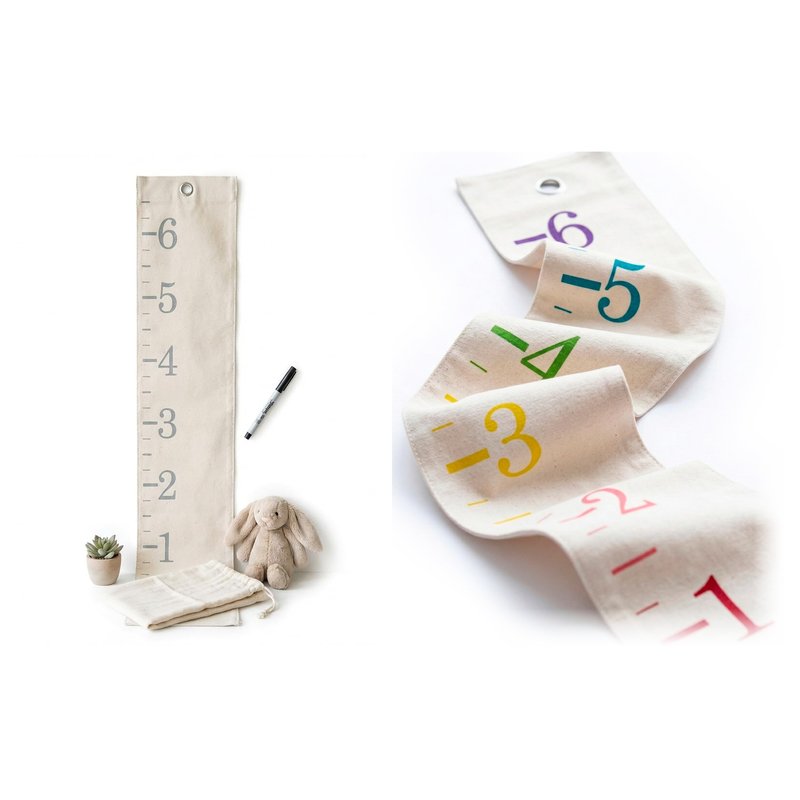
White Loft
For two makers in one house: the rainbow chart plus the classic gray one, so each child has their own to mark. As a set it costs 15% less than the two bought separately.
$68.83 on Amazon
See it on AmazonPrices checked October 2026; they can change.
How Messy Are Art Supplies? Honest Mess Ratings
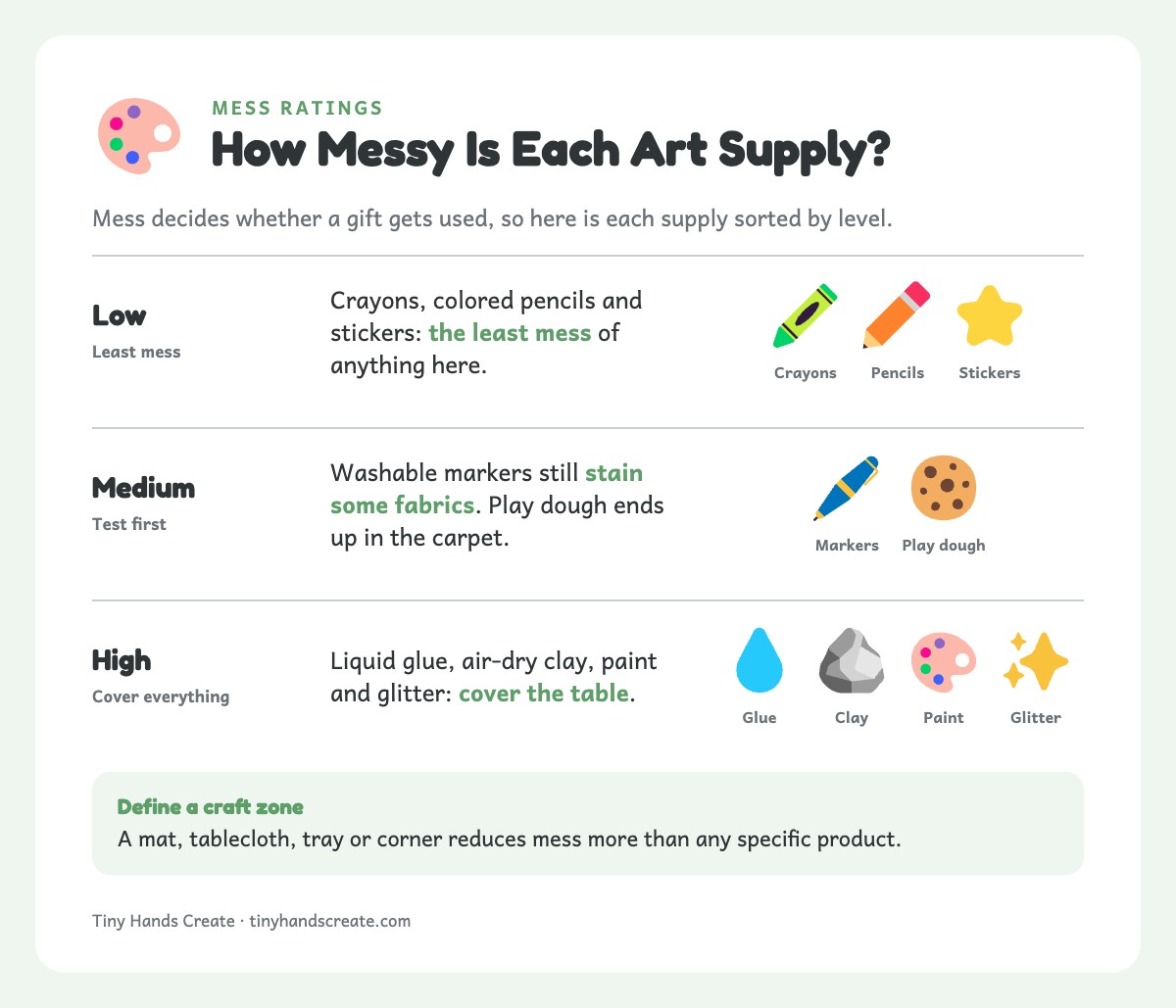
Mess is the part that decides whether a gift gets used, so here it is in one place.
| Supply | Mess level | What happens | Quick fix |
|---|---|---|---|
| Crayons, colored pencils, stickers | Low | The least mess of anything here. | A bin to put them back in. |
| Washable markers | Medium | “Washable” still stains some fabrics and porous surfaces. | Test on a corner first. |
| Play dough | Medium | Play dough in the carpet is a particular kind of pain. | Keep it on a mat or tray. |
| Liquid glue | High | It leaves a trail between the bottle and the paper. | Expect it, and cover the table. |
| Air-dry clay | High | It dries into little flakes that migrate. | Wipe up with a damp cloth so the dust stays down. |
| Paint | High | It travels to the chair, the floor, the wall, and their own ear. | Cover everything. |
| Glitter | High | Glitter is forever: sparkle in the carpet until the next move. | Check that the family is okay with it first. |
Setting up a designated craft zone (a mat, a tablecloth, a tray, a corner) reduces mess more than any specific product. A shower curtain liner under the table is cheap and lifesaving. When the zone is defined, kids learn that crafting happens here.
Teach cleanup as part of the craft. Even a 2-year-old can put crayons back in a bin. A 5-year-old can wipe the table. An 8-year-old can wash brushes.
A gift that includes a mini cleanup kit (a small cloth, a sponge, a bin for scraps) quietly builds the habit. It also makes parents more willing to say yes to the next project.
Frequently Asked Questions
What are the best gifts for kids who love crafts if I don’t know what supplies they already have?
Go for consumables: a stack of good paper, a set of washable markers or colored pencils (depending on age), a few glue sticks, and a couple of rolls of masking tape. Every craft-loving kid runs out of these, and you can’t really duplicate them.
What are good craft gifts for a 7 year old who says they’re “too old” for kid stuff?
Look for tools and kits that feel like real hobbies rather than toys. A simple weaving loom, a sewing or embroidery starter set, a quality colored pencil set with a sharpener, and a real sketchbook all feel grown-up. Skip pastel packaging and anything with a baby-ish look.
What are good art gift ideas for an 8 year old who already has a lot of supplies?
Upgrade quality rather than quantity. A blending-friendly colored pencil set, a fine-detail brush set, heavier paper for painting, or a project binder to organize finished work all feel like a step up. A craft date (a planned afternoon doing a project together) is also a great option for the kid who has everything.
What art gifts work for kids age 6?
A sketchbook with a decent set of colored pencils, a bead assortment with sturdy string, and friendship bracelet thread are all winners. So are a watercolor set with a few brushes and a small block of air-dry clay with simple tools. Most 6-year-olds can use these on their own. Sit nearby for small beads, and step in for hot glue and sharp needles.
How do I know if a craft kit is safe for a toddler under 3?
Check the box for a small-parts warning and do the toilet-paper-tube test: any piece that fits entirely inside the tube is a choking hazard under 3. Skip kits with beads, googly eyes, sequins, tiny gems, small pom-poms, glitter, magnets, or button batteries. The ACMI AP (Approved Product) seal certifies that an art material is non-toxic, with labeling that follows ASTM D-4236, the US art-materials labeling standard. It doesn’t cover choking hazards or age suitability, so still do the tube test and read the age label. Keep small parts like beads and small stickers off the list until 4.
Are craft kits worth buying, or should I build my own?
Both have a place. A homemade kit is usually better for ages 2 to 5, because open-ended materials get used more often than single-project kits. For ages 6 to 8, a good project kit can introduce a new skill like weaving or embroidery. Add extra supplies so the hobby continues after the first project.
How much mess should I expect from art supplies?
More than you’d like, honestly, but you can manage it. Cover the table, use a wipeable tray or mat, choose washable materials, and create a defined craft zone. Expect the most mess from paint, glue, clay, and glitter, and the least from crayons, colored pencils, and stickers.
Wrapping Up: Give the Gift of a Craft Table
My one pick for any craft-loving kid: a stack of paper, a handful of good supplies for their age, and a place to use them. Everything else is a bonus. The kids who grow up making things aren’t the ones with the biggest kits. They’re the ones with permission to make a mess, time to explore, and a grown-up who says “show me what you made” with real interest.
So match the supplies to the hands, skip the tiny-parts kits until the toddler years are behind you, tuck in a refill, and let the craft table do the rest. Your kid will thank you, probably by gluing something to a cardboard box.