
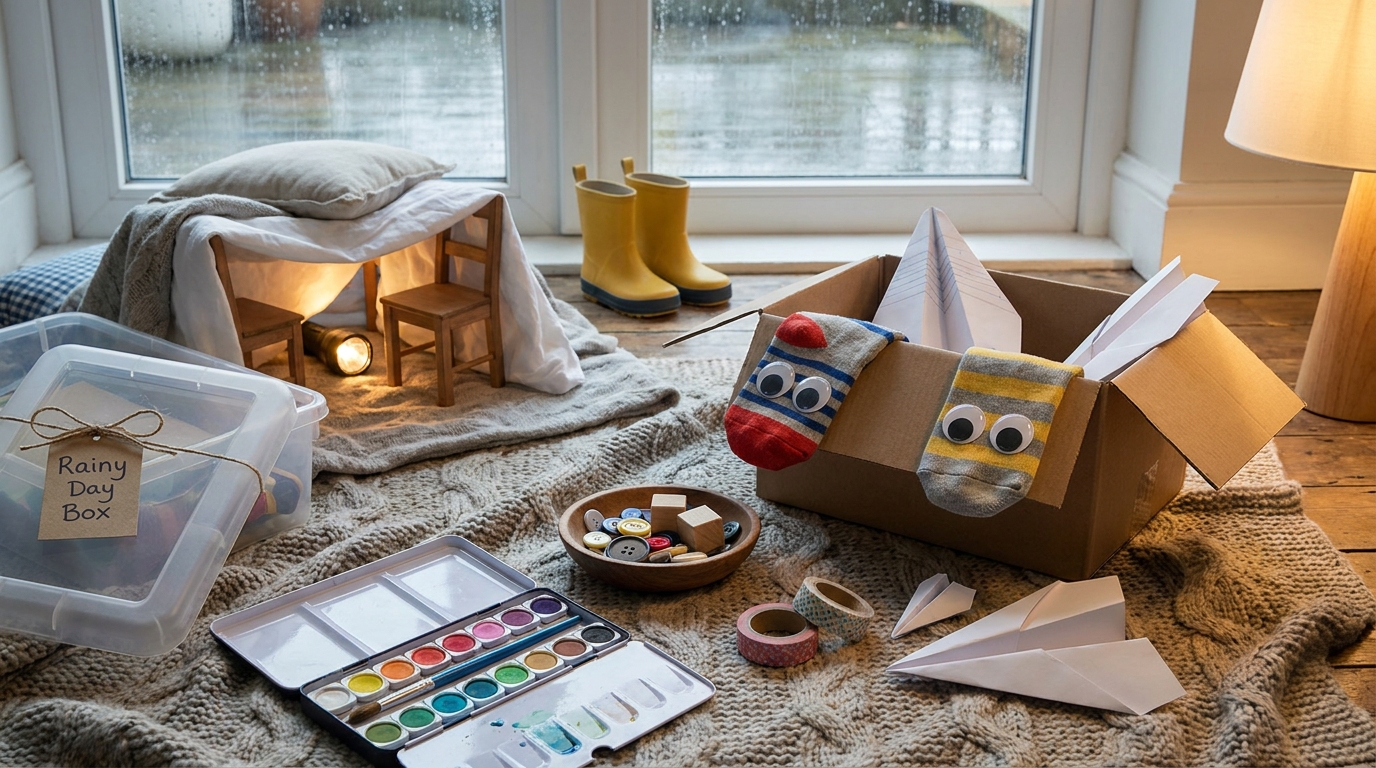
Rainy Day Indoor Activities for Kids: 20 Boredom-Busting Ideas for Any Age
Discover 20 boredom-busting indoor activities for kids aged 1-8+, categorized by mess level and age, so you can easily find the perfect screen-free idea for your family on a rainy day.
- Choose activities based on your desired mess level, from zero-mess to high-mess options.
- Select age-appropriate activities for kids from toddlers to 8+ years old.
- Utilize quick, zero-prep activities like sock puppets or pillow forts for instant fun.
- Incorporate active games like freeze dance to help kids burn pent-up energy indoors.
- Engage kids with creative ideas like indoor scavenger hunts or paper airplane contests.
This post contains affiliate links. As an Amazon Associate I earn from qualifying purchases.
It’s 9:14 on a gray Tuesday morning, and my kids have already asked “can we go outside” four times. I used to panic and hand over a tablet. Now I keep a list sorted by how much cleanup I can handle that day.
Here’s that list: 20 rainy day indoor activities for kids ages 1 to 8 and up. Ideas 1-15 are sorted by mess level, and ideas 16-20 are sorted by age, with a few extras in each age section. Short on time? Use the quick-pick table below to grab one idea for your child’s age and the mess you can handle today.
| Age | Zero-mess pick | Low-mess pick | Messy pick |
|---|---|---|---|
| 1-2 years | 16. Pots and pans band | 10. Large paper stickers (supervised) | 13. Water play (adult within arm’s reach) |
| 3-5 years | 4. Freeze dance | 7. Loose parts (ages 4+) | 12. Shaving cream painting |
| 6+ years | 19. Stop-motion animation | 8. Nano tape squishies | 11. Slime (adult-led) |
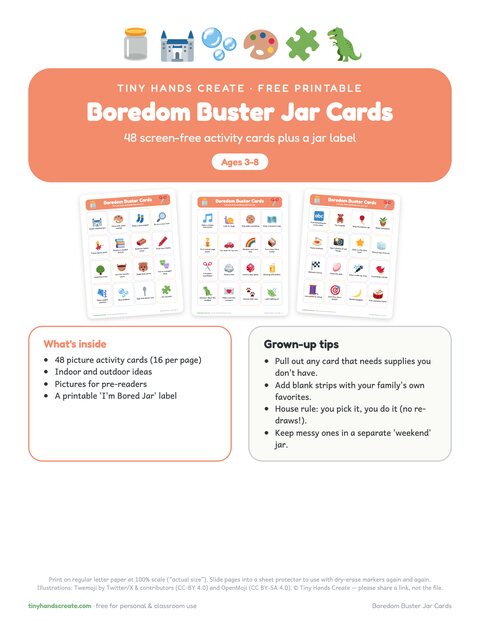
Free printable · 5 pages
Boredom Buster Jar Cards
48 screen-free picture activity cards and an 'I'm Bored Jar' label.
Free. Your download link appears right here. You'll also join the Daily Printable Drop. Unsubscribe anytime. Privacy
In this article (12 sections)
- Zero-Mess Activities You Can Start in Two Minutes
- Low-Mess Activities That Still Feel Like an Event
- Messy Rainy Day Activities for Kids (Worth the Cleanup)
- Rainy Day Activities for Toddlers (Ages 1-3)
- Rainy Day Activities for Preschoolers (Ages 3-5)
- Rainy Day Activities for Big Kids (Ages 6+)
- Rainy Day Activities That Cross Every Age Group
- Rainy Day Activity Bin: What to Stock So You’re Never Scrambling
- Rainy Day Survival Tips for Parents
- Rainy Week Plan: Themed Days and Multi-Day Ideas
- FAQ
- Final Thoughts: Pick Two or Three Rainy Day Activities
Zero-Mess Activities You Can Start in Two Minutes
These are your go-tos for the mornings when you need something right now — no supply gathering, no plastic tablecloth, no bracing yourself. Most of these use things you probably already have.
1. Sock Puppet Theater
Grab a pile of mismatched socks (every household has a drawer of orphans) and turn a cardboard box on its side as the “stage.” Draw the faces on with marker. For kids under 4, skip buttons and googly eyes, which are choking hazards; for older kids, glue them on firmly with an adult.
Kids 6 and up can write a two-minute skit, and younger kids can improvise one out loud. Toddlers just love making the puppet talk in a silly voice.
2. Pillow Fort + Flashlight Reading
This one is embarrassingly simple and somehow never gets old. Drag every couch cushion and blanket into one room and build a low fort. Hand over a flashlight and let them “camp” with a stack of books.
I set a timer for 20 minutes of quiet fort time most rainy afternoons, and it resets my toddler every time.
Safety firstSupervise fort time, keep the walls low with one side open, and skip cords or ties. Don’t let babies or toddlers sleep in a fort of pillows and blankets.
3. Indoor Scavenger Hunt
Write (or for pre-readers, draw) a list of 8-10 household objects. Think something red, something soft, something that makes a sound, and something smaller than your hand. Kids race around the house checking things off. It can last five minutes or thirty, depending on how sneaky your clues get. For a ready-made list, adapt our backyard scavenger hunt by swapping the outdoor finds for things in your living room and kitchen.
4. Freeze Dance Party
Phone, speaker, done. Play music, everyone dances, and you pause it randomly so everyone freezes mid-move. This burns real physical energy indoors, which matters more than people give it credit for. A lot of “rainy day meltdowns” are really just pent-up wiggles with nowhere to go. Three or four songs (about 10 minutes) is plenty.
5. Paper Airplane Contest
Fold two or three designs from plain printer paper. Try a pointed dart for distance, a wide-winged glider for hang time, and a stunt plane with the back wing edges bent up for loops. Mark a starting line with tape. Then measure each flight with a tape measure and write the distances down.
How to fold a basic dart:
- Crease the center. Fold the sheet in half the long way, then unfold it.
- Fold the top corners. Bring both top corners in to meet the center crease.
- Fold the edges again. Fold each slanted edge in to the center crease a second time.
- Make the wings. Fold the plane in half along the center crease, then fold each side down to make a wing.
For kids 6+, turn it into a mini engineering challenge. Give everyone three throws and record the best distance. Then let them change one thing, like a wing fold or a paper clip on the nose, and test again.
Finish with a stunt round: who can make one that loops, or one that lands standing up? Kids who love the folding part can move on to our easy origami for beginners.
Low-Mess Activities That Still Feel Like an Event
These need a little setup — five to ten minutes — and produce a small, contained mess you can wipe down with one paper towel. This is my sweet spot on most weekday rainy afternoons.
6. Watercolors and Paper
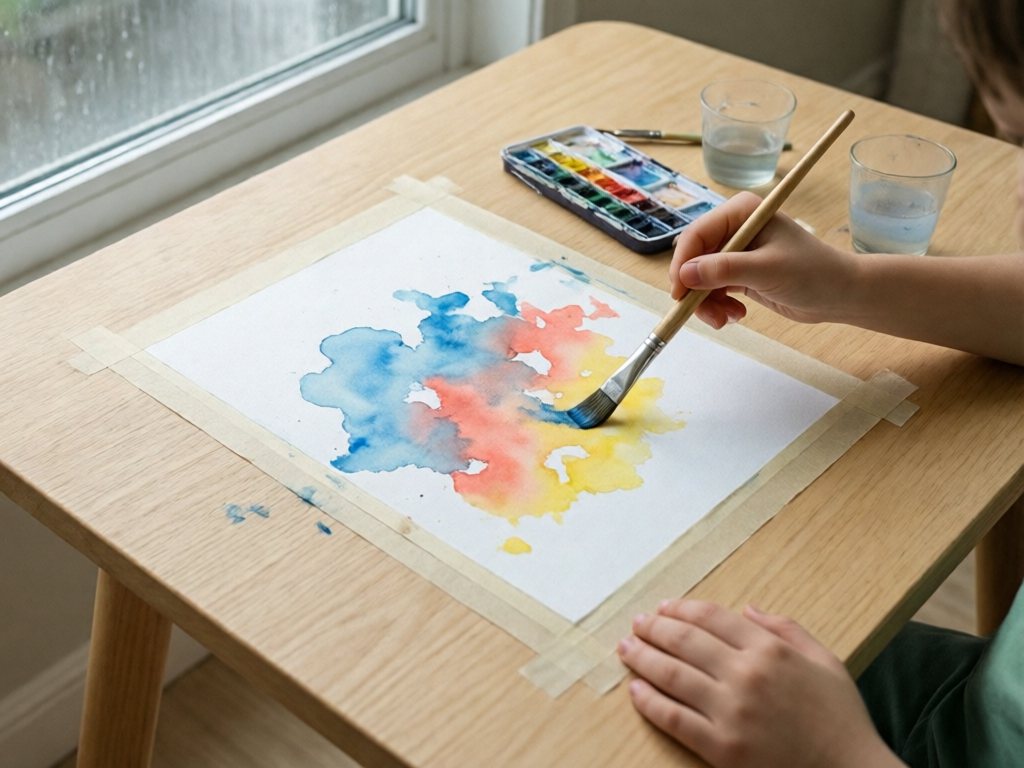
Watercolor sets are one of the lowest-mess “real art” activities, and the pans and brush make it feel grown-up. Use non-toxic, washable watercolors and discourage putting brushes or paint in mouths. Tape the paper to the table, which prevents a lot of watercolor chaos because a sliding page is what tips the water cup. Then fill a small cup with water and let them go.
Want technique ideas beyond free painting? Our watercolor painting guide covers salt texture, wet-on-wet blending, and white-crayon resist painting, with versions for toddlers through big kids. If your kids want a prompt, pull out our printable Watercolor Project Cards.
7. Loose Parts Building
Got a bin of buttons, bottle caps, wooden beads, pom-poms, or little wood slices? Loose parts play is about as low-mess as it gets. Nothing is wet or sticky; it’s just sorting, stacking, and building. My preschooler will happily spend 40 minutes making “families” out of buttons sorted by color.
If you don’t have a stash yet, it’s worth building one. Our loose parts play ideas post has 30+ combinations for toddlers through early elementary. Most of it comes from things you already have or can grab cheap at a craft store.
Safety firstFor kids under 4, use only pieces larger than a toilet-paper tube and supervise closely. Keep small parts, button batteries, and magnets out of the bin.
8. Nano Tape Squishies
This one is newer in our house, and my second grader reaches for it first. Nano tape (the reusable double-sided gel tape) can be squished into stretchy “squishies” or folded into bubble pets and bag charms. It’s mess-free, with no glue or paint, and it holds attention for 30-45 minutes.
Our nano tape crafts guide has the full step-by-step if your kids haven’t tried it yet.
Safety firstKeep nano tape supervised, and skip it for kids who still mouth objects.
9. Cardboard Box Creations
Save your next few Amazon boxes instead of breaking them down right away. With markers and maybe some tape, a box becomes a puppet theater, a race car, a “store,” a robot costume, or a dollhouse.
It’s low-mess (a few stray marker lines, easily contained) and it works across a huge age range. Toddlers like climbing in and out. Big kids like designing and cutting, with an adult handling any box-cutter work.
We collected 25 build ideas by age and box size in our cardboard box crafts roundup. It goes well beyond “draw a face on it.”
10. Sticker and Washi Tape Scenes
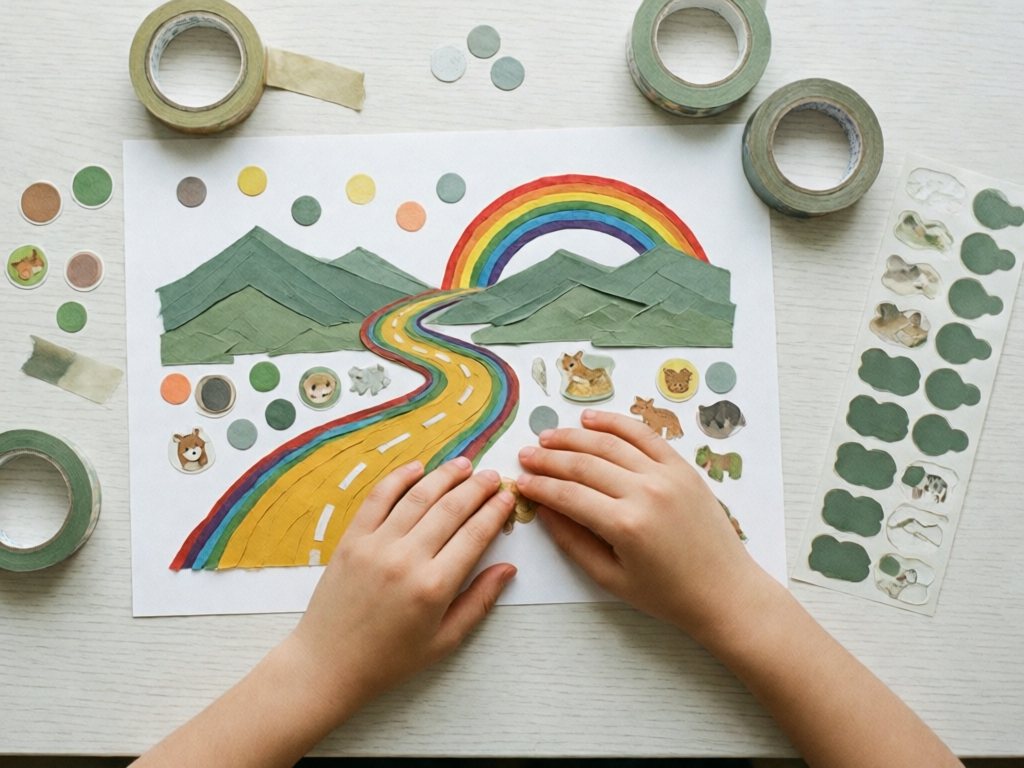
Give a kid blank paper and a pile of stickers or a few rolls of washi tape. You’ll get 20+ minutes of quiet, focused play with almost no cleanup. This is one of my go-to activities for restaurant waits, doctor’s office waits, and rainy afternoons alike.
For more setups, see our sticker activities for toddlers.
Safety firstFor kids under 3, use large paper stickers only. Skip small foam or gem stickers, which are choking hazards, and stay close while they play.
Messy Rainy Day Activities for Kids (Worth the Cleanup)
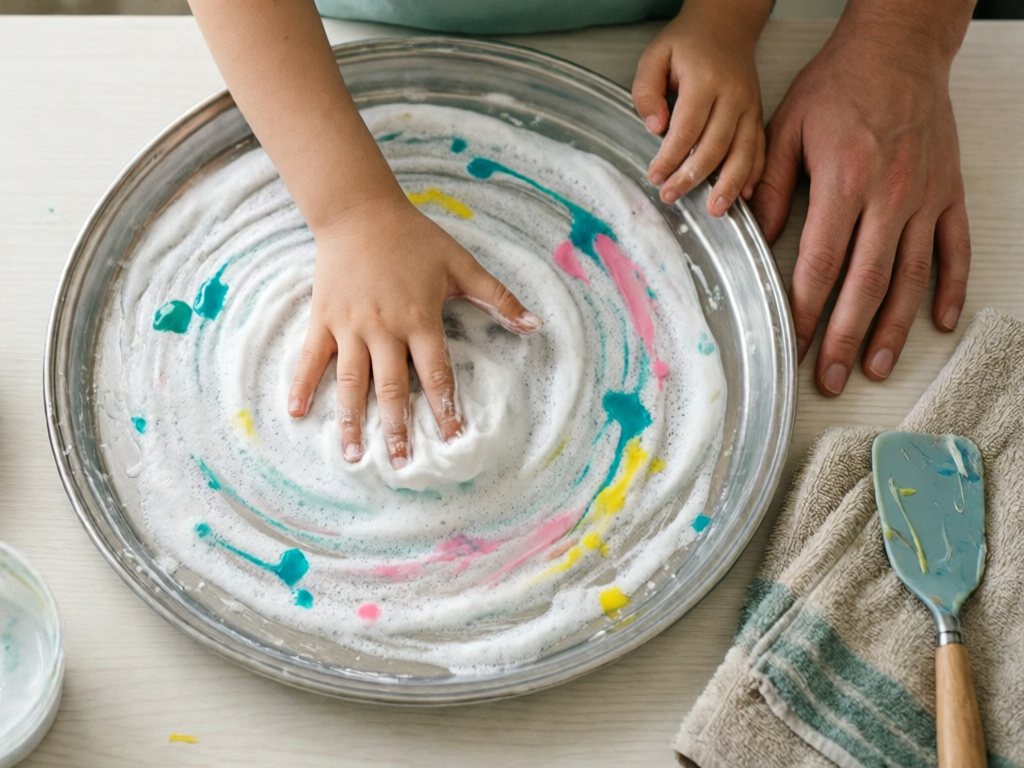
Some days you have the bandwidth for a real mess, and these are the activities kids remember. Save them for days when you can work on a hard floor, or just accept that bath time is happening early tonight.
Mess zone setup, before anything gets opened:
- Lay a shower curtain or plastic tablecloth on a hard floor.
- Stack two or three old towels within reach.
- Grab a squeegee for trays and tabletops.
- Open a pack of wipes or dampen a washcloth.
- Fill a bowl with rinse water and keep it up on the counter.
- Clear the sink so hand-washing is one step away.
| Activity | Mess Level | Best Age | Setup Time | Cleanup Method |
|---|---|---|---|---|
| 11. Slime making | High | 6+ (adult-led) | 10 min | Wipe surfaces. Wash hands with warm soapy water. |
| 12. Shaving cream sensory painting | High | 3+ (adult within reach) | 2 min | Squeegee or towel wipe. It rinses easily. |
| 13. Indoor “rain” water play | High (wet) | 1+ (adult within arm’s reach) | 5 min | Towels down first, mop after. |
| 14. Balloon science experiments | Medium-high | 5+ (adult-led for ages 5-7; skip under 5) | 5 min | Bin popped pieces right away, then sweep. |
| 15. No-bake cooking projects | Medium | 3+ | 10 min | Standard kitchen cleanup. |
11. Slime Making
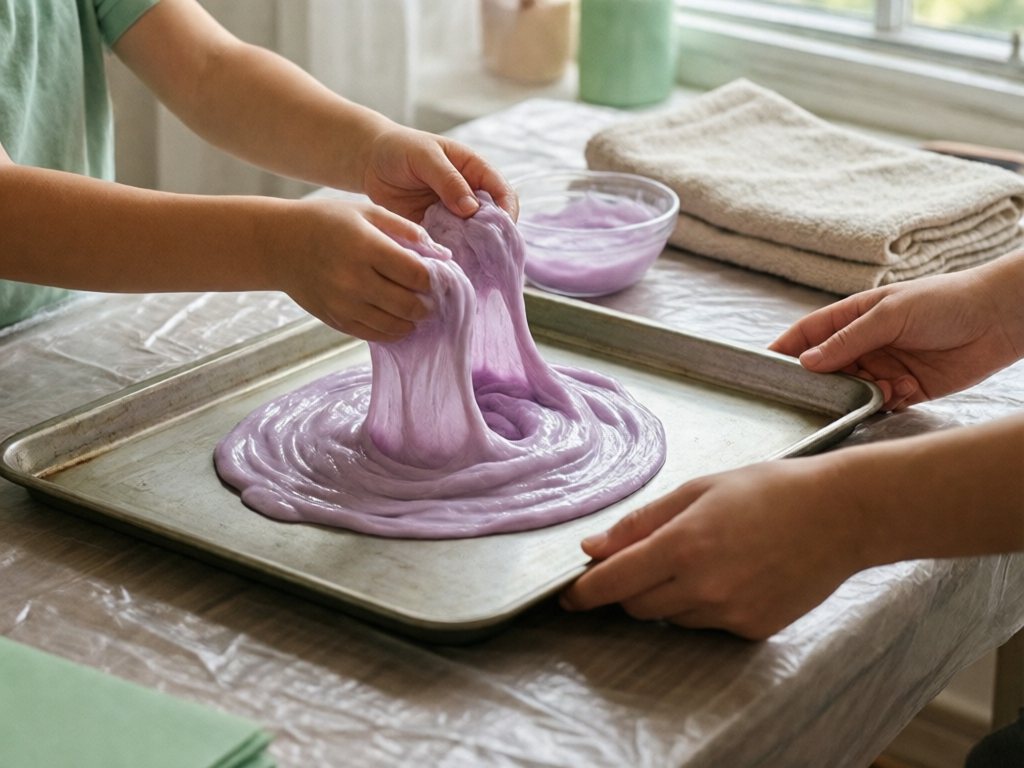
There’s a reason slime never goes out of style. It’s satisfying sensory play, and the “recipe” element keeps older kids engaged. Commit to a workspace: a plastic tablecloth or a big cookie sheet with sides, plus a rule about staying seated.
Want butter slime, floam, or cloud slime, or fixes for “it’s too sticky” and “it won’t stop stretching apart”? Our complete slime recipes guide covers every variation and troubleshooting fix we’ve found.
Safety firstSlime is for ages 6+ and adult-led. Skip it for kids who mouth things, and keep it away from pets. No tasting, and wash hands before and after. Borax, boric acid, and the sodium borate in contact lens solution can irritate skin and are harmful if swallowed. That means contact lens solution is not a borax-free swap. Choose a recipe without those activators, or a store-bought kit labeled for your child’s age. Stop if skin gets irritated.
12. Shaving Cream Sensory Painting
Spray plain shaving cream onto a tray or cookie sheet and let kids ages 3 and up finger-paint in it. Add a few drops of food coloring and swirl. It looks chaotic but stays contained, and for most kids the sensory input is calming. Let them opt out if they dislike the texture.
For more ways to use the rest of the can, see our shaving cream sensory activities.
Safety firstStay within reach the whole time. Shaving cream is not edible, so keep it out of eyes and mouths. Use plain unscented foam and rinse hands afterward. Food coloring can stain grout, wood, and porous surfaces, so test a spot first and stick to a tray.
13. Indoor “Rain” Water Play
When the rain is the whole problem, bring it inside. Fill a shallow bin with an inch or two of water and add cups, funnels, and a few bath toys. Set it on a towel-lined patch of kitchen or bathroom floor and let them pour and splash.
It sounds too simple, but water play often holds my toddler and preschooler longer than I expect. I’ve sat right beside the bin with my coffee for 45 minutes while they poured between a dollar-store measuring cup set and a mixing bowl.
Our water play activities for toddlers post has more setups.
Safety firstToddlers can drown in an inch or two of water in seconds. Use touch supervision: stay within arm’s reach and never step away, even to answer the phone or the door. Empty the bin right after play.
14. Balloon Science Experiments
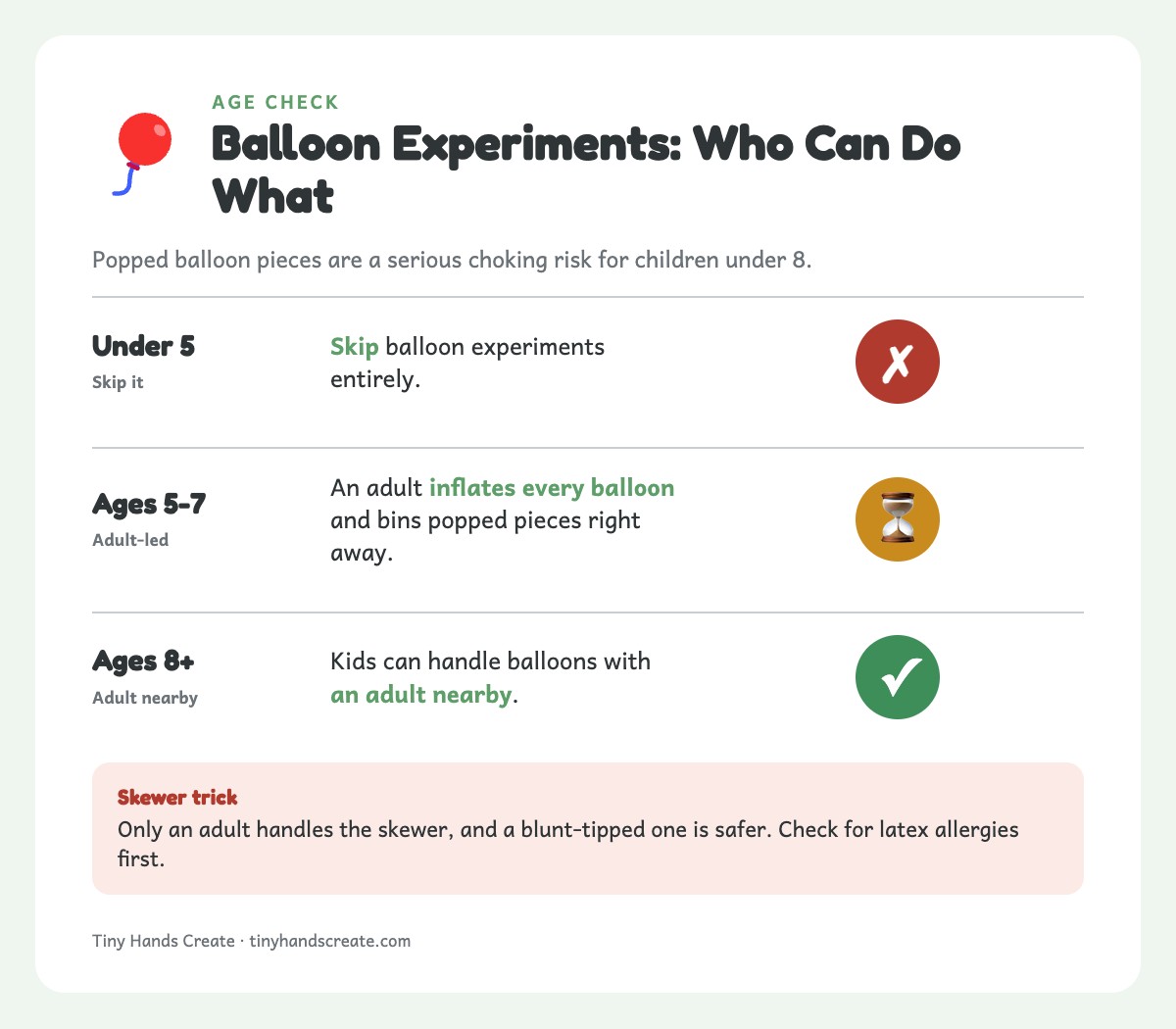
Try static electricity tricks, balloon rockets on a string, and the balloon skewer trick. You really can poke a skewer through without popping it, and it’s a great “wait, WHAT” moment. Balloons are cheap, and the “science” framing wins over kids who’d roll their eyes at a craft.
Our balloon science experiments post has 10 that all use stuff from a regular grocery run.
Safety firstUninflated balloons and popped pieces are a serious choking risk for children under 8. Skip this one for kids under 5. For ages 5-7, keep it adult-led: an adult inflates every balloon and throws popped pieces away right away. Kids 8 and up can handle balloons with an adult nearby. Only an adult handles the skewer, and a blunt-tipped one is safer. Keep string short and check for latex allergies first.
15. No-Bake Cooking Projects
Think energy balls, “personal pizza” on English muffins, yogurt bark, or trail mix assembly: anything a kid can measure, pour, and mix without an oven. It’s a useful life skill and buys you 20-30 minutes of focused, cooperative activity. It works for ages 3 and up with an adult at the counter.
Safety firstCheck for allergies first, since energy balls often contain nuts, seeds, or honey. For kids under 4, skip whole nuts and hard or small pieces (chop them or use seed butter). No honey under 12 months, and no tasting raw dough or eggs. Wash hands before you start.
Rainy Day Activities for Toddlers (Ages 1-3)
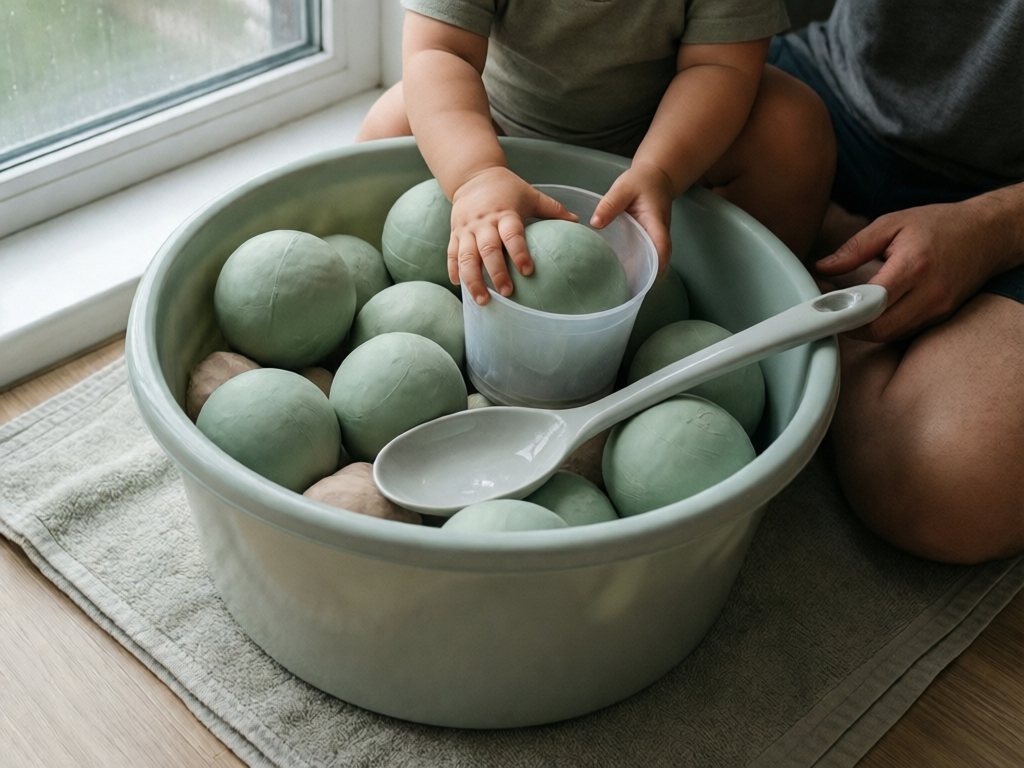
Toddlers do best with short, sensory-forward activities under close adult supervision. Three-year-olds sit in both groups, so start here and move to the preschool section when these feel too easy.
From the main list: marker-face sock puppets (#1), a pillow fort (#2), freeze dance (#4), boxes (#9), large paper stickers (#10), and water play (#13).
Safety firstFor ages 1-2, fill sensory bins with water or with large objects too big to swallow. Save dry rice, pasta, and oats for about age 3 and up, and only for a child who reliably no longer mouths things. Small dry grains can be choked on or breathed in, and they are possible allergens. Sit right beside the bin and enforce a no-eating rule.
16. Pots and Pans Band
Hand over wooden spoons plus every mixing bowl you own. Set it all on a towel to muffle the noise (slightly). Setup takes about 2 minutes, and ages 1-3 love it.
More Toddler Ideas
- Sensory bin scooping. Fill a large bin with an inch of water or with large soft balls, plus cups and spoons. Follow the fill rules in the safety note above. Setup: 5 min. Mess: medium. Safety: empty water right after play.
- Sticker peeling. Peeling stickers off the sheet is its own activity for an 18-month-old. No “placing them correctly” required. Setup: 2 min. Mess: none. Safety: large paper stickers only, with no small foam or gem stickers.
- Box crawling. An empty box big enough to sit in, with a door and window cut out. Setup: 5 min. Mess: none. Safety: an adult does the cutting before play starts.
- Water painting. A spill-resistant cup of plain water and a paintbrush on dark construction paper or a chalkboard. The “paint” appears and then disappears as it dries. Setup: 2 min. Mess: low. Safety: supervise, and empty the cup when you’re done.
Want more contained-mess sensory options? Our DIY sensory bins guide has 15 fill ideas organized by theme and season. Pick the fills that match your child’s age and mouthing stage.
Rainy Day Activities for Preschoolers (Ages 3-5)
Preschoolers start wanting a “product” to show off or hang up. Pretend play gets more complex too, which opens up a lot of options.
From the main list: the scavenger hunt (#3), freeze dance (#4), watercolors (#6), loose parts for ages 4+ (#7), shaving cream painting (#12), and no-bake cooking (#15).
17. Dress-Up Storytelling
Pull out a bin of old clothes, hats, and scarves and add a simple prompt: “You’re a pirate looking for treasure in the living room.” There’s no setup beyond dumping out the bin.
18. Indoor Obstacle Course
Line up couch cushions to jump over. Add a pool noodle or a tape line on the floor to crawl along, plus a second strip of tape to balance-walk. Setup takes about 10 minutes.
For more ways to burn energy inside, see our indoor gross motor activities.
Safety firstClear hard edges, move chairs out of the way, and supervise the whole course.
More Preschool Ideas
- Playdough with tools. Set out cookie cutters, a child-safe plastic knife, and a garlic press for “spaghetti hair.” A placemat keeps it tidy. Our playdough recipes and printable Playdough Recipe Card Pack are a good starting point. Setup: 5 min. Mess: low. Safety: adult-supervised. Dough is salty and contains wheat, so discourage eating it.
- Simple weaving. Weave short lengths of yarn through holes punched in a paper plate with a blunt plastic needle. Setup: 10 min. Mess: low. Safety: keep yarn pieces under about 12 inches. Never let kids wrap yarn around a neck or wrist, and snip leftovers when you’re done.
- Process art projects. Squeezing, dripping, and layering with no “correct” outcome. See our process art for toddlers post. Most of those ideas scale up to preschoolers. Setup: 5 min. Mess: medium. Safety: use washable, non-toxic supplies and cover the table.
Rainy Day Activities for Big Kids (Ages 6+)
Elementary-age kids want a challenge, a bit of independence, and nothing that feels like a “little kid activity.”
From the main list: paper airplanes (#5), nano tape squishies (#8), box builds (#9), adult-led slime (#11), and balloon science (#14), adult-led through age 7.
19. Stop-Motion Animation
All you need is a phone and a few small toys. Download a free stop-motion app and prop the phone against a stack of books. Move the toys a tiny bit between photos, and plan on about 8-12 photos for each second of movie.
Setup is about 5 minutes. Most kids this age figure out the app quickly and will film for an hour.
20. DIY Escape Room
Older siblings love designing these for younger ones, and it buys you a break. Setup takes about 15 minutes.
- Pick a prize. A snack or a small toy works.
- Write 4 clues. Mix a riddle, a counting clue, a picture clue, and a “look under” clue.
- Hide them in order. Each clue points to the next hiding spot, and the last one points to the prize.
- Set a timer. 15-20 minutes keeps it exciting.
TipShort on time? Copy this clue set. Clue 1: “I keep your food cold” (hide clue 2 in the fridge door). Clue 2: “Look under something soft” (hide clue 3 under a couch cushion). Clue 3: a drawing of the bathtub (hide clue 4 in the dry tub). Clue 4: “Count the kitchen chairs and check under the last one” (the prize).
More Big-Kid Ideas
- Board game or card game tournament. With 4 or 8 players, a bracket drawn on a sheet of paper turns “we’re bored” into a structured event. It runs about an hour.
- Room “renovation.” An adult moves any heavy furniture and anchors tall pieces to the wall. Kids rearrange light items like pillows and toys, or redesign a dollhouse or Lego setup. Keep small pieces away from kids under 4. Plan on about 30 minutes.
Rainy Day Activities That Cross Every Age Group
These extra ideas flex across a wide age range, so they suit rainy days when kids of different ages all need something to do at once.
- Baking together. Toddlers dump pre-measured cups, preschoolers stir, and big kids read the recipe and measure.
- Family art wall. Tape a 6-foot strip of butcher paper (or taped-together sheets of printer paper) to a wall or the floor. Everyone draws one mural together. Plan on about 30 minutes.
- Puzzle marathon. Set out a big floor puzzle that family members can drift in and out of all day.
- Backyard-brought-inside nature sorting. Did you grab leaves, rocks, or pinecones on a walk before the rain hit? Big kids can sort, glue, and label a collection on paper. Toddlers can sort big leaves and large pinecones into piles with you right beside them. Our fall leaf crafts post has similar seasonal sorting projects.
Safety firstBaking: An adult handles the oven and hot pans. No tasting raw dough or batter, since raw flour and eggs can carry bacteria. Wash hands first, check for allergies, and supervise young kids. Nature sorting: Toddlers and any child who still mouths things get only large, clean items, like big leaves or a pinecone too big to swallow, with an adult beside them. Skip small rocks, seeds, and acorns for kids under 4. Shake off dirt and bugs, toss anything damp or moldy, and wash hands afterward.
Rainy Day Activity Bin: What to Stock So You’re Never Scrambling
What changed rainy days for our house: I stopped trying to think of something in the moment. Instead, I keep a labeled plastic tote stocked with rainy day-only supplies that don’t come out any other time. The novelty matters. A $3 pack of pipe cleaners feels way more exciting when it’s been sitting untouched for a month.
What’s in our bin:
| Category | Items |
|---|---|
| Zero-mess | Sticker sheets, playing cards, a mini flashlight, blank scavenger hunt cards. |
| Low-mess | Washi tape, loose parts jar, a small watercolor set, nano tape. |
| Full-mess | Slime kit ingredients, a shaving cream can, food coloring. |
| Big kid extras | A stop-motion-friendly stand for the phone, a deck of “would you rather” cards, a small notebook for comic-making. |
I restock it every couple of months and rotate what’s in there so it doesn’t go stale. I also tuck in our Boredom Buster Jar Cards. When someone says “I’m bored,” they pull a card and that’s the activity.
The bin lives on a high shelf in the closet, out of little hands’ reach and out of everyday rotation. That’s part of what keeps it special.
Rainy Day Survival Tips for Parents
A few things I’ve learned the hard way, because the activities only work if the day itself doesn’t fall apart around them:
- Don’t front-load everything before 10am. If you burn through your best three activities by mid-morning, you’ve got a long, activity-less afternoon ahead. Space them out. One activity per hour-ish block is realistic, and a picture schedule like our daily routine chart printable helps kids see what’s next.
- Build in a snack and a screen break without guilt. Twenty minutes of a show while you make lunch is not a rainy-day failure. It’s a tool, same as the slime.
- Lower the bar on “productive.” If everyone stayed reasonably regulated and nobody watched six hours of TV, the day worked, even if no craft got finished.
- Expect a meltdown around hour four or five. Indoor days without outside play tend to bring bigger emotions by late afternoon. It often has more to do with pent-up energy, hunger, or tiredness than discipline. Slip in a five-minute movement reset before it hits, like freeze dance or a few laps up and down the stairs. Keep a few calming tools ready too. Our calm down activities post has 20 that work for end-of-rainy-day overwhelm.
- Get outside for five minutes if you possibly can, even in a light drizzle with rain boots and a jacket. Try jumping in puddles or counting worms on the sidewalk. A quick trip often helps kids burn energy and reset their mood.
- If you don’t know what your kid is into yet, or you’re stuck choosing between crafts, sensory play, and pretend play, try our activity finder quiz. It’s a two-minute way to get a shortlist for their age and interests.
Rainy Week Plan: Themed Days and Multi-Day Ideas
Sometimes a rainy stretch turns into a rainy week, and a single list can start to feel thin by day three. That’s when I treat it like a mini event instead of a scramble. Try a themed day (all-crafts day, all-science day, backwards day where dinner is breakfast food). Or pull from a structured multi-day plan like our spring break activity countdown, which gives you five days of screen-free structure.
FAQ
What’s the best rainy day activity for a 2-year-old?
Water play is my first pick for most 2-year-olds. A shallow tub with an inch of water and some measuring cups tends to hold a toddler’s attention longer than crafts do. A bin of large objects too big to swallow, with cups for scooping, works too. Save dry rice, pasta, or oat bins for about age 3, and only for a child who reliably no longer mouths things.
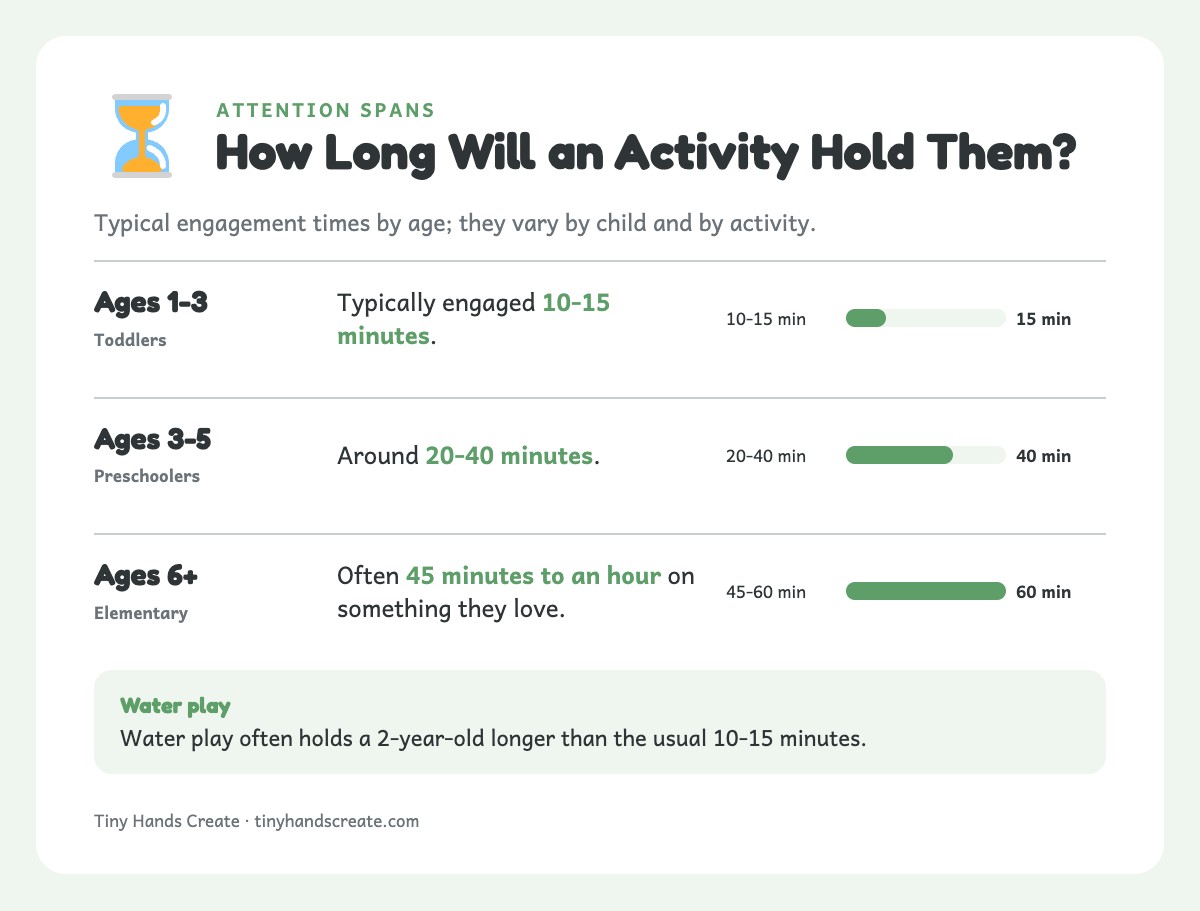
Two-year-olds are still developing the fine motor control most crafts require. Stay within arm’s reach the whole time, and empty the water as soon as play ends. Most activities hold a 2-year-old for 10-15 minutes, though water play often runs longer. Don’t expect a “finished product.” The pouring and scooping is the whole point.
How do I keep a rainy day mess contained without banning messy play entirely?
Designate a “mess zone” and keep messy activities inside it. A section of kitchen or bathroom floor with a plastic tablecloth, shower curtain, or towels down works well. Kids respond well to the boundary once it’s a routine (“messy stuff happens on the blue towel”). You’re not saying no to slime or shaving cream painting, just choosing where it happens.
My kids fight more on rainy days when they can’t go outside. What can I do?
This is extremely common and usually comes down to pent-up physical energy with nowhere to go. Build in a movement break before switching to a quieter activity. Freeze dance, an indoor obstacle course, or a few trips up and down the stairs all work. Kids with wiggles to burn struggle to sit still for a craft or game. Handle the energy first and the sibling friction usually drops.
How long should I expect a rainy day activity to actually hold my kid’s attention?
It varies a lot by age and by child. Toddlers (1-3) typically stay engaged 10-15 minutes, and preschoolers (3-5) around 20-40 minutes. Elementary-age kids (6+) can often sustain 45 minutes to an hour on something they love, like a stop-motion film or a building project. If an activity ends faster than expected, it didn’t “fail.” It just tells you what to expect from that activity next time.
What are good rainy day activities for multiple kids of different ages at once?
Look for activities with a low floor and a high ceiling: things a toddler can join simply while an older sibling adds complexity. Baking together, a shared art mural on butcher paper, a big floor puzzle, and cardboard box building all work well. Each kid can join at their own skill level, so nobody needs a separate activity.
Is it okay to just let my kids watch TV on rainy days sometimes?
Yes. A rainy day plan works best as a toolkit, not a strict schedule. Some screen time, especially to buy yourself 20-30 minutes to make lunch or take a work call, is a normal part of a full indoor day. The goal of a list like this isn’t zero screens, it’s having other options ready so screens aren’t the only option.
How do I build a rainy day activity stash without spending a lot of money?
Most of the best rainy day activities use things you already own. Think socks for puppets, cardboard boxes, couch cushions for forts, and paper for airplanes. Dry pasta or rice works for sensory bins once kids are about 3 and past mouthing. The few items worth buying are a basic watercolor set, a bag of loose parts, washi tape, and slime-making basics. Store them separately as “rainy day only” supplies and they last for months.
Final Thoughts: Pick Two or Three Rainy Day Activities
Rainy days used to feel like something to survive in our house. Now I pull out the bin and let a Tuesday be a little weird. You don’t need all of these at once. Pick two or three that match your kids’ ages and your energy today, and keep the rest for the next gray morning.