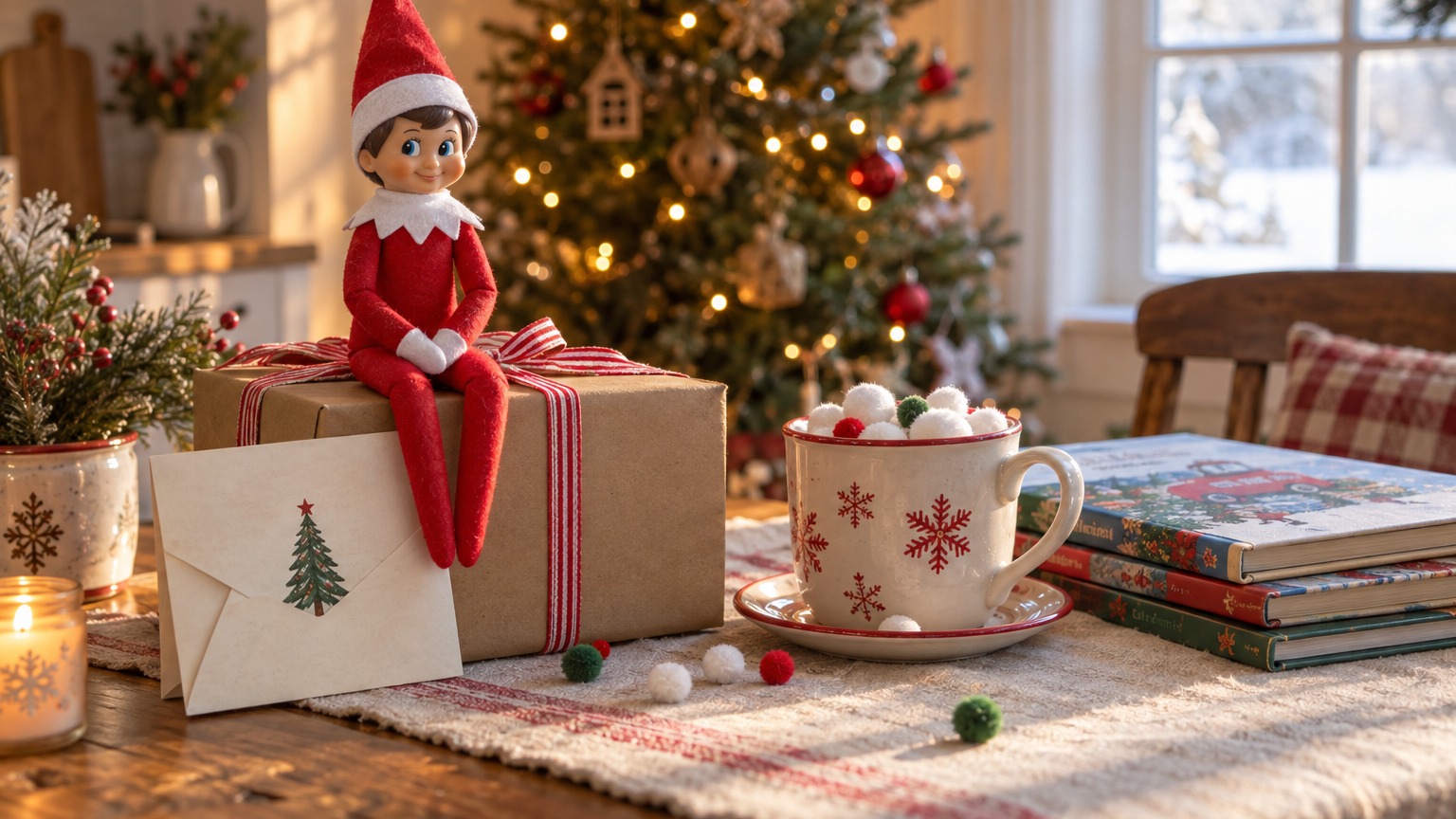
Elf on the Shelf Arrival Ideas for a First-Time Elf
Learn simple, low-prep Elf on the Shelf arrival ideas, age-tailored explanations, and clear house rules designed for kids ages 2–6.
- Choose low-prep arrival setups that you can realistically repeat each night.
- Explain the elf using 2–3 simple, consistent sentences tailored to your child's age.
- Keep toddler rules concrete and easy to remember, like 'look with eyes, not hands.'
- Decide whether to start December 1 for 24 nights or Thanksgiving weekend.
This post contains affiliate links. As an Amazon Associate I earn from qualifying purchases.
The first year we brought an elf home, I had a plan the size of a small Hollywood production. There would be a fog machine (a kettle). There would be a hand-lettered scroll (a coffee-stained napkin). There would be a tiny paper parachute, hand-cut, that would float down from the ceiling fan while my toddler gasped in wonder.
What actually happened: at 10:40 p.m. the parachute tangled in the ceiling fan. I ended up on a kitchen chair in my socks, unwinding paper towel and yarn without waking my two-year-old (learn from me: fan off, sturdy step stool). The elf landed in the fruit bowl. My daughter found him at 6:15 a.m., pointed, and said, “Man. Banana man.”
She loved him anyway. These elf on the shelf arrival ideas are for first-timers with kids ages 2-6: how to explain the elf, five low-prep arrivals, two copy-ready letters, and day-one house rules. If you’d like all 24 nights mapped out, there’s a matching printable: the Toddler Elf 24-Night Planner Card Pack.
Want an arrival tonight? Jump to the comparison table below.
In this article (13 sections)
- How to Explain the Elf to a 2- to 6-Year-Old
- Before Arrival Night: A 15-Minute Setup Checklist
- Five Low-Prep Arrival Setups, Compared
- The Five Arrivals, Step by Step
- The Arrival Letter: Two Versions to Copy
- Day-One House Rules That Make the Other 23 Nights Easy
- What the First Morning Looks Like (A Script)
- Keeping All 24 Nights Easy
- Making It Age-Appropriate: A Quick Guide by Age
- Troubleshooting Common First-Year Problems
- A Few Gentle Notes on Safety
- Frequently Asked Questions
- One Last Thing Before You Hit the Shelf
How to Explain the Elf to a 2- to 6-Year-Old
Here’s what I wish someone had told me before I spent forty minutes on a parachute: a first arrival doesn’t need to be impressive. It needs to be easy to set up, easy to understand, and easy to repeat on all 24 nights. You’ll be doing this at 11 p.m. when you’re tired and the kids are finally asleep, and a simple arrival tells you (and your kid) that this is going to be fun, not a nightly performance.
A note on timing: many families bring the elf in on December 1, which gives you 24 nights to Christmas Eve. Starting the day after Thanksgiving (November 27 in 2026) means about 28 nights. Use the 24-night plan and repeat a few “home base” spots for the extra nights, or keep it simple and start December 1. Either way, you have a week or two to get ready, and none of this takes long.
Before you plan a single arrival, decide on your elf story. Kids this age don’t need a lore document. They need two or three sentences that stay the same every time they ask, because they will ask, often at the dinner table, often in front of grandparents.
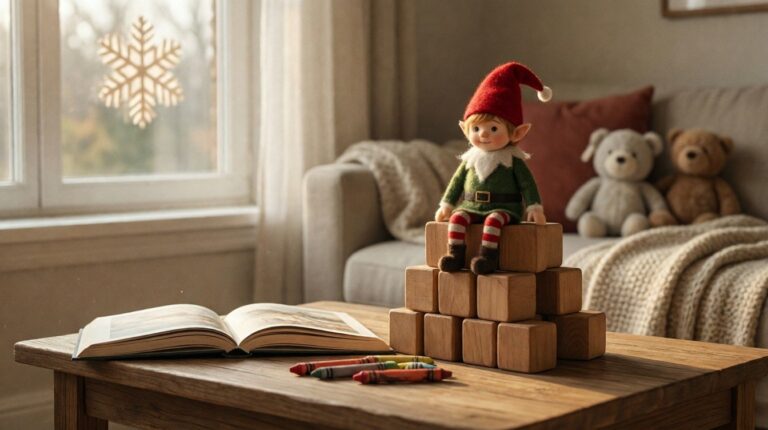
Here’s the short version of the tradition, in case you’re new to it. A scout elf arrives at your house at the start of December. Each night he flies back to the North Pole to report to Santa, and each morning he’s in a new spot. The kids look for him. There’s one big rule (more on that below). On Christmas Eve he goes home for the year.
How you tell it depends on your child’s age.
Ages 2 to 3: Keep it to a few concrete ideas
Toddlers live in the “right now.” A two-year-old doesn’t need to know about reports to Santa or the North Pole logistics. What helps:
- One sentence about who he is: “This is [Name]. He’s a Christmas helper who lives here until Christmas.”
- One sentence about what he does: “He sits and watches, and every morning he’s somewhere new.”
- One sentence about the rule: “We use our eyes, not our hands.” (Or “We look with our eyes.”)
Repeat those exact words every time. Toddlers learn rules through repetition, not explanation, so the same three sentences are what make it stick.
For December afternoons, when the elf has been found and everybody still has energy, our indoor activities for toddlers on rainy days list helps.
A word on the very youngest kids: if your toddler is under about two and a half, the elf may not register as a “thing” at all, and that’s fine. For them, a new spot each morning is simply a new object to point at and name. You’re building the tradition for the family, and the understanding comes later.
Ages 4 to 6: Give them a job and a little mystery
Four- to six-year-olds want a role and some stakes. They’ll ask follow-up questions, and some of them will test the rules on purpose. A story that works well at this age:
- “[Name] is a scout elf. He comes from the North Pole to help Santa learn what Christmas is like at our house.”
- “Every night, when we’re asleep, he flies home and tells Santa about our day, mostly the good parts.”
- “In the morning, he’s back in a new spot, and you get to find him.”
- “He has magic. If people touch him, the magic can get wobbly, so we look and don’t touch.”
Then give them a job. A 5-year-old who is “Head Elf Spotter” has a reason to get up and look, and a reason to protect the elf’s magic. Kids this age also love to name the elf, so let them pick. Vote on three finalists if siblings are involved, or you’ll spend the first morning refereeing.
The “reports to Santa” framing is optional. Some parents lean on it as a behavior tool; others skip it entirely because they don’t want the elf to be a spy. Some kids feel anxious when they feel watched, so I go light on the reports-to-Santa part. December should feel fun, not monitored. You can tell the story as “he’s here to join in the fun and bring a little surprise each morning” and not lose a thing.
The one answer to have ready: “Is he alive?”
At some point a four-year-old will ask whether the elf is real or whether he moves on his own. Decide your answer now so you don’t improvise at 7 a.m. Some families say, “He’s a magic helper. Let’s watch and see.” Some say, “It’s part of our Christmas fun.” Neither is wrong. What matters is that both parents and any grandparent who’s visiting give the same answer, so write it down and read it to each other.
Before Arrival Night: A 15-Minute Setup Checklist
The best arrivals are boring to prepare. Here’s what to do this week so the night itself takes five minutes. You can copy this checklist as is.
Arrival prep checklist
- Pick a name (or decide the kids will name him on day one, and write “kids name him” on your sticky note)
- Choose which of the five arrivals below fits your house
- Write or print-by-hand the arrival letter (wording in the next sections)
- Choose the “home base” spot: a shelf, the mantel, or a basket where he lands first
- Set a phone reminder labeled “ELF” for 9:30 p.m. every night, which you will not regret by night 6
- Decide the one-sentence rule you’ll tell the kids (see the house rules section)
- Hide the elf where nobody will stumble on him, like the top of a closet or a bin inside a bin
- Gather the supplies for your arrival and put them in one bag
- Tell the other adults (partner, grandparent, babysitter) the rules and the story
Don’t skip that reminder. Many parents forget to move the elf at least once, usually right when the novelty wears off and the exhaustion sets in.
A mess warning from a mom who has swept up many an ill-advised flour angel: skip flour, glitter, and anything that “just needs a quick vacuum” on your first arrival. Save your energy for later. A toddler who finds sparkly chaos on day one will expect it every day.
Five Low-Prep Arrival Setups, Compared
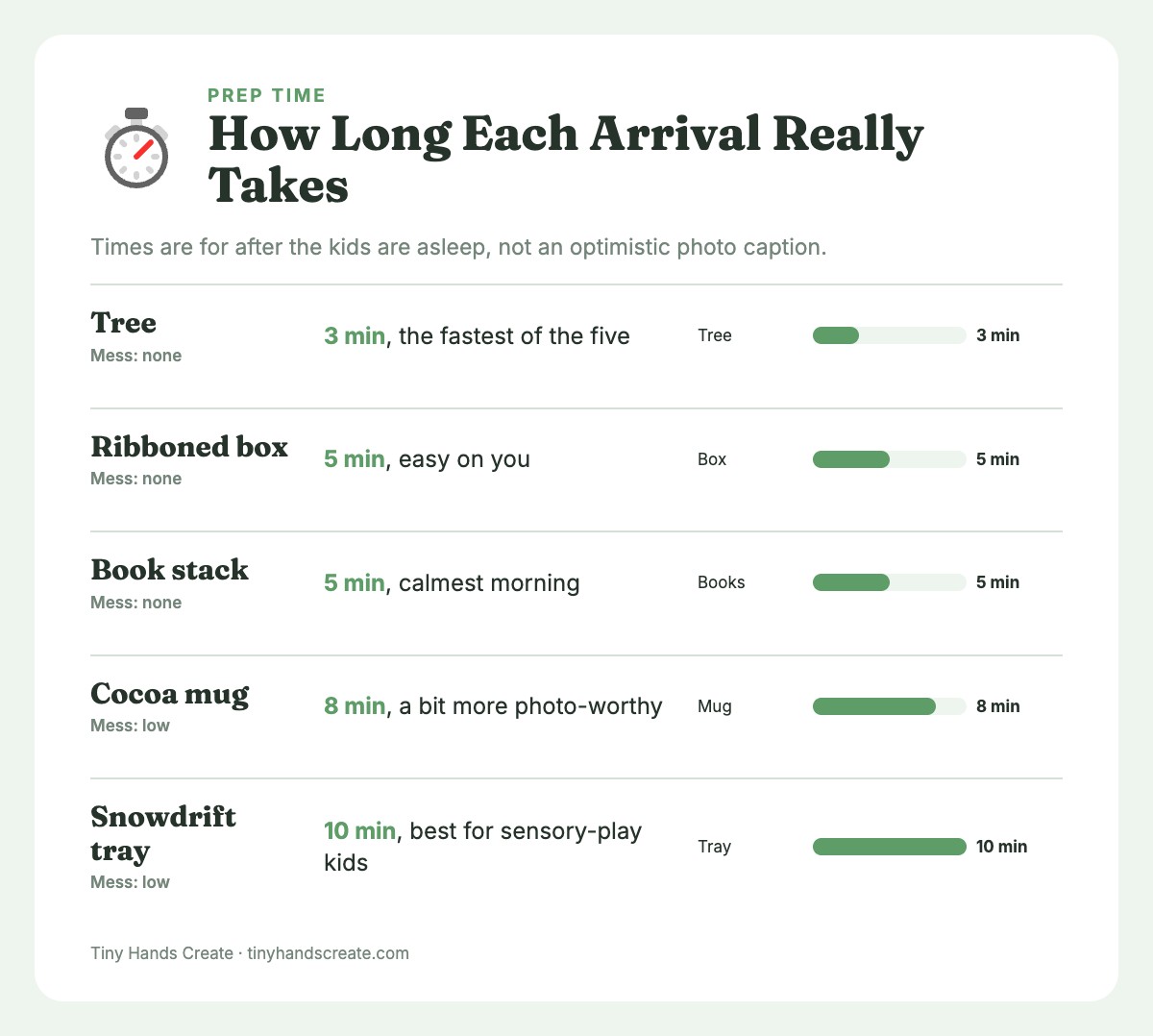
Here’s the comparison. Prep time is what it actually takes when you’re doing it after the kids are asleep, not what an optimistic photo caption says. Mess is rated on a scale from none (nothing to clean up) to low (a few pieces of something).
| Arrival | Prep time | What you need | Mess | Best for |
|---|---|---|---|---|
| 1. The Ribboned Arrival Box | 5 min | Small box or gift box, ribbon, letter, elf | None | Ages 2-6, tidy families |
| 2. Landed in the Tree | 3 min | Christmas tree (or any greenery), letter, elf | None | Ages 2-6, if you have a tree up by Dec 1 |
| 3. The Cocoa Mug Arrival | 8 min | Big mug, cotton balls or marshmallows, letter, elf, small plate | Low | Ages 2-6: cotton balls or marshmallows for 4+ only; under 4, a folded dish towel or an empty mug |
| 4. The Snowdrift Tray | 10 min | Baking tray, crumpled white paper or large white felt pieces, letter, elf | Low | Ages 4-6 (supervised only for 3), kids who love sensory play |
| 5. The Book-Stack Landing | 5 min | 4-6 picture books, small gift bag or envelope for the letter, elf | None | Ages 2-6, bookish kids |
If you want my honest ranking for a first-timer: the Ribboned Arrival Box and the Book-Stack Landing are the easiest on you, and the Tree is the fastest. The Cocoa Mug and Snowdrift Tray are a bit more photo-worthy and need a few more minutes.
Choose based on the child, not on what looks best online. A kid who is scared of surprises might prefer the box, since it announces itself with a ribbon. A kid who loves a big discovery might love the tree. And if your two-year-old puts everything in their mouth, skip the marshmallows. More on that in a moment.
The Five Arrivals, Step by Step
1. The Ribboned Arrival Box
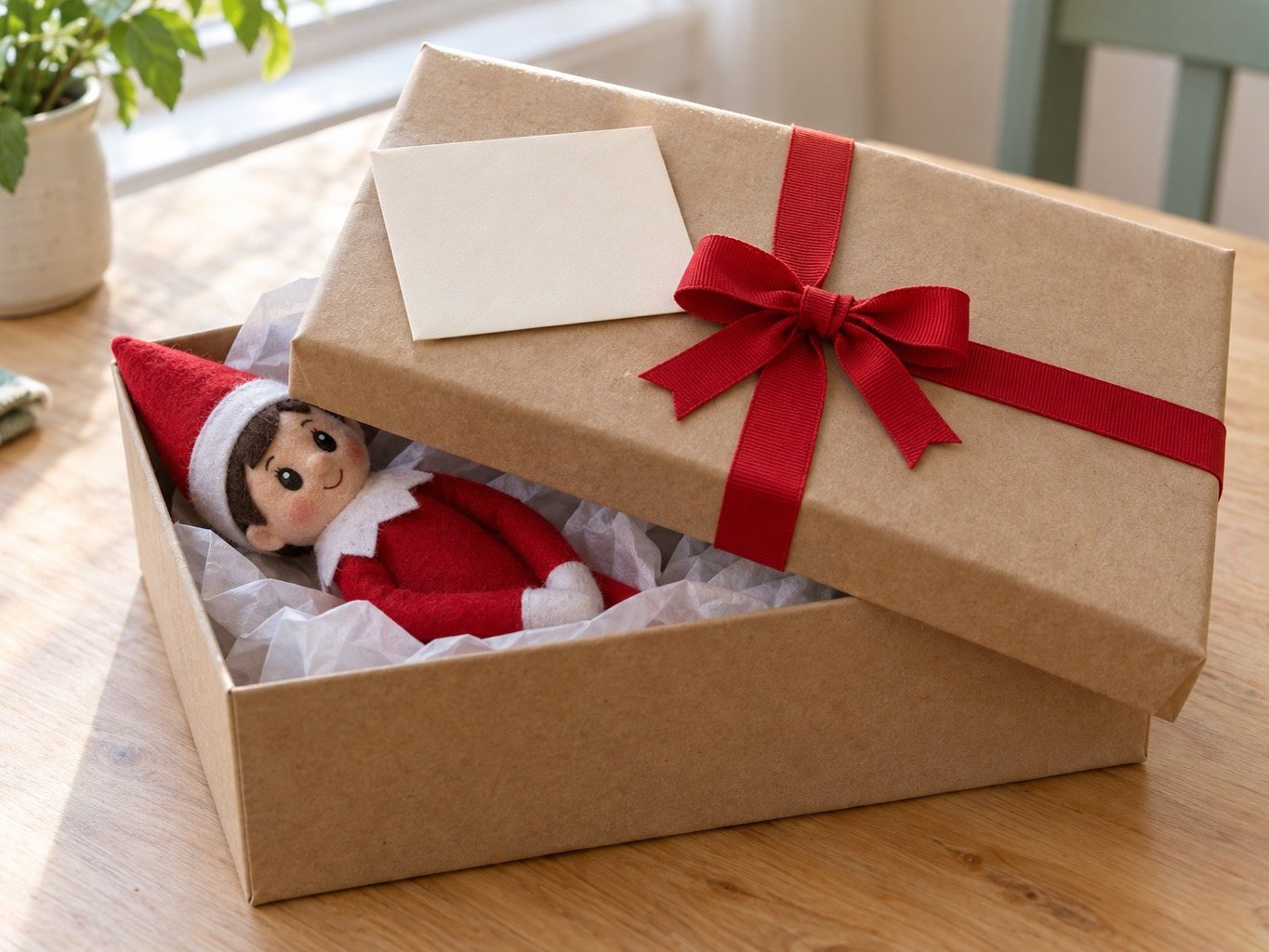
This is the classic. The elf arrives in a small box, with a letter tucked on top.
What to do:
- Pick a box. Find one big enough for the elf to lie flat: a shoebox, a gift box, or a cardboard box from your recycling. To dress it up, wrap just the lid in kraft or plain paper so it still comes off.
- Add a ribbon. Tie it around the whole box. A loose bow works, so don’t stress about perfect loops. For toddlers, keep ribbon pieces under about 6 inches.
- Top it with the letter. Tuck it in an envelope with the kids’ names on the front.
- Set it out. Pick somewhere visible, like the kitchen table, the front-door bench, or the coffee table.
The morning: Your kids find the box and, usually after a very long pause, open it. Read the letter out loud. The ribbon goes straight in the trash, but they can touch the box and the letter, because the no-touching rule (which the letter introduces) only applies to the elf.
Why I like it: Toddlers love having something to open, and older kids love having something to wonder about. Once the elf is out, the box becomes a hiding spot for a later night, a craft box, or a mailbox for letters to him. If you like cardboard, our cardboard box crafts for kids list has more ways to use it.
Mess level: None. The ribbon goes in the trash as soon as the box is open.
2. Landed in the Tree
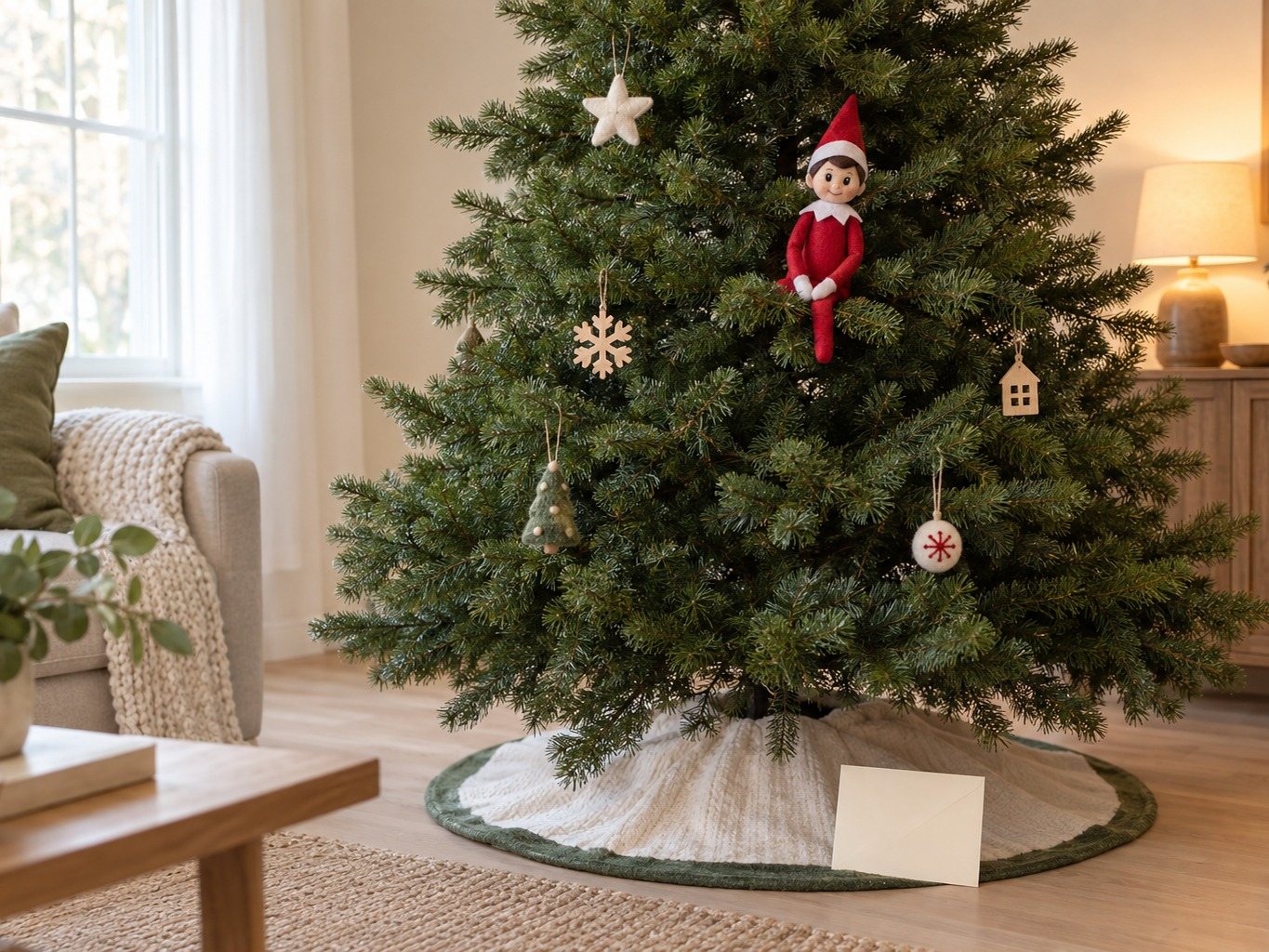
This is the fastest one in the book. The elf arrives sitting in the branches of your Christmas tree, as if he landed there on the way in.
What to do:
- Tuck him in. Set the elf in the branches at a height the kids can see but can’t easily reach. Adult eye level is usually too high for a toddler, which is the point.
- Prop the letter. Lean it against the tree skirt. Skip clips and clothespins on low branches, since they’re small parts at toddler height.
- Check his seat. Make sure he’s secure. Elves topple off branches.
The morning: The kids walk in and the tree already looks special in the morning light, now with a visitor. Expect squealing.
Safety firstAnchor the tree, keep small or breakable ornaments off the lower branches, and don’t encourage a toddler to reach or climb for him. Keep the elf away from lights, cords, and any heat source, and avoid heavy ornaments above him that could swing onto little heads.
Why I like it: It takes three minutes and looks a little magical without any props. The tree also works as an easy “home base” spot on later nights.
Mess level: None.
3. The Cocoa Mug Arrival
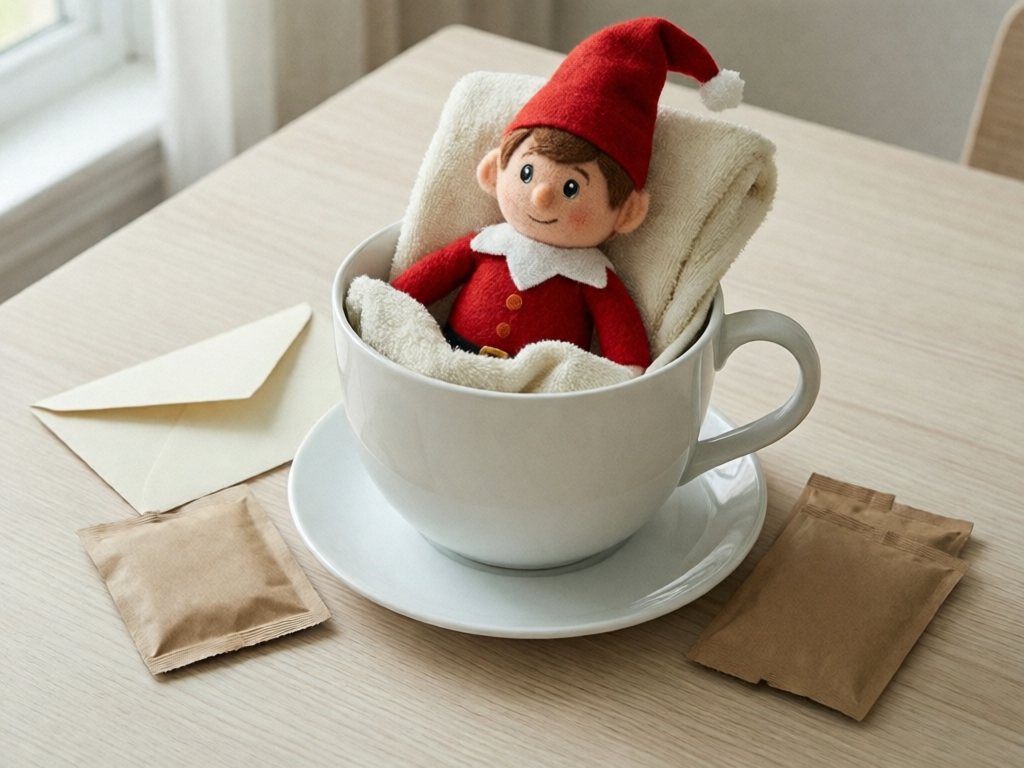
The elf is perched in a giant mug, as if he’s taking a warm bath in hot chocolate.
What to do:
- Grab a big mug. Use the biggest one you own (a soup mug is perfect).
- Fill the top (ages 4 and up only). Tuck the elf in with cotton balls or real mini marshmallows. For under-4s, see the safety note below.
- Plate it. Set the mug on a small plate and put the letter next to it, with a couple of cocoa packets if you like.
Safety firstWhole mini marshmallows and loose cotton balls can be a choking or mouth-stuffing hazard for kids under 4. If you have a child under 4, leave the mug empty and tuck the elf in with a folded dish towel instead. Better a boring mug than an emergency.
The morning: Your kids find him in a “hot chocolate bath,” and many families make real cocoa as part of the first-morning ritual. Pour it into a regular mug (not the elf’s!), let it cool until just warm before serving young children, and keep hot mugs out of reach.
Mess level: Low. A few cotton balls or marshmallows will roll around, and you’ll find one in your sock later.
4. The Snowdrift Tray
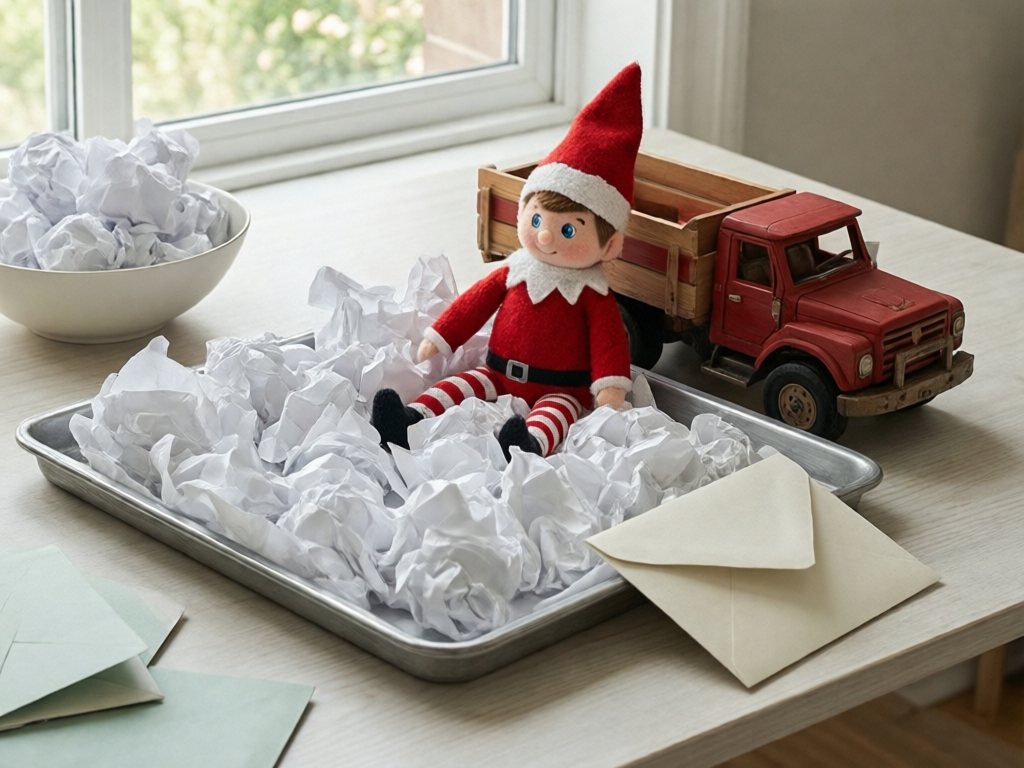
For kids who love sensory play, the elf arrives in a “snowdrift.”
What to do:
- Make the snow. Line a baking tray or a shallow bin with crumpled white paper or large white felt pieces.
- Settle him in. Nestle the elf into the “snow” and add a prop or two, such as a big toy truck or a stuffed animal. For kids under 4, every prop should be too big to fit through a toilet-paper tube.
- Add the letter. Put it on the tray or beside it.
The morning: The kids find the tray and want to play with the snow. This is the rule’s first real test, because the snow is touchable and the elf isn’t. Set the rule clearly in the letter, then redirect the wanderers to a second bowl of crumpled white paper you’ve set out.
For ages 4 and up, a bowl of white pom-poms, tongs, and a muffin tin makes a sweet little sorting game. If your toddler loves this sort of thing, our fall sensory bin is a similar setup with seasonal bits.
Safety firstSkip cotton balls and pillow stuffing here. They are mouthing, choking, and inhalation hazards. Use paper or felt, and stay close if a 3-year-old is playing.
Mess level: Low. Paper scraps travel. Do it on a tray, not directly on the couch.
5. The Book-Stack Landing
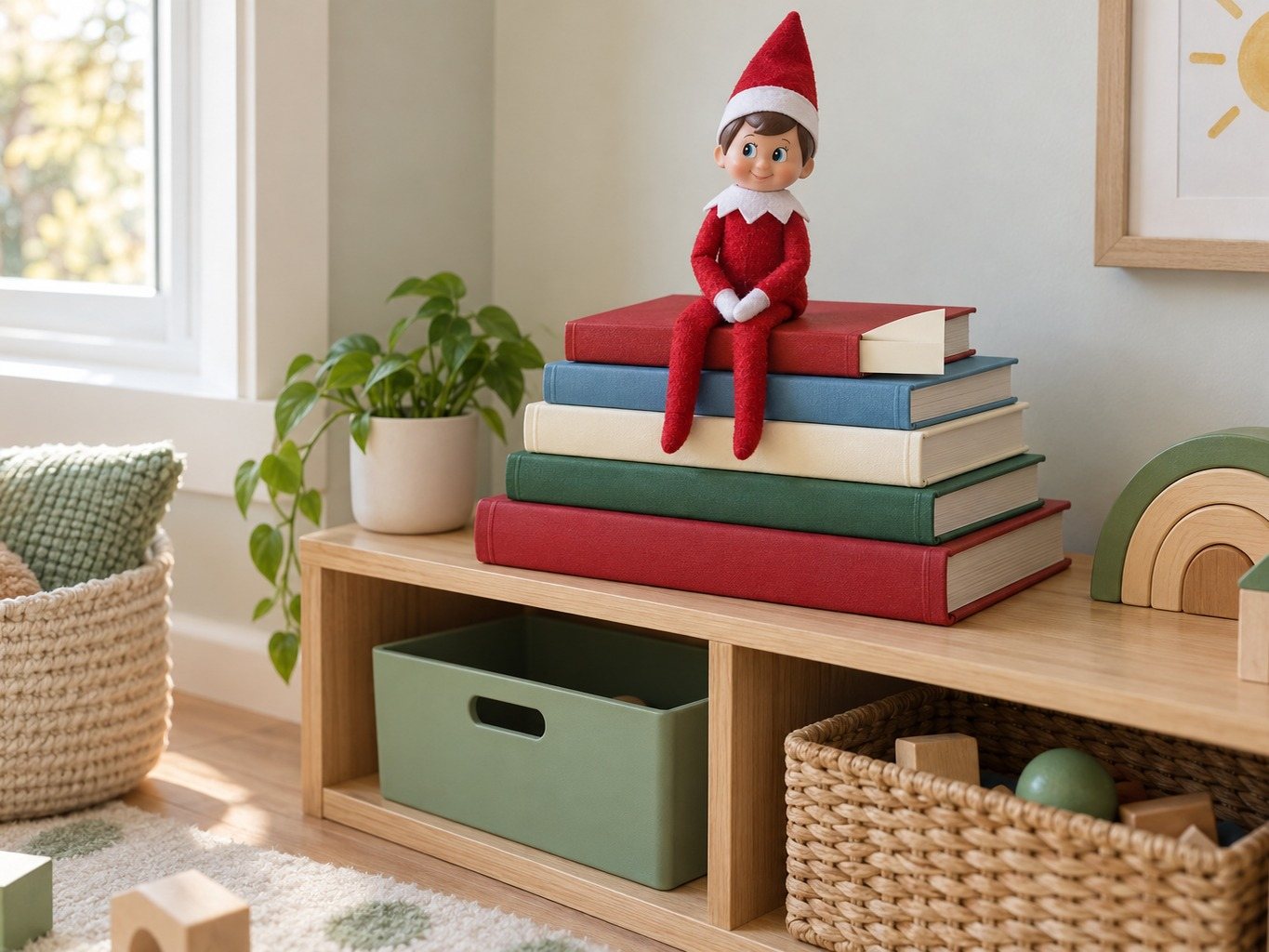
The elf arrives on a stack of Christmas picture books, with the letter tucked inside the top book like a bookmark.
What to do:
- Stack the books. Pick four to six picture books and stack them with the biggest one on the bottom.
- Seat the elf. Sit him on top.
- Tuck in the letter. Slip it into the top book like a bookmark, or lean the envelope against the stack.
The morning: Your kids find the elf, read the letter, and immediately want you to read the stack with them. It’s the calmest arrival of the five, and it sets up a morning routine: elf, letter, and a book or two before breakfast.
If your child has trouble sitting still for books, this is a gentle way to build that up over 24 mornings. It also pairs nicely with independent play for toddlers, because a kid used to quiet looking-and-reading time settles into solo play more easily while you sort out the day.
Mess level: None.
A sixth idea I’m deliberately leaving out
You’ll see a lot of arrival ideas online that involve flour “snow angels,” glitter trails, or toilet paper tossed through the house. They look great in photos. For a first-time elf, I’d skip them. They make the arrival so big that every night after feels like a letdown, and they make you the cleanup crew by day two. If you want a big night later in the month, like a pom-pom “snowball fight” for kids 4 and up, save it for a night when you have energy.
The Arrival Letter: Two Versions to Copy
The letter is the heart of a first arrival. It does three jobs at once: it tells your kid who the elf is, states the rule, and sets expectations for the month.
Here are two versions you can copy straight from the page. Replace the bracketed bits with your own details.
Arrival letter for ages 2 to 3
Hi [Child’s name]!
I’m [Elf name]. I flew all the way from the North Pole to be your Christmas helper!
I’m going to sit and watch. Every morning I’ll be in a new place. Can you find me?
Use your eyes, not your hands. That keeps my magic safe.
I’m so happy to be here!
Love, [Elf name]
Read it out loud in a bright, slow voice. Point to the elf when you say “I’m [Elf name].” Point to your eyes when you say “use your eyes.” Toddlers learn rules through gestures as much as words, so make it a little game.
Arrival letter for ages 4 to 6
Dear [Child’s name] (and [sibling’s name]),
My name is [Elf name], and I’m a scout elf from the North Pole. Santa sent me to your house this year to see how Christmas happens here, and I can’t wait!
Here’s how it works. Each night, after everyone is asleep, I fly back to the North Pole. In the morning, I’ll be sitting in a new place somewhere in the house. Your job is to find me. Check high and low!
Here’s my one big rule: please don’t touch me. My Christmas magic is delicate, and it needs to stay strong for the flight. You can wave, whisper, and tell me about your day. Just keep your hands to yourself.
I can’t wait to spend Christmas with you.
Your friend,
[Elf name]
You’ll notice neither letter threatens, scolds, or hints that the elf is judging behavior. That’s on purpose. The elf is a fun guest, not a security camera. If you want to add a goal, like “I’d love to see you being kind to each other,” that’s a gentle option for the older version.
Tips for writing your own version
- Use the child’s name. A letter that says “Dear Marcus” gets far more attention than one that says “Dear child.”
- Print it in clear block capitals. Kids this age can’t read cursive, and big block letters help a 5- or 6-year-old who’s just starting to sound out words.
- Keep it short. Stay under 100 words for the younger version, or you’ll lose a toddler halfway through. Six-year-olds start to wiggle during a long letter, too.
- Optional: disguise your handwriting. If you’re feeling fancy, write with your non-dominant hand so your kid doesn’t recognize the writing. Still stick to block capitals.
- Roll or fold it. A scroll tied with ribbon (or a folded note with a seal sticker) feels more special than a plain sheet. If you like the idea of a little paper craft to go with it, a letter to Santa for kids who can’t write yet pairs nicely, because the kids can write (or draw) back to the elf.
Letting the kids write back
For the 4-to-6 crowd, a reply letter is a great first-morning activity. Offer paper and crayons and say, “Do you want to tell [Elf name] something?” A five-year-old might draw a picture of the family. A three-year-old might scribble and tell you what it says. Leave the reply by the elf’s spot, and the next morning there may be a tiny note back. That’s one more night of the tradition you don’t have to plan.
Day-One House Rules That Make the Other 23 Nights Easy
This is the part I wish I’d taken more seriously our first year, because it’s where the tradition either stays fun or turns into a daily argument. Set these on day one, in a calm moment, with the whole family.
The rules checklist
Copy this list into your notes app or onto a sticky note on the fridge:
Elf house rules
- We look with our eyes, not our hands. The elf’s magic stays strong if nobody touches him. (Accidents happen, and the plan for them is just below.)
- The elf is a helper, not a boss. He doesn’t tell anyone what to do, and nobody is “in trouble with the elf.”
- Everyone gets a turn to find him. Siblings take turns being the first to spot him, or everyone yells “found him!” together.
- No elf talk at bedtime. The elf is a morning thing. Bedtime is for sleep.
- Keep it a secret from other kids until the family decides it’s okay to share. (Helpful if you have cousins, friends, or classmates with different traditions.)
- The elf’s visit ends on Christmas Eve. He goes home until next year.
Keep it to six or fewer. A toddler can handle one rule. A five-year-old can handle all six.
The “he got touched” plan
Sooner or later, someone will touch the elf. A two-year-old will grab him without thinking, and a five-year-old will “just check” if he’s real. Don’t panic and don’t scold. Pick your family’s response ahead of time:
- Quick fix: “Oh, the magic got a little wobbly. Let’s leave him alone for a day and he’ll recharge.” Then, honestly, just keep going. A toddler won’t track it.
- Slightly more ritual: Leave a tiny note from the elf: “Thank you for the hug. My magic is a little tired today. I’ll be back tomorrow!” And leave a small treat, like a sticker, to show it’s okay.
My own version: “Oops, he got a touch! Let’s be extra gentle tomorrow,” and we move on. If your child is upset about it, reassure them: “The magic is okay, I promise. He just needs a little rest.” A tiny note, a sticker, and a hug usually does it.
Rules for the grown-ups
The family rules aren’t just for kids. A few for the adults:
- Decide who moves him. If both parents move him, you’ll end up with an elf who stays put two nights in a row because each of you thought the other did it. Pick one mover, or split it: one adult on odd nights, the other on even nights.
- Don’t promise what you can’t deliver. If your kid asks, “Will the elf bring me a Lego set?” the answer should be “He doesn’t bring presents. He brings fun.”
- Don’t use him as a threat. This is the single most common way the elf tradition goes wrong. “The elf is watching” turns a playful guest into a nag, and a three-year-old who’s afraid of the elf is not having a good December.
- Go easy on yourself. You will miss a night. Keep a backup line ready (there are a few under “Know when to let a night slide” below) and take the pressure off.
What the First Morning Looks Like (A Script)
The arrival is a moment, so plan the morning, too. Here’s a simple flow that works for most families.
- Wait for the kids to find the elf. Don’t lead them. Hang back in the kitchen with your coffee and listen for the gasp.
- Let them react. Some kids shriek, some stare, some whisper, and a few cry because a stranger is in the house. All are normal. If your child is nervous, say, “He’s a friendly helper. He can sit right there and we can say hi from here.”
- Read the letter out loud. Sit with the kids, and read slowly.
- Name him. If you haven’t picked a name, now’s the time.
- Review the rule in one sentence. “Eyes, not hands.”
- Do one small thing together. Hot cocoa, a book, a reply letter, or a few minutes of drawing. This ties the elf to a happy routine.
- Take one photo. One. The rest of the month, you’ll be glad you didn’t commit to a nightly photo shoot.
If you need an easy follow-up activity, try salt dough ornaments for toddlers. Salt dough is not edible, so supervise closely and keep it away from kids who mouth things. A few Christmas crafts for 2-year-olds can also fill an hour without a lot of supplies.
Keeping All 24 Nights Easy
Arrival night is the easy part. The real marathon is the three weeks that follow. Here’s how to keep it light.
If you’d like the whole month mapped out, the Toddler Elf 24-Night Planner Card Pack plans all 24 nights for you.
Plan “home base” spots
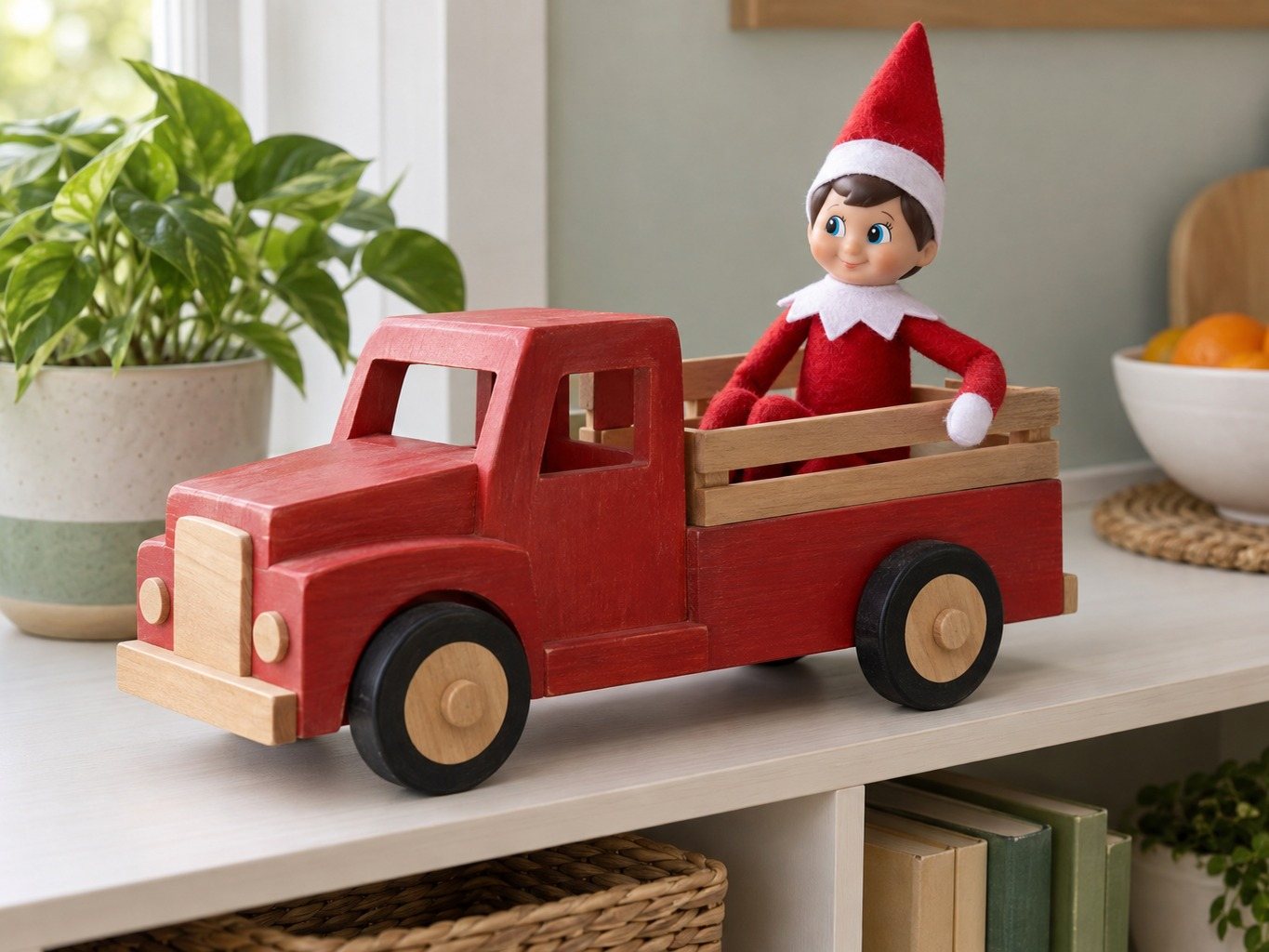
Make a short list of 8 to 10 spots in your house where the elf can sit with zero setup. Think a bookshelf, the fruit bowl, a plant, a stuffed animal pile, the TV console, or the bathroom sink (clean, of course). Then rotate through them. You don’t need 24 unique scenes. A five-year-old will be thrilled to find the elf in the same shelf spot for the third time, as long as he’s doing something slightly different.
Make a “ten-minute” rule
If a move takes more than ten minutes, it’s too complicated for a normal night. A few that fit:
- Elf sits in a toy truck or train.
- Elf holds a small sign: “Good morning!”
- Elf is “reading” a picture book.
- Elf is tucked into a stuffed animal’s arms.
- Elf is sitting on a high bookshelf, out of reach. Keep him and everything else well away from blind and curtain cords.
- Elf is in the cereal cupboard, peeking out.
Mix in “elf visits” that are really activities
Some of the best elf mornings double as the day’s activity. Leave a small item with the elf, and you’ve planned the morning for free:
- A little note and a set of crayons: “Draw me a Christmas tree!”
- A bag of cotton balls and tongs: a snow-moving game (ages 4 and up; for under 4, use large soft items like a dish towel or big felt pieces).
- A paper chain strip: “Help me make a countdown.”
- A pair of mittens and a bowl of pom-poms: “Pom-pom snowballs!” (ages 4 and up; for under 4, use large soft items like a dish towel or big felt pieces).
If you want a ready-made countdown to pair with the elf, our printable advent calendar with activities for toddlers has a gentle structure you can follow. Pairing the two means the elf’s spot is one thing to find and the advent activity is the other thing to do.
Know when to let a night slide
You will forget. Maybe once, maybe three times. Here are the backup lines:
- “He’s so tired from the trip that he stayed put today.”
- “Maybe he’s playing hide-and-seek. Let’s look for his new spot.”
- “He’s practicing being still. Pretty good, right?”
Most kids will accept it without a second thought. Don’t spiral. A consistent tradition matters more than a perfect one.
Make a plan for sick days, travel, and sleepovers
If you’re traveling, the elf can come along (in a bag, in the car). Or he can stay home and “wait” with a note: “I’ll be right here when you get back.”
If a child is sick, keep the elf low-key. A sick kid does not need a big production.
For sleepovers and grandparent visits, share the rules with the host ahead of time. A grandparent who picks up the elf “just to look” will cause a minor crisis, so a quick text beforehand is worthwhile.
Handle sibling squabbles early
With two or more kids, the biggest elf conflict is who gets to spot him first. A few easy fixes:
- Take turns by day. Monday is Sibling A’s day to spot him, and Tuesday is Sibling B’s.
- Everyone “finds” him together. Kids stand at the end of the hall and count to three, then run to find him.
- The finder tells the family where he is in a “whisper reveal” instead of grabbing him.
Making It Age-Appropriate: A Quick Guide by Age
| Age | What they get | What to skip |
|---|---|---|
| 2 | A new spot each morning, a one-line rule, pointing and naming | Long letters, marshmallows, cotton balls and other small parts, complicated hunts |
| 3 | A simple story, a name, helping “find” him | Marshmallows, cotton balls, and other small parts (use a dish towel or large soft items), threats |
| 4 | A name vote, a job (spotter), a reply letter | Long “reports” about behavior |
| 5 | Mini mysteries, notes back and forth, small clues | Anything that feels like surveillance |
| 6 | Writing back, planning “where he’ll go next,” helping to move him | Over-explaining the magic; they may already be curious about how it works |
If a six-year-old starts poking at the logic (“how does he fly if he can’t move?”), a good answer is: “That’s the magic of Christmas. What do you think?” Many kids at this age enjoy playing along even if they have suspicions. You can also let them in on a job: “Want to help me pick where he goes tomorrow?” That turns the tradition into a shared game, not a secret that eventually falls apart.
Troubleshooting Common First-Year Problems
My toddler is scared of the elf
Some kids find the doll’s stare unsettling. Start him somewhere he isn’t looking straight at your child, or sit him facing away at first. Let your child approach in their own time.
If it doesn’t improve after a few days, it’s fine to retire him early. There’s no rule that says he has to stay all 24 nights.
My kid is too curious and keeps checking if he’s moved
That’s actually a good sign. Make it a game: “Let’s check at breakfast!” Or encourage a “guess where he’ll be” the night before.
My kid is bored of him by day five
Novelty fades. Add a small reason to look: a note, a mini challenge, or a treat. Or just let the elf rest in a place for two days. Kids don’t need a daily hit.
I’m exhausted
Then reduce the elf to a simple pattern: three spots in rotation. Some families only move him every other night. It’s still a tradition.
My partner is not into this
Share the load. Give them a job that’s easy, like writing the letters or choosing the spots on odd nights. A tradition both adults like is a tradition that lasts.
A Few Gentle Notes on Safety
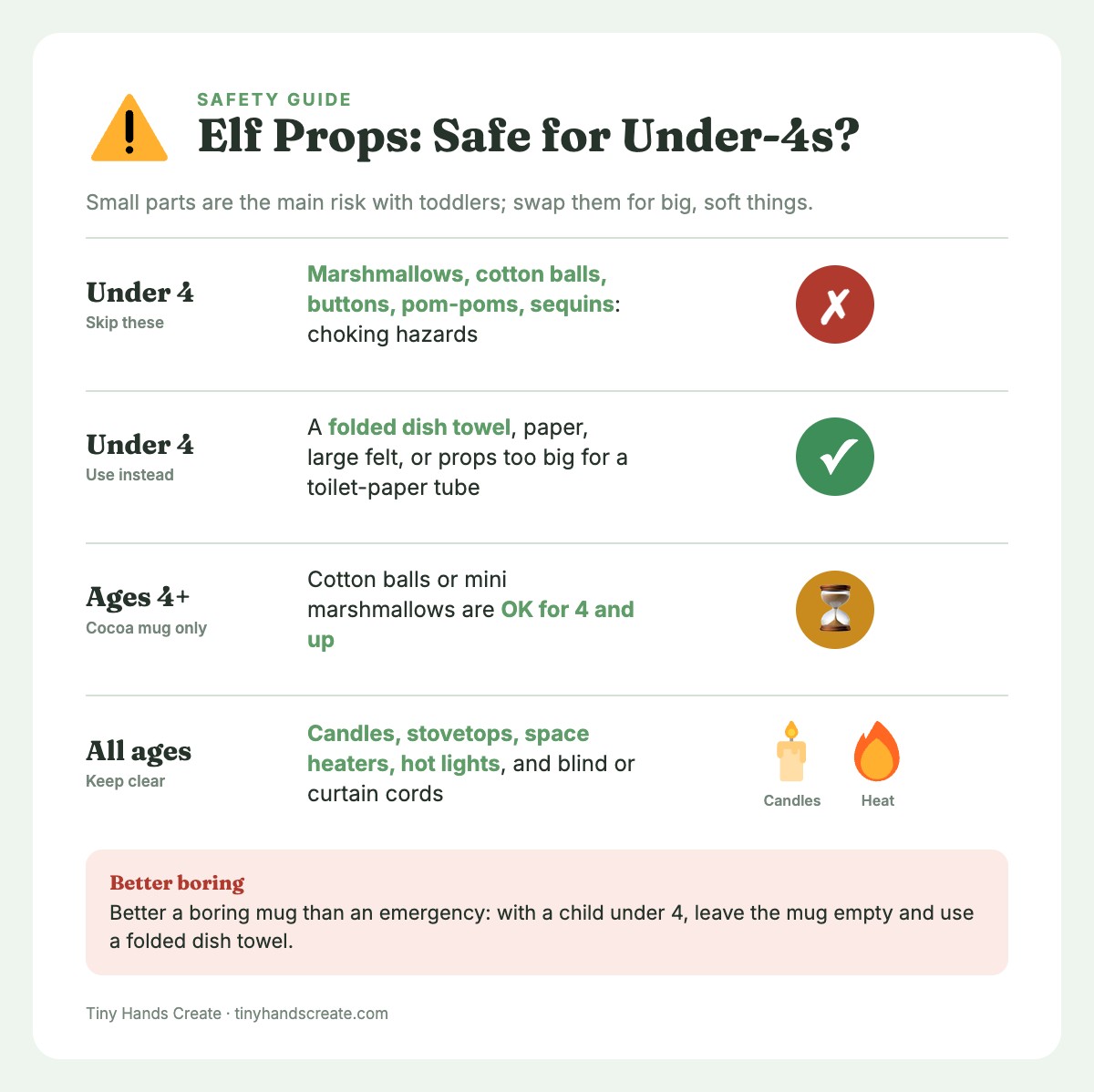
Each arrival above has its own safety note. Here’s the whole-month version.
Safety firstKeep marshmallows, cotton balls, buttons, pom-poms, sequins, and other small parts away from kids under 4, since they’re choking hazards. Keep the elf and every prop away from candles, stovetops, space heaters, and hot lights, and well clear of blind and curtain cords. Skip glitter and tape on skin. If you use food in a setup, clear it away by the next evening so it doesn’t spoil or attract pests. And never perch him anywhere unstable: a lightweight tabletop tree plus an elf is a toppling recipe.
Frequently Asked Questions
What are the easiest elf on the shelf arrival ideas for a first-time elf?
The easiest arrivals take under ten minutes and use things you already own. The ribboned arrival box, the tree landing, and the book-stack landing all need almost no prep and make no mess. If you can find a box, a ribbon, and a letter, you can pull off a first arrival in five minutes. Save the fancier ideas for later in the month, when you’ve found your rhythm.
What should an elf on the shelf arrival letter say?
A good arrival letter does three things: it introduces the elf by name, explains that he’ll be somewhere new each morning, and gives the one rule, which is to look with eyes and not touch. For a 2- to 3-year-old, keep it to four or five short lines. For a 4- to 6-year-old, add a sentence about the North Pole and a friendly invitation to find him. Use the child’s name and avoid anything that sounds like a threat. Both sample letters are above on this page, ready to copy.
When should the elf arrive?
Many families bring the elf on December 1, which gives you 24 nights until Christmas Eve. Others start the day after Thanksgiving, which adds a few extra nights. For a first-timer, I’d lean toward December 1 because it’s easy to remember and the countdown feels natural. If you’re starting late, it’s perfectly fine to begin any night in December, and the elf can simply say he’s been delayed by weather at the North Pole.
Is the elf too scary or too much for a two-year-old?
It depends on the child. Some two-year-olds adore the elf and some find the stare unsettling. Try a gentle introduction: sit him in a neutral spot, don’t make a big announcement, and let your toddler approach at their own pace. Keep the rule to one simple phrase, like “eyes, not hands.” If your child seems frightened after a few days, put the elf away without fuss. You can try again next year when your child is a bit older.
What do I do if my child touches the elf?
Stay calm and decide your family’s response ahead of time. The simplest approach is a light line like, “Oops, his magic needs a rest today, so let’s give him some space.” You can leave a tiny note from the elf the next morning, saying he’s feeling better. It doesn’t need to be a big deal, and for toddlers, it usually isn’t. Most kids forget within a minute.
How do I make an elf on the shelf arrival box?
Use any small box that’s big enough for the elf to lie flat, such as a gift box or shoebox. Tie a ribbon around it, put the arrival letter in an envelope on top, and set it where your kids will see it first thing in the morning, like the kitchen table or the front door bench. If you want a quick upgrade, wrap only the lid in plain paper so it still opens easily. The box can be reused later as a hiding spot or a mailbox for letters to the elf.
How do I keep the elf from becoming a nightly chore?
Plan simple, repeatable moves and set a ten-minute limit on each night’s setup. Keep a short list of easy “home base” spots, set a phone reminder, and share the job with another adult if you can. Have backup lines ready for the night you forget, such as “He was so tired from the trip that he stayed put.” Many families also move the elf every other night after the first week. A calm, consistent tradition beats an elaborate one that burns you out by December 10.
One Last Thing Before You Hit the Shelf
A first-time elf doesn’t need a perfect arrival, a fancy scene, or a photo-ready setup. He needs a spot, a short letter, and a clear rule: look with your eyes, not your hands. If you get those three right on day one, you’ve done the hard part. The 24 mornings will be a string of tiny, silly discoveries, like a banana man in the fruit bowl, and your kid will remember those small moments long after the details fade.
Pick one arrival from the table, copy the letter that fits your child’s age, set your phone reminder, and go to bed. Tomorrow morning you’ll hear the gasp from the kitchen, and that’s the whole point. Happy December, mama.