Water Beads Activities for Kids: Safe Sensory Play by Age
Learn why real water beads are unsafe for children, especially those under five, and discover taste-safe gel alternatives with age-by-age activity recommendations for safe sensory play.
- Avoid real water beads, especially for kids under 5 or those who mouth toys.
- Opt for taste-safe gel alternatives like chia or basil gel for sensory play.
- Seek immediate ER care if your child swallows a real water bead.
- Match sensory materials to your child's age for safe play.
- Maintain arm's reach supervision for all sensory activities.
This post contains affiliate links. As an Amazon Associate I earn from qualifying purchases.
In this article (11 sections)
- What Are Water Beads?
- Safety First: What Every Parent Needs to Know
- Age-by-Age Guide
- Taste-Safe Alternatives to Real Water Beads
- Water Bead Activities for Kids: Sensory Bin Ideas
- Learning Activities with Taste-Safe Gel (Ages 4+)
- Creative Gel Play Ideas (Ages 3+)
- At a Glance: Every Activity, Material, and Age
- If You Already Own Real Water Beads (Not Recommended)
- Cleanup, Storage, and Disposal
- Frequently Asked Questions
What Are Water Beads?
Real water beads are unsafe for children under 5. This guide leads with the safety rules, then gives you four taste-safe gel swaps and water beads activities sorted by age.
Water beads (also called gel beads, water pearls, or hydrogel beads) start as tiny, hard pellets. They swell into soft, marble-sized orbs after soaking. They’re smooth, bouncy, and cool to the touch, which is why kids love them. The swaps below give you the same squish with far less risk.
Safety First: What Every Parent Needs to Know
Safety firstSkip real water beads for babies, toddlers, and any child under 5. Skip them too for any child who still puts things in their mouth.
The U.S. Consumer Product Safety Commission has warned that swallowed beads keep absorbing fluid inside the body. They can swell and block the intestines, sometimes needing surgery, and they may not show up on X-rays. The CPSC has reported serious injuries, including deaths, in young children.
We don’t recommend real water beads at any age, so our default is simple: don’t buy them. Every activity on this page uses a taste-safe gel or plain water instead.
This matters most if a younger child lives in or visits your home.
If you already own some and choose to use them anyway, follow these rules every single time:
- Only for children age 5 and up who reliably no longer mouth toys. The label’s minimum age has to allow it too.
- An adult stays within arm’s reach for the entire activity, at every age, no exceptions.
- Count the beads out and count them back in, so you know if one is missing.
- Sweep and check the floor when you’re done, and keep the bin lidded between uses.
- Store dry and hydrated beads in a container with a locking lid, up and away from younger siblings.
- Never let beads go down a drain, because they keep swelling and can clog pipes.
- Beads can end up in ears and noses at any age, so watch closely.
EmergencyThis applies to real water beads. If a child swallows one, or you think they might have, go to the ER right away. Don’t wait for vomiting, belly pain, or unusual sleepiness, because symptoms can be delayed.
If a bead is in the nose or ear, get urgent medical care and don’t try to dig it out. Call 911 for any trouble breathing.
In the U.S., Poison Help (1-800-222-1222) can advise you, but don’t let the call delay care.
Age-by-Age Guide
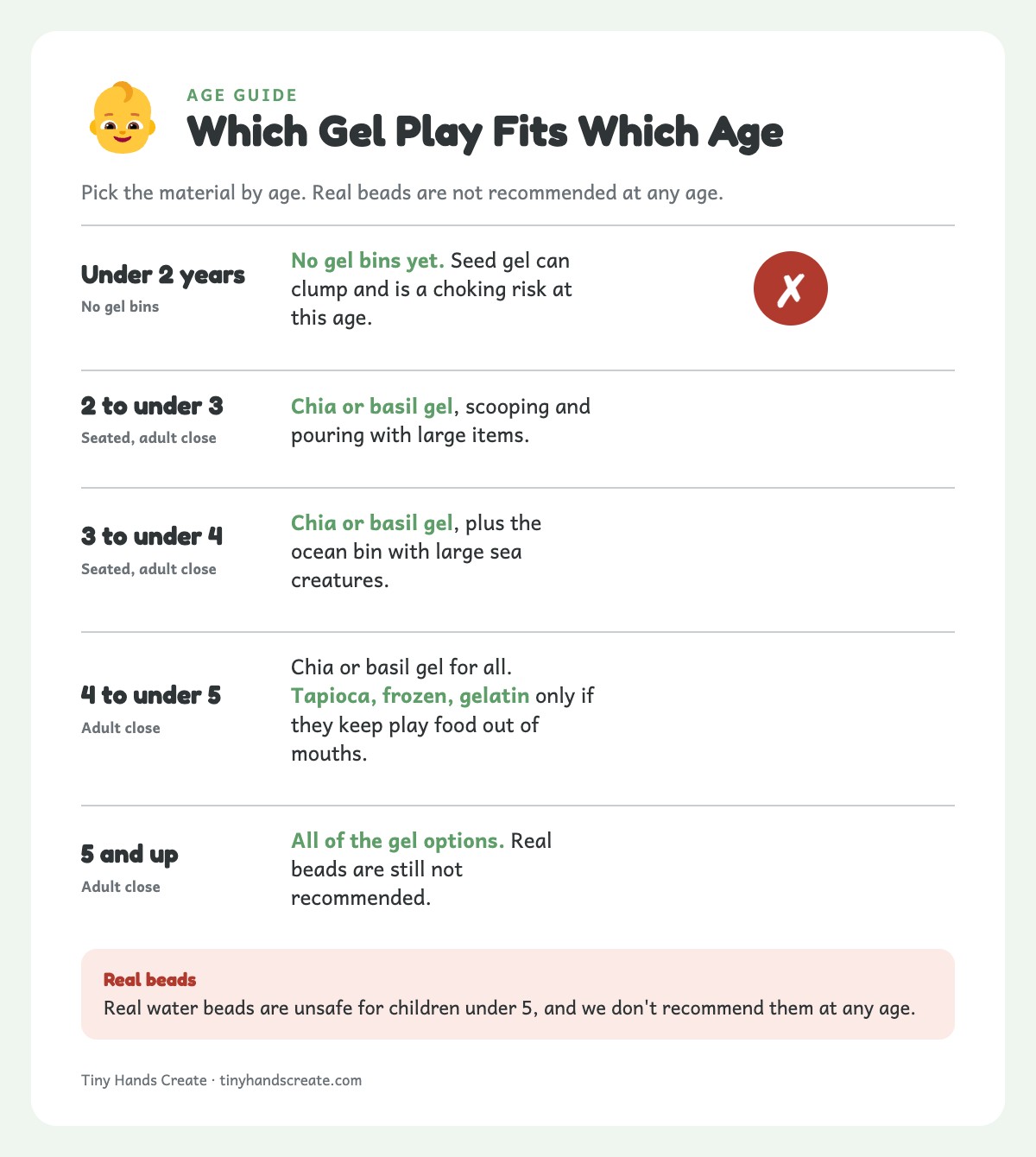
Match the material to your child’s age, not the other way around.
| Age | Use | Skip | Supervision |
|---|---|---|---|
| Under 12 months | No gel bins. See our Edible Sensory Play Ideas for Babies | All gel materials and real beads | Adult hands-on |
| 12 to under 24 months | No gel bins yet. Seed gel can clump and is a choking risk at this age. Stick with our Edible Sensory Play Ideas for Babies, and get your pediatrician’s OK before trying any gel | All gel materials and real beads | Adult hands-on |
| 2 to under 3 years | Chia or basil gel, scooping and pouring with large items | Small objects, tapioca, gelatin, real beads | Child seated, adult within reach |
| 3 to under 4 years | Chia or basil gel, plus the ocean bin with large sea creatures | Whole tapioca, gelatin, frozen pieces, real beads | Child seated, adult within reach |
| 4 to under 5 years | Chia or basil gel for everyone. Tapioca pearls, frozen chia gel, and gelatin cubes only for kids who reliably keep play food out of their mouths | Real beads. Tapioca, frozen, and gelatin pieces for any 4-year-old who still mouths things | Adult close, child seated |
| 5 and up | All of the gel options | Real beads (not recommended; see the rules above if you already own some) | Adult close |
For more ideas in the 1 to 3 range, try our play-based learning ideas for 2-year-olds.
Taste-Safe Alternatives to Real Water Beads
Almost every activity below works with a taste-safe stand-in. These materials give you the same squish, scoop, and pour. They’re non-toxic if tasted, but “taste-safe” doesn’t mean choke-proof.
For kids 2 and 3, serve only the soft gel forms, with the child seated and an adult close by. For babies and 1-year-olds, our Edible Sensory Play Ideas for Babies guide covers taste-safe play in more depth.
Safety firstSeed gel is still a choking risk, because swollen seeds can clump together. Keep it to ages 2 and up. Serve it only when it’s fully soaked and stirred smooth, because dry seeds stick in the throat. Keep dry seeds out of reach. Seat the child, stay within reach, and stop if they cough or gag. Check for seed allergies before the first bin, and ask your pediatrician if your child has feeding or swallowing concerns.
Cooked Tapioca Pearls (Boba)
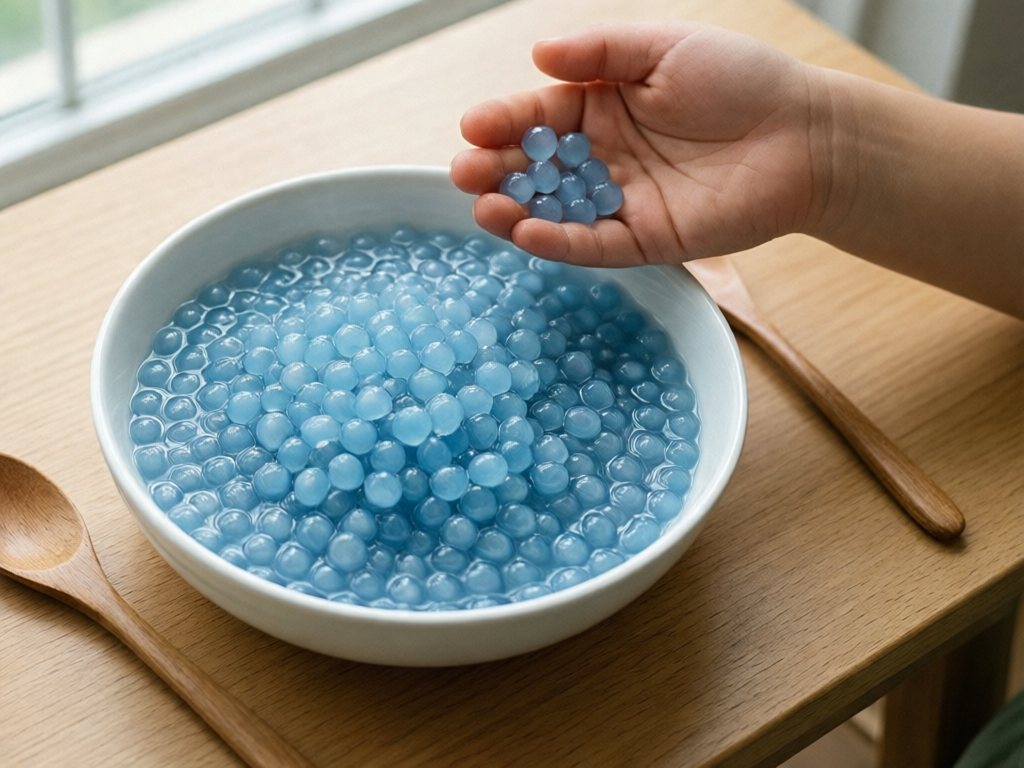
Use small tapioca pearls, the kind sold for bubble tea, not the giant black boba. An adult handles the boiling water. They turn slick, round, and translucent, nearly identical to water beads in texture.
- Boil. Add 1 cup pearls to 6 to 8 cups of boiling water and stir so they don’t stick.
- Cook. Follow the package time, usually 15 to 20 minutes, until translucent.
- Rinse and chill. Drain, rinse under cold water until they stop feeling sticky, then move them to an ice-water bath until cool.
- Color. Toss with a drop of food coloring in a zip-top bag.
They’re edible, but round and chewy means a choking hazard under age 4. Save them for kids 4 and up who keep play food out of their mouths.
Skip the rinse and you get a sticky, gummy mess. Cooked pearls also turn hard in the fridge, so make them fresh for each session and toss the whole batch after play.
Chia Seed Gel
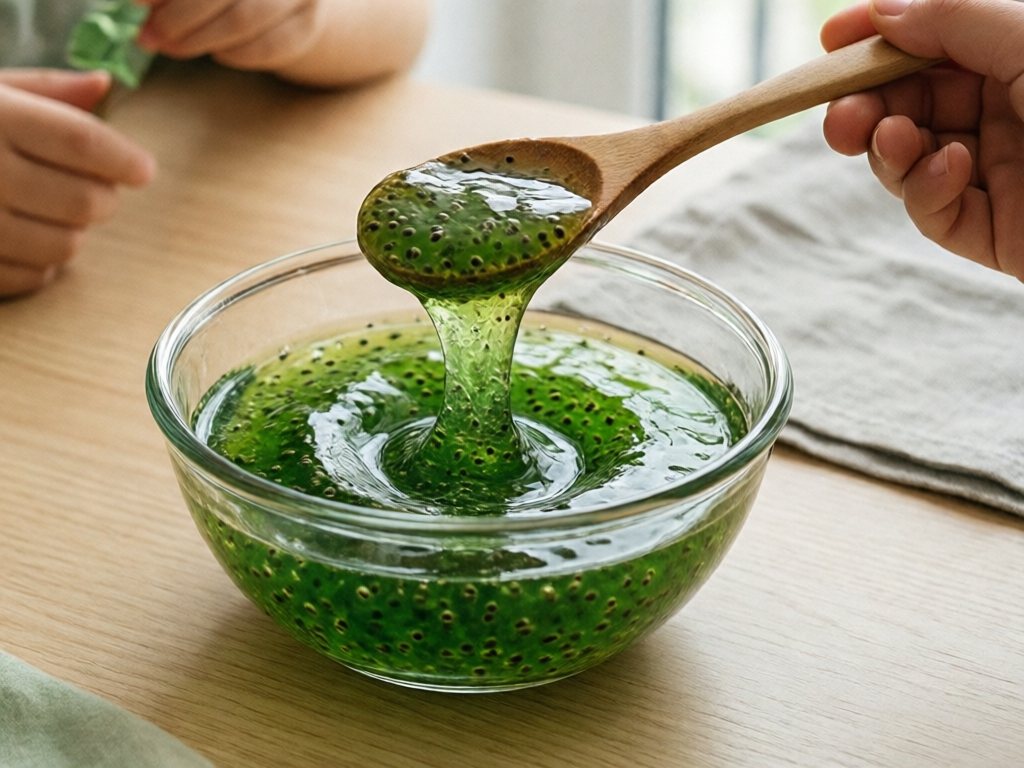
- Measure. Add 1/4 cup chia seeds to 1 cup water.
- Stir twice. Stir well, rest 5 minutes, then stir again to break up clumps.
- Wait. Let it sit 20 to 30 minutes, until the seeds swell into a slippery gel.
- Color. Stir in food coloring for a bright bin.
- Check. Stir out any dry clumps before play.
The texture lands somewhere between water beads and tapioca pudding. It’s messier and looser than the other options. Some kids love that and others find it frustrating, so test a small batch before you fill a whole bin.
My honest take: this is the messiest gel here. It clings to hands and cups, so I keep a damp cloth next to the bin. Spilled chia gel is also slippery on the floor, so play on a tray or tablecloth.
Chia and basil gel are the softest options, so they’re the best pick for ages 2 and 3. They’re not for babies or 1-year-olds, because even soft gel can clump in a small throat.
Soaked Basil Seeds
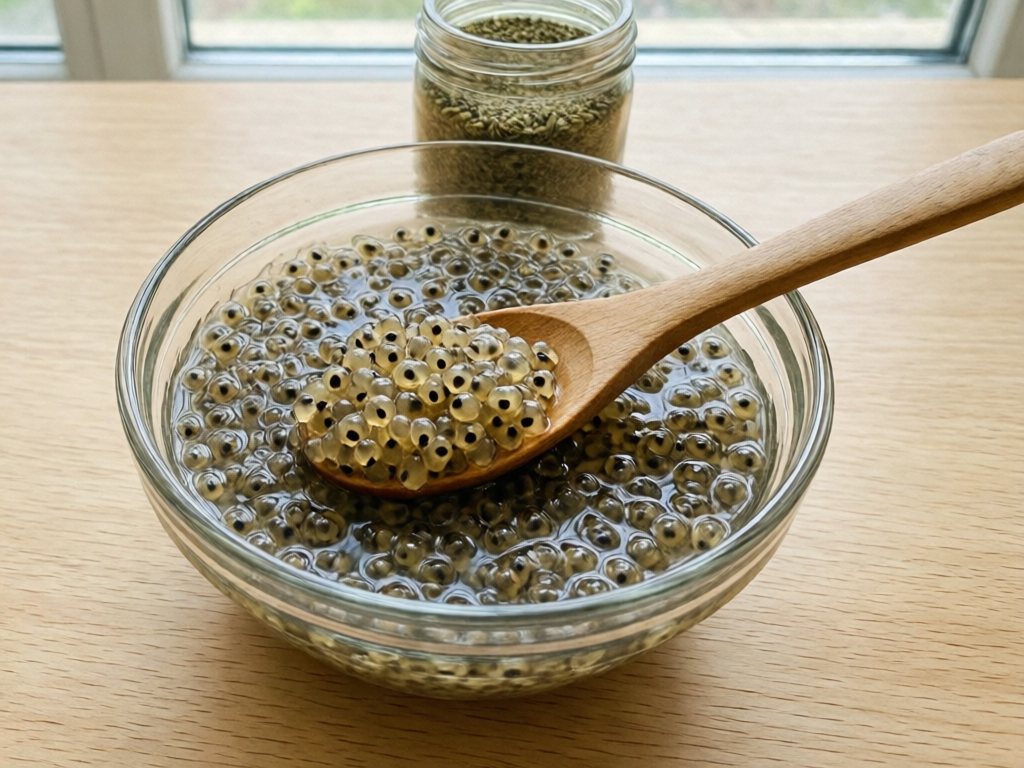
Basil seeds (sold as sabja seeds at Indian grocery stores) puff up into little gel-coated dots with a tiny black center, almost like mini frogspawn. Soak 2 tablespoons in 1 cup water for about 15 minutes.
They’re a fun, often more affordable substitute for chia if you have easy access to them. Like chia, they make a soft gel that suits kids 2 and up with close supervision. Soak fully and stir out any dry clumps first.
Jelly or Gelatin Cubes
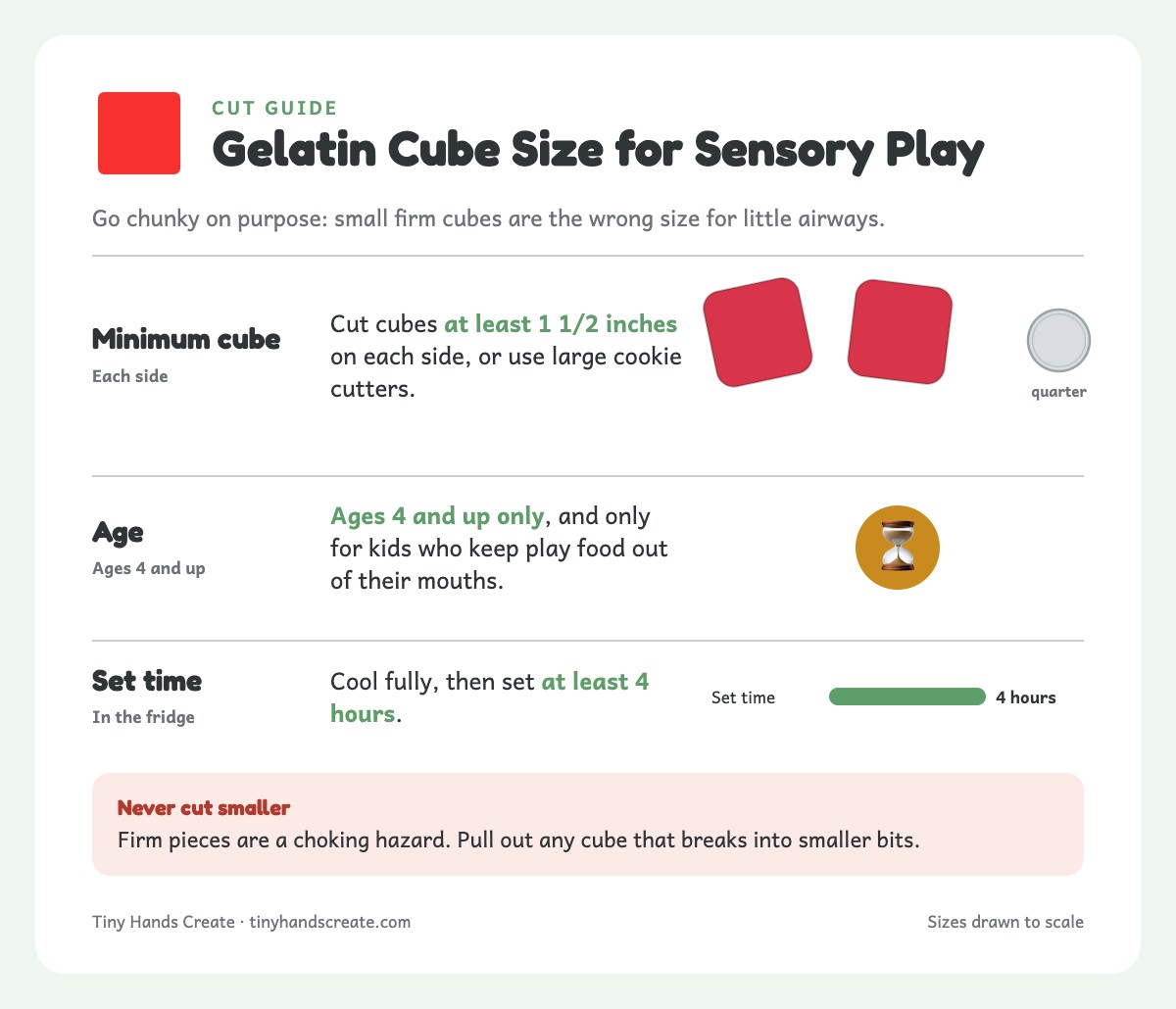
An adult handles the boiling water, then the gelatin cools fully and sets in the fridge for at least 4 hours. Use double the usual gelatin-to-liquid ratio so it sets firm.
Then cut it into big cubes, at least 1 1/2 inches on each side, or use large cookie cutters for shapes. Go chunky on purpose, because small firm cubes are the wrong size for little airways.
Safety firstGelatin cubes are for ages 4 and up only, and only for kids who reliably keep play food out of their mouths. Firm pieces are a choking hazard, so keep every cube at least 1 1/2 inches across and never cut them smaller.
These are for handling, not eating. Seat the child, stay within arm’s reach, and pull out any cube that breaks into smaller bits.
These hold their shape better than any other alternative, which makes them great for sorting and cutting practice. If you like making sensory materials from pantry staples, our DIY Playdough Recipes for Kids roundup has ten more homemade options.
| Material | Prep time | Texture | Minimum age | Allergen note |
|---|---|---|---|---|
| Chia seed gel | About 30 min soak | Soft, loose gel | 2+ (seated, close supervision) | Seed allergies |
| Basil seed gel | About 15 min soak | Soft gel with a tiny center | 2+ (seated, close supervision) | Seed allergies |
| Cooked tapioca pearls | 30+ min with cooling | Round, slick, chewy | 4+ (choking risk under 4) | Check food dyes |
| Gelatin cubes | Set 4+ hours | Firm, cut into 1 1/2-inch or larger cubes | 4+ (choking risk under 4; no mouthing, adult within reach) | Animal-derived; check juice and dyes |
Good to knowAn adult handles all boiling water, and everything cools fully before play. Keep play to about an hour at room temperature, and wrap up sooner if the room is warm.
Throw out anything kids have handled once the session ends. Only a never-played-with portion of chia gel, basil gel, or gelatin can be saved, covered in the fridge, for up to 1 day. Toss anything that smells off, and check for food allergies first.
Water Bead Activities for Kids: Sensory Bin Ideas
Basic Sensory Bin
Fill a large, shallow bin with chia or basil gel for ages 2 and 3, or tapioca pearls for ages 4 and up. Add cups, scoops, slotted spoons, and small funnels, and seat the child. One batch (1/4 cup chia plus 1 cup water) fills about a quart, which suits a shoebox-sized bin. Double or triple it for a large tub.
Let kids pour, scoop, and transfer between containers. It builds hand-eye coordination, grip strength, and bilateral hand use.
Expect some escapees. I slide a towel under the bin, and play usually lasts a good 15 to 20 minutes before kids wander off.
It also pairs nicely with the themes in our 50 Easy Sensory Bin Ideas for Toddlers if you want to rotate materials throughout the year.
Hidden Treasure Discovery (Ages 4+)
Bury large plastic animals and letter tiles in a bin of same-colored tapioca pearls or chia gel. Skip coins, gems, and other small parts.
The objects vanish into the translucent mass, so kids have to feel around to find them. It’s harder than it sounds, because everything slips away just as they grab it.
For a learning twist, have your child pull out a letter tile and name it. Or hide numbered tiles and have them line the numbers up in order.
Frozen Sensory Tray (Ages 4+)
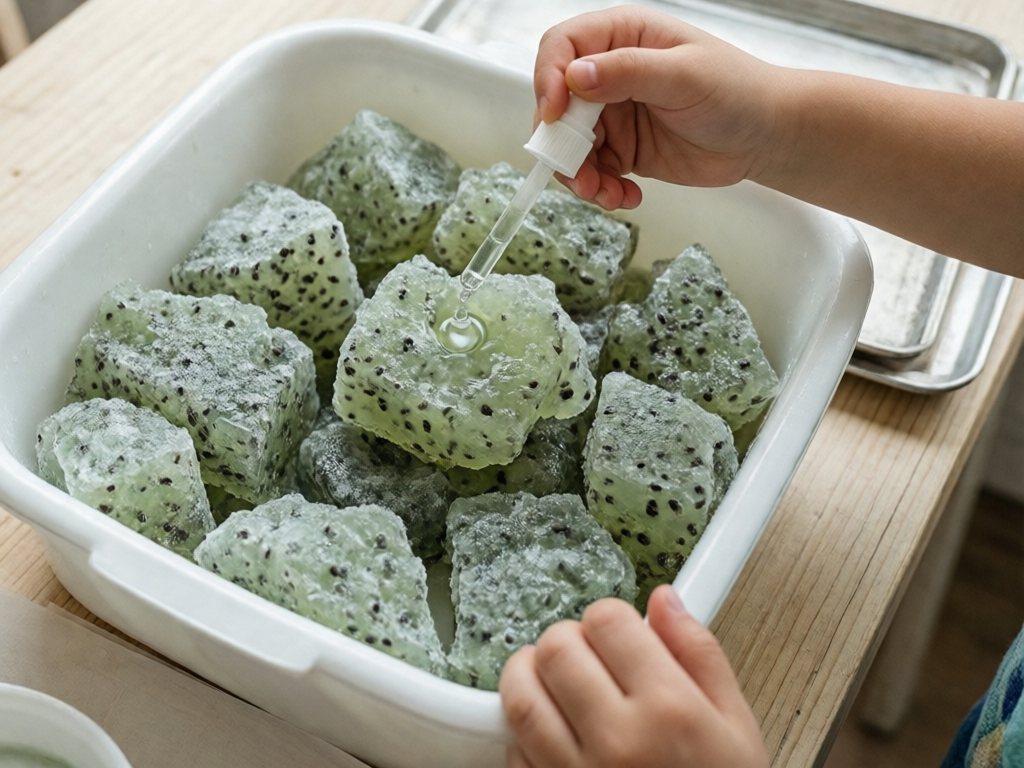
Spread chia gel on a rimmed baking sheet and freeze overnight. Break the frozen gel into large chunks, not bite-sized bits, and serve it in a bin.
Safety firstFrozen pieces are hard, so keep the child seated and supervised. Keep the pieces out of mouths, and stop when hands get cold. A 4-year-old who still mouths things should skip this one.
The chunks feel cold and firm on the outside but still a little squishy underneath. Add a dropper of lukewarm tap water (never hot) and let kids discover they can speed up the melting.
It’s a hands-on intro to states of matter. It pairs well with the melting and freezing demos in our Kitchen Science Experiments for Kids collection.
Learning Activities with Taste-Safe Gel (Ages 4+)
Color Sorting and Matching (Ages 4+)
Set out dyed gelatin cubes (1 1/2 inches or larger) or tapioca pearls in five or six colors. Add matching colored bowls or a muffin tin. This one is for kids who reliably keep play food out of their mouths, with an adult within reach.
Have kids sort each piece into the right container using blunt, child-safe tongs instead of fingers. That builds fine-motor strength and the tripod grasp used for writing.
Counting and Simple Math (Ages 4+)
Label a muffin tin with a number in each cup. Kids count the right number of tapioca pearls into each section.
For older preschoolers, write simple addition problems on cards and use the pearls as counters. “3 + 2 = ?” becomes “put three orange pearls and two purple pearls together. How many total?”
Letter and Sight Word Discovery (Ages 4+)
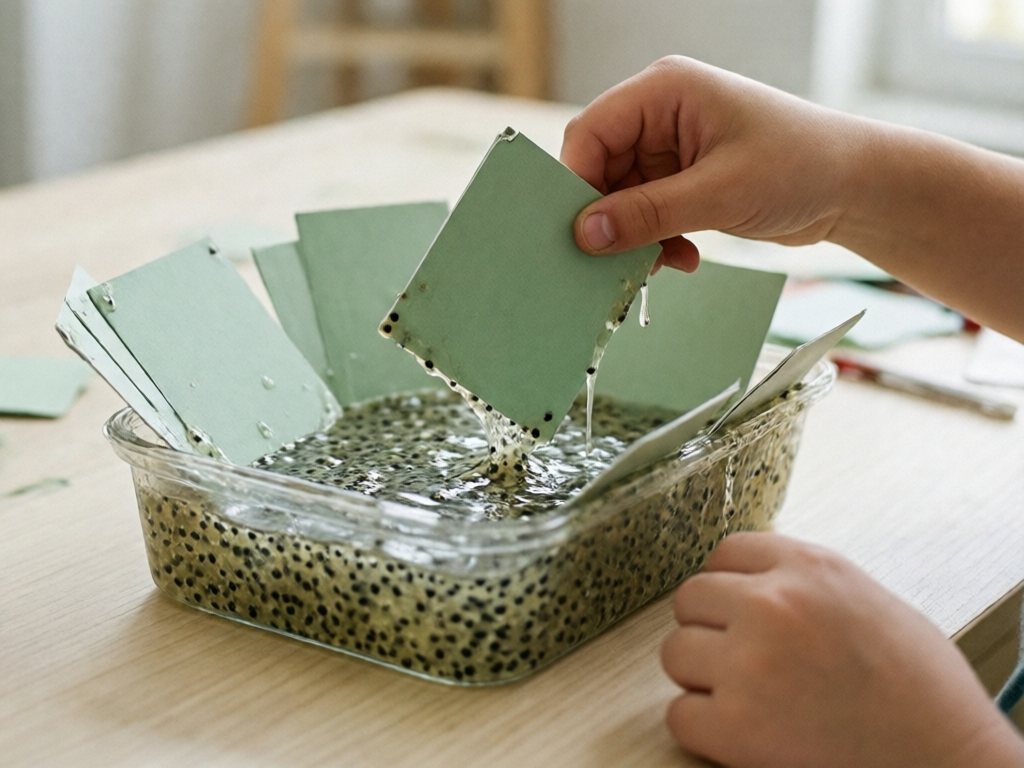
Write letters or simple sight words on small laminated index cards and bury them in a tapioca or basil seed gel bin. Kids dig through, find a card, and identify the letter or read the word.
For phonics practice, have them find a letter and name something that starts with that sound. Heads up: tapioca gets sticky if it wasn’t rinsed well. The cards will need re-laminating if they get soggy.
For a tidier setup, our no-mess sensory play ideas cover more contained options.
Creative Gel Play Ideas (Ages 3+)
Ocean Sensory World (Ages 3+)
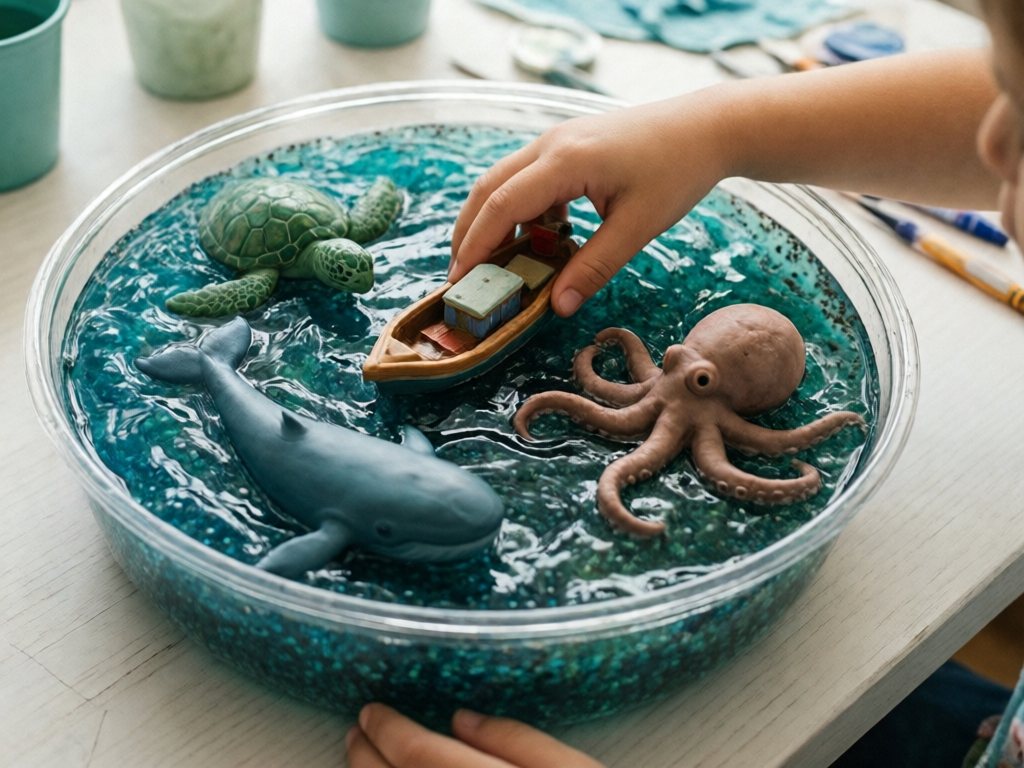
Fill a bin with blue and green chia gel. Add a toy boat and large plastic sea creatures that won’t fit through a toilet-paper tube.
Skip small shells, stones, and glass gems, which are small parts and can have sharp edges. For seaweed, use felt strips a few inches long at most, or skip it.
Kids build underwater scenes and narrate what’s happening. Add a spray bottle of water for “waves” if you don’t mind a little extra mess.
Flower Arranging Vase (Ages 4+)
You’ll often see this one done with real water beads. I skip them and use plain water, which gives the same arranging practice.
Fill a sturdy, non-breakable vase or jar halfway with water. Let your child arrange non-toxic flowers (gerbera or carnations work) or blunt, wire-free fakes. Placing each stem takes a careful pinch and a steady hand, and kids get to choose which colors go together.
Scooping Transfer Game (Ages 4+)
Set up two identical bins of chia gel or tapioca pearls, with an empty bowl for each player. Hand out slotted spoons and take turns moving pieces to the bowl. Skip the timer so nobody rushes.
Pieces slide off the spoon constantly, which is the funny part. It builds coordination and patience.
At a Glance: Every Activity, Material, and Age
Here’s the whole lineup in one place: what to use, the youngest age it suits, and how much lead time you need.
| Activity | Youngest age | Material | Prep time |
|---|---|---|---|
| Scoop-and-pour bin | 2+ | Chia or basil gel (tapioca only at 4+) | About 30 min |
| Ocean sensory world | 3+ (large creatures only) | Chia gel, blue and green dye | About 30 min |
| Hidden treasure dig | 4+ | Cooked tapioca pearls or chia gel | 30+ min |
| Frozen sensory tray | 4+ | Frozen chia gel | 30 min + overnight freeze |
| Color sorting with tongs | 4+ | Dyed gelatin cubes (1 1/2 inches or larger) or tapioca | Gelatin sets 4+ hours |
| Counting and simple math bin | 4+ | Tapioca pearls | 30+ min |
| Letter and sight word dig | 4+ | Tapioca pearls or basil seed gel | 30+ min |
| Scooping transfer game | 4+ | Chia gel or tapioca pearls | 30+ min |
| Flower arranging vase | 4+ | Plain water, no beads | 5 min |
If a dry sensory bin fits your household better than anything gel-based, our Rainbow Rice Sensory Bin guide is a solid alternative to keep in rotation.
If You Already Own Real Water Beads (Not Recommended)
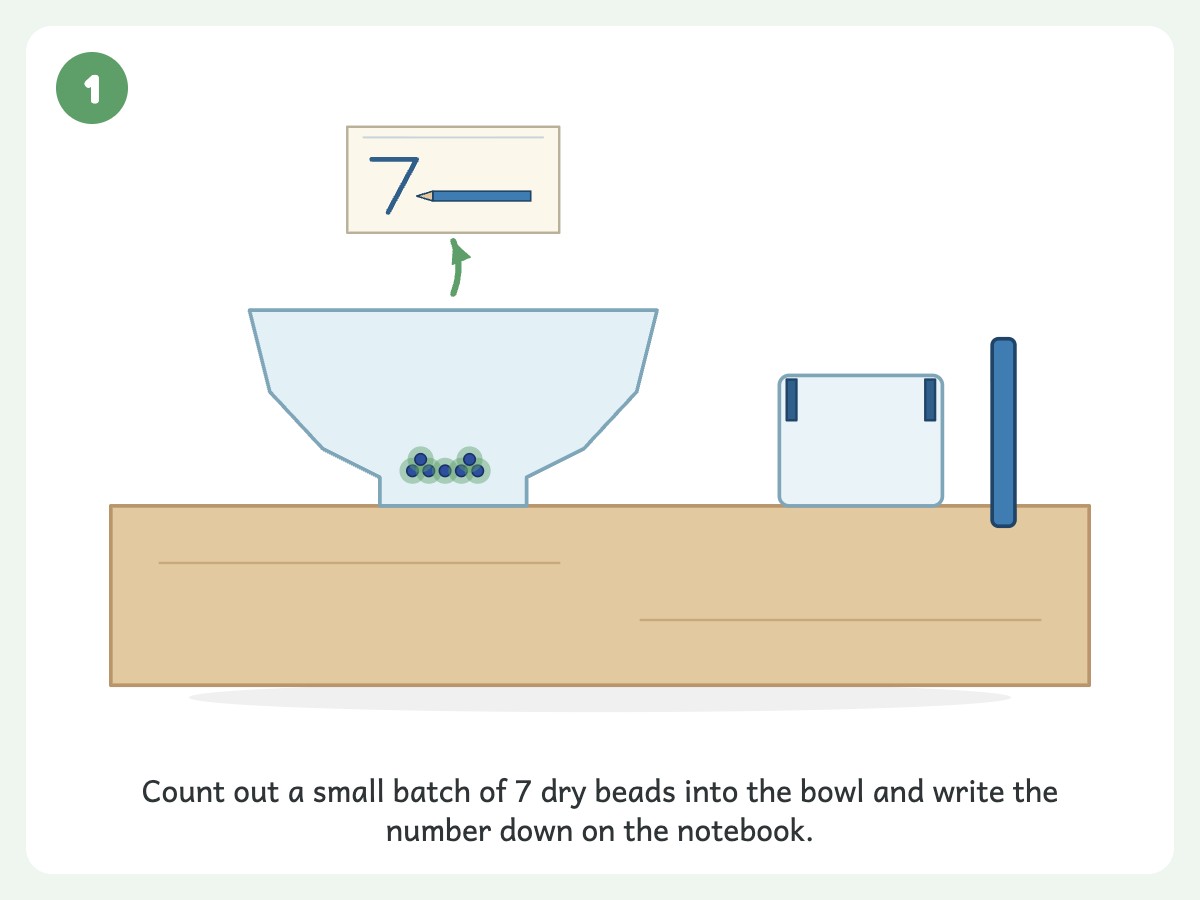
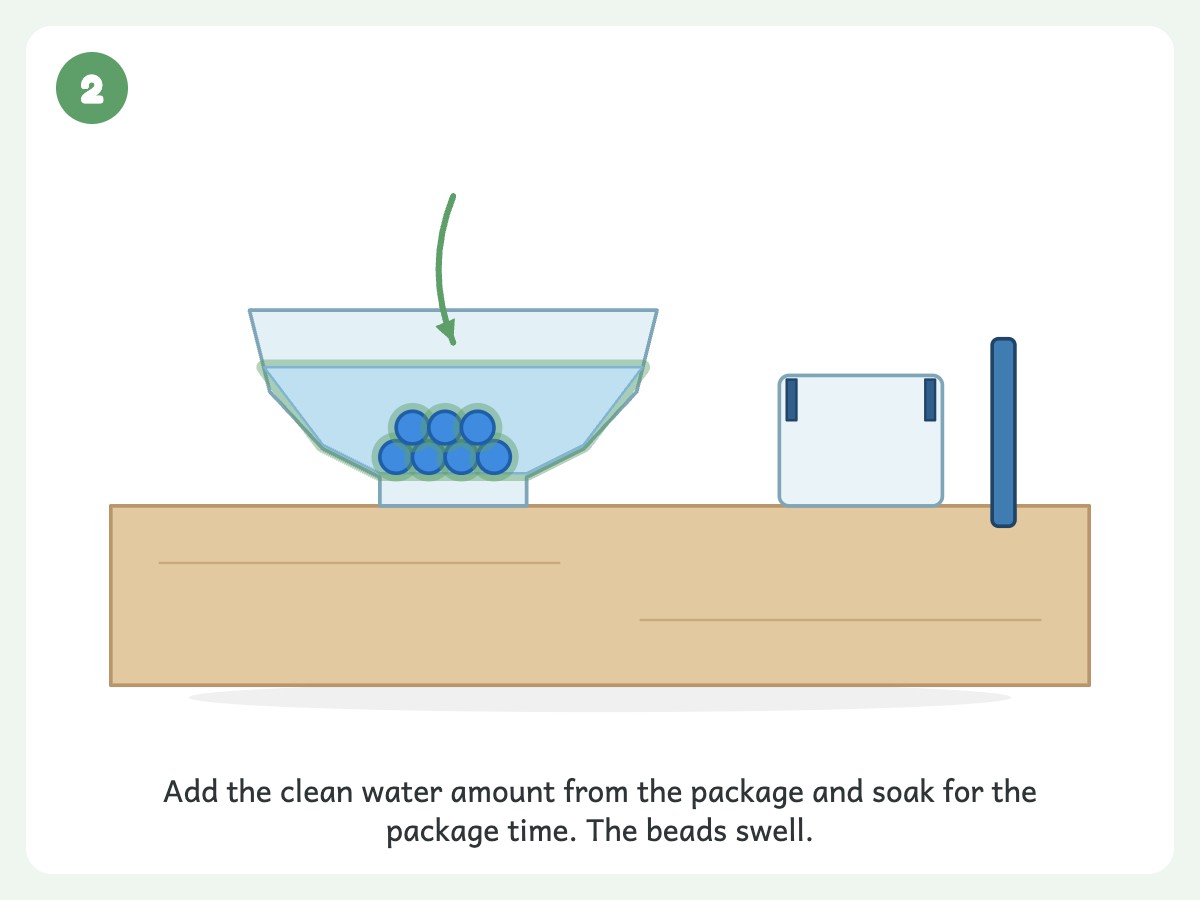
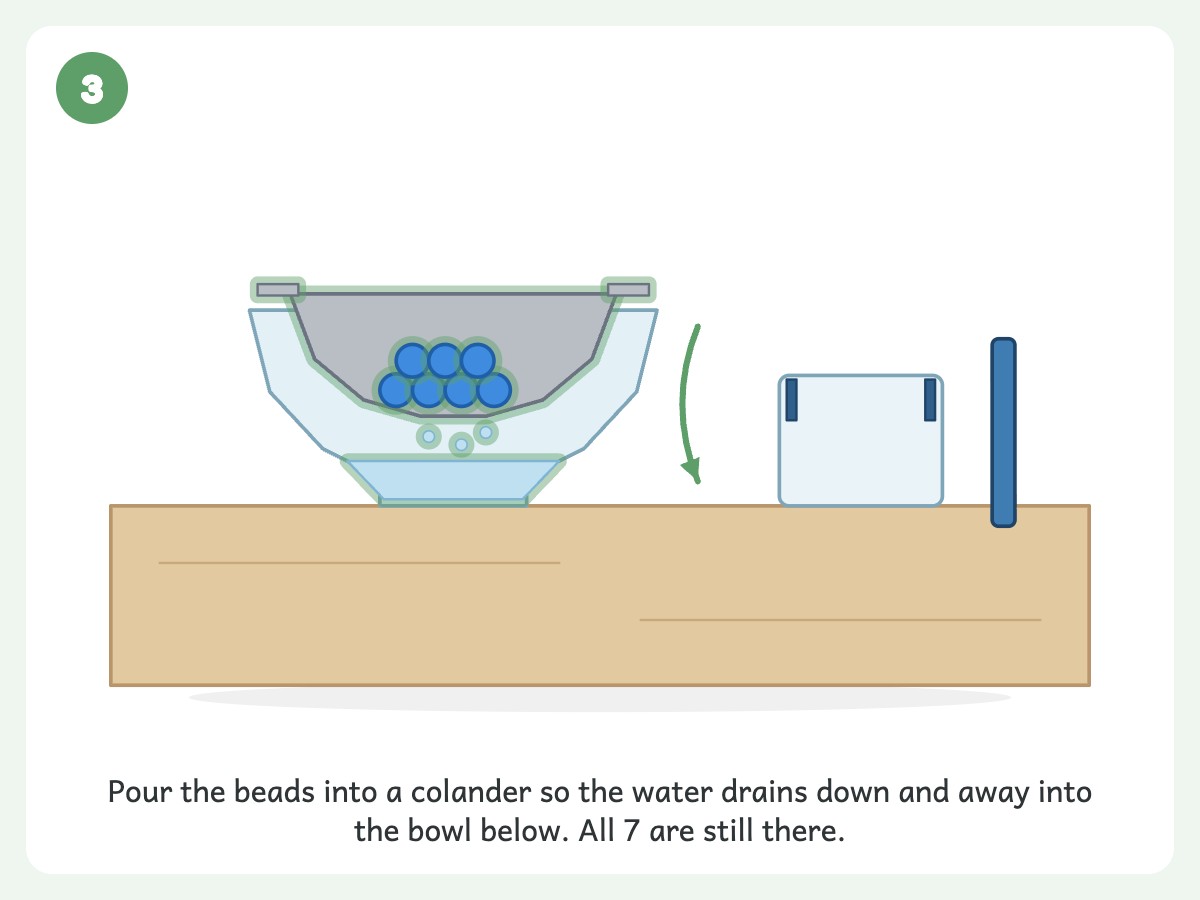
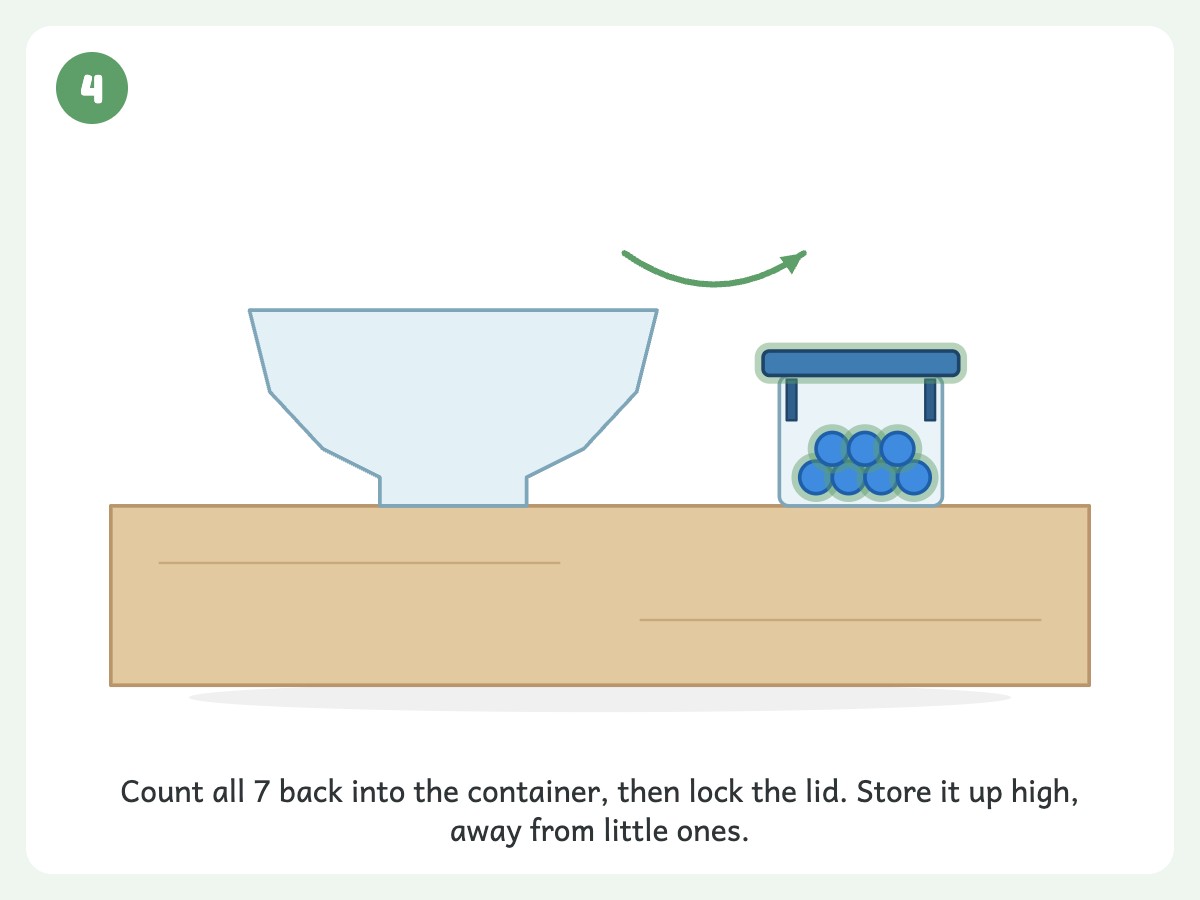
We don’t recommend real beads, and none of the activities above need them. If you choose to use ones you already own, every rule in the safety section applies. These three steps keep track of every bead.
- Count out a small batch. Count the dry beads into a bowl and write the number down. A small batch means fewer beads to track.
- Soak by the package. Use the amount of clean water and the soak time on the package, then drain through a colander.
- Count them back in. After play, count the beads back into a container with a locking lid. If the number is short, search the floor, clothes, and toys until you find the missing bead.
Follow the package for how long hydrated beads keep. Toss them if they turn cloudy, slimy, or smelly.
Cleanup, Storage, and Disposal
Gel that kids have handled doesn’t get saved. Plan to toss it after play.
Four habits keep the mess and the risk contained.
- Sweep up strays right away. They’re slippery, and they’re a choking hazard for toddlers and pets.
- Lock up real water beads. Use a container with a locking lid, up and out of reach of younger siblings.
- Trash everything, never the drain. Beads and gels keep swelling in water and can clog pipes. Let real beads dry out or bag them first.
- Play on a contained surface. A large bin, a rimmed tray, or a plastic tablecloth catches escapees before they hit the floor.
| Material | Play-time limit | After play | Disposal |
|---|---|---|---|
| Chia or basil gel | About 1 hour at room temp | Toss what was handled; unused portion covered in fridge up to 1 day | Trash or compost |
| Cooked tapioca | About 1 hour at room temp | Toss what was handled; make fresh next time | Trash or compost |
| Gelatin cubes | About 1 hour at room temp | Toss what was handled; unused portion covered in fridge up to 1 day | Trash or compost |
| Real water beads | Arm’s-reach supervision | Count back into a locking container, up and away | Dry out or bag, then trash |
Keep an adult within arm’s reach, and enjoy the squish.
Frequently Asked Questions
Are water beads safe for sensory play?
Real water beads carry a serious swallowing risk. The CPSC has warned that a swallowed bead keeps absorbing fluid and can block the intestines. We don’t recommend them at any age, and never for a child under 5. Chia or basil gel gives kids 2 and up the same squish with far less risk.
What age can kids start using water beads?
We don’t recommend real water beads at any age, and they’re never for children under 5. If you use ones you already own, keep them to kids 5 and up who no longer mouth objects. Follow the label if its minimum age is higher, and stay within arm’s reach the entire time.
What happens if a child swallows a water bead?
Go to the ER right away, even if the child seems fine. A swallowed bead keeps absorbing fluid and can block the intestines, and symptoms can be delayed. Call 911 for any trouble breathing. Poison Help (1-800-222-1222) can advise you, but don’t let the call delay care.
How do you play with water beads?
The simplest approach is a scoop-and-pour sensory bin with cups, scoops, and funnels. From there, try a treasure hunt, frozen chia gel for ages 4 and up, or color sorting and counting games. We use taste-safe gels instead of real beads, starting at age 2.
What’s a safe alternative to water beads for toddlers?
Chia seed gel and soaked basil seeds are the softest picks for toddlers 2 and up. Cooked tapioca pearls and large gelatin cubes (at least 1 1/2 inches) mimic the texture too, but they’re a choking risk under age 4. All are non-toxic if tasted. Keep an adult close and check for allergies.
Are water beads toxic?
The main danger isn’t poison, it’s swallowing. A bead that gets swallowed can swell and block the intestines. That’s why we skip real beads and use taste-safe gels instead.
Crafty Mama
Crafty Mama is a former elementary art teacher turned stay-at-home parent who believes every child is creative — they just need the right invitation. She develops age-appropriate activities, crafts, and projects that spark imagination while keeping mess (and parent stress) to a minimum.