Kinetic Sand Activities: 25+ Ideas, DIY Recipes, and How It Works
Discover the magic of kinetic sand with DIY recipes and engaging activities for toddlers to older kids. You'll learn how to make your own and tailor play for different developmental stages.
- Make classic cornstarch kinetic sand using play sand, cornstarch, and oil.
- Try a two-ingredient silky sand recipe that's taste-safe for toddlers.
- Add essential oils or flavored gelatin for scented, colorful kinetic sand.
- Engage toddlers with simple sensory play using cups, scoops, and hiding toys.
- Challenge preschoolers with cookie cutters, themed digs, and imaginative play.
This post contains affiliate links. As an Amazon Associate I earn from qualifying purchases.
In this article (13 sections)
- What Makes Kinetic Sand So Irresistibly Satisfying
- How Does Kinetic Sand Actually Work?
- Cloud Sand, Kinetic Dirt, and Other Kinetic Sand Cousins
- DIY Kinetic Sand Recipes That Actually Work
- Kinetic Sand Activities at a Glance
- Best Kinetic Sand Activities by Age
- 25 Kinetic Sand Ideas: Quick Things to Build, Make, and Try
- Themed Kinetic Sand Sensory Bins
- Setup, Storage, and Cleanup Tips
- Choosing Between Kinetic Sand and Other Sensory Materials
- Safety Notes for Kinetic Sand Play
- Why Kinetic Sand Deserves a Permanent Spot in Your Playroom
- Frequently Asked Questions
What Makes Kinetic Sand So Irresistibly Satisfying
The first time I poured a bag of kinetic sand onto a table during circle time, twenty pairs of preschool eyes went wide and the room fell completely silent. One little boy whispered, “It’s moving by itself.” He wasn’t wrong—kinetic sand has this almost alive quality, the way it flows through fingers like slow-motion water but holds its shape when you press it together. I’ve introduced hundreds of sensory materials over the years, and nothing captivates children quite like this stuff.
Whether you buy the brand-name product or make your own version at home, kinetic sand delivers an extraordinary sensory experience that’s mess-contained, endlessly reusable, and packed with developmental benefits. It builds the same fine motor strength as squeezing playdough, encourages open-ended creative thinking, and provides the kind of calm, focused play that helps children regulate their emotions. Below I’ll walk through exactly how the stuff works, my go-to homemade recipes, and the activities that keep kids playing far longer than you’d expect.
How Does Kinetic Sand Actually Work?
This is the question I get asked most at craft fairs and parent nights, and the answer is simpler than most people expect. Commercial kinetic sand is roughly 98% ordinary sand and 2% polymer—usually dimethicone, a silicone-based compound also found in some lotions and hair products. That thin polymer coating wraps around every individual grain of sand.
Here’s the part that feels like magic but is really just chemistry: the coating makes each grain slightly sticky to its neighbors (through weak molecular attraction called cohesion) while making the whole mass repel water and resist sticking to your hands or a table. That combination is why kinetic sand flows and pours like a liquid when loose, yet holds a shape—a ball, a castle, a footprint—the instant you compress it. Regular sand needs water to clump; kinetic sand clumps on its own and never dries out, which is also why it never needs to be rehydrated the way a sandbox does after a hot afternoon.
It’s the same underlying principle that makes playdough moldable, just achieved with an oily coating instead of gluten and water. Once you see the coating-and-cohesion trick, you’ll notice it in a whole family of similar sensory products—which brings up two of the most common mix-ups.
Cloud Sand, Kinetic Dirt, and Other Kinetic Sand Cousins
Shoppers searching for kinetic sand often land on a few lookalike products, so it’s worth untangling what’s actually different.
What Is Cloud Sand?
“Cloud sand” is usually a marketing name for what most sensory-play parents call cloud dough—a flour-and-oil mixture, not a sand-and-polymer one. Cloud dough is fluffier and more crumbly than kinetic sand, mixes up in about two minutes with pantry staples, and is genuinely taste-safe since it’s just flour and baby oil. If your child likes the light, powdery texture more than the dense, moldable one, that recipe is the better fit.
What Is Kinetic Dirt?
Kinetic dirt is the exact same polymer-coated sand, just tinted brown or tan and marketed toward dinosaur digs, bug hunts, and construction play. There’s no chemical difference—it behaves identically to standard kinetic sand. If you want the look without buying a separate product, stir a tablespoon of cocoa powder or a few drops of brown food coloring into any batch of homemade sand below. It pairs beautifully with a pretend mud kitchen setup if you want to extend the “digging in dirt” theme outdoors, too.
DIY Kinetic Sand Recipes That Actually Work
Store-bought kinetic sand is wonderful but pricey, especially if you want enough for a big sensory bin. These homemade versions use inexpensive ingredients and produce genuinely satisfying results.
Classic Cornstarch Kinetic Sand
This is my go-to recipe for a moldable, slightly crumbly texture that’s very close to the commercial product.
- 5 cups fine play sand (available at hardware stores)
- 3 cups cornstarch
- 1 cup vegetable oil or baby oil
- A few drops of food coloring (optional)
Mix the sand and cornstarch together in a large bin. Slowly drizzle in the oil while stirring with your hands or a large spoon. Keep mixing until the sand holds together when squeezed but crumbles apart when released. If it’s too dry, add more oil a tablespoon at a time. If too oily, add more sand. This recipe stores well in an airtight container for several weeks.
Two-Ingredient Silky Sand
For an even simpler version, mix 8 cups of fine sand with 1 cup of cornstarch and slowly add water until you reach a moldable consistency. This version is less oily and dries out faster, but it’s incredibly silky and completely taste-safe for toddlers who might sneak a nibble.
Scented Kinetic Sand
Add a sensory layer by mixing in a few drops of essential oil (lavender for calming play, peppermint for energizing play, or orange for a cheerful citrus scent). You can also stir in a packet of flavored gelatin powder for color and a fruity smell that kids adore. Strawberry gelatin creates a beautiful pink sand with an amazing scent.
| Recipe | Key Ingredients | Texture | Taste-Safe? |
|---|---|---|---|
| Classic Cornstarch | Sand, cornstarch, oil | Dense, moldable, holds detail | No—contains oil |
| Two-Ingredient Silky | Sand, cornstarch, water | Silkier, dries out faster | Yes |
| Scented | Base recipe + essential oil or gelatin | Same as base recipe | Depends on base |
| Kinetic Dirt | Base recipe + cocoa powder or brown coloring | Same as base recipe | Depends on base |
Kinetic Sand Activities at a Glance
If you’re short on time and just need a starting point, here’s a quick-reference table before the full breakdown below.
| Activity | Best Age | Materials Needed | Prep Time |
|---|---|---|---|
| Scoop and dump exploration | 18 months–3 years | Bin, cups, scoops | 1 minute |
| Alphabet or number dig | 3–5 years | Letter or number beads | 5 minutes |
| Dinosaur fossil dig | 3–6 years | Toy dinosaurs, paintbrushes, tweezers | 5 minutes |
| Construction zone | 3–6 years | Toy trucks, blocks, pebbles | 5 minutes |
| Beach day indoor | 3–7 years | Seashells, sand molds, sea creatures | 5 minutes |
| Bakery shop pretend play | 4–7 years | Cupcake liners, rolling pin, cutters | 5 minutes |
| Measured castle challenge | 5–7 years | Rulers, tape measure, molds | 2 minutes |
| Number stamp equations | 5–7 years | Number stamps, flat tray | 2 minutes |
| Mini zen garden | 5–7 years | Small rake, stones, mini plants | 10 minutes |
Best Kinetic Sand Activities by Age
The beauty of kinetic sand is that it scales perfectly across age groups. Here’s how I structure play for different developmental stages.
Toddlers (18 Months to 3 Years)
Keep it simple and sensory-focused. Pour kinetic sand into a shallow bin or rimmed baking sheet. Provide cups, scoops, and spoons for filling and dumping. Add small plastic animals to hide and discover. Let toddlers simply squeeze, poke, and feel the sand—this tactile exploration is doing important work for their developing sensory system. Supervise closely since this age group will taste-test everything.
Preschoolers (3 to 5 Years)
This is the sweet spot for kinetic sand play. Supply cookie cutters, small rolling pins, and plastic knives for cutting and shaping. Add muffin tins, small bowls, and ice cream scoops for molding. Introduce themed play by burying letter beads for an alphabet dig, small gems and coins for treasure hunting, or tiny dinosaurs for a paleontologist excavation. These activities build fine motor precision and imaginative play skills simultaneously.
Kindergarteners and Beyond (5 to 7 Years)
Older children enjoy more structured challenges. Ask them to build a castle with specific features (a tower, a moat, a bridge). Provide rulers and tape measures to practice measuring. Use number stamps to press equations into flattened sand. Create a mini zen garden with small rakes, stones, and miniature plants. At this age, kinetic sand becomes a medium for focused, meditative creative work.
25 Kinetic Sand Ideas: Quick Things to Build, Make, and Try
When you just need fresh prompts, hand your child (or yourself) this list. Most require nothing more than what’s already in the sand bin.
- Press handprints or footprints and compare sizes
- Build a mountain and tunnel a marble through it
- Make a family of “sand people” with pebble eyes
- Shape the alphabet letter by letter with a stylus
- Build a maze and roll a small ball through it
- Sculpt a volcano and “erupt” it with a marble drop
- Create a topographic map with hills and valleys
- Mold a birthday cake and decorate with beads
- Build a bridge that has to hold a toy car’s weight
- Press cookie cutters and guess the shape by touch, eyes closed
- Make a sand “snowman” using three stacked balls
- Bury coins and sort by value once found
- Build a castle, then measure its height with a ruler
- Create a sensory “path” and walk toy cars along it
- Make a nest and fill it with plastic eggs
- Sculpt initials or a name in the sand
- Build a pyramid and compare it to a photo of a real one
- Hide magnetic letters and dig them out to spell a word
- Create a mini obstacle course for a toy figure
- Mold a bowl shape and fill it with pom-poms as “food”
- Build a wall, then test which toy can knock it down
- Press leaves or shells into flattened sand to make prints
- Make a balance scale challenge—which shape holds the most sand?
- Build two towers and measure the difference in height
- Create a “fossil” by pressing a toy dinosaur foot into the sand
Themed Kinetic Sand Sensory Bins
A themed sensory bin takes basic kinetic sand play to a whole new level of engagement. Pair any of these with a rotating sensory bin schedule and you’ve got activities that kept my preschoolers playing for forty-five minutes straight—an eternity in preschool time.
Construction Zone
Fill a large bin with kinetic sand and add toy dump trucks, excavators, and bulldozers. Include small wooden blocks for building structures, popsicle sticks for fencing, and pebbles for gravel. Mark roads with a plastic knife. Kids will dig, haul, build, and demolish for ages.
Dinosaur Fossil Dig
Bury small plastic dinosaur skeletons or regular dinosaur toys deep in the sand. Provide paintbrushes, spoons, and tweezers as excavation tools. Include a simple chart showing different dinosaur types for children to identify their finds. The brushing and tweezing develops incredible fine motor control and hand steadiness.
Beach Day Indoor
Use natural-colored kinetic sand and add small seashells, plastic sea creatures, driftwood pieces, and blue glass gems for water. Provide sand castle molds and small shovels. This is a wonderful rainy-day activity that brings summer indoors and works beautifully with blue-tinted sand for the ocean area alongside natural sand for the beach.
Bakery Shop
Supply cupcake liners, small cake pans, a rolling pin, and cookie cutters. Add birthday candles, beads for sprinkles, and small pompoms for frosting. Let children mold cakes, cupcakes, and cookies. Set up a pretend display case and take orders. This combines sensory play with math concepts (counting candles, dividing portions) and social skills (customer-baker interactions).
Setup, Storage, and Cleanup Tips
Kinetic sand is far less messy than regular sand, but a few strategies keep things tidy and extend the life of your sand supply.
- Always play on a contained surface — a large rimmed baking sheet, a plastic storage bin lid, or a shower curtain spread on the floor catches stray sand
- Store in airtight containers — kinetic sand dries out when left uncovered, but revives beautifully with a few drops of water kneaded in
- Keep different colors separate — once mixed, colored sands turn into a murky brown (ask me how I know)
- Vacuum loose grains with a handheld vacuum rather than trying to sweep—it clings to broom bristles
- Refresh homemade sand every two to three weeks by adding a small amount of oil and re-mixing
For classroom or playgroup settings, I recommend having each child work on an individual rimmed tray. It defines their workspace, prevents conflicts, and makes cleanup a simple dump-back-into-the-bin situation.
Choosing Between Kinetic Sand and Other Sensory Materials
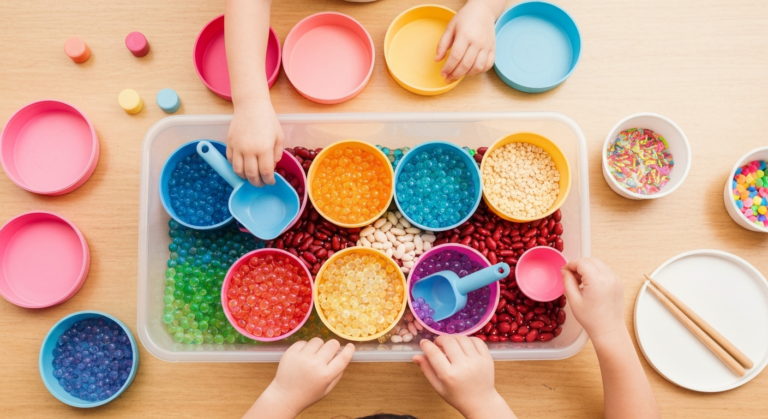
If you’re trying to decide what to add to your sensory shelf next, it helps to know how kinetic sand stacks up against its closest competitors. Playdough holds finer detail and is fully taste-safe, but it dries out within a day or two if left uncovered, while kinetic sand can sit out for weeks. Water beads offer a completely different squish-and-roll sensation and are wonderful for scooping practice, but they need more supervision for children who mouth toys, since a swallowed bead poses a real hazard. Kinetic sand lands in a nice middle ground: it molds like dough, contains itself like beads, and never needs the daily maintenance either alternative does.
Safety Notes for Kinetic Sand Play
- Commercial kinetic sand is labeled non-toxic, but non-toxic doesn’t mean edible—discourage tasting, especially in children under 3
- The two-ingredient water-based recipe above is the safest homemade option if you expect younger toddlers to mouth it
- Skip essential oils entirely for children with known sensitivities, and always dilute well within the base recipe rather than applying oil directly to skin
- Small add-ins like beads, gems, or letter tiles are choking hazards for children under 3—stick to large scoops and animals for that age group instead
- Homemade oil-based sand can feel slippery on hard floors if spilled, so keep play contained to a tray or mat
Why Kinetic Sand Deserves a Permanent Spot in Your Playroom
In a world of flashing screens and noisy electronic toys, kinetic sand offers something increasingly rare: quiet, deep, self-directed play. I’ve watched anxious children calm down within minutes of sinking their hands into it. I’ve seen children with sensory processing differences gradually increase their tolerance for tactile input through regular sand play. And I’ve observed kids who “don’t like art” create elaborate, detailed sand sculptures they were genuinely proud of.
The developmental benefits are extensive—bilateral hand coordination from molding and shaping, grip strength from squeezing and pressing, spatial awareness from building three-dimensional structures, and emotional regulation from the inherently calming sensory input. But beyond all the educational justifications, the simplest reason to keep kinetic sand around is that it makes children deeply, quietly happy. And sometimes that’s the best reason of all.
Frequently Asked Questions
How does kinetic sand actually work?
Commercial kinetic sand is about 98% sand and 2% polymer, usually dimethicone. That coating makes each grain slightly sticky to its neighbors while repelling water and resisting your hands, so it flows like a liquid when loose but holds any shape you press it into.
What’s in kinetic sand?
Store-bought kinetic sand contains fine sand coated in a thin layer of silicone-based polymer, most commonly dimethicone. Homemade versions swap that polymer for cornstarch mixed with oil or water, which creates a similar—though not identical—moldable texture.
What is cloud sand, and is it the same as kinetic sand?
Cloud sand is usually another name for cloud dough, a flour-and-oil mixture that’s fluffier and more crumbly than kinetic sand. It’s a different recipe entirely, though both are popular tactile sensory bin bases.
What is kinetic dirt?
Kinetic dirt is standard polymer-coated kinetic sand tinted brown or tan for dinosaur, bug, or construction-themed play. It behaves exactly like regular kinetic sand—only the color is different.
Is homemade kinetic sand as good as store-bought?
It gets close. The cornstarch-and-oil recipe produces a texture very similar to the commercial product at a fraction of the cost, though it needs occasional refreshing with a little extra oil as it dries out over a few weeks.
What age is kinetic sand safe for?
Kinetic sand works well from about 18 months onward with close supervision, since younger toddlers may try to taste it. For children under 3, stick to the water-based homemade recipe and skip small add-ins like beads or gems, which pose a choking risk.
Crafty Mama
Crafty Mama is a former elementary art teacher turned stay-at-home parent who believes every child is creative — they just need the right invitation. She develops age-appropriate activities, crafts, and projects that spark imagination while keeping mess (and parent stress) to a minimum.