Thanksgiving Sensory Bin for Toddlers with Corn & Cranberries
Create a fun Thanksgiving sensory bin for your toddler using dried corn and cranberries. You'll get guidance on age-appropriate materials, night-before prep, play ideas, and mess control.
- Ensure materials like whole cranberries are age-appropriate for your toddler.
- Prep your corn and cranberry sensory bin the night before.
- Get play ideas to maximize engagement with the sensory bin.
- Learn strategies for effective mess control during playtime.
- Choose corn and cranberries for unique sensory benefits over rice.
This post contains affiliate links. As an Amazon Associate I earn from qualifying purchases.
Two Thanksgivings ago I tore open a bag of cranberries and about forty hit the kitchen floor. My toddler dropped to her knees and chased them, shrieking with joy.
It bought me a few quiet minutes, but loose cranberries and a distracted parent are a setup I now avoid.
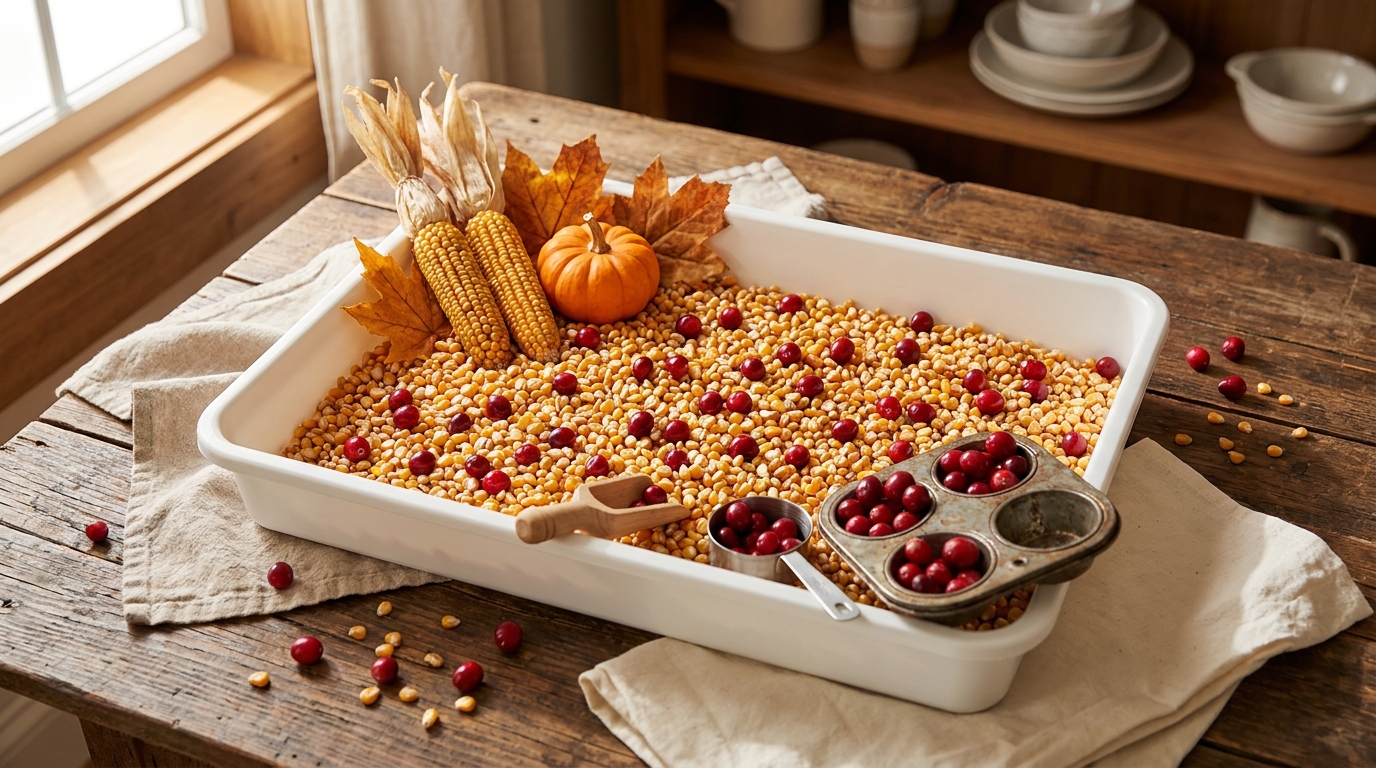
This Thanksgiving sensory bin for toddlers uses dried corn and cranberries, prepped the night before. Below: which materials suit which ages (loose kernels and whole cranberries are not for children who still mouth things), a prep plan, play ideas, and mess control.
Free printable · 6 pages
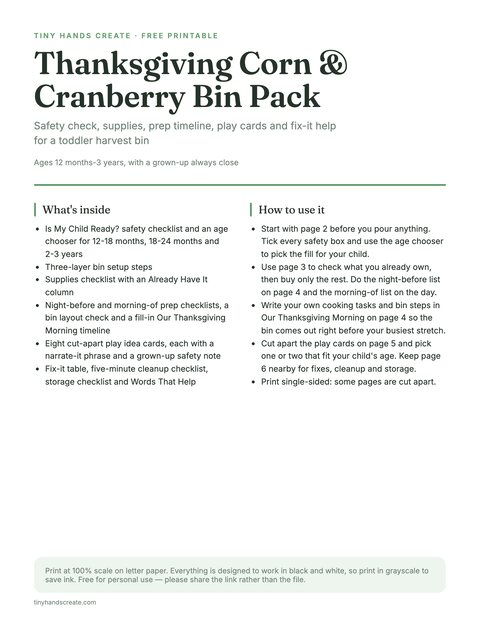
Thanksgiving Corn & Cranberry Bin Pack
A safety check with an age chooser, a supply checklist with bin setup, a night-before and morning-of prep timeline, eight cut-apart play idea cards, and a fix-it, cleanup and storage page for the corn and cranberry sensory bin.
Free. Your download link appears right here. You'll also join the Daily Printable Drop. Unsubscribe anytime. Privacy
In this article (13 sections)
- Why Corn and Cranberries Make a Great Toddler Sensory Bin
- Safety First: Read This Before You Pour Anything
- What You Need (and Where You Probably Already Have It)
- The Prep-Ahead Timing Guide: Night Before vs. Day-Of
- Setting Up the Bin, Step by Step
- Play Ideas by Age
- Keeping Dinner on Track
- The Mess Plan: Realistic Expectations
- Variations and Swaps
- Storing and Reusing Your Bin
- Follow-Up Activities After the Bin
- Frequently Asked Questions
- Wrapping Up
Why Corn and Cranberries Make a Great Toddler Sensory Bin
Most sensory bins reach for rice because it’s cheap and familiar. Rice is fine (see the rainbow rice sensory bin). But dried corn and cranberries give toddlers things rice can’t:
- Real weight and sound. Dried corn kernels are heavier than rice, so they pour with a satisfying hiss and land in a cup with a little rattle. Toddlers who are learning cause and effect love a sound they can make on purpose.
- Rolling and bouncing. For a child past the mouthing stage, fresh cranberries are round, firm, and a little bouncy. They roll away, which sounds like a downside until you realize that “chase the cranberry” is half the fun.
- Color that actually looks like fall. Deep red against golden-yellow is already gorgeous. You don’t need dye, glitter, or a theme kit.
- A real harvest connection. Corn and cranberries are on the Thanksgiving table, so your toddler gets to touch the same foods they’ll see on the plate later. Even at 18 months, “this is corn, we’ll eat corn today” lands.
- Zero extra spending. If you’re already buying cranberries for sauce, a second bag costs a few dollars. Popcorn kernels or a couple of ears of dried corn are pantry or produce-aisle items.
There’s also a quieter benefit. Thanksgiving Day tends to be loud, crowded, and off-schedule, and toddlers feel that. A bin with a clear edge and a simple job gives them a calm, contained spot in the middle of the chaos.
Why it works for ages 1 to 3
| Age | What they’re working on | What the bin gives them |
|---|---|---|
| 12-18 months | Grasping, dumping, mouthing, banging | A mini pumpkin to hold, a cob you hold for them to pat and roll, a bowl to dump into, sound-making with a shallow scoop |
| 18-24 months | Scooping, transferring, simple pretend | Spoon-to-bowl pouring, “feeding” a toy turkey, filling a muffin tin |
| 2-3 years | Sorting, counting, imaginative play | Color sorting, counting, “farm” and “kitchen” scenes |
One bin, three ages. You adjust the tools and the safety setup, not the whole activity.
Safety First: Read This Before You Pour Anything
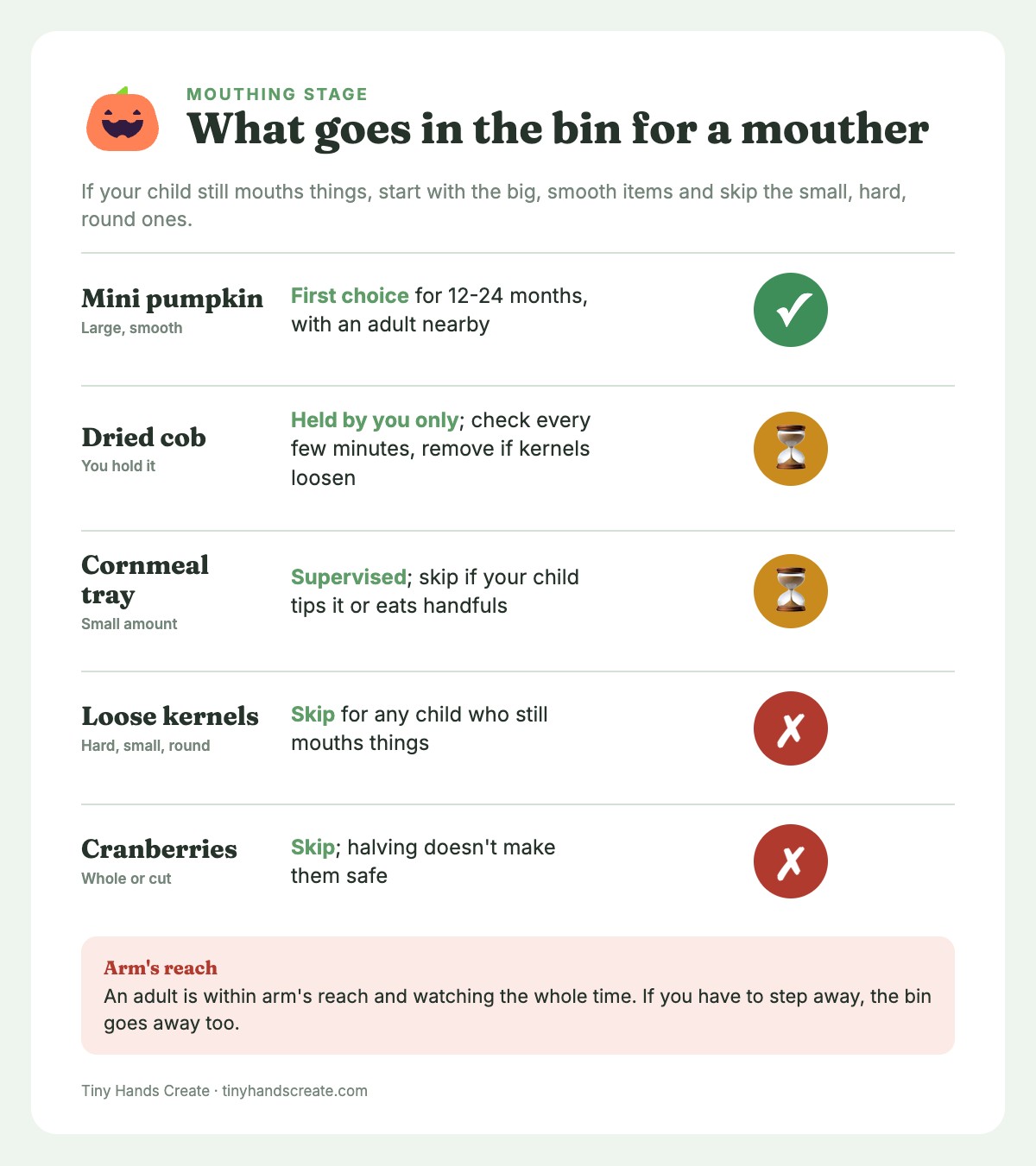
Dried corn kernels and whole cranberries are both small, firm, and round, and that combination needs real care with a toddler. Which materials you use depends on whether your child still mouths things, not just on their age.
Safety firstChildren under 4 carry the highest choking risk, and popcorn kernels are a well-known hazard. Loose kernels and whole cranberries are only for children who no longer mouth objects, with an adult within arm’s reach the whole time. They are not for under-3s who mouth things. This is a sit-with-me activity, not a set-it-down-and-answer-emails one. Caregivers should also learn infant and child first aid and CPR.
| Material | 12-24 months (mouthing) | 2-3 years | 3-4 years |
|---|---|---|---|
| Mini pumpkin or other large, smooth item | First choice, supervised | Supervised | Supervised |
| Whole dried cobs (kernels can shed) | Held by you only, checked every few minutes, removed if kernels loosen | Adult within arm’s reach, checked every few minutes; hold the cob yourself if the child still mouths things; remove if kernels loosen | Adult within arm’s reach, checked every few minutes; hold the cob yourself if the child still mouths things; remove if kernels loosen |
| Cornmeal on a tray | Small amount on a tray, supervised; skip if your child tips it or eats handfuls | On a tray or in the bin, supervised; skip if your child tips it or eats handfuls | On a tray or in the bin, supervised; skip if your child tips it or eats handfuls |
| Loose corn kernels | Skip | Skip if still mouthing | Only if the child reliably does not mouth them, adult within arm’s reach; otherwise skip |
| Whole or cut cranberries | Skip | Skip if still mouthing | Only if the child reliably does not mouth them, adult within arm’s reach; otherwise skip |
The rules I follow every time
- An adult is within arm’s reach and watching, the whole time. Not “in the next room.” Not “on a call.” If you have to step away, the bin goes away too.
- Child sits down to play. No walking, running, or climbing with the materials in hand or mouth. A low table, a high-chair tray, or a mat on the floor with a defined edge all work.
- Match the fill to your child’s mouthing stage. If your toddler still puts most things in their mouth, skip loose kernels and all cranberries, whole or cut. Use a mini pumpkin, a cob that you hold, and a small tray of cornmeal instead.
- Know what counts as a choking risk. Children under 4 are at the highest risk, and hard, small, round foods like popcorn kernels and whole cranberries are known hazards. Learn infant and child first aid and CPR before you need it. For guidance on your own child, ask your pediatrician.
- Nothing from the bin is a snack. Tell your child “this is for playing, not eating,” then offer a real snack nearby so they aren’t confused.
- Check your corn. Use food-grade corn, such as popcorn kernels or corn sold for cooking and popping. Bags of corn sold as animal feed or decorative corn from a craft store can be treated, dyed, or sprayed, and they aren’t meant for a toddler’s hands.
- Mind allergies. If anyone in the house has a corn allergy or a sensitivity to cranberries, skip the bin or swap the fill.
- Keep it dry. Wet corn and mushy cranberries can grow mold. Toss anything that got damp and sat around.
- Keep water play separate and watched. The floating cranberry idea below is for ages 4 and up, or a 3-year-old who reliably does not mouth things. Use a shallow dish, stay within arm’s reach, and never leave a child alone near any amount of water.
- Do a quick sweep at the end. Loose kernels on the floor are slip hazards and mouth bait for the next small person who crawls through.
Making it safer for the youngest crowd (12-24 months)
If your child is on the younger or more mouthy end, adjust like this:
- Start with a mini pumpkin. For 12-18 months, a large, smooth item like a mini pumpkin is the safest main thing to hold, push, and roll.
- Swap loose kernels for a whole cob that you hold. A dried cob is big enough to bang and roll, but it can shed hard kernels at any time. Pick off loose ones before play, check it every few minutes, and take it away the moment kernels come loose.
- Leave the cranberries out. Halved cranberries are still firm pieces that can be swallowed, so cutting them is not a safety fix. For 12-24 months or any child who mouths things, use large red felt shapes instead. Leftover scraps from no-sew felt crafts work well.
- Use a small amount of fine cornmeal as the “sand.” It avoids the hard-kernel problem, but it isn’t risk-free. The dust can be inhaled, and polenta is coarse and gritty. Keep a little on a tray, watch closely, and skip it for a child who tips it or eats handfuls.
- Keep sessions short. About 10 minutes with you beside them beats a long session of drifting attention, which is when mouthing tends to happen.
If you have a baby in the house too, the post on edible sensory play for babies walks through textures that are designed for tiny mouths. It’s a better match for the youngest sibling while the toddler works the full corn-and-cranberry bin at a separate spot.
What You Need (and Where You Probably Already Have It)
The whole idea is to avoid a shopping trip, so here’s the list, sorted by “you already have it” and “grab it with the groceries.”
The bin
| Item | Amount | Notes |
|---|---|---|
| Shallow tub or baking pan | One, roughly under-bed size or a 9×13 pan | Shallow is better than deep, since toddlers fall into deep bins |
| Dried corn (popcorn kernels or food-grade corn) | 4-6 cups | Food-grade only. Only for children who no longer mouth things, with close supervision. Otherwise use the cobs and cornmeal |
| Dried corn cobs or popcorn on the cob | 2-3 ears | Check for loose kernels before play and every few minutes during. Hold the cob yourself for the youngest or any child who still mouths things. Don’t twist kernels off the cob, since that makes loose hard pieces |
| Fresh cranberries | 1 bag (about 12 oz) | Only for children past the mouthing stage. Buy an extra bag, rinse the play ones, and never put them back in the sauce |
| Dry fine cornmeal | Optional: 1-2 cups for a thin layer on a tray; about 4 cups for half of a 9×13 pan, an inch deep (more for a bigger tub) | Soft base layer; dust can be inhaled, so keep amounts small for younger toddlers |
The tools
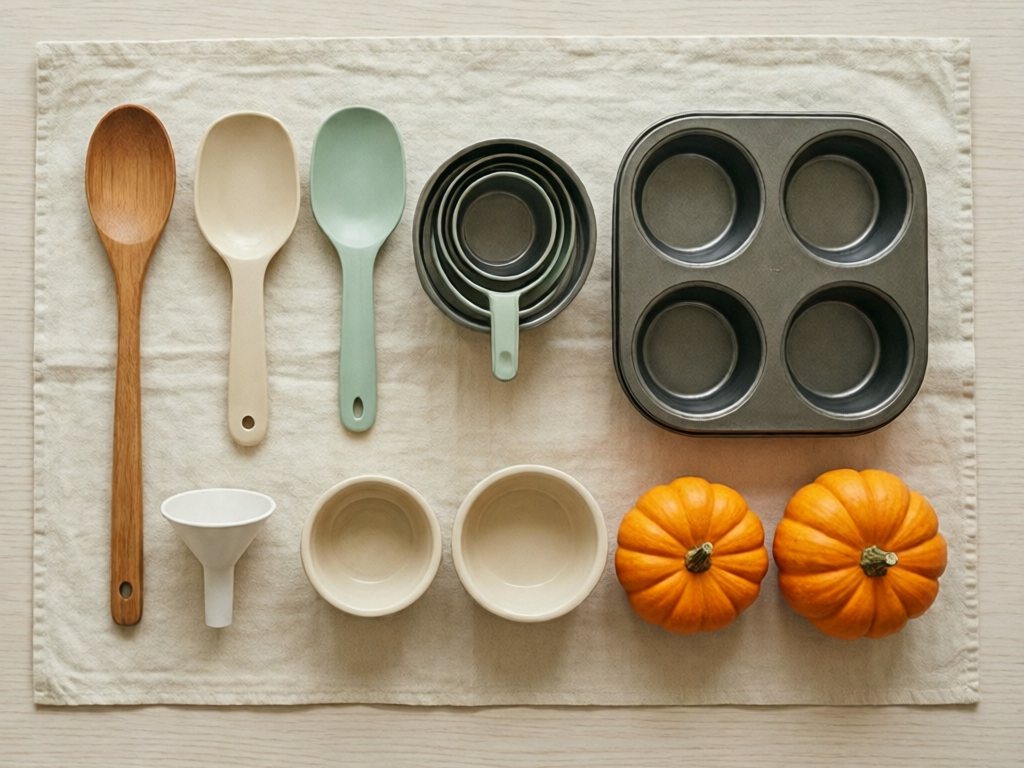
| Item | Why it earns its place |
|---|---|
| Wooden spoon and a few plastic scoops | Basic transferring practice |
| Measuring cups (1 cup, 1/2 cup, 1/4 cup) | Pouring and the “big cup, little cup” idea |
| Muffin tin | Built-in sorting and filling stations |
| Two or three small bowls | Dump and fill, stack and carry |
| Small funnel | Pouring into a smaller opening is surprisingly absorbing |
| Toy turkey, farm animals, or small trucks | Pretend play that gives the bin a story |
| A couple of mini pumpkins or small gourds | Big, safe things to hold and stack |
| A few real fall leaves | Texture contrast, free from the yard. Use dry, clean leaves and skip them for a child who mouths things |
The mess control kit
- A flat bedsheet, old shower curtain liner, or large baking sheet to catch spills
- A handheld brush and dustpan within reach
- A towel or two for any cranberry juice, if you use cranberries
- An old shirt or smock for your child (cranberry juice stains fabric)
- A big zip bag or lidded container for storage afterward
If you’ve already built other fall bins, you can borrow tools and leftover fill from them. For more ideas, the toddler sensory bin ideas roundup has plenty of mix-and-match options, and the same scoops, cups, and trays will carry over. If your toddler wants a no-mess alternative, no-mess sensory play has ideas that skip the loose pieces entirely.
The Prep-Ahead Timing Guide: Night Before vs. Day-Of
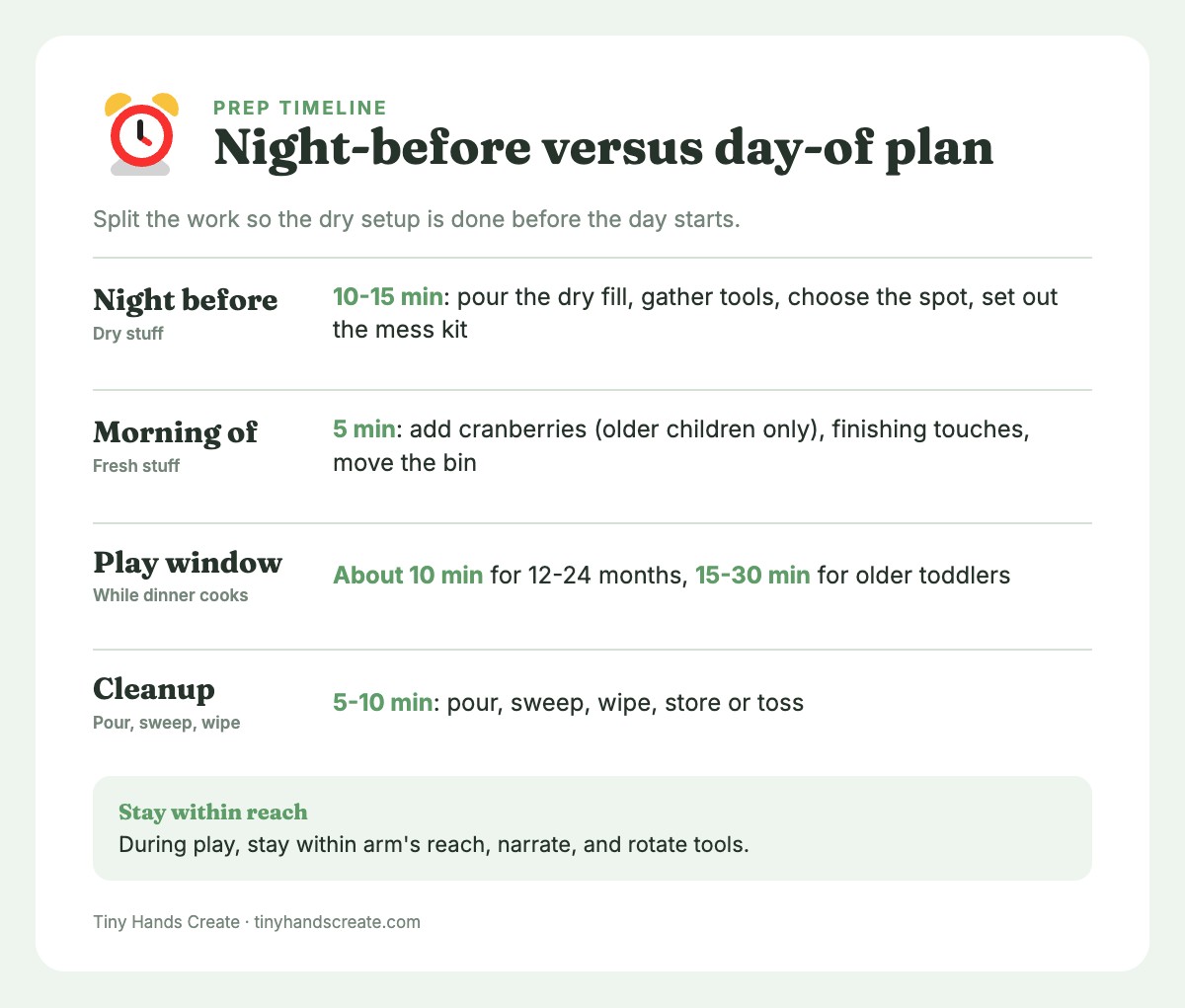
This is the heart of the plan. The bin only helps on a busy day if the setup is already done. Here’s how I split the work so Thanksgiving morning asks almost nothing of me.
At a glance
| When | Time needed | What you do |
|---|---|---|
| Night before (or any quiet evening) | 10-15 minutes | Pour the dry fill, gather tools, choose the spot, set out the mess kit |
| Morning of | 5 minutes | Add the cranberries (older children only), add finishing touches, move the bin |
| Play window (while dinner cooks) | About 10 minutes (12-24 months), 15-30 minutes (older) | Stay within arm’s reach, narrate, rotate tools |
| Cleanup | 5-10 minutes | Pour, sweep, wipe, store or toss |
The night before: the dry stuff
Do all the work that doesn’t involve anything wet or perishable. This is the part that saves you on the actual day.
- Pick the play spot. Choose a place where you can see your child from where you’ll be working. A kitchen corner, the edge of the dining room, or a mat just outside the kitchen all work. Take a moment to check that the spot is out of the main traffic path.
- Lay down the mess barrier. Spread the sheet or shower curtain liner and set the empty tub on top, so you’re not wrestling with fabric tomorrow while a toddler hovers.
- Pour the dry fill. For a child who mouths things, put a thin layer of cornmeal on a tray. For older children, pour cornmeal into one half of the bin and kernels (only past the mouthing stage) into the other, about an inch deep. That’s roughly 4 cups of each for a 9×13 pan. Cover it with a lid or clean towel, and store it out of reach of children and pets overnight.
- Gather the tools. Put scoops, cups, bowls, a muffin tin, and a funnel on a small tray or in a basket next to the bin. If you find yourself hunting for the muffin tin at 11 a.m. on Thanksgiving, that’s a sign this step got skipped.
- Set aside the extras. Put mini pumpkins, leaves, cobs, and a toy turkey in a separate small bag or basket, so you can add them at the right moment instead of dumping everything in at once.
- Park the cleanup tools. Put the brush, dustpan, and a towel somewhere you can reach without leaving your child.
- Keep the cranberries cold (only for a child past the mouthing stage). Leave them in the refrigerator in their bag until the next day, where they stay firm. If your child still mouths things, skip cranberries entirely.
The morning of: the fresh stuff
This should take five minutes, and you can do it while the coffee brews.
- Sort the cranberries (older toddlers only). Rinse them, pull out any soft or squished ones, and set aside the firm ones for play. Keep play cranberries out of the sauce.
- Decide who gets cranberries. For 12 to 24 months, or any child who still tastes everything, leave them out and use a mini pumpkin, a cob that you hold, and a tray of cornmeal. Halving doesn’t make them safe.
- Add the cranberries, if using. Scatter them across the top of the corn or cornmeal. A few in a separate small bowl make a “special” scoop target for a child past the mouthing stage.
- Add the finishing touches. Tuck in a mini pumpkin. For an older child, add a couple of leaves and a cob or two; for a child who mouths things, skip the leaves and keep the cob in your hand. Put the toy turkey off to one side for later (introducing it halfway through rekindles interest).
- Move the bin to its spot. Carry it over, place it on the sheet, and set the tool tray beside it.
During the play window
Here’s what I’ve learned from a few holidays of trial and error:
- Bring it out when you’re at your busiest, not at the very start. If you start the bin at 8 a.m. and the main cooking doesn’t begin until noon, you’ll burn through the novelty before you need it. Bring it out right before a stretch of seated, low-risk prep, such as tearing greens, mixing, and assembling.
- Sit down with your child for the first two minutes. Show them one move, like scooping cornmeal into a cup. Then move to a seated task within arm’s reach.
- Rotate one new thing at a time. After 10 to 15 minutes, add the toy turkey, swap the scoop for a funnel, or bring out the muffin tin. Fresh tools restart attention without needing a whole new activity.
- End on your terms. When you hear the first “all done!” or see the first handful of corn flying across the room, call it. Quitting a minute early keeps the bin special for next time.
Sample timeline for a busy cooking morning
| Time | Cooking task | Bin step |
|---|---|---|
| 9:30 a.m. | Coffee, quick breakfast | Add cranberries (only for a child past the mouthing stage; otherwise skip) and finishing touches |
| 10:00 a.m. | Seated prep, no knives: tear greens, mix stuffing | Bring out bin; first scoop demo |
| 10:20 a.m. | Seated prep of sides at the table | Add muffin tin or funnel |
| 10:40 a.m. | Pie assembly at the table | Introduce toy turkey and pumpkins |
| 11:00 a.m. | Bin winds down | Clean up while child helps with a “last scoop” |
| 11:15 a.m. | Transition to snack, nap, or a different activity | Store or toss the bin |
Adjust the clock to your own schedule. Plan about 10 minutes for 12-24 months and 15-30 minutes for older toddlers. With the younger group, pack the bin up after the first or second row and start a second activity. Stove and knife work waits for a second adult or naptime.
Setting Up the Bin, Step by Step
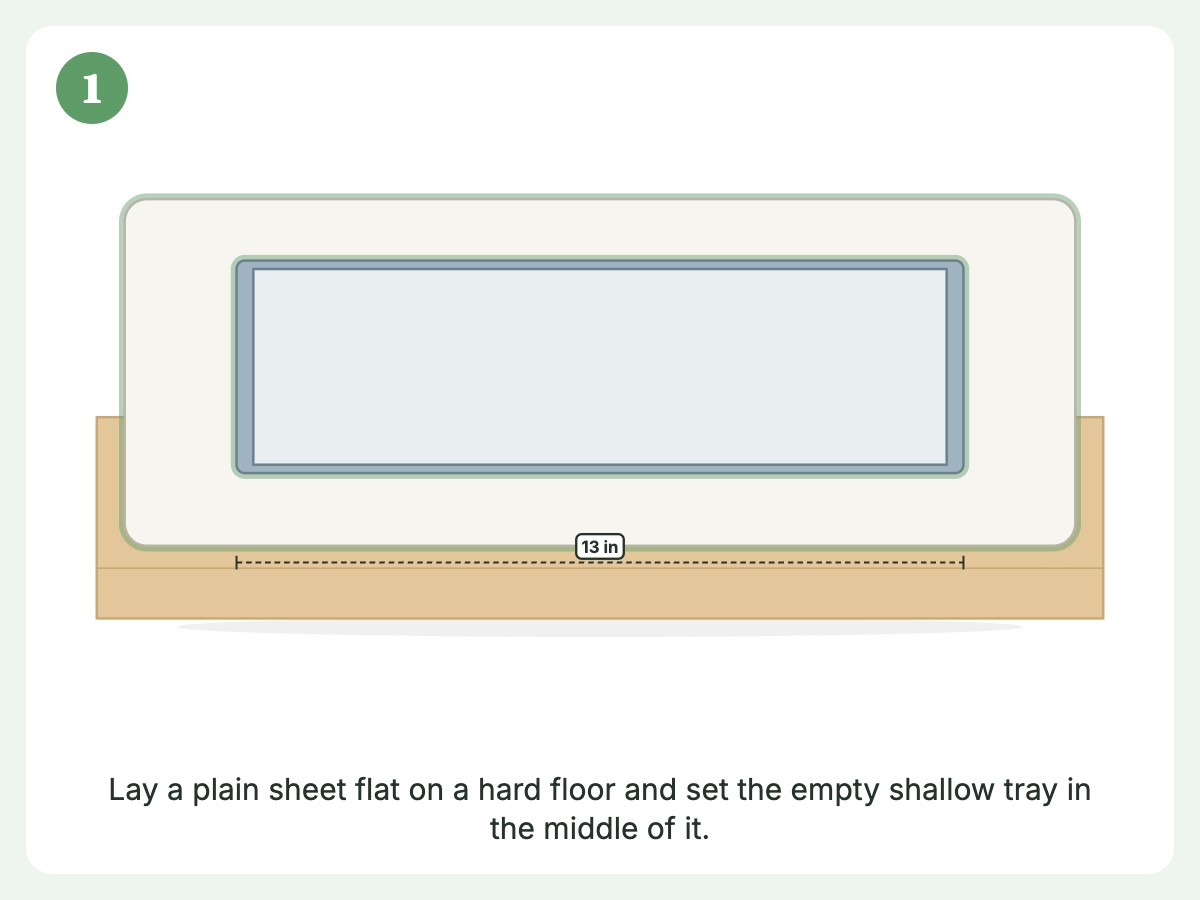
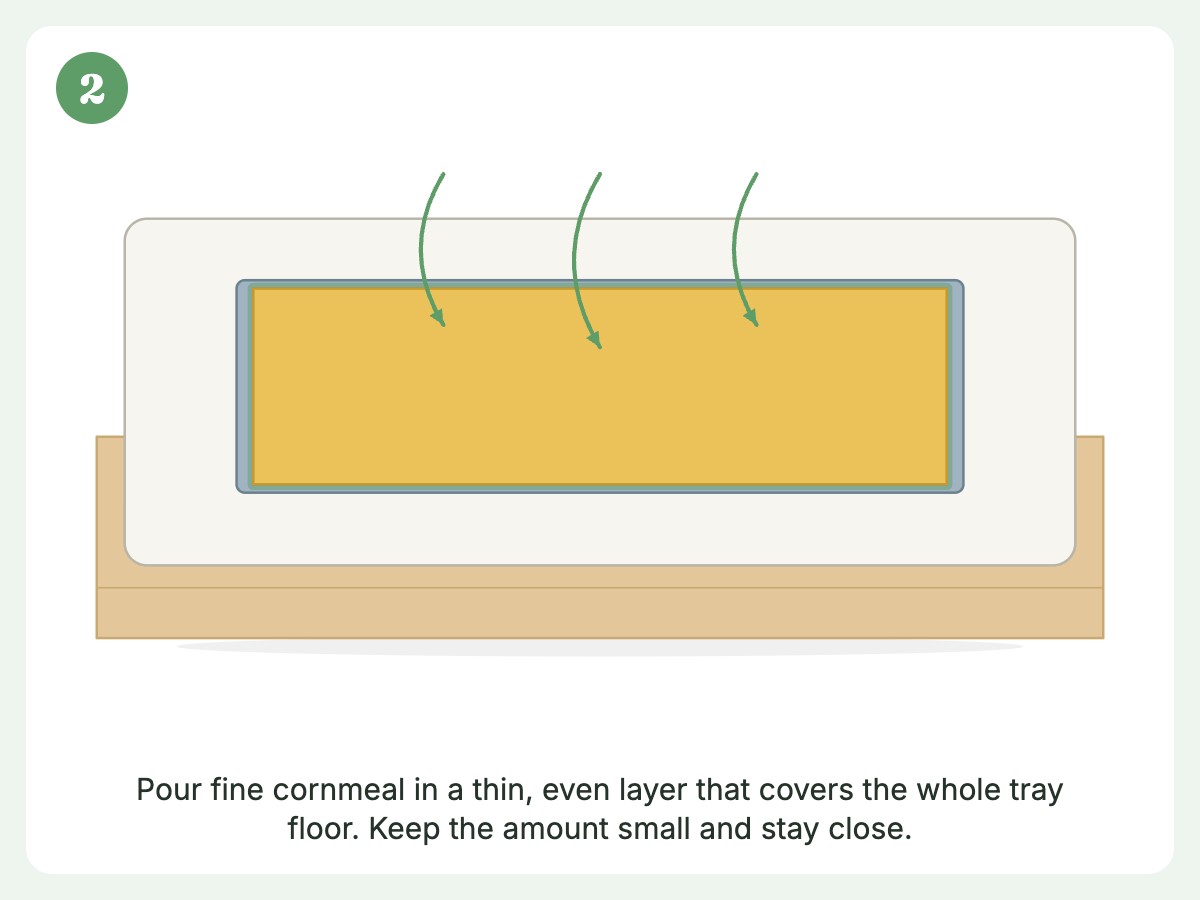
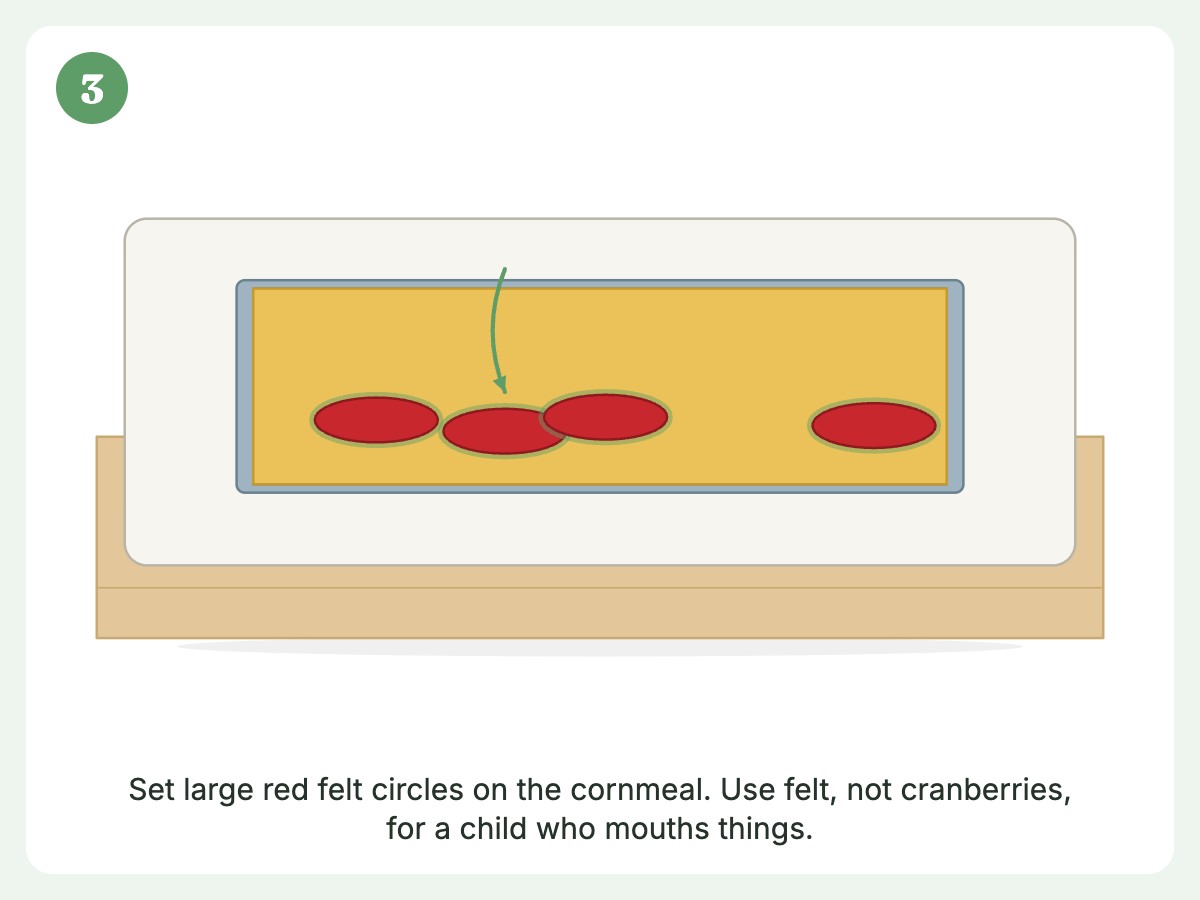
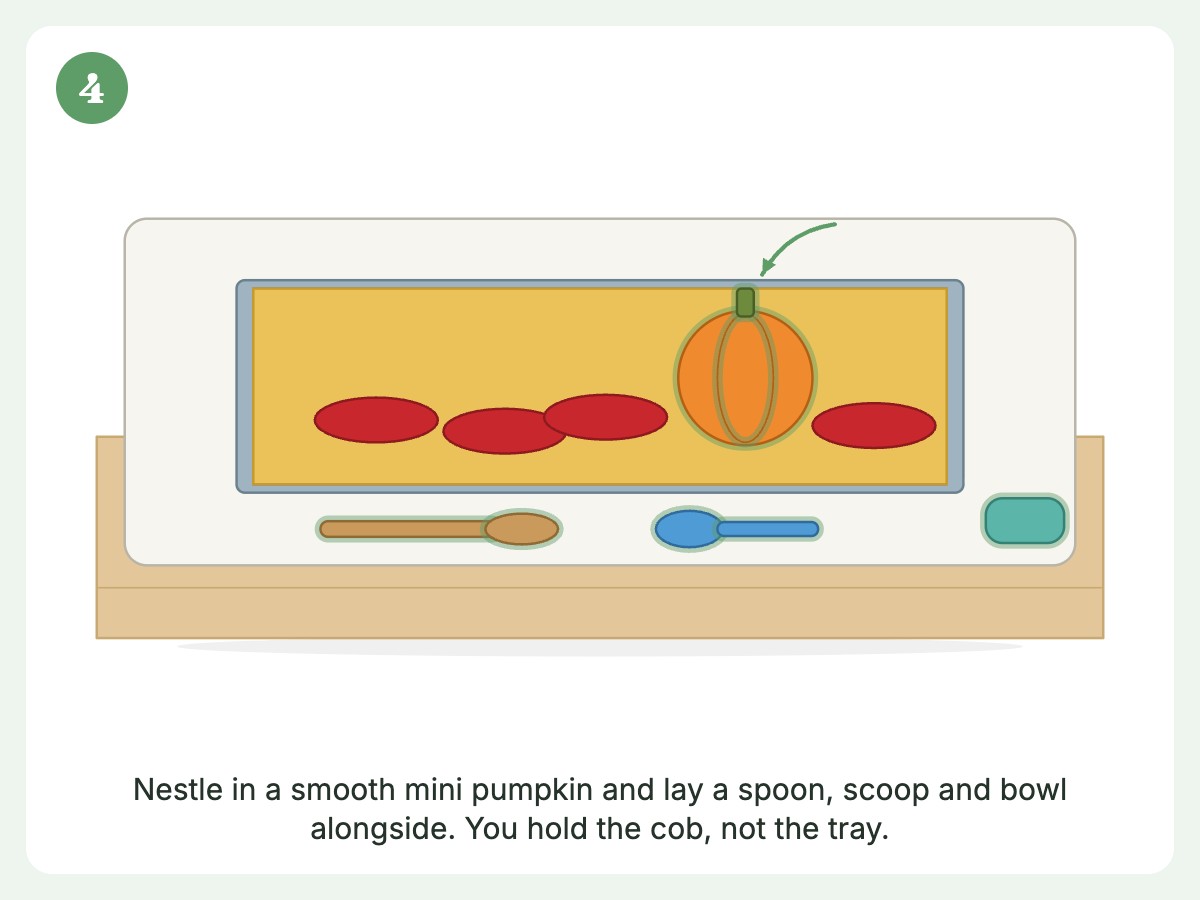
You’ve done the night-before prep, so this is the visual layout. Think of it as three layers, from bottom to top.
Layer 1: The base
For a child past the mouthing stage, pour cornmeal about an inch deep into one half of the tub and dried kernels into the other half. That gives you a built-in soft-versus-hard comparison your toddler will feel instantly. For a younger toddler, use a thin layer of cornmeal on a tray and a mini pumpkin instead.
Layer 2: The reds
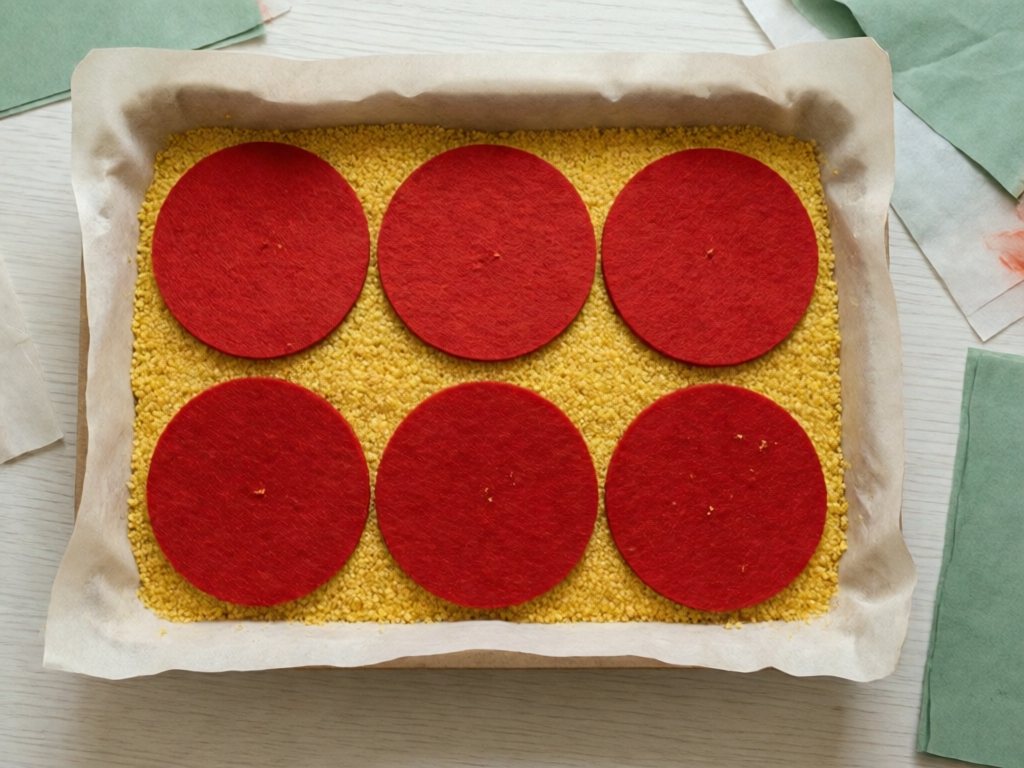
If your child is past the mouthing stage, scatter cranberries across the top. Don’t mix them in. Letting the red sit on top of the gold gives the bin a visible “oh, wow” moment when your child first sees it, and it keeps the cranberries from getting buried and lost.
Layer 3: The play tools and extras
Place a few scoops and cups along the edge, tuck a mini pumpkin into one corner, and lay a couple of dry leaves on top (skip them for a child who mouths things). Keep the toy turkey out of sight for now.
Quick layout checklist
- Bin sits on a sheet or liner
- Child’s chair, mat, or tray is in a stable spot
- You can reach your child from your workspace
- Brush and dustpan are within reach
- A real snack is nearby so nobody asks to eat the corn
- Pets are out of range (corn cobs and loose kernels can cause intestinal blockage if swallowed)
Play Ideas by Age
These run from simplest to most involved, so pick the ones that match your child. Every idea follows the safety table above: loose kernels and cranberries only for a child past the mouthing stage, with you within arm’s reach the whole time.
For 12-18 months: grab, bang, and dump
At this age, play is mostly exploring with hands and mouth, so the goal is big, simple actions.
- Pumpkin hugging. A mini pumpkin makes a surprisingly satisfying thing to carry, push, and roll. Start here, since it’s the safest main item at this age.
- Cob rolling. Check a dried cob for loose kernels, then hold one end while your toddler pats and rolls it along the tray. Take it away the moment a kernel comes loose. Narrate: “Roll, roll, roll.”
- Bowl and dump. Put a couple of large items, like a mini pumpkin and a wooden spoon, in one bowl, with a bigger bowl beside it to dump them into. They’ll do this on repeat. A spoonful of cornmeal on the tray works too, with you right beside them; skip it if they tip it or eat handfuls.
- Spoon banging. Offer a wooden spoon and an empty pan. Rattling the pan with a spoon is a perfectly good activity.
For 18-24 months: scoop and fill
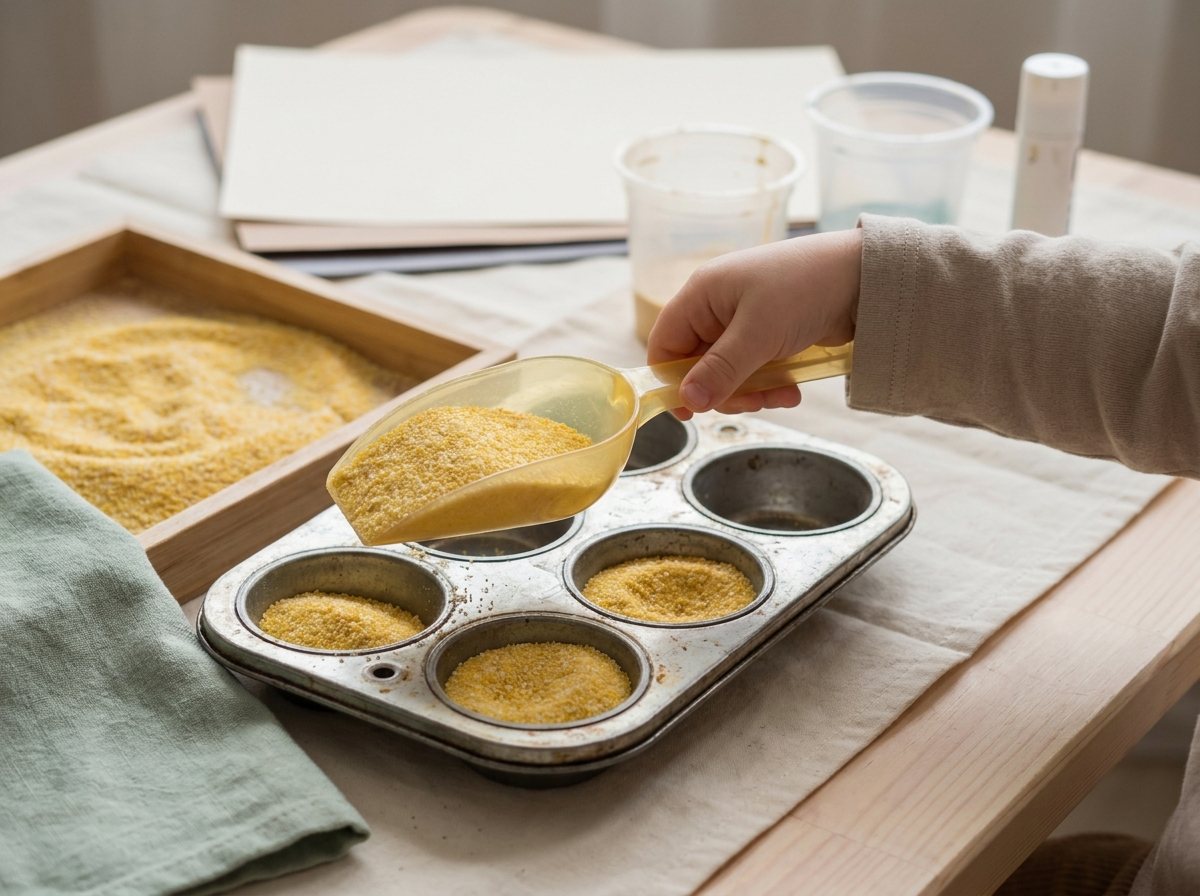
Scooping takes real hand coordination, and this is when your toddler starts to enjoy it. For more hand-building play, see these fine motor activities for toddlers.
- Scoop and pour. One scoop from the bin into a cup, then pour back. Repeat roughly thirty times.
- Muffin tin fill. Hand your toddler a scoop and say, “Can we fill each hole?” The tin turns a random scooping job into a goal.
- Feed the turkey. Introduce the toy turkey and offer a spoon. “Turkey is hungry! Can he have a scoop of cornmeal?” Pretend feeding is a big milestone at this age.
- Funnel pour. A small funnel on top of a cup makes a surprisingly hard, surprisingly fun challenge.
For 2-3 years: sort, count, and pretend
Older toddlers want a mission.
- Color sort. If you’ve included other fall items, like orange mini pumpkins and green leaves, ask your child to sort by color into the muffin tin. More ideas live in our sorting activities for toddlers.
- Counting. “Can you put five in the bowl?” Use cranberries only for a child past the mouthing stage; otherwise count large red felt circles. Even if they only get to three, that’s counting practice.
- Farm scene. Place toy farm animals in the bin and let your child build a corn field. Add a toy tractor if you have one.
- Kitchen pretend. Give them a small pot and spoon and let them “cook” Thanksgiving dinner in the bin. They’ve been watching you all day, so they’ll have plenty of ideas.
- Harvest basket. Hand them a small basket and say, “Let’s harvest the corn!” They gather mini pumpkins while you narrate. Add cobs only if they no longer mouth things, and check for loose kernels as you go. Add cranberries only for a child past the mouthing stage, with you within arm’s reach.
Ten-minute add-ons (age limits noted)
| Add-on | How it works | Mess level |
|---|---|---|
| Floating cranberry bowl (ages 4+, or a 3-year-old who reliably does not mouth things) | An inch of water at most in a shallow dish, with fresh cranberries floating. Stay within arm’s reach the whole time and empty the dish right after | Medium |
| Cob “paintbrush” (you hold the cob for a child who still mouths things) | Check the cob for loose kernels first. Then roll it in a tray of washable paint and press it on paper for a bumpy print. Save the page as a placemat for the kids’ table | Medium-high |
| Cranberry rolling ramp (only if the child does not mouth things) | Prop a baking sheet on a cushion and let cranberries roll down | Low-medium |
| Leaf crunch (only if the child does not mouth things) | Add a few clean, dry leaves to crumple and sprinkle | Low |
| Smell test (ages 3+, and only if the child does not mouth things) | You hold a whole cranberry and a whole corn cob for your child to sniff and compare | Low |
Words that help
A few words to sprinkle in while they play:
- Textures: bumpy, smooth, hard, soft, gritty
- Actions: scoop, pour, dump, roll, fill, stir
- Positions: in, out, on top, under, next to
- Opposites: full and empty, big and little, heavy and light
- Harvest words: corn, cob, kernel, cranberry, pumpkin, harvest
Pick two or three each time and repeat them.
Keeping Dinner on Track
This bin isn’t a babysitter. It keeps a toddler happily busy within arm’s reach while you do simple seated tasks. That’s a smaller promise than “hands-free,” and a more honest one.
What works
- Keep the bin within arm’s reach. If you can touch your child from where you work, you’re set. If you can’t, move the bin.
- Assign yourself simple, seated jobs while they play. Tearing lettuce, rolling out a crust, and arranging a relish tray all work at a table beside the bin. Knives, the stove, and boiling water wait for a second adult or naptime.
- Pre-plan your “bin breaks.” If your child needs something, stop what you’re doing and help. The bin works because you can step in quickly.
- Have a second activity ready. When the bin loses its magic, don’t fight it. Switch to a sticker page, a snack, or a set of loose parts play ideas you’ve saved. Bin time is a window, not an all-day plan.
What to do when it falls apart
It will, at some point. Here’s my fallback list:
- Offer a snack at the table, away from the bin.
- Hand over a small job in the kitchen, like tearing lettuce or stirring dry ingredients.
- For ages 3 and up only, let them “help” wash a few unbreakable dishes in a shallow basin with no more than an inch of soapy water, away from the stove and within arm’s reach. Empty the basin when you’re done.
- Do a five-minute dance party. It resets the mood faster than almost anything.
- Call it. If the bin’s magic is gone, it’s gone. Pack it up and move on.
Managing the crowd
If you’re hosting, the bin can become a magnet for every small person in the house. A few thoughts:
- Set a “bin buddy” rule. Older cousins can join if they sit down and stay gentle with the materials.
- Keep it away from the table path. A spilled bin during gravy-carrying is no one’s idea of fun.
- Offer an alternative for older kids. Kids over 3 will usually want something more complex. Hand them a basket of leaves and some paper for leaf rubbings, or the Thanksgiving placemat printable for the kids’ table.
The Mess Plan: Realistic Expectations
I promised a mess talk, and here it is. Corn and cranberries are not the messiest sensory materials in the world (that title belongs to anything involving paint or flour), but they have their own personality.
What to expect
- Corn kernels will roll everywhere. They bounce, roll, and hide under furniture. Expect to find a few on Black Friday.
- Cranberry juice stains. Once cranberries are squished or cut, the juice stains fabric, grout, and skin for a little while.
- Cornmeal makes dust. It clings to damp hands and can be breathed in. Keep small amounts on a tray, and skip it for a child who tips it or eats handfuls.
- Toddlers dump things. The entire bin may end up on the floor in the first five minutes. That’s a normal part of exploring cause and effect.
How to contain it
| Mess problem | Fix |
|---|---|
| Rolling kernels | Keep the fill well below the rim, plus a sheet or liner underneath |
| Juice stains on clothes | Put your child in a smock or old shirt; pre-treat with cold water soon after |
| Cornmeal dust | Keep it on a tray, not directly on the floor |
| Cranberry stains on counters or table | Wipe right away with a damp cloth |
| Corn in the carpet | Skip carpet entirely; use a hard floor or a washable rug |
| Everything everywhere | Accept some mess and plan a five-minute cleanup |
The five-minute cleanup routine
- Invite your child to help. “Let’s put the pumpkin back.” Even a 20-month-old can drop a mini pumpkin, a scoop, or a felt shape into the bin. You handle any cobs and loose kernels yourself.
- Gather the tools. Collect scoops, bowls, and cups into a bin or sink.
- Fold the sheet. This one is your job. Lift the edges of the sheet or liner inward and pour the loose pieces back into the bin.
- Sweep and brush. Use the handheld brush and dustpan on the floor around the bin.
- Do a hands-and-knees scan. Look under chairs and near baseboards for strays.
- Wipe up cranberry juice. Use a damp cloth, and rinse with cold water for stained fabric.
- Wash hands. Yours and theirs.
If you want to keep the mess even smaller, try the ideas in mess-free art activities for toddlers for the portions of your holiday that call for crafting.
Variations and Swaps
Not every house has the same ingredients or the same kids. Here’s how to adjust.
Fill swaps
| If you… | Try this instead |
|---|---|
| Have a child who mouths everything | Start with a mini pumpkin or other large, smooth item, plus a little cornmeal on a tray (skip it if they tip it or eat handfuls). Add a dried cob only if you hold it, check it every few minutes, and remove it if kernels loosen. Skip loose kernels and cranberries |
| Have a corn allergy in the house | Skip corn. Check any substitute against your child’s allergies, or use non-food items like large felt shapes and mini pumpkins |
| Don’t have fresh cranberries | Use large red felt shapes or large red pom-poms over 1.75 inches (nothing that fits through a toilet-paper tube) |
| Want a lower-mess option | Use dry cornmeal on a tray with only a few scoops and bowls |
| Want a sweeter smell | Let your child sniff a cinnamon stick in a sealed jar that you hold. Keep it out of the bin |
| Have a lot of kids | Use a shallow, low-sided tub on the floor with plenty of tools to share. Keep it dry and never add water |
Theme swaps
- Farm and harvest. Add toy tractors, farm animals, and a small wooden crate.
- Kitchen play. Add a small pot, a whisk, and a couple of mini pie tins.
- Gratitude bin. Hand your child a large red felt circle (or a cranberry, for a child past the mouthing stage) and say one thing you’re thankful for, then let them drop it into a cup. Even if their answer is “dog,” you’ve just started a lovely tradition.
- Pilgrim-free harvest. If you’d like to focus on the harvest rather than a particular historical story, keep to corn, pumpkins, and leaves, and leave out costumed figures.
Other fall bin ideas
To rotate bins this fall, the DIY sensory bins roundup has fills and themes for the whole year. The acorns-and-pinecones fall bin makes a good companion, and it uses the same tools.
Storing and Reusing Your Bin
You can usually get a second round out of the bin, as long as you handle the fresh and dry parts differently.
What keeps
- Dried corn kernels. Pour them through a funnel into an airtight container or a zip bag. They stay good for months if they stay dry.
- Dried cobs. Keep them in a basket or a paper bag in a dry spot.
- Cornmeal. If it hasn’t gotten wet or been mouthed, store it in an airtight jar labeled play-only for another bin. Don’t cook with it.
- Tools and toys. Wash and dry them, then put them back in the basket.
What doesn’t
- Play cranberries. Toss or compost them, especially if juicy or mushy, and never put them back in the sauce.
- Anything that got damp. Moisture and food-based fill don’t mix.
- Anything a child has been mouthing a lot. Better safe than sorry; toss it and refresh next time.
- Cornmeal that’s clumped. That means it got wet. Throw it out.
Quick storage checklist
- Kernels in an airtight container
- Cobs in a dry basket
- Cranberries bagged and composted or tossed
- Bin rinsed and dried
- Sheet shaken out and folded
- Tools back in their tray
Follow-Up Activities After the Bin
If your bin was a hit and you want to stretch the theme a little, these keep the harvest vibe going without a lot of extra work.
- Leaf sun prints. If the day is sunny, the leaf sun print science activity is a calm seated follow-up.
- Leaf-and-cranberry sorting at the table. For a child past the mouthing stage, hand over a small plate with a few leaves and cranberries, plus a bowl, with you beside them. Sorting while seated is a calm activity right before dinner.
- A “thankful jar.” Tape a piece of paper to a clear jar, and let your toddler drop in a large red pom-pom (over 1.75 inches) or a felt circle each time someone shares something they’re thankful for. You’ll end up with a jar of red and a few sweet answers.
- Mini pumpkin art. The mini pumpkins from the bin can go straight into one of these pumpkin crafts for kids later in the week.
- A handprint turkey. If your toddler still has energy after the bin, a handprint turkey craft makes a keepsake and a good wind-down. You’ll find more holiday crafts on the Tiny Hands Create homepage.
None of these are required. The bin alone is plenty.
Frequently Asked Questions
Is a corn and cranberry sensory bin safe for a 1-year-old?
It can be, with changes. Loose dried corn kernels and whole cranberries are small, firm, and round, which makes them a choking concern for young children who still put things in their mouths. For a 1-year-old, I’d skip loose kernels and all cranberries, whole or cut. Start with a mini pumpkin, add a dried cob only if you hold it and check it for loose kernels, and use a small amount of dry cornmeal on a tray, skipping it if they tip it or eat handfuls. An adult sits right beside them the entire time. Your pediatrician is the best person to ask about your specific child.
What kind of corn should I use for a toddler sensory bin?
Use food-grade corn, such as popcorn kernels or corn sold for cooking. Avoid corn sold as animal feed and decorative corn from craft stores, because those can be treated, dyed, or sprayed and aren’t intended for little hands. Dried popcorn on the cob works well: a toddler can pat and roll it while you hold it, and older kids past the mouthing stage can hold it themselves. If you’re unsure what a product contains, check the label or skip it.
Can I use fresh cranberries in a sensory bin, and how long do they last?
Yes, for a child who no longer mouths things. Fresh cranberries are firm and keep well in the fridge before play, which is why I add them on the morning of. Once they’re in the bin, use them within the same day. Squished, wet, or mouthed cranberries should be tossed. Because they can stain, put your child in an old shirt and keep a damp cloth nearby.
How long will my toddler play with this bin?
Plan about 10 minutes for 12 to 24 months and 15 to 30 minutes for older toddlers. You can stretch it by rotating one new tool or toy in every 10 minutes, such as a funnel, a muffin tin, or a toy turkey. When your child starts throwing the materials or losing interest, call it done and switch to a snack or a different activity.
What do I do if my toddler keeps trying to eat the corn or cranberries?
First, take the loose pieces out and switch to larger items like mini pumpkins, or a cob that you hold. Say clearly, “This is for playing, not eating,” and offer a real snack right away so they understand the difference. If the mouthing continues, the bin isn’t a good fit for this stage, so put it away and try again in a few months, or try a non-food option from our list of toddler sensory bin ideas.
How do I get cranberry stains out of clothes and surfaces?
Act fast. Rinse the stained fabric in cold water as soon as you can, then wash as usual. For hard surfaces, wipe the juice up with a damp cloth right away. To avoid the problem, put your child in a smock or an old shirt before they start, and consider keeping the bin on a washable sheet.
Can I set this up the night before and leave it out?
You can set up the dry parts, such as the corn, cornmeal, tools, and sheet, the night before and cover the bin. I’d wait to add the fresh cranberries until the morning of, and I wouldn’t leave an uncovered bin where pets or children could reach it unsupervised. Keep the cranberries in the fridge until you’re ready to play.
Wrapping Up
Thanksgiving can be a lot, for you and for your littlest guests. A simple bin of corn and cranberries won’t turn the day into a Pinterest board, and that’s the point. It gives your toddler something real to do with their hands while you do your own thing a few feet away, and it uses what you already have in the kitchen.
Set up the dry parts the night before, add the fresh parts in the morning, sit close, and stay flexible. If your child plays happily for fifteen minutes with you beside them, count it as a win. If they last ten, count that as a win too. Either way, you got a little breathing room, they got a little harvest magic, and the turkey got basted. Happy Thanksgiving!