Stocking Stuffers for Toddlers That Aren’t Junk (Ages 1 to 3)
Discover how to choose useful, non-junk stocking stuffers for toddlers (ages 1-3) and ensure their safety. You'll learn the crucial toilet-paper-tube test and other checks to avoid choking hazards.
- Use a toilet-paper tube to test for choking hazards; anything that fits inside is unsafe.
- Choose useful items toddlers can squish, scribble, pour, stack, or stick.
- Beyond the tube test, check for squishables, detachable parts, batteries, and magnets.
- Download the free Toddler Stocking Stuffer Planner + Tube Test printable.
This post contains affiliate links. As an Amazon Associate I earn from qualifying purchases.
Two Decembers ago, I filled my daughter’s stocking with confetti with a price tag: a plastic whistle, tiny bouncy balls, a mini figurine with a hat that came off. She abandoned all of it in eleven minutes, and I ended up on the floor hunting for the hat. It was in her mouth.
Now my stockings are useful, the way toddlers define it: things to squish, scribble with, pour, stack, or stick.
This post covers a cardboard-tube small-parts check, an age chart for 1 to 3, three sample stockings, and a skip list. Every idea comes with a small-parts note, and I flag the ones that need an adult close by. The free Toddler Stocking Stuffer Planner + Tube Test printable goes with it.
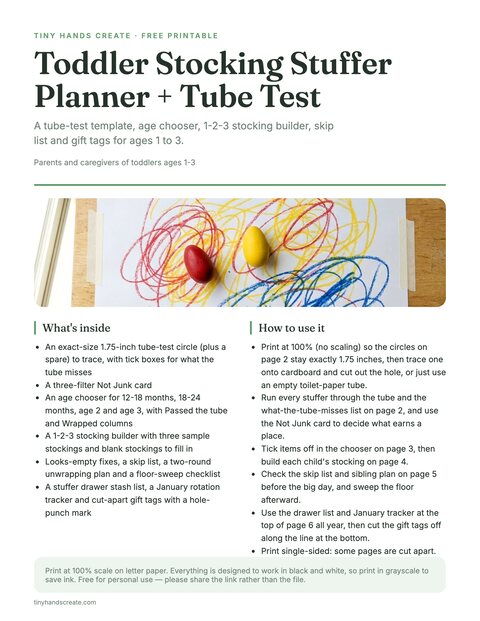
Free printable · 6 pages
Toddler Stocking Stuffer Planner + Tube Test
A 1.75-inch tube-test circle with a what-the-tube-misses checklist, a three-filter Not Junk card, an age-by-age stuffer chooser, a 1-2-3 stocking builder with three sample stockings, a skip list and older-sibling plan, a stuffer drawer list with a January rotation tracker, and cut-apart gift tags.
Free. Your download link appears right here. You'll also join the Daily Printable Drop. Unsubscribe anytime. Privacy
In this article (16 sections)
- The Toilet-Paper-Tube Test: Check for Choking Hazards
- What “Not Junk” Actually Means (My Three Filters)
- Toddler Stocking Stuffers by Age (Ages 1 to 3 Chart)
- Stocking Stuffers for 12 to 18 Months
- Stocking Stuffers for 18 to 24 Months
- Stocking Stuffers for Age 2
- Stocking Stuffers for Age 3
- The Sensory and Art Stuffers Worth Sneaking In
- Building a Stocking That Works (Three Sample Stockings)
- Keeping It Safe When Older Siblings Are in the Mix
- What to Skip: Stocking Stuffers Not Safe for Toddlers
- Making Stuffers Last Past January
- A Few DIY Stuffers You Can Make in an Evening
- Stocking ideas from our sister brands
- Frequently Asked Questions
- Final Tips for Filling a Toddler Stocking
The Toilet-Paper-Tube Test: Check for Choking Hazards
If you take one thing from this whole post, make it this section. The idea behind it is simple: children under three put things in their mouths, and their airways are small. Anything small enough to fit inside a certain size can lodge in the throat. Safety standards use a small cylinder to test toys for this, and you can approximate it at home with an empty toilet-paper roll.
Safety firstThe tube is a size check for solid pieces only. The legal small-parts rule covers children under 3, but many pediatric sources advise the same caution to about age 4 for kids who still mouth things, so use the tube across the whole 1 to 3 range. Anything that fits, or any piece that could come off, stays out of the stocking.
How to run the test
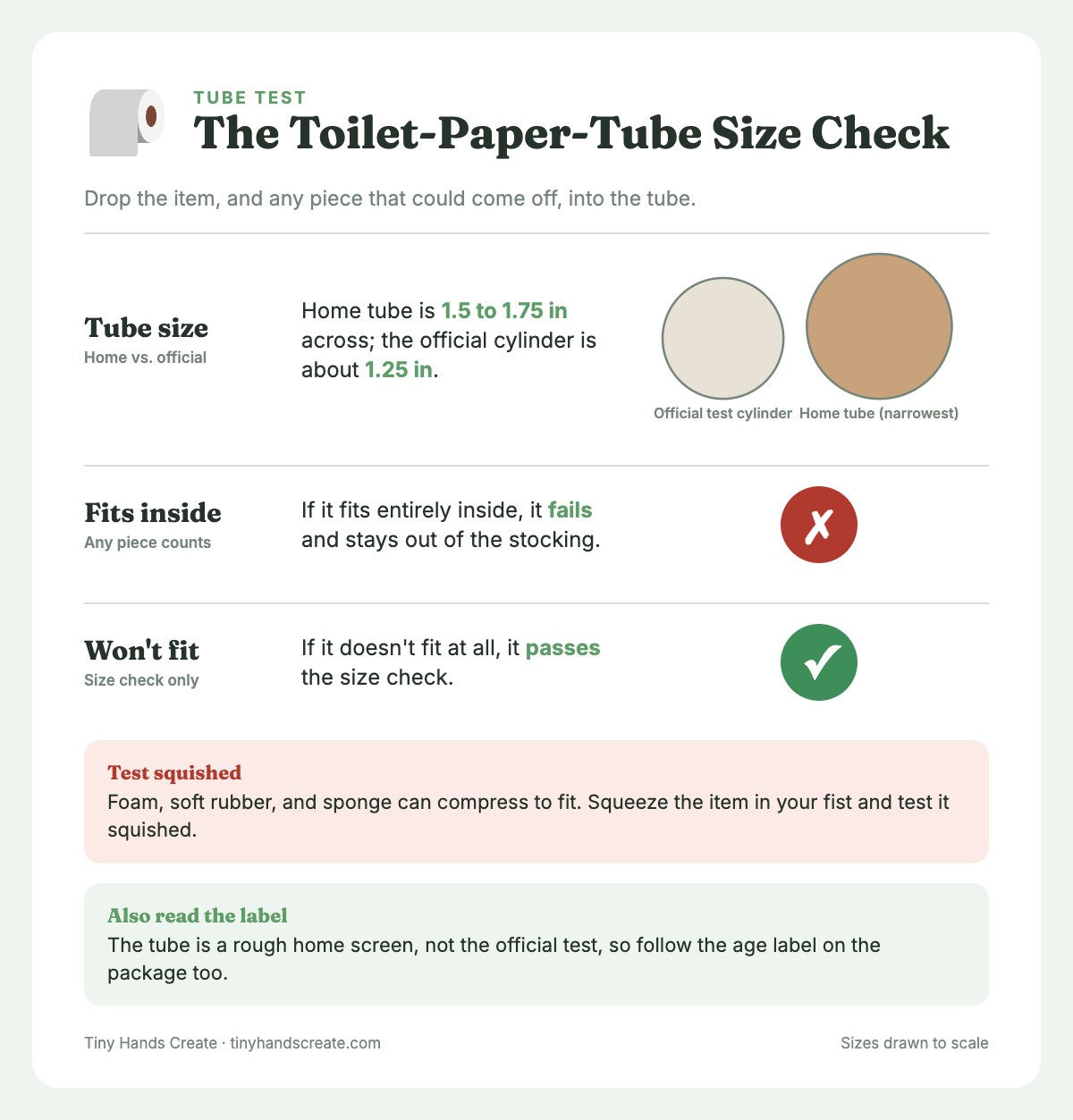
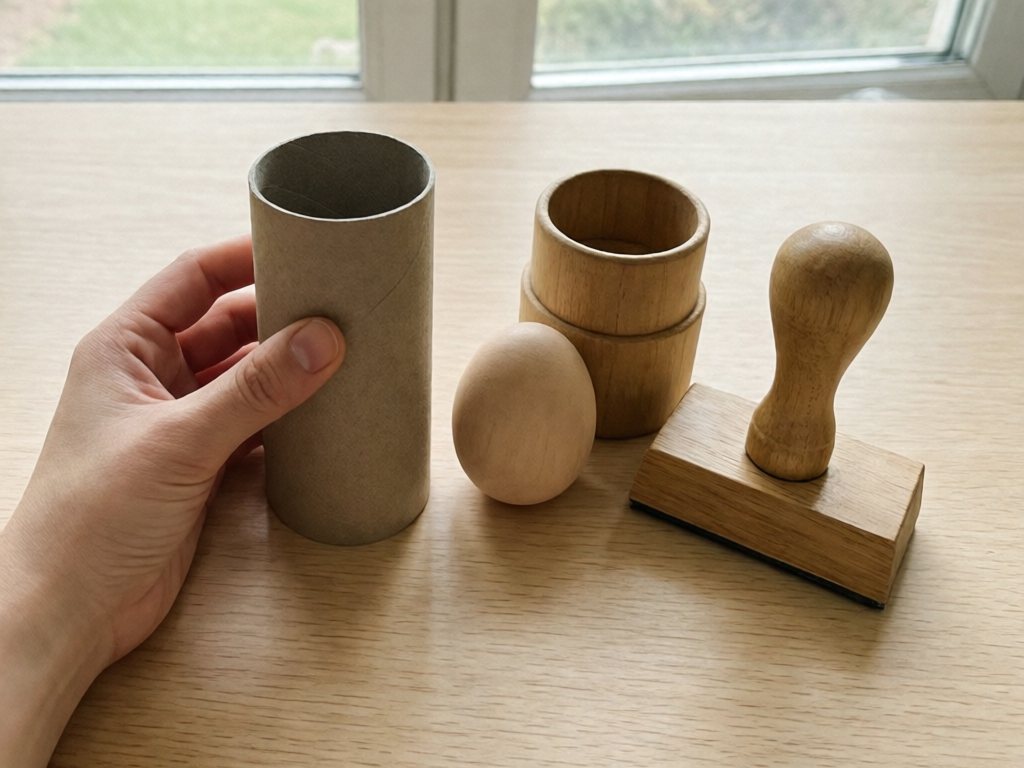
- Grab an empty toilet-paper tube. Use a rigid, round tube, not a squashed one. Standard rolls are about 1.5 to 1.75 inches across, wider than the official test cylinder (about 1.25 inches), so more items fail. That is the safe direction. A toilet-paper tube is a rough home screen, not the official test, so also follow the age label on the package.
- Drop the item (or any piece of it) into the open end of the tube. If it fits entirely inside, it fails.
- If it fits, it is a choking risk for a toddler, and it doesn’t go in the stocking. Not “maybe with supervision,” just no.
- If it doesn’t fit at all, it passes the size check.
What the test does NOT catch
The tube is a size check, not a full safety inspection. A few things sneak past it, so run these checks too:
- Squishables. Foam, soft rubber, and sponge shapes can compress to fit through the tube even if they look too big. Squeeze the item in your fist and test it squished.
- Pieces that detach. A big toy with a glued-on eye, a pom-pom nose, or a snap-on hat has small parts hiding in it. Tug on everything. Give it a good twist. If something pops off and the popped-off piece fits in the tube, the toy fails.
- Things that break into small bits. A cheap crayon can snap into stubs. A brittle plastic toy can crack. Think about what happens after a toddler has thrown it at the wall for a week.
- Batteries. Skip any toy with a battery door that opens without a screwdriver, and skip loose button batteries entirely. They are especially dangerous if swallowed. Emergency steps are in the box below.
- Magnets. Skip small or high-powered magnets entirely.
- Long cords and strings. Ribbons, strings, and cords on toys are a strangulation risk for little ones. Keep them short or skip them.
- Edges. Run your thumb along it. Rough seams, sharp corners, and splintery wood have no place in a toddler stocking.
- Latex balloons. Uninflated balloons and popped balloon pieces are a choking risk for young kids. Leave them out.
Emergency: batteries and magnetsIf a button battery or any magnet is swallowed or suspected, go to the ER now. Call the National Battery Ingestion Hotline at 800-498-8666 or Poison Help at 1-800-222-1222. Do not wait for symptoms, do not induce vomiting, and do not give food. A button battery can cause severe burns within about 2 hours. Magnets swallowed separately can pull together across the gut. If any small part goes missing and a child is coughing, drooling, or struggling to breathe, call 911 or seek urgent care.
Keep a spare tube with the gifts
Here’s the trick that made this painless for me: I keep a spare tube in the drawer where I hide holiday gifts. Every time something comes out of a package, it goes over the tube. It takes about two seconds per item, and it makes the whole process feel less like a worry and more like a ritual. If you’re shopping in person, you can pop an extra tube in your bag and test in the aisle.
One more note: this test is for the toddler in the room, but stockings often get hung in a house with older siblings too. More on that later, because the sibling stash is the number-one way small parts end up in a toddler’s hands.
What “Not Junk” Actually Means (My Three Filters)
“Junk” is a slippery word, so let me pin it down. When I say a stocking stuffer isn’t junk, I mean it clears all three of these filters:
- It gets used for more than one afternoon. A toddler stuffer should earn its keep for weeks, like the crayons, play dough, scoops, and chunky stamps that live in the play basket. A novelty item does one trick and is done.
- It puts the toddler’s own hands to work. The child should be the engine: pouring, scribbling, pressing, squeezing, stacking, scooping. If the item mostly performs for the child (flashes, plays a tune, wiggles), they tend to watch it for a minute and move on.
- It passes the small-parts check. Everything here clears the tube. No exceptions, no “it’s probably fine.”
Notice what’s missing from the list: cuteness, sparkle, and “it was on sale.” Those are real factors when I’m shopping, but they don’t get an item into the stocking by themselves.
I’m describing gift types and what to look for rather than specific products. That’s on purpose. Good toddler gear comes in many forms, and what matters is the shape, size, and material, so you can find the right thing wherever you shop or make it yourself. Most of these types are budget-friendly, and the DIY options near the end cost even less.
Toddler Stocking Stuffers by Age (Ages 1 to 3 Chart)
Here’s the table I keep taped inside the gift cabinet. Find your child’s row and read the last column before anything goes in.
| Age | Item type | How they’ll use it | Small-parts check |
|---|---|---|---|
| 12–18 months | Chunky crayons (fat, egg-shaped or palm-sized) | Scribbling with a whole-fist grip on big paper or a taped-down paper roll | Must be too big to fit in the tube; check the paper wrapper is removed; toss any broken stubs |
| 12–18 months | Soft-bodied board book | Turning thick pages, pointing, “reading” the same book 40 times | No flaps with tiny pieces, no attached charms; corners should be rounded |
| 12–18 months | Large wooden or silicone stacking cups | Nesting, stacking, scooping in the bath or sandbox | Smallest cup must not fit in the tube; check no loose inserts |
| 12–18 months | Large scoop and pour set (a big spoon and a sturdy tub) | Scooping and dumping water in the bath, with an adult within arm’s reach | Scoop head and handle should be one piece; whole item bigger than the tube |
| 12–18 months | Washable, chunky finger paint or paint stick | Smearing, dabbing, hand and finger painting | Not a small-parts item, but check the lid is too big for the tube or a screw-on type, and keep the lid yourself. Paint is for skin and paper: look for an ASTM D-4236 or AP-certified label, keep it out of eyes, and call Poison Help (1-800-222-1222) with any concerns |
| 12–18 months | Textured fabric ball (big, soft) | Rolling, squeezing, carrying, tossing | Ball must be much larger than the tube opening; no loose beads inside or sewn-on bits |
| 18–24 months | Lump of play dough in a big tub | Squishing, poking, rolling with hands | Play dough is not food. Expect tastes, redirect gently, and skip it if your child eats it; skip tiny cutters |
| 18–24 months | Large chunky stamps (one-piece, big handle) | Pressing on an ink pad and paper | Entire stamp bigger than the tube; one solid piece, no removable parts |
| 18–24 months | Fat sidewalk chalk (thick sticks) | Scribbling outside or on a dark paper | Sticks need to be thick enough that even a broken half doesn’t fit in the tube |
| 18–24 months | Wide-handled paint brush plus a small dish | Painting with water or paint | Brush handle long and wide; no loose bristles or small ferrule that can pop off |
| 18–24 months | Large wooden knob puzzle (3–5 pieces) | Pulling out and fitting back in | Every piece must fail the tube test (be too big to fit in it); inspect that knobs are not loose |
| 18–24 months | Washable markers (jumbo size) | Early scribbling with a firmer line | Caps are the risk: every cap must be too big for the tube or vented, and an adult holds the caps |
| 2 years | Big sticker sheets (large stickers) | Peeling and sticking onto paper | Peeled stickers can be mouthed, so stay close; skip tiny sticker dots |
| 2 years | Lacing cards or large-bead threading with a thick lace | Threading a short, thick lace through big holes | Beads must fail the tube test (be bigger than it); lace under about 7 inches, adult present, never worn around the neck, put away after play |
| 2 years | Child-safe scissors (blunt, loop handled) plus play dough (adult-assisted) | Snipping dough “snakes” | Check no small screws or caps; blunt blades |
| 2 years | Chunky watercolor set or a washable paint tray | Painting with a big brush and a little water | Pods are usually larger than the tube; check each one. Also check the brush (handle big, head firmly attached) |
| 2 years | Sponge shapes or large sponge brushes | Dabbing paint, washing toy dishes in the bath | Squish the sponge to check the compressed size; use large pieces only |
| 2 years | A roll of washi-style paper tape (wide, easy-tear) | Sticking on the table, “decorating” boxes | Rolls are bigger than the tube; keep the tape in your hand when not in use |
| 3 years | Child-safe scissors and a stack of scrap paper | Snipping practice, confetti mess | Blunt tips; sweep snippets up as you go (paper bits are a choking hazard); scissors stay with an adult nearby |
| 3 years | Glue sticks (large barrel, washable) | Gluing paper collage | Barrel must be big; glue sticks are fine for most 3s but supervise for mouthing |
| 3 years | Big beads and a thick lace for stringing | Threading, pattern making | Beads must clear the tube test (be larger than it); skip anything small or glued |
| 3 years | Kids’ stamp pad (washable ink) with large stamps | Stamping animals, shapes, or letters | Stamps must be big, one piece; lid of the ink pad stays in your hands |
| 3 years | Mini notebook or sketchbook with thick pages | Scribbling, drawing, pretend-writing | No spiral wire that can poke; choose a glued or taped spine |
| 3 years | Jumbo paper roll or a pad of large paper | Big art, tracing, taping down | Few small parts; check the cardboard core is secure, tape the ends flat, and keep the roll away from cribs |
You don’t need all of these. A good stocking is three to six items from the right row for your child. I’ll show you how to combine them below.
Stocking Stuffers for 12 to 18 Months
This is the “everything goes in the mouth” stage, and also the “I’m learning to hold things” stage. So you’re looking for stuffers that are big, sturdy, mouth-safe, and satisfying to grab. It’s also the stage where a single good item can win the morning, because a one-year-old is usually just as delighted by the wrapping paper.
Chunky crayons and big paper
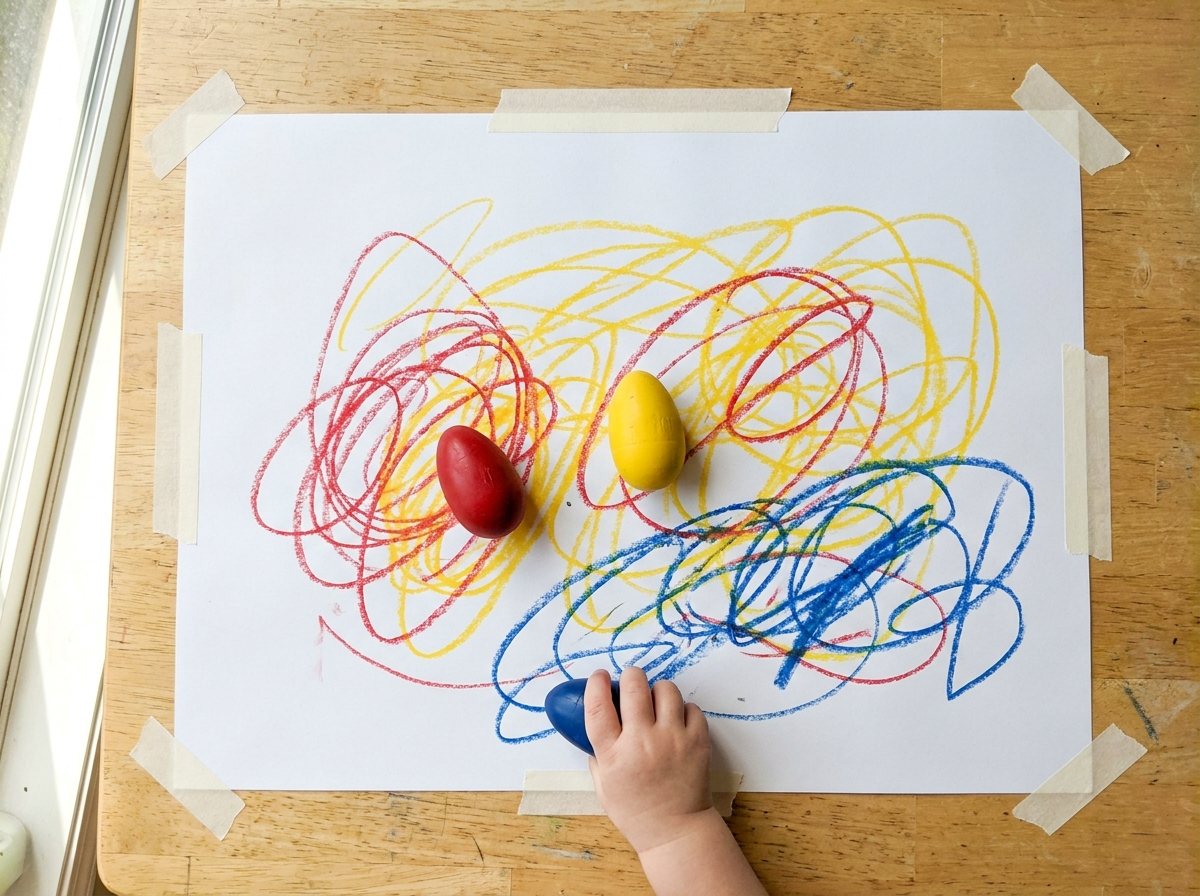
A chunky crayon is usually the first art tool a one-year-old can really use. Look for crayons shaped like eggs, palm-sized discs, or fat triangles that fit a fist. Little hands grip with the whole palm, so skinny crayons are frustrating and break easily.
To keep the mess small: tape a big sheet of paper to the floor or the high chair tray. Toddlers will color on the tray if you don’t. Plan to peel crayon off a surface at least once this holiday season.
A big, soft board book
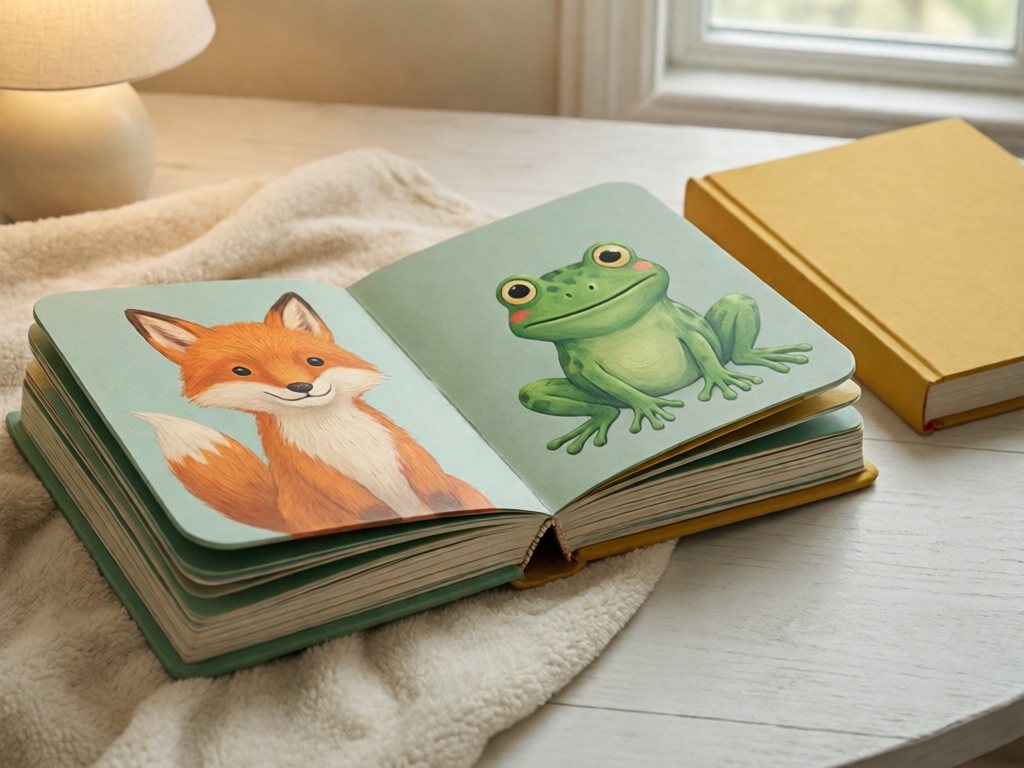
A good board book is a stocking stuffer that doubles as a bedtime routine. Pick one with thick pages, rounded corners, and pictures of everyday stuff: animals, foods, vehicles, families. Skip any with attached charms, squeakers, or tiny flaps that peel off.
Stacking cups, scoops, and tubs
A set of nesting cups gets used constantly. One-year-olds bang them, stack them, scoop with them, and fill them in the bath. Check that the smallest cup is clearly bigger than the tube opening. If the set has any inserts or lids, pull on them to make sure they don’t pop out.
A scoop and a sturdy tub combo is the quiet hero here. Put a scoop in the stocking and fill the tub later with water, only with an adult within arm’s reach and never left alone with standing water. Skip dry oats and rice for this age group, since they get mouthed and inhaled. One scoop and one tub can fuel a whole afternoon.
Washable finger paint
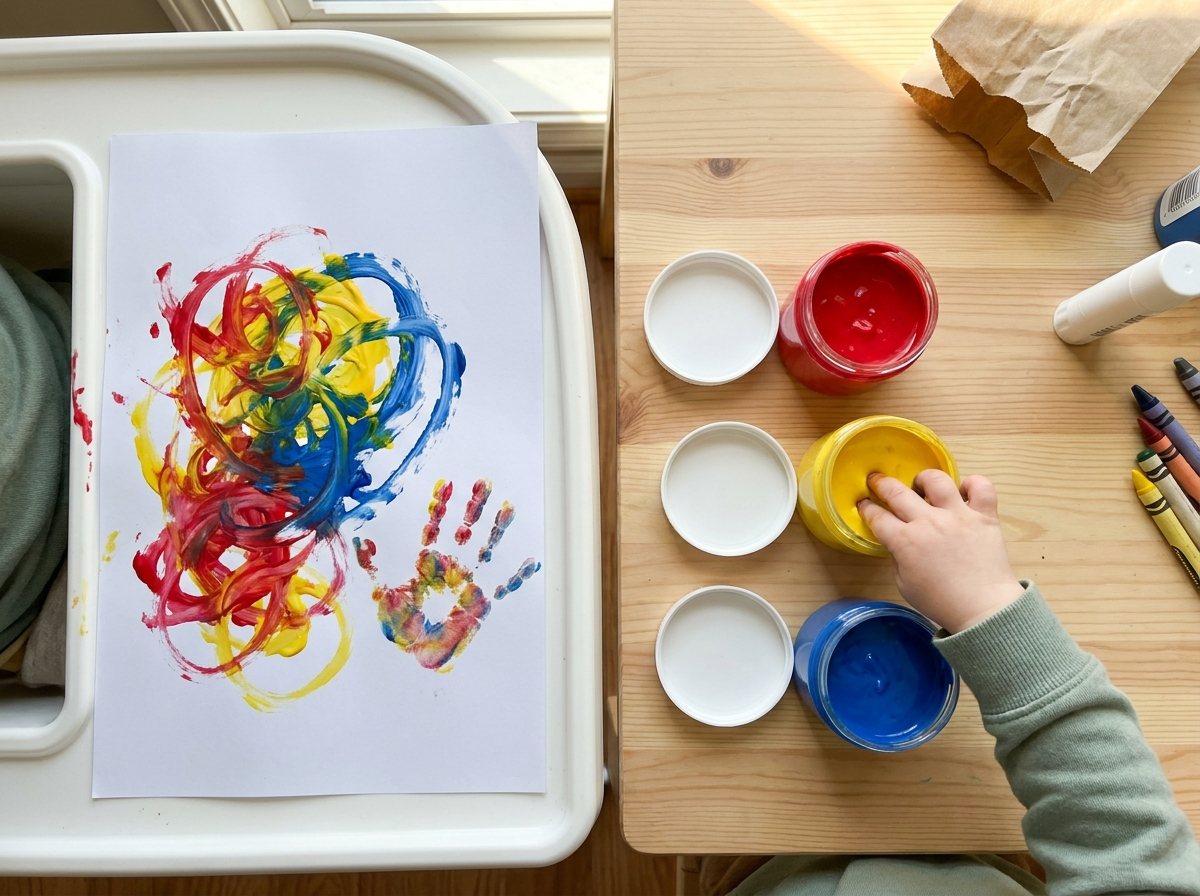
Finger paint is the stuffer I’d pick first for a one-year-old. A small tub of washable, non-toxic paint feels like a luxury at this age. Check the label for ASTM D-4236 or AP certification. Serve it on a high chair tray with a smock (or just a diaper, honestly) and let them go. The mess is real but contained.
Safety firstStay beside them the whole time; paint is for skin and paper, not for eating. Expect a taste anyway, keep it away from eyes, and call Poison Help (1-800-222-1222) with any concerns.
For a gentler first paint experience, try sensory play with no mess. Sealed bags of paint taped to the window let a one-year-old squish and smear without a drop on the floor. Stay right beside them, and remove the bag when play ends.
Double-bag and tape the seams, never use it in a crib, and throw it out at the first leak or bite mark. Full notes are in the sealed squish bags section below.
A big, soft fabric ball
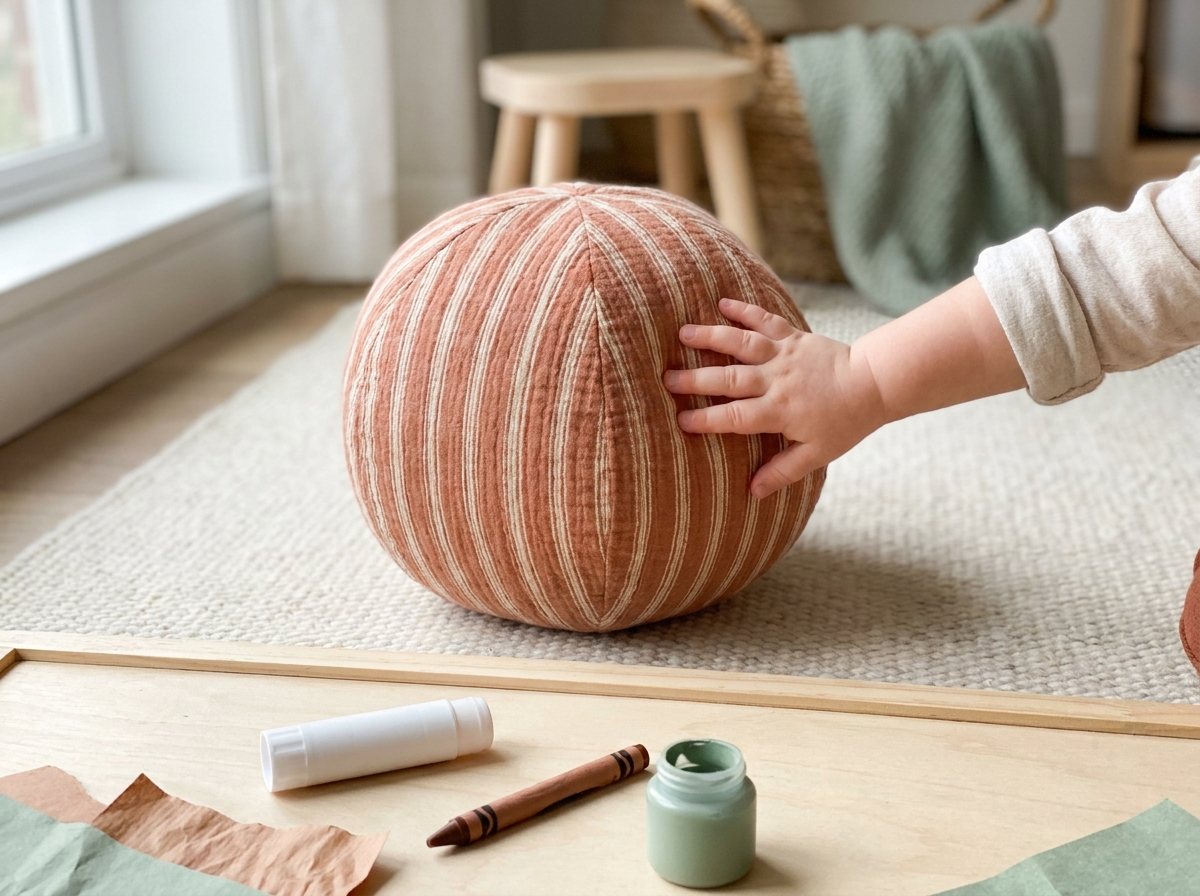
Soft balls are great for rolling, crawling after, and passing back and forth. The key is size: the ball should be far bigger than the tube opening, with no tiny beads or sewn-on bits that can break loose. Pull and tug all the seams.
Stocking Stuffers for 18 to 24 Months
Somewhere around 18 months, toddlers shift gears. They want to do things on purpose: stack, push, pour, pull things apart. This is also where the first real art tools show up, and where “I do it myself” starts to appear.
Play dough (the stuffer that earns its keep)
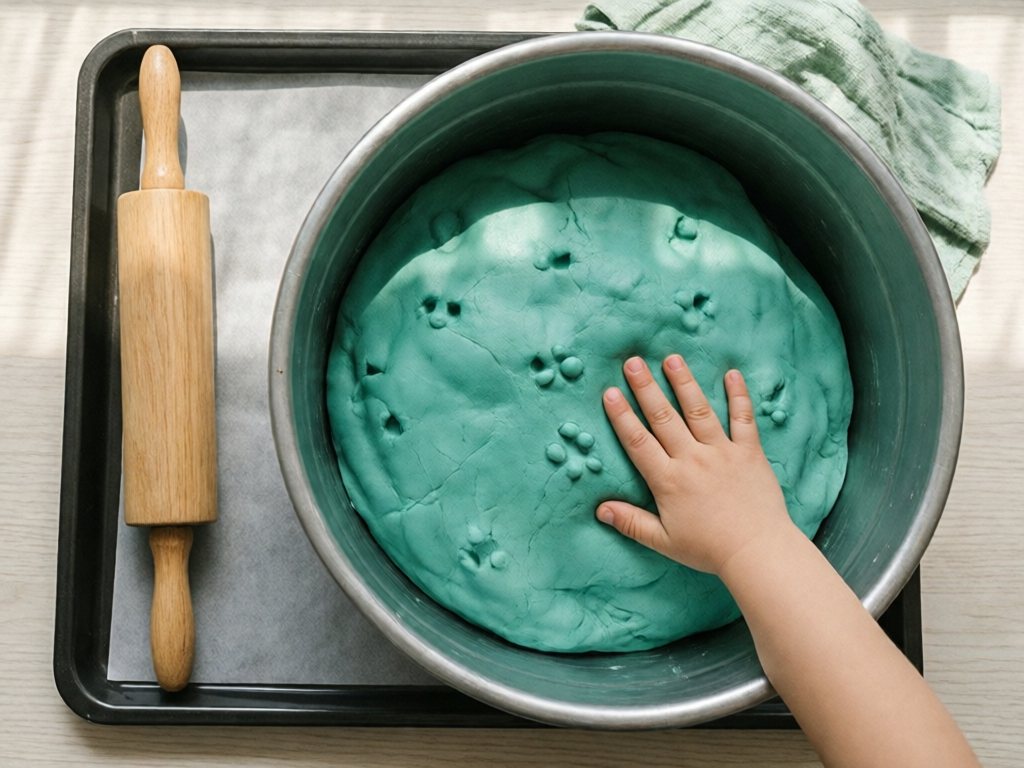
A tub of play dough costs very little to make or buy, lasts weeks, and gets used in lots of ways: squishing, poking, rolling, pressing with a spoon. For this age, skip the tiny cutters and the sets with mini accessories. Keep it to a lump of dough and one or two chunky tools like a wooden rolling pin or a big plastic spoon.
Fair warning: play dough on carpet is a lesson in humility. Set up on a baking sheet or a tray, and keep a damp cloth nearby. Dry dough crumbles vacuum up easily; wet dough does not.
Play dough is not food. Stay close, expect a taste or two, and put it away if your child keeps eating it.
Large, chunky stamps
Big one-piece stamps with a fat handle are brilliant at this age. Toddlers love the thunk of pressing a stamp onto paper. Look for stamps that are a single molded piece, so there are no little parts to come loose. Pair with a washable ink pad (and keep the lid up on a shelf when not in use).
Fat sidewalk chalk
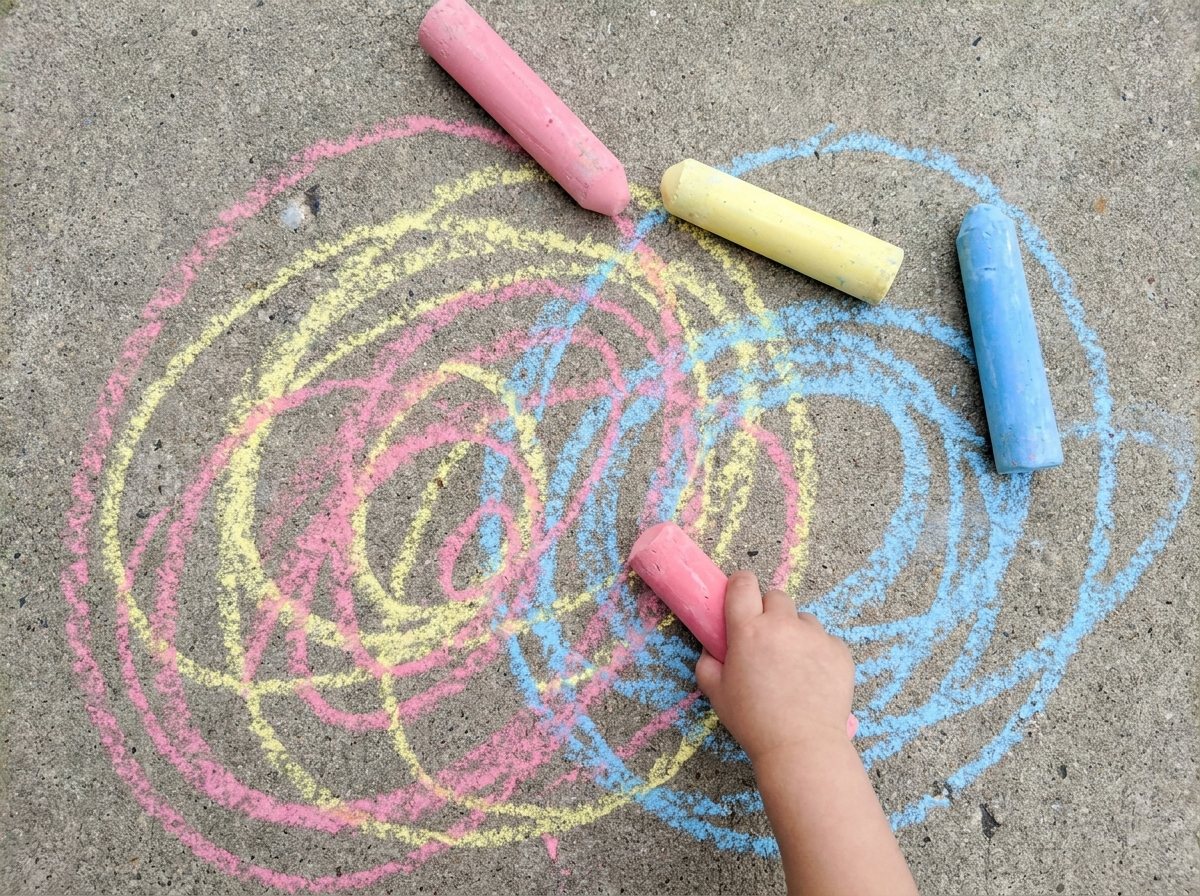
Chalk is one of the best stocking stuffers of the year because it keeps children outside, which keeps the mess outside. Pick thick sticks, thick enough that even a broken half is wider than the tube. Thin chalk snaps into tiny, mouthable bits. For winter climates, chalk on a dark piece of paper or a chalkboard-style place mat works indoors.
A wide-handled brush and a small dish
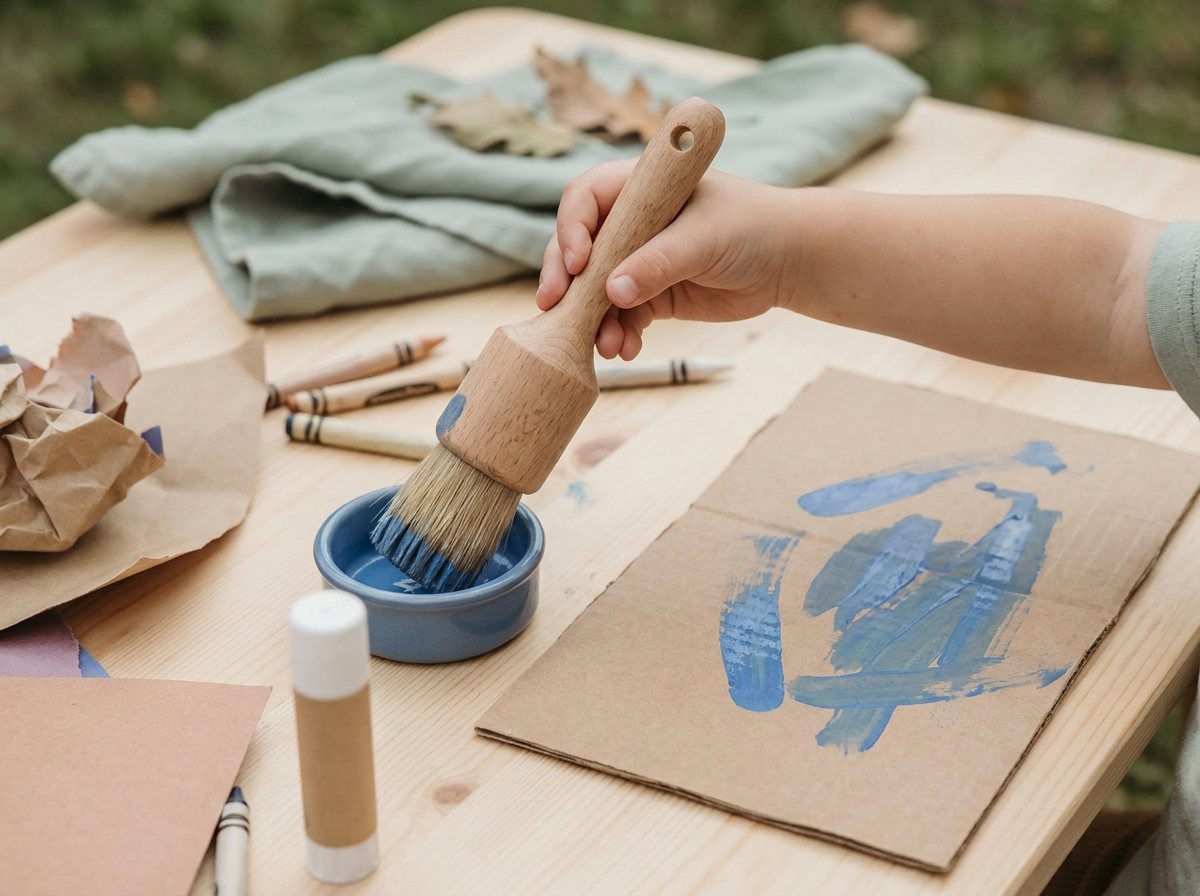
Toddlers this age love having a real paintbrush, like the grown-ups use. Choose one with a thick, easy-to-grip handle and a firmly attached head. Add a small, sturdy dish (a muffin tin cup works) and a little paint or water. Water painting on the patio or a piece of cardboard is a wonderful low-mess way to practice before real paint.
A knob puzzle with three to five pieces
Knob puzzles are the original fine-motor workout. A 3 to 5 piece wooden puzzle with chunky pieces is perfect for this age. Every piece should be well bigger than the tube opening, and the knobs should be firmly attached. Give each piece a tug before wrapping.
If you want more ideas for hand-strengthening play that you can build around these stuffers, our fine motor activities for toddlers post has setups that pair well with puzzles, dough, and chunky tools.
Jumbo washable markers
Jumbo markers glide easily and give instant color. They also come with caps, and caps are the one real watch-out here. Choose markers whose caps are too big for the tube or vented, and keep the caps in a “grown-up only” spot. Hold the marker, uncap it, hand it over, and recap it when it’s done. This keeps ink off the couch and caps out of mouths.
Stocking Stuffers for Age 2
Two-year-olds are strong, curious, and fiercely independent, so they love tools that feel real. They want to be “like the big kids.”
Big sticker sheets
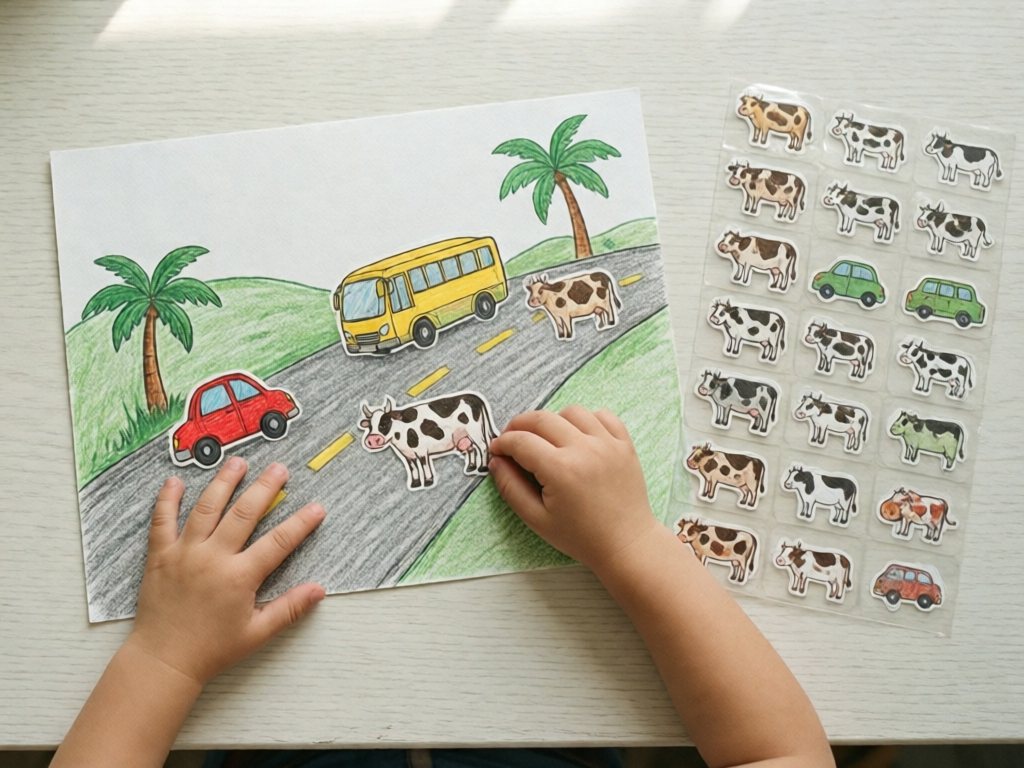
A two-year-old will peel, stick, re-stick, and apply stickers to the dog, the wall, and their own forehead. Choose large stickers (think palm-sized) rather than tiny dots, because the small ones are a mouthing hazard and also frustrating to peel. Peeled stickers can end up in mouths, so keep a close eye during sticker time.
For a bit of structure, give a sticker sheet and a big piece of paper with a simple scene drawn on it, like a road, a pond, or a barn. The child “decorates” the scene. This turns a five-minute activity into a twenty-minute one.
Lacing cards and big beads
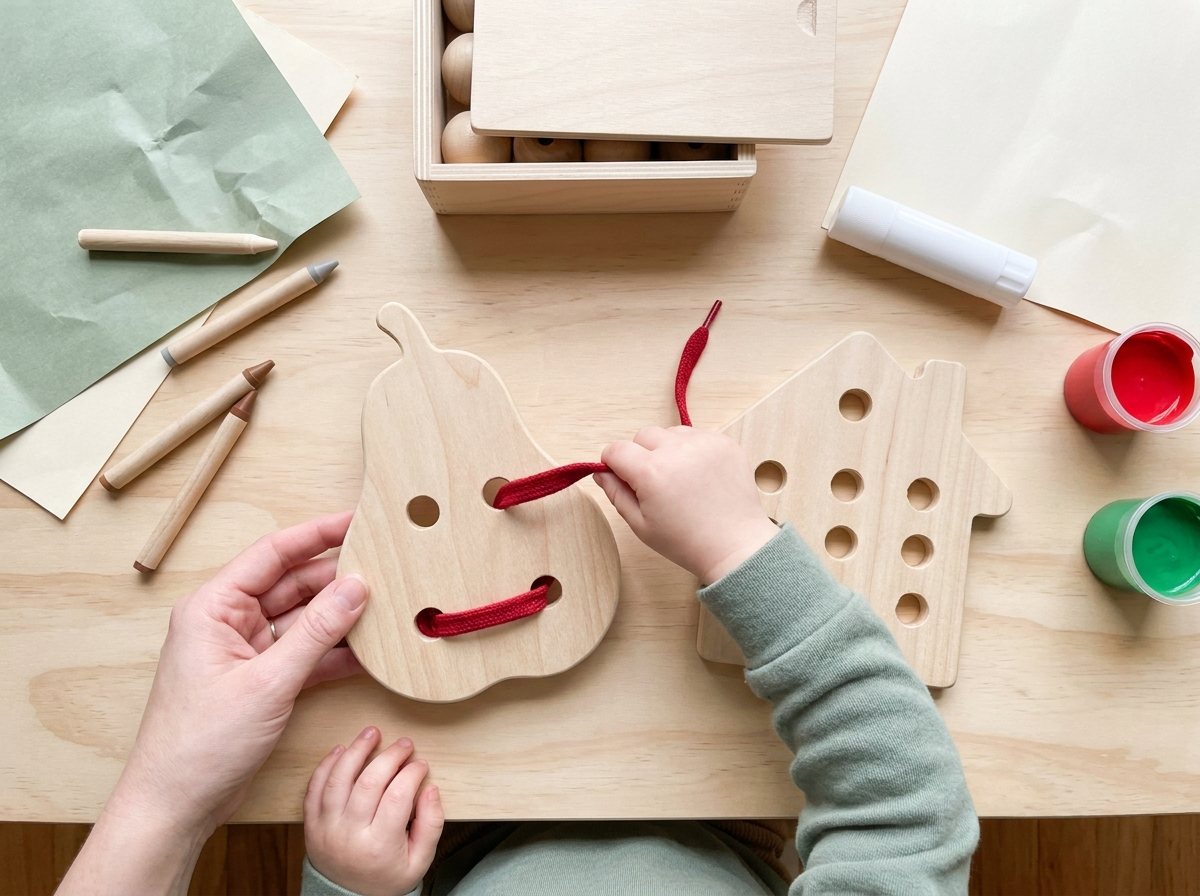
Threading is a calm, focused activity. For two-year-olds, pick lacing cards with big holes and a short, thick lace, or chunky beads with large holes. Each bead needs to be much bigger than the tube opening. Keep laces under about 7 inches, stay close, never let a lace go around the neck, and put it away after play. Any cord is a strangulation risk.
Blunt toddler scissors with play dough (adult-assisted)
This is my favorite “grown-up feeling” stuffer. Give a pair of blunt, loop-handled toddler scissors and some play dough. Roll dough into snakes, and let the child snip them into pieces. Dough is far more forgiving than paper for beginners, because it doesn’t need two hands and a lot of coordination. Supervise closely, keep scissors for dough only, and put them away afterward.
Chunky watercolor set or paint pods
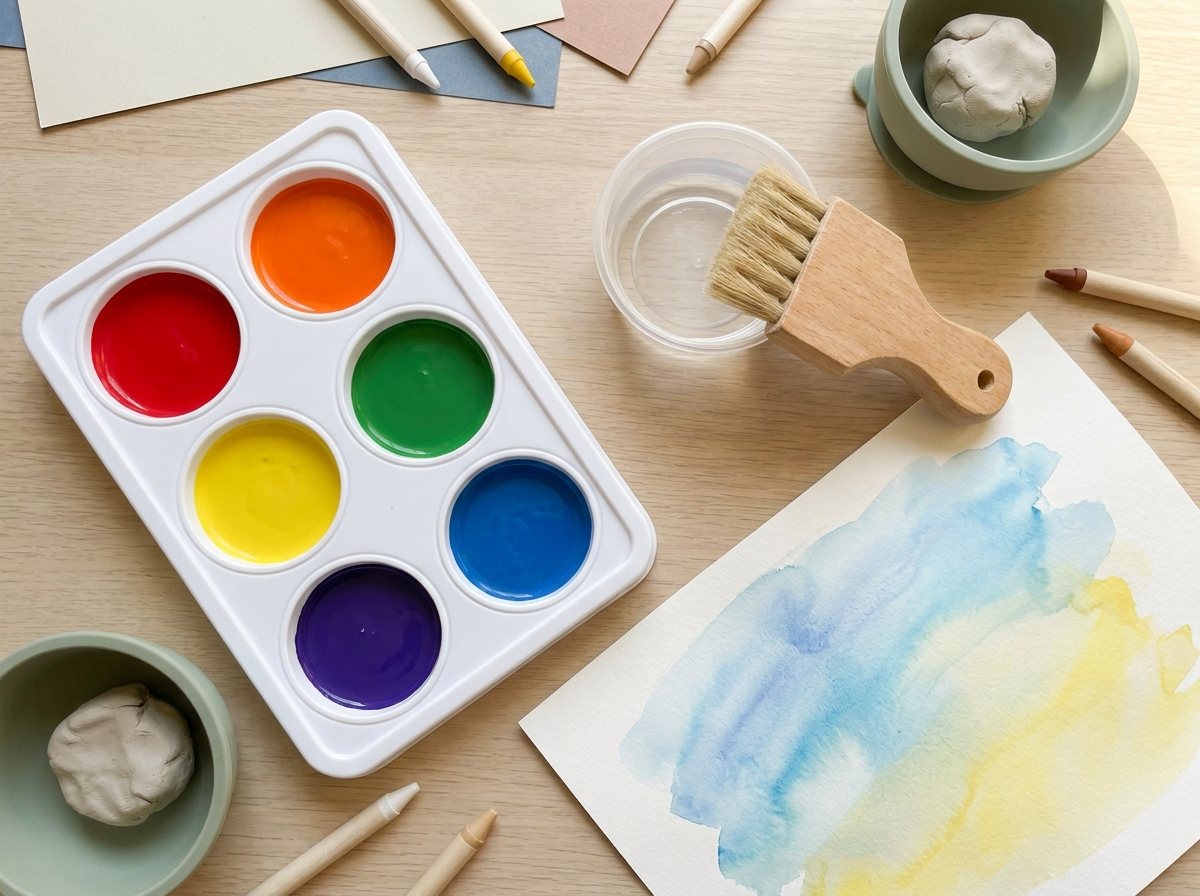
A simple tray of watercolor paints with a big brush is a lovely stuffer for a two-year-old. Pods are usually larger than the tube, but check each one. Watercolors are one of the lowest-mess paints out there, especially compared to tempera, so they’re a good choice if you’re nervous about messy projects. For a deeper dive, our mess-free art ideas for toddlers will give you a few setups to pair with it.
Sponge shapes
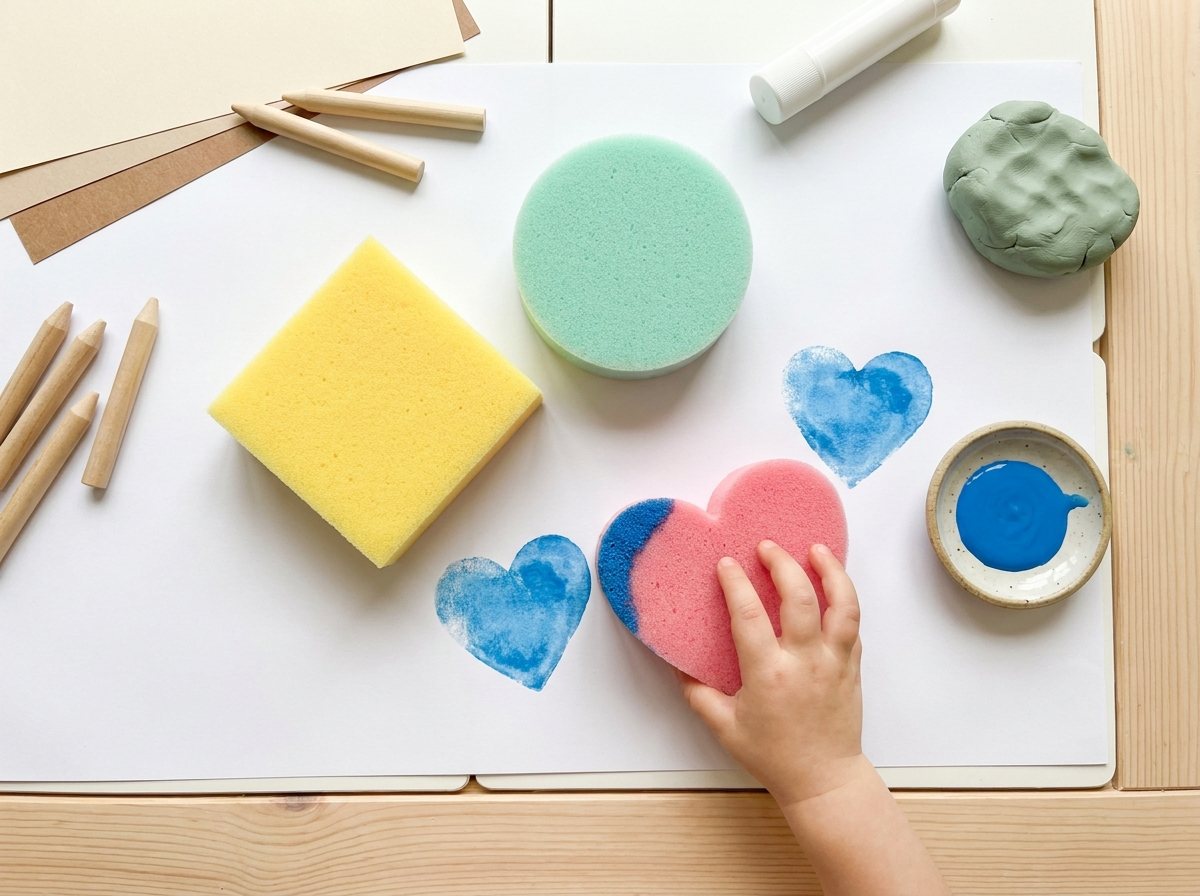
A pack of large sponge pieces is a surprisingly good stuffer. Dab them in paint, press them on paper, wash toy dishes with them in the bath. Squish each sponge in your fist and test it squished. If the compressed sponge fits in the tube, it’s too small. Go big.
Wide washi-style paper tape
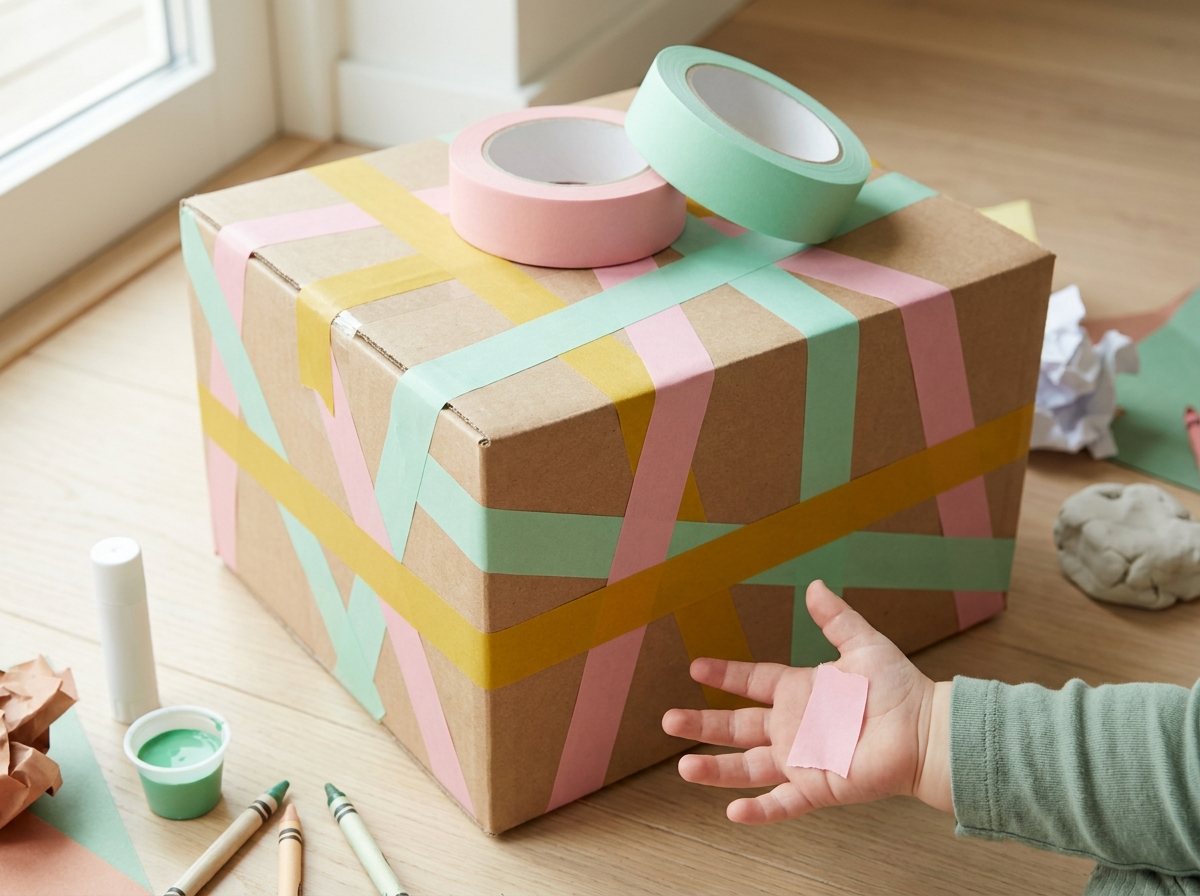
Two-year-olds love to rip off a strip and stick it on a table, a cardboard box, a window. It comes off most surfaces without a fuss. Choose a wide, easy-tear roll so little fingers can manage it, and keep the roll in your hand when it’s not in use (tape strips on the carpet can end up in mouths).
Stocking Stuffers for Age 3
Three-year-olds are a different audience. They can follow two-step directions, they love “projects,” and they want their own supplies. This is the age where a stuffer can become a whole afternoon. If you’re hunting for stocking stuffers for toddlers age 3, aim for items that let them make something and show it to you.
Child-safe scissors practice kit
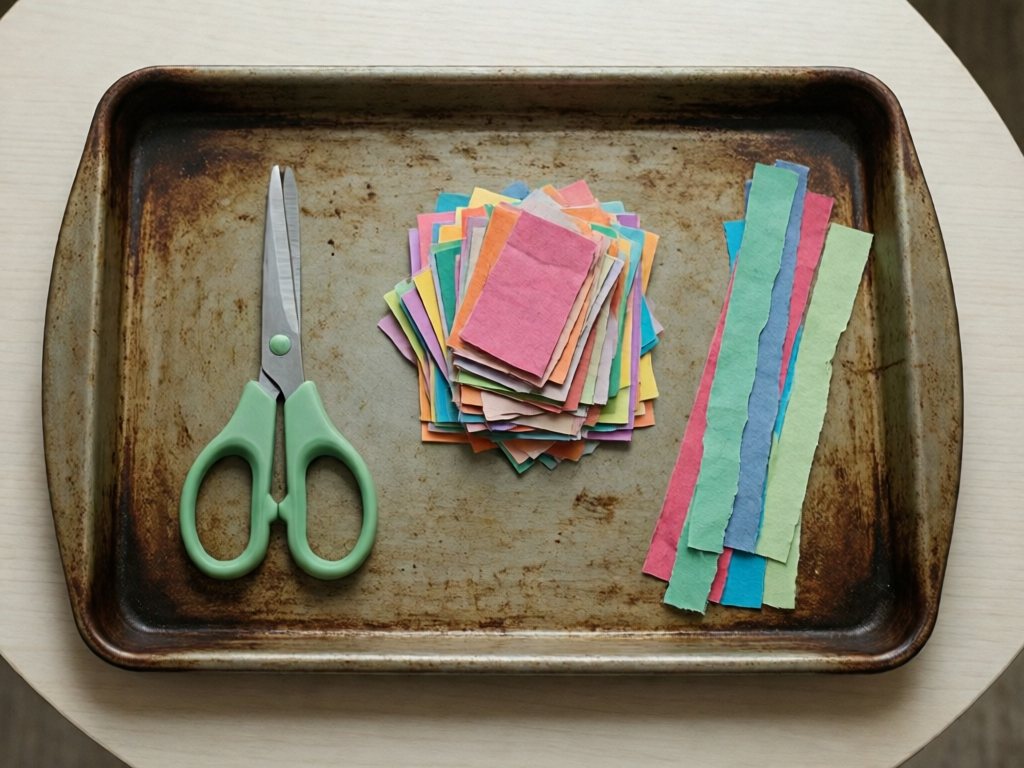
By three, many kids are ready for real snipping practice with blunt-tipped child scissors. Pair scissors with a stack of scrap paper, an old magazine, or a pile of junk mail. The snippets will go everywhere. Put a sheet or big tray underneath and sweep them up right away, because small paper bits are a choking hazard.
Glue sticks and paper
A big-barrel, washable glue stick is the entry point to collage. Give a stack of colored paper scraps, a few scraps of fabric or felt, and let them glue to their heart’s content. Keep an eye on mouthing, since glue sticks are non-toxic but not meant for eating.
Big beads and thick string for stringing
Three-year-olds can string beads for a good ten minutes, which feels like an eternity. Pick large beads (clearly bigger than the tube opening) and a thick, blunt-ended lace. If you’re gifting a “bracelet kit,” check the maker’s age label, keep the beads big and the string under about 7 inches, and skip any with small spacer beads or detachable parts. This is a fantastic fine-motor stuffer.
Washable stamp pad and big stamps
A washable ink pad and large one-piece stamps will keep a three-year-old printing for ages. Make sure every stamp passes the tube test, and keep the ink pad’s lid out of reach.
A mini sketchbook
A small sketchbook with thick pages is a gift that says “your art matters.” Choose a glued or taped spine rather than a metal spiral. Add a chunky crayon or two and a jumbo washable marker, and the stocking has a whole creative kit. Toddlers love having a “book of my own.”
A big roll of paper
If there’s one stuffer I’d recommend above the rest for a three-year-old, it’s a big roll of plain paper. Tape it to the floor, the table, or a wall, and let them scribble big. It’s also a canvas for chalk, paint, stamps, and stickers. There are few small parts to check; just make sure the cardboard core stays attached. Tape the ends flat so no one trips, and keep the roll away from cribs.
The Sensory and Art Stuffers Worth Sneaking In
Some of my favorite stocking items don’t fit neatly into an age bracket. They’re simply good for toddlers of all stripes, and they keep paying back in play long after the holidays.
Sealed squish bags
Take a zip-top bag, add a few spoonfuls of non-toxic washable paint, and seal it well with strong tape. A toddler can squish and press it without any mess. It’s an easy DIY stuffer, and sensory bin ideas for toddlers has more variations. Double-bag and tape all edges. Keep an adult within arm’s reach, never use the bag in a crib or leave a child alone with it, and throw it out at the first leak or bite mark.
A pack of bubbles
Bubbles are the ultimate no-fuss stuffer. Bubble solution isn’t for drinking, so stay close and wipe hands afterward. If a child swallows a mouthful, call Poison Help at 1-800-222-1222. A bottle with a wide, spill-resistant top works best for little hands. They’re an outdoor treat, or a bath-time treat if your bathroom can handle it. Check that the wand is too big for the tube, and that the bottle cap isn’t a tiny, easy-to-pop-off piece.
Scoops, funnels, and tubs for the bath or sandbox
Silicone scoops and large plastic funnels turn bath time into pouring practice. They also work in the sandbox. For water play, stay within arm’s reach. Test the funnel’s smaller end against the tube, and make sure nothing detaches.
Dry-erase or water-reveal mats
A mat that you draw on with water, which dries and disappears, is a rare reusable art tool. It’s mess-free and endlessly repeatable. Choose the large size, and check that any attached pen or stylus is bigger than the tube.
Big paint-dabbers (dot markers)
Dot markers are a favorite for toddlers because there’s no wrong way to use them. Pick the jumbo size with caps that are larger than the tube or vented, and hold the caps yourself. Dot-dabbing on big paper is a calm, satisfying activity.
Building a Stocking That Works (Three Sample Stockings)
Individual items are great, but a stocking is a package.
The 1-2-3 ruleOne thing to make a mark, one thing to squish or pour, and one thing to look at or read. That guarantees variety without cramming the stocking full.
Here are three combinations to copy:
Sample stocking A: the 14-month-old
- One chunky egg-shaped crayon
- A big sheet of paper (to tape to the high chair tray)
- A small tub of washable finger paint
- A thick board book
- A scoop and a sturdy tub
Good for: tray scribbling, bath pouring with you beside them, and a bedtime book.
Sample stocking B: the 2-year-old
- A big sticker sheet and a paper “scene”
- A lump of play dough with blunt toddler scissors
- A chunky brush and a watercolor tray
- A roll of wide paper tape
- A set of lacing cards
Good for: a rainy afternoon of sticking, snipping dough, and painting.
Sample stocking C: the 3-year-old
- A mini sketchbook
- A jumbo marker set with caps too big for the tube or vented (an adult holds the caps)
- A washable stamp pad with large stamps
- Big beads and a thick lace
- A glue stick and a bag of paper scraps
Good for: a full craft session. The stocking doubles as the craft bin.
A word on the “it looks empty” worry
I know. Chunky crayons and a board book don’t fill a stocking the way a pile of tiny trinkets does. Here are my favorite fixes:
- Use the stocking as a container. Roll the big paper and tuck it in vertically. It fills the stocking and looks impressive.
- Wrap each item separately. Toddlers love unwrapping, and five wrapped items feels generous. Use plain paper without ribbon or bows, stay beside the child while they unwrap, and clear all wrapping straight away.
- Pad the top with tissue paper for display only. Remove it before the stocking goes to the toddler, and clear wrapping paper, bows, ribbon, and tape right away.
- Think big, not many. One large item beats ten small ones in both safety and play value.
Keeping It Safe When Older Siblings Are in the Mix
This is the part nobody warns you about. The stocking itself might be perfectly toddler-safe, but if the big brother’s stocking has beads, building bricks, and tiny erasers, those things will find the toddler by noon.
A few strategies that have worked for us:
- Open stockings in two rounds. Toddler stocking first, with the big kids busy elsewhere, then older kids’ stockings in a separate space.
- Use a “big kid zone.” A high table or a separate room where small-parts toys live. Hand off tiny items there and teach the older child to “keep it up high.”
- Ask the older siblings to be your safety patrol. Kids love a job. “Can you help me check for little pieces?” works wonders.
- Do a post-unwrapping sweep. After gifts, spend five minutes on hands and knees checking the floor and couch cushions. It’s the least glamorous holiday tradition and the most important one.
- Skip the candy trap. Under age four, avoid hard candy, whole nuts, popcorn, whole grapes (quarter them lengthwise), marshmallows, gum, and chunks of raw carrot or apple. If the stockings have candy, keep it in the big-kid stockings only, out of the toddler’s reach. This is about choking, not allergies; ask your pediatrician about introducing nuts in forms like thinned nut butter.
If your family stocking tradition is “everyone gets a stocking of the same stuff,” consider keeping the toddler’s stocking different. It’s not unfair; it’s age-appropriate.
What to Skip: Stocking Stuffers Not Safe for Toddlers
I’m not here to shame any trinket, but these categories deserve a hard pass for toddlers:
- Anything that fits in the tube. I’ll keep saying it. This includes tiny cars, mini figurines, jewelry, hair clips with small parts, and mini erasers.
- Bouncy balls and marbles. Small, round, and very easy to swallow. Larger balls only, well beyond the tube opening.
- Magnet sets. Skip small and high-powered magnets for all young children. Magnets swallowed separately can pull together across the gut, which is an emergency (see the box above).
- Button-cell battery gadgets. If the battery door isn’t screw-secured, skip it.
- Slime and putty with tiny add-ins. Foam beads, glitter, and charms are a problem for toddlers. Most slime is better for older kids.
- Latex balloons. A popped balloon is dangerous for young kids.
- Toys with long cords or strings. Strangulation risk.
- Cheap markers or crayons that snap. Look for sturdy, jumbo, washable.
- Anything with a strong chemical smell. If it smells off, it probably is. Trust your nose.
- Novelty noise-makers. Whistles, tiny horns, and loud toys are a no for ears and mouths.
None of these are bad things. They’re just wrong for this age, and they can wait a year or two.
Making Stuffers Last Past January
A “not junk” stocking keeps giving long after the wrapping paper is gone. Here’s how I stretch it.
- Rotate, don’t dump. Toddlers get overwhelmed by too much. Keep a few stuffers in a closet and swap them in every week or two. A “new” set of chalk in February feels like a gift all over again.
- Pair a stuffer with a mini-kit. The sticker sheet becomes part of a busy bag; the beads and lace get their own pouch. Our busy bags for toddlers post shows how to turn a stocking item into a quiet-time activity you can toss in a diaper bag.
- Create a “yes” tray. One tray with crayons, paper, stamps, and tape. It’s the toddler’s art station, and they can pull it out whenever they want. It’s also where you can retire the “no, not on the wall” speech.
- Keep a stuffer drawer. When you find a sturdy, tube-passing item during the year, stash it. By October you’ll have a head start, and you won’t be stuck with a last-minute bag of tiny plastic. For older-kid ideas, see gifts for kids who love crafts.
- Let the mess be part of the gift. The biggest gift you can give a toddler is permission to explore. Put down a sheet, tape the paper down, and let them go. A stocking full of art supplies is really a stocking full of “yes.”
A Few DIY Stuffers You Can Make in an Evening
Not everything has to be bought. Some of the best stuffers are things you make with household items. The tube test is for solid pieces only, so each item below has its own safety note.
DIY safetyCooking dough is an adult-only step, done away from the child, with the dough cooled completely before gifting. Dough is salty, not for eating, and contains wheat. Bags always need an adult within arm’s reach.
- A homemade dough tub. Mix 1 cup flour, 1/4 cup salt, 2 tsp cream of tartar, 1 cup water, and 1 tbsp oil. Cook on the stove over medium-low heat, stirring, until it pulls into a ball (adult only, away from the child), then cool completely. Pack in a big jar. It’s very salty, not edible, and contains wheat. Our soft playdough recipe has more detail.
- A sticker-scene board. Draw a big, simple scene on a sheet of cardstock (a barn, a beach, a road), and pair with a sheet of large stickers.
- A scribble roll. Roll up plain paper and close it with a strip of paper tape instead of a ribbon, since ribbons are a strangulation risk. Tuck it into the stocking.
- A seek-and-find board book. Use a plain board book and draw a simple picture on each page, or add large stickers with an adult nearby, for a seek-and-find game.
- A chalk-and-board set. A small piece of cardboard painted with non-toxic paint and a stick of fat dustless chalk, with an adult nearby.
- A sensory squish bag. As above: non-toxic washable paint only, double-bag, tape the seams, and keep an adult within arm’s reach.
None of these require special skills. If your idea of crafting is “put it in a bag,” you can handle every one.
From our sister brands
Stocking ideas from our sister brands
A book to tuck in beside the stocking, a set of dividers flat enough to go inside it, and one bigger gift for anyone skipping the small stuff.
Akoni Books and White Loft are sister brands of this site. When you buy through these links we may earn a portion of the revenue, at no additional cost to you.

Akoni Books
A Christmas storybook starring your toddler
For ages 2 and up. The pictures are drawn from one photo to look like your child, and you see the cover and first pages before paying. The digital edition is ready in minutes if you are filling stockings late. Order a printed copy by December 5 and most US orders arrive before Christmas.
Digital $9.99 · Softcover $29.99 · Hardcover $39.99, shipping included
First book? Code WELCOME5 takes $5 off at checkout.
Preview it free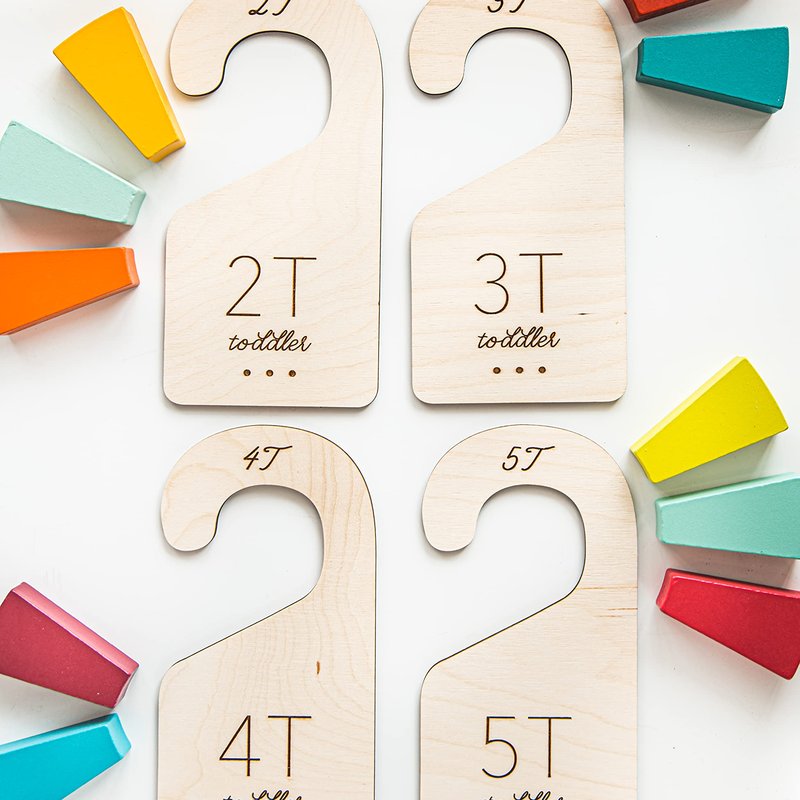
White Loft
Toddler Closet Dividers, set of 4
Four flat birch wood dividers etched 2T, 3T, 4T and 5T. They fit in a stocking, then hang on the closet rod and keep the clothes that fit now apart from the sizes still to come. A gift for whoever dresses the toddler.
$22.95 on Amazon
See it on Amazon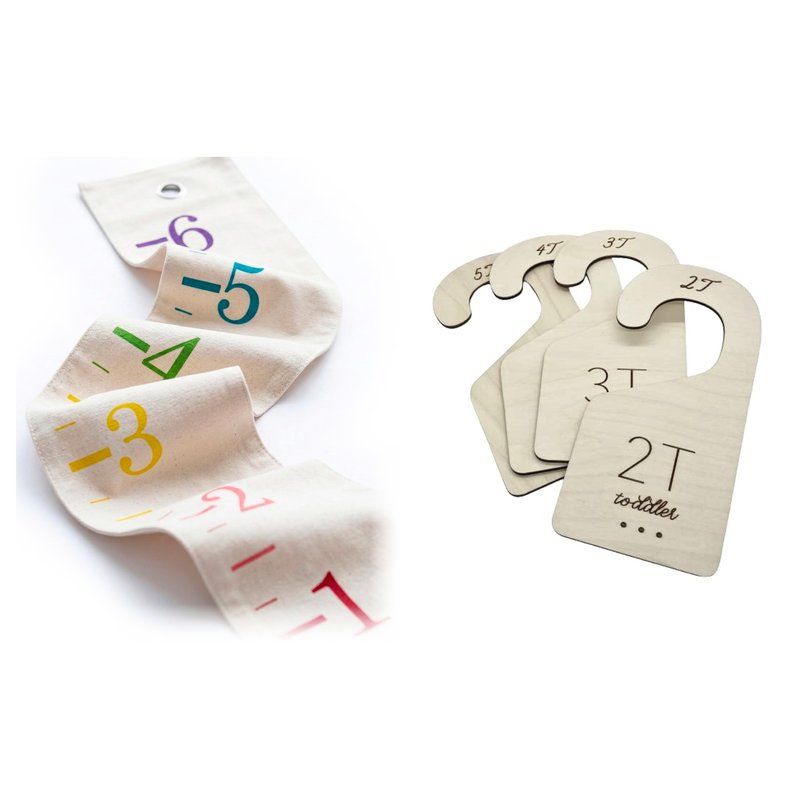
White Loft
The toddler dividers plus the rainbow growth chart, for 15% less than buying them separately. They arrive as two separately packaged items, so one can go in the stocking and one under the tree.
$53.50 on Amazon
See it on AmazonPrices checked October 2026; they can change.
Frequently Asked Questions
What are good stocking stuffers for toddlers age 2?
Two-year-olds love tools that feel real and let them make a mark. Strong picks include large stickers, play dough with blunt toddler scissors, a chunky brush with a watercolor tray, lacing cards with big beads, wide paper tape, and sponge shapes. Every one should pass the toilet-paper-tube test, meaning no piece is small enough to fit inside a tube. The age table above lists more ideas, with a small-parts check for each.
What are good stocking stuffers for toddlers age 3?
Three-year-olds are ready for more “project” items. Think a mini sketchbook, a washable stamp pad with large stamps, a glue stick with scrap paper, child-safe scissors for snipping practice, big beads with a thick lace, and a big roll of paper. These tend to last for weeks, and they turn the stocking into a craft kit. Keep the same small-parts rule: if any piece fits in the tube, it waits until the child is older.
What are safe stocking stuffers for toddlers around 1 year old?
For young toddlers (about 12 to 18 months), choose items that are big, soft or sturdy, and mouth-safe. Good picks are chunky crayons, thick board books, stacking cups, a big soft ball, a scoop and tub, and washable finger paint with you right beside them. Skip anything that fits through a toilet-paper tube, anything with detachable parts, long cords, button batteries, and small magnets. When in doubt, go bigger and simpler.
How do I know if something is a choking hazard for my toddler?
Use the toilet-paper-tube test. If an item, or any piece that could come off it, fits completely inside a standard toilet-paper tube, it’s a choking risk for children under three. Many pediatric sources advise the same caution to about age 4 for kids who still mouth things. Also squeeze soft items (foam and sponge compress), tug on attached parts, and think about what could break off. The tube is a quick screen, not a guarantee, so keep supervising play and check the maker’s age label too.
What are stocking stuffers for kids that aren’t junk?
I use three filters: it will be used for more than one afternoon, it gets the child’s own hands working (scribbling, pouring, stamping, stacking, squishing), and it passes the small-parts check. Art supplies, sensory tools, books, and open-ended items like paper tape and play dough usually clear all three. Novelty items that do one trick, or that come in tiny pieces, usually don’t.
My toddler has older siblings. How do I keep small parts away?
Open the toddler’s stocking first, in a separate moment from the big kids’ stockings. Set up a high or separate “big kid zone” for small-parts toys, and enlist older siblings as safety helpers. After the unwrapping, do a quick floor and cushion sweep. Keep candy, hard treats, and tiny trinkets only in the older kids’ stockings and out of the toddler’s reach.
Is it okay if my toddler’s stocking looks small or “empty”?
Absolutely. Toddlers care about the experience, not the quantity. Wrap each item separately for more unwrapping fun, and tuck in a rolled-up piece of big paper to fill the space. If you pad the top with tissue for display, remove it before the stocking goes to the toddler. One big, useful item will outlast ten tiny ones, and it’ll keep your floor free of small parts.
Final Tips for Filling a Toddler Stocking
Here’s what I’ve learned from my own tiny-whistle disaster: a toddler doesn’t need a stocking that looks abundant. They need a few things that fit their hands, invite them to make a mark, and keep them happy on a long December afternoon. A fat crayon, a lump of dough, a roll of paper, and a book can do more than a whole drawer of trinkets.
So grab that spare toilet-paper tube, test your haul, and wrap up a few good things. Expect some crayon on the table and dough on the rug. That’s what a well-chosen stocking looks like in January, and it’s a pretty great sign.