Spring Break Activity Countdown: 5 Days of Screen-Free Projects for Kids at Home
Get a 5-day screen-free spring break activity plan for kids ages 2-9, featuring nature crafts, kitchen science, and art projects. You'll find a free printable planner with daily guides and a supply checklist, using mostly common household items.
- Get a 5-day screen-free spring break activity plan for kids 2-9.
- Download your free printable planner with daily activities and supply lists.
- Utilize common pantry and recycling-bin items for most project supplies.
- Engage kids with nature crafts, kitchen science, cardboard builds, and art.
This post contains affiliate links. As an Amazon Associate I earn from qualifying purchases.
Here are five days of screen-free spring break activities for kids 2–9: nature crafts, kitchen science, cardboard building, process art, and outdoor art.
Each day has one or two prepped anchor projects, a night-before prep list, safety notes, and tips for different ages. Most supplies are pantry and recycling-bin basics.
Leave free play around those anchor projects. When it stalls, pull an idea from our boredom busters list. The Adapt by Age table near the end shows what each age can do.
Want it on paper? The free Spring Break Screen-Free Countdown Planner below has the day-by-day plan, a supply checklist, and a tick-off tracker.
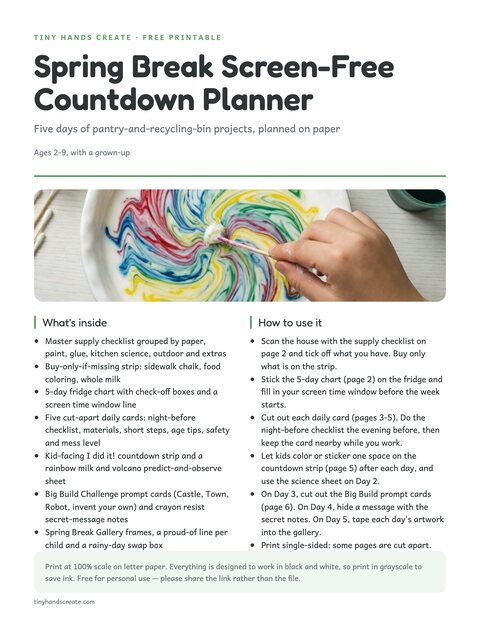
Free printable · 6 pages
Spring Break Screen-Free Countdown Planner
A supply checklist with a buy-only-if-missing strip, a 5-day fridge chart, five cut-apart daily activity cards with night-before prep and safety notes, an I did it! countdown strip, a science predict-and-observe sheet, Big Build prompt cards, hidden-message notes and a gallery page.
Free. Your download link appears right here. You'll also join the Daily Printable Drop. Unsubscribe anytime. Privacy
In this article (11 sections)
- Daily Overview at a Glance
- Spring Break Supply Checklist
- Day 1: Nature Crafts for Kids (Pinecone Bird Feeder and Seed Mosaic)
- Day 2: Kitchen Science Experiments for Kids
- Day 3: Cardboard Building Challenge
- Day 4: Rainy Day Process Art for Kids (Marble Painting and Crayon Resist)
- Day 5: Outdoor Art Activities (Sidewalk Chalk Mural and Leaf Prints)
- Adapting for Mixed Ages
- Bonus Day Ideas (If Spring Break Is Longer)
- Frequently Asked Questions
- If You Only Do Two Days
Daily Overview at a Glance
| Day | Theme | Activities | Mess Level | Best For |
|---|---|---|---|---|
| Day 1 | Nature Crafts | Pinecone Bird Feeder, Seed Mosaic | Low–Medium | Ages 2–9. Seed mosaic is 4+. |
| Day 2 | Kitchen Science | Volcano Eruption, Rainbow Milk | Medium | Ages 2–9. Adult pours vinegar for under-4s. |
| Day 3 | Cardboard Building | Big Build Challenge, Marble Run (optional) | Low | Ages 2–9. Adult cuts cardboard. Marbles are 5+. |
| Day 4 | Rainy Day Process Art | Marble Painting, Crayon Resist Watercolor | Medium | Ages 2–9. Marbles are 5+. |
| Day 5 | Outdoor Art | Sidewalk Chalk Murals, Leaf Prints | Low–Medium | Ages 2–9. Adult watches the driveway edge. |
Spring Break Supply Checklist
Scan the house first. Most of this is already here, and the items marked (buy if missing) are the only likely purchases.
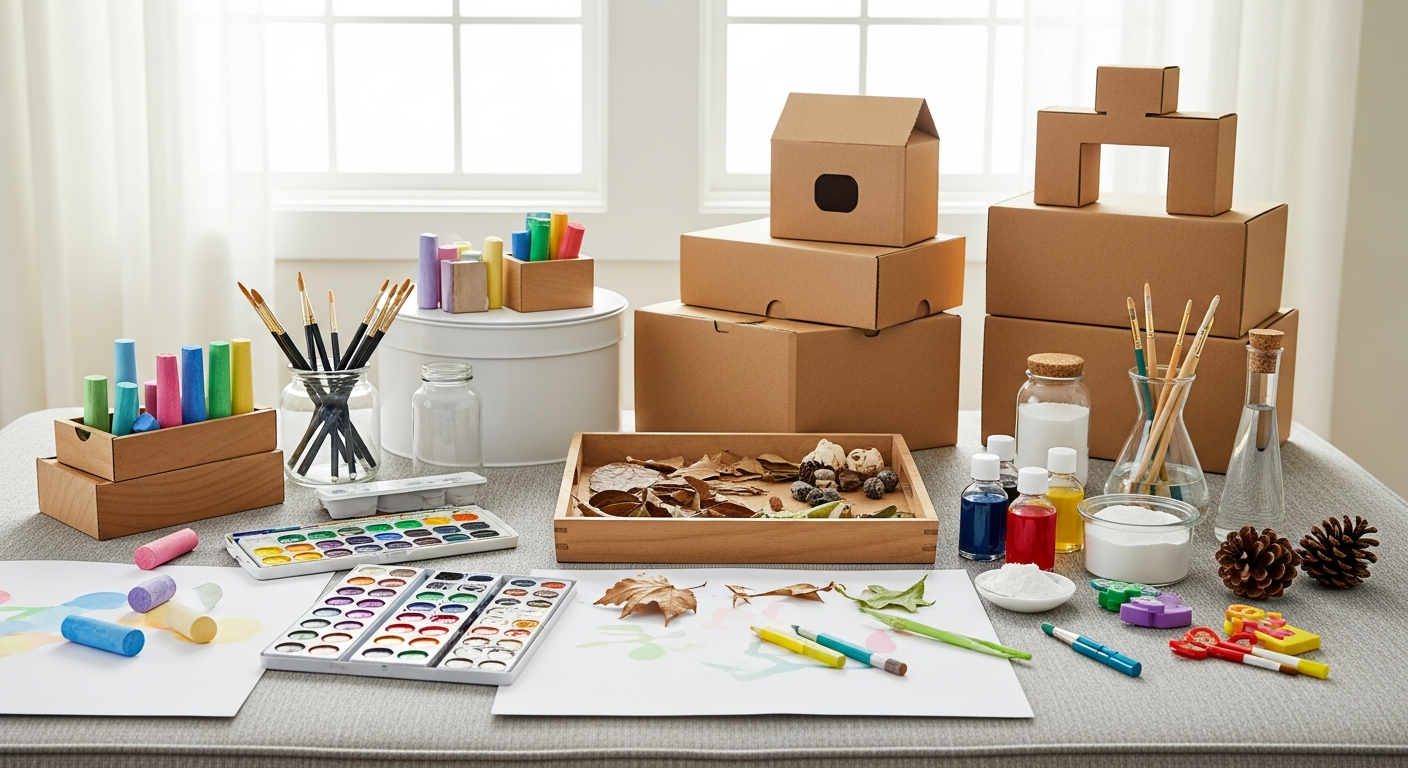
- Paper and cardboard: construction paper, cardboard boxes, cardboard tubes, white cardstock.
- Paint: washable tempera in primary colors, white and black. Watercolors if you have them. Paintbrushes and a foam brush.
- Glue and drawing: white school glue, glue sticks, crayons (including white), markers for decorating.
- Scissors: child-safe, for thin paper only. An adult cuts thick cardboard and keeps the cutter out of reach.
- Kitchen: baking soda (half a box), white vinegar (a 32 oz bottle), dish soap, cotton swabs. Droppers or a turkey baster if you have them. Food coloring and whole milk (buy if missing).
- Outdoor: sidewalk chalk (buy if missing), buckets, a spray bottle.
- Balls: one tennis ball for children under 5. Two or three marbles for ages 5+ only.
- Extras: one big roll of masking tape, a ruler, string or yarn, aluminum foil, small cups and a rimmed tray.
- Bird feeder: sunflower seed butter or peanut butter, plain wild birdseed.
- Nature: gathered during the week (pinecones, leaves, sticks).
Day 1: Nature Crafts for Kids (Pinecone Bird Feeder and Seed Mosaic)
Theme: We’re using what the natural world gives us: seeds, sticks, pinecones and leaves. Today they become things that are beautiful and useful.
Prep the night before: Go outside or check your yard for pinecones (or grab them from a park on your walk). Learn to spot poison ivy, oak and sumac, skip any plant you can’t identify, and wash hands after gathering. Pull out peanut butter or sunflower seed butter (peanut-free), birdseed if you have it, and string. Find a tray or container for the seed mosaic.
Morning anchor activity (30–45 minutes): Pinecone Bird Feeder
Afternoon anchor activity (20–30 minutes): Seed and Nature Mosaic.
Activity 1A: Pinecone Bird Feeder
Safety firstBirdseed is not food. Keep an adult within arm’s reach the whole time.
- Choking: Whole seeds and nuts are choking hazards under 4. Spread the butter thinly, never in thick globs.
- Allergies: Use sunflower seed butter if anyone has a nut allergy or hasn’t tried peanuts yet. Check the seed mix for peanuts and tree nuts, and the jar’s cross-contamination label.
- String: The string goes on last, after the spreading and rolling, so little kids never handle a pinecone with a long loop on it. An adult handles all string for under-5s, keeps loops away from necks, and hangs the feeder out of reach.
- Hygiene: Wild bird feeders can carry salmonella, so wash hands after touching the feeder or the birdseed.
- Mold and wildlife: Take the feeder down if it gets wet or moldy. In bear country, peanut butter feeders can attract wildlife, so check local guidance.
Kids get to make something that does a real job: it feeds birds. Ages 2–9 can all join in at their own level, with an adult close by. I use sunflower seed butter as the default whenever toddlers or allergies are involved.
Materials:
- 1–2 pinecones per child (the bigger and more open, the better)
- Peanut butter or sunflower seed butter (sunflower is peanut-free; check the label).
- Plain wild birdseed, or unsalted sunflower seeds and rolled oats. Skip bread, salted or flavored foods, and any mix with peanuts or whole nuts.
- String or twine
- A tray or plate for rolling
- Butter knife or craft stick for spreading
Instructions:
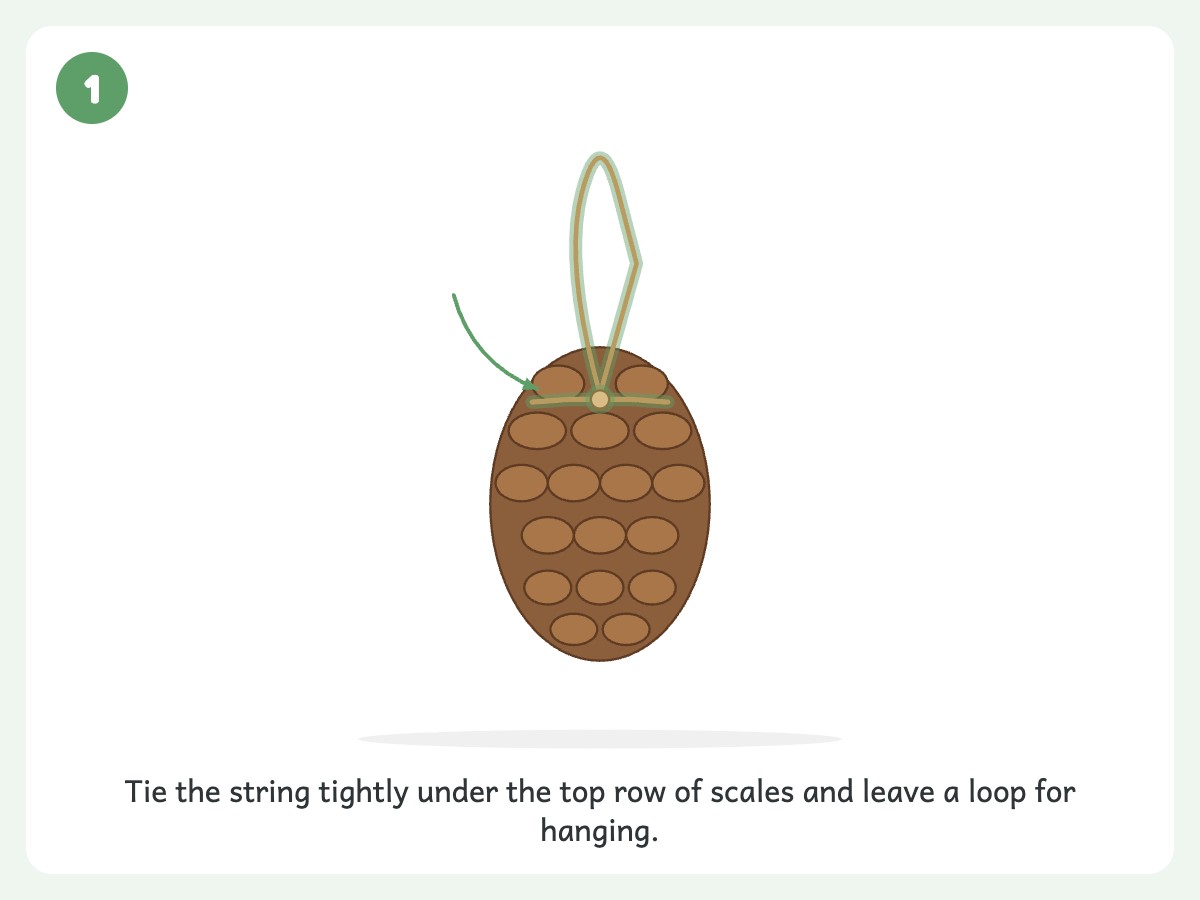
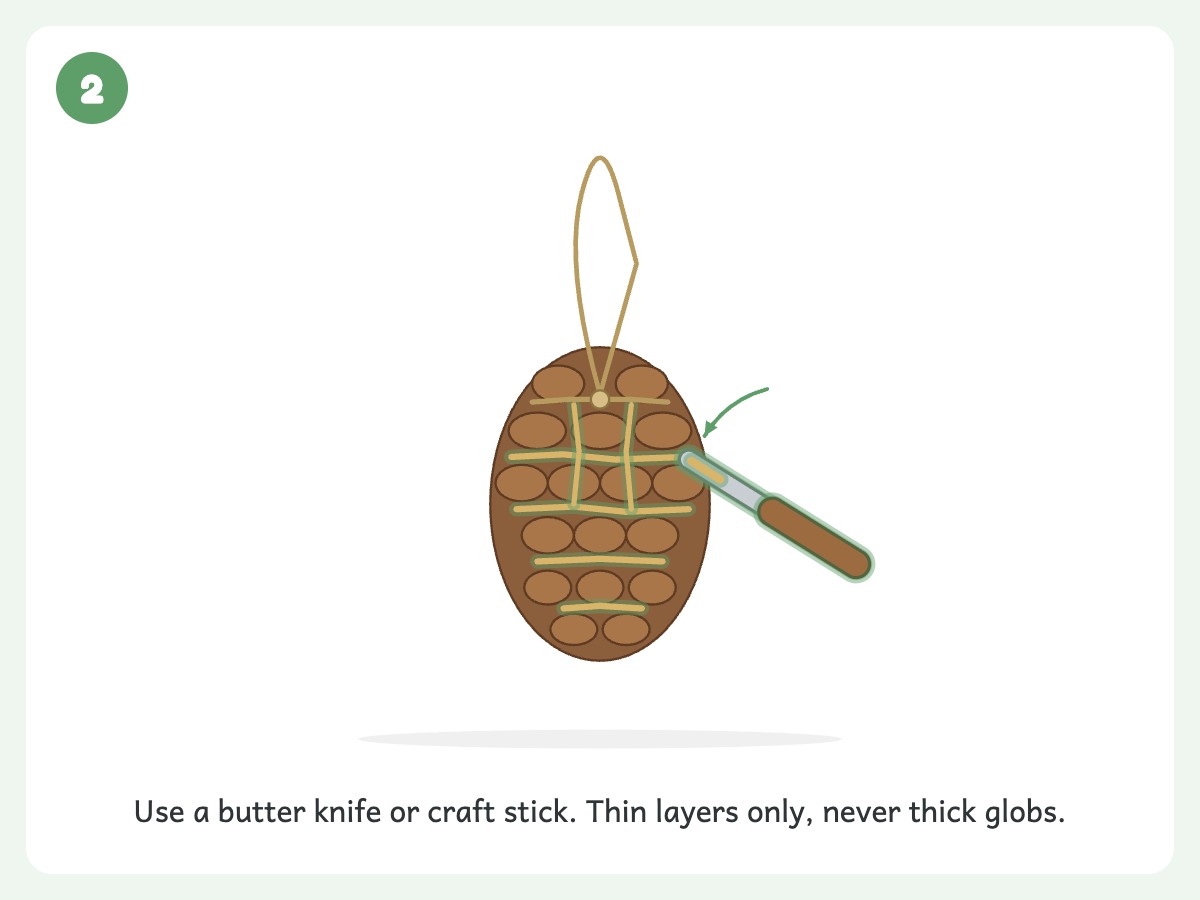
- Spread. Using a butter knife or craft stick, spread a thin layer of peanut butter or sunflower butter over the pinecone. Leave the top row of scales bare so the string has a clean spot to grip later. Get it into the gaps and crevices — that’s where the seeds will stick.
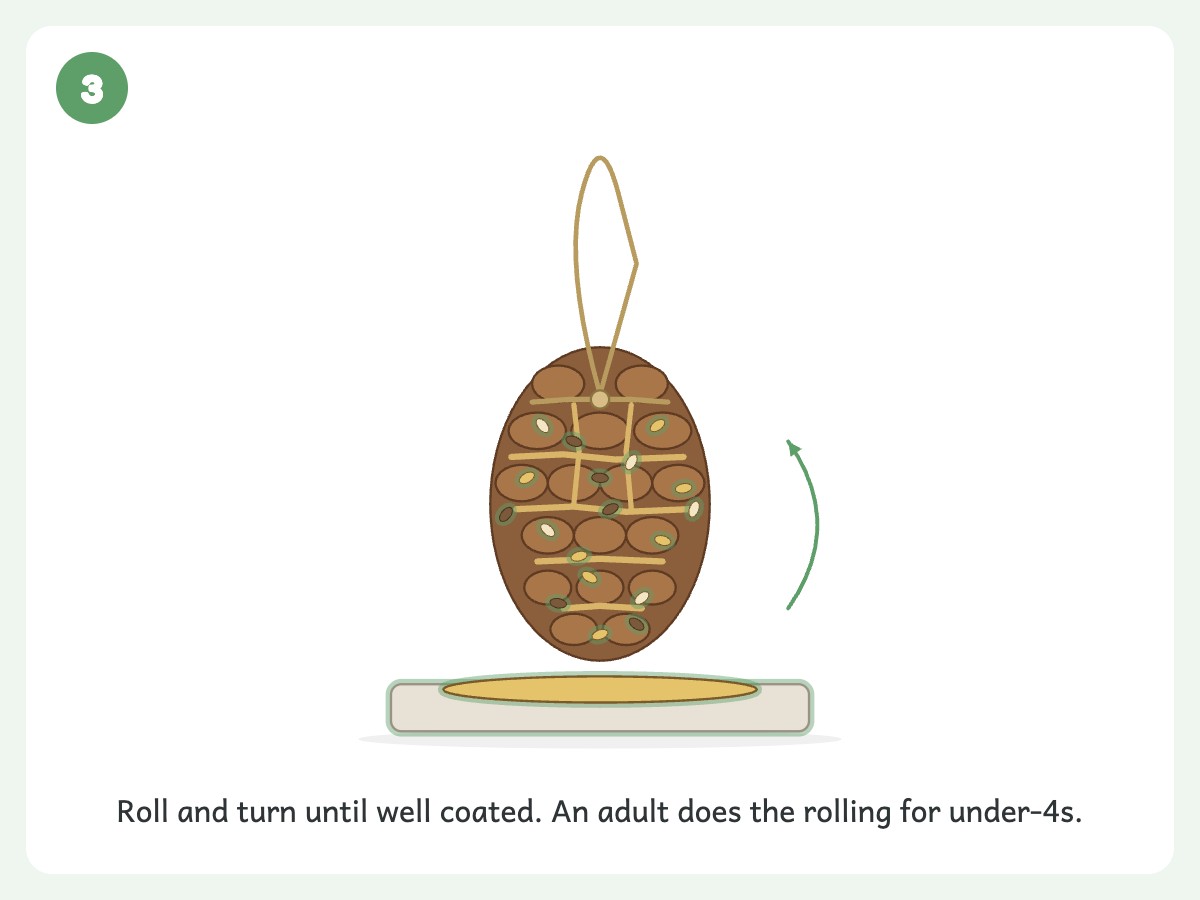
- Roll. Pour birdseed onto a tray or plate. Roll the coated pinecone through the seeds, pressing gently so they stick in the butter. Turn and roll until well coated. An adult does the rolling for children under 4.
- Tie the string last. Once the spreading and rolling are done, an adult ties about 12 inches of string tightly under the top row of scales, leaving a loop for hanging. Kids 5+ can try the knot with you watching. Under-5s don’t carry or play with the feeder once the string is on: it goes straight from your hands to the branch. Keep the loop away from necks, and cut the string off and throw it away when the feeder comes down.
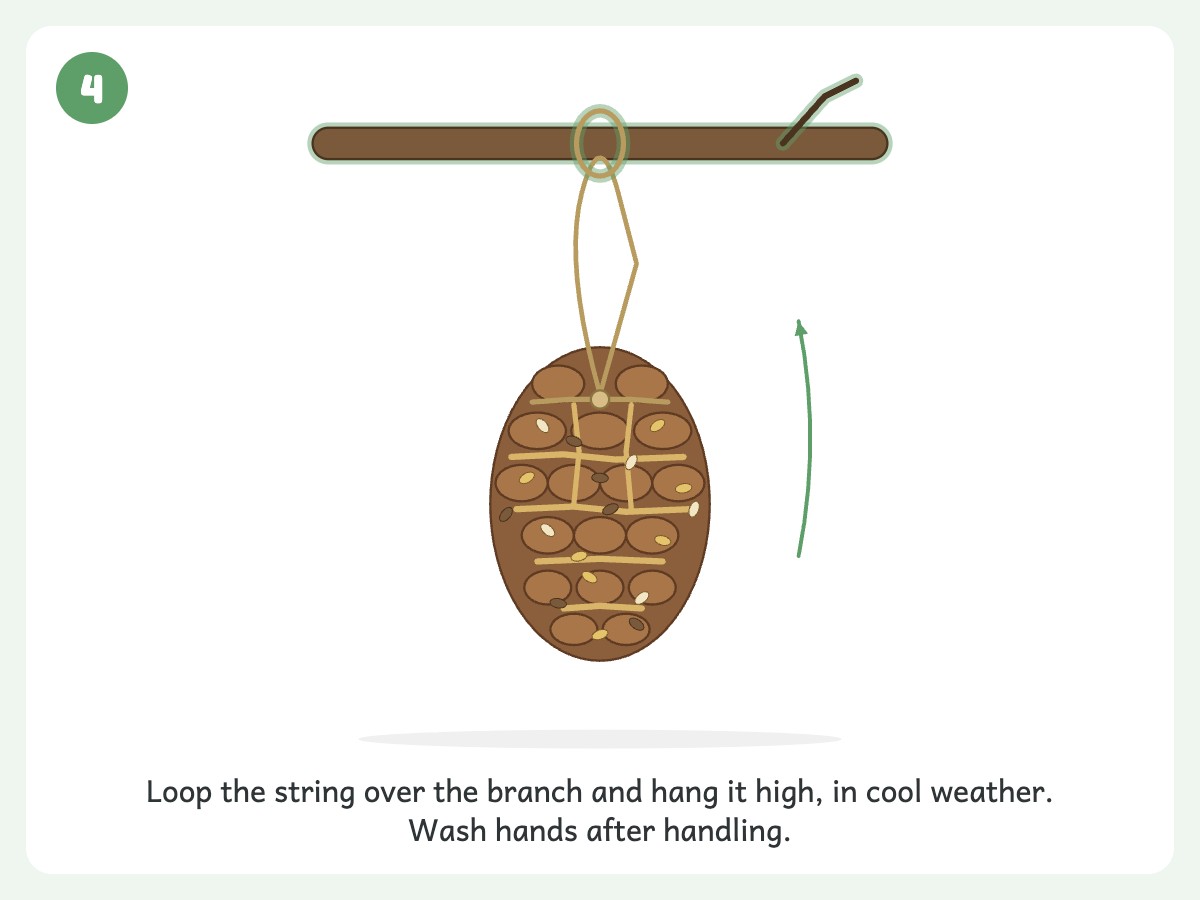
- Hang. Hang the finished feeder from a tree branch or porch railing, just out of toddler reach but visible from a window. Put it out in cool weather, since the butter softens in heat. Take it down if it gets wet or moldy, and wash hands every time you handle it.
- Watch and wait. Birds may come the same day if you’re quiet and lucky, but sometimes it takes a day or two. This patience-building is part of the activity.
For under-4s: Their whole job is spreading a thin layer of sunflower seed butter, seated next to you. An adult does the seed rolling, the tying and the hanging, and toddlers never hold loose seed. Nothing goes in mouths, and hands get washed at the end.
Good to knowIf the feeder slips, retie the string tighter under the top row of scales. In my experience the string slides most on tightly closed pinecones, so pick open ones. The butter is sticky, so work on the porch or over a garbage bag.
Activity 1B: Seed and Nature Mosaic
Safety firstAges 4+ only. Seeds, beans and rice are choking hazards under 4. They are not food, and seed allergies exist. Supervision alone isn’t enough for toddlers, so use the paper alternative below for them. Wash hands afterward.
Kids press seeds into glue one small patch at a time, and the patches build into a picture. It’s slow, quiet work, which is why I save it for the afternoon.
Materials:
- A piece of cardboard (from any box)
- White school glue
- Assorted seeds: dried beans, lentils, rice, birdseed, sunflower seeds, pumpkin seeds.
- Optional extras from outside: dried flower petals, leaves, small sticks
- Markers or pencil for drawing a simple outline first.
Instructions:
- If your child wants to work from a shape: draw a simple outline on the cardboard first. Shamrock, butterfly, sun, house, their initial — something with clear interior space to fill.
- If your child prefers to work freely, skip the outline entirely.
- Pour your seeds and natural materials into small bowls or sections of an egg carton for easy sorting and access.
- Apply glue to a section of the cardboard and press seeds into the glue. Work section by section to avoid the glue drying before seeds are placed.
- Fill the shape or fill the whole board — either approach is valid.
- Set aside to dry flat for several hours or overnight. Seeds can still come loose, so keep the finished mosaic away from children under 4.
Tips: Younger kids tend to work in patches of one color or material. Older kids like detailed patterns. Don’t push for precision: a messy all-over mosaic is as good as a careful one.
Good to knowIf seeds won’t stick, the glue layer is too thin or already dry. Add more glue, press each seed down, and let the board dry flat overnight.
Age range: 4+ for the seed version. For children under 4, skip the seeds: let them stick torn paper and big leaves onto contact paper instead, with an adult within reach. If you add pom-poms, use only ones larger than 1.75 inches across, too big to fit through a toilet-paper tube.
TipTake a nature walk to look for pinecones, seed pods, rocks and feathers. Bring a bag and talk about what you find. It pairs well with our outdoor nature activities for kids if you want to make the whole day about exploring outside.
Day 2: Kitchen Science Experiments for Kids
Theme: Kitchen science day is always a crowd-pleaser. It feels like you’re doing something you’re not supposed to do. You make messes on purpose, combine things that react dramatically, and call it educational.
Prep the night before: Make sure you have baking soda, white vinegar, dish soap, whole milk, and food coloring. Pull out containers, trays, and anything you don’t mind getting a little messy.
Morning anchor activity (30–45 minutes): Volcano Eruption Station
Afternoon anchor activity (20 minutes): Rainbow Milk.
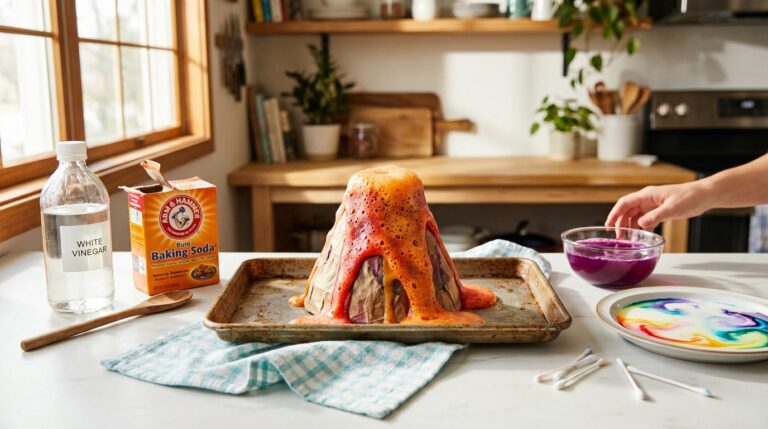
Activity 2A: Volcano Eruption Station
Safety firstNobody tastes the fizz. Keep it away from faces, and use kid goggles if you have them. An adult pre-measures the vinegar and pours it for children under 4. If the mix gets in eyes, rinse with clean water for several minutes, and call Poison Control or a doctor if irritation continues. If a child swallows more than a taste of the soapy mix, call Poison Control at 1-800-222-1222 (US).
Set this up as a station, not a single eruption, so kids can change one thing at a time. How much baking soda? How much vinegar? What does dish soap add?
Ours overflows almost every time, so I set the cups on a rimmed baking sheet and keep a towel nearby.
Materials:
- Baking soda (at least half a box — you’ll use more than you expect)
- White vinegar (a 32 oz bottle is plenty).
- Dish soap
- Food coloring
- Small cups, bowls, or containers (one per child works; more is better)
- A plastic tray or rimmed baking sheet, or do this outside.
- Spoons and droppers if you have them (turkey baster, medicine dropper, even a straw to drip with).
- Optional: build a volcano shape from playdough or aluminum foil around a cup to add theater
Instructions:
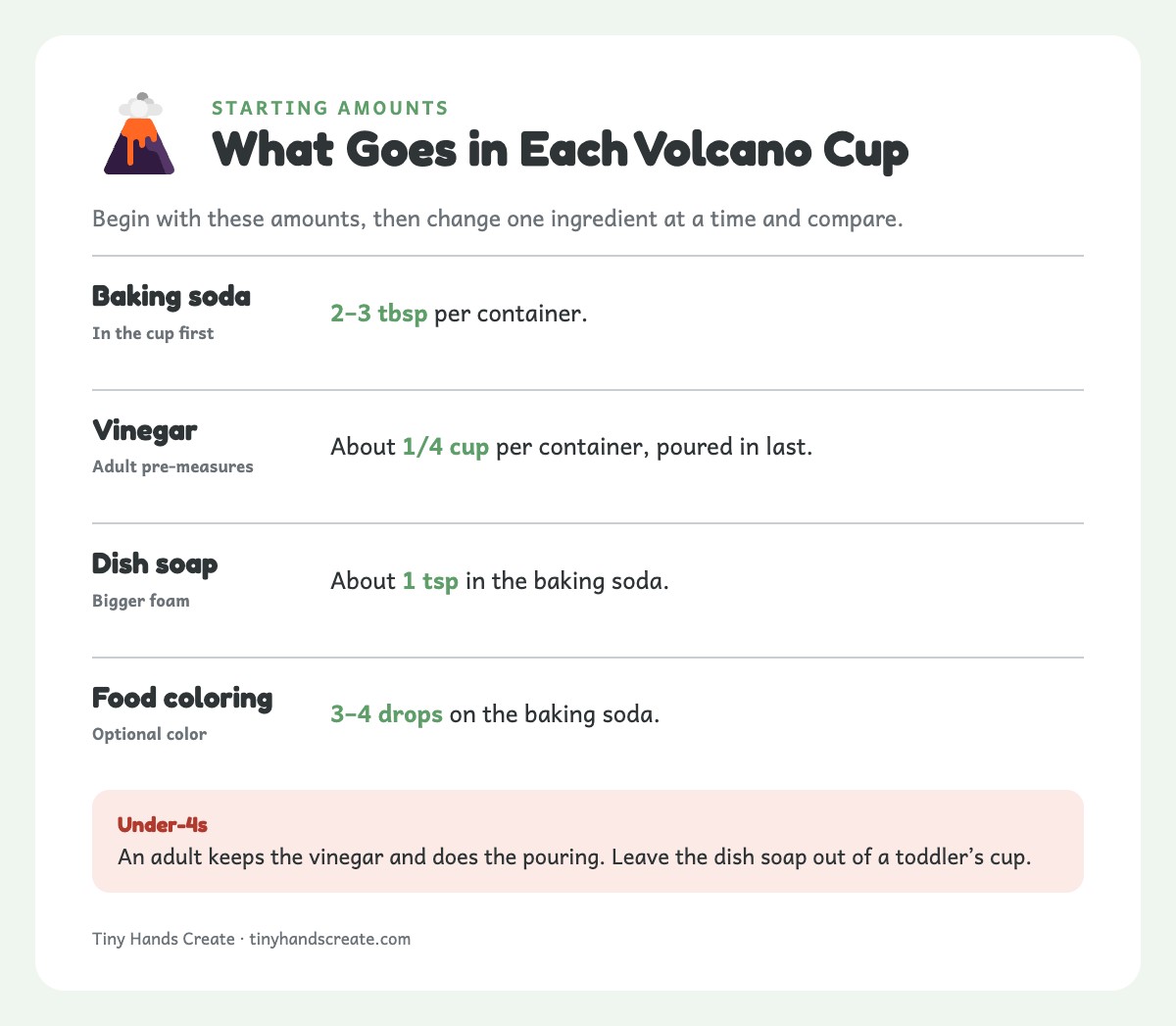
- Set up the station: put 1–2 tablespoons of baking soda in each container. An adult pre-measures about 1/4 cup of vinegar per container into a small cup or pitcher. For children under 4, the adult keeps the vinegar and does the pouring.
- Optional volcano theater: mold playdough or aluminum foil into a mountain shape around a small plastic cup. The cup holds the baking soda; the mountain is pure drama.
- Let kids add 3–4 drops of food coloring to their baking soda.
- Add about 1 teaspoon of dish soap to the baking soda. It makes the foam much bigger. Leave the soap out of a toddler’s cup.
- Pour or drip vinegar in. Watch it erupt.
- The experiment part: now ask questions. What happens if you add MORE vinegar? Does it keep going? What if you add more baking soda? What if you add a different color? Let them try things rather than telling them what will happen.
| Ingredient | Starting amount | Try changing it |
|---|---|---|
| Baking soda | 1–2 tbsp | Extra soda just settles at the bottom. Vinegar is what runs out first. |
| Vinegar | 1/4 cup | More vinegar keeps the fizz going until the soda is used up. |
| Dish soap | 1 tsp | Skip it and compare the foam. |
| Food coloring | 3–4 drops | Mix two colors for a new one. |
Conversation prompts:
- “What do you notice about the fizzing? What’s it made of?” (Carbon dioxide bubbles!)
- “Does the dish soap make a difference? Why do you think that is?”
- “What do you think would happen if we added hot water instead of cold?”
For under-4s: Give them their own “baby volcano”: a spoonful of baking soda, no dish soap, and a splash of vinegar that you pour. They stir and watch. Stay within arm’s reach, since vinegar stings eyes and the fizz can get tasted.
Older kids can run it like a scientist: guess, test, write down what happened. The Kitchen Science Lab Notebook printable goes with our kitchen science experiments for kids post, which has more to try.
Activity 2B: Rainbow Milk
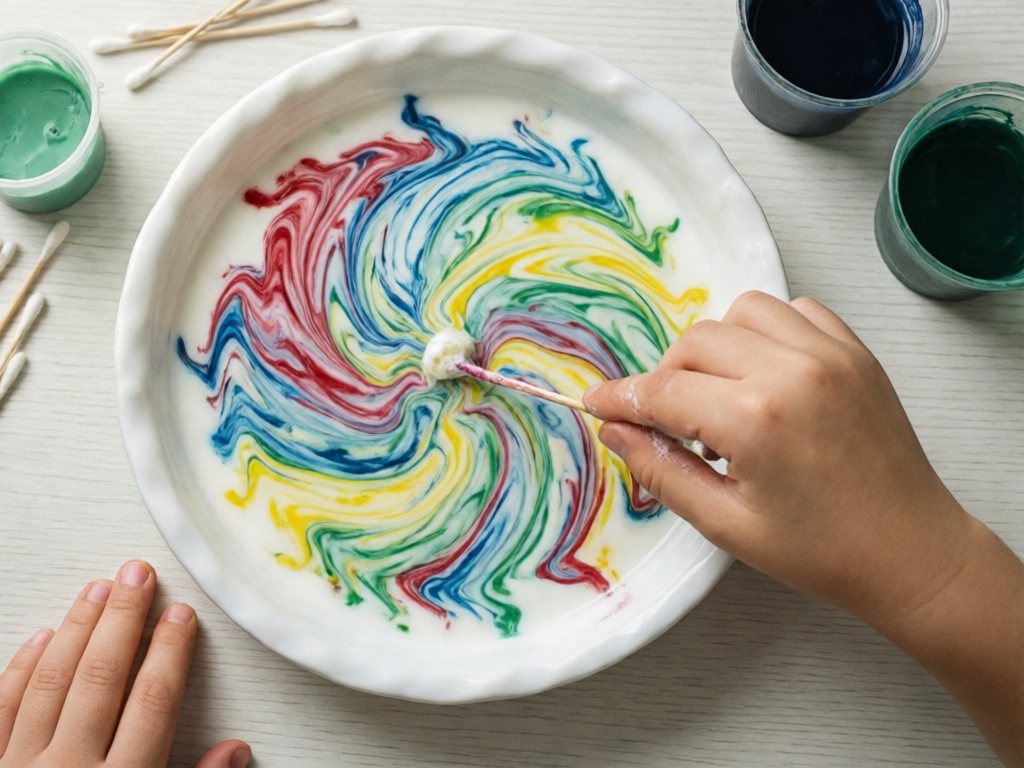
One touch of a soapy swab sends the colors racing to the edge of the dish. There is almost no setup, so it suits a worn-out afternoon.
Safety firstThe soapy milk must not be tasted or drunk. Wash hands afterward and throw the milk out when you’re done. Skip this one for kids with a milk allergy. Food coloring stains, so protect clothes and surfaces.
Materials:
- Whole milk (works best; 2% is less vivid; skim barely works)
- Food coloring in at least 3–4 colors.
- Dish soap
- A shallow dish or plate with a rim (a pie plate or the lid of a pot works great).
- Cotton swabs or droppers
Instructions:
- Pour about 1/2 cup of whole milk into the shallow dish, roughly a centimeter deep. Let it settle and go still.
- Add drops of food coloring around the dish — don’t mix. Dot the colors in different spots: a drop of red here, a drop of blue there, yellow in the middle.
- Dip a cotton swab in dish soap. Touch the soapy swab tip to the center of the milk.
- Watch: the colors will explode outward in swirling, flowing patterns. The effect usually lasts 20–30 seconds of active movement before slowing.
- Repeat by touching the swab to different spots in the milk. Each touch starts new movement.
Why does it work? Dish soap lowers the milk’s surface tension and interacts with its fats and proteins, which sets the dye swirling. The food coloring just makes that movement visible. You can explain this to older kids as a simple conversation; for little ones, just let it be magic.
Extension: Try water instead of milk. The effect is much weaker. Milk with more fat tends to show it better, so compare skim and whole if you have both. Cream is one to test and see.
For toddlers: Mostly watching. They’ll want to put their fingers in, which is fine. The soapy milk must not be tasted or drunk, so stay close and wash hands afterward.
TipIf the kids are hooked on science, try our balloon science experiments for kids. Kids who love the volcano will enjoy the static electricity and air pressure experiments there.
Day 3: Cardboard Building Challenge
Theme: Today is engineering day. We’re building big things from cardboard, and the only rule is there are no rules about what to build.
Prep the night before: Collect every cardboard box in your house. Amazon boxes, cereal boxes, toilet rolls, egg cartons, shoeboxes — put them all in a pile in one room. Add tape (masking tape is easier for kids than clear tape), scissors, and markers. That’s it.
Anchor activity (1.5–2+ hours): The Big Build Challenge.
Optional afternoon extension (20–30 minutes): Cardboard Marble Run.
The build can fill a whole morning if you frame it as a challenge with a little structure.
Activity 3A: The Big Build Challenge
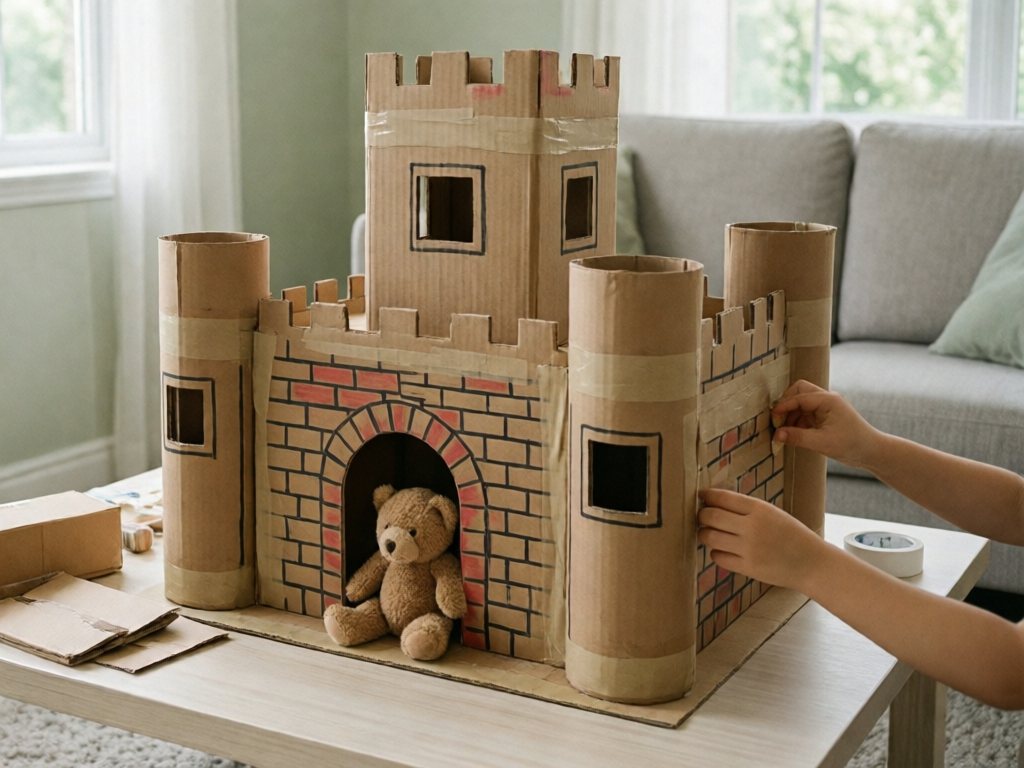
Safety firstAdults cut all thick or corrugated cardboard. Keep the cutter out of reach. Kids use child-safe scissors on thin card only. Fold or tape over rough edges. Wearable builds are for ages 5+ with an adult watching, and a closed box never goes over a head. For children under 5, keep string pieces under 6–7 inches. Never put string or yarn around a neck, and cut off and remove all string after play.
Materials:
- All your cardboard boxes (the more variety in size, the better)
- Masking tape (at least one big roll — you’ll use more than you think).
- Scissors
- Markers for decorating
- Optional: paint for finishing touches
How to set it up:
Pile all the cardboard in the middle of the room. Tell kids: “Today we have a building challenge. You can make ANYTHING you want, together or on your own.”
Then offer three prompts. They can pick one or ignore all three.
- The Castle Challenge: Can you build a castle big enough to put a stuffed animal inside?
- The Town Challenge: Can you build a whole cardboard town — houses, a shop, a road?
- The Robot Challenge (ages 5+): Can you build a robot that a person could wear? An adult watches the whole time. Never put a closed box over anyone’s head: keep the face fully open. Use no neck or head closures, and keep robots away from stairs. Under-5s build a robot for a stuffed animal instead.
Then step back. This is the hard part for me, especially when something collapses. Offer tape or hold a wall while they tape it, but let them solve the design problems. If they get stuck, ask “What have you tried?” Collapsing is part of the process, and rebuilding is half the fun.
The decoration phase: Once the main structure is done, offer markers and paint. Windows, brick patterns, control panels and faces add another 30–45 minutes. Slower builders get time to finish while the others decorate. Painting means smocks.
Want more builds? Our cardboard box crafts for kids post has more project ideas for different ages.
Activity 3B: Afternoon — Cardboard Marble Run (Optional Extension)
Safety firstMarbles are for ages 5+ only. Supervise closely. For anyone under 5, use a tennis ball or another ball too big to fit through a toilet-paper tube. Count marbles back in, and clear small parts away before a baby or toddler is around.
If the build wraps up early or the builders still have energy, a ball run on the wall is a good follow-up.
Materials:
- Toilet paper rolls and paper towel rolls (for marbles, ages 5+)
- Cardboard strips cut from boxes, 5–6 inches wide for tennis-ball chutes, and a ruler
- Tape
- A tennis ball or similarly large ball. Marbles only for ages 5+ with close supervision.
Instructions:
- Make ramps. A tennis ball is too wide for a cardboard tube, so under-5s need wider chutes. An adult cuts cardboard strips 5–6 inches wide and folds up a 1-inch wall along each long side. That leaves a U-shaped channel 3–4 inches across. Open box flaps work too. For marbles with kids 5+, use whole tubes or tubes cut in half lengthwise.
- Tape to the wall. Tape the chutes to a wall, each one angled slightly downward.
- Test. Drop the ball in at the top. It should roll from section to section down to the floor.
- Fix and extend. See how far it can travel without falling off, or send it along a set path.
Each time the ball falls off or stops, kids have to work out why and fix it. Expect a lot of rebuilding. Use masking tape and test a hidden spot first. I have pulled paint off a wall with stronger tape.
Day 4: Rainy Day Process Art for Kids (Marble Painting and Crayon Resist)
Theme: Today is about making art without worrying about what it looks like. That’s harder than it sounds for older kids who’ve become self-conscious about their drawing. We’re choosing techniques where the process itself creates the beauty.
Prep the night before: Set up a dedicated art space with protection on the table. Gather paint, paper, a tennis ball (marbles only if every child is 5+), tape, crayons, and watercolors if you have them.
For more on why process art matters — especially for toddlers and preschoolers — see our guide to process art for toddlers. It covers letting go of the product and trusting the process.
Morning anchor activity (30–45 minutes): Marble Painting
Afternoon anchor activity (30–40 minutes): Crayon Resist Watercolor.
Activity 4A: Marble Painting
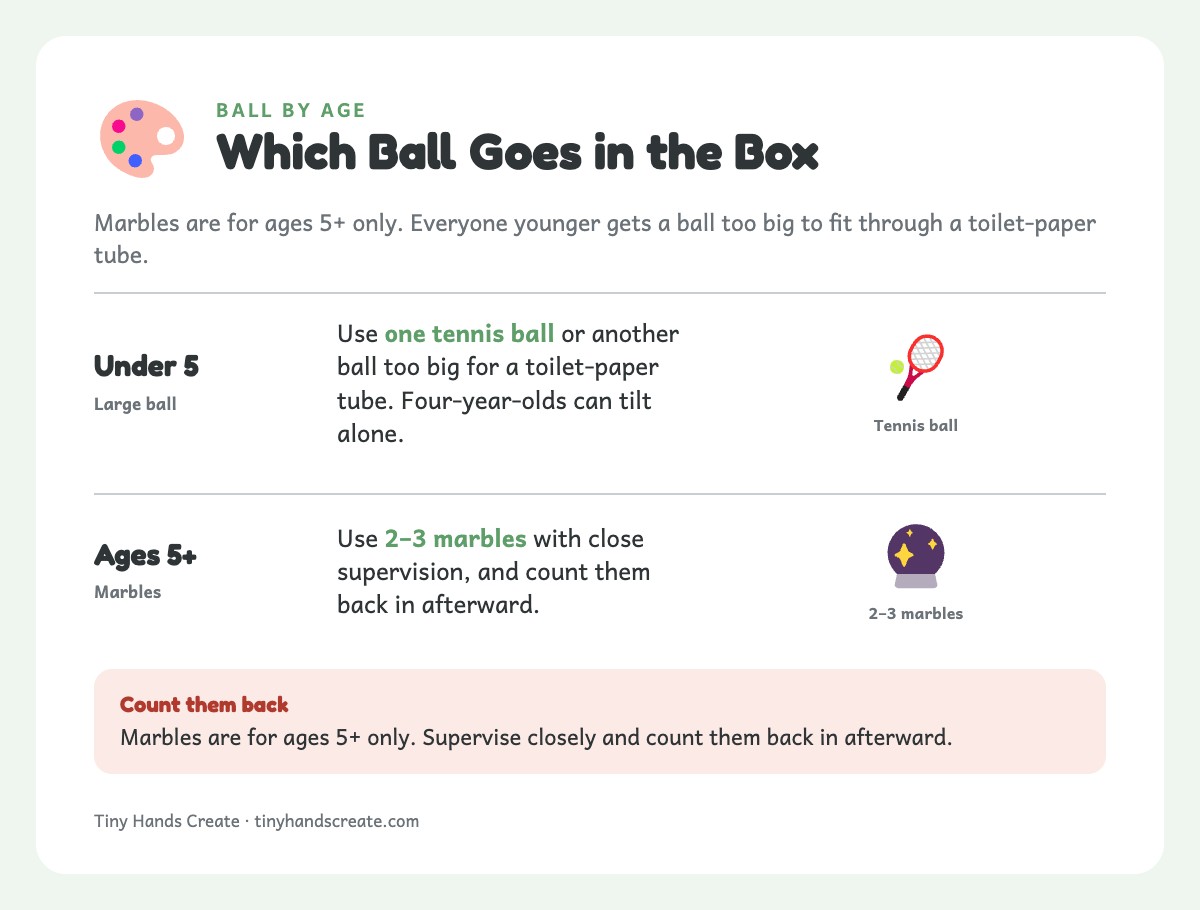
Safety firstMarbles are for ages 5+ only. Supervise closely and count them back in afterward. For children under 5, use a tennis ball or another ball too big to fit through a toilet-paper tube. Toddlers may taste paint, so stay close and wash hands when you finish.
The rolling ball draws the picture: it drags paint across the paper in lines and loops. You can’t predict what you’ll get, and no two come out the same.
Materials:
- Paper cut to fit inside a box lid or baking tray with sides
- Non-toxic, washable paint in several colors (look for the AP or ASTM D-4236 label).
- A tennis ball or similarly large ball for under-5s. Marbles only for ages 5+ with close supervision.
- A box with sides — a shoebox lid is perfect; a baking tray with a rim works too
- Spoons for dropping paint blobs.
Instructions:
- Place your paper in the bottom of the tray or box lid.
- Drop blobs of paint — 3–5 colors — directly onto the paper. Keep the amounts small; a pea-sized blob per color is enough.
- Place 2–3 marbles in the box, or one large ball for under-5s.
- Tilt, shake, and roll the box side to side, forward and back. Watch the marbles roll through the paint and drag it across the paper, creating lines, swirls, and patterns.
- Keep going until you’re happy with the result, or start fresh with new paper for a second try.
- Lift the paper out carefully (it’ll be wet) and set flat to dry.
Tips: Metallic paint adds extra drama if you have any. Skip glitter for kids who still mouth things, and remember toddlers may taste paint. Black paper makes the colors pop.
Good to knowIf the paint turns muddy brown, there were too many colors in the box at once. I get the clearest prints from two or three colors and a fresh sheet for each round.
Variation — big box painting: For kids 5+, use a larger box (like a cardboard shipping box), bigger paint blobs and several marbles. Two or three kids can tilt it together.
For under-5s: Use a tennis ball in a large box, never a marble. Hold the box with toddlers and tilt it together. Four-year-olds can tilt on their own with the large ball.
Activity 4B: Crayon Resist Watercolor
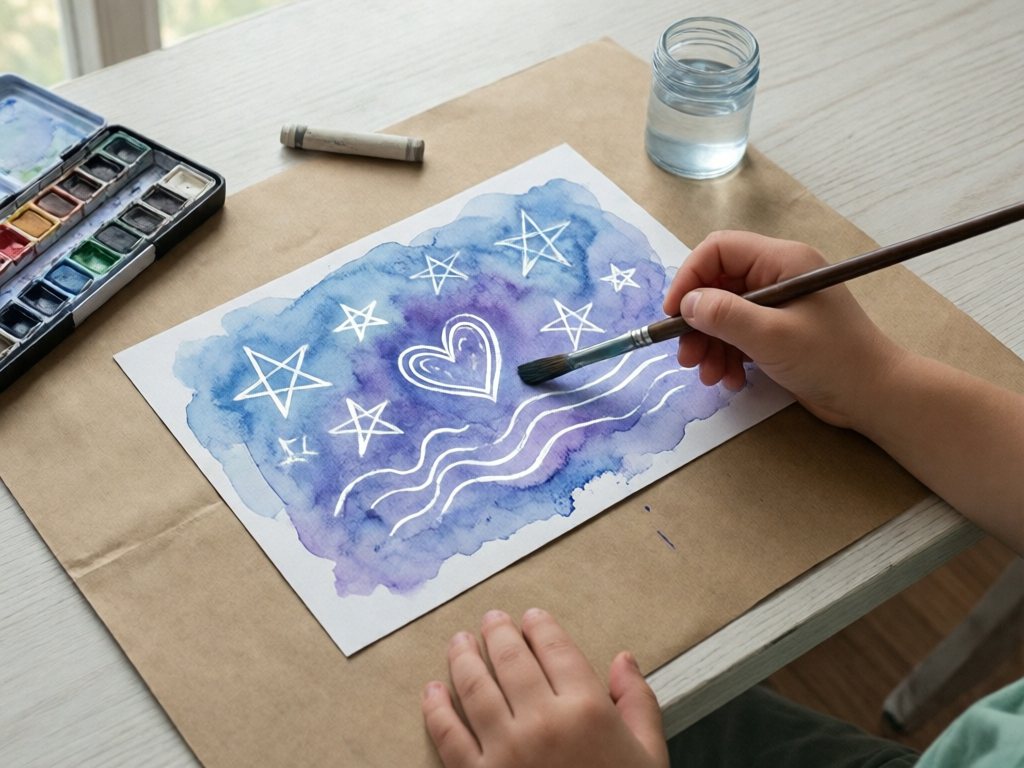
Safety firstToddlers may mouth crayons and taste paint. Use non-toxic, washable watercolors and crayons, and stay within arm’s reach. Pick up broken crayon bits before a toddler finds them. The rinse water is not a drink, and everyone washes hands at the end.
A wash of watercolor reveals a hidden crayon drawing. It works because wax repels water-based paint, so the crayon lines “resist” the color.
Materials:
- White cardstock or thick white paper. Printer paper works in a pinch, but the result is less vivid.
- White crayon or light-colored crayons
- Watercolor paints or very watered-down tempera.
- Paintbrush
- Pencil (optional, for initial planning)
Instructions:
- Using a WHITE crayon, draw a picture or pattern on the white paper. Encourage kids to press hard — the wax needs to really coat the paper. Since white on white is nearly invisible, this feels like magic-in-waiting. Designs that work wonderfully: stars, hearts, swirls, waves, rainbows, animals, words.
- Alternatively, use colored crayons to draw a picture, pressing firmly. The colors you can see will all resist the paint.
- Paint over the entire paper with a wash of watercolor. Watch the hidden drawing appear as the paint slides away from the waxy areas.
- The water and paint will pool in the uncrayoned areas, creating depth and color variation. Let dry flat.
Multi-color variation: Instead of one wash color, use multiple colors for a rainbow wash across the paper. This is especially striking if the hidden drawing is a simple outline of something.
Surprise pictures variation: Have a parent do the hidden crayon drawing, then give it to the child to “reveal” with the paint. Write a secret message, draw their name, or make a picture of their pet. They paint and discover it. This is the one I get asked to repeat.
Watercolor gets drippy, so cover the table first. For more techniques, see our watercolor painting for kids guide, which pairs with the Watercolor Project Cards printable.
TipIf the art energy runs out after lunch, switch to our calm-down activities for kids.
Day 5: Outdoor Art Activities (Sidewalk Chalk Mural and Leaf Prints)
Theme: We’re taking everything outside. Spring air, natural surfaces, and the freedom of working big — this is the day for the most expansive, exuberant art of the week.
Prep the night before: Check the weather. Have a backup rainy-day plan (move the art inside: paper instead of sidewalk, trays for leaf printing). Gather leaves from outside in a variety of sizes and shapes. Skip poison ivy, oak, sumac and any plant you can’t identify, and wash hands afterward. Set out the sidewalk chalk.
Morning anchor activity (45–60 minutes): Giant Sidewalk Chalk Mural
Afternoon anchor activity (30–40 minutes): Leaf Printing.
Activity 5A: Giant Sidewalk Chalk Mural
Safety firstUse a driveway away from the street, with an adult watching. Check that the pavement isn’t hot before anyone lies down for the body trace. Put sunscreen on, take water breaks, and discourage mouthing chalk.
The key word here is “giant.” Not little individual drawings, but one collaborative enormous mural that uses your whole driveway or sidewalk section. Scale changes everything about this activity.
Materials:
- Sidewalk chalk in as many colors as possible
- A driveway, sidewalk, or any flat paved outdoor surface.
- Optional: spray bottles with water for blending chalk
- Optional: large paintbrushes and water for “painting” with chalk
The mural concept:
Before you start, decide on a theme together. Some classics:
- The Underwater World: Ocean floor across the whole driveway, with fish, seaweed, treasure chests, submarines. Divide zones: “this corner is the coral reef, this area is open ocean.”
- Our Town: Houses, roads, a park, a school, a shop — a whole neighborhood laid out like a map.
- The Rainbow World: Every section of the driveway is a different color, with everything in that zone drawn in that color.
- The Life-Size Body Trace: Lie down on the pavement, trace each other, then decorate the outlines. Add clothes, hairstyles, what’s in your imaginary pocket.
The life-size body trace lets kids see themselves at actual scale. Trace, then fill in. Draw your outfit for the day, or invent a superhero costume. Add your favorite food floating around you.
Chalk techniques to try:
- Blending: Draw two colors side by side, wet a finger or sponge, and blend at the edges.
- Chalk painting: Dip a brush in water, then draw it through chalk to paint with the pigment.
- Texture rubbings: Hold chalk sideways and rub over a textured surface (a drainage grate, a rough patch of concrete) for interesting texture effects.
- Spray bottle smearing: Spray lightly with water over finished chalk drawing to create a soft, blurred watercolor effect.
For all ages: Toddlers can scribble alongside older kids working on detailed drawings. There’s enough space that nobody’s work gets in anyone else’s way. For more chalk games, see our sidewalk chalk activities for kids.
Activity 5B: Leaf Printing
Safety firstPrint only with leaves you know are safe. Skip poison ivy, oak, sumac and any plant you can’t identify. Toddlers may mouth leaves and taste paint, so stay within arm’s reach and use non-toxic, washable paint. Everyone washes hands after gathering and again after printing.
A painted leaf pressed onto paper prints every vein and edge. My first print of the day is usually a blob because I used too much paint, so go thin.
Materials:
- Fresh leaves in a variety of shapes and sizes. Gather them that morning so they stay flexible.
- Non-toxic, washable paint in several colors
- Paper — white, cardstock if possible
- Foam brush or regular paintbrush
- A flat surface to paint on (a tray, a piece of cardboard).
- Optional: a rolling pin for crisp prints.
Instructions:
- Lay a leaf flat on your painting surface with the vein side UP. This side has more texture and makes better prints.
- Using a foam brush, paint the vein side of the leaf with a thin, even coat of paint. Don’t glob it on — a thin coat gives the best impression.
- Carefully pick up the painted leaf and place it paint-side down on your paper.
- Place a piece of scrap paper over the leaf and press firmly all over — pay attention to the edges and the central vein. Press with your whole hand, not just fingers.
- Carefully peel back the leaf to reveal the print.
- Repeat with different leaves and different colors, layering and overlapping for a lush, botanical effect.
Design ideas:
- Tree scene: Use sticks as trunks and leaf prints as the canopy.
- Wrapping paper: Cover a whole sheet in overlapping leaf prints and use it as gift wrap.
- Nature journal page: Put the original leaf beside each print. Write the type of leaf (oak, maple) if you know it.
- Rainbow gradient: Do the same leaf print in each rainbow color in a row.
Day 5 closing activity — The Spring Break Gallery:
At the end of Day 5, gather everything your kids made during the week. That means every leaf print, every marble painting and every cardboard structure that survived. Lay it all out or hang it up for a mini gallery walk. Let each kid tell you one thing they’re proud of, and take photos. It tells kids their work mattered enough to be seen.
TipWeek over and still hearing “I’m bored”? Our free Boredom Buster gives you a random creative activity idea instantly. Bust the boredom →
Adapting for Mixed Ages
A toddler and a seven-year-old can share a table all week. The gap feels smaller when nobody is rushing.
- Same activity, different version. In marble painting, a toddler tilts a box with a tennis ball. A school-age child uses bigger paper, marbles and chosen colors.
- Use the helper role sparingly. Older kids enjoy demonstrating a technique, mixing paint or running the supply station. Asked too often, they resent it.
- Accept parallel play. Kids working side by side on their own versions are still engaged.
- Keep zones separate on build day. Two tables, or two corners, protect an older child’s project from a younger sibling. Tell both kids the plan before the week starts.
- Save one focused project for nap time. Crayon resist works well. Use a monitor or stay in earshot, and clear small parts away before the baby wakes.
Adapt by Age: What Each Child Does
| Activity | Ages 2–3 | Ages 3–5 | Ages 5–9 |
|---|---|---|---|
| Pinecone bird feeder | Spreads a thin layer of seed butter. Adult rolls in seed, ties and hangs. | Spreads the butter and, from age 4, rolls in seed. Adult ties the string. | Makes the whole feeder, ties the knot with you watching, and looks up local birds. |
| Seed mosaic | No seeds. Sticks torn paper and big leaves on contact paper, with an adult within reach. | Age 3 stays on the paper version. From age 4, glues seeds in patches of one color. | Draws an outline and fills it with detailed patterns. |
| Volcano station | Stirs and watches a soap-free baby volcano. Adult pours a splash of vinegar. | From age 4, drips vinegar with a dropper and predicts what will happen. Adult pours for 3-year-olds. | Tests how much vinegar keeps the fizz going and records the results. |
| Rainbow milk | Watches up close. No tasting, and an adult stays within reach. | Adds the color drops, touches the swab and predicts where colors will go. | Draws or photographs the patterns and tries to repeat one. |
| Big Build Challenge | Stacks, knocks down and sits in open boxes. | Builds their own idea and tells you about it. Adult cuts. | Takes on a castle, puppet theater or spaceship. Short string only, with an adult watching. |
| Marble run | Rolls a tennis ball down wide cardboard channels an adult folded and taped up. | Helps place the wide cardboard channels and tests with a tennis ball. | Designs the run and can use marbles with close supervision. |
| Marble painting | Tilts a large box with a tennis ball while an adult holds it. | Picks the colors and tilts alone, still with the large ball. | Uses marbles and tries to steer the lines. |
| Crayon resist | Paints over marks an adult helped make. | Draws hidden pictures and reveals them. Allow several tries. | Writes a white-crayon message, trades with a sibling and reveals it. |
| Chalk mural | Scribbles in their own zone, away from the driveway edge. | Fills one zone of the mural and gets traced. | Plans the theme, traces others and tries blending. |
| Leaf prints | Paints the leaf and pushes hard. Adult places and peels it. | Picks the leaves and colors and prints alone. | Makes a nature journal page or a rainbow row. |
Not sure what suits each child? The activity finder quiz can narrow it down.
Bonus Day Ideas (If Spring Break Is Longer)
If your break runs longer than five days, here are three fast-setup additions.
Bonus Day A: Homemade Playdough + Invitation to Create
Make a batch (or two) of homemade playdough in the morning. Set it out with natural materials (sticks, seeds, pebbles, dried pasta) and no instructions. That is an “invitation to create,” and kids usually start building scenes right away. For children under 4, skip the seeds, pebbles and pasta and offer large sticks and cookie cutters instead.
Find more open-ended play ideas in our loose parts play ideas post, and a full recipe in our homemade playdough recipes.
Bonus Day B: Puppet Theater
Use the cardboard skills from Day 3 to build a puppet theater: a large box with a window an adult cuts in the front. Make puppets from paper bags, socks, or toilet rolls. Write a simple script, practice and perform. Building, puppet-making and the show can fill a full day.
Bonus Day C: Nature Scavenger Hunt + Documentation
Go outside with a list of things to find: something rough, something smooth, something that was once alive, something that smells interesting. Our printable backyard scavenger hunt is a ready-made list. Photograph or draw what you find, then make a nature journal page back at home.
For more structure, pair it with our outdoor nature activities for kids guide.
Crafty Mama
Crafty Mama is a former elementary art teacher turned stay-at-home parent who believes every child is creative — they just need the right invitation. She develops age-appropriate activities, crafts, and projects that spark imagination while keeping mess (and parent stress) to a minimum.
Frequently Asked Questions
What if my kids say they’re bored right away?
Give it a few more minutes and start the project yourself. “I’m making my volcano. Do you want to make yours?” is often enough.
If they truly resist an activity, move on to another one. Not every activity lands with every kid.
How do I handle screen time during spring break?
Set the expectation before the week starts. Try: “This week we do activities together in the morning. Screen time is in the afternoon after quiet time.”
A predictable rule removes the negotiation. The answer is always the same: after the morning activity.
What if I only have one child and these activities feel weird for solo play?
Most of these work fine solo. The science experiments are arguably better with one child, since nobody competes for the dropper. For the chalk mural or a puppet show, invite a neighbor kid or join in yourself for the first 15 minutes.
My child is particularly messy and I’m already exhausted. Are any of these lower-mess?
Yes. The seed mosaic, cardboard building challenge, and sidewalk chalk are all very manageable mess-wise. Marble painting can be nearly mess-free if you use a tray with high sides. The science experiments are water-and-soap based and clean up easily. The universal trick is to limit the paint. Give a small amount on a plate instead of a bottle, and the mess stays small.
What do I do when one child is engaged and the other isn’t, and the disengaged one is disrupting the engaged one?
Give the disengaged child a specific job in a slightly separate spot. Try “Your job is to make more leaf prints over here,” or put them in charge of rinsing brushes. A defined role in a separate space usually works better than pushing them back into the activity they rejected.
Can I do just two days of this plan?
Yes. This is a menu, not a requirement, and even one activity that goes well makes a good spring break.
My kids are different ages — 3 and 7 — and I’m worried the younger one will ruin the older one’s projects.
Give each child a zone, and tell your older child the plan before the week starts. On build day (Day 3), set up two separate tables if you can. Balance it with shared projects like the sidewalk chalk mural, which has space for everyone.
If You Only Do Two Days
Spring break usually has a few moments of real connection and many moments of everyone just coexisting. Both are fine.
You don’t need all five days. If you only do two, I’d pick the bird feeder day and the cardboard build day. Watch for birds, let the castle collapse once and get rebuilt, and call it a good spring break.