Pattern Worksheets for Preschool: Free Printable Pack + Activities
You'll discover how pattern recognition is a strong predictor of your preschooler's mathematical success and learn how to use engaging worksheets effectively to build this crucial skill, covering various pattern types and teaching strategies.
- Recognize pattern skills as a strong predictor of your child's math success.
- Utilize engaging, varied worksheets to effectively build your child's pattern skills.
- Introduce pattern types (AB, ABB, ABC, growing) in a progressive order.
- Start with hands-on pattern building before transferring to paper worksheets.
- Encourage verbalizing patterns and using finger tracking for better understanding.
This post contains affiliate links. As an Amazon Associate I earn from qualifying purchases.
In this article (10 sections)
- The Hidden Superpower Inside Pattern Recognition
- What’s Inside the Free Printable Pattern Pack
- Pattern Recognition by Age: Preschool, Pre-K, and Kindergarten
- Types of Patterns Every Preschooler Should Practice
- At a Glance: Pattern Activities by Age, Materials, and Prep Time
- How to Use Pattern Worksheets Effectively
- More Ways to Practice Beyond the Page
- Materials That Make Pattern Practice More Fun
- Connecting Patterns to Everyday Life
- Frequently Asked Questions
The Hidden Superpower Inside Pattern Recognition
Here’s something that blew my mind during a child development workshop years ago: the ability to recognize and predict patterns is one of the strongest predictors of mathematical success in elementary school. Not counting. Not number recognition. Patterns. When a preschooler looks at a row of red-blue-red-blue beads and knows the next one should be red, their brain is performing the same fundamental operation that will later help them understand multiplication tables, algebraic sequences, skip counting, and even musical rhythms. It’s the same logic that shows up years later in math games using household items — spotting the rule, then predicting what comes next.
I spent years watching this click for kids in my preschool classroom, and I can tell you that worksheets—done right—are one of the most effective ways to build this skill. Not boring, fill-in-the-blank drudgery, but colorful, engaging pages that make children feel like pattern detectives solving a puzzle. The key is variety, progression, and just enough challenge to keep things interesting without tipping into frustration.
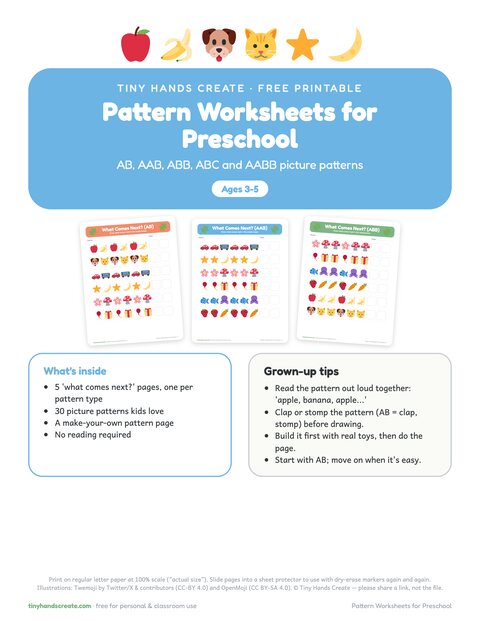
Free printable · 7 pages
Pattern Worksheets for Preschool
AB, AAB, ABB, ABC and AABB picture patterns, plus a make-your-own page.
Free. Your download link appears right here. You'll also join the Daily Printable Drop. Unsubscribe anytime. Privacy
What’s Inside the Free Printable Pattern Pack
To make this easier to put into practice today, I put together the free printable pack (grab it with the form above). It’s seven pages, built to go from “just starting out” to “ready for kindergarten”:
- 1 cover page with grown-up tips for using the pack — how to introduce each pattern type and what to watch for if your child gets stuck
- 5 “What Comes Next?” picture-pattern pages — one page each for AB, AAB, ABB, ABC, and AABB patterns. Every page has six rows using simple, familiar pictures (fruit, pets, vehicles, sun/moon/stars, and similar sets), and your child draws the next two pictures in each row
- 1 “Make Your Own Pattern” page — a blank page where your child designs their own pattern instead of just continuing one someone else made
That progression—AB, then AAB and ABB, then ABC, then AABB—mirrors the order kids actually master these skills in, which is why the pack is built this way instead of throwing every pattern type at a child on day one.
Pattern Recognition by Age: Preschool, Pre-K, and Kindergarten
One of the most common questions I get is some version of “is my child behind?” Pattern skills develop on a wide spectrum, but here’s a rough map of what to expect at each stage, and it’s worth knowing before you decide which pack page to start with.
| Age / Stage | Typical Pattern Skill | What It Looks Like |
|---|---|---|
| Around 3 (preschool) | AB patterns | Copies a red-blue-red-blue sequence with objects; may need the pattern built for them first |
| 3.5–4 (preschool/pre-k) | AB solid, starting AAB/ABB | Extends an AB pattern independently; needs support holding a 3-element unit in mind |
| 4–5 (pre-k) | AAB, ABB, ABC | Can name the “rule” out loud; starts noticing patterns without being prompted |
| 5–6 (kindergarten) | ABC, AABB, growing patterns | Connects patterns to skip counting and early addition; can find the error in a broken pattern |
These ranges overlap a lot, and that’s normal — a child who’s confidently doing ABB patterns at 3.5 isn’t advanced, and a five-year-old still working on solid AB patterns isn’t behind. Kindergarten pattern recognition standards generally expect children to identify, extend, and create repeating patterns, so the goal by the end of pre-k is comfort with AB through ABC before growing patterns get introduced.
Types of Patterns Every Preschooler Should Practice
Before diving into specific worksheet activities, it helps to understand the different pattern types your child will encounter. Building from simple to complex is essential—rushing to harder patterns before the basics are solid leads to confusion and discouragement. If your child is still working on sorting by color or shape, that’s a natural step to take first — our color sorting activities for toddlers are a good warm-up before patterns.
AB Patterns (The Starting Point)
This is the classic beginner pattern: two elements that alternate. Red-blue-red-blue. Circle-square-circle-square. Big-small-big-small. Most three-year-olds can learn to identify and continue AB patterns with practice. On worksheets, these appear as rows of colored shapes, pictures, or objects with a blank space at the end for the child to fill in — this is page one of the free pack’s “What Comes Next?” set.
ABB and AAB Patterns
Once children master AB, introduce three-element repeating units. Sun-moon-moon-sun-moon-moon is an ABB pattern. Star-star-heart-star-star-heart is an AAB pattern. These require children to hold a slightly longer sequence in working memory, which is excellent brain exercise.
ABC Patterns
Three different elements rotating: triangle-circle-square-triangle-circle-square. This is where many preschoolers need extra time and repetition. Worksheets that use familiar objects—animals, foods, or vehicles—tend to be more engaging than abstract shapes at this level. If shapes specifically are tricky for your child, our printable shape recognition activities are worth doing alongside pattern practice.
AABB Patterns
A step up from AAB and ABB: two of one element, then two of another, repeating. Two suns, two moons, two suns, two moons. This is the pattern type that trips up even some kindergartners, because it’s easy to slip into AB or ABB by accident partway through a row. Slowing down and pointing to each picture individually (more on that below) fixes this fast.
Growing Patterns
For kindergarten-ready children, growing patterns introduce the concept of change: one dot, two dots, three dots, four dots. Or a staircase that adds one block each step. These are fundamentally different from repeating patterns and lay the groundwork for understanding addition and number sequences. They’re a natural next step once a child is comfortable with everything in the free pack.
At a Glance: Pattern Activities by Age, Materials, and Prep Time
If you only have ten minutes and want to know what to do right now, this should help.
| Activity | Best Age | Materials | Prep Time |
|---|---|---|---|
| Build a pattern with real objects | 3+ | Blocks, buttons, cereal pieces, toys you already own | 0 minutes |
| AB worksheet page | 3–4 | Free pack, crayons | 2 minutes (printing) |
| AAB / ABB worksheet pages | 4–5 | Free pack, do-a-dot markers or crayons | 2 minutes |
| ABC worksheet page | 4.5–6 | Free pack, colored pencils | 2 minutes |
| AABB worksheet page | 5–6 | Free pack | 2 minutes |
| Make-your-own pattern page | 5+ | Free pack, stickers or stamps | 2 minutes |
| Pattern scavenger hunt around the house | 3–6 | None | 0 minutes |
| Find-the-mistake pattern hunt | 4–6 | Paper, marker | 5 minutes |
How to Use Pattern Worksheets Effectively
Handing a child a worksheet and a crayon is fine, but a few teaching strategies make the experience dramatically more effective.
Start with Hands-On, Then Transfer to Paper
Before any worksheet, build the pattern physically. Use colored wooden blocks, pom-poms, buttons, or cereal pieces to create a pattern on the table. Threading beads onto a string or pipe cleaner in a repeating color pattern works well too — see our simple threading activities for toddlers for setup ideas. Have your child copy the pattern, then extend it. Once they can do this confidently, the worksheet version feels like familiar territory rather than a confusing new task.
Talk Through the Pattern Out Loud
Encourage children to verbalize: “Red, blue, red, blue—what comes next?” Saying the pattern aloud uses auditory processing to reinforce visual recognition. Many children who struggle with patterns on paper can identify them easily when they hear the rhythm. Clapping or tapping the pattern adds a kinesthetic layer that strengthens understanding even further.
Use a Pointer or Finger Tracking
Teach children to point to each element in the pattern from left to right before deciding what comes next. This simple strategy prevents the common mistake of looking only at the last two items and guessing. It also reinforces left-to-right tracking, which is a critical pre-reading skill.
More Ways to Practice Beyond the Page
Once your child has worked through the free pack, these formats keep pattern practice fresh using supplies you likely already have at home.
Color-the-Pattern Pages
Draw a row of outlined shapes with the first few colored in to establish the pattern, and let your child color the remaining shapes to continue it. This combines pattern recognition with fine motor practice. Supply chunky crayons or thick colored pencils for small hands, and keep an example pattern visible at the top of the page.
Cut-and-Paste Pattern Strips
Give children a strip with a pattern that has gaps, plus a set of small pictures to cut out and glue in the correct spots. This builds scissor skills, spatial reasoning, and pattern logic at the same time. Use safety scissors with spring-loaded handles for children still developing hand strength, and a glue stick rather than liquid glue for cleaner results.
Find-the-Mistake Patterns
Draw a completed pattern with one element that doesn’t belong. The child circles the mistake and says or writes what the correct picture should have been. This is cognitively more demanding than continuing a pattern because it requires holding the rule in mind while scanning for a violation.
Materials That Make Pattern Practice More Fun
The right supplies transform a worksheet session from a chore into an activity kids actually request.
- Do-a-dot markers — perfect for stamping colored circles into pattern grids; see our do-a-dot printables for toddlers for more ways to use them
- Sticker sheets in various shapes and colors — children place stickers instead of drawing
- Bingo daubers — similar to do-a-dot markers but with bigger, more satisfying stamps
- Mini rubber stamps with ink pads — animals, shapes, or seasonal images
- Washi tape strips — cut and stick to create patterns on blank paper
- Dry-erase pockets — slip worksheets inside so children can practice with dry-erase markers and reuse the same page multiple times
Laminating frequently-used worksheets or placing them in sheet protectors also allows for repeated practice without reprinting. A fine-tip dry-erase marker and a small sock or felt eraser make this a self-correcting activity children can do independently. A quick safety note: bingo dauber and rubber stamp ink are generally non-toxic but will stain hands and clothing, so an old shirt or wipeable mat helps. If there’s a younger sibling around, keep small buttons and stickers out of reach — they’re a choking hazard for children under three.
Connecting Patterns to Everyday Life
The real magic happens when children start seeing patterns everywhere—and they will, once you plant the seed.
Point out patterns in clothing (stripes on a shirt), architecture (brick patterns on buildings), nature (petals on flowers, segments on caterpillars), and music (verse-chorus-verse). At the grocery store, arrange fruit in a pattern on the conveyor belt. During bath time, line up rubber ducks and boats in alternating order.
When children recognize that the same skill they practice on worksheets applies to the real world, the learning becomes deeply embedded. They stop seeing patterns as a school activity and start seeing them as a lens for understanding how the world is organized.
That’s the real gift of pattern recognition—not just academic readiness, but a way of thinking that says: I can find the order in things. I can figure out what comes next. I can make sense of this. And for a preschooler building confidence in their own intelligence, that feeling is absolutely priceless.
Frequently Asked Questions
What age do kids start recognizing patterns?
Most children can copy and continue simple AB patterns (like red-blue-red-blue) around age 3. By 4, many are ready for AAB and ABB patterns, and ABC patterns typically follow between 4.5 and kindergarten.
What’s the difference between AB, AAB, ABB, ABC, and AABB patterns?
AB alternates two elements (red-blue-red-blue). AAB and ABB use three-element units where two of one thing repeat (star-star-heart or sun-moon-moon). ABC rotates three different elements. AABB repeats two of one element followed by two of another. They’re taught roughly in that order, from simplest to most complex.
Is pattern recognition part of kindergarten readiness?
Yes. Kindergarten math standards generally expect children to identify, extend, and create repeating patterns, and this skill directly supports early skip counting and addition. Solid AB through ABC pattern skills before kindergarten make that transition much smoother.
What’s included in the free printable pattern pack?
It’s a 7-page pack: one cover page with grown-up tips, five “What Comes Next?” picture-pattern pages (AB, AAB, ABB, ABC, and AABB, each with six rows), and one “Make Your Own Pattern” page. Grab it with the form above.
My preschooler keeps guessing instead of reading the pattern. What should I do?
This almost always means they’re looking only at the last one or two items instead of the whole sequence. Have them point to each picture from left to right and say it out loud before answering — this single habit fixes guessing faster than anything else.
Do preschool pattern worksheets need to involve coloring?
No. Worksheets can use stickers, do-a-dot markers, stamps, or simply pointing and saying the answer aloud. Coloring adds fine motor practice, but the pattern recognition itself doesn’t require a crayon.
Crafty Mama
Crafty Mama is a former elementary art teacher turned stay-at-home parent who believes every child is creative — they just need the right invitation. She develops age-appropriate activities, crafts, and projects that spark imagination while keeping mess (and parent stress) to a minimum.