Easy STEM Activities for Preschoolers: Science Made Fun
Discover 30 easy STEM activities for preschoolers using household items, complete with safety guidelines, quick-start options, and tips for nurturing your child's curiosity.
- Explore 30 easy STEM activities for preschoolers using common household items.
- Prioritize safety by checking choking hazards and supervising adult-only steps.
- Nurture curiosity by asking questions and embracing mess, not formal instruction.
- Download your free printable STEM challenge pack and journal for all activities.
- Start quickly with 5 easy activities like Color Mixing Magic or Sink or Float.
This post contains affiliate links. As an Amazon Associate I earn from qualifying purchases.
Here are 30 easy STEM activities for preschoolers, grouped into science, engineering, math and nature, all with household items. Each one lists the age, prep time, mess level and any adult-only step. No lab coat needed: at this age, science is wonder, questions and making things fizz, roll and float. Three take days to show results (crystals, bean sprouts and the water cycle bag), and I’ve flagged them in the tables. Grab the free printable challenge pack below, too.
Quick start: 5 easiest activitiesShort on time? Begin with Color Mixing Magic (#2), Sink or Float (#3), Tallest Tower (#12), Shape Hunt (#22) and Shadow Play (#27). Each takes about five minutes to set up.
In this article (10 sections)
- Safety Basics Before You Start
- What Is STEM for Preschoolers?
- Tips for STEM Success with Preschoolers
- Easy Science Experiments for Preschoolers (10 Activities)
- Engineering Challenges (8 Activities)
- Math Activities (6 Activities)
- Nature-Based STEM (6 Activities)
- Your Starter STEM Supply Kit
- Frequently Asked Questions
- Conclusion
Safety Basics Before You Start
Safety firstChoking hazards: raisins, marbles, coins, beads, buttons, shells and seeds are all risky for kids under 4, so swap in items at least 2 inches (5 cm) across and supervise closely. Balloons and balloon pieces are a choking hazard for kids under 8, so an adult handles them. Adult-only steps: hot water, heat sources, and cutting cardboard. Never taste or drink any experiment, wash hands afterward, and stay within arm’s reach during all water play. Check for allergies (milk, wheat, latex) in group settings.
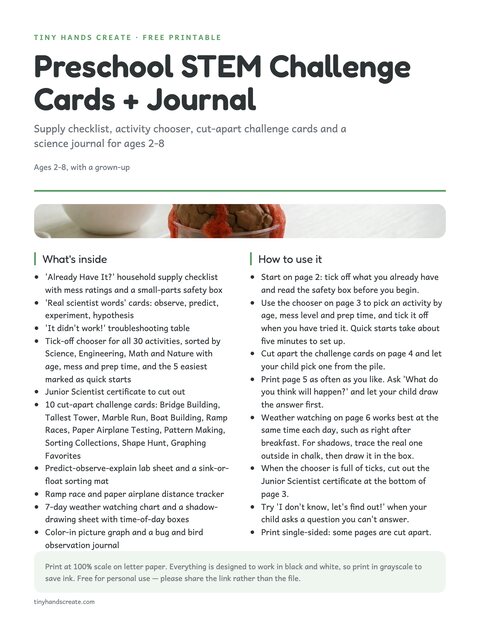
Free printable · 6 pages
Preschool STEM Challenge Cards & Journal
An 'Already Have It?' supply checklist with a safety box, real scientist word cards and an 'It didn't work!' table, a tick-off chooser for all 30 STEM activities with a Junior Scientist certificate, 10 cut-apart engineering and math challenge cards, a predict-observe-explain lab sheet, sink-or-float mat and distance tracker, plus a weather chart, shadow sheet, picture graph and bug and bird journal.
Free. Your download link appears right here. You'll also join the Daily Printable Drop. Unsubscribe anytime. Privacy
What Is STEM for Preschoolers?
STEM stands for Science, Technology, Engineering, and Mathematics. Here is what each one looks like for preschoolers.
| Letter | What it looks like | Example on this page |
|---|---|---|
| Science | Observing, asking questions, predicting, experimenting | Sink or Float (#3) |
| Technology | Using simple tools, noticing cause and effect | Ramp Races (#17), Bug Hunt with a magnifier (#25) |
| Engineering | Building, creating, problem-solving | Tallest Tower (#12) |
| Math | Counting, sorting, patterns, comparing sizes | Pattern Making (#19) |
At this age, formal instruction isn’t the goal. The goal is nurturing curiosity and showing kids that exploring how things work is fun.
Tips for STEM Success with Preschoolers
Ask questions, don’t give answers: “What do you think will happen?” “Why do you think that happened?” Questions build thinking skills.
Embrace mess and “failure”: Experiments that don’t “work” are still learning. Discuss what happened and try again.
Follow their lead: If they want to keep mixing colors instead of moving on, let them. Deep exploration beats checking off activities.
Use a few real science words: Mixing in words like “observe” and “predict” can build vocabulary if you explain them simply.
Connect to their world: Relate activities to things they already know and care about.
Want to go deeper on one topic? Our Color Sorting Activities for Toddlers: 20 Easy Learning Ideas pairs well with the sorting games below. For more fizzing and mixing, try our kitchen science experiments with the Kitchen Science Lab Notebook printable.
Our balloon science ideas come with the Balloon Science Experiment Cards + Lab Notebook (an adult handles the balloons for kids under 8). The Preschool STEM Challenge Cards & Journal below give you printable prompts for all of it.
Easy Science Experiments for Preschoolers (10 Activities)
| Activity | Age | Prep | Mess | Adult-only step |
|---|---|---|---|---|
| 1. Baking Soda Volcano | 3+ | 10 min | Medium | Pouring vinegar with little ones |
| 2. Color Mixing Magic | 2+ | 5 min | Low | None |
| 3. Sink or Float | 2+ | 5 min | Medium | Water supervision |
| 4. Magic Milk | 3+ | 5 min | Low-medium | Handling dish soap |
| 5. Growing Crystals | 4+ | 10 min, then 3-7 days | Low | Hot water |
| 6. Invisible Ink | 4+ | 5 min | Low | All ironing (the reveal step) |
| 7. Dancing Raisins | 4+ | 5 min | Low | Adult holds the glass and counts the raisins in and out; no eating |
| 8. Static Electricity Fun | 3+ (adult demo) | 2 min | None | Adult handles the balloon the whole time; kids watch |
| 9. Plant Growth Observation | 3+ | 5 min, then up to a week | None | Handling seeds for under-4s |
| 10. Rain Cloud in a Jar | 3+ | 5 min | Low | Shaving cream, no tasting |
Fair warning from one crafty mama to another: put a tray or old towel under every experiment in this section. Mess is part of the fun, but it’s easier to love when it stays on the tray.
1. Baking Soda Volcano
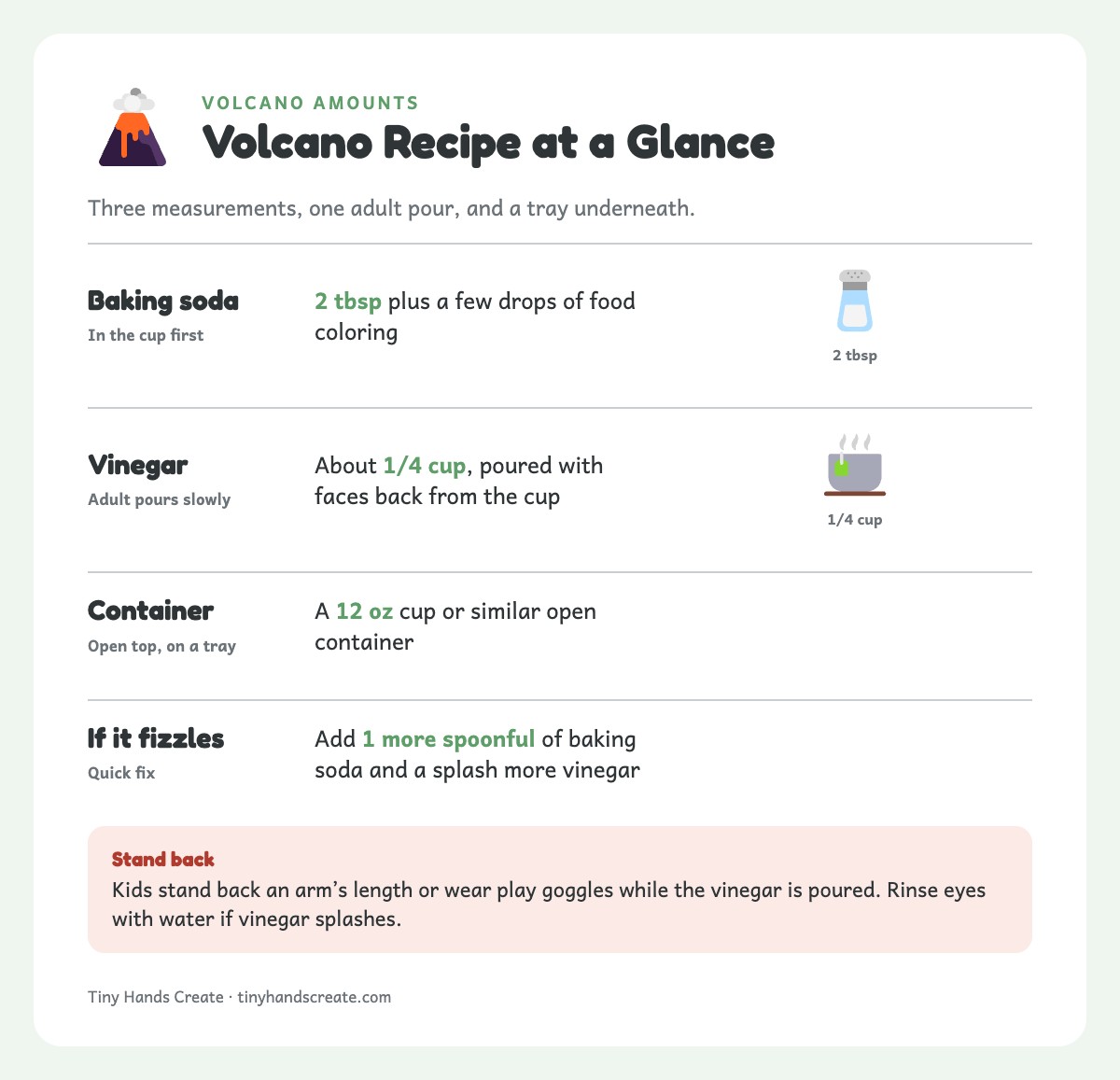
Materials: Baking soda, vinegar, food coloring, an open-top container, playdough or a tray. Set the open container on a rimmed tray, since the foam can spill over the top. Kids stand back an arm’s length or wear play goggles while the vinegar is poured. Rinse eyes with water if vinegar splashes. Check allergies (or use gluten-free dough) in groups.
- Build the volcano. Mold playdough around the container so the opening stays clear.
- Add the powder. Spoon 2 tbsp baking soda and a few drops of food coloring into a 12 oz cup or similar open container.
- Make it erupt. With faces back from the cup, an adult pours, or guides the child’s pouring, about 1/4 cup vinegar slowly. Then watch the eruption.
- If it fizzles. Add another spoonful of baking soda and a splash more vinegar.
The science: Acid-base reaction creates carbon dioxide gas
Mess level: Medium
2. Color Mixing Magic
Materials: Clear cups, water, food coloring, paper towels
- Set up the cups. Line up five clear cups. Fill the 1st, 3rd and 5th with water about 3/4 full and add red, yellow and blue food coloring. Leave the other two empty.
- Fold the strips. Fold paper towels into strips about 2 inches wide.
- Connect them. Put one end of a strip in each colored cup and the other end in the neighboring empty cup.
- Wait and watch. The colors “walk” up the towels over about 20 minutes.
- If nothing moves. Add more food coloring and use a tighter paper towel fold.
Ask: “What color do you think the empty cup will turn?”
The science: Capillary action, color mixing
Mess level: Low
3. Sink or Float
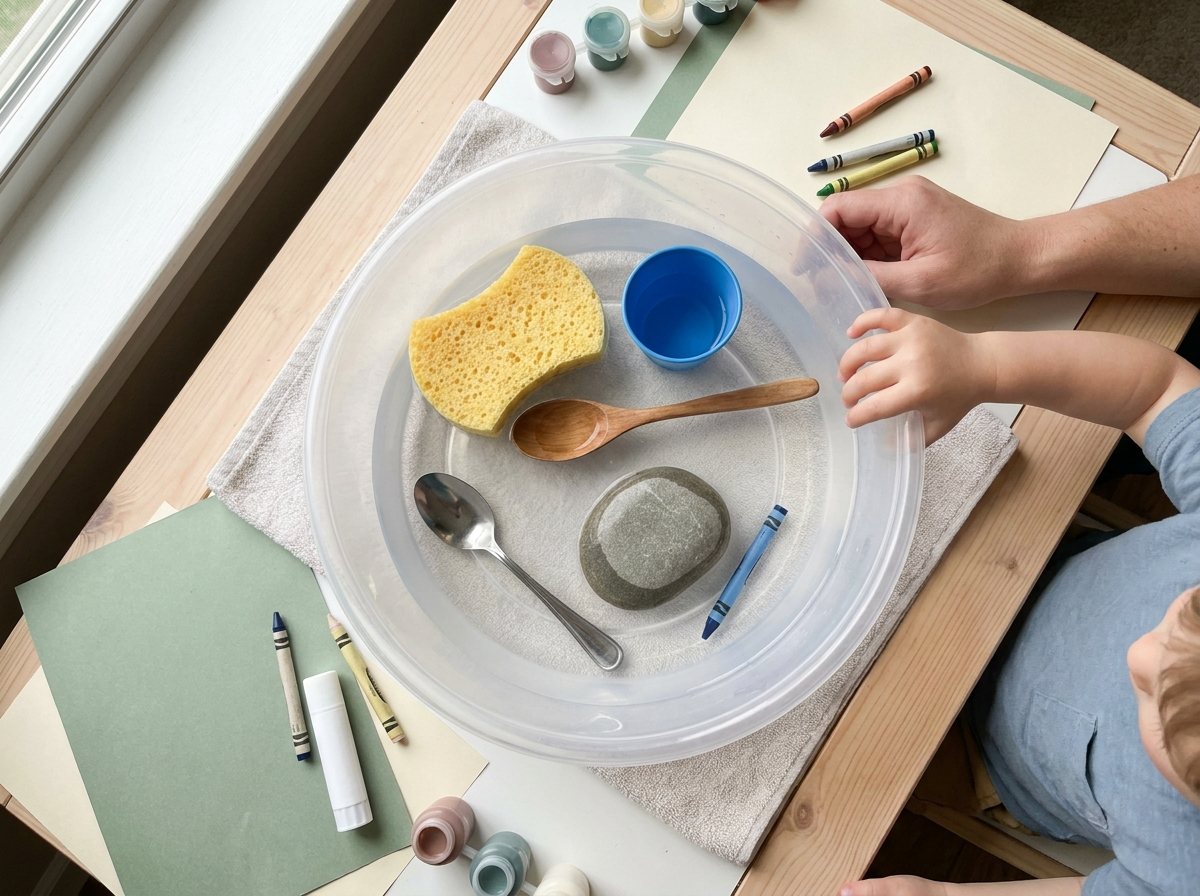
Materials: Basin of water, and items like a sponge, wooden spoon, metal spoon, plastic cup, crayon and a large smooth rock. Stay within arm’s reach during all water play and empty the basin afterward.
- Gather six items. Use the items listed above and line them up next to the basin.
- Predict. Hold up one item at a time and ask, “Will it sink or float?” Let your child say it out loud or point.
- Test it. Gently place the item in the water and watch.
- Sort. Make a sink pile and a float pile. If a prediction was wrong, say “Interesting! Let’s test it again.”
Ask: “What do the floaters have in common?”
The science: Density and buoyancy
Mess level: Medium (water)
4. Magic Milk
Safety firstThis milk is not for drinking. Keep the dish soap out of reach, throw the milk away afterward, and check for milk allergies in group settings.
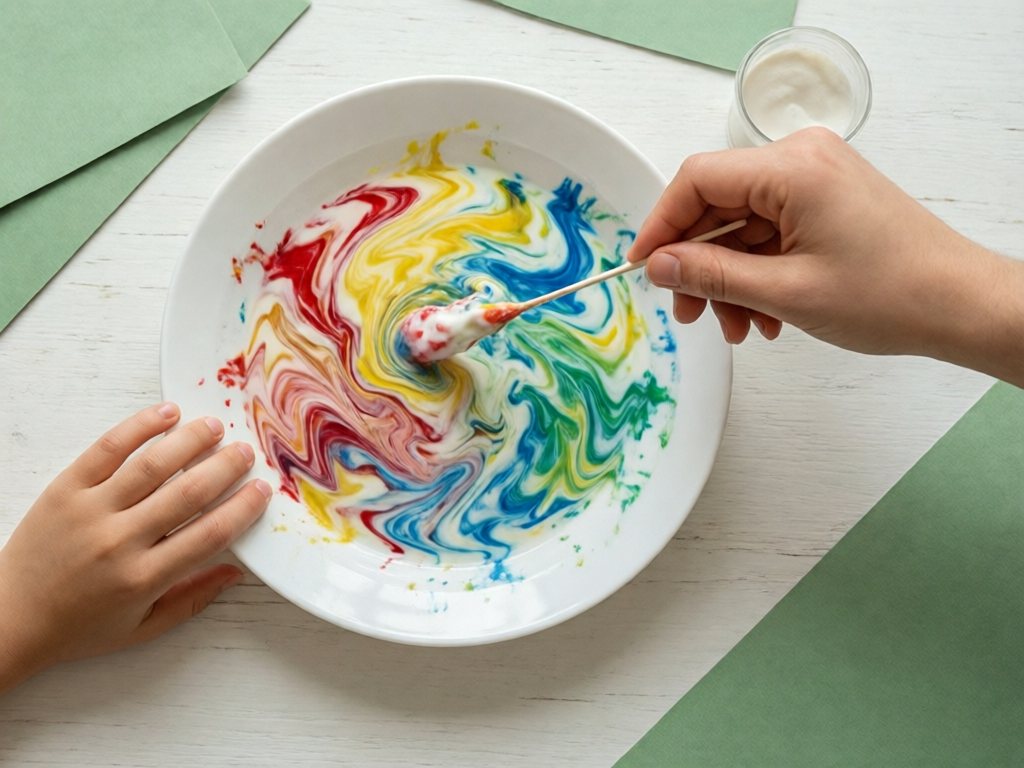
Materials: Whole milk, food coloring, dish soap, cotton swab, a small shallow dish
- Pour the milk. Pour whole milk into the dish until the bottom is covered, about 1/2 cup.
- Add color. Drip 4 or 5 drops of different food coloring near the middle.
- Add soap. The adult dabs a drop of dish soap on the tip of a cotton swab.
- Touch and watch. Your child touches the soapy tip to the middle of the milk and holds it still for 10 seconds. The colors burst outward!
- If the colors don’t move. Use whole milk, not skim, and add a fresh drop of soap to the swab.
Ask: “Where do you think the colors are going?”
The science: Dish soap lowers the surface tension and chases the milk fat around, which pulls the food coloring into swirls
Mess level: Low-medium
5. Growing Crystals
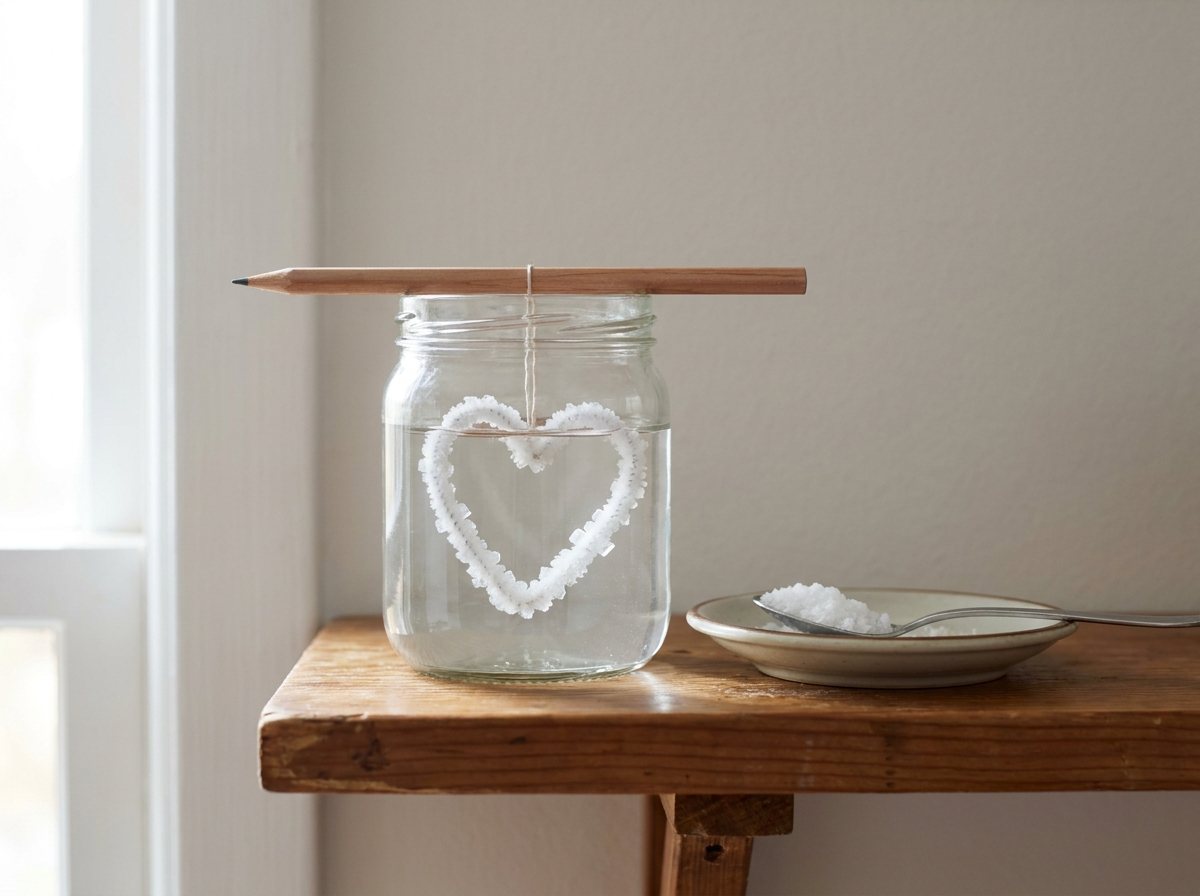
Safety firstAdult-only: the adult pours the hot water and stirs the solution at the counter, away from children, and kids watch from a safe distance. Let the solution cool before the jar goes anywhere near them. Keep the jar out of reach, no tasting, and wash hands after touching the crystals. We use salt here instead of borax, which irritates skin and eyes.
Materials: Table salt, hot water (adult-poured), pipe cleaners, small jar, spoon, a pencil
- Make a shape. Your child bends a pipe cleaner into a heart, star or spiral, leaving a tail to hang it by.
- Mix the salt water (adult only). The adult pours 1/2 cup of very hot tap water into the jar and stirs in salt a spoonful at a time until no more dissolves, about 3 tablespoons. Let it cool.
- Hang it. Wrap the tail around a pencil laid across the jar so the shape hangs in the cooled solution without touching the bottom. Set the jar somewhere out of reach.
- Check daily. Look once a day for 3 to 7 days. Expect a salt crust and small, cube-like crystals as the water evaporates.
- If nothing grows. Move the jar somewhere warmer and drier. For crystals that are easier to spot, set a damp sponge in a shallow dish of the cooled solution and watch the edges.
Real talk: most kids lose interest after a few minutes, so we make the daily check part of snack time.
The science: As the water evaporates, the salt is left behind and forms crystals
Mess level: Low
6. Invisible Ink
Safety firstBurn risk. Kids only paint the message. The adult does all the ironing while the child watches from a safe distance. Never leave a hot iron unattended, and let it cool unplugged and out of reach with the cord tucked away. Lemon juice stings eyes and small cuts, so wash hands after painting.
Materials: Lemon juice, white paper, cotton swab, an iron and ironing board (adult-operated), a thin cotton cloth
- Paint the message. Your child dips a cotton swab in lemon juice and writes or draws on white paper.
- Let it dry. Wait until the paper is completely dry.
- Reveal it (adult only). The adult lays the paper on the ironing board, covers it with the cloth, and irons on a low, no-steam setting. Keep the iron moving and check every few seconds until the message turns brown.
- If nothing shows. Use more lemon juice next time and iron a little longer.
No-heat option: Paint the message with equal parts baking soda and water, let it dry, then brush purple grape juice over the page to reveal it.
The science: Lemon juice weakens the paper where it was applied, so those spots brown sooner when warmed
Mess level: Low
7. Dancing Raisins
Safety firstRaisins are a choking hazard under age 4 and still need care at 4 and 5, so this one is an adult-run demo for ages 4+. The adult holds the glass, counts the raisins in, and counts every one back out into the trash afterward. Don’t eat the soaked raisins or drink the liquid. For younger kids, skip this activity and try Sink or Float (#3) instead.
Materials: Club soda or sparkling water, 6 raisins, clear glass
- Pour. The adult fills a clear glass with club soda.
- Count them in. The adult drops in 6 raisins while you count out loud together.
- Watch them dance. The raisins sink, rise and “dance” for a few minutes. Ask, “Why do you think they go back down?”
- If they stall. Add a splash of fresh soda.
- Count them out. When you’re done, the adult pours out the soda and counts all 6 raisins into the trash.
The science: Bubbles stick to the wrinkly raisins and lift them; when the bubbles pop, they sink again
Mess level: Low
8. Static Electricity Fun
Safety firstUninflated and popped balloons are a choking hazard for kids under 8. This is an adult demo: an adult inflates, ties and holds the balloon the whole time. Kids watch, and they never hold, chew or blow up balloons. Keep spare uninflated balloons out of reach. If the balloon pops, pick up every piece right away and throw it out. Skip latex if anyone has an allergy. Don’t eat anything that has been on the table.
Materials: Balloon, torn paper pieces or large cereal rings
What to do: The adult rubs the balloon on their own hair or a sweater (cue the giggles), then holds it just above the paper pieces or cereal. Your child watches the pieces jump and tells you where to move the balloon next. Put the balloon away, out of sight and out of reach, the moment you’re done.
The science: Electrical charges
Mess level: None
9. Plant Growth Observation
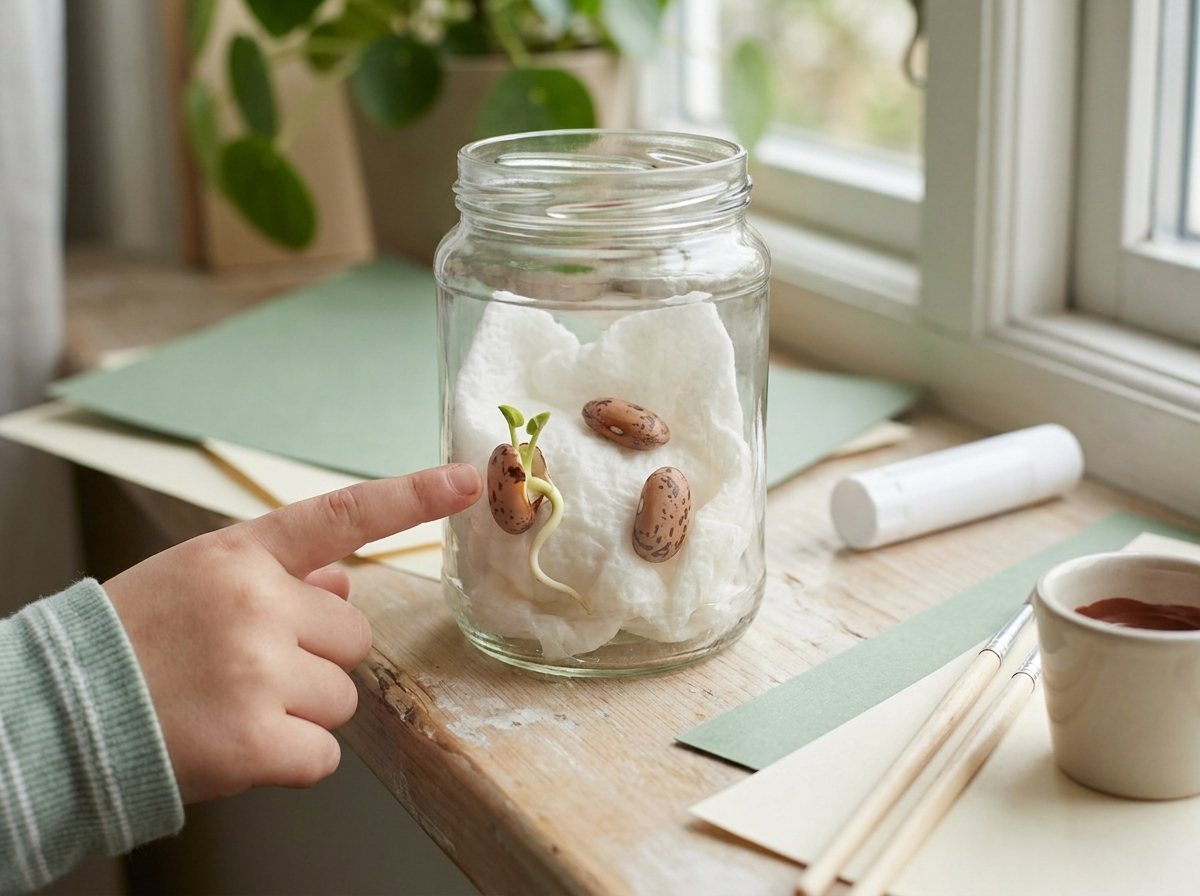
Safety firstBean seeds are a choking hazard for kids under 4. For that age, the adult handles the seeds and sets up the jar, then covers it so little hands can look but not reach in. Use dried pinto beans from the pantry or grocery store. Never use garden seed packets (often coated with fungicide), castor beans, or kidney beans (toxic raw). Nobody eats the sprouting beans, so keep them out of mouths, and throw out the towel and beans if you see mold.
Materials: 3 or 4 dried pinto beans from the grocery store, clear jar or container with a loose lid or cover, wet paper towel
- Line the jar. Fold a wet paper towel and press it against the inside of the jar.
- Add the beans. Tuck the beans between the towel and the side of the jar where you can see them, then cover the top loosely. For under-4s, the adult does this step.
- Check daily. Keep the towel damp and look once a day. Roots and sprouts usually show within a week. Ask, “What do you think will come out first?”
- If nothing happens. Try fresh beans and a warmer spot.
The science: Germination and plant biology
Mess level: None
Love watching things grow? Our growing plants with kids guide has more.
10. Rain Cloud in a Jar
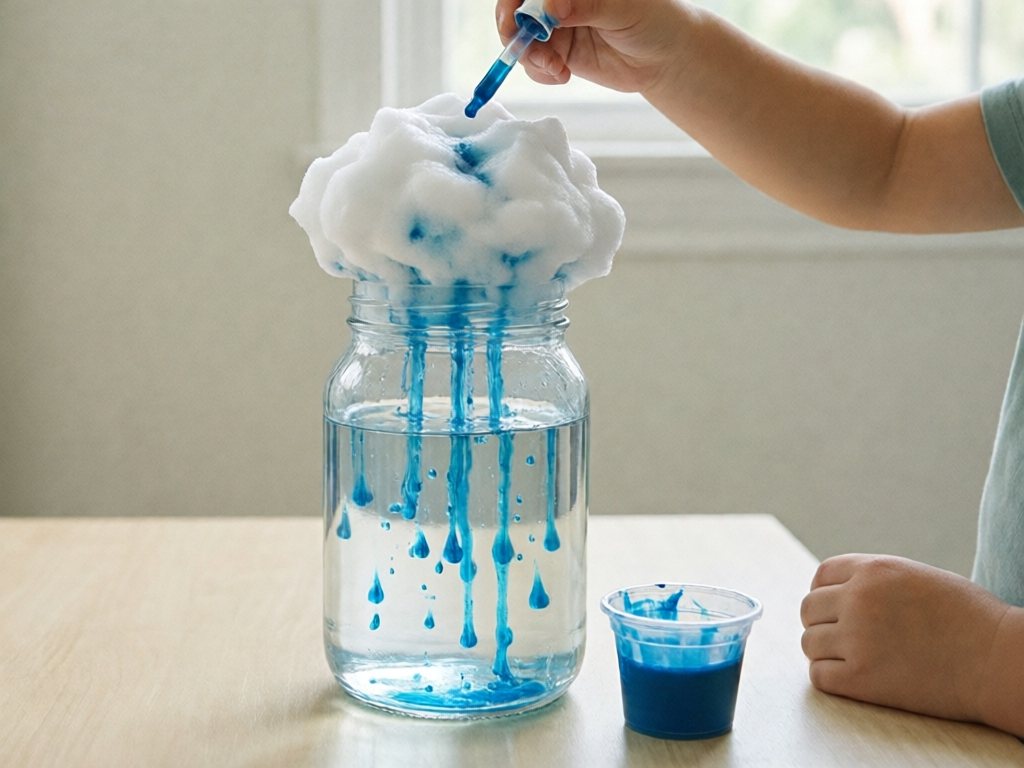
Materials: Clear jar, water, shaving cream (not for tasting), food coloring
- Fill the jar. Fill a clear jar about 3/4 full with water.
- Make a cloud. Spray a thick layer of shaving cream on top.
- Make it rain. Drip food coloring onto the cloud, a few drops at a time, and watch it “rain” through.
- If it won’t rain. Keep adding drops in one spot until the cloud is too full to hold them.
The science: A simple model of how clouds get heavy with water and rain falls
Mess level: Low
Engineering Challenges (8 Activities)
| Challenge | Ages | Safe-size note for under-4s | Mess |
|---|---|---|---|
| 11. Bridge Building | 3+ | Large blocks only | None |
| 12. Tallest Tower | 2+ | Large blocks or Duplo | None |
| 13. Marble Run | 3+ | Ball at least 2 in (5 cm) across on a wide ramp; marbles 4+ only | Low |
| 14. Egg Drop | 4+ | Hard-boiled egg | Potentially high |
| 15. Boat Building | 3+ | Large weights, not pennies | Medium |
| 16. Cardboard Box House | 2+ | Adult cuts everything | Low |
| 17. Ramp Races | 2+ | Large toy cars | None |
| 18. Paper Airplane Testing | 4+ | None | None |
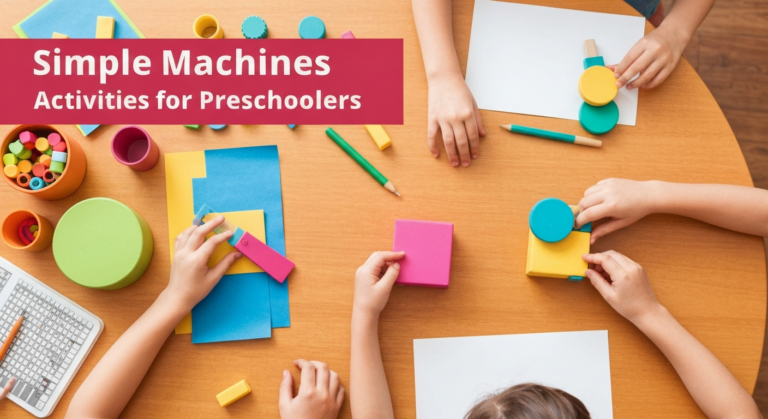
For more build ideas, see our building challenges for kids and simple machines activities.
11. Bridge Building
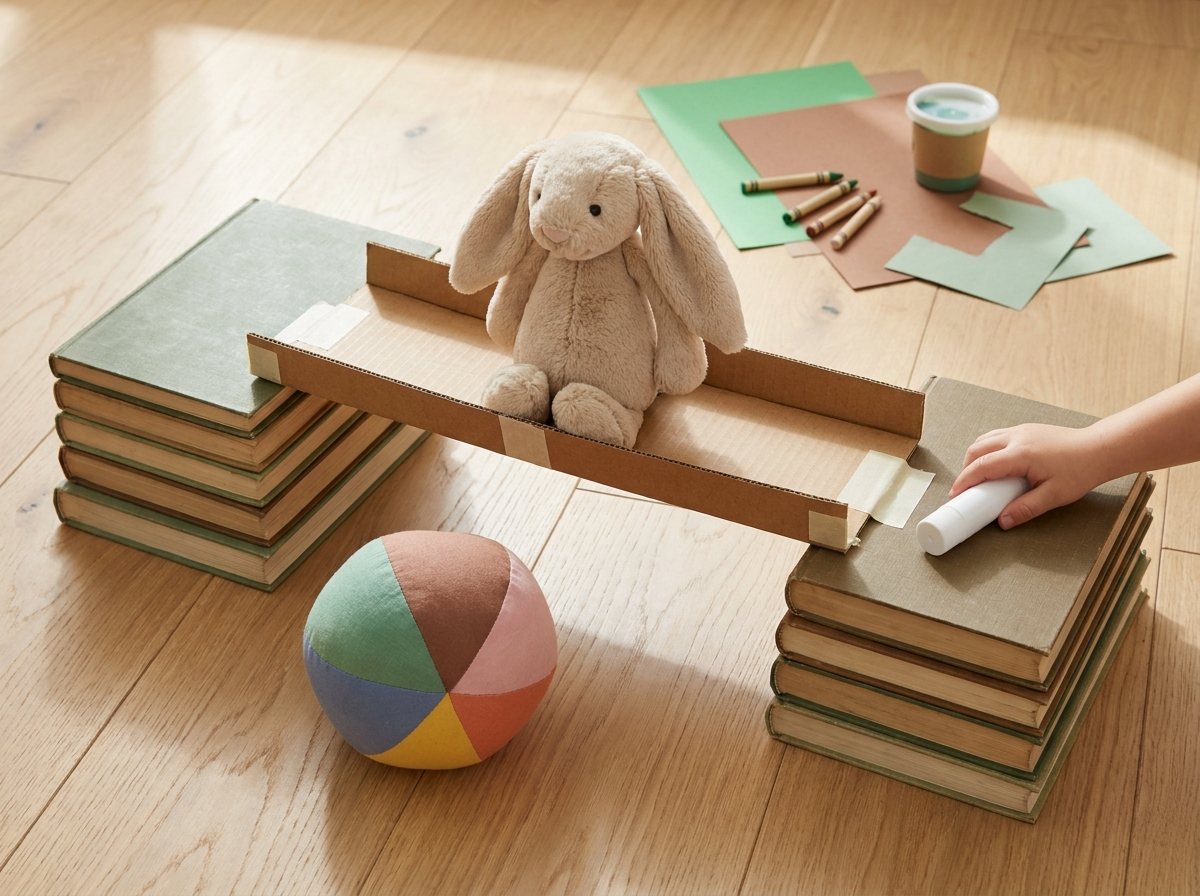
Materials: Large blocks, books, or cardboard; large soft toys or a large ball for testing. For under-4s, use only items at least 2 inches (5 cm) across.
Challenge: Build a bridge that spans a gap and holds weight.
- Make the gap. Stack two piles of books about 8 inches (20 cm) apart.
- Build. Lay a strip of cardboard, a long block or a book across the gap.
- Test it. Set a stuffed animal in the middle, then a large ball. Does it hold?
- If it sags or falls. Fold up the long edges of the cardboard like a gutter, add a second layer, or push the piles closer and try again.
Skills: Structural engineering, problem-solving
Mess level: None
12. Tallest Tower
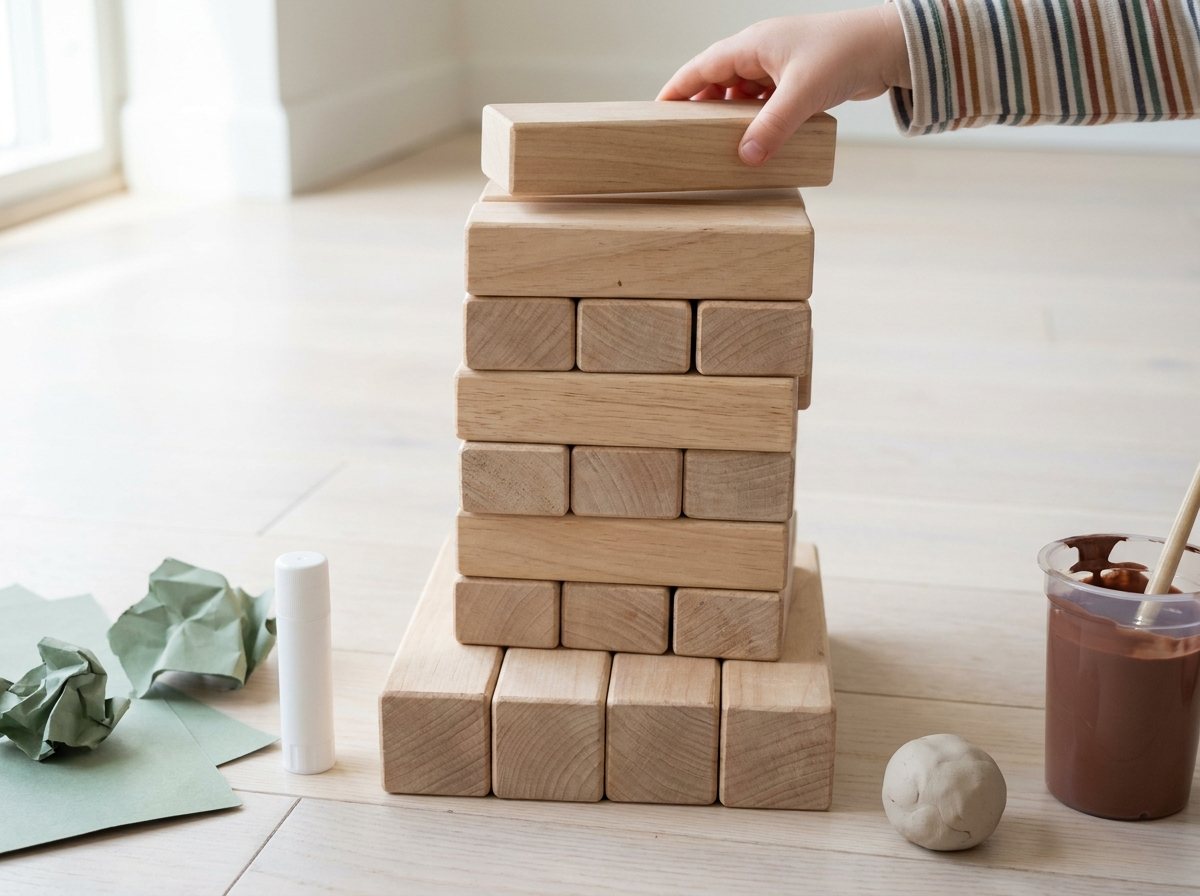
Materials: Large blocks, Duplo-size bricks, cardboard boxes, or cups
- Start wide. Lay a base of 4 or 5 big blocks side by side.
- Stack up. Add layers one at a time and stop when it wobbles.
- Test it. Count the blocks. Can it stand for 10 seconds on its own?
- If it falls. Ask, “What could we change?” Try a wider base and rebuild.
Skills: Balance, stability, spatial reasoning
Mess level: None
13. Marble Run
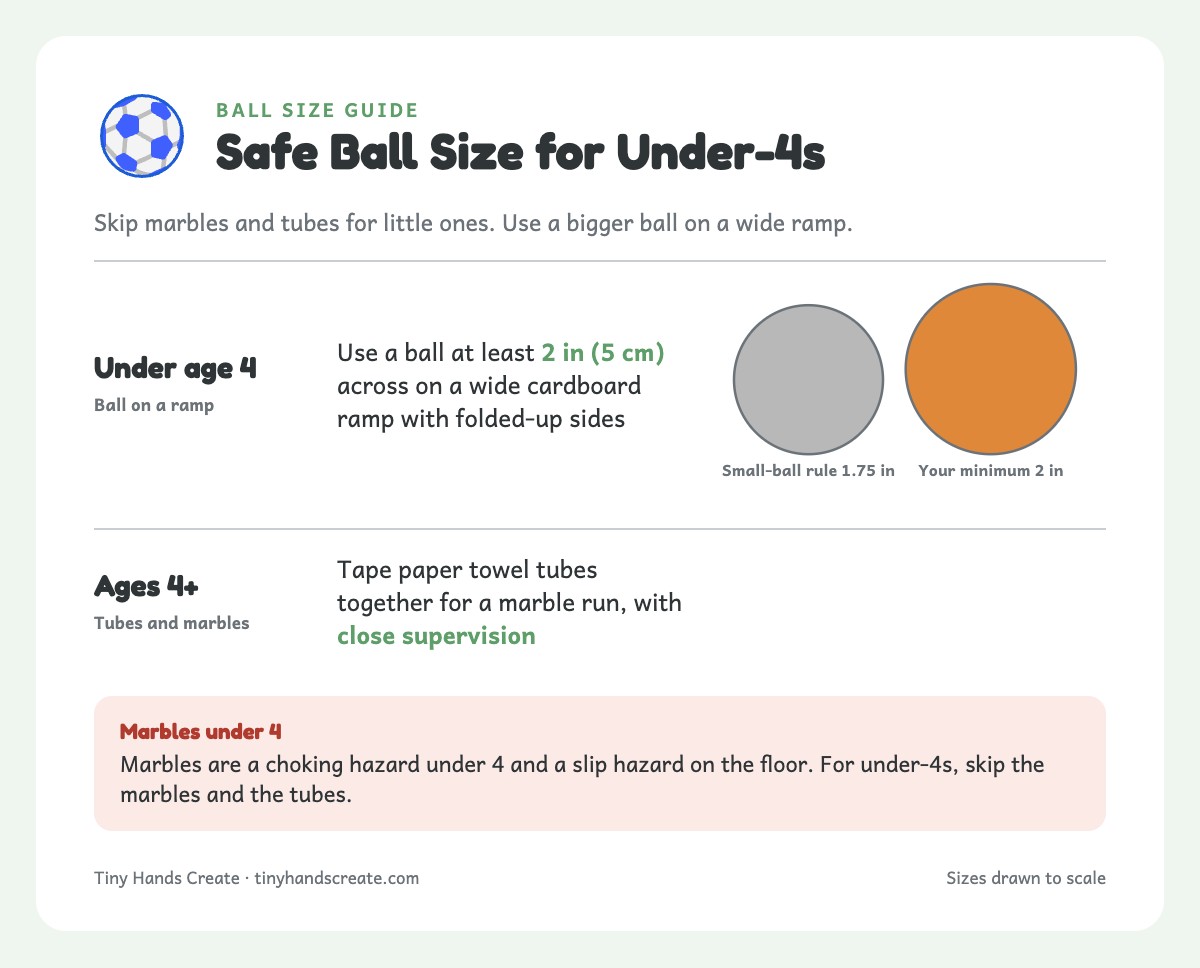
Safety firstMarbles are a choking hazard under 4 and a slip hazard on the floor. For under-4s, skip the marbles and the tubes. Use a ball at least 2 inches (5 cm) across and roll it down a wide cardboard ramp or channel instead. The U.S. small-ball rule for toys for under-3s is 1.75 inches (4.4 cm), so 2 inches gives you a little margin. Ping-pong balls are too small for this age. Save tube-and-marble runs for ages 4+ with close supervision.
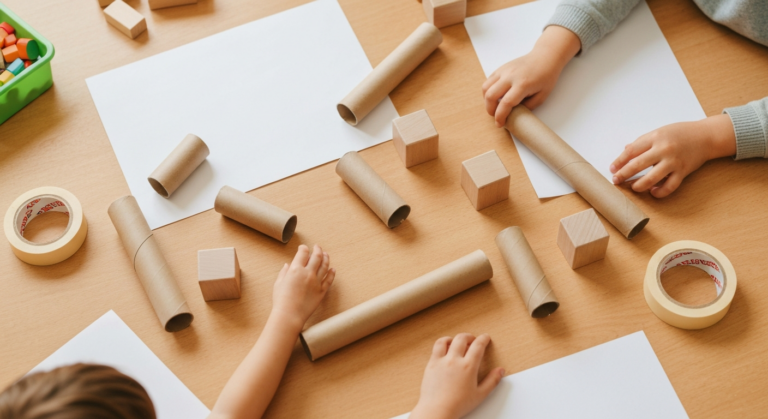
Materials: Cardboard, tape, blocks or books to prop it up, and a ball at least 2 inches (5 cm) across. For ages 4+, add paper towel tubes and a marble.
Challenge: Create a track that carries the ball from high to low. Under-4s build a wide cardboard ramp with folded-up sides. Ages 4+ can tape tubes together for a marble.
Skills: Gravity, angles, sequential thinking
Mess level: Low
14. Egg Drop Challenge
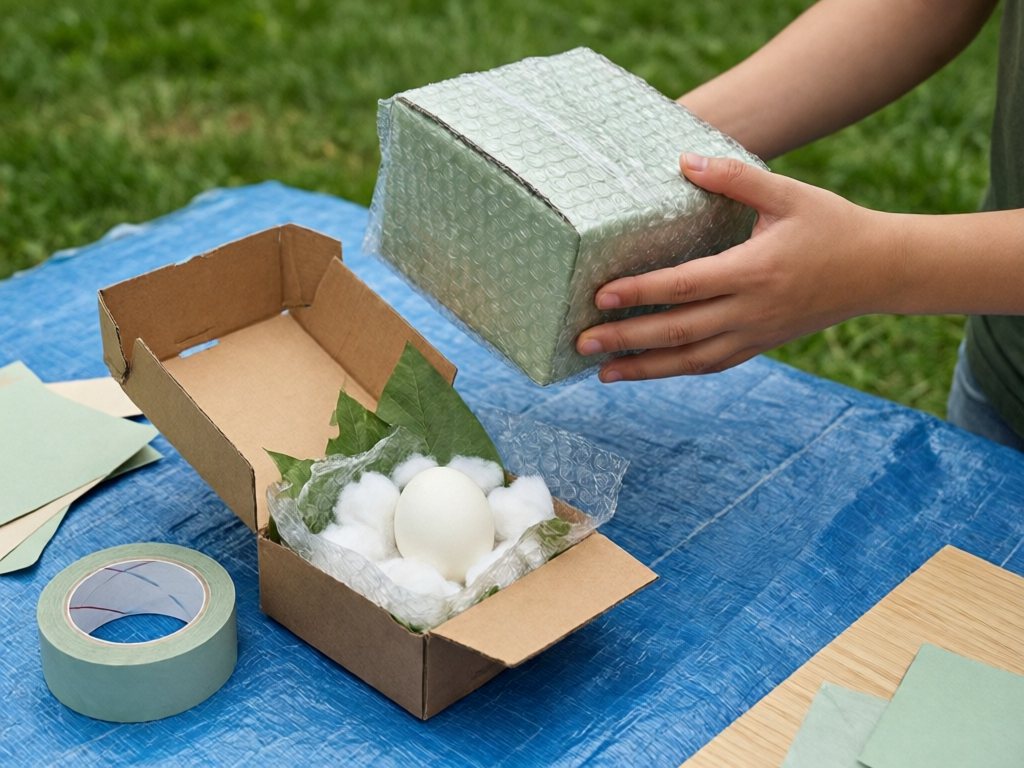
Safety firstDo it outdoors or on a tarp, with the adult doing the dropping and no climbing on furniture. Stick with hard-boiled eggs, kept in the fridge until you start. The adult picks up any shell pieces, the dropped egg goes in the trash, and everyone washes hands afterward.
Materials: Hard-boiled egg, a small box or plastic cup, tape, cushioning materials (cotton balls, bubble wrap, fabric)
Challenge: Protect an egg from cracking when it’s dropped.
- Build a nest. Set the egg in the box or cup, pack cushioning all around it, and tape it closed.
- Predict. Ask, “Will it crack?”
- Drop it. Standing on the ground, the adult drops the package from shoulder height.
- Check. Open it together and look for cracks.
- If it cracked. Add more padding or swap in a different material, then try again with a new hard-boiled egg.
Skills: Material properties, impact absorption
Mess level: Potentially high (but worth it)
15. Boat Building
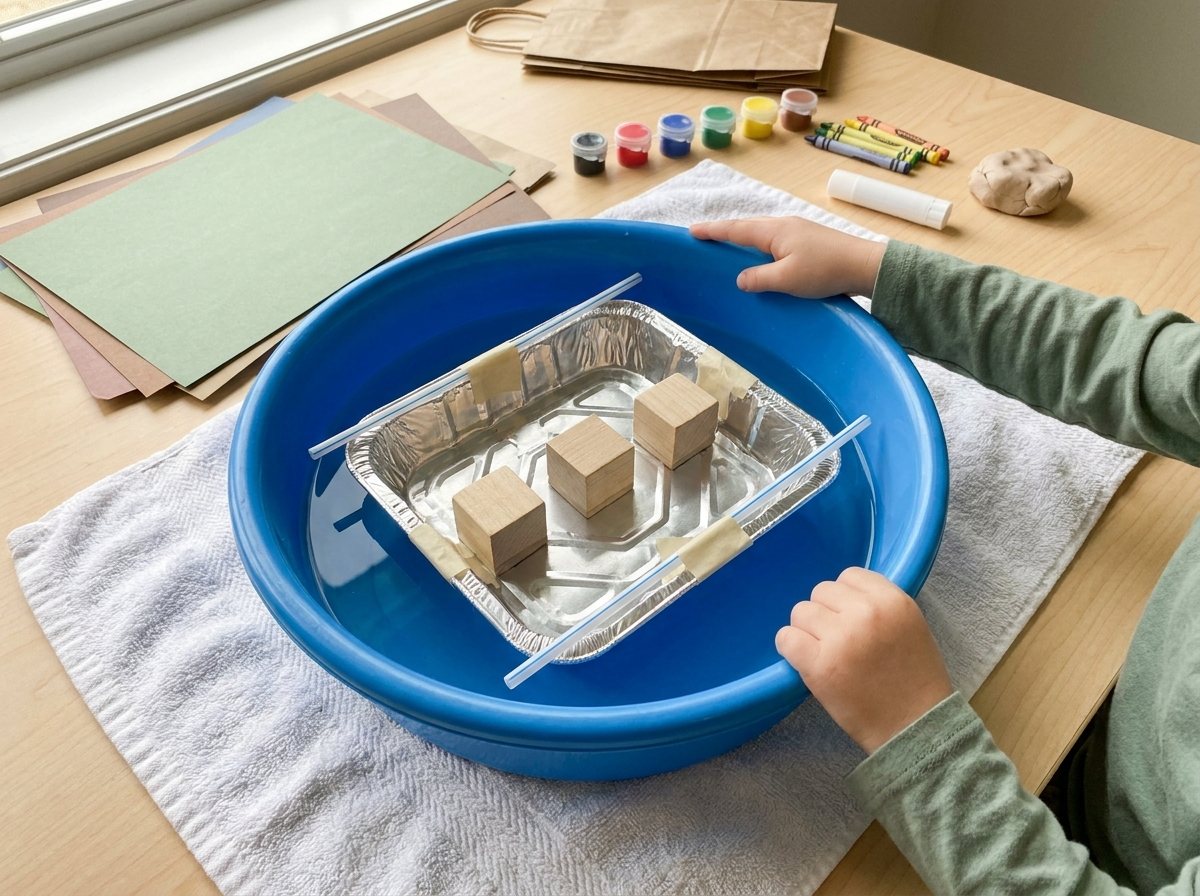
Materials: Foil, straws, tape, small tub of water, and large weights like big blocks or other toys at least 2 inches (5 cm) across (pennies only for ages 4+). Stay within arm’s reach during water play, and empty the tub afterward. Watch for foil scraps and straw pieces.
Challenge: Build a boat that floats and holds the most weights.
- Shape it. Fold up the edges of a foil square about 8 inches (20 cm) across to make a flat boat with walls. For pennies (ages 4+), a 4-inch (10 cm) square works. Tape straws along the sides if you like.
- Float it. Set the boat gently on the water.
- Load it. Add weights one at a time, counting together, until it sinks.
- If it sinks fast. Make the walls taller and the bottom wider, spread the weights out, and count again.
Skills: Buoyancy, weight distribution
Mess level: Medium (water)
16. Cardboard Box House
Materials: A large cardboard box about 3 ft (90 cm) tall (an appliance or moving box works), packing tape, non-toxic markers, a pillow. An adult cuts all doors and windows; kids use child-safe scissors on thin paper only. Keep at least two open sides so no one gets stuck inside.
Challenge: Design and decorate a house with doors and windows.
- Plan it. Stand the box upright and let your child mark where the door and two windows should go.
- Cut the openings (adult only). The adult cuts off the top flaps, cuts out a doorway big enough to crawl through, and cuts two windows on three sides so they fold open like shutters. The open top and the doorway keep two sides open.
- Decorate. Your child draws bricks, a roof line, flowers or a house number. Plan on about 20 minutes, and lay newspaper underneath, because some marker always lands on hands and floor.
- Move in. Add a pillow and a toy “resident.” Ask, “What else does your house need?”
- If it sags or collapses. Tape every seam inside and out, and reinforce the corners with an extra strip of cardboard.
Skills: Spatial planning, design
Mess level: Low
17. Ramp Races
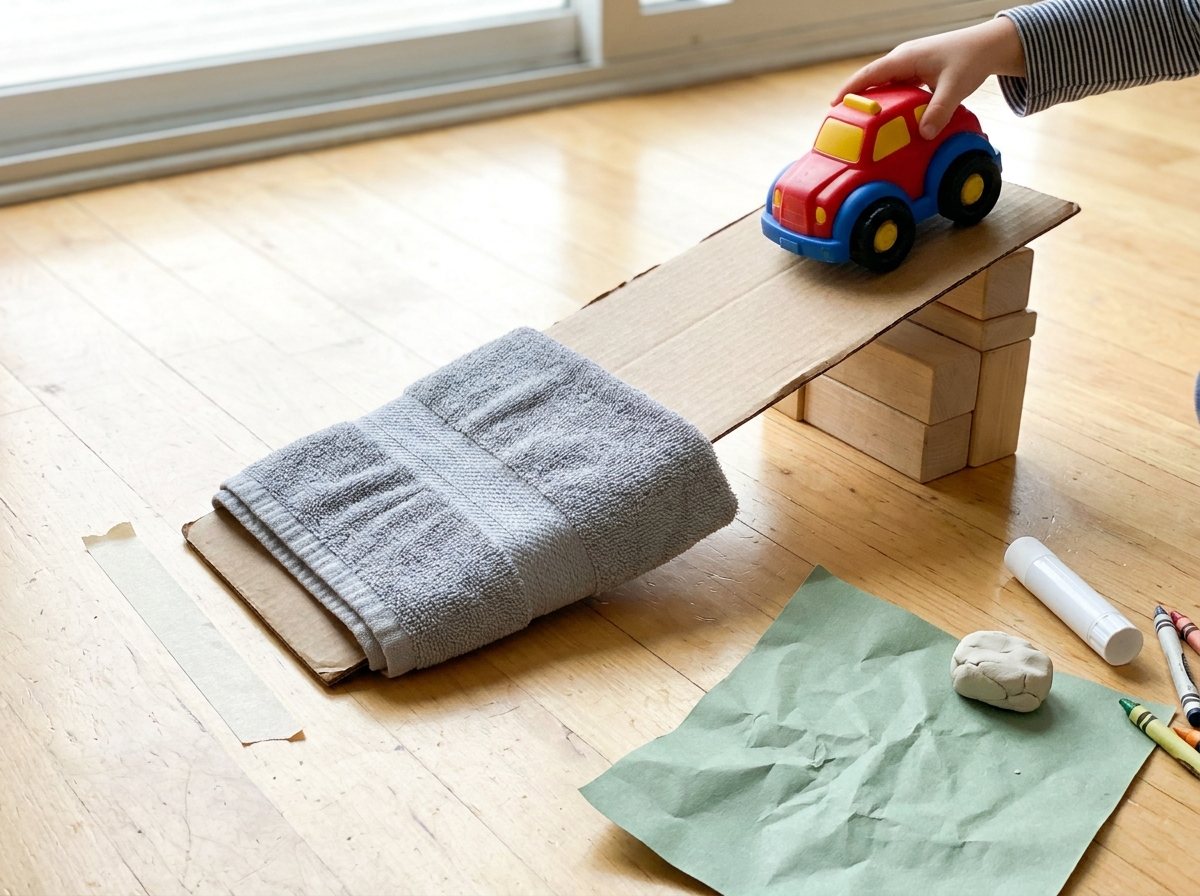
Materials: Flat surface (stiff cardboard or a board), blocks to prop it, large toy cars, a towel, tape
Challenge: What angle makes cars go fastest? What surface?
- Start low. Prop one end of the board on blocks about 4 inches (10 cm) high.
- Roll and mark. Let a car go from the top without pushing, and mark where it stops with tape.
- Go higher. Raise the end to about 8 inches (20 cm) and roll the same car. Which run went farther?
- Change the surface. Lay a towel over the ramp and try again.
- If cars fly off the side. Line the edges with blocks or lower the ramp.
Skills: Variables, slopes, friction
Mess level: None
18. Paper Airplane Testing
Materials: Paper, open space, tape, a few blocks
Challenge: Which fold design flies farthest? Straightest?
- Fold two planes. The adult folds a simple pointy dart and a wide-wing plane while your child helps press the creases.
- Make a start line. Put a strip of tape on the floor.
- Fly and mark. Throw each plane 3 times from the line, away from faces, and set a block where it lands.
- Compare. Count the steps to each block. Which flew farthest? Which flew straightest?
- If it nosedives. Bend the back edges of the wings up a little and try again.
Skills: Aerodynamics, testing variables
Mess level: None
Math Activities (6 Activities)
| Activity | Age | Prep | Mess |
|---|---|---|---|
| 19. Pattern Making | 3+ | 2 min | None |
| 20. Sorting Collections | 3+ | 5 min | None |
| 21. Measuring Everything | 3+ | 2 min | None |
| 22. Shape Hunt | 2+ | 5 min | None |
| 23. Counting Games | 3+ | 2 min | None |
| 24. Graphing Favorites | 4+ | 5 min | None |
19. Pattern Making
Materials: Colored blocks, large beads, or Duplo-size bricks. Avoid small beads and LEGO under 4.
- Start a pattern. Lay out an AB pattern, like red, blue, red, blue, repeated 3 times.
- Your turn. Ask, “What comes next?” and let your child add the next 2 pieces.
- Level up. Try AABB (red, red, blue, blue), then ABC.
- If it’s tricky. Go back to 2 colors and say the pattern out loud together.
Skills: Pattern recognition, sequencing
Mess level: None
For printable practice, try our pattern worksheets for preschool.
20. Sorting Collections
Materials: Large buttons, shells, leaves, toys, a few bowls. For under-4s, use only items at least 2 inches (5 cm) across, never include coin or button batteries or magnets, and supervise closely.
- Make a pile. Mix about 15 items together on a tray.
- Sort. Pick one rule, like color or size, and sort the pile into bowls.
- Count. Count each group together. Which has the most?
- Switch rules. Mix everything up and sort by something new. Can your child guess your rule?
- If it’s too hard. Start with just 2 groups, like big and small.
Skills: Classification, counting, comparing
Mess level: None
21. Measuring Everything
Materials: Rulers, soft cloth tape, blocks (as non-standard units)
What to do: Measure furniture, toys and family members with blocks or a soft tape. Then compare: which is longer, which is shorter? Skip retractable metal tapes, which can snap back.
Keep everyone on the floor, with no climbing on or pulling at furniture.
Skills: Measurement, comparison, number sense
Mess level: None
22. Shape Hunt
Materials: Paper shapes or shape cutouts
- Pick a shape. Show a paper circle, rectangle or triangle.
- Hunt. Walk through one room and point out every matching shape you can find, such as a plate, a window or a book.
- Count. Tally each shape on paper. Which shape won?
- If it’s too easy. Hunt for two shapes at once.
Skills: Shape recognition, observation
Mess level: None
23. Counting Games
Materials: Counters, cups, dice. For under-4s, use large counters (Duplo-size bricks or anything at least 2 inches / 5 cm across) and an oversized foam die, and supervise closely. Standard dice and small counters are for ages 4+.
- Roll. Roll the die and count the dots together.
- Count out. Count that many counters into a cup, touching each one as you go.
- Compare. Roll again and fill a second cup. Which cup has more?
- Add. Tip both cups together and count them all.
- If counting gets wobbly. Line the counters up in a row before you count.
Skills: One-to-one correspondence, addition basics
Mess level: None
24. Graphing Favorites
Materials: Paper, marker, stickers or stamps
- Pick a question. Choose one with 3 answers, like “Which fruit do you like best: apple, banana or grapes?”
- Draw the graph. Draw 3 columns and put a picture of each answer at the bottom.
- Survey. Ask each family member and add a sticker to their answer’s column.
- Read it. Count each column. Which has the most? The fewest?
- If you need more votes. Let the stuffed animals vote too, or ask grandparents on the next call.
Skills: Data collection, visual representation
Mess level: None
When math play turns into letter play, try these Free Printable Alphabet Worksheets for Preschoolers. For more counting and sorting, see our math games with household items.
Nature-Based STEM (6 Activities)
| Activity | Age | Prep | Mess |
|---|---|---|---|
| 25. Bug Hunt and Observation | 3+ | 5 min | None |
| 26. Weather Watching | 3+ | 5 min | None |
| 27. Shadow Play | 2+ | 2 min | None |
| 28. Nature Collections | 2+ | 2 min | Low |
| 29. Bird Watching | 3+ | 2 min | None |
| 30. Water Cycle in a Bag | 3+ (jar version under 4) | 5 min, then hours to days | None |
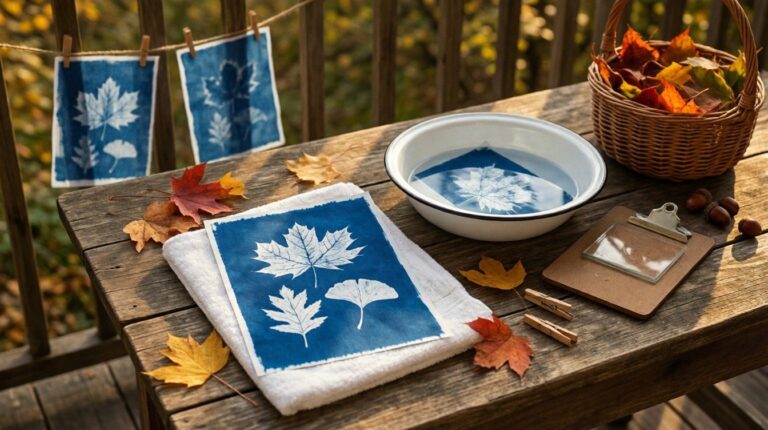
On a sunny day, add our leaf sun print science to the list. It has its own Leaf Sun Print Science Card Pack.
25. Bug Hunt and Observation
Safety first
- Adults, not kids, catch the insects. Stay away from bees, wasps and ants, and never touch unknown insects.
- If someone is stung, scrape out any stinger with a fingernail or the edge of a card, wash the area, and hold a cold pack on it.
- Call 911 or your local emergency number right away for trouble breathing, swelling of the face, lips or throat, widespread hives, or dizziness.
- If a child with a known sting allergy is stung, use their prescribed epinephrine and call 911.
- Call your child’s doctor if milder swelling or redness keeps getting worse.
- Never aim a magnifier at the sun or at eyes.
- Poke air holes in the jar lid and release the bugs soon.
- Check for ticks afterward, and use sunscreen, a hat and shade.
Materials: Magnifying glass, bug jar, notebook (see our bug hunting activities for more)
What to do: Find bugs outside. The adult gently catches one in the jar, and kids look without touching. Draw what you see. Count legs, look at colors.
Skills: Observation, documentation, entomology basics
Mess level: None
26. Weather Watching
Materials: Paper for a weather chart, crayons, outdoor thermometer
- Make a chart. Draw 7 boxes, one per day, with little pictures for sunny, cloudy, rainy and windy.
- Look outside. At the same time each day, check the sky together and read the thermometer.
- Record it. Your child draws the weather in that day’s box, and you write the temperature.
- Spot patterns. At the end of the week, count the sunny days. Which weather won?
- If you forget. Tie the check to breakfast so it becomes part of the routine.
Skills: Observation, data tracking, meteorology
Mess level: None
27. Shadow Play
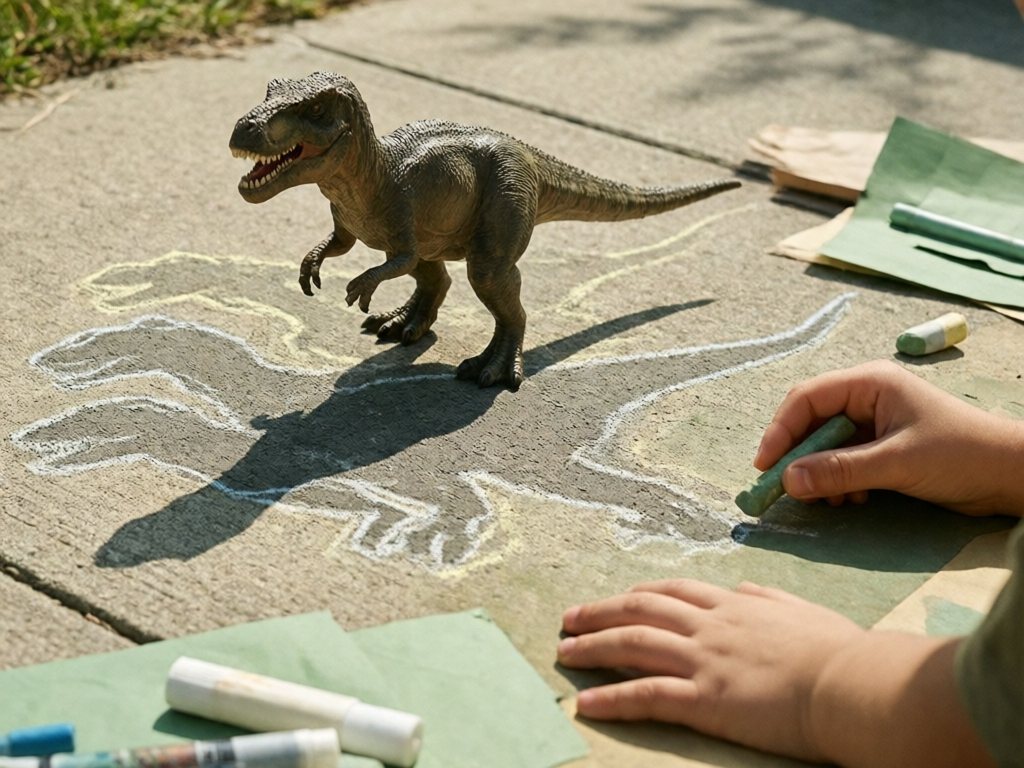
Materials: Sunny day, chalk, various objects
- Pick a spot. Set a toy on the sidewalk in full sun.
- Trace. Trace its shadow with chalk in the morning.
- Trace again. Come back at lunch and again in the afternoon, and trace each time.
- Compare. Ask, “What happened to the shadow?” Then make shadow puppets with your hands.
Skills: Light and shadow concepts, noticing that shadows change through the day
Mess level: None
28. Nature Collections
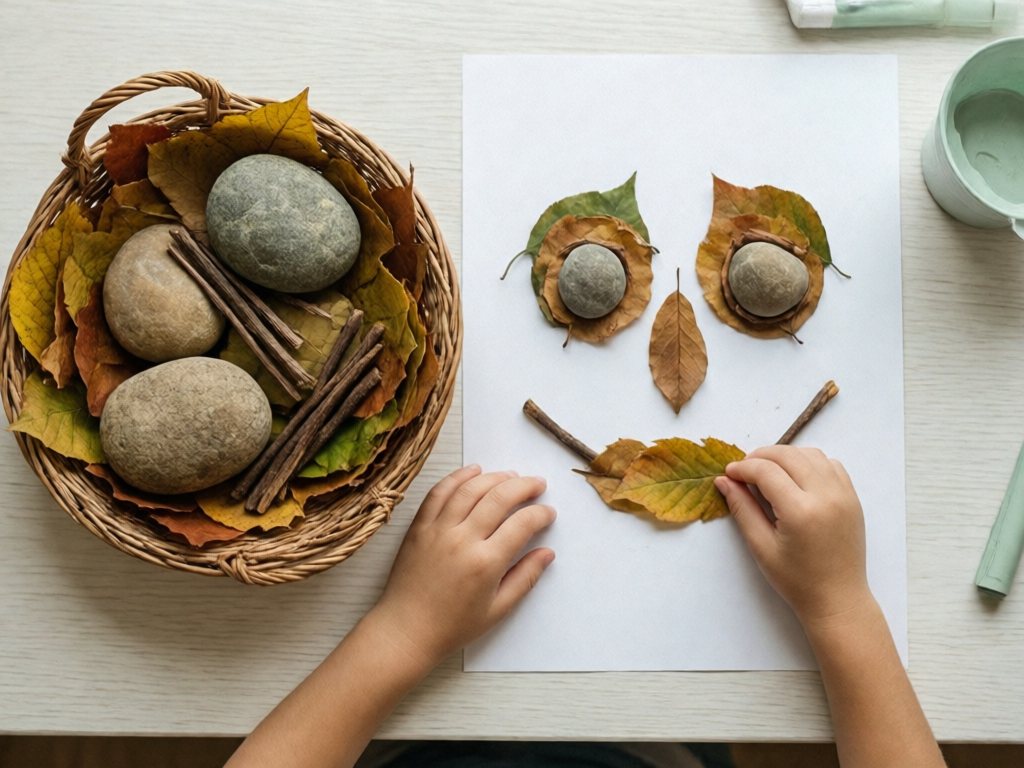
Safety first
- Nothing goes in the mouth, and an adult checks everything that gets collected.
- Leave berries, mushrooms and unknown plants alone, and steer clear of poison ivy.
- For under-4s, collect only rocks at least 2 inches (5 cm) across, and skip acorns and other small bits.
- Watch for sharp sticks and animal droppings.
- Wash hands when you come back inside.
Materials: Container, natural items found outside
- Set a mission. Ask your child to find 5 leaves, 5 rocks and 5 sticks.
- Check the haul. The adult looks over each find before it goes in the container.
- Sort. Back home, sort by type, color or size and count each pile.
- Make art. Arrange the finds into a face, a rainbow or a pattern on paper.
- If interest fades. Switch to a texture hunt: something bumpy, something smooth, something soft.
Skills: Classification, observation
Mess level: Low
29. Bird Watching
Materials: Bird guide or app, binoculars (optional), paper and crayon
- Pick a spot. Sit by a window or on a park bench for 10 minutes.
- Watch quietly. Make a tally mark for every bird you see.
- Describe. Talk about colors and size. Is it bigger or smaller than your hand?
- Look it up. Use the guide or app together to name one or two birds.
- If no birds show. Try early morning, or sit near trees, bushes or water.
Skills: Observation, identification, counting
Mess level: None
30. Water Cycle in a Bag
Safety first
- Plastic bags are a suffocation hazard. Never let young children put plastic bags over the head or face.
- The adult fills, seals and tapes the bag flat against the glass, high and out of reach, away from blind and curtain cords. It stays up there the whole time.
- Kids look at it only with an adult present.
- Use only 1/4 cup of water, since a sealed bag in a hot window can swell and burst.
- When you’re done, the adult takes it down and throws it away.
- For under-4s, use a clear plastic jar with the lid screwed on tight instead of a bag.
Materials: Sturdy gallon zip-top bag (or a clear plastic jar with a lid for under-4s), 1/4 cup water, blue food coloring, tape
- Fill it. The adult pours 1/4 cup of water and 2 drops of blue food coloring into the bag or jar and seals it tight.
- Put it in the sun. The adult tapes the bag flat against a sunny window, high up and out of reach, where it stays for the whole experiment. A jar goes on a sunny windowsill.
- Check in. Look together once or twice a day, with an adult present. On a warm window, droplets usually form near the top within several hours and slide back down like rain. Keep watching for a few days.
- If nothing happens. Move it to a sunnier, warmer window and give it another day.
Skills: Water cycle, observation over time
Mess level: None
For more, see our weather activities and experiments.
Your Starter STEM Supply Kit
You don’t need much. Keep these in one bin and you can say yes to most experiments.
When you don’t know an answer, try “I don’t know, let’s find out!”
- Measuring cups and spoons
- Funnels and containers
- Magnifying glass
- Tape and cardboard
- Baking soda, vinegar, food coloring
- A large ball (at least 2 in / 5 cm across)
- Soft cloth measuring tape
Crafty Mama
Crafty Mama is a former elementary art teacher turned stay-at-home parent who believes every child is creative — they just need the right invitation. She develops age-appropriate activities, crafts, and projects that spark imagination while keeping mess (and parent stress) to a minimum.
Frequently Asked Questions
Is my preschooler too young for STEM?
Absolutely not! Preschoolers are natural scientists. They’re constantly experimenting, even if it looks like “making a mess.” These activities channel that curiosity productively.
What if experiments don’t work as expected?
That’s actually valuable! Talk about what happened and why. Real scientists’ experiments often don’t go as planned. The learning is in the process.
How do I explain the science without getting too complicated?
Keep explanations simple and concrete. “The bubbles are pushing the raisins up!” is perfect for preschoolers. Save detailed explanations for when they ask more questions.
Do I need to buy special materials?
Most activities use common household items. A magnifying glass is worth having but isn’t required to start.
Conclusion
Honest mama note: the volcano and the walking colors get asked for again and again, while crystals are slow and often a flop. That’s okay. The wonder when something fizzes or changes is the point.
Start with one activity this week. Ask questions, make predictions together, and see where their curiosity leads.
Curious about the “T” in STEM? Try Coding Activities for Kids Without a Computer for a screen-free next step.
—