Handprint Turkey Craft for Toddlers: A Foolproof Guide
This post contains affiliate links. As an Amazon Associate I earn from qualifying purchases.
The first time I tried a handprint turkey with my daughter, she was eighteen months old, deeply suspicious of the paintbrush, and about four seconds away from wiping a fully loaded palm across the front of her white onesie. I had watched maybe six tutorials the night before. Every single one showed a serene toddler sitting calmly with an open hand while a parent gently brushed on paint like they were applying nail polish. Not one of them mentioned that my actual toddler would curl her fingers into a fist the moment paint touched her skin, or that “brown paint” apparently tastes interesting enough to sample.
We got there eventually. The turkey we ended up with — lopsided, one smudged wing, a thumbprint head that looks more like a confused peanut — still hangs on our fridge every November. But it took a second attempt, a towel under the highchair, and abandoning the idea that this was going to look like the pictures.
That’s the craft I want to walk you through here: not the Pinterest-perfect version, but the one that actually survives contact with a real one, two, or three-year-old. We’ll cover the logistics nobody puts in the tutorial — how to hold a hand that doesn’t want to be held, what paint actually comes out of carpet, and how to adapt the whole project depending on whether you’re working with a barely-mobile one-year-old or a very opinionated three-year-old who wants to do it “by myself.”
In this article (12 sections)
- What You Actually Need (And What’s Optional)
- Which Paint Actually Won’t Stain
- Step-by-Step: The Basic Handprint Turkey
- Turkey Craft for a 1-Year-Old
- Getting a Toddler to Hold Still Long Enough
- Troubleshooting Table: Common Handprint Turkey Problems
- Easy Variations for Different Ages
- Adding Feathers and Details Without Losing Your Mind
- Cleanup: What Actually Comes Out (And What Doesn’t)
- Keeping the Finished Turkey: Display and Storage Ideas
- Frequently Asked Questions
- A Slightly Messy Tradition Worth Keeping
What You Actually Need (And What’s Optional)
Before you touch paint to skin, get everything laid out within arm’s reach. The single biggest mess-maker in this craft isn’t the paint — it’s you, mid-project, walking away to grab a wipe you forgot.
The essentials:
- Washable paint in brown, plus your feather colors (orange, red, yellow) — more on which formula to pick below
- A paper plate or shallow tray for the paint (not a cup — you want a wide, low surface a small hand can press into flat)
- Thick cardstock or a paper plate for the turkey base
- Baby wipes or a damp washcloth, within grabbing distance, not “in the other room”
- A towel or splash mat under the whole workspace
- A black marker or paint pen for the eye and beak, added after everything dries
- Optional: googly eyes, a small orange triangle for the beak, glue
Skip these for now if your child is under 2:
- Multiple paint colors applied to the same hand in sequence (it will smear before you get color two on)
- Small stick-on pieces like feathers or wattles that need fine motor placement — add those yourself later, or skip entirely
- Anything that requires the print to sit still while wet for longer than a few seconds
If you’ve read our guide on mess-free art activities for toddlers, you know we’re generally fans of zero-cleanup setups. This isn’t one of those crafts — handprint turkeys require actual paint on actual skin — but you can still borrow the “contain it before it starts” philosophy: painter’s tape down a large piece of butcher paper on the table edge to catch overflow, and have the wipes out before the paint lid comes off, not after.
Which Paint Actually Won’t Stain
This is the part every tutorial skips, and it’s the part that determines whether this craft is a fun ten minutes or a ruined outfit. Not all “washable” paint is created equal, and the label alone doesn’t tell you enough.
| Paint Type | Stains Fabric? | Stains Skin? | Dries On Fingers Fast? | Best For |
|---|---|---|---|---|
| Washable tempera (Crayola-style) | Rarely, if caught within a few hours | No, washes off with soap and water | Yes — can start drying in 30-60 seconds | Best overall choice for this craft |
| Finger paint (thick, tub-style) | Sometimes, especially bold colors on light fabric | No | No — stays workable much longer | Good if you want extra time to get the print right, bad if toddler smears it everywhere while you wait |
| Acrylic craft paint | Yes, often permanently | Can stain skin for a day or two | Very fast | Avoid entirely for this project |
| Tempera “puck” paint (like classroom trays) | Rarely | No | Medium | Fine, but harder to get thick, even coverage on a palm |
| Watercolor | Almost never | No | Slow, stays wet | Too thin/translucent for a bold handprint — passes over skin without leaving a solid print |
The practical takeaway: reach for washable tempera in the squeeze bottle, not a craft-store acrylic bottle that happened to be on sale. Acrylic is the single most common reason a “quick craft” turns into a stained-onesie crisis. If you only remember one line from this whole section, make it that one.
A second trick that doesn’t get mentioned enough: dress your toddler in something you’ve already accepted as a “craft outfit,” or better, do this shirtless/diaper-only if the room is warm enough. It removes the single biggest variable. You cannot stain skin that’s about to get a bath anyway.
Step-by-Step: The Basic Handprint Turkey
Here’s the version that works for most toddlers 18 months and up. We’ll cover 1-year-olds and their specific adaptations in the next section.
- Prep the base first, with no toddler nearby. Cut or trace a simple oval “turkey body” onto brown cardstock if you want a body underneath the print, or skip this — many handprint turkeys just use the print itself as the body with the hand as the tail feathers.
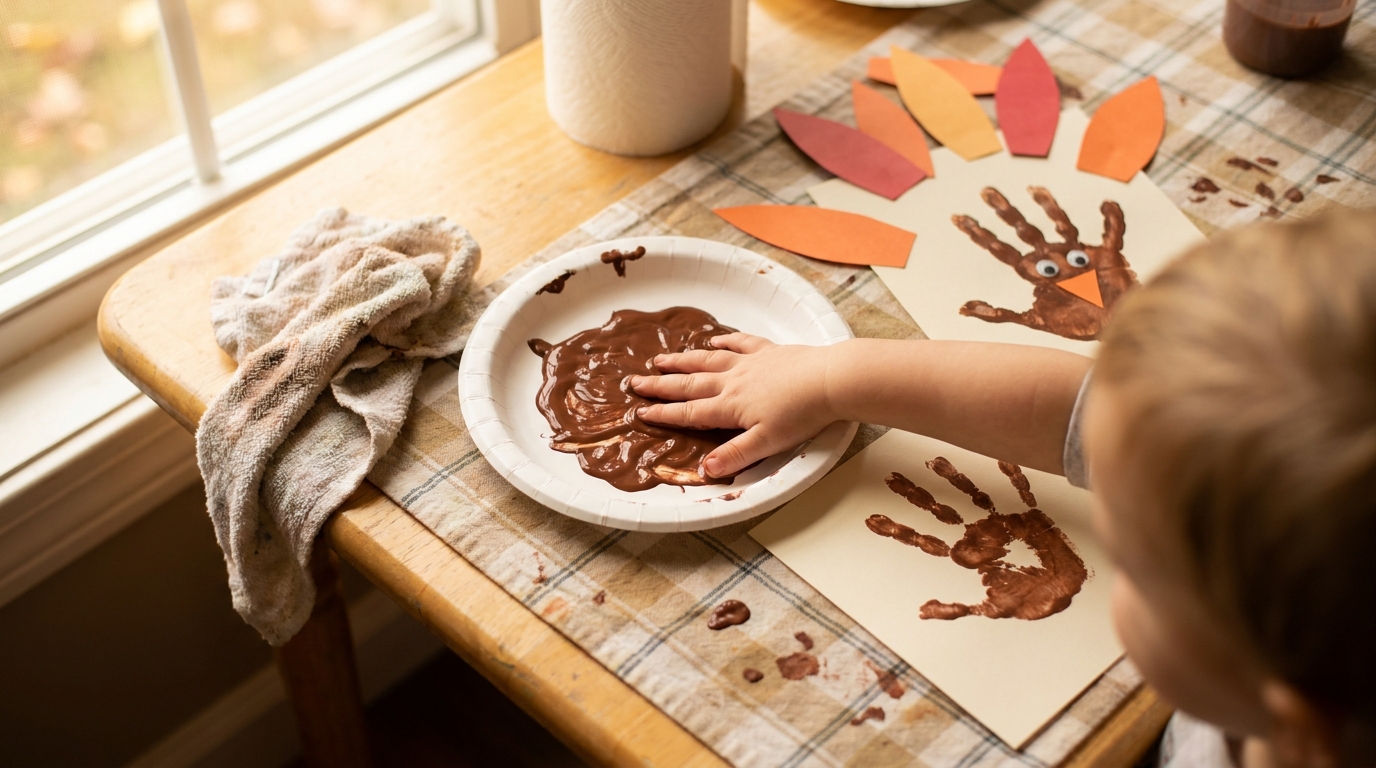
- Pour a thin, even layer of brown paint onto a paper plate. Thin matters. A thick blob means your toddler’s palm sinks in unevenly and you get a smeared, uneven turkey shape instead of a clean print.
- Have your child press their palm flat into the paint, not their whole hand slapping down. This is the part almost nobody’s toddler does on the first try. See the next section for exactly how to manage this.
- Press the painted hand firmly onto the paper, fingers spread if you can manage it (spread fingers = feathers; a closed fist just gives you a brown blob, which is also fine and can become the turkey’s body instead).
- Lift straight up. Don’t drag the hand sideways — that’s what causes the smudging everyone complains about. A clean vertical lift is 80% of getting a crisp print.
- Immediately get the hand to a wipe or sink. Don’t let your toddler “look at” the paint on their hand for even ten seconds — that’s exactly when it ends up in a mouth, hair, or on a wall.
- Once the print dries (20-30 minutes for washable tempera), add the face. Draw a small oval for the head at the base of the thumb, add two dot eyes, and a triangle beak in orange or yellow. This is the step that turns “brown handprint” into “turkey” in everyone’s eyes, including your toddler’s.
- Optional: color in the fingers. Once fully dry, some parents go back over each finger-feather with a different color marker or a dab of paint on a cotton swab — red, orange, yellow tips. This is a nice add-on for a 3-year-old who wants to keep “helping,” but totally skippable.
Turkey Craft for a 1-Year-Old
A one-year-old handprint turkey is a genuinely different project from a three-year-old one, and treating it the same way is where most of the frustration comes from. At this age, your toddler is not going to press their own palm down with intention. You are doing almost all of the mechanical work; they’re just providing the hand.
Here’s what actually works:
- Paint your child’s hand, don’t have them dip it. Use a small sponge brush or your own finger to apply a thin coat of paint directly to their palm while you hold their wrist steady with your other hand. Dipping into a plate requires a level of cooperation most one-year-olds don’t have yet, and it usually ends with a hand slapped flat into the plate itself.
- Press the print for them. Guide the painted hand down onto the paper using gentle pressure at the wrist, not the fingers. Trying to spread their fingers open is optional and often not worth the fight — a closed-fist print still makes a perfectly good little turkey blob, and you can turn it into the body with separate paper feathers glued on (cut these out ahead of time, since a one-year-old can’t help with cutting).
- Do one print per sitting. Attempting the classic multi-color “feather rainbow” — where each finger gets a different colored fan of feathers around a central print — is a 2-3 year old project. For a one-year-old, one clean brown print, face added later once dry, is the whole win.
- Expect the print to be imperfect, and that’s the actual charm of it at this age. A slightly smudged, off-center handprint from a 12-month-old is the kind of thing that becomes more valuable with every passing year, not less.
If your one-year-old is genuinely resistant to having their hand touched with a wet paintbrush (some are, and it’s a completely normal sensory response), consider a footprint turkey instead of a handprint one — same paint, same process, but pressing a foot down is often easier to manage than getting a fist to open, and a lot of one-year-olds tolerate foot painting better than hand painting since they’re not using their feet to explore or resist in the same way.
Getting a Toddler to Hold Still Long Enough
This is the actual skill of this craft, and it’s rarely written down anywhere. A few things that consistently help:
Do it during a low-energy window, not right after nap or right before a meal. The 20 minutes after breakfast, when your toddler is fed, rested, and not yet bored, is usually the highest-cooperation window in most households.
Use a second adult if you have one, even just for two minutes. One person holds the wrist steady and controls the angle of the hand; the other applies paint and manages the paper. Solo parents can absolutely still do this — it just takes a bit more setup, like propping the hand against the edge of a highchair tray for stability instead of holding it entirely with your own hand.
Narrate what’s happening, constantly, in a calm voice. “I’m going to paint your hand, then we press it down, then wipe wipe wipe.” Toddlers tolerate sensory experiences much better when they can predict what’s next. Silence, or worse, a rushed “okay now hold still,” tends to spike resistance.
Give them a job. Even a one-year-old can be handed a second paper plate to “hold” while you work, which occupies their other hand and gives them a sense of participation instead of just being a passive object having things done to them.
Try the seated-in-lap method. Sit your toddler on your lap facing away from you, table in front, and bring their arm forward from behind. This gives you far more control over the wrist and forearm than standing across a table trying to grab a moving hand, and it keeps their body more contained overall — much harder for them to twist away or reach for something else with the free hand.
Accept the “one good print” strategy. Don’t aim for five perfect handprint turkeys for five kids or five colors. Aim for one solid print, on one piece of paper, and consider the session a success. You can always do it again next year.
Troubleshooting Table: Common Handprint Turkey Problems
This is the part I wish existed before my first attempt. Here’s what actually goes wrong, and the fix that works in the moment — not after the fact.
| Problem | Why It Happens | Quick Fix |
|---|---|---|
| Print is smudged or double-printed | Hand dragged sideways on lift, or toddler pressed down twice | Lift straight up in one motion; if it smudges, let it dry and just call it an “abstract turkey” — or wipe the paper clean and try again with a fresh piece while the paint on the hand is still workable |
| Toddler won’t hold still or open their hand | Sensory resistance to wet paint, or simply not interested in cooperating right now | Try the seated-in-lap hold described above; if resistance continues, switch to a footprint version or paint the hand for them rather than asking them to dip it themselves |
| Paint got on the carpet | Paper plate tipped, or a painted hand touched the floor before you could grab it | Blot immediately with a dry paper towel — don’t rub. Follow with a damp cloth and a small amount of dish soap for washable tempera; it lifts out far more easily wet than once it sets. Acrylic paint on carpet is much harder to fully remove, another reason to avoid it for this craft |
| Paint ended up on clothing | Toddler wiped hand on shirt before you could intercept | For washable tempera, rinse under cold water immediately, then treat with a stain pre-treater and wash as usual — cold water first is key, since hot water can help set some pigments |
| Toddler tried to eat the paint | Very common under age 2 — hands go to mouths reflexively | Use only non-toxic, “AP” or “CP” labeled paint (standard for kids’ washable paint) so a small taste is not a safety concern; redirect immediately and wipe hands, and consider working near a sink so you can rinse a mouth if needed |
| Print doesn’t look like a turkey at all | Totally normal, especially under age 2 — closed fists and partial prints are the norm, not the exception | Add the face and beak once dry; a single brown oval with a face and a paper triangle beak still reads clearly as “turkey” to any adult looking at a toddler’s craft |
| Paint dried out on the plate before the print happened | Washable tempera dries fast, especially in a thin layer in a warm room | Pour paint just before you need it, not five minutes ahead; keep a small spray bottle of water nearby to re-wet the plate if there’s a delay |
Easy Variations for Different Ages
Once you’ve got the basic print down, here’s how to adjust the level of complexity so the craft actually matches what your child can (and wants to) do.
Ages 1-2: One print, added-on face.
Single handprint or footprint, paint applied by you, face and beak added once dry. This is the whole project — resist the urge to add more steps at this age. It photographs beautifully and it’s genuinely all the craft your toddler needs to feel proud of.
Ages 2-3: Multiple prints, self-directed color.
At this age, many toddlers can dip and press their own hand with some guidance, and some enjoy doing several prints in a row — a whole “flock” on one page, or a fan of feather-colored fingerprints (dip just the fingertips in different colors) around a central brown palm print. This is also the age where kids start caring about the outcome enough to want to help pick colors, which is a nice moment to hand over some control.
Ages 3+: Full participation.
Three-year-olds can often manage the whole sequence with light supervision: scooping their own paint with a small brush, pressing their own print, and helping glue on a paper beak or googly eyes once things dry. This is also a good age to introduce a bit of process art alongside the product — letting them paint extra “feathers” freehand around the print with no pressure for it to look like anything specific. If your child enjoys that kind of open-ended, no-wrong-answers painting, our process art for toddlers guide has more ideas in that direction.
A no-paint fallback for a bad day:
If your toddler is simply not in the mood for wet paint on a given afternoon — and that happens, no craft is worth a meltdown — trace their hand onto brown paper instead, cut it out together (or you cut, they “help”), and glue it onto a body shape. Same visual result, zero mess, and it’s a fine substitute rather than a downgrade.
Adding Feathers and Details Without Losing Your Mind
The temptation with any Thanksgiving craft is to add feathers, wattles, a top hat, a pilgrim collar — and there’s nothing wrong with any of that, but sequence it correctly or you’ll fight your toddler through step four while they’re already bored.
- Pre-cut everything before you start. Beak triangles, wattle shapes, feather cutouts — all cut ahead of time, before your toddler is sitting at the table. Cutting mid-craft while a toddler waits is a guaranteed meltdown trigger.
- Add details only after the paint is fully dry. Wet paint plus glued paper pieces equals a soggy mess that never quite sticks. Give it the full 20-30 minutes, or come back to it the next day — the print will still be there.
- Let your toddler place stickers or googly eyes even if the placement is “wrong.” A googly eye glued onto the turkey’s foot instead of its face is still a win at this age. Precision is not the goal.
- Consider a marker instead of glued-on pieces entirely. A permanent marker face — two dots, a triangle, a squiggly wattle line — survives far better over years of handling than glued paper, especially if this is going in a memory box rather than staying flat under glass.
For families who like to build a whole autumn craft rotation rather than a single one-off project, this pairs naturally with our fall leaf crafts roundup or our pumpkin crafts for kids guide — both make good “the week before” or “the week after” companions to a Thanksgiving handprint project, and they use a lot of the same basic paint-and-paper setup.
Cleanup: What Actually Comes Out (And What Doesn’t)
Real talk on cleanup, broken down by surface:
Skin: Washable tempera comes off with plain soap and warm water almost every time. If a bit of color lingers in nail beds or knuckle creases, a little baby oil on a cotton pad before washing helps lift it without scrubbing.
Clothing: Rinse under cold running water immediately, working from the back of the fabric to push paint out rather than through it. Then treat with a stain remover and wash normally. The window that matters most is the first ten minutes — paint that sits and dries into fabric for an hour is a much harder fight than paint rinsed right away.
Carpet: Blot, don’t rub, with a dry towel first to lift excess paint before it spreads. Follow with a cloth dampened in cool water and a drop of dish soap, working in small circles from the outside of the stain inward. Repeat as needed. This is genuinely one of the more forgiving messes with washable paint — it’s acrylic and permanent paint that create the carpet disasters people post about online, not standard kids’ washable tempera.
Table and hard surfaces: A damp cloth handles washable paint on wood, laminate, or tile with zero drama. Wipe promptly rather than letting it dry into a film, which just takes an extra minute of scrubbing instead of one wipe.
Your hands, as the adult doing most of the applying: Keep a wipe tucked into your own waistband or pocket during the whole process. You will touch more paint than your toddler does, guaranteed, and you don’t want to be the one who then touches a doorknob, phone, or your own shirt.
Keeping the Finished Turkey: Display and Storage Ideas
Once it’s dry, a handprint turkey deserves better than a fridge magnet for exactly one season (though the fridge is a perfectly fine first stop). A few ways to make it last:
- Laminate it or slip it into a plastic page protector if you want it to survive years of trotting out at Thanksgiving. Paper alone yellows and gets brittle within a couple of years.
- Photograph it before storing, with your child’s age and the date written on the back or in the photo caption. A box of handprint crafts is lovely, but a labeled digital record of “age 1, age 2, age 3” side by side is the version most parents actually go back and look at.
- Turn it into a place card or table centerpiece for Thanksgiving dinner itself — mount it on cardstock, prop it against a small stand, and it becomes part of the holiday rather than just a craft that happened before it.
- Start (or add to) a growth-chart-style keepsake book — one handprint turkey per year, same format, glued into a simple binder or scrapbook. Watching the print size change year over year ends up being more meaningful than any single year’s version on its own.
Frequently Asked Questions
What’s the best paint for a handprint turkey craft with toddlers?
Washable tempera paint, applied in a thin layer, is the best choice for both skin and fabric safety. Avoid craft-store acrylic paint entirely — it’s not designed to be washable and can stain both skin and clothing. Look for paint labeled non-toxic with an AP or CP safety seal, which is standard on children’s washable paint brands.
How do I do a turkey handprint craft with a 1-year-old who won’t hold still?
Skip asking a one-year-old to dip and press their own hand — instead, apply the paint to their palm yourself with a sponge brush while holding their wrist steady, then guide the press onto paper using pressure at the wrist rather than the fingers. Sitting them on your lap facing away from you, with their arm brought forward, gives you far more control than facing them across a table. If hand painting causes real resistance, a footprint version often works better at this age.
Will washable paint stain my toddler’s clothes?
Standard washable tempera paint very rarely causes permanent stains if you rinse it under cold water within the first several minutes. The bigger risk is letting it dry into fabric for an hour or more, or accidentally using acrylic paint instead of washable tempera, which is far more likely to set permanently.
How do I stop the handprint from smudging?
Smudging almost always comes from dragging the hand sideways when lifting it off the paper, or from a toddler pressing down more than once. Lift straight up in one clean motion, and if a smudge happens anyway, either let it dry and treat it as a fun “abstract” turkey, or quickly swap in a fresh piece of paper while the paint on the hand is still wet enough to try again.
What if my toddler refuses to touch the paint at all?
This is common and not worth forcing. Try warming up with a non-paint sensory activity first, like squishing washable paint inside a sealed zip-top bag so they can experience the texture without direct skin contact, or offer a paintbrush so they control the application themselves rather than having a hand dipped for them. You can also trace their hand with a marker as a mess-free substitute that still produces a similar keepsake shape.
How long does the paint need to dry before adding the face and feathers?
Most washable tempera paint is dry to the touch in 20-30 minutes in a thin layer, though it’s safest to wait closer to an hour before adding glued-on details like a paper beak or googly eyes, since those need a fully dry, non-tacky surface to stick well.
Is a handprint turkey craft appropriate for a 1-year-old, or is that too young?
One year old is a perfectly reasonable age to start, as long as expectations are adjusted — the parent does most of the mechanical work (applying paint, guiding the press), and a single, possibly closed-fist print is a complete success at this age. It’s less about the child executing the craft and more about capturing a handprint from that exact age, which is the part most families actually value later.
A Slightly Messy Tradition Worth Keeping
However this one turns out — crisp feathers and a perfect little beak, or a lopsided brown smudge that needs a lot of imagination to read as “turkey” — it’s going to be exactly right for the toddler you have this year. Keep a wipe within reach, keep your expectations low and your camera ready, and let the actual craft take the fifteen distracted, paint-smeared minutes it’s going to take. Next November, you’ll have a slightly bigger hand to compare it to.