Last-Minute Halloween Costumes for Toddlers Using Home Items
This post contains affiliate links. As an Amazon Associate I earn from qualifying purchases.
Two Octobers ago, I ordered my son a dinosaur costume in July. July. I was so proud of myself. Then the package sat in “pending shipment” purgatory for six weeks, arrived on November 3rd (four days after Halloween, in a box that had clearly been kicked down at least one flight of stairs), and I spent the morning of October 31st standing in his closet in a mild panic with a two-year-old tugging at my leg asking why he wasn’t a “dino guy” yet.
What actually happened next is the reason this article exists. I grabbed his green footie pajamas, cut jagged triangle spikes out of an empty cereal box, taped them down his back with painter’s tape, and drew scales on his cheeks with a washable face crayon we already owned. Eight minutes, tops. He looked ridiculous and perfect. He also never once complained about a costume being too tight, too itchy, or too warm — because it was pajamas with cardboard on them, and pajamas are, definitionally, comfortable.
That’s the whole secret to last-minute Halloween costumes for toddlers: the ones you build from stuff already in your house are frequently better than the store-bought version, because they fit your actual kid, in their actual size, made from fabric they already tolerate. No scratchy polyester. No mystery growth spurt that makes a 2T costume suddenly a 3T problem the day before Halloween.
This article is a working list, not inspiration-board fluff. Below you’ll find a closet-raid table with 12 real costumes, each built from three household items you almost certainly already own, with a five-minute assembly note so you know exactly what to do with them. No sewing machine, no glue gun required (though I’ll flag where a glue gun speeds things up if you happen to have one warmed up), and no trip to the store. Just a toddler, a pile of stuff from around the house, and about ten minutes you didn’t think you had.
In this article (10 sections)
- Why Last-Minute Doesn’t Mean Low-Effort
- How to Use the Closet-Raid Method
- The Closet-Raid Table: 12 No-Sew Costumes From What’s Already in Your House
- No-Sew Tricks That Actually Hold Up on a Toddler
- Room-by-Room: Where to Find Costume Pieces Fast
- Safety First: What to Skip When You’re Rushing
- Matching Costumes for Siblings (Or You)
- When They Refuse to Wear It: A Real Backup Plan
- Frequently Asked Questions
- One Last Thing
Why Last-Minute Doesn’t Mean Low-Effort
There’s a quiet assumption baked into most Halloween costume content: that “last minute” is a consolation prize, a lesser version of the costume you would have made if you’d planned better. I want to push back on that, because in my experience with toddlers specifically, last-minute home-item costumes usually win.
Here’s why. A toddler between one and four years old does not care about costume accuracy. They care about three things: can I move my arms, is it itchy, and can I still get my hands into my pumpkin bucket. A $35 licensed costume from the store checks none of those boxes reliably — the zippers snag, the fabric is stiff enough to stand up on its own, and half of them come with a matching headpiece that’s in the trash by the second driveway.
A costume built from your kid’s own soft leggings, an old flannel shirt, or their favorite gray sweatsuit checks all three boxes automatically, because it’s clothing they already wear and already tolerate. You’re not fighting a new costume; you’re accessorizing an old outfit. That distinction matters enormously for the 1-4 age range, where the single biggest costume failure mode isn’t “it doesn’t look good” — it’s “they refuse to put it on, or take it off four minutes after leaving the house.”
So when you’re searching for easy toddler costume ideas at 9pm the night before, or scrambling the morning of a daycare parade, know that you’re not settling. You’re accidentally doing the thing that actually works best for this age group.
How to Use the Closet-Raid Method
Before the table, three quick ground rules that make this whole approach work, especially if you’re moving fast:
Start with what they’re already wearing, not what you wish you had. If your toddler is already dressed in gray sweatpants and a white shirt, don’t fight that — look at the table below for a costume that starts with gray or white (ghost, sheep, astronaut) instead of hunting for the “perfect” base outfit buried in a drawer somewhere.
Pick costumes that don’t require anything near the face. No masks, no full-head coverings, nothing that limits their vision or breathing. Every costume in the table below is designed to be worn with a completely open, unobstructed face — partly for safety, partly because a toddler will physically fight you over anything covering their eyes or nose within about ninety seconds.
Test the “walk to the mailbox” rule. If you can’t picture your toddler walking to the end of the driveway and back in the costume without you adjusting it three times, simplify it further. The best last-minute costume is the one that survives contact with an actual toddler, not the one that looks best sitting still on a hanger.
With those three rules in mind, here’s the list.
The Closet-Raid Table: 12 No-Sew Costumes From What’s Already in Your House
Each of these uses exactly three items most households have on hand, and each one comes together in five minutes or less — no needle, no sewing machine, and in most cases, no glue gun (I’ve flagged the two where a glue gun helps but isn’t required).
| Costume | 3 Household Items | 5-Minute Assembly |
|---|---|---|
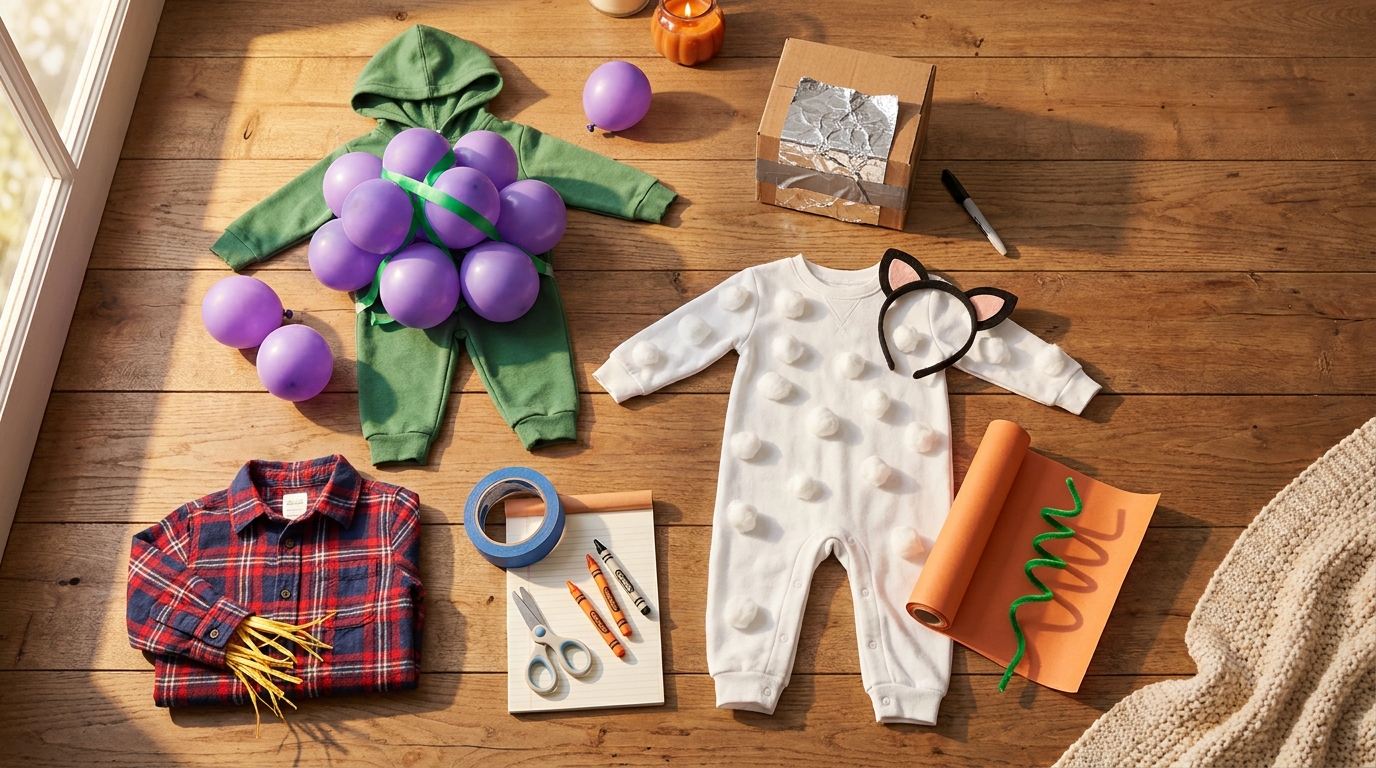
| Bunch of Grapes | Purple balloons, safety pins (or painter’s tape), green shirt or leggings | Blow up 8-10 balloons, pin or tape them in a cluster to the front of a green shirt. Twist a green pipe cleaner into a leaf shape and tape it to a plain headband for the “stem.” |
| Cardboard Box Robot | Medium cardboard box, aluminum foil, marker | Cut head and arm holes in the box. Wrap the outside in foil (tape the edges down). Draw buttons and a control panel with a marker. Skip the head box — a foil-covered headband with pipe-cleaner antennae reads as “robot” without blocking their view. |
| Cozy Little Lamb | White sweatsuit, cotton balls, black headband | Tape or safety-pin cotton balls in clusters across the front of a white sweatsuit — you don’t need full coverage, just enough to read as fluffy. Clip two black felt ovals (cut from an old sock or shirt) to a headband for ears. |
| Bag of Jelly Beans | Clear trash bag, balloons in mixed colors, ribbon | Cut a head hole and two arm holes in the bottom of a large clear trash bag. Loosely fill with 10-15 un-inflated or lightly-inflated balloons before your toddler steps in. Cinch the top gently around their shoulders with ribbon — not tight, just enough to keep balloons from spilling out. |
| Paper Bag Pumpkin | Orange shirt (or a grocery bag), green pipe cleaner, black marker | If using a shirt: draw pumpkin ridges down the front with a marker and skip the bag entirely — it’s faster and doesn’t limit arm movement. Twist a green pipe cleaner into a curly stem and tape it to a headband. |
| Superhero with Cape | Old pillowcase or hand towel, ribbon or hair tie, favorite colored shirt | Cut the two bottom corners off a pillowcase to round them. Tie ribbon loosely around the neck (never knot it tight — a breakaway loop is safest). Let them wear whatever shirt matches the cape color; add a felt or paper letter taped to the chest if you want a logo. |
| Friendly Ghost | White oversized adult t-shirt, black felt scraps, fabric or hot glue | Slip the white shirt over their regular clothes like a dress — no cutting eye holes, no covering the face. Glue or tape two black felt circles and an oval to the front for the classic ghost eyes-and-mouth, positioned on the chest, not the face. |
| Cat or Puppy | Black or brown sweatsuit, felt scraps, washable face crayon | Cut two triangle ears from felt and safety-pin or glue them to a plain headband. Use a washable face crayon (not permanent marker) to draw a small nose and three whiskers on each cheek. |
| Construction Worker | Old flannel shirt or dad’s t-shirt, toy tool belt (or ribbon with taped-on toy tools), paper hat | Roll the sleeves of an oversized shirt up to fit. Tie a ribbon around the waist and tape a couple of toy tools to it, or use an actual toy tool belt if you have one lying around. A folded newspaper or brown paper hat completes it in under a minute. |
| Scarecrow | Flannel shirt, yellow yarn or raffia, straw hat (or any wide-brim hat) | Stuff bits of yellow yarn or raffia into the cuffs and collar of a flannel shirt so it peeks out. Add suspenders made from ribbon if you have them, and top with any hat you own — a sun hat works fine. |
| Astronaut | White sweatsuit, silver duct tape, foil-covered headband | Run a few strips of silver duct tape across the chest and down the sleeves of a white sweatsuit for a “spacesuit” look. Cover a soft headband in foil for a helmet-adjacent detail without anything near the face or ears. |
| Busy Bee | Yellow shirt or onesie, black electrical tape, pipe cleaners | Wrap 3-4 strips of black electrical tape around a yellow shirt to create stripes. Twist two pipe cleaners into loops and tape them to a headband for antennae. |
A few notes on that table before you dive in: every costume above skips face coverings entirely, which matters more than it might seem — more on that in the safety section below. And if you want more no-sew accessory ideas beyond what’s listed here, our No-Sew Felt Crafts for Toddlers roundup has a dozen glue-only ear, wing, and tail patterns that pair well with any of the animal costumes above.
No-Sew Tricks That Actually Hold Up on a Toddler
The phrase “diy toddler halloween costume no sew” gets searched a lot, and for good reason — most parents reaching for a last-minute costume do not own, or do not have time to dig out, a sewing machine. The good news is that no-sew doesn’t mean flimsy, as long as you match the right fastening method to the job.
Here’s what actually holds up under toddler-level physical activity, versus what looks fine in a photo and falls apart by the second house:
| Fastening Method | Best For | Toddler-Proof? |
|---|---|---|
| Safety pins | Balloons, felt shapes, light fabric pieces | Yes, if pinned through two layers and positioned away from where hands and mouths reach |
| Painter’s tape or duct tape | Cardboard, felt, paper accents on shirts | Yes, and painter’s tape peels off skin and fabric without residue |
| Fabric glue or hot glue gun | Permanent attachments like ears on a headband, felt eyes on a shirt | Yes, but let it cool/dry fully before your toddler touches it — hot glue stays warm longer than you’d think |
| Velcro dots | Anything you’ll want to remove quickly (a cape, a belt) | Yes, and it’s the fastest one-handed option if your toddler is already mid-meltdown |
| Ribbon or hair ties | Loosely tying a cape, cinching a waist | Yes, as long as it’s a loop, never a tight double knot a toddler could get stuck in |
The rule of thumb I use: anything touching skin gets tape or a loose tie, and anything decorative but not load-bearing (a felt shape, a paper accent) gets pinned or glued to fabric, never directly to the child. If you’re building an animal costume with ears, tails, or wings, a headband or waistband is always the safer mounting point than the garment itself, because it comes off in one motion if your toddler decides four minutes in that they hate it.
For Ages 1-2 vs. Ages 3-4
The no-sew approach shifts slightly depending on where your toddler falls in that 1-4 range. For one- and two-year-olds, skip anything with small detachable pieces entirely — balloon costumes, loose pipe cleaner antennae, and small felt shapes are choking hazards for a kid who still investigates the world by mouth. Stick to costumes built entirely from clothing plus tape or marker: the ghost, the scarecrow, and the cat (minus any small felt pieces — just the drawn-on whiskers) are your safest bets.
For three- and four-year-olds, you have more room to work with. They can typically wear a balloon-based costume, tolerate a headband with attached ears, and even help with the assembly, which — fair warning — will roughly triple your assembly time but is genuinely a fun ten minutes if you’re not racing the clock.
Room-by-Room: Where to Find Costume Pieces Fast
If you’re standing in the middle of your house wondering where a toddler costume from things at home is actually going to come from, it helps to think room by room instead of staring blankly at a closet. Here’s where the good stuff usually is:
The linen closet and dresser drawers. White and gray sweatsuits, oversized adult t-shirts, old flannel shirts, plain headbands, and mismatched socks (great for stuffing sleeves for the scarecrow). This is your base-layer source for almost every costume in the table above.
The kitchen junk drawer and pantry. Rubber bands, twist ties, painter’s tape, a marker that still works, and — if you’re building the jelly bean or grape costume — the box of balloons left over from the last birthday party.
The recycling bin. Cereal boxes for spikes or robot panels, a cardboard shipping box for the robot costume, and aluminum foil from the kitchen drawer next to it. Our Cardboard Box Crafts for Kids collection has more ways to repurpose a box beyond the robot costume above if your toddler ends up loving theirs and wants a matching prop or accessory.
The garage or laundry room. A wide-brim sun hat for the scarecrow, an old work shirt for the construction worker, and duct tape, which shows up in nearly every household’s junk drawer or toolbox and works for at least four of the costumes above.
A sibling’s or your own closet. Adult t-shirts make excellent oversized “dress” costumes for the ghost and can be knotted or safety-pinned to the right length in seconds. An older sibling’s outgrown hat or scarf works the same way.
If your toddler’s costume ends up being Halloween-adjacent rather than Halloween-specific — say, a pumpkin shirt from last year that still fits, worn with this year’s stem headband — that’s not a failure of the method, that’s the method working exactly as intended. For more pumpkin-specific project ideas that pair naturally with the pumpkin costume above (think a matching trick-or-treat bucket or porch decor), check out Pumpkin Crafts for Kids.
Safety First: What to Skip When You’re Rushing
This is the section I’d ask you not to skim, even though it’s tempting when you’re in a hurry. Toddlers between one and four have specific vulnerabilities that a rushed costume decision can bump right into, and none of the fixes take extra time — they’re mostly about what not to add.
Skip anything over the face. No masks, no hoods that pull down over the eyes, no full-head coverage of any kind. Beyond the obvious tripping and visibility risk, a mask restricts a toddler’s breathing more than adults tend to expect, and every costume in the table above is built specifically to avoid this by keeping decorative elements on the chest, a headband, or a waistband instead.
Watch drawstrings and long ties. Anything tied around the neck — including the superhero cape above — should be a loose loop with breakaway-style tension, not a tight knot. If you can slide two fingers under it easily, it’s loose enough.
Skip small, detachable pieces for the youngest toddlers. As mentioned above, balloons, loose pipe cleaners, and small felt shapes are a choking risk for one- and two-year-olds who mouth objects. Build their costume from clothing, tape, and marker instead.
Use washable, kid-safe face crayons only — and only for cheeks, never eyes. If a costume calls for whiskers or a nose (the cat costume, for instance), reach for a washable face crayon marketed for kids, not a regular marker, and keep it well away from the eye area.
Think about layering before you think about looks. If it’s cold where you are, the best costume is the one that fits comfortably over a long-sleeve base layer, not the one that requires bare arms. Nearly every costume in the table above — the lamb, the astronaut, the scarecrow, the construction worker — works fine layered over a warm shirt underneath, since they’re built from oversized or loose-fitting pieces to begin with.
Check for tripping hazards at toddler height. A cape that drags on the ground, an oversized shirt worn as a dress with the hem too long, or a hat brim that flops into their eyes are all things a toddler will trip over or yank at within minutes. When in doubt, roll it, cuff it, or trim it shorter than looks “right” in a photo — comfort and mobility beat perfect proportions every time at this age.
Matching Costumes for Siblings (Or You)
If you’ve got more than one small kid, or a toddler who wants “the same as” their older sibling or a parent, the closet-raid method scales sideways easily, because most of these costumes are really just a base color plus a repeatable accessory.
A few combinations that work well from the same small pile of supplies:
- Two bunches of grapes in slightly different shades of purple and green, from one bag of assorted balloons — no need to match exactly, siblings rarely mind.
- Farmer and scarecrow, both built from flannel shirts and straw hats, distinguished only by whether the yarn is stuffed in the sleeves (scarecrow) or left out (farmer with a bandana instead).
- A litter of cats and puppies, using the same headband-and-ear method but different ear shapes (pointed for cat, floppy for puppy) and different washable-crayon markings.
- A parent and toddler construction crew, since the flannel-shirt-plus-tool-belt combination works at any size and requires zero adjustment beyond finding a smaller shirt.
- A whole hive of bees, if you happen to have more than one yellow shirt in the house — a genuinely fast option for twins or close-in-age siblings.
The advantage of matching from the same materials isn’t just cuteness for photos — it also means you’re not doubling your prep time. Cut the felt ears for both kids at once, blow up all the balloons in one batch, and you’ve effectively built two costumes in barely more time than one.
When They Refuse to Wear It: A Real Backup Plan
I’d be doing you a disservice if I ended this article pretending every toddler cooperates with a costume plan. Somewhere between finishing the ears and getting out the door, a real number of toddlers decide — passionately, immediately, non-negotiably — that they will not be wearing the thing you just made. This is developmentally normal, deeply inconvenient, and worth planning for rather than being surprised by.
A few things that actually help in the moment:
Let them wear it as a “cape” or accessory instead of the full costume. A ghost shirt refused as a dress can often be accepted draped over the shoulders like a cape instead. Flexibility on how it’s worn beats insisting on the original plan.
Put it on you first, or on a stuffed animal, and let them watch. Toddlers frequently need to see something modeled as safe and fun before trying it themselves — thirty seconds of you wearing the headband ears is often the fastest way past a refusal.
Have a one-piece fallback ready. If the layered costume gets rejected entirely, the single-item version — just the ears on a headband, just the cape, just the face-crayon whiskers — often gets accepted because it’s a smaller ask. A toddler in their regular clothes with cat whiskers drawn on is still, unmistakably, a cat.
Accept the compromise and move on. If it’s five minutes before you need to leave and the costume is a full no, that’s fine. A toddler in a favorite outfit having a good time beats a toddler in a costume having a miserable one, every single time, and nobody at the door handing out candy is grading your effort.
If costume resistance is a recurring theme in your house (it often is, especially with new textures or anything worn on the head), it can help to build some low-stakes practice into the days leading up to Halloween — even a few minutes of dress-up play with the same headband or shirt a day or two ahead gives them a chance to get used to it before the actual event. And if you’re looking for other low-mess, high-engagement projects to fill the runway to Halloween, our Halloween Crafts for Kids: 20 Non-Scary Projects roundup has plenty of options that double as gentle costume-adjacent practice — decorating a pumpkin shirt, making paper ears to wear around the house, that kind of thing.
Frequently Asked Questions
What’s the fastest Halloween costume for a toddler using stuff I already have?
The ghost (an oversized white t-shirt worn as a dress, with felt eyes glued on the chest) and the scarecrow (a flannel shirt with yarn stuffed in the cuffs) are the two fastest options in this list — both can be fully assembled in about three minutes with items nearly every household already has on hand.
How do I make a no-sew toddler costume that will actually survive a night of trick-or-treating?
Match your fastening method to the job: use tape or safety pins for anything on fabric, and mount decorative pieces like ears or wings on a headband or waistband rather than directly on the child’s clothing. That way, if a piece comes loose, it’s easy to reattach or remove entirely without unraveling the whole costume.
What age is too young for a Halloween costume?
There’s no strict cutoff, but for babies and young one-year-olds, keep it extremely simple — a themed onesie or a single accessory like animal ears on a soft headband is plenty. Skip anything with small parts, tight elastic, or anything covering the face at any age under two or three.
Are masks safe for toddlers on Halloween?
Generally, no — full-face masks restrict breathing and vision more than most parents expect, and they’re one of the top reasons toddlers refuse or fight a costume outright. Every costume in this article is designed to avoid the face entirely, using headbands, drawn-on details, and chest-level decoration instead.
How do I keep my toddler’s costume warm enough for cold-weather trick-or-treating?
Choose costumes built on loose or oversized layers — the lamb, astronaut, scarecrow, and construction worker options all work comfortably over a long-sleeve shirt and leggings underneath. Avoid costumes with balloons or bulky attachments if you’ll also need a winter coat on top, since coats and balloons don’t mix well.
What if my toddler refuses to wear their costume?
Offer a scaled-down version — just the headband, just the cape, just the drawn-on details — since a smaller ask is often accepted where the full costume was refused. And if they still say no, let it go; a happy toddler in their regular clothes is a better Halloween outcome than a miserable one in a costume nobody’s grading.
Can I make matching costumes for two kids from the same materials?
Yes — costumes like the bunch of grapes, the cat-and-puppy pair, and the farmer-and-scarecrow combo all scale easily from one shared pile of supplies (one bag of balloons, one flannel shirt each, a shared roll of felt), and prepping both at once usually takes barely longer than making just one.
One Last Thing
If you take nothing else from this list, take this: the costume that gets made in ten rushed minutes from stuff you already own is not the backup plan. For a toddler, it’s very often the actual best option — comfortable, familiar, and built to survive real contact with a real kid who mostly just wants to get to the candy part. Grab whatever’s closest, tape it on, and go have a good, slightly chaotic night.