Fall Scavenger Hunt Printable for Toddlers (Leaves & Acorns)
Discover how to create and run a simple, picture-based fall scavenger hunt for your toddler (ages 2-4) using leaves and acorns, ensuring safety and fun. You'll learn how to make picture-clue cards and manage the activity.
- Use picture-clue cards for toddlers who can't read.
- Limit hunts to fall items like leaves and acorns for better toddler focus.
- Prioritize safety: point-and-show for small items (acorns) for kids under 4.
- Keep hunts short (10-25 min) and simple to ensure toddler success.
- Download or hand-draw picture clue cards for easy setup.
This post contains affiliate links. As an Amazon Associate I earn from qualifying purchases.
Last October I handed my three-year-old a paper lunch bag. Four minutes later she sat in the driveway with one leaf, announcing she was done. Toddlers can’t read a list, so I rebuilt our hunt around pictures: one card, one picture per find, fall items only.
Here’s what this post covers: the picture-clue card, how to run it, leaf and acorn versions, age adjustments, and safety. Bring a wet wipe, because the outdoors comes home with you.
Safety firstAcorns, caps, small rocks, twigs and pinecone scales are choking hazards for every child under 4, so an adult stays within arm’s reach. Scan first for poison ivy and sumac (“leaves of three, let it be”). If a child swallows acorn pieces, a mushroom, a berry or an unknown plant, call Poison Control at 1-800-222-1222 (US) or the pediatrician right away. Don’t wait for symptoms.
In this article (14 sections)
- Why a Fall-Only Hunt Works So Well for Toddlers
- The Picture-Clue Hunt Card
- How to Run the Hunt Without It Falling Apart
- The Leaf Scavenger Hunt: Matching Colors and Shapes
- The Acorn Scavenger Hunt for Preschoolers
- Advanced Fall Scavenger Hunt Card for Ages 3-4
- Adjusting the Hunt by Age
- What to Bring (and What to Expect Mess-Wise)
- What to Do With Your Finds Afterward
- Making the Hunt Last: Variations for the Whole Season
- Turning the Hunt Into a Party or Playdate Game
- Ground Rules for Toddler Hunts
- Frequently Asked Questions
- Start Your Fall Hunt
Why a Fall-Only Hunt Works So Well for Toddlers
If you’ve ever tried a general nature hunt with a toddler, you know the problem is too much stuff. A summer yard is a hundred shades of green with a few flowers. There’s nothing to anchor on.
Fall fixes this. In October, the outdoors goes high-contrast. Leaves turn bright and become easy to spot against grass. Acorns sit like tiny brown jewels on pavement. Everything is on the ground, right at toddler height, ready to be grabbed. You don’t have to ask your child to look up or squint at something far away. The whole hunt happens between knee and ankle.
A few other reasons this season is the sweet spot:
- Color is the easiest clue. Color matching is an early skill toddlers enjoy, and matching is easier than naming. “Find a red leaf” is a clue a two-year-old can win.
- It’s sensory without a setup. Crunching, rustling, scooping, and sniffing are built in, and finds are free and plentiful.
- Failure is nearly impossible. If the card says “yellow leaf” and your kid brings you a brown one, you celebrate and say, “Ooh, that’s a brown leaf! Let’s look for the yellow one next.” Nobody loses.
- It’s short. Plan on 10 to 25 minutes, which fits before-dinner, after-nap, and “we need to leave the house or I’ll scream” windows.
If you already have the more general backyard scavenger hunt in your rotation, think of this as its autumn cousin. It’s narrower on purpose. A smaller list means more wins per minute, and wins are what keep a toddler walking.
The Picture-Clue Hunt Card
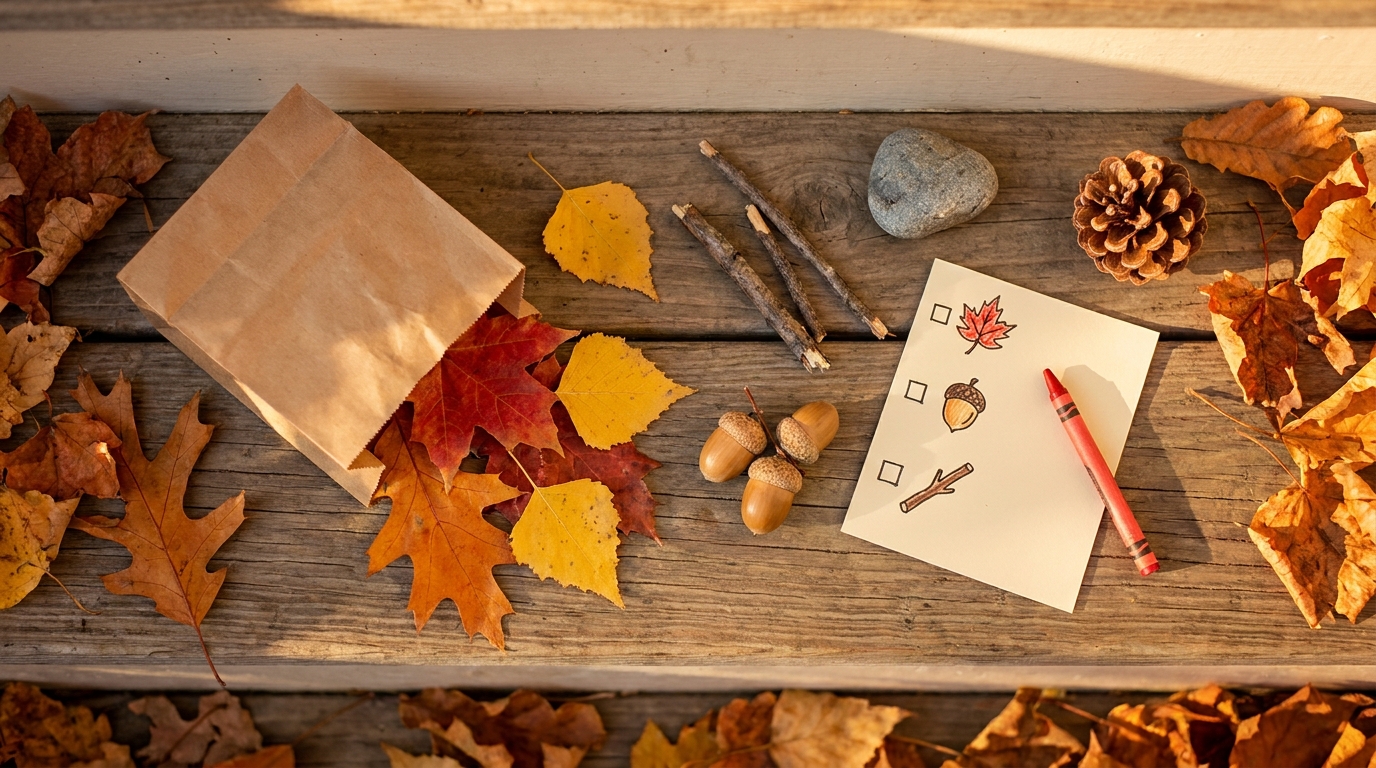
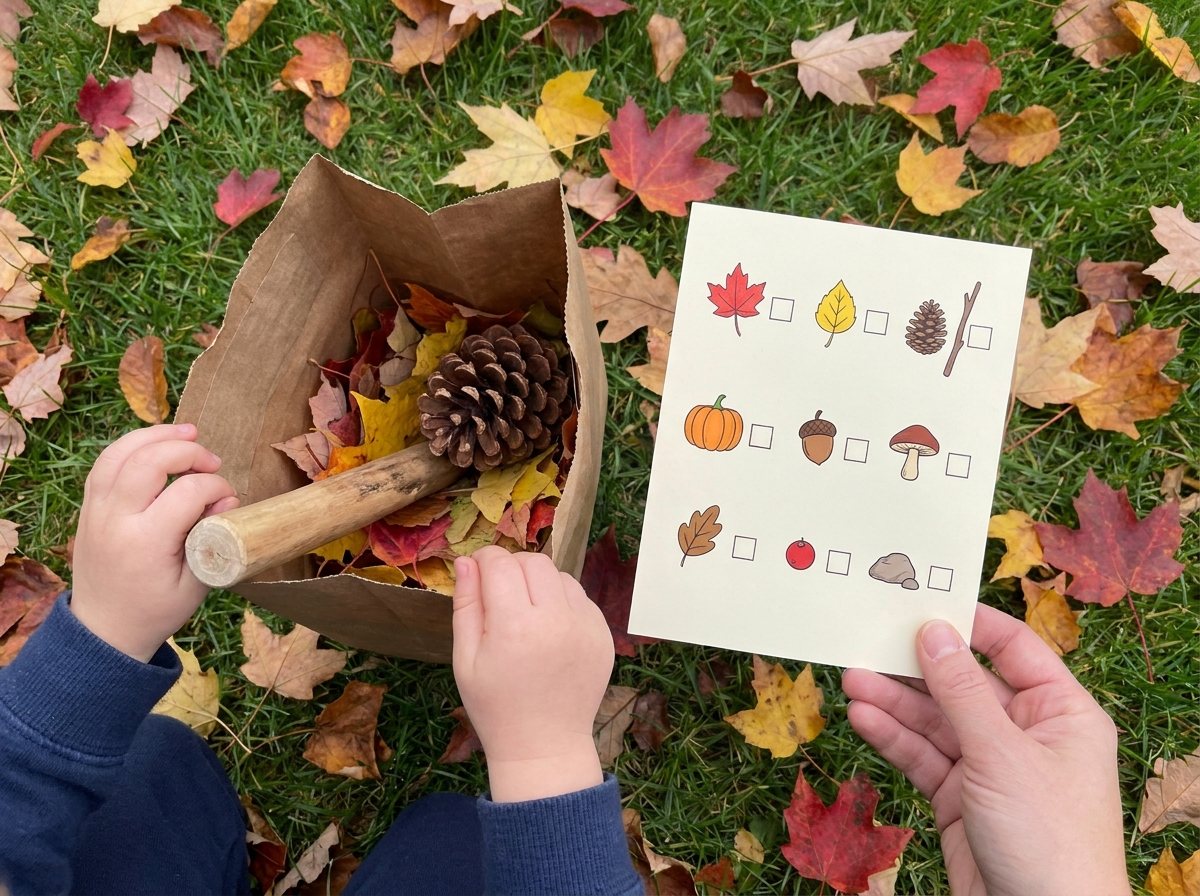
This is the heart of the whole post. The card has ten finds, each with a picture clue and a tick box. No reading required: the picture is the clue. You’ll show your toddler the picture, say the word out loud, and let them go find the real thing.
How to use it
Download and print the card above, then clip it to a lanyard so your hands stay free. The printable has real illustrations; the emoji table below is a quick reference. No printer? Hand-draw the ten icons on an index card with a fat marker. Stick-figure quality is fine, because your toddler will not grade your art.
Safety firstFor children under 4, acorns, caps and pinecones are point-and-show finds. Your child points, and an adult picks the item up and carries it. Nothing small goes in your child’s hands or mouth.
Fall Picture-Clue Hunt Card (Ages 2.5-3)
| ✔ | Picture Clue | Say It Out Loud | What the Real Thing Looks Like |
|---|---|---|---|
| ☐ | 🍂 | Brown leaf | Crunchy, dry, any shade of brown |
| ☐ | 🍁 | Red leaf | Bright red or deep maroon. Adult hand-picks from maples or the ground, away from vines. |
| ☐ | 🟡 | Yellow leaf | Sunny yellow, often a birch or aspen leaf |
| ☐ | 🟠 | Orange leaf | Pumpkin orange, often a mix of colors |
| ☐ | 🌰 | Acorn | Smooth, tan or brown, with or without its cap. Point and show; an adult carries it. |
| ☐ | 🧢 (a little hat) | Acorn cap | The little scratchy hat, like a tiny bowl. Point and show; an adult carries it. |
| ☐ | 🪵 | Big stick | Sturdy and longer than your child’s forearm, with no sharp or broken ends. An adult checks it first. Small twigs stay on the ground. |
| ☐ | 🪨 | Smooth rock | Bigger than your child’s fist, too large to swallow, smooth and cool |
| ☐ | 🌲 | Large pinecone | Bigger than your child’s fist, closed or open. Nothing gets broken off, and no loose scales go in the bag. |
| ☐ | 🎃 | Pumpkin | Spotted on a porch or in a garden (look, don’t pick) |
A few notes on how this card is built:
- The first four finds are all leaves, on purpose. Early success builds momentum. Leaves are the most abundant and easiest to find, so your child gets four quick wins before the harder stuff.
- The pumpkin is a “spotting” find. Toddlers can’t carry a pumpkin, and a neighbor’s porch pumpkin is not up for grabs. It teaches the difference between “things we collect” and “things we only look at.”
- Acorn and acorn cap are separate finds because for toddlers, finding the cap without the nut is exactly as thrilling as finding the nut.
- No item requires a specific tree. You don’t need to be a botanist. Whatever fall has dropped near you counts.
A Shorter Card for Two-Year-Olds
For ages 2 to 2.5, ten items is too many. Cut it down to five:
| ✔ | Picture Clue | Say It Out Loud |
|---|---|---|
| ☐ | 🍂 | Brown leaf |
| ☐ | 🍁 | Red leaf |
| ☐ | 🌰 | Acorn |
| ☐ | 🪵 | Big stick |
| ☐ | 🌲 | Large pinecone |
That’s it. Five finds, one bag, done in ten minutes. Honestly, if your two-year-old finds three of five and wants to stomp in the leaf pile for the rest of the time, the hunt was a success.
How to Run the Hunt Without It Falling Apart
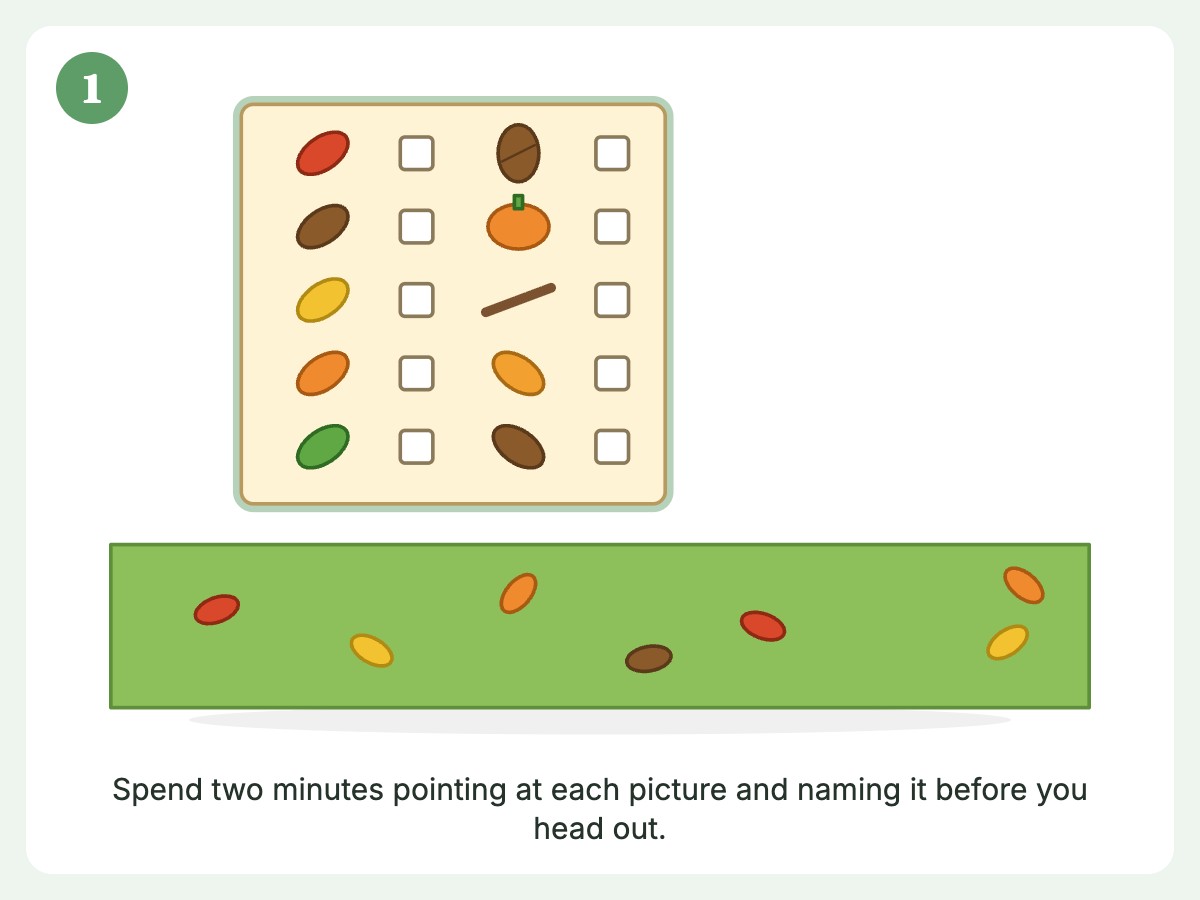
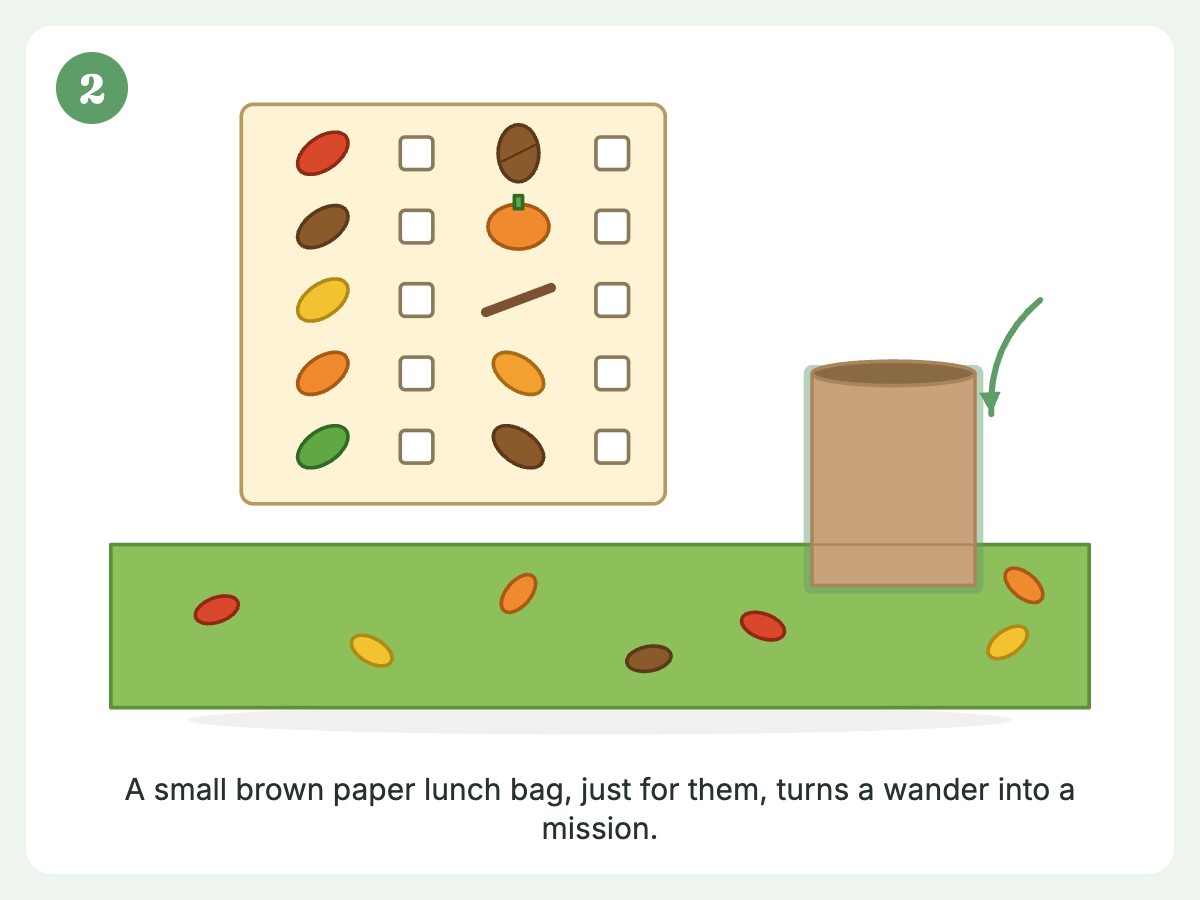
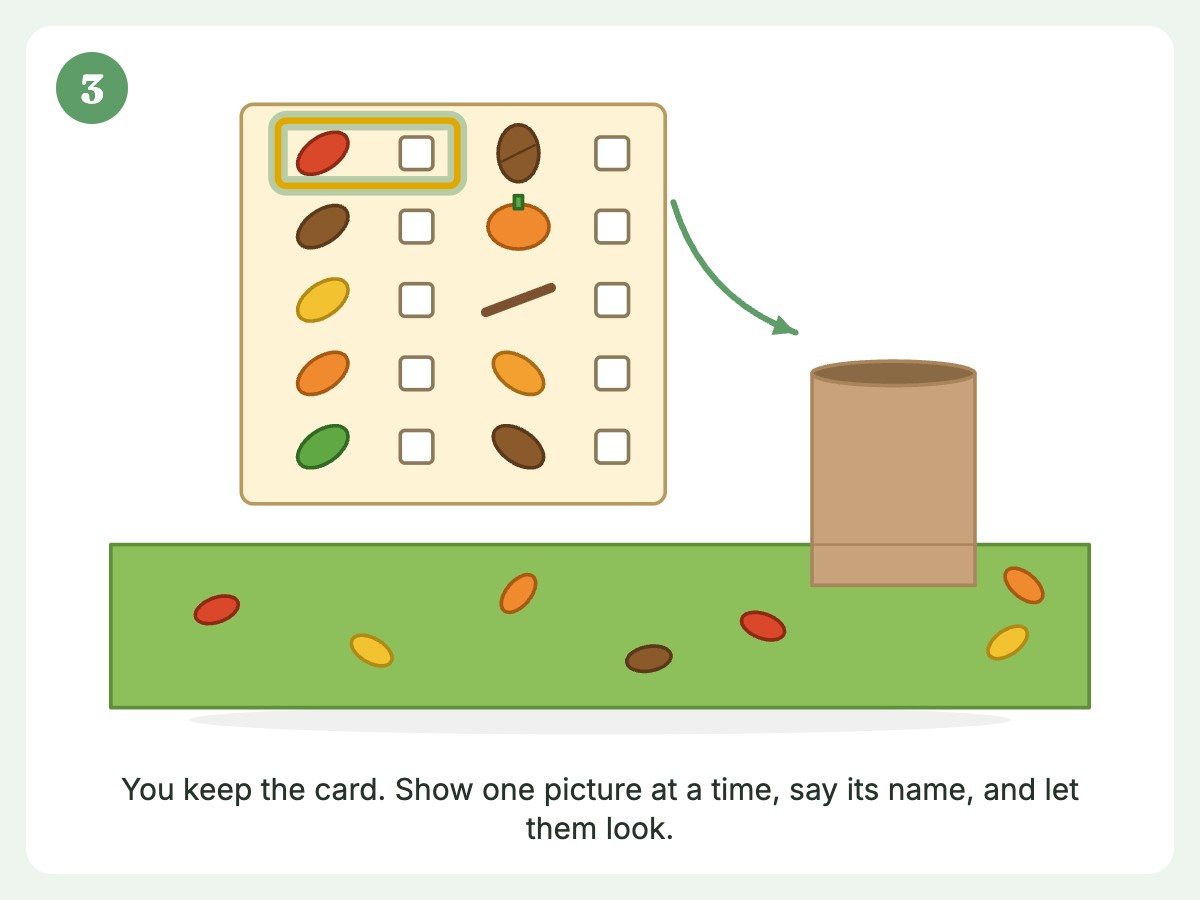
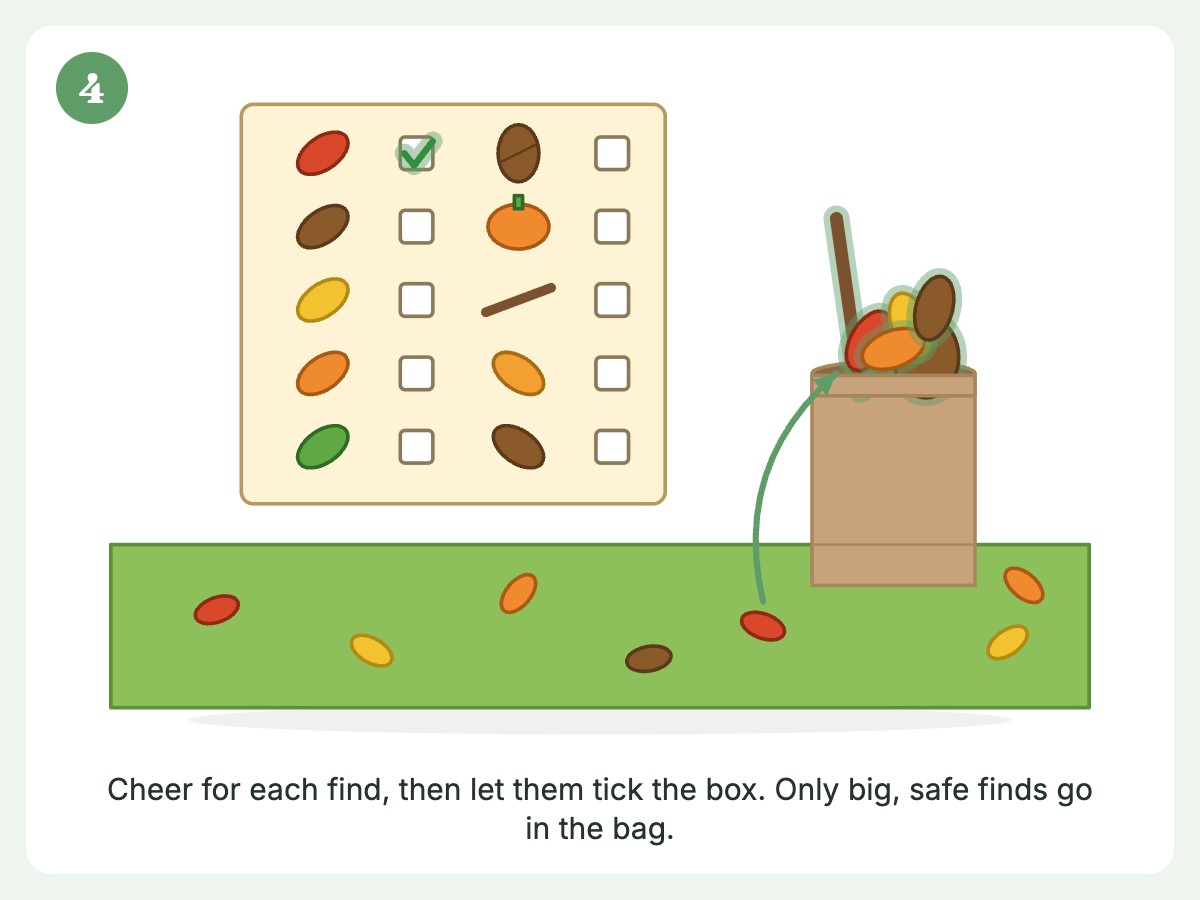
Here’s the part nobody tells you: the card matters less than your delivery. A scavenger hunt for a toddler is basically a game of “I’ll show you a picture, you point at the real world.” Here’s the flow that’s worked for us.
Step 1: Show the card first, before leaving the house
Spend two minutes on the couch or porch showing each picture. Point and name: “Look, a red leaf! Acorn! Stick!” Toddlers do better when they’ve previewed the clues. It’s the same reason they ask for the same book forty times.
Step 2: Give them their own bag
A paper lunch bag, a small tote, or an old pail. Having their own container matters enormously. It turns a vague wander into a mission. If you have two kids, give them separate bags so there’s no negotiating over who found the better acorn.
Step 3: Hold the card, not the pencil
At this age, you’re the card keeper. Your toddler is the finder. Walk slowly, hold up one picture at a time, and say, “Can you find a red leaf?” Don’t read the whole list aloud. One clue at a time is plenty.
Step 4: Celebrate and tick
When they bring over a find, make a big deal. Then let them put a sticker or a fat crayon mark in the tick box (or, if you’re running this off your phone, just say “check!” loudly and hold up a high five). The tick is the reward. It sounds small, but toddlers love finishing things.
Step 5: Let the detours happen
If your kid finds a worm, a snail shell, or the most interesting puddle of all time, follow it. Nature hunts are supposed to stretch. The card is a starting point, and you can always get back to it. Or not.
What if they find the “wrong” thing?
This happens constantly. You ask for an acorn and get a rock. Don’t correct. Instead try: “That’s a cool rock! Rock goes in the bag. Now let’s find an acorn, they look like this.” Show the picture again. Toddlers learn category boundaries slowly, and every near-miss is practice. Tiny pebbles go back on the ground, and only big rocks (bigger than a fist) go in the bag.
The Leaf Scavenger Hunt: Matching Colors and Shapes
A leaf scavenger hunt for kids is the easiest fall activity in existence, because leaves come pre-sorted by color and are stuck in every yard, sidewalk crack, and parking lot. For toddlers, we use leaves for two skills: color matching and shape noticing.
The color-match leaf hunt
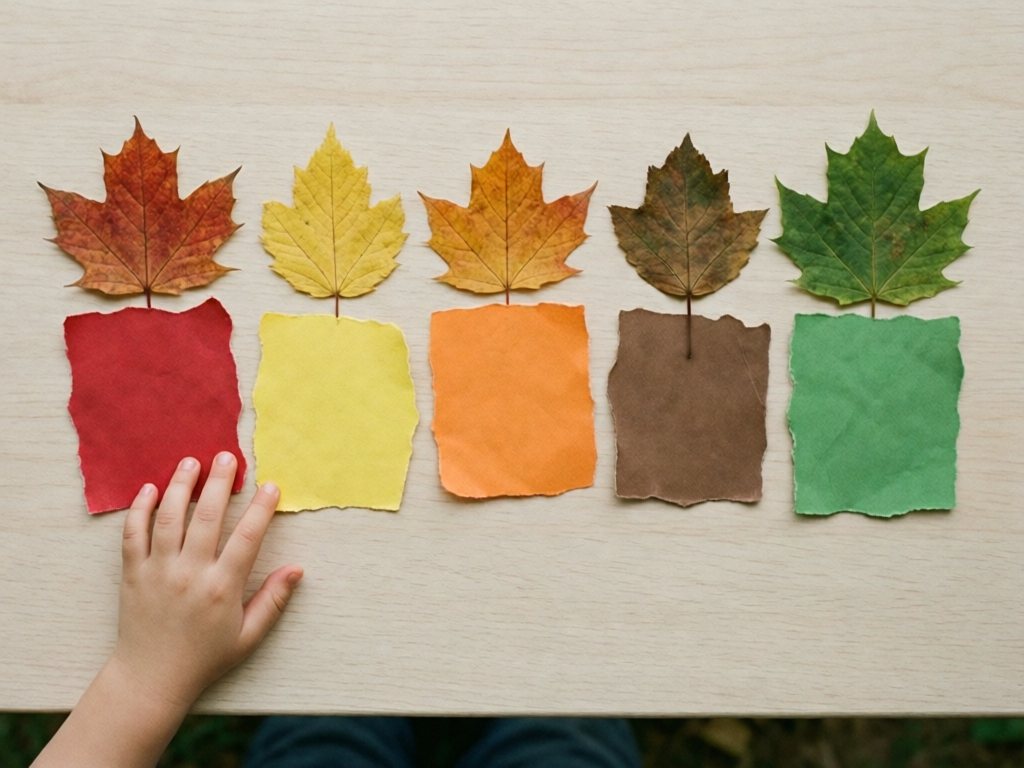
This is the best starter version. Before you go outside, tear a few scraps of colored paper (red, yellow, orange, brown, and green) and hand them to your child. They’re now holding their “clue.” Their job is to find a leaf that’s the same color as the paper.
| Paper Scrap | What They Look For | Tip |
|---|---|---|
| Red | Maple leaves, some oak leaves | Red can be harder to find in some regions, so cheer extra loud when you spot one. |
| Yellow | Birch, aspen, ginkgo, some maples | Usually easy to spot near the ground |
| Orange | Mixed maples, sweetgum | Often shades toward red or brown |
| Brown | Almost any dried leaf | The guaranteed win |
| Green | Evergreen needles, holly, late-season holdouts | Good for talking about why some leaves stay green |
No colored paper in the house? Use crayons, or fabric scraps, or the cover of a book. A color swatch from the hardware store works great. If you want a no-prep version, just hold up your child’s red jacket and say, “Find a leaf that’s red like this!”
The shape-notice leaf hunt
Once your child has the color game down, try shape language. You don’t need to name shapes like “lobed” or “serrated.” Just use words toddlers know:
- Pointy leaf: maple leaves and sweetgum have pointy edges
- Round leaf: aspen, some birch, and many shrubs
- Skinny leaf: willow and some oaks
- Big leaf: bigger than your hand? Find the biggest leaf you can
- Tiny leaf: smaller than your thumb
The “biggest” and “smallest” leaf games are huge hits. They also sneak in early math vocabulary without anyone saying the word “math.”
The leaf-pile finale
After the hunt, the best part: dump the leaf finds, plus a rake pile if you have one, and let them stomp, scoop, and throw. You are allowed to let this go on for a while. If you want to take the leaf obsession indoors afterward, the roundup of fall leaf crafts for kids has projects that work with exactly the kind of leaves a toddler can collect.
A note on leaf freshness
Dry leaves crumble when toddlers grab them, which is part of the fun but can also mean tears if their “perfect” leaf disintegrates. Fresh-fallen leaves are bendier than bone-dry ones. Carry them in a paper bag, dry them flat on a tray before storing, and toss any that smell musty or look moldy. If a find crumbles, shrug and say, “Now it’s leaf confetti!” and carry on.
The Acorn Scavenger Hunt for Preschoolers
An acorn scavenger hunt for preschoolers is its own little adventure, because acorns are small, hidden, and slightly mysterious. Kids love them. Part of the charm is the cap: a toddler who has never thought about “hats” suddenly realizes that nuts wear them.
Where to find acorns
Acorns come from oak trees, so your first mission is finding an oak. Here’s how to spot one without being a tree expert:
- Look for leaves with rounded lobes (like a mitten with bumpy fingers) or pointy lobes (like a spiky star)
- Look for acorns or caps already on the ground beneath the tree
- Look for squirrels. They hang around oaks like toddlers hang around snack tables.
Under a good oak in October, you can scoop up dozens of acorns in a minute. Parks, school grounds, church lawns, and older neighborhoods with mature trees are all good sources.
The acorn hunt itself
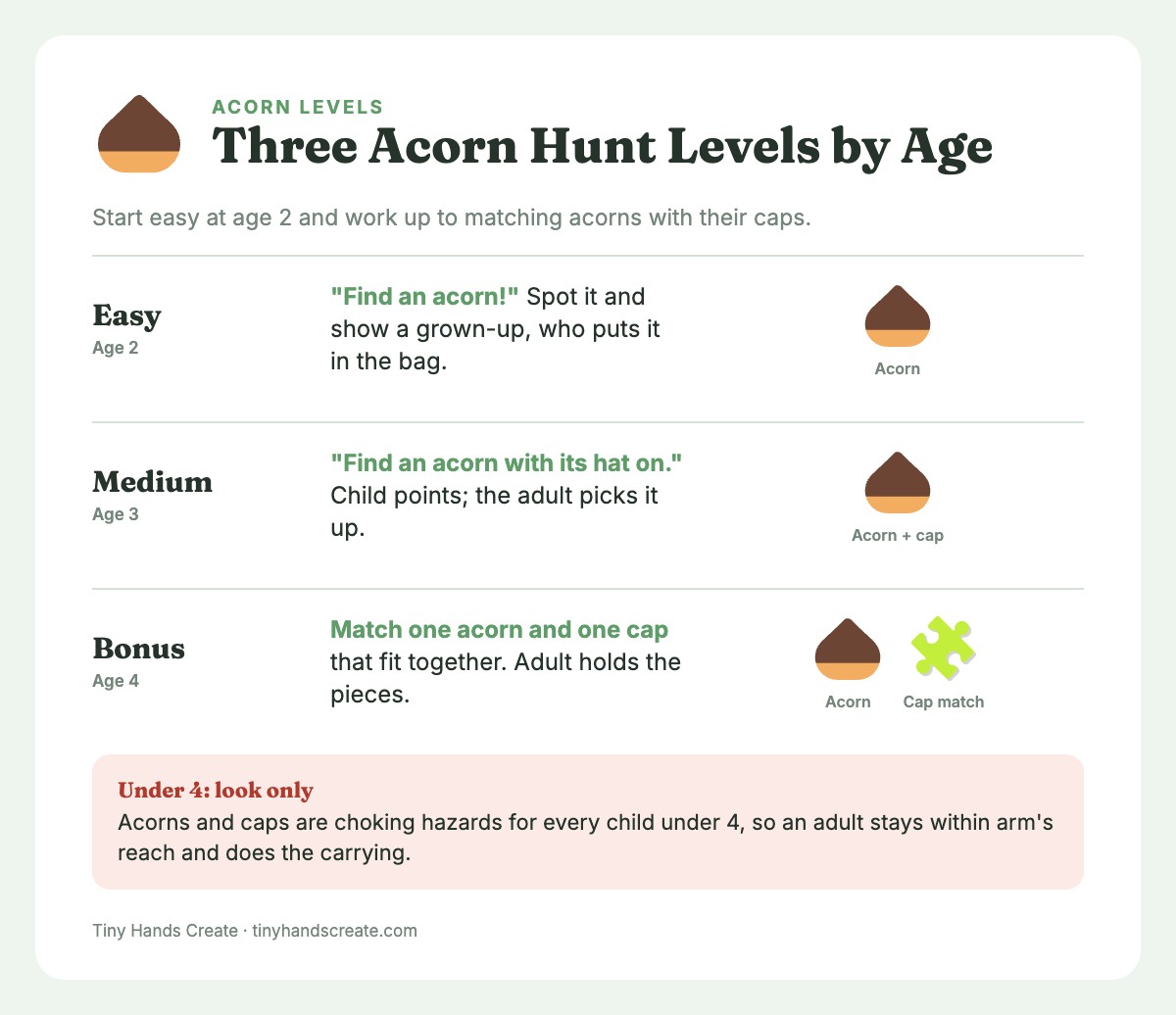
Try these three levels, depending on your child’s age:
| Level | Ages | The Challenge |
|---|---|---|
| Easy | 2 | “Find an acorn!” Spot an acorn and show a grown-up, who puts it in the bag. |
| Medium | 3 | “Find an acorn with its hat on.” Your child points to a whole acorn with the cap attached, and the adult picks it up. |
| Bonus | 4 | “Find a matching pair: one acorn and one cap that fit together.” An adult holds the pieces while your child directs the fit. This is a real puzzle. |
The matching pair challenge is surprisingly tricky and surprisingly satisfying. A cap that’s too big or too small won’t sit right, and kids learn to test, swap, and try again. It’s a sneaky fine-motor and problem-solving workout.
Acorn safety, the short version
- Acorns are not food. Raw acorns aren’t edible because of their tannins, and they can cause stomach upset or worse. Acorns and caps are choking hazards for every child under 4, so stay within arm’s reach.
- Check for tiny holes. A small round hole in the shell usually means a weevil larva lived inside. Leave any with holes outside. Acorns without visible holes can still hide larvae, so freeze the ones you bring home in a sealed bag for a few days, then keep them in a closed container.
- Wash hands after. Dirt, tree sap, and bits of who-knows-what come along for the ride.
- Keep it look-and-show. Have your child point and hand you finds to put in the bag. Small rocks and pinecone scales are choking hazards too.
If your child is a determined collector and you want more ways to use the haul, the guide to acorn crafts for toddlers has no-mess ideas that keep the acorns out of mouths and in small-hand-friendly projects.
Advanced Fall Scavenger Hunt Card for Ages 3-4
Once your child has mastered the first card (or if you have a four-year-old who finished it in six minutes and is now bored), swap in the advanced card. It’s still picture-based, but the clues get a little more specific.
Fall Picture-Clue Hunt Card, Level 2 (Ages 3-4)
| ✔ | Picture Clue | Say It Out Loud | Why It’s Trickier |
|---|---|---|---|
| ☐ | 🍁🍁 | Two red leaves | Counting to two |
| ☐ | 🌰🧢 | Acorn with its cap on | Finding a complete one |
| ☐ | 🍂⬆️ | The biggest leaf | Comparing sizes |
| ☐ | 🍂⬇️ | The smallest leaf | Comparing sizes |
| ☐ | 🌿 | Something green | Late-season holdouts are rare |
| ☐ | 🪶 | A feather | Needs a sharp eye |
| ☐ | 🐿️ | A squirrel | Spotted, not caught! |
| ☐ | 🍄 | A mushroom | Look only. Do not touch or pick. |
| ☐ | 🕸️ | A spider web | Best on dewy mornings |
| ☐ | 👣 | A footprint in the mud | Yours counts |
Two notes on this card:
- “Spotted” finds are a different game. The squirrel, the mushroom, the spider web, and the footprint can’t be collected. Teach your child to say “I spy it!” and point instead. It’s a great introduction to the rule of leaving wild things where they are.
- Mushrooms are look-only, always. Many mushrooms are toxic, and you can’t tell safe from unsafe by looking. Make “we don’t touch or taste mushrooms” a firm rule from the start. If a mushroom or berry goes in a mouth, call Poison Control at 1-800-222-1222.
Adjusting the Hunt by Age
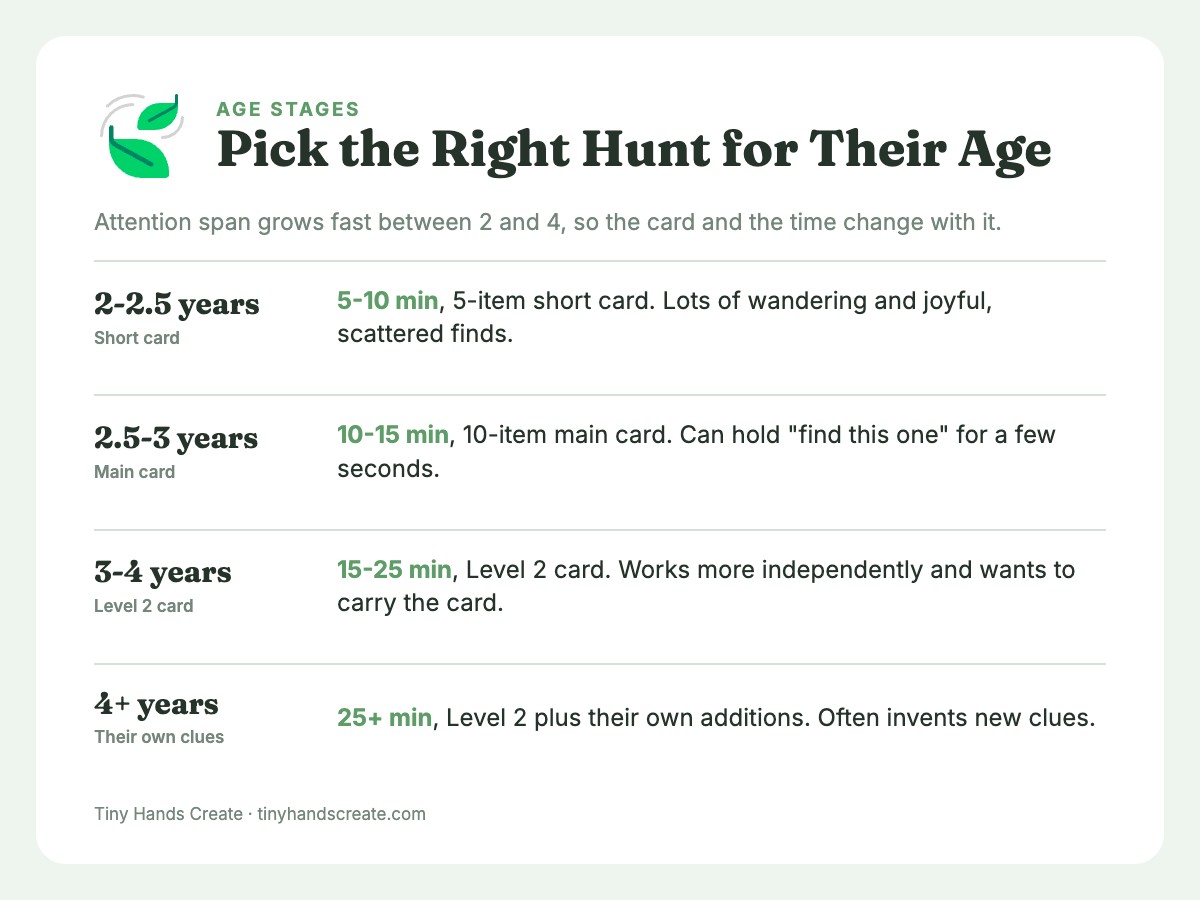
A two-year-old and a four-year-old are practically different species. Here’s a quick guide to how the hunt shifts as your child grows.
| Age | Attention Span | Best Card | What to Expect |
|---|---|---|---|
| 2-2.5 years | 5-10 min | 5-item short card | Lots of wandering, lots of repeated “leaf!” Finds are scattered and joyful. |
| 2.5-3 years | 10-15 min | 10-item main card | Can hold the idea of “find this one” for a few seconds at a time |
| 3-4 years | 15-25 min | Level 2 card | Starts working independently, wants to carry the card, may argue about what counts |
| 4+ years | 25+ min | Level 2 plus their own additions | Often wants to invent new clues. Let them draw their own picture clues! |
Good to knowUnder 2? Make it a sensory walk only. Offer big leaves held in your hand, and leave out acorns, caps, pinecones and sticks.
For the little ones: keep it sensory
For a young two-year-old, don’t worry about the card at all. Hand them a bag, point at leaves, and narrate. “Crunchy leaf! Red leaf! Oh, a stick!” The card is just a prop for you, and the real learning is the vocabulary and the sensory input.
For the older ones: hand over the job
By four, many kids love being the boss of the card. Let them tick off finds themselves, hold the pencil, and even add a new clue. “What else should we hunt for?” “Dog!” “Okay, draw a dog.” The ownership makes the hunt feel like their game, not yours.
What to Bring (and What to Expect Mess-Wise)
This is a low-supply activity, which is part of why I love it. Here’s the real-life kit:
The essentials
- A small bag or pail for each child
- The hunt card (hand-copied, on your phone, or just in your head)
- A fat crayon or sticker for ticking off finds
- Weather-appropriate clothes
The nice-to-haves
- A wet wipe or two for hands. Acorn dust and tree sap are real.
- A choking-safe snack for afterward (applesauce, thin or grated apple), because hunting makes toddlers ravenous
- A second bag for any extras you decide to bring home
- A cheap magnifying glass for the “look closely” finds
- A towel or old blanket for the car seat, because leaves and mud come home with you
What to expect, mess-wise
I want to be honest about this. This is an outdoor activity, so the mess is the outdoors. You can expect:
- Dirt under every fingernail
- A trail of leaf bits across your entry floor
- At least one acorn cap that ends up in your coat pocket and gets discovered in the wash three weeks later
- One bag so overstuffed it rips
None of this is a disaster. Set up a landing zone by the door with a bucket for finds and a spot for muddy shoes, and it’s contained. If mess is your biggest barrier to outdoor play, shake the leaves off outside before coming in. A quick brush-down on the porch saves your sanity.
What to Do With Your Finds Afterward
A scavenger hunt isn’t over when you walk back inside. The finds are the starting point for a second activity, and honestly this is where my kids have gotten the most mileage.
Safety firstFor children under 4, every after-hunt activity uses leaves, large pinecones and big sticks only. Acorns and caps go on a high shelf or stay adult-handled, and an adult stays within arm’s reach during all play with the finds.
Sort them
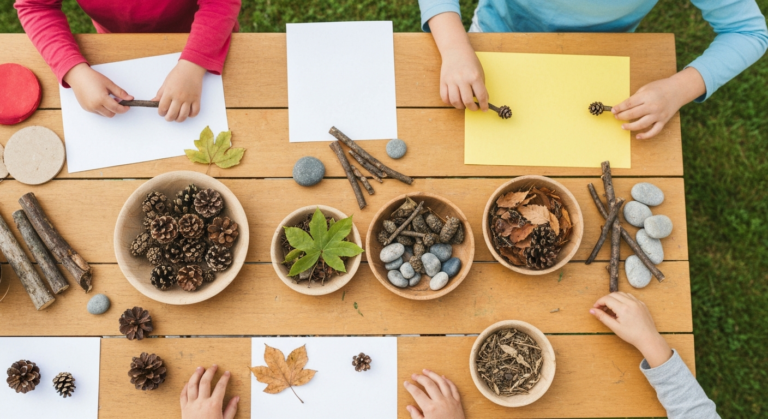
Before you dump the bag, pull out the acorns, caps and any small bits for the high shelf. Then spread the leaves, large pinecones and big sticks on a tray or towel and let your toddler sort while you sit within arm’s reach. By color, by size, by “leaves” and “not leaves.”
Sorting builds early categorizing skills, and it feels like play. Add muffin tins or egg cartons if you want dividers. For counting practice with the same finds, the fall counting printable for acorns and leaves 1-10 is a natural next step.
Make a sensory bin
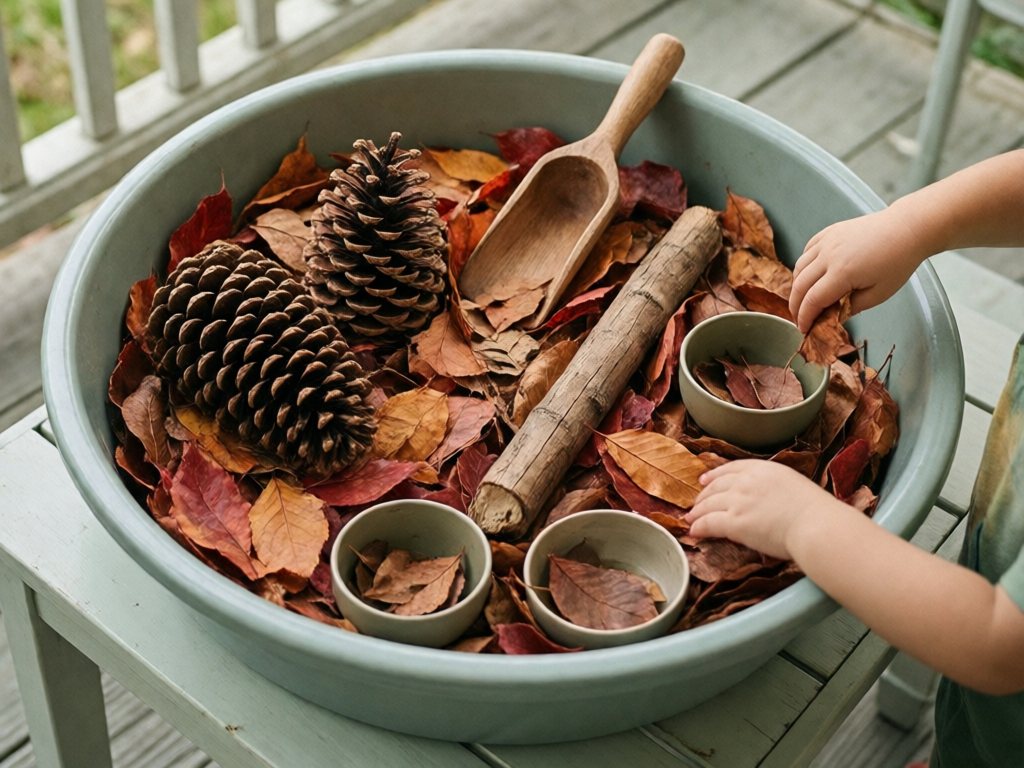
Toss dry leaves, large pinecones and big sticks into a bin with scoops and little bowls. For children 4 and up under supervision, you can add acorns. It’s pure, calm, hands-on play. The guide to a fall sensory bin with acorns and pinecones walks through exactly how to set one up, including what to add and what to skip for little mouths.
Make a tiny nature collage
Give your child a piece of cardboard or heavy paper and a glue stick. Under 4, it’s leaves only, stuck wherever they want. Kids 4 and up can add caps and twigs with you sitting alongside. There’s no right answer. Let it dry flat and you’ve got a fall keepsake.
Do a leaf rubbing
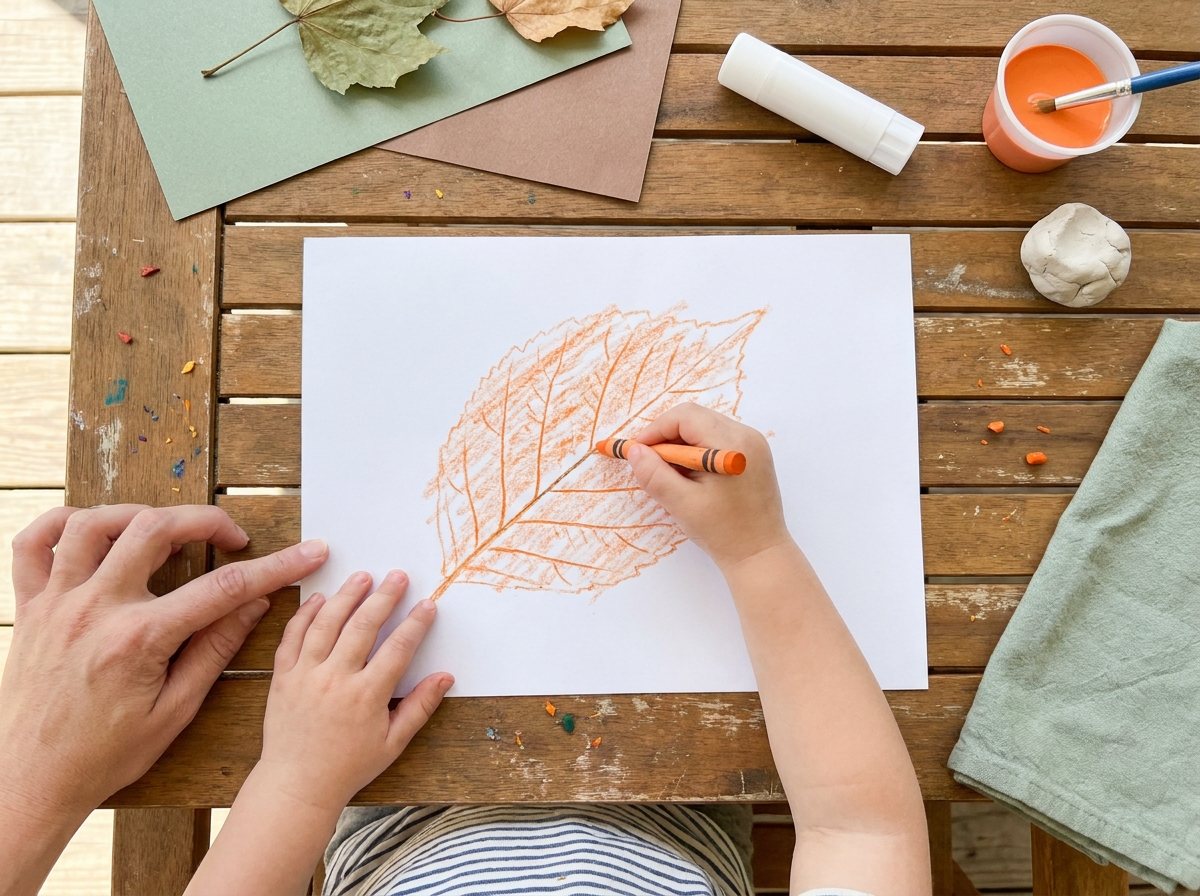
Put a leaf under a thin sheet of paper, rub the side of a peeled crayon over it, and watch the veins appear. Toddlers think this is actual magic. Do it on the porch table and you’ll be done in five minutes.
Make a “nature table”
Pick a windowsill or a low shelf and set out the best finds: the biggest leaf, the largest pinecone, the funny-shaped stick. Let your child rearrange it all week. The perfect acorn gets a spot on a higher shelf, where your toddler can see it but not reach it.
It keeps the hunt alive long after you’ve come inside, and it gives you something to point to when you say, “Remember when we found that?”
Tuck them into the mud kitchen or dramatic play
Leaves become “plates.” Big sticks become “spoons.” Large pinecones become “cupcakes.” If you have a play kitchen outside, the hunt’s loot has just become your child’s kitchen supplies for the day.
Under 4, the acorns stay on the shelf and an adult stays within arm’s reach during play-kitchen time. Kids 4 and up can stir acorn “soup” with you nearby. For more setups, see these mud kitchen play ideas.
Making the Hunt Last: Variations for the Whole Season
You can run the same hunt several times as the season shifts. Here’s how it changes:
| Time of Fall | What’s Different | Hunt Twist |
|---|---|---|
| Early fall (Sept) | Leaves just starting to turn, acorns beginning to drop | Look for the first red leaf; first acorns often still green |
| Peak fall (Oct) | Max color, max acorns | The main card is at its best |
| Late fall (Nov) | Bare branches, brown leaves, dry acorns | Swap color clues for texture clues: crunchy, soft, spiky |
| After first frost | Frost-coated leaves and grass | A “find something frosty” bonus clue |
You can also change where you hunt. Do it in your backyard one week, the neighborhood park the next, and a friend’s yard after that. Different trees mean different finds, and your toddler will notice that the “same” game plays out differently every time.
For more ways to get outside once the weather turns, the roundup of outdoor nature activities for kids has more ideas that carry through the whole season.
Turning the Hunt Into a Party or Playdate Game
The card also works for groups. If you’re hosting a small fall gathering or a playdate, here’s how to scale it:
- Give each child a bag and a copy of the card. Hand-draw a couple, or let the parents hold the card for each child.
- Make it a team game. Pair a three-year-old with a four-year-old, and let the older one help find the harder items. An adult stays within arm’s reach of every child under 4. The older child helps find things, not keep anyone safe.
- Skip the competition. Toddlers aren’t ready for “who finds the most.” Instead, celebrate everything that everyone finds, and end with a “show and tell” circle where each child holds up one favorite item.
- Have a snack ready. Thin apple slices or grated apple, or applesauce, plus water or lukewarm pasteurized cider, make a good finale.
- Keep it short. Twenty minutes is plenty for a group of toddlers. Anything longer and someone will melt down.
Ground Rules for Toddler Hunts
Toddlers need a few clear, repeated rules. Here are the ones I use:
- “We look with our eyes first.” Before grabbing, we point and show.
- “Nothing goes in our mouths.” Acorns, leaves, sticks, rocks, all of it. Every child under 4 stays within arm’s reach of an adult.
- “We don’t pick mushrooms or berries.” Ever. Wild berries can be toxic.
- “We leave animals alone.” Squirrels, bugs, birds: look, wave, don’t chase.
- “We stay where I can see you.” Set a boundary: from the porch to the fence, from the bench to the tree.
- “We wash hands when we’re done.” Make it a ritual: hunt, then sink.
A few extra tips:
- Check for hazards before you go. Broken glass, litter, or dog waste hide well under leaves. Do a quick scan of the area.
- Watch for ticks and bugs. If you’re in a wooded area, check your child’s skin and clothes afterward, especially around the hairline and behind the ears.
- Dress in layers. Fall mornings start cold and warm up fast.
- Know your plants. Poison ivy turns red and orange in fall and can still cause a rash. Remember “leaves of three, let it be,” scan the area before you go, and hand-pick leaves for your toddler wherever vines grow. If you’re unsure what’s growing nearby, stick to cleared lawns and parks.
Frequently Asked Questions
What age is a fall scavenger hunt for toddlers best for?
This hunt works best for ages 2 to 4. Two-year-olds do well with the short five-item card and lots of adult narration, three-year-olds can handle the full ten-item card, and four-year-olds will enjoy the Level 2 card and often want to add their own clues. Children younger than two can join in too, but treat it as a sensory walk with big leaves rather than a hunt. Skip acorns, caps, pinecones and sticks, and keep a close eye on mouthing.
How do I do a scavenger hunt with a toddler who can’t read?
Use picture clues instead of words. Show your child a simple image (a leaf, an acorn, a stick), say the word aloud, and let them find the real thing. The card on this page is built exactly this way: every find has a picture and a spoken name, so your child never needs to read anything. You hold the card and show one picture at a time.
How long should a toddler scavenger hunt last?
Plan for 10 to 25 minutes depending on age. Two-year-olds are often done in about ten minutes, while four-year-olds may happily go for twenty-five. Shorter is better than longer, and it’s perfectly fine to stop after three or four finds. If your child gets absorbed in stomping leaves or inspecting a bug, that counts as the activity too.
Are acorns safe for toddlers to hold and collect?
Acorns are fine to look at and carry with a grown-up nearby, but they are not food. They are a choking hazard for every child under 4, and raw acorns contain tannins that can cause stomach upset or worse. Stay within arm’s reach, keep acorns out of mouths, and wash hands afterward. If a child swallows a piece, call Poison Control at 1-800-222-1222. Skip any with small round holes, since that usually means a weevil larva was living inside.
What if we don’t have oak trees or colorful leaves where we live?
Adapt the card to what’s around you. In places without much fall color, swap the colored-leaf clues for texture clues (crunchy, smooth, spiky) or use whatever seeds, pods, and pinecones drop locally. If there are no oaks nearby, replace the acorn finds with pinecones, seed pods, or interesting sticks. The format works with any seasonal finds, so the card can match your actual neighborhood.
What do we do with all the leaves and acorns we collect?
Lots of things. Sort them by color and size on a tray, or add them to a sensory bin with scoops. You can glue leaves onto cardboard for a nature collage, make leaf rubbings with crayons, or set up a small nature table on a shelf. For children under 4, use leaves, large pinecones and big sticks, keep acorns and caps on a high shelf, and stay within arm’s reach. Many kids are just as happy using leaves and pinecones as pretend “soup ingredients” in outdoor play. Toss anything that gets moldy or buggy after a few days.
My toddler loses interest after two minutes. What can I do?
Shrink the hunt and raise the energy. Use the five-item card, narrate with a silly voice, and celebrate every find like it’s a gold medal. Give your child their own bag, because holding a “job” helps. If attention still drifts, stop and play in the leaf pile for a bit, then try one more find. Some days the hunt is two minutes, some days it’s twenty, and both are normal.
Start Your Fall Hunt
The best thing about this hunt is how little it asks of you. A paper bag, a few pictures, and a patch of ground with fallen leaves are enough for a full outdoor adventure. Your toddler doesn’t need to find everything on the card, or anything on the card, to have a good time. They need a little time outside, a grown-up who’s excited about a red leaf, and a bag to carry their treasures home.
So print the card, grab a bag, and go find some fall. Bring a wet wipe. And when your kid holds up a stick and proudly announces it’s an acorn, just say, “Great find!” and keep walking.