St. Patrick’s Day Crafts from Your Recycling Bin: Zero Cost, All Fun
Discover how to create fun, free St. Patrick's Day crafts using items from your recycling bin, fostering creativity and problem-solving in your kids without a trip to the store.
- Transform your recycling into St. Patrick's Day crafts.
- Boost kids' creativity and problem-solving with open-ended materials.
- Save common items like toilet paper rolls, egg cartons, and cereal boxes.
- Teach your children about repurposing and reducing waste.
- Focus on the making process, not just the final product.
This post contains affiliate links. As an Amazon Associate I earn from qualifying purchases.
It’s March 14th. You just realized St. Patrick’s Day is Tuesday. Your kid came home from school talking about leprechauns and shamrocks and golden rainbows, and now they’re staring at you with that expectant look — the one that says, So what are WE doing?
You do a quick mental inventory of your craft supplies. Green paint: maybe half a dried-out bottle. Green construction paper: used up at Valentine’s Day for some reason you can’t recall. Shamrock stamps or stickers: definitely not. And there is absolutely no way you’re making a special trip to the craft store in the next 48 hours.
Here’s the thing, though. You walk to your recycling bin, flip open the lid, and — oh. There are toilet paper rolls. A flattened cereal box. Three egg cartons. Some paper towel tubes. A pile of newspaper. And suddenly, St. Patrick’s Day is completely covered. I’ve been making holiday crafts from recycling bins for years now, and I’m here to tell you that not only are these activities free, they’re actually better than the kits from the store. So let’s dig in.
In this article (10 sections)
- Why Recycled-Material Crafts Teach More Than You’d Expect
- What to Save: Your Recycled Craft Materials Roundup
- Craft Overview at a Glance
- The Crafts: Step-by-Step Instructions
- Adapting by Age: Toddlers, Preschoolers, and School-Age Kids
- The Leprechaun Trap Challenge
- Green-Themed Sensory Play
- Displaying Your St. Patrick’s Day Creations
- Frequently Asked Questions
- One Last Thing
Why Recycled-Material Crafts Teach More Than You’d Expect
Before we get into the actual crafts, I want to make a quick case for why raiding your recycling bin is genuinely good for kids — not just good for your wallet.
When children work with open-ended, irregular materials, they engage in what educators call divergent thinking: they’re not following a template or coloring inside predetermined lines. A toilet paper roll doesn’t come with instructions. A child looks at it and has to decide: this could be a hat, a body, a telescope, a tunnel. That moment of decision-making is where real creativity lives.
There’s also something deeply satisfying to kids about transforming trash into treasure. When your five-year-old makes a shamrock wreath out of egg cartons she watched you toss in the recycling yesterday, she feels genuinely powerful. She made something beautiful from something that was about to be thrown away. That’s not a small thing.
Research on process art for toddlers backs this up: when children focus on the making rather than the product, they develop persistence, fine motor skills, and creative confidence. Recycled material crafts are inherently process-focused because the materials are imperfect and irregular — no two toilet rolls are exactly the same diameter, no two egg cartons are the exact same shade of cardboard. Kids learn to adapt, problem-solve, and work with what they’ve got. Sound familiar? That’s basically parenting.
And honestly, the environmental message isn’t lost on kids either. When you explain that instead of throwing this away, we’re making something new, you’re planting seeds of awareness that stick around way longer than any craft.
What to Save: Your Recycled Craft Materials Roundup
You don’t need to go hunting — just pay attention to what flows through your house in the next day or two. Here’s what works brilliantly for St. Patrick’s Day crafts:
Paper and Cardboard
- Toilet paper and paper towel tubes (the holy grail of recycled crafts)
- Egg cartons — both the twelve-count cardboard kind and styrofoam work
- Cereal boxes and cracker boxes (the lightweight cardboard is perfect for cutting)
- Newspaper and old magazines (especially anything with greens, yellows, or blues)
- Paper bags — brown or white
- Cardboard shipping boxes or Amazon boxes
Glass and Plastic
- Glass jars (baby food jars, jam jars, pasta sauce jars)
- Clear plastic bottles — water bottles and soda bottles
- Plastic lids in various sizes
- Egg shells if you have any from cooking
Fabric and Fiber
- Old ribbon or twine
- Worn-out green clothing scraps
- Cotton balls
- Old socks (yes, really — we’ll use these)
Extras
- Aluminum foil
- Popsicle sticks if you have any
- Old buttons
- Dried pasta or beans
What you’ll also need (not recycled, but basics most households have):
- Green, yellow, and white paint
- Glue — white school glue and/or a glue gun if your kids are older
- Tape
- Scissors
- Markers or crayons
- Googly eyes (optional but beloved)
Craft Overview at a Glance
| Craft | Best Age | Time | Mess Level | Materials |
|---|---|---|---|---|
| Toilet Roll Leprechaun | 2–7 | 20 min | Low | TP roll, paint, paper |
| Egg Carton Shamrock Wreath | 3–8 | 30 min | Medium | Egg carton, paint, wire/cardboard |
| Cardboard Rainbow Mobile | 2–6 | 25 min | Low-Medium | Cereal box, paint, string |
| Newspaper Leprechaun Hat | 4–8 | 20 min | Low | Newspaper, tape, paint |
| Tin Can Pot of Gold | 3–7 | 15 min | Low | Tin can, foil, yellow circles |
| Rainbow Wind Sock | 3–8 | 30 min | Medium | Paper towel tube, tissue/crepe paper |
| Egg Carton Caterpillar Shamrock | 2–5 | 15 min | Medium | Egg carton cups, paint |
| Cereal Box Leprechaun Trap | 5–9 | 45 min | Low | Cardboard box, tape, creativity |
| Jar Lantern Rainbow | 3–8 | 20 min | Low | Glass jar, tissue paper, Mod Podge |
| Newspaper Pot of Gold Cones | 3–7 | 25 min | Low | Newspaper, foil, yellow paper |
The Crafts: Step-by-Step Instructions
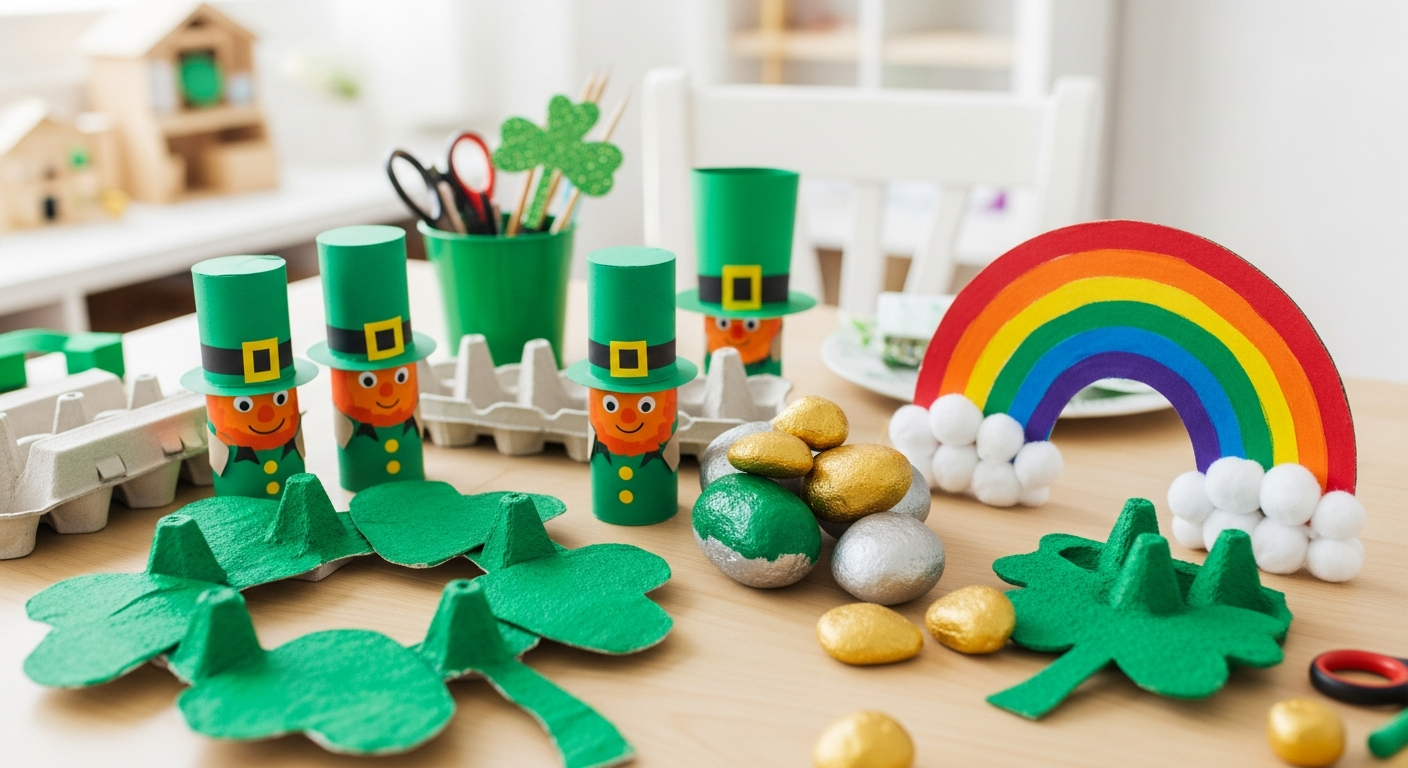
1. Toilet Roll Leprechaun
This is the entry point — quick, recognizable, and endlessly customizable. If you do nothing else this St. Patrick’s Day, do this one.
Materials:
- 1 toilet paper roll per child
- Green paint
- Small square of green paper or felt for the hat brim (can cut from a cereal box painted green)
- Small strip of black paper or black marker for the hat band
- Yellow paper for the buckle
- Skin-tone paint or paper for the face area
- Googly eyes (or draw them on)
- Orange yarn or paper strips for hair/beard
- White school glue
Step-by-step:
- Paint the top two-thirds of the toilet roll green. This will be the leprechaun’s hat. Let dry (10 minutes, or use a hair dryer to speed things up).
- Paint the bottom third in whatever skin tone you’re working with — peach, brown, tan. Let dry.
- While that dries, cut a small circle from green cardboard (cereal box works great) about an inch larger than the toilet roll diameter all around. This is the hat brim. Cut a hole in the center just big enough to slide the toilet roll through — but actually, it’s easier to just glue it on like a flat ring around the outside of the roll. Simpler wins.
- Cut a thin strip of black paper and glue it horizontally across the hat where the green transitions to face — this is the hat band. Cut a tiny yellow square or rectangle for the buckle and glue it centered on the black band.
- Once the face area is dry, glue on googly eyes or draw them. Add a simple curved smile with a marker. Give your leprechaun rosy cheeks with a dab of red or pink paint on your fingertip.
- For hair and beard: cut orange yarn into short pieces for hair (glue around the face), and longer wispy pieces for a beard under the chin.
- Optional: cut two small circles from cardboard, paint them brown, and glue them to the back of the roll as little ears.
Age adaptations: Toddlers can do all the painting and gluing with help from you on the assembly. Older kids can cut their own pieces and design their leprechaun’s expression independently. School-age kids love making a whole family of leprechauns with different expressions and hair colors.
Mess level: Low. This is a great one for the kitchen table with just a sheet of newspaper underneath.
2. Egg Carton Shamrock Wreath
This one looks genuinely impressive hanging on a door or window, and your recycling bin probably has everything you need right now.
Materials:
- 2–3 cardboard egg cartons (the 12-count kind)
- Green paint (various shades if you have them)
- Cardboard circle for the wreath base (cut from a large box, or use a paper plate with the center cut out)
- White school glue or hot glue
- Ribbon or string for hanging
- Yellow or gold paint for accents
- Optional: gold glitter or gold stickers
Step-by-step:
- Cut the individual egg cups from the cartons. You’ll want about 20–30 cups depending on your wreath size.
- Using scissors, trim each cup so the edges are more rounded and petal-like. Make four small cuts from the rim of each cup down the sides, creating four petal sections. Press these sections outward gently to make each cup look like a four-leaf clover or shamrock. (This takes a little practice — the first few are awkward, then it clicks.)
- Paint all your egg cups green. Use different shades if you have them — mixing a little white into some, a little blue into others — for a more natural, leafy look. Set aside to dry.
- Paint your cardboard ring/wreath base green as well.
- Once everything is dry, glue the shamrock cups onto the wreath base, overlapping slightly, pointing outward. Work in a full circle. Fill in any gaps with smaller cups or flat pieces of egg carton cut into leaf shapes.
- Add a ribbon or loop of twine at the back for hanging.
- Optional extras: paint the tips of some shamrocks gold, add a few gold-painted small bows made from cereal box cardboard, or glue a “Happy St. Patrick’s Day” message cut from cardboard in the center.
Age adaptations: Toddlers love the painting and will enjoy squeezing the egg cups — skip the cutting and let them paint pre-cut cups. Preschoolers can do the cutting with child-safe scissors once they see the technique. School-age kids can design the whole layout before gluing and love adding decorative details.
Mess level: Medium. The painting will need a dedicated space. Do it outdoors or on a covered table.
3. Cardboard Rainbow Mobile
A rainbow mobile made from cereal box cardboard is lightweight, colorful, and looks magical hanging in a window where sunlight hits it.
Materials:
- 2–3 cereal boxes or cracker boxes
- Red, orange, yellow, green, blue, and purple paint
- Scissors
- String or yarn
- Tape or glue
- A stick or wooden dowel for hanging (or use a paper towel tube painted brown)
- Cotton balls for clouds (optional)
Step-by-step:
- Open your cereal boxes flat and cut rainbow arch shapes — you want several strips of cardboard in decreasing sizes so you can layer them or make individual colored arches. The easiest method: cut 6 arch strips of roughly the same size and paint each one a different rainbow color.
- Alternatively, cut one large arch and paint the stripes directly on it — this is easier for younger kids.
- Paint each arch (or stripe) in its rainbow color. Let dry completely.
- If making individual arches: once dry, layer them and glue or tape together at the ends so they fan out in the rainbow shape. Punch a small hole at the top center.
- Thread string through the hole and tie to your hanging stick or paper towel tube.
- Add cotton ball clouds at each end of the rainbow, glued to small cardboard squares for structure.
- Hang in a window or from the ceiling with tape.
Age adaptations: Toddlers can finger-paint the rainbow colors — embrace the color mixing that happens. Preschoolers love painting each stripe carefully. Older kids can cut their own arches and design the proportions themselves.
Mess level: Low to medium. Standard painting mess — cover your surface and you’re fine.
4. Newspaper Leprechaun Hat
This craft has a theatrical payoff — kids can actually WEAR their leprechaun hats. Making a wearable item from newspaper feels like a magic trick.
Materials:
- Several sheets of newspaper
- Tape
- Green paint or green tempera
- Black construction paper or black marker for the band
- Yellow paper for the buckle
- A child’s head to measure against
Step-by-step:
- Start with the hat brim: lay three or four sheets of newspaper flat on the table, stacked. Help your child place their head in the center and draw a circle about an inch larger than their head all the way around. Cut this out — you’ve got your brim. Cut a smaller circle in the center that fits their head (test it as you go — slightly snug is fine because newspaper has give).
- For the hat body: roll sheets of newspaper into a tall cylinder. Start with one sheet rolled into a tube, then roll more sheets around the outside to make it sturdy. Tape it well.
- Flatten the bottom of the cylinder and cut fringe around the bottom edge — about 1–2 inches of cuts spaced an inch apart. Fold these fringe pieces outward. This is how you’ll attach the cylinder to the brim.
- Slide the cylinder through the brim circle, then tape or glue the folded fringe to the underside of the brim. Press firmly and add extra tape to make it sturdy.
- Paint the whole hat green. Two coats may be needed since newspaper absorbs paint. Let dry between coats.
- Add a black band (strip of black paper) around the base of the hat, and a yellow buckle in the center.
- Wear it. Dance a jig. You’ve earned it.
Age adaptations: Younger kids should have the rolling and structural parts done for them — their job is the painting and decorating. Older kids (6+) can do the whole project with light guidance. This is also a great “let’s figure it out together” craft if you’ve never done paper hat-making before.
Mess level: Low once you get past the painting phase.
5. Tin Can Pot of Gold
Tin cans (clean, with any sharp edges filed down or covered with tape) make absolutely perfect pots of gold. If you’ve got a bean can or a coffee can, you’ve got this craft.
Materials:
- 1 clean tin can (sharp edges covered with tape or a strip of duct tape)
- Black paint
- Yellow or gold circles (cut from yellow paper, or use real coins)
- Aluminum foil crumpled into small balls (your “gold”)
- Optional: rainbow made from paper strips attached to the back
Step-by-step:
- Paint the tin can black, inside and out (at least the inside top edge visible when looking down). Let dry.
- Cut small circles from yellow cardboard or paper — these are your coins. You can also use real pennies if you have them.
- Crumple small pieces of aluminum foil into coin-sized balls for a 3D gold effect.
- Arrange your gold: put the foil balls inside the can, let them spill over the top.
- Optional rainbow: cut strips of paper in red, orange, yellow, green, blue, and purple. Tape them together in a fan at one end. Tape this fan to the back of the can so the rainbow arches up behind it. Instant pot of gold scene.
- You can use the pot of gold as a centerpiece or as a coin bank — cut a slot in the plastic lid if your can has one, or cover the top with a piece of cardboard with a slot cut in it.
Age adaptations: Toddlers love filling and emptying — just give them the painted can and let them put things in and take them out. Preschoolers can help paint and do the assembly. School-age kids enjoy making it look realistic and may want to add details like a handle or legs with cardboard.
Mess level: Low. Just painting cleanup needed.
6. Rainbow Wind Sock
This one is perfect for hanging outside on a windy March day. It’s cheerful, colorful, and takes about 30 minutes start to finish.
Materials:
- 1 paper towel tube
- Strips of tissue paper, crepe paper, or old newspaper painted in rainbow colors
- Paint (for the tube)
- Tape
- String for hanging
- Scissors
Step-by-step:
- Paint the paper towel tube — green works great for the tube itself. Set aside to dry.
- Cut your streamers: you want long strips (12–18 inches each) in red, orange, yellow, green, blue, and purple. Tissue paper tears easily and works great. Crepe paper streamers are ideal if you have any. Newspaper can be cut into strips and painted — let dry before attaching.
- Tape the streamers around the inside of one end of the tube, alternating colors, so they hang down when the tube is held horizontally. Overlap them slightly so there are no gaps.
- Punch two holes at the other end of the tube (or use tape loops) and thread string through for hanging.
- Hang outside from a porch or hook. Watch it fly!
Age adaptations: All ages can tear or cut streamers — the motion control for very young ones is great fine motor practice. The taping is easier for older kids; help toddlers by pre-applying tape while they press the streamers down.
Mess level: Medium if painting newspaper strips. Low if using tissue paper.
7. Egg Carton Shamrock Caterpillar
This is the toddler-friendliest craft on the list. It’s quick, tactile, and the result is immediately recognizable.
Materials:
- Row of 3 egg cups from a cardboard egg carton
- Green paint
- Googly eyes or markers for eyes
- Pipe cleaner or folded paper for antennae (optional)
- Glue
Step-by-step:
- Cut a row of three connected egg cups from the carton. These will be the three lobes of the shamrock.
- Paint them all green. Let dry.
- Add a stem: cut a small strip of cardboard, paint it green, and glue it to the bottom of the center cup.
- Add googly eyes to one of the end cups to give your shamrock a friendly face.
- Optional: add a tiny “hat” made from a scrap of black paper rolled into a cylinder and balanced on top.
This craft works equally well as just a simple shamrock (skip the eyes) or as a character. Kids love deciding which version they’re making.
Age adaptations: Toddlers do the painting and pressing of googly eyes. Preschoolers can manage the gluing with regular white glue. School-age kids may prefer to make a whole collection with different expressions.
Mess level: Medium. Green paint travels.
8. Jar Lantern Rainbow
When you hold a finished jar lantern up to the light, it glows like a stained glass window. They’re stunning for how simple they are.
Materials:
- Clean glass jar (baby food jar, jam jar, pasta sauce jar — any size)
- Tissue paper in rainbow colors (or old wrapping tissue, or tissue paper from gift bags)
- Mod Podge or watered-down white glue (1 part water, 1 part glue)
- Paintbrush
- Optional: battery-operated tea light to place inside
Step-by-step:
- Tear tissue paper into small irregular pieces — about the size of a postage stamp to a quarter. No need for neat shapes; irregular looks beautiful.
- Paint a section of the outside of the jar with the glue mixture.
- Press tissue paper pieces onto the glued area, overlapping slightly. The pieces will wrinkle naturally, and that’s perfect — it adds texture.
- Paint over the tissue with another layer of glue to seal.
- Continue around the jar, mixing rainbow colors and letting them overlap. Green, yellow, and orange are perfect for St. Patrick’s Day, but a full rainbow is gorgeous.
- Let dry completely — at least an hour.
- Place a battery-operated tea light inside and turn off the room lights. The glow through the colored tissue is genuinely magical.
Age adaptations: This is one where toddlers can do almost the entire thing. Tearing tissue, pressing pieces, painting glue — it’s all toddler-accessible. The result will be abstract and beautiful. Older kids can plan out patterns or color gradients.
Mess level: Low. The glue washes off easily and tissue paper doesn’t make much mess.
9. Newspaper Cone Pot of Gold
A different take on the pot of gold — this version is a sculptural cone that can stand on its own.
Materials:
- Several sheets of newspaper
- Tape
- Black paint or black marker
- Yellow paper circles or foil balls for gold
- Optional: ribbon handle
Step-by-step:
- Roll a sheet of newspaper into a cone shape. This takes a little practice — start from a corner, roll diagonally toward the opposite corner, and adjust the cone’s proportions as you go. Tape the cone securely.
- Trim the bottom of the cone so it sits flat on a surface.
- Paint the cone black. Two coats for even coverage. Let dry.
- Fill the top of the cone with yellow paper circles (your coins) and aluminum foil balls (your gold nuggets).
- Optional: punch two small holes near the top rim and thread ribbon through to create a handle — now it’s a little purse-pot-of-gold.
Age adaptations: Rolling cones is a great challenge for ages 5+. Younger kids will need you to make the cone while they do the painting and filling.
Mess level: Low.
Adapting by Age: Toddlers, Preschoolers, and School-Age Kids
One of the beautiful things about recycled material crafts is how naturally they scale. Here’s a cheat sheet:
Toddlers (Ages 2–3)
Focus on: painting, tearing, pressing, filling, and emptying. Skip any steps involving scissors — those are your job. Let them decide what their finished piece “is.” A green-painted toilet roll is a leprechaun OR a tree OR a tunnel for toy cars, depending on their mood, and all of those are correct. Check out process art for toddlers for more on why the process matters more than the product at this age.
Ideal crafts from this list: Jar Lantern (tearing and pressing), Egg Carton Caterpillar (painting), Tin Can Pot of Gold (filling with gold), Rainbow Mobile (finger painting).
Preschoolers (Ages 3–5)
Focus on: cutting simple shapes with child scissors, making decisions about design, doing most steps independently with light guidance. This age group LOVES when you tell them their job matters — “I need you to cut all the streamers for me” turns a craft into a mission. For more ideas that suit this age, see our mess-free art activities for toddlers post, which has great techniques that work for older toddlers and preschoolers alike.
Ideal crafts from this list: Toilet Roll Leprechaun (painting, gluing), Rainbow Wind Sock (cutting streamers, taping), Egg Carton Wreath (painting, gluing).
School-Age Kids (Ages 5–8+)
Focus on: multi-step projects, designing before building, adding their own ideas. Ask them to plan their project first: “What will yours look like? What materials do you need?” School-age kids also love the challenge format — see the Leprechaun Trap section below. These kids can handle glue guns (supervised), more complex cutting, and painting in multiple layers. They’re also old enough to help younger siblings, which makes them feel important and keeps everyone engaged.
Ideal crafts from this list: Egg Carton Shamrock Wreath (full assembly), Newspaper Leprechaun Hat (wearable, complex), Cardboard Leprechaun Trap (next section!).
The Leprechaun Trap Challenge
This deserves its own section because it is arguably the most exciting St. Patrick’s Day activity for kids ages 4 and up, and it uses nothing but recycled materials and imagination.
The premise: leprechauns are sneaky, magical creatures who are always trying to escape. Your job is to build a trap clever enough to catch one. The trap has to lure the leprechaun in with gold (or something shiny), then trap them when they go after it.
What you’ll need:
- Any cardboard box (shoebox, cereal box, cracker box)
- Cardboard scraps for building
- Aluminum foil (for bait — leprechauns love shiny gold)
- Tape, glue
- String (for triggers and mechanisms)
- Sticks or pencils (for propping up lids)
- Green paint or green paper
- Any “decorations” that feel like leprechaun bait: fake coins, gold stars, green glitter
How to run this as an activity:
Present it as a genuine engineering challenge. Tell your kid: “Leprechauns love gold. We need to make something that will lure a leprechaun in but trap them before they can escape. What would YOUR trap look like?” Then step back.
Common designs kids come up with:
- A box propped up with a stick, with a string tied to the stick. Gold inside. Pull the string when the leprechaun goes in.
- A box with a hole cut in one end — leprechaun walks in, can’t get back out.
- A ramp made of cardboard leading down into a box — leprechaun slides in.
- A “room” decorated with shamrocks and gold, with a door that “locks” (tape).
The best part of this activity is that there’s no right answer and no failure. If your child’s trap wouldn’t actually catch anything, that’s fine — the thinking and building is the whole point. You can extend this into the evening by leaving traps out “for the leprechaun” and placing a few gold-wrapped coins nearby in the morning.
This is an excellent activity to pair with loose parts play — the open-ended building mentality is identical, and kids who’ve done loose parts play tend to throw themselves into trap-building with particular gusto.
Green-Themed Sensory Play
Not every St. Patrick’s Day activity has to be a craft. Sensory play — which is especially important for toddlers and preschoolers — can be themed beautifully and set up in about five minutes. For more sensory-friendly activities, see our guide to mess-free art activities for toddlers.
Green Sensory Bin
Fill a bin or large bowl with dried green lentils or green split peas (very cheap at any grocery store). Add gold-colored objects: coins, yellow bottle caps, pieces of yellow straw, gold-painted pebbles from outside. Let toddlers and preschoolers dig, pour, and search for treasure. Add small plastic cups for scooping.
Rainbow Ice Play
Freeze water in rainbow colors the night before using food coloring — an ice cube tray with sections of red, orange, yellow, green, blue, and purple ice. Put them in a bin and let kids watch the colors melt and mix. Outside or in the bathtub is ideal for this one.
Green Playdough from Scratch
Make a quick batch of homemade playdough (1 cup flour, 1/2 cup salt, 2 tsp cream of tartar, 1 cup water, 1 tbsp oil — cook over medium heat until it forms a ball, cool before use). Add green food coloring. Provide shamrock cookie cutters, rolling pins, and small plastic coins for pressing into the dough. This entertains toddlers for a surprisingly long time.
Shaving Cream Rainbow Tray
Spray shaving cream onto a tray. Drop food coloring in rainbow stripes across the surface. Let kids swirl and mix with their fingers. Great sensory experience, and they’re essentially making a rainbow. (This one is messy — do it at the kitchen table with a smock on the kid and paper towels nearby.)
Displaying Your St. Patrick’s Day Creations
Part of what makes holiday crafting meaningful is what happens after. If you make all of this stuff and it goes directly into a bin, the magic deflates. Here are some quick display ideas:
The Craft Gallery Wall: Run a length of twine across a wall or window frame and use clothespins to hang flat crafts — rainbows, shamrocks, drawings. This takes five minutes and looks genuinely impressive.
The Windowsill Collection: Line up your 3D crafts along a windowsill where they’ll catch light. Jar lanterns especially look gorgeous here.
The “Museum”: Tell your kids you’re opening a St. Patrick’s Day Museum and ask them to make a label for each exhibit (even just a scrawled name). This extends the activity and gives it ceremony.
Wear It: The newspaper hat is obviously designed to be worn. Encourage it. Photo opportunity guaranteed.
Gift It: Did Grandma get a toilet roll leprechaun in the mail last year? She might need a new one. Giving handmade crafts extends the joy and teaches kids generosity.
Crafty Mama
Crafty Mama is a former elementary art teacher turned stay-at-home parent who believes every child is creative — they just need the right invitation. She develops age-appropriate activities, crafts, and projects that spark imagination while keeping mess (and parent stress) to a minimum.
Frequently Asked Questions
Q: My toddler is 2 and doesn’t really “get” St. Patrick’s Day yet. Is this worth doing?
A: Absolutely yes — but lower the expectation. The holiday theme is for YOU and for the photos. For your two-year-old, this is just “we’re painting stuff green today,” and that’s a perfect day. They don’t need to understand leprechauns to enjoy sensory play or painting. The tradition of doing something together matters more than the comprehension of the holiday.
Q: My 7-year-old says crafts are “babyish.” How do I get them interested?
A: Reframe it as engineering or a challenge. The Leprechaun Trap works brilliantly for this age group because it’s genuinely problem-solving, not “crafting.” You can also give them a leadership role: “I need your help setting up the craft stuff for your little sibling.” Kids who feel like assistants rather than students often get pulled in.
Q: We don’t have egg cartons. Can I substitute?
A: Yes! Egg cups from an egg carton are basically just small curved forms. You can substitute: cupcake liners (smooth them flat or keep them round), muffin tin-shaped pieces of tin foil, or just cut petal shapes from cardboard. The shamrock wreath especially can be made from flat cardboard leaf shapes cut from any box.
Q: How do I keep this low-mess when my kids are super messy painters?
A: The single biggest trick is limiting paint amounts. Put a small dab of paint in a plastic lid or on a paper plate — don’t give them the whole bottle. When they run out they’ll ask for more, which is a natural stopping point. Also: smocks (an old t-shirt worn backward works perfectly), a garbage bag opened flat under the work surface, and setting up a “washing station” — a bowl of soapy water and a towel — before you start means cleanup is faster.
Q: My kids finish crafts really fast and then want more. What do I do?
A: First of all, this is a wonderful problem. Have a “making pile” ready — a box of assorted recycled materials they can pull from freely. Tell them the only rule is they have to tell you what they’re making before they start. This loose structure keeps them focused without limiting them. For more ideas on this style of open-ended play, check out loose parts play ideas.
Q: Can I prep any of these the night before?
A: Yes — and I highly recommend it. You can cut all the egg cups, pre-cut your cardboard shapes, and pre-paint base coats on toilet rolls the night before kids are involved. The next day, they jump straight to the fun parts. This also means dried paint when they need it dry, which speeds everything up considerably.
Q: What if everything looks terrible and nothing like the pictures?
A: Then you’ve done it right. I’m serious. The point of these crafts isn’t a Pinterest-worthy product — it’s time together and the joy of making. A wonky leprechaun with one googly eye falling off is a better memory than a perfect kit-made one. Display it proudly. Your kid made that from a toilet paper roll and some green paint, and that’s genuinely impressive.
One Last Thing
March 17th will come and go, but what your kid will remember isn’t whether your shamrock wreath looked perfectly symmetrical. They’ll remember painting at the kitchen table with you, being allowed to get the toilet rolls out of the recycling bin, and maybe — if you ran the leprechaun trap challenge — the thrill of checking their trap in the morning.
Recycled crafts aren’t a backup plan for when you couldn’t get to the craft store. They’re a better version of the lesson: materials are everywhere, creativity is the real resource, and the best art often starts with something you almost threw away.
Happy St. Patrick’s Day. Now go check your recycling bin.