Bug Hunting Activities for Curious Kids
Discover how bug hunting can spark your child's curiosity and develop scientific skills. Learn essential gear and age-appropriate activities to turn any backyard into an exciting exploration zone.
- Bug hunting builds observation skills, patience, and scientific thinking in your child.
- Equip your child with basic tools like a magnifying glass and observation jars for exploration.
- Tailor bug activities to your child's age, from toddler naming to school-age experiments.
- Engage your kids in a free, accessible activity that works in any backyard or park.
This post contains affiliate links. As an Amazon Associate I earn from qualifying purchases.
In this article (6 sections)
The Moment a Roly-Poly Changed Everything
I’ll never forget the afternoon a four-year-old in my class discovered a roly-poly bug under a rock during recess. She cupped it in her palms, brought it over with enormous eyes, and said, “It rolled into a tiny ball. Is it scared of me?” That one question launched a two-week classroom investigation into insects, habitats, and animal defense mechanisms. It was the most engaged I’d ever seen that group of kids—all because of a bug the size of a pencil eraser.
Bug hunting is one of the most underrated kids’ activities out there. It costs nothing, it works in any backyard or park, and it taps into children’s natural curiosity about living things. Beyond the thrill of discovery, it builds observation skills, patience, gentle handling, and real scientific thinking. Whether your child is two or twelve, there’s a bug activity perfectly suited to their age and interest level.
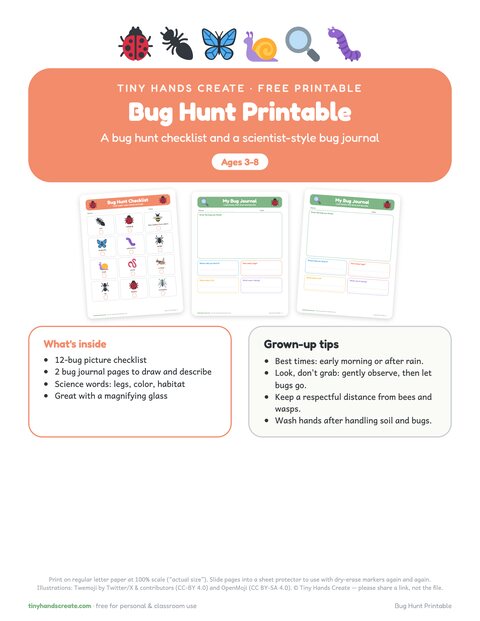
Free printable · 4 pages
Bug Hunt Printable
A 12-bug picture checklist and scientist-style bug journal pages.
Free. Your download link appears right here. You'll also join the Daily Printable Drop. Unsubscribe anytime. Privacy
Essential Bug Hunting Gear
You can absolutely go bug hunting with nothing but curious eyes and careful hands. But a few simple tools elevate the experience from a quick peek to a genuine exploration session.
Basic Bug Hunting Kit
- Magnifying glass — a large-handled one is best for small hands; dollar stores often carry kid-sized versions
- Clear plastic containers with lids — punch small air holes for temporary observation jars
- Soft paintbrush — for gently moving small insects without hurting them
- Plastic tweezers or bug tongs — kid-friendly tools for picking up insects safely
- Small notebook and crayons — for drawing and recording discoveries
- A simple bug identification guide — picture-based field guides for kids work wonderfully
Advanced Explorer Add-Ons
- Bug vacuum or aspirator — these gentle suction tools let kids capture tiny insects without touching them
- Headband magnifier or kid binoculars — for observing butterflies, dragonflies, and other insects at a distance
- White sheet and a flashlight — for nighttime moth observation (a huge hit at summer campouts)
- Small terrarium or bug habitat box — for short-term observation with proper ventilation
Pack everything in a small backpack or canvas tote bag, and your child has an official “field research kit” that makes them feel like a real entomologist.
Bug Hunting Activities by Age
Matching the activity to your child’s developmental stage keeps frustration low and fascination high.
Toddlers (18 Months to 3 Years)
At this age, bug hunting is really about noticing and naming. Take a slow walk through the yard or a park path and point out any insects you see. Say their names clearly: “Look, an ant! See how tiny it is?” Let toddlers crouch down and watch bugs move. Provide a magnifying glass and show them how to hold it. Don’t worry about identification—the goal is building observation habits and vocabulary. Most toddlers are thrilled simply watching a line of ants march along a crack in the sidewalk.
Preschoolers (3 to 5 Years)
This age group is ready for active searching. Teach them to gently lift rocks, look under leaves, check the bark of trees, and peer into flower centers. Bring observation jars for temporary close-up viewing—always release bugs after a few minutes. Start a simple bug tally chart: draw columns for ants, beetles, butterflies, worms, and spiders. Make tally marks for each sighting. This introduces data collection and counting skills in a completely organic way.
School-Age Kids (5 to 8 Years)
Older children can handle more structured exploration. Create a bug journal where they sketch each insect, note the date, location, weather, and what the bug was doing. Introduce the concept of habitat: “Why do you think we found the beetle under the log but the butterfly near the flowers?” Encourage hypotheses and experiments: “Do ants prefer sugar or crackers? Let’s set up a test!” This is genuine scientific method practice wrapped in adventure.
Structured Bug Hunting Games
When free exploration needs a boost, these games add excitement and focus to outdoor time.
Bug Bingo
Create bingo cards with pictures of common local insects: ant, ladybug, butterfly, beetle, spider, worm, grasshopper, bee, dragonfly, caterpillar, fly, moth. Laminate the cards for reuse and provide stickers or washable markers for marking sightings. The first person to complete a row wins. This works beautifully for nature walks, park visits, and camping trips.
Insect Scavenger Hunt
Write a list of clues rather than specific bugs: “Find something with six legs. Find something with wings. Find something that crawls on the ground. Find something that makes a web. Find something with spots.” This approach works even if your local bug population is limited, because children can search creatively and learn that spiders aren’t technically insects (eight legs versus six—a great teaching moment).
Bug Safari Photography
Give older children a camera or tablet and challenge them to photograph as many different insects as they can find. Set rules: the bug must be clearly visible, and they can’t photograph the same species twice. After the safari, look through the photos together and try to identify each insect. Print the best shots and create a field guide poster for the playroom wall.
Worm Charming
This classic British garden game is hilarious and surprisingly effective. Water a patch of ground thoroughly, then have children tap and vibrate the soil surface by pushing a garden fork in and wiggling it, or by stomping gently nearby. The vibrations encourage earthworms to come to the surface. Count how many appear in five minutes. This teaches children about earthworm biology and soil ecology in the most hands-on way possible.
Important Safety and Ethics for Bug Hunting
Teaching children to respect insects is just as important as teaching them to find them. These ground rules keep kids safe and bugs unharmed.
- Look but don’t squeeze — teach gentle handling from the start, and model it yourself
- Always release — observe in jars for a few minutes, then return bugs to exactly where you found them
- Never disturb nests or hives — observe bees, wasps, and ant colonies from a safe distance
- Learn which bugs to avoid — teach children to recognize stinging insects and leave them alone
- Wash hands afterward — especially after touching soil, bark, or insects
- Check for ticks after exploring wooded or grassy areas, particularly during warm months
- Wear closed-toe shoes in areas with fire ants, thorns, or rough terrain
Frame these rules positively: “We’re scientists, and scientists treat their subjects with respect.” Children who learn gentle handling early develop empathy for all living creatures, not just the cute and cuddly ones.
Bringing Bug Learning Indoors
Rainy days and cold seasons don’t have to end the bug exploration. Plenty of indoor activities keep the entomology enthusiasm alive.
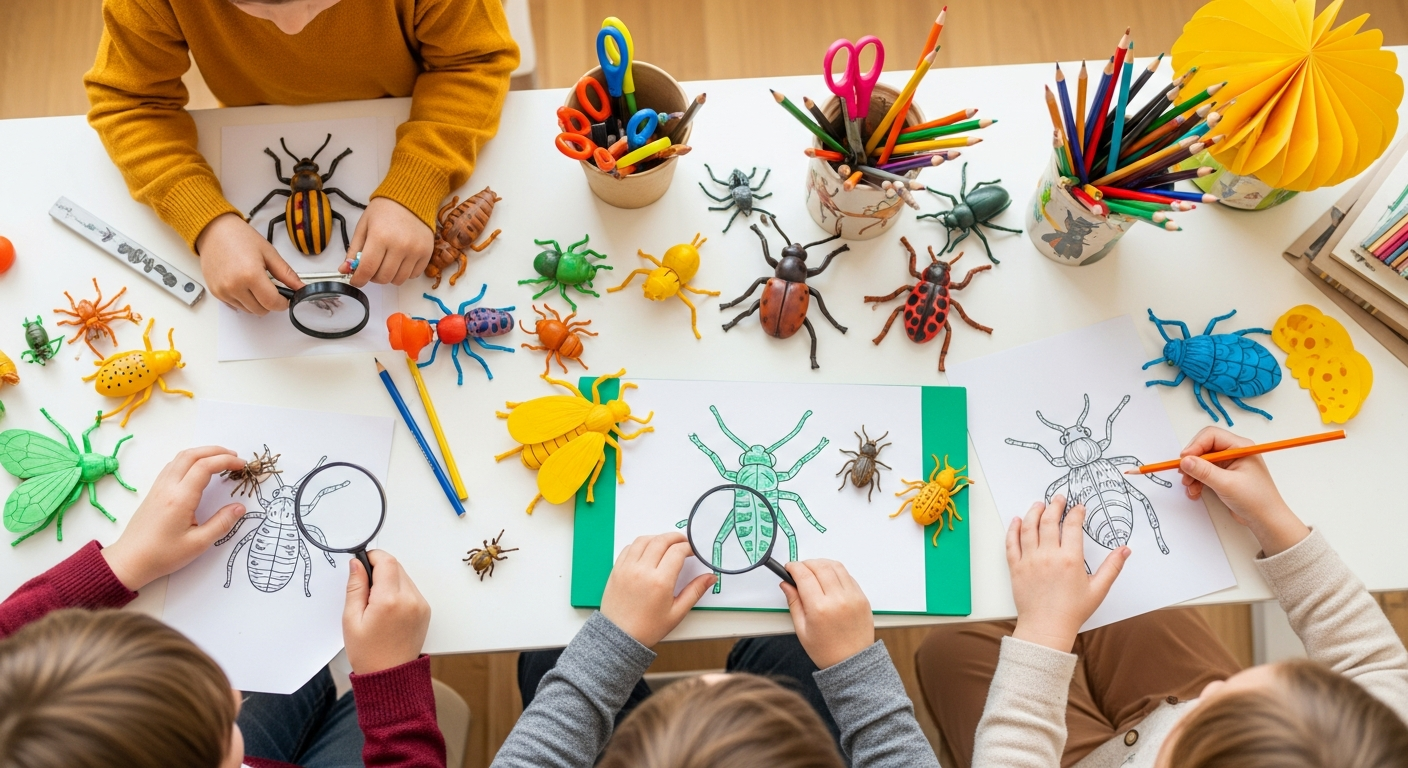
Bug anatomy art: Print or draw a large outline of an insect and label the parts together—head, thorax, abdomen, six legs, antennae, wings. Use playdough to build a 3D model. This reinforces the scientific vocabulary and helps children understand the difference between insects, arachnids, and other crawlers.
Life cycle projects: Study the butterfly or ladybug life cycle using pasta shapes glued to paper—a small shell for the egg, a spiral for the larva, a shell for the pupa, and a bow-tie for the adult butterfly. These make gorgeous display pieces and cement understanding of metamorphosis.
Bug habitat dioramas: Use a shoebox, construction paper, natural materials, and plastic insects to create a miniature habitat. A pond scene, a garden, a forest floor, or a desert each present different bugs and environments. This project integrates art, science, and geography into one satisfying build.
The world of insects is vast, strange, and endlessly fascinating. When you hand a child a magnifying glass and say, “Let’s see what we can find,” you’re not just filling an afternoon—you’re opening a door to scientific wonder that some children walk through for the rest of their lives. And honestly, that’s one of the best parts of this job.
Crafty Mama
Crafty Mama is a former elementary art teacher turned stay-at-home parent who believes every child is creative — they just need the right invitation. She develops age-appropriate activities, crafts, and projects that spark imagination while keeping mess (and parent stress) to a minimum.