Simple Threading Activities for Toddlers
Discover how simple threading activities significantly boost your toddler's fine motor skills, crucial for writing and self-care. Learn age-appropriate activities to support their development from 12 months onward.
- Boost your toddler's fine motor skills, essential for writing and self-care, with threading.
- Match threading activities to your child's age for optimal learning and engagement.
- Understand the 5 stages of threading development, from 12 months to 5 years.
- Introduce pre-threading with large objects like pool noodle rings on a dowel.
- For 18-24 months, use stiff cords or pipe cleaners, not floppy string.
This post contains affiliate links. As an Amazon Associate I earn from qualifying purchases.
In this article (6 sections)
Why My Classroom Had Threading Stations on Every Table
During my first year teaching preschool, I noticed something that changed my entire approach to fine motor development. The children who could thread beads onto a string were the same children who could hold a pencil properly, button their own coats, and zip their backpacks independently. The children who struggled with threading struggled with all of those tasks too. The correlation was so clear that I started putting threading activities on every table, every single day. Within two months, the difference in my students’ hand strength and coordination was visible to every parent at pick-up time. Threading is not just a cute activity. It is the single most effective fine motor exercise I have ever used with young children.
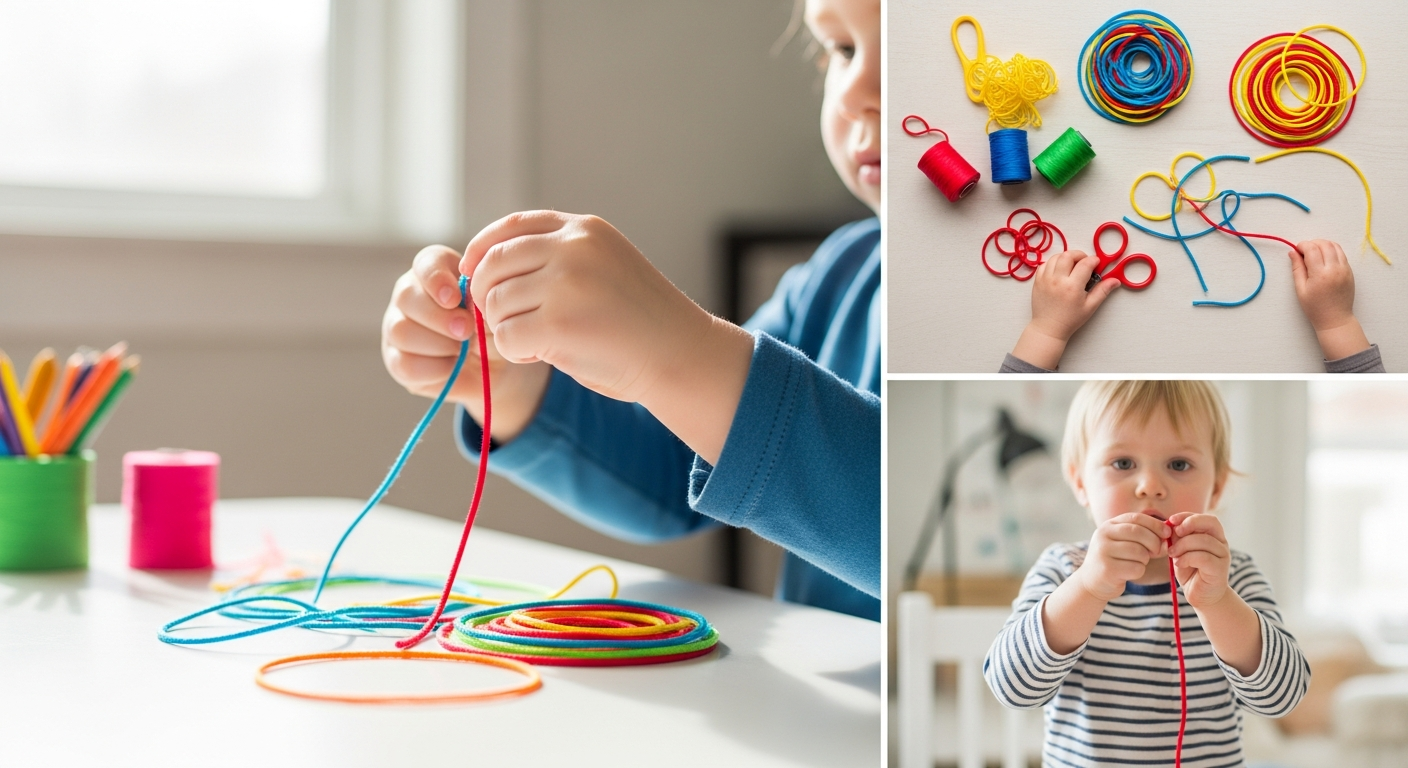
Threading, also called lacing, stringing, or sewing, involves pushing a string, lace, or cord through holes in objects. It sounds simple, and that is exactly why it works so beautifully for toddlers. The basic motion, pinch the string, find the hole, push through, pull, requires the coordination of both hands working together, precise finger control, visual tracking, and sustained concentration. These are the exact skills that form the foundation for writing, self-care tasks, and countless other abilities children need as they grow. Here are the best threading activities for toddlers, organized from easiest to most challenging.
Understanding Threading Development by Age
Before setting up activities, it helps to know what to expect at each stage. Threading ability develops in a predictable sequence:
- 12-18 months: Toddlers can push large objects onto thick dowels or pegs. True threading with a string is too challenging at this stage, but peg-and-ring stacking toys build the same foundational skills.
- 18-24 months: Children can thread large objects with big holes onto stiff cords or pipe cleaners. The rigidity of the cord is key because floppy string is nearly impossible for hands this young to control.
- 2-3 years: Children can thread medium-sized beads onto thick laces with stiff tips (like shoelaces). They can manage lacing cards with pre-punched holes and chunky laces.
- 3-4 years: Children can thread smaller beads onto thinner string, sew through lacing cards with more holes, and begin simple weaving activities.
- 4-5 years: Children can thread small beads, use a blunt tapestry needle with yarn, and complete more complex sewing and weaving projects.
Matching the activity to your child’s current stage is critical. Too easy and they lose interest. Too hard and they get frustrated and refuse to try again. Aim for activities where they can succeed about 80 percent of the time with occasional challenges that stretch their skills.
Beginner Threading Activities (Ages 12-24 Months)
At this stage, the goal is simply to introduce the concept of putting one thing through or onto another. Use large objects with wide openings and stiff “strings.”
Pool Noodle and Pipe Cleaner Threading
Materials: A pool noodle cut into 1-inch rings, thick pipe cleaners or a wooden dowel pushed into a playdough base
Cut a pool noodle into chunky rings. Show your toddler how to slide the rings onto an upright dowel secured in a ball of playdough, or onto a thick pipe cleaner held upright. The pool noodle holes are perfectly sized for little hands to manage, and the rings are light, colorful, and satisfying to stack. This is pre-threading, building the understanding that objects can go onto and through other objects.
Paper Towel Roll Stacking
Materials: An upright paper towel holder (or a stick secured in a jar with playdough), cardboard tubes cut into rings of different widths
Cut paper towel and toilet paper tubes into rings of varying widths. Toddlers drop the rings over the upright pole. Paint the rings in different colors for a color-matching version: red rings go on first, then blue, then yellow. The large diameter of the tube rings means this is achievable even for the youngest toddlers.
Pipe Cleaner and Colander Threading
Materials: A metal colander turned upside down, thick pipe cleaners in assorted colors
This is genius in its simplicity. Turn a colander upside down so the holes face up. Give your toddler pipe cleaners and show them how to push the pipe cleaners through the holes. The pipe cleaners are stiff enough to push through without flopping, and the colander has dozens of holes to choose from. Toddlers love seeing the colorful pipe cleaners sticking up from the colander like a rainbow porcupine. This builds the push-through motion that is the foundation of all threading.
Intermediate Threading Activities (Ages 2-3)
At this stage, children are ready for actual stringing activities where objects slide along a cord or lace.
Stiff Cord and Large Bead Threading
Materials: Large wooden beads with wide holes (at least 1 inch in diameter), a thick shoelace or stiff cord with a taped or plastic tip
The key to success at this age is the stiffness of the cord. A floppy piece of yarn is incredibly frustrating for two-year-olds because it bends and folds when they try to push it through a bead. A thick shoelace with its built-in plastic aglet (the stiff tip) solves this problem perfectly. Alternatively, wrap the end of a piece of yarn tightly with tape to create a stiff point. Provide 8 to 12 large beads and let children thread freely. Once they master the motion, introduce color patterns: red bead, blue bead, red bead, blue bead.
Pasta Threading
Materials: Rigatoni, penne, or wagon wheel pasta (dried), pipe cleaners or stiff laces
Dried pasta with large holes threads beautifully onto pipe cleaners. Dye the pasta first by shaking it in a bag with food coloring and a splash of rubbing alcohol, then spread it on wax paper to dry overnight. The colored pasta makes the threading activity more visually engaging and adds a sorting and patterning dimension. Children thread colored pasta in patterns to make necklaces, bracelets, or garlands.
Cheerio Necklaces
Materials: Cheerios or Froot Loops cereal, a pipe cleaner or yarn with a taped tip
This classic activity works beautifully because the reward is edible. Children thread cereal onto a pipe cleaner or sturdy string, and when finished, they can wear their necklace and eat it. Froot Loops add color for patterning practice. The small size of the cereal hole provides a step up in difficulty from large beads, challenging children to refine their aim and finger precision.
DIY Lacing Cards
Materials: Heavy cardboard or cardstock, a hole punch, shoelaces or thick yarn with taped tips, markers or stickers for decoration
Cut simple shapes from heavy cardboard: a circle, a heart, a star, a fish. Punch holes around the edge of each shape, spacing them about 1 inch apart. Children thread a lace through the holes, going around the entire shape. Decorate the shapes with markers or stickers before or after lacing. Laminate the shapes for durability if you plan to reuse them. These homemade lacing cards work just as well as store-bought versions and can be customized to your child’s interests: dinosaur shapes, vehicle shapes, or letter shapes.
Advanced Threading Activities (Ages 3-5)
Children at this stage have developed enough finger control and patience for smaller beads, more complex patterns, and simple sewing projects.
Pony Bead Threading
Materials: Pony beads in assorted colors, thin lacing cord or yarn with a taped tip
Pony beads have smaller holes than large wooden beads, requiring more precise aim. Children can create bracelets, necklaces, and keychains with detailed color patterns. Provide pattern cards showing specific color sequences for children to replicate. Start with two-color patterns (AB) and progress to three-color (ABC) and more complex patterns (AABB, ABB). Pattern work during threading builds early algebraic thinking and sequential memory.
Button Sewing Cards
Materials: A large piece of burlap or felt, large buttons, a plastic tapestry needle, thick yarn
Thread a plastic tapestry needle with yarn and knot the end. Show your child how to push the needle up through the fabric and then through a button hole, back down through the second hole and through the fabric, and pull tight. This is actual sewing, simplified for small hands. The blunt tapestry needle is safe, the burlap is easy to push through, and the large buttons are satisfying to secure. Children sew 3 to 5 buttons onto their fabric and beam with the accomplishment of real sewing.
Nature Threading
Materials: Natural items with holes or that can be pierced (leaves, flower petals, thin bark), a blunt tapestry needle, thick yarn or string
Go on a nature walk and collect leaves, flower petals, and other flat natural items. Back at home, use a tapestry needle to poke a hole through each item (an adult may need to start the holes for younger children). Thread the natural items onto yarn to create a nature garland. Hang it across a window or along a mantle. This combines outdoor exploration, fine motor practice, and natural art into one beautiful activity.
Setting Up a Threading Station That Invites Play
A dedicated threading station encourages children to practice this skill independently and frequently. Here is how to create one:
- Container: Use a shallow tray or divided container to hold threading supplies. A muffin tin works perfectly for sorting beads by color while keeping strings and tools organized in the remaining cups.
- Visibility: Store the station on a low, accessible shelf where your child can see the materials and choose to use them independently.
- Rotation: Change the threading materials every week or two. One week might feature large wooden beads, the next week pasta, the next week buttons. Fresh materials renew interest.
- Progression: Gradually decrease the size of the beads and holes as your child’s skills improve. Move from pool noodle rings to large wooden beads to pony beads to small craft beads over the course of several months.
- Display: Hang finished necklaces and garlands where your child can see them. Seeing their completed work motivates them to create more and builds confidence in their abilities.
Threading is one of those deceptively simple activities that delivers outsized developmental benefits. Every time your toddler pushes a lace through a bead, they are strengthening the muscles that will hold a pencil, refining the coordination that will button a shirt, and building the patience that will carry them through challenging tasks for years to come. Set up that colander with pipe cleaners today, and watch those tiny hands get to work.
Crafty Mama
Crafty Mama is a former elementary art teacher turned stay-at-home parent who believes every child is creative — they just need the right invitation. She develops age-appropriate activities, crafts, and projects that spark imagination while keeping mess (and parent stress) to a minimum.