Shaving Cream Sensory Activities
Discover nine engaging shaving cream activities for kids aged 3-7, covering sensory play, learning, and art. You'll also find essential safety guidelines, taste-safe alternatives, and a free printable activity pack to ensure fun and safe play.
- Explore nine shaving cream activities for kids aged 3-7, categorized by play type.
- Prioritize safety: shaving cream is not food; use taste-safe alternatives if your child mouths objects.
- Follow detailed steps for eye contact or swallowing, including calling Poison Control.
- Download a free printable activity pack with supplies, safety, and activity cards.
- Choose fragrance-free, menthol-free shaving cream and always supervise closely.
This post contains affiliate links. As an Amazon Associate I earn from qualifying purchases.
The first time I sprayed a mound of shaving cream onto a table for a small group of four-year-olds, nobody moved for a few seconds. Then one kid pressed both palms in, and the whole table followed.
This page has nine shaving cream activities for kids about 3 to 7, in three groups: classic sensory play, letter and number learning, and color, foam and art experiments. Safety notes come first, because shaving cream is not food and needs a few ground rules.
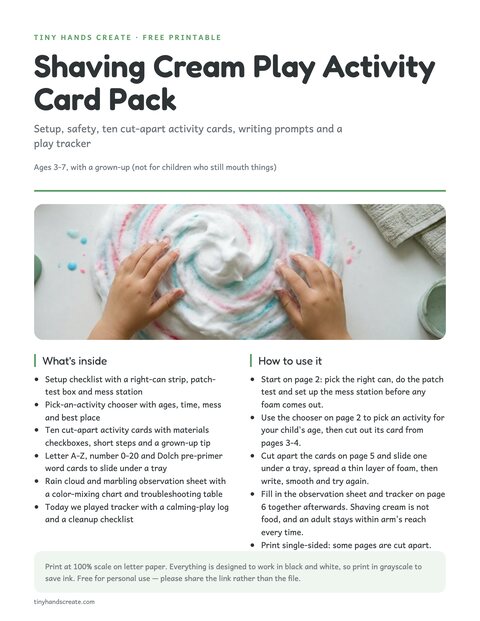
Free printable · 6 pages
Shaving Cream Play Activity Card Pack
A supplies and safety checklist, an activity chooser, ten cut-apart activity cards, letter, number and Dolch pre-primer word cards, a rain cloud and marbling observation sheet, a troubleshooting table and a Today we played tracker.
Free. Your download link appears right here. You'll also join the Daily Printable Drop. Unsubscribe anytime. Privacy
One honest trade-off: the foam goes flat within a few minutes and can dry out little hands. Spray small amounts and top up as you go. For more low-mess ideas, see our no-mess sensory play ideas and the Mess-Free Sensory Play Kit printable.
In this article (9 sections)
- Nine Shaving Cream Activities at a Glance
- Is Shaving Cream Safe for Kids? Ages and Precautions
- What Shaving Cream to Buy and How Much to Use
- Classic Shaving Cream Sensory Explorations
- Shaving Cream Learning Activities
- Color, Foam and Art Experiments
- Mess Management: Keeping Shaving Cream Play Manageable
- Troubleshooting
- Shaving Cream FAQ
Nine Shaving Cream Activities at a Glance
| Activity | Best ages | Time | Mess | Extra supplies |
|---|---|---|---|---|
| Tabletop play | 3+ | 15-30 min | Medium | Washable watercolors (optional) |
| Car wash | 3+ | 20-30 min | Medium | Toy cars, new brushes, water bin |
| Window painting | 3+ | 15-20 min | Low | Squeegee |
| Letter writing | 4-7 | 10-15 min | Low | Alphabet cards |
| Number practice | 4-7 | 10-15 min | Low | Die or number cards |
| Sight words | 5-7 | 10-15 min | Low | Word cards |
| Rain clouds | 3+ | 10-15 min | Low | Clear glass, dropper |
| Marbled paper | 4+ | 20-30 min | Medium | Cardstock, baking pan |
| Puffy paint | 4+ | 20 min plus drying | Medium | White glue, cardstock |
Good to knowNone of these are edible. Every activity needs an adult nearby.
Is Shaving Cream Safe for Kids? Ages and Precautions
Safety firstShaving cream is not food. Skip it for any child who still puts hands or objects in their mouth, at any age. Use a taste-safe foam instead.
| Situation | What to do |
|---|---|
| Child still mouths things | Use plain, unsweetened whipped yogurt or whipped cream you whip yourself, not a spray can. Both are dairy, so only offer them to a child who has already had dairy with no reaction. Keep an adult within arm’s reach. Don’t leave them out long, because they spoil. |
| Eyes and face | Keep foam away from eyes, face and mouth. Remind kids not to touch their faces with foamy hands. If foam gets in the eyes, flush with lukewarm water for 15 minutes. Then call Poison Control (1-800-222-1222). Get urgent medical care if the eye is still red or painful, or if vision is blurry. |
| Swallowed | Follow the four steps under “If Your Child Swallows Shaving Cream” below. |
| Skin | Skip it on broken skin or active eczema. Check with your pediatrician first if your child has eczema or contact dermatitis. Wash off promptly. Stop if you see redness, itching or a rash. |
The taste-safe swap is for the mouthing stage only. It doesn’t replace supervision, so stay close the whole time.
Taste-safe foam works for the tabletop, car wash and letter activities. Skip it for marbled paper and puffy paint, which need a stable foam. It goes flat faster than shaving cream, so use small amounts.
If Your Child Swallows Shaving Cream
- Wipe. Wipe out the mouth.
- Sip. Give a few sips of water.
- No vomiting. Do not make them vomit.
- Call. Call Poison Control (1-800-222-1222) for any swallowed amount. They can advise on the specific product.
Safety firstCall 911 if your child has trouble breathing, is drowsy, or keeps vomiting.
Pre-Play Safety Checklist
- Child does not put hands or objects in their mouth
- No broken skin or active eczema
- Fragrance-free, menthol-free foam
- Patch test done (15-30 min wait; up to 24 hours for very reactive skin)
- Adult within arm’s reach
- Damp cloth and water nearby
- Window or glass activity: tempered glass only, non-slip mat down
What Shaving Cream to Buy and How Much to Use
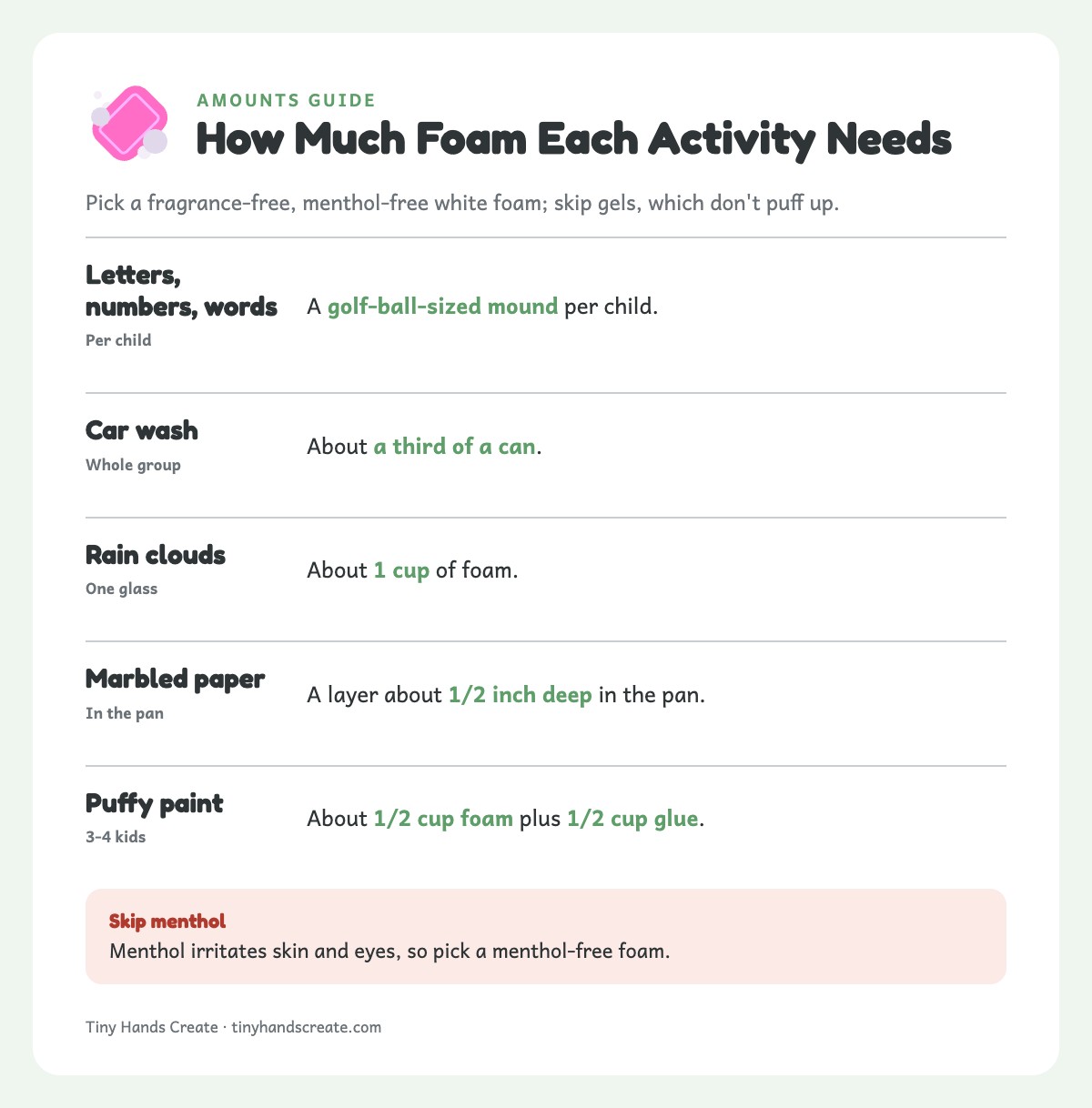
Pick a fragrance-free, menthol-free white foam. Menthol irritates skin and eyes, so skip it. Skip gels too, because they don’t puff up.
Classic foam is the fluffiest. For reactive skin, a fragrance-free sensitive-skin foam is the better pick. It’s a little less fluffy.
A standard 6-11 oz can goes a long way. Here is about how much each activity uses:
| Activity | How much |
|---|---|
| Letters, numbers, sight words | A golf-ball-sized mound per child |
| Car wash | About a third of a can |
| Rain clouds | About 1 cup of foam |
| Marbled paper | A layer about 1/2 inch deep in the pan |
| Puffy paint | About 1/2 cup foam plus 1/2 cup glue for 3-4 kids |
Patch test: Put a small dab on the inner forearm and wait 15-30 minutes before play. For very reactive skin, wait up to 24 hours. Look for redness, itching or a rash, and skip the activity if you see any.
A patch test lowers the risk of a reaction, but it doesn’t remove it. Keep an eye on skin during play too.
Classic Shaving Cream Sensory Explorations
These activities use shaving cream as the main sensory material. They’re simple to set up, and the foam wipes off non-porous surfaces with a damp cloth.
Tabletop Shaving Cream Play
Materials:
- A can of shaving cream
- A smooth table, plastic tablecloth or large tray
- Optional: food coloring or washable liquid watercolors
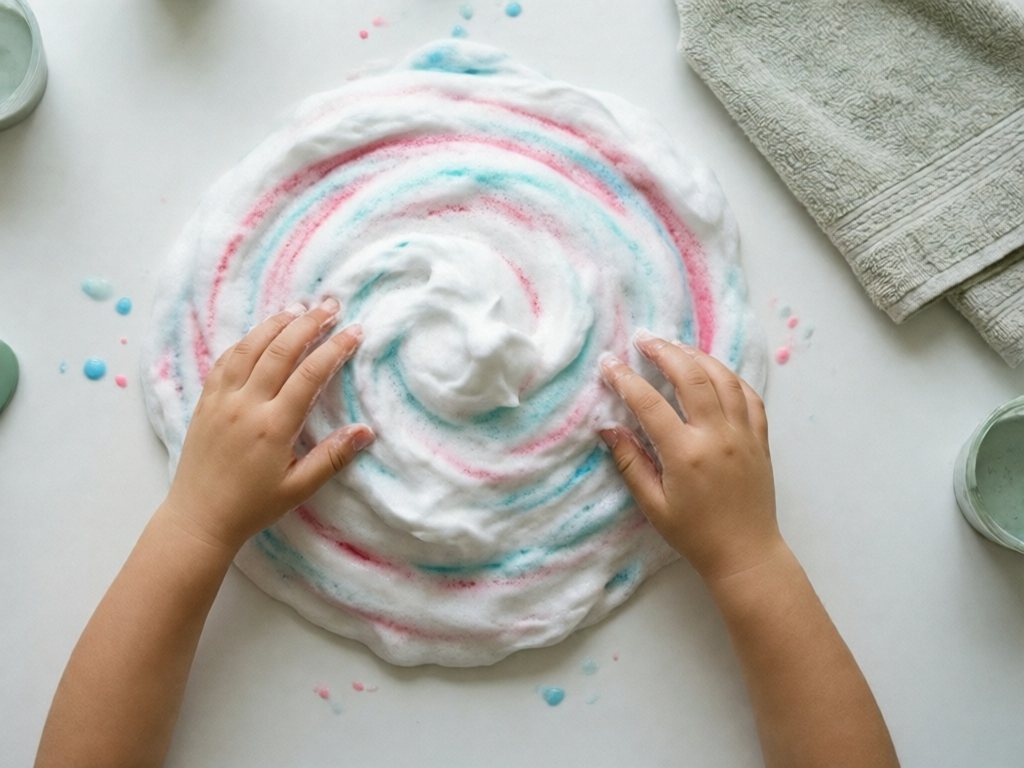
Spray a mound of shaving cream onto the table, tray or cookie sheet. Let your child spread, swirl, pile and flatten it with their hands.
Add a drop or two of food coloring and watch them discover color mixing as the colors swirl through the white foam.
Expect kids to spend most of the time just squishing. That is the point. Squishing and drawing in the foam is good fine motor practice too.
On a cookie sheet, our foam flattens within a few minutes. I respray a small mound instead of starting with a mountain.
Some kids dislike the feel, so never force it. Offer a spoon or brush instead. Talk to your pediatrician or an occupational therapist if sensory difficulties persist.
TipNo full-body play; hands and forearms only. Roll up sleeves or use an oversized adult t-shirt as a smock. Foam will still wander onto elbows and chins. Keep a damp towel nearby and remind kids to keep foamy hands away from their faces.
Shaving Cream Car Wash
Materials:
- Shaving cream
- Plastic toy cars and trucks
- A shallow bin of warm water
- New, dedicated toothbrushes or small scrub brushes (never old family toothbrushes)
- Towels for drying
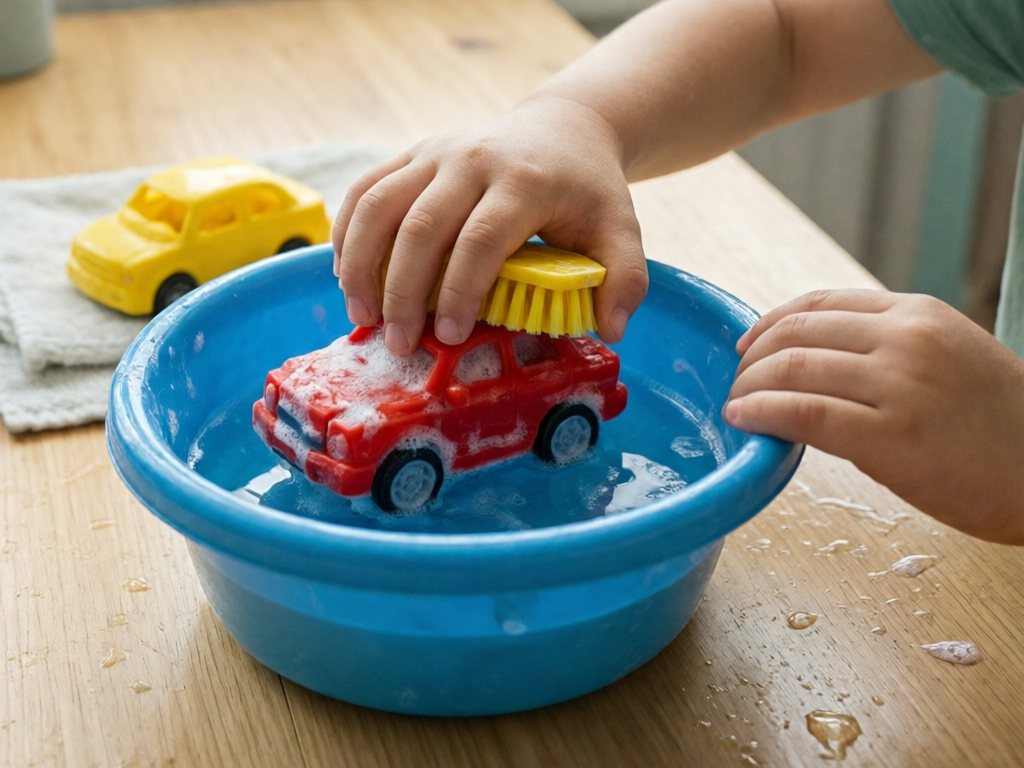
- Soap up. Cover the toy vehicles in shaving cream (the “soap”).
- Scrub. Let kids scrub with the brushes in the water bin.
- Rinse and dry. Dunk, then dry with towels.
This mixes sensory play with pretend play and sequencing (soap, scrub, rinse, dry). In my groups, kids sent every car through the wash again and again, and the scrubbing gives little hands a good workout.
Safety firstNever leave a young child alone with a water bin, even a shallow one.
Shaving Cream Window Painting
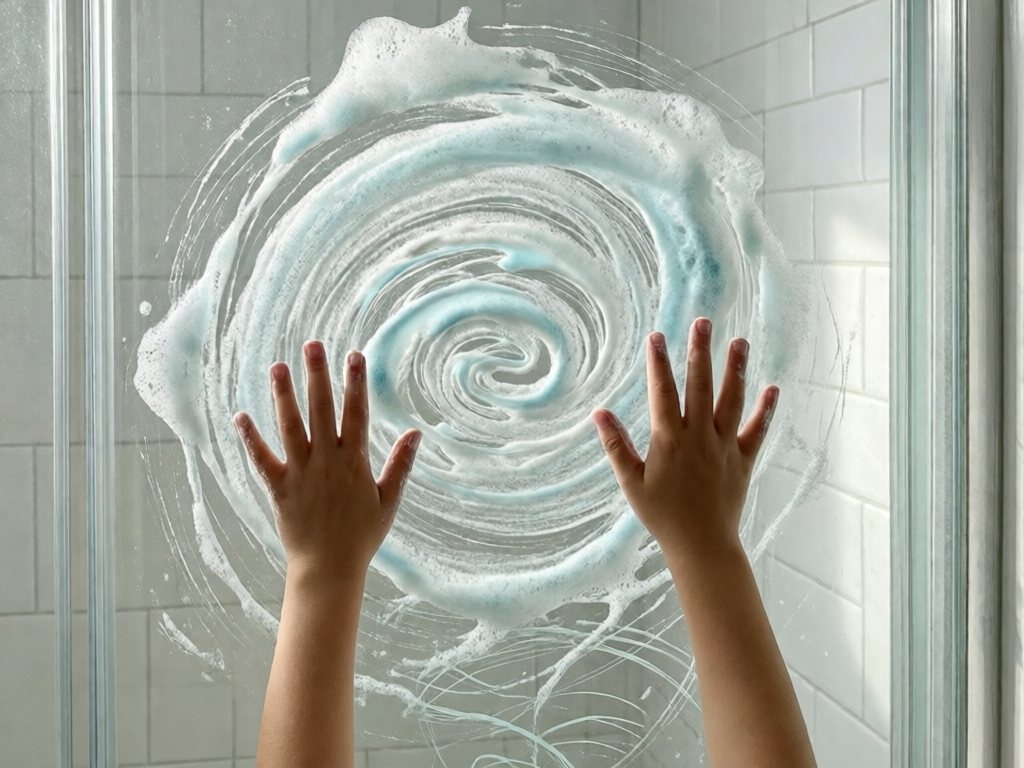
Materials:
- Shaving cream
- A sliding glass door, large window or shower door (tempered glass), or a plastic table or large tray as a safer alternative
- Optional: food coloring mixed into the cream
Spray shaving cream on a glass surface and let your child spread, draw and make designs. The vertical surface is a different motor experience than table play: kids work against gravity and use bigger arm movements. When they’re done, squeegee and rinse with water.
Safety firstSupervise closely. Use only tempered or shatter-resistant glass (shower doors usually are). Put a non-slip mat underneath and wipe drips off the floor as you go. Don’t let kids lean hard on the glass. For 3-year-olds, use the plastic table or large tray instead of glass.
Shaving Cream Learning Activities
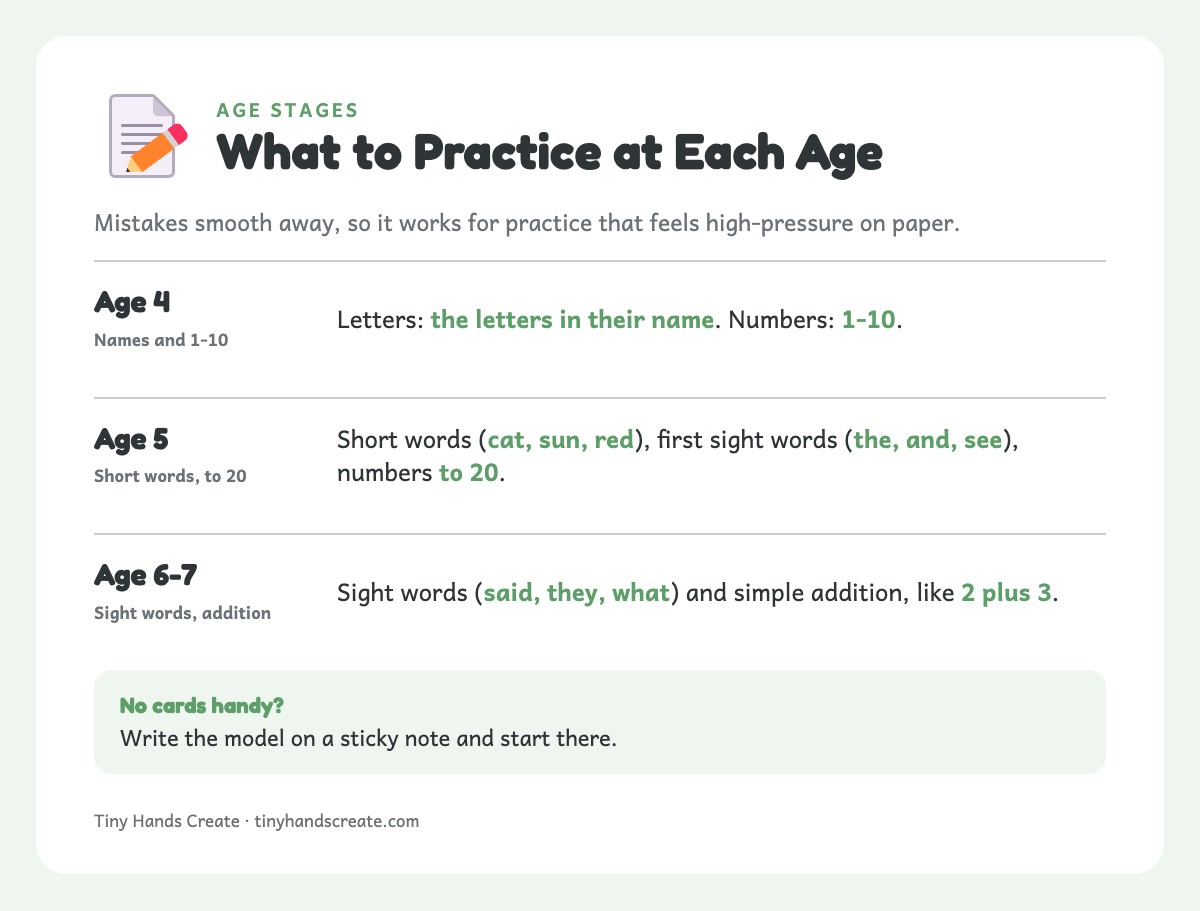
Shaving cream also works for practice that would feel high-pressure on paper, because mistakes smooth away. Pair these with our alphabet worksheets, number tracing worksheets and sight word flashcards for models to copy.
No cards handy? Write the model on a sticky note and start here. Ages are a rough guide, so follow what your child already knows.
| Age | Letters and words | Numbers |
|---|---|---|
| 4 | The letters in their name | 1-10 |
| 5 | Short words: cat, sun, red. First sight words: the, and, see | Numbers to 20 |
| 6-7 | Sight words: said, they, what | Simple addition, like 2 plus 3 |
Shaving Cream Letter Writing
Materials:
- Shaving cream spread on a table or tray
- Alphabet flashcards or a written model to copy
Spread shaving cream in an even layer on the table. Call out a letter and have your child write it with a finger. If it doesn’t look right, they smooth the surface and try again — no erasers, no crossing out. This can feel less stressful for children who are nervous about writing. A golf-ball-sized mound spread thin is plenty per child.
Start with the letters in your child’s name, then try short words like cat, sun and red. If a letter comes out backwards, show the card again, smooth the foam and let them have another go. No fuss needed.
Shaving Cream Number Practice
Materials:
- Shaving cream spread on a surface
- Number cards or dice
Roll a die and have your child write the number in the shaving cream. Or call out numbers for them to write. For a bigger challenge, try simple addition: “Write the answer to 2 plus 3.”
Start with 1-10, then move on to the teen numbers. A backwards 3 or 7 is easy to fix: smooth the foam and write it again next to the card.
Sight Word Practice
Materials:
- Shaving cream on a tray or table
- Sight word flashcards
Show a sight word card and have your child write the word in the shaving cream. This suits kindergartners and first graders learning high-frequency words. Have them say the word, trace it, say it again, then smooth the surface and swap in a new card.
Good starter words: the, and, see, can, like. A handful of words per session is plenty.
Color, Foam and Art Experiments
Rain clouds is a quick science demo; marbling and puffy paint turn the foam into art. For more of the science side, try our kitchen science experiments for kids and color mixing experiments for preschoolers.
Shaving Cream Rain Clouds
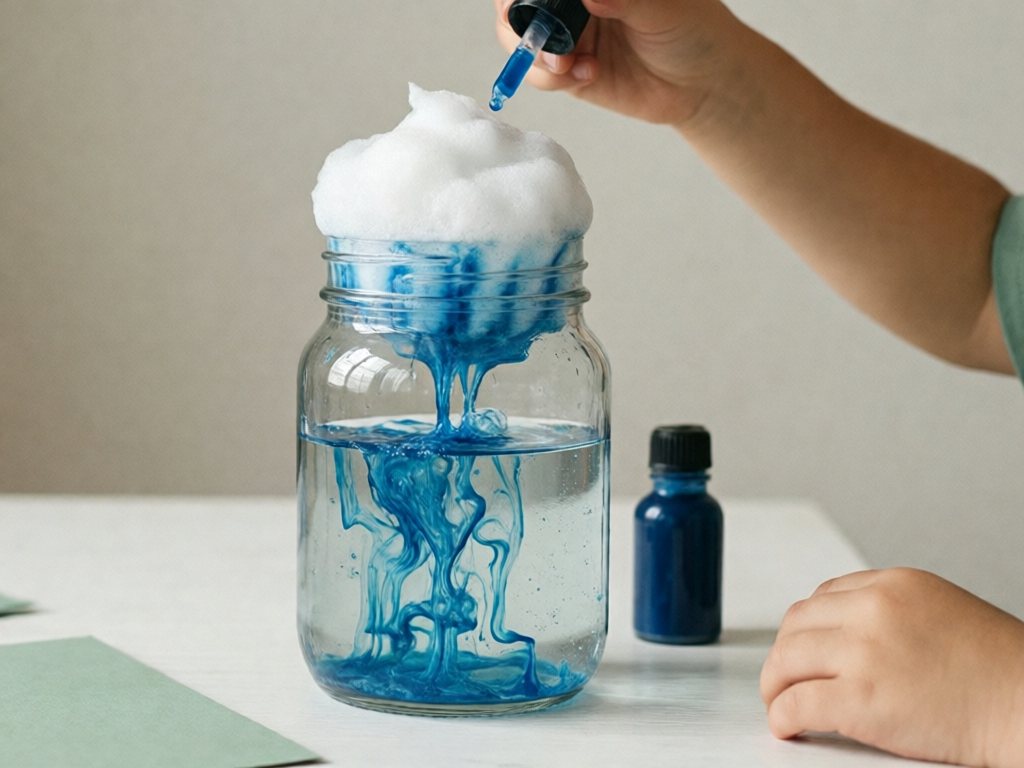
Materials:
- A clear glass or jar filled three-quarters with water
- About 1 cup of shaving cream, sprayed on top of the water (the “cloud”)
- Liquid food coloring
- A dropper or spoon
- Fill the glass. Fill it about three-quarters with water.
- Add the cloud. Spray a thick layer of shaving cream on top, about 1 cup.
- Drip the color. Use a dropper to add food coloring onto the cloud.
- Watch it rain. The color sits on top at first, then soaks through and streaks down into the water.
This is a simplified model of rain. Real clouds aren’t foam; the color just soaks through the foam and sinks into the water. Ask your child to guess which color will break through first.
Food coloring can stain, so keep it on a wipeable surface. For more rainy-day science, see our weather activities and experiments.
Shaving Cream Marbled Paper
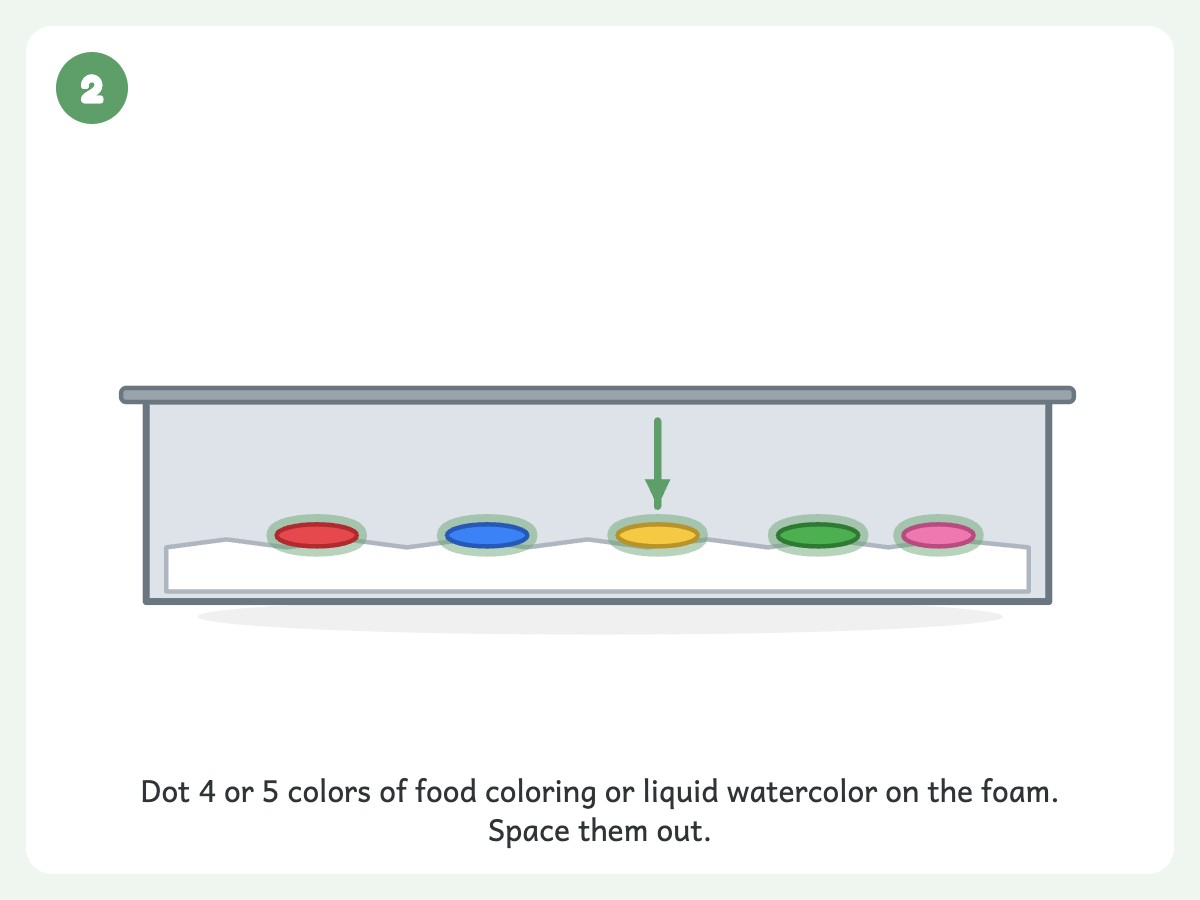
Materials:
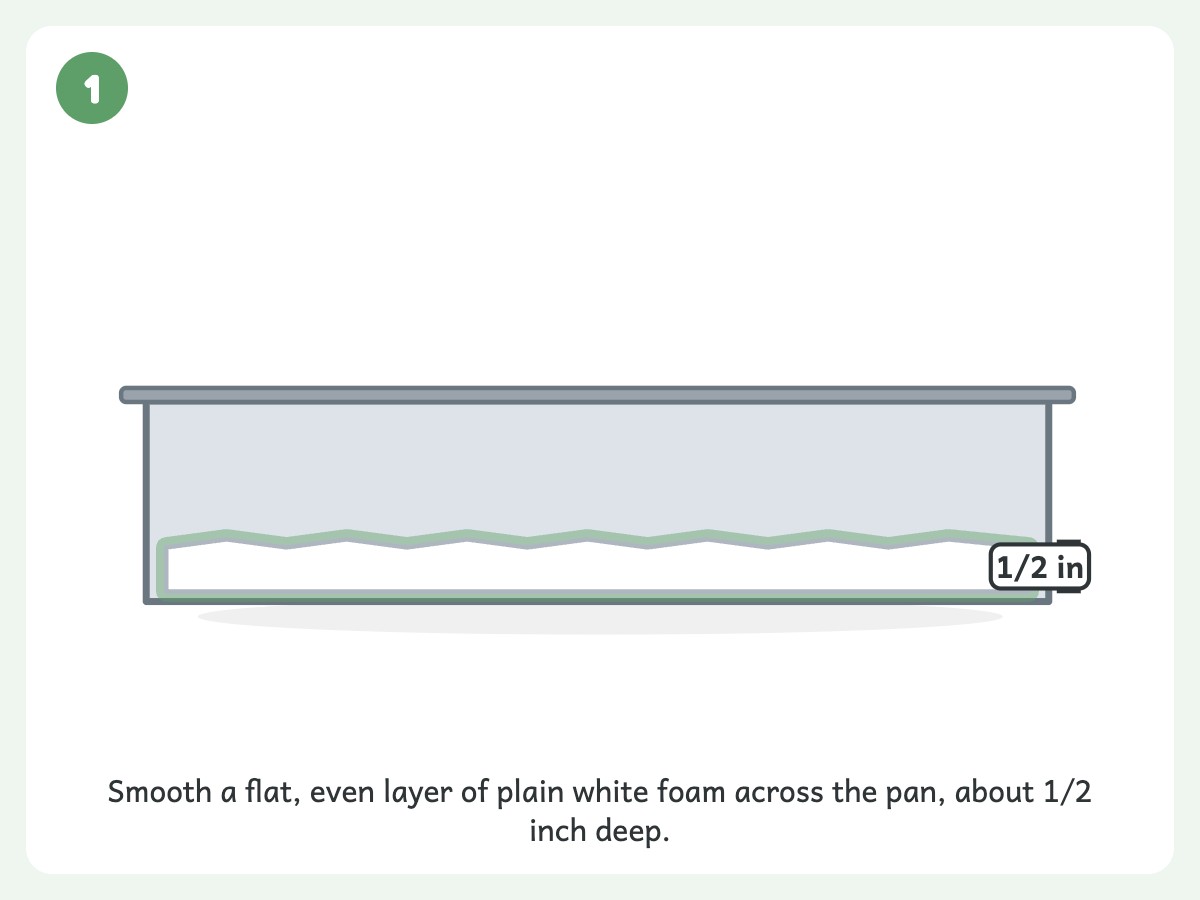
- Shaving cream spread in an even layer, about 1/2 inch deep, on a baking pan
- Drops of food coloring or liquid watercolors (multiple colors)
- A toothpick or fork for swirling
- White cardstock
- A ruler or straight edge for scraping
- Spread. Smooth shaving cream across the pan in an even layer about 1/2 inch deep.
- Dot the color. Drop several colors onto the surface.
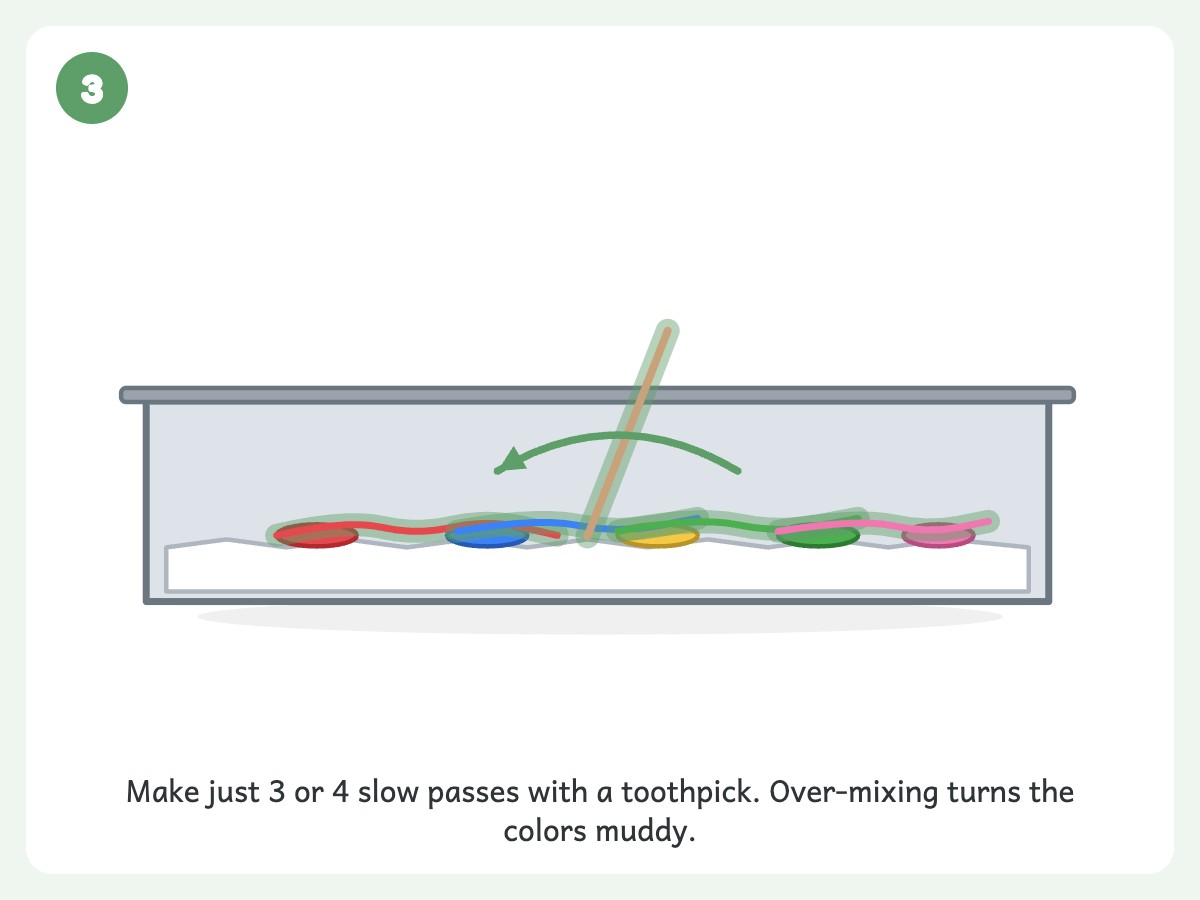
- Swirl gently. Use a toothpick; a few swirls make the best patterns, so don’t over-mix.
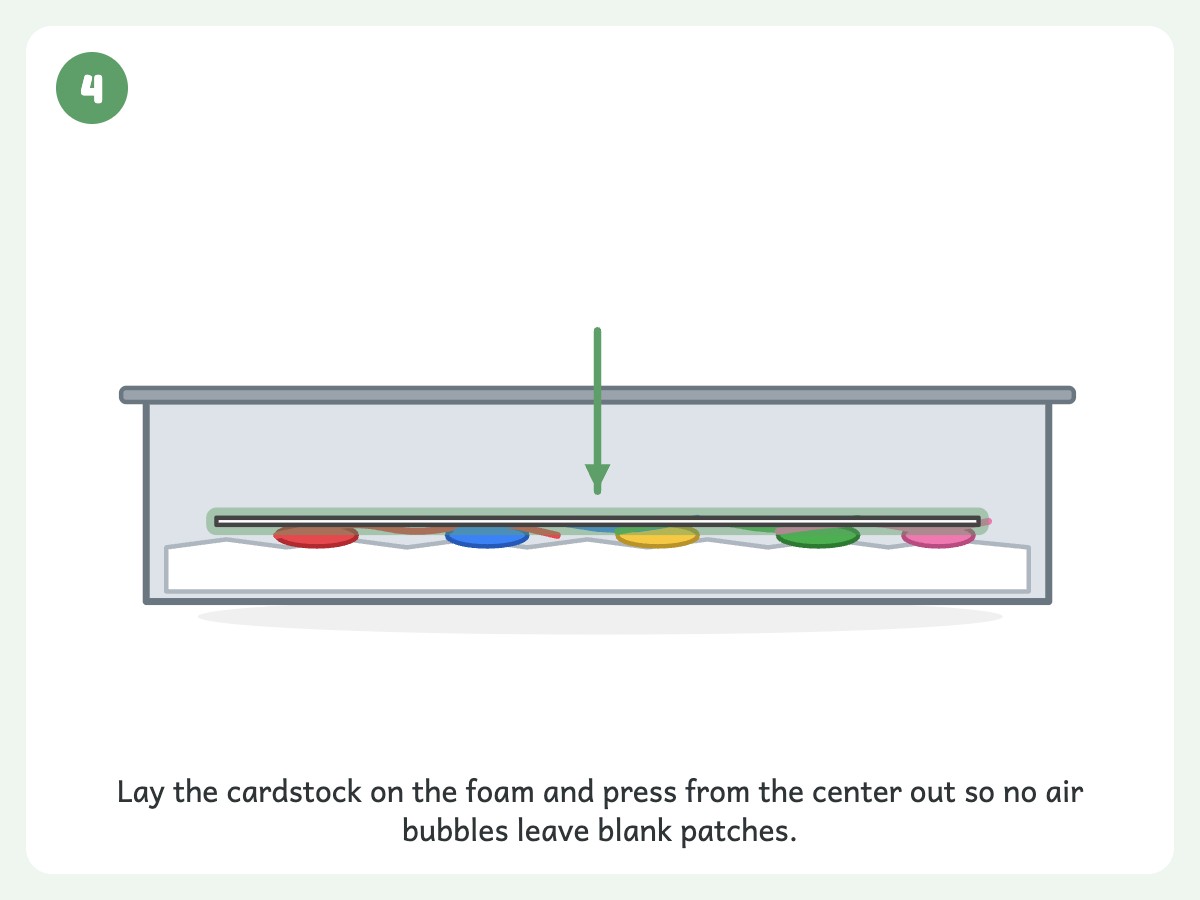
- Press. Lay cardstock firmly on the foam, then lift it off.
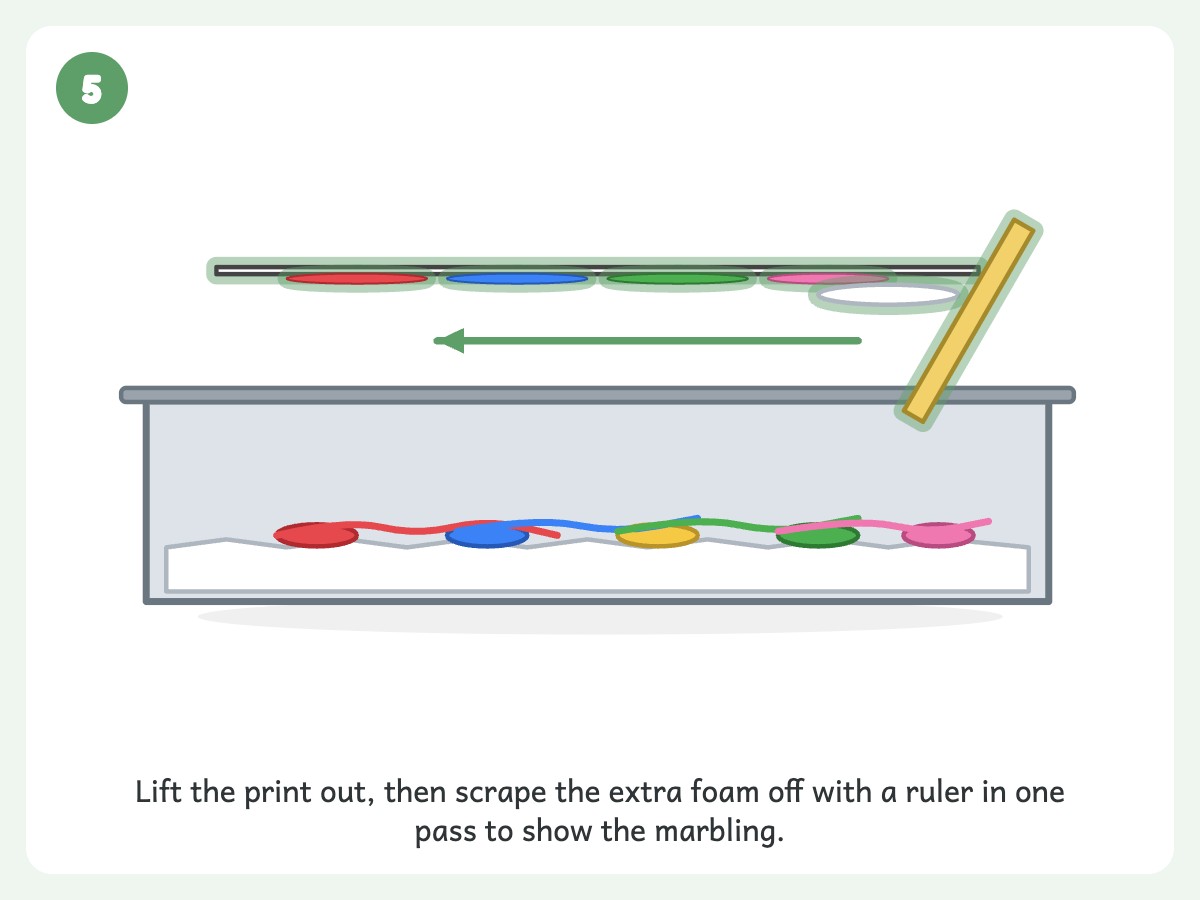
- Scrape. Use a ruler to scrape off the excess cream.
What’s left is a marbled print that looks like fancy book endpapers, and each one is unique. Use it for cards, book covers or framing. Washable watercolors stain less than food coloring on skin and clothes.
My first batch came out muddy grey because I let the kids swirl until the colors blended. Now we count three or four passes with the toothpick, then stop.
TipPress the cardstock from the center out so air bubbles don’t leave blank patches. Spread fresh foam for each new set of colors.
Shaving Cream and Glue Puffy Paint
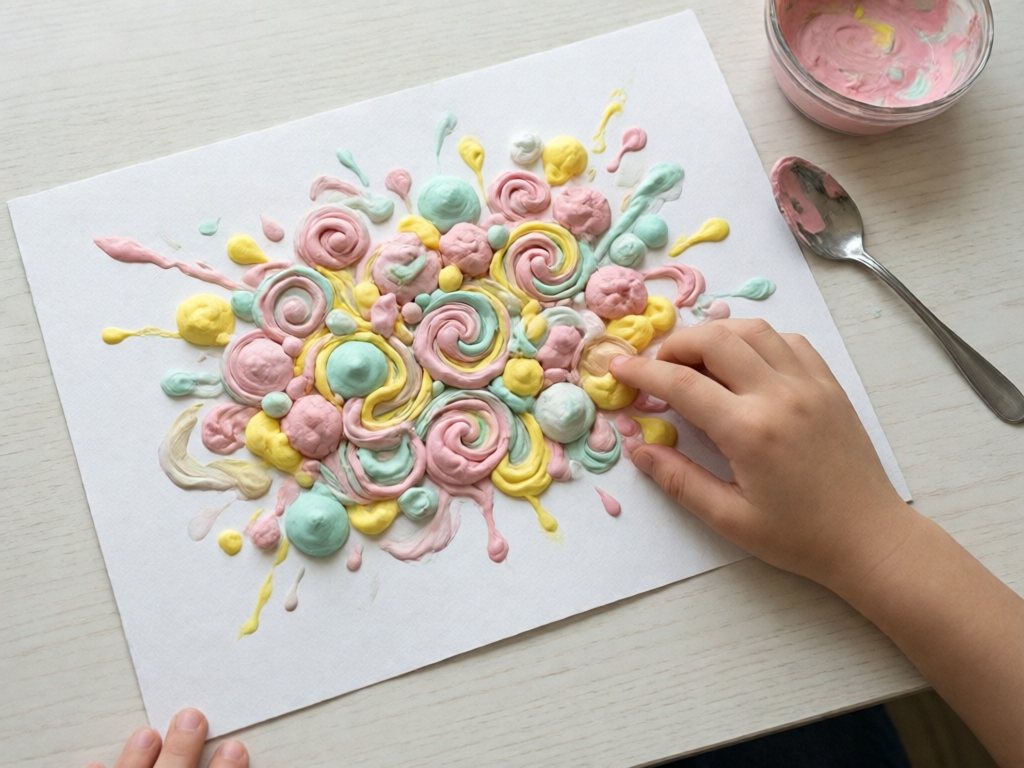
Materials:
- About 1/2 cup shaving cream and 1/2 cup white school glue (equal parts, enough for 3-4 kids)
- Food coloring
- Mixing bowl and spoon
- Heavy cardstock or cardboard
- Mix. Stir about 1/2 cup shaving cream and 1/2 cup glue in a bowl. That makes enough for 3-4 kids.
- Color. Divide into portions and add food coloring to each. It can stain, so protect clothes and surfaces.
- Paint. Spread, drip or squeeze onto cardstock.
- Dry. Leave flat overnight to 24 hours, depending on thickness.
The dried paint stays soft, puffy and slightly spongy, so it makes raised, three-dimensional art. Thick layers can stay tacky longer. Wash hands when you’re done, since the mix has glue in it.
Mess Management: Keeping Shaving Cream Play Manageable
A little prep is the difference between “fun mess” and “why is there foam on the ceiling?”
- Choose your surface: Kitchen tables, outdoor tables and cookie sheets work well. Avoid carpet and upholstered furniture.
- Use a cookie sheet as a portable tray: It contains the cream and carries easily to the sink. My shortcut: scrape the leftover foam into the trash with a ruler or spatula first. Then the sink only gets a thin film.
- Keep damp cloths nearby: Some kids get upset when foam lands on their face or somewhere unexpected, and a cloth within reach usually heads off a meltdown.
- Protect floors: A plastic tablecloth under the activity area catches drips.
Safety firstFoam makes tub floors very slippery. Save tub play for older kids who stay seated on a non-slip suction mat. Stay within arm’s reach and never leave them alone. Rinse foam off the tub floor before anyone stands.
| Surface | Cleanup | Watch out for |
|---|---|---|
| Table or tray (non-porous) | Damp cloth | Foam doesn’t disinfect |
| Glass or shower door | Squeegee and rinse | Slippery floor below |
| Tub | Rinse the floor | Slippery tub floor |
| Clothing | Pre-treat food coloring | Dye stains |
| Grout and wood | Wipe quickly | May stain; use washable watercolors |
Shaving cream wipes off non-porous surfaces easily. It doesn’t disinfect, though. Food coloring can stain grout, wood, clothes and skin.
Troubleshooting
| Problem | Fix |
|---|---|
| Child hates the feel | Offer a spoon, brush or gloves, or seal some foam in a zip-top bag for squishing. Never force it. |
| Foam in the eyes | Flush with lukewarm water for 15 minutes. Then call Poison Control (1-800-222-1222). Get urgent medical care if the eye is still red or painful, or if vision is blurry. |
| Food coloring stains | Switch to washable liquid watercolors. |
| Flat foam | Spray a fresh layer; it deflates quickly. |
| Foam on the floor or tub | Rinse it off before anyone stands. |
| Marbled print is muddy | Don’t over-swirl, and use fewer colors. |
| Marbled print is faint | Press harder, and scrape the cream off in one pass. |
| Puffy paint stays tacky | Use thinner layers and give it a full 24 hours. |
Shaving Cream FAQ
Is shaving cream safe for toddlers?
It’s best for kids about 3+ with supervision. It isn’t for children who still mouth objects.
What if my child swallows some?
Wipe out the mouth, give a few sips of water, and do not make them vomit. Call Poison Control at 1-800-222-1222 for any swallowed amount. Call 911 for trouble breathing, drowsiness or repeated vomiting.
What are taste-safe alternatives?
Plain, unsweetened whipped yogurt or whipped cream you whip yourself, not a spray can. Only offer them to a child who has already had dairy. They work for tabletop, car wash and letter play, but not for marbling or puffy paint. See our edible sensory play ideas.
How do I get food coloring off skin?
Wash with soap and water; it may fade over a day or two. Washable watercolors stain less.
If your child dislikes the cold, wet feel of foam, try cloud dough or playdough next. Both are dry and easy to handle.
Crafty Mama
Crafty Mama is a former elementary art teacher turned stay-at-home parent who believes every child is creative — they just need the right invitation. She develops age-appropriate activities, crafts, and projects that spark imagination while keeping mess (and parent stress) to a minimum.