Easy Origami for Kids: Beginner Folding Projects
You'll discover five easy origami projects for kids, learn about the best paper to use, and get tips for successful folding, including safety notes and fixes for common frustrations.
- Start with the Classic Cup or Accordion Butterfly, saving the Jumping Frog for last.
- Use printer paper or origami paper; cut 8.5-inch squares for small hands.
- Work on a hard surface and demonstrate each fold before your child tries.
- Supervise young children and ensure safety with materials like pipe cleaners.
This post contains affiliate links. As an Amazon Associate I earn from qualifying purchases.
Few crafts earn a gasp like a paper frog that actually hops across the table. That is why I love origami with kids: a flat sheet of paper becomes something three-dimensional, with little or no glue or scissors and no batteries.
Below you’ll find five beginner models, the best paper to use, safety notes, and fixes for common folding frustrations. Expect a few torn corners and crumpled first attempts. That’s part of the fun.
Start with the cup or the butterfly. Save the frog for last.
| Project | Age | Paper | Time | Difficulty (1-3) | What it teaches |
|---|---|---|---|---|---|
| 1. Classic Cup | 4+ | 6-inch square | 5 min | 1 | Diagonal folds, symmetry |
| 2. Accordion Butterfly | 5+ | 6-inch square, plus a pipe cleaner or tape | 10 min | 1 | Pleat folds |
| 3. Paper Boat | 4+ | Letter paper | 10 min | 2 | Visualizing 3D shapes |
| 4. Fortune Teller | 5+ | 8-inch square | 15 min | 2 | Precision, symmetry |
| 5. Jumping Frog | 5+ | Index card | 15-20 min | 3 | Sequencing |
In this article (7 sections)
Why Origami Is Great for Kids (Skills It Builds)
When children follow a folding sequence, they practice spatial thinking, sequencing, and working memory. Pressing each crease gives little fingers practice with small, controlled movements. Folding also puts math in their hands: halve a square and you get two equal parts, and words like diagonal, corner, and edge start to mean something.
Origami is also cheap, since many beginner projects work with plain printer paper. You can cut your own squares from letter paper, and the three steps are in the paper section below. For ready-made step cards, use the Origami Beginner Project Card Pack on this page.
For more hand-strengthening play, try our cutting practice sheets and these fine motor activities.
Best Paper for Kids’ Origami and Setup Tips
Paper Choices for Beginners
| Paper | Thickness | Best for | Watch out for |
|---|---|---|---|
| Origami paper (kami) | Thin | Most models; one colored side and one white side show which side is which | Tears if pressed too hard |
| Printer paper, cut into squares | Medium | Beginners; holds creases well | Needs pre-cutting |
| Construction paper | Thick | Simple models with few folds | Cracks on many-fold models |
| Newspaper | Thin | Practice, hats, and boats | Ink on hands; kids mouth paper |
Make a Square From Letter Paper
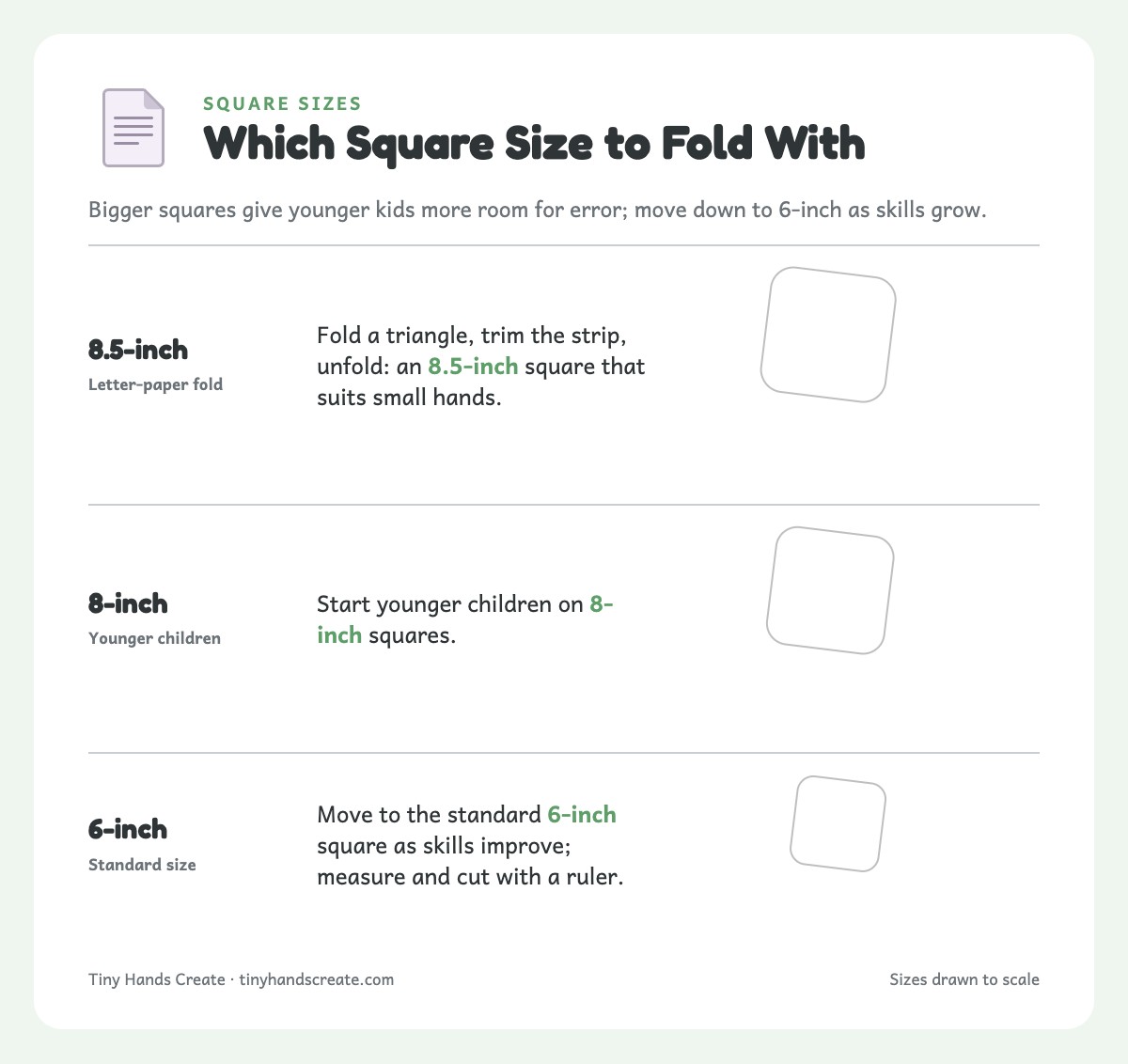
- Fold a triangle. Fold one short edge over so it lines up with a long edge. Crease.
- Trim the strip. Cut off the leftover rectangle beside the triangle.
- Unfold. Open the triangle and you have an 8.5-inch square.
That big square suits small hands. For 6-inch squares, measure and cut with a ruler instead. Don’t worry about the diagonal crease left behind. The cup starts with that fold anyway.
Before You Fold
- Work on a hard, flat surface — a table or clipboard works much better than a carpeted floor
- Use the back of a spoon or an old plastic card for children who struggle with pressing sharp creases
- Start with larger paper (8-inch squares) for younger children and move to standard 6-inch as their skills improve
- Demonstrate each fold first, then let the child try, then demonstrate the next fold — don’t rush ahead
- Keep a finished model next to the workspace so children can see what they’re working toward
Safety firstWash hands after handling newspaper. Supervise children under 4 with paper, and keep small folded pieces and scraps away from mouths and younger siblings. Never use newspaper or dyed paper for anything near the mouth. Cutting squares is an adult job, or a supervised one with child-safe scissors. Pipe cleaners have sharp wire at the cut ends, so bend each tip back on itself before handing one over.
Easy Origami Projects for Kids (Step by Step)
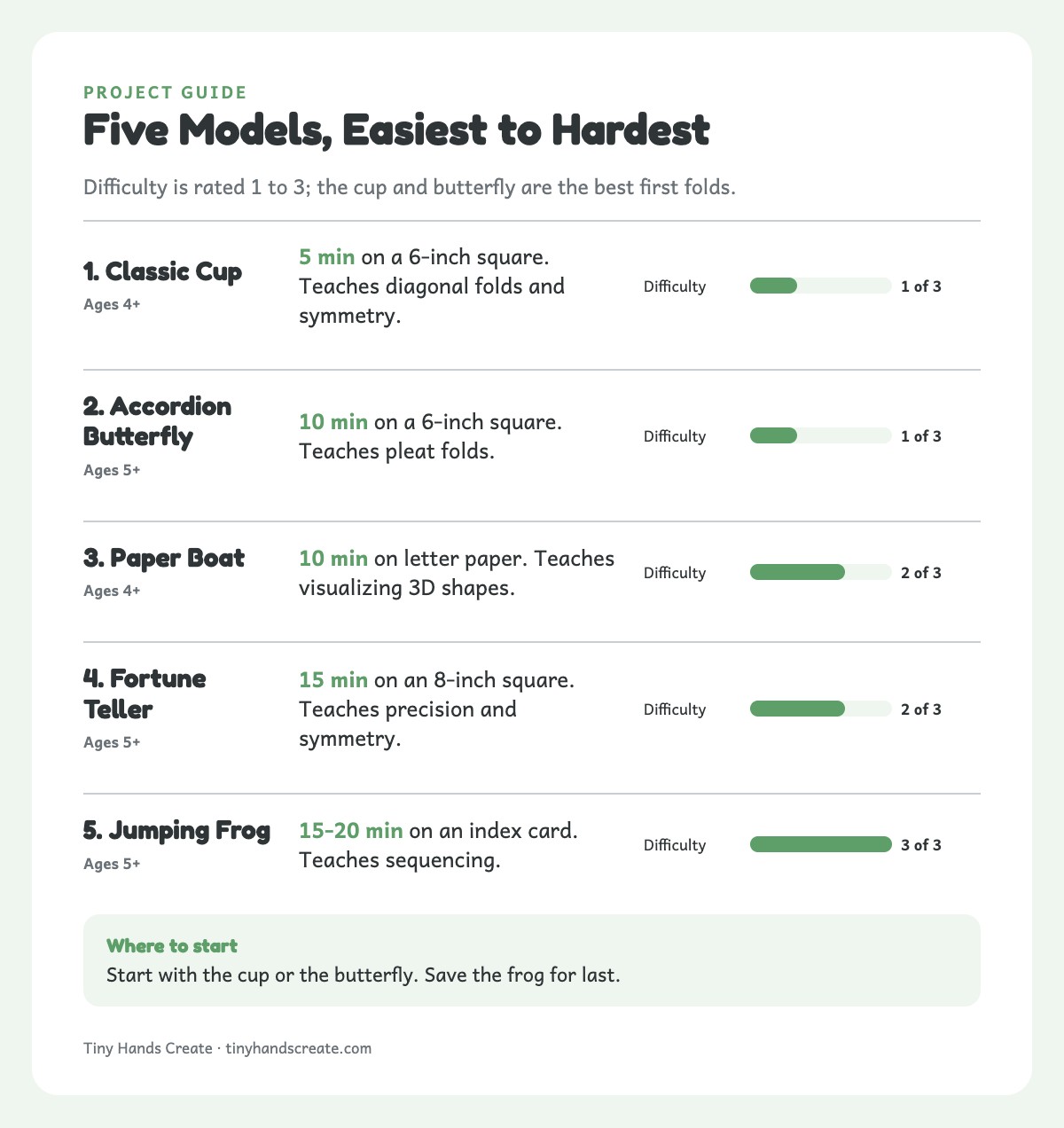
These projects run from easiest to hardest, so start with the cup or the butterfly and save the frog for last. Kids ages 4-8 can finish them, and they still look charming when the folds are a little wonky.
Three projects use a square. The boat uses a sheet of letter paper and the frog uses an index card. None need glue.
A few fold words show up in the steps. Here is what each one means.
| Fold word | What it means | How to do it |
|---|---|---|
| Crease | Press the fold flat | Run a fingernail or the back of a spoon along the fold. |
| Unfold | Open the fold back up | The line it leaves is your guide for the next step. |
| Diagonal fold | Corner to opposite corner | Match the two corners first, then press. A square becomes a triangle. |
| Valley fold | Fold the paper toward you | The crease dips down like a valley. Most steps here are valley folds. |
| Mountain fold | Fold the paper away from you | The crease peaks up like a mountain. Pleats switch between valley and mountain. |
| Colored side down | White side faces you | The color ends up on the outside of the model. |
| Flip | Turn the paper over | Turn it like the page of a book. |
The step diagrams in our Origami Beginner Project Card Pack match the cup, butterfly, fortune teller, and frog below. Print a set and keep it at the workspace.
1. The Classic Cup (Ages 4+)
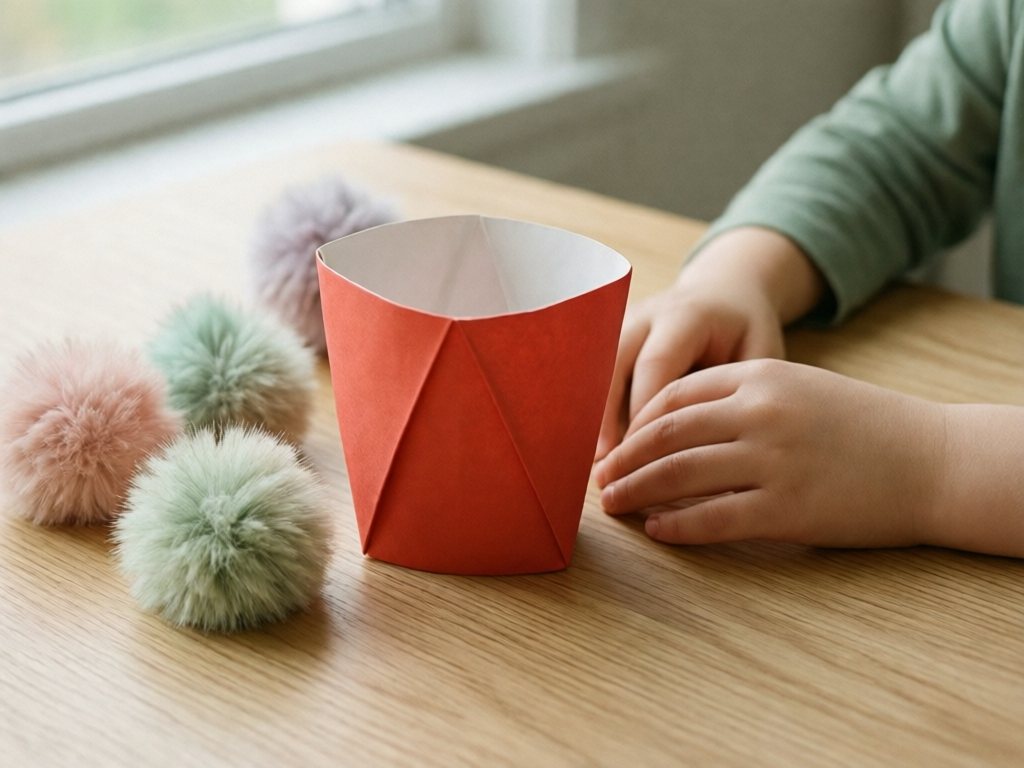
This is a great first project because the finished cup actually works. It holds dry items like pom poms, and kids love filling and emptying it. Three-year-olds can join in if an adult does the creases.
- Make a triangle. Start with a square, colored side down. Fold it in half diagonally, with the long edge at the bottom and the point up.
- Fold the right corner. Fold the right corner across so its tip meets the left side about a third of the way down. Crease firmly.
- Fold the left corner. Fold the left corner across to meet the right side the same way. The bottom should now be a flat edge.
- Fold the front rim. Fold the top front point down into the pocket.
- Fold the back rim. Flip over and fold the back point down into its pocket too. Open the cup.
Scoop dry items like pom poms into your cup. Plain paper holds water for only a few seconds, if at all, so keep any water play quick. For a game, line up three cups and toss pom poms into them from a step back.
Safety firstDo not drink from the cup. Paper and inks aren’t made for food contact, and the paper has been handled with unwashed hands.
2. The Accordion Butterfly (Ages 5+)
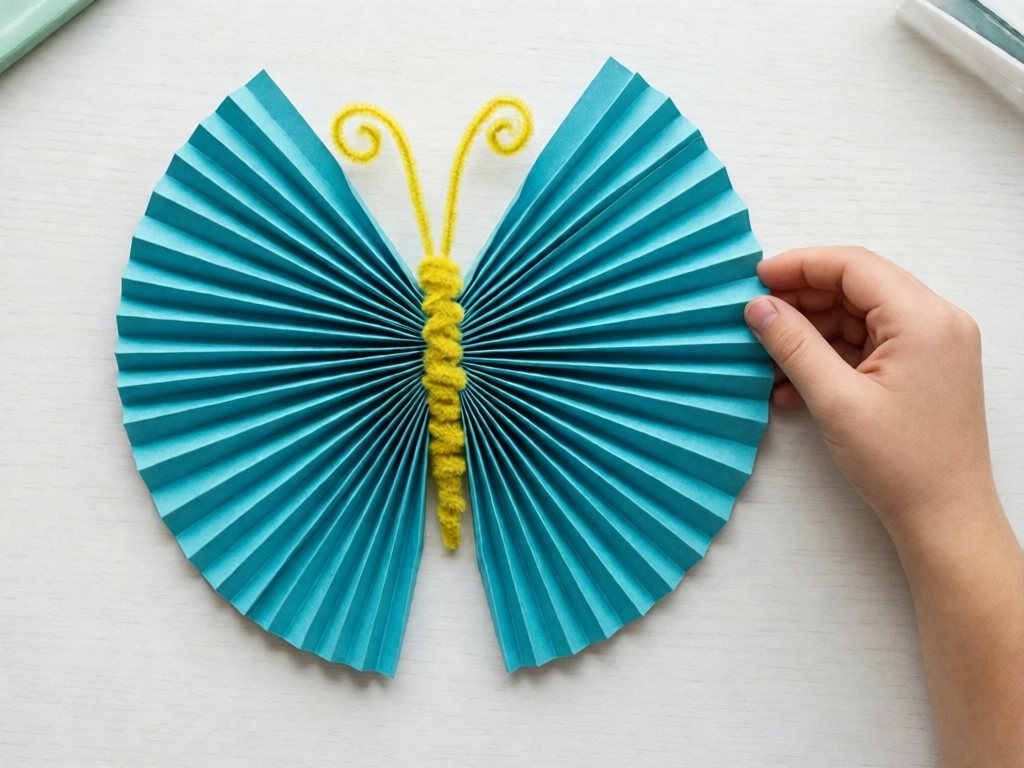
This butterfly looks impressive, but it’s really just back-and-forth pleat folds, which suits kindergarteners. You’ll need a square plus a pipe cleaner or a piece of tape.
- First pleat. Start with a square, colored side up. Fold the bottom edge up about an inch and crease firmly.
- Flip and fold. Turn the paper over and fold that strip up again, keeping the same width.
- Keep going. Flip and fold, back and forth, until the whole square is one pleated strip.
- Pinch the middle. Squeeze the center of the strip tight between two fingers.
- Tie it off. Wrap a folded pipe cleaner or a piece of tape around the pinch. Twist the pipe cleaner ends into antennae, then bend each cut tip back on itself so no sharp wire pokes out. Use tape instead for kids who still mouth things.
- Fan the wings. Spread the pleats out on each side of the pinch.
Tape a few to a window or wall for a garland, or tape them to popsicle sticks for puppet shows. For a fancier butterfly, let kids color or stamp the square before they pleat it.
3. The Paper Boat (Ages 4+)
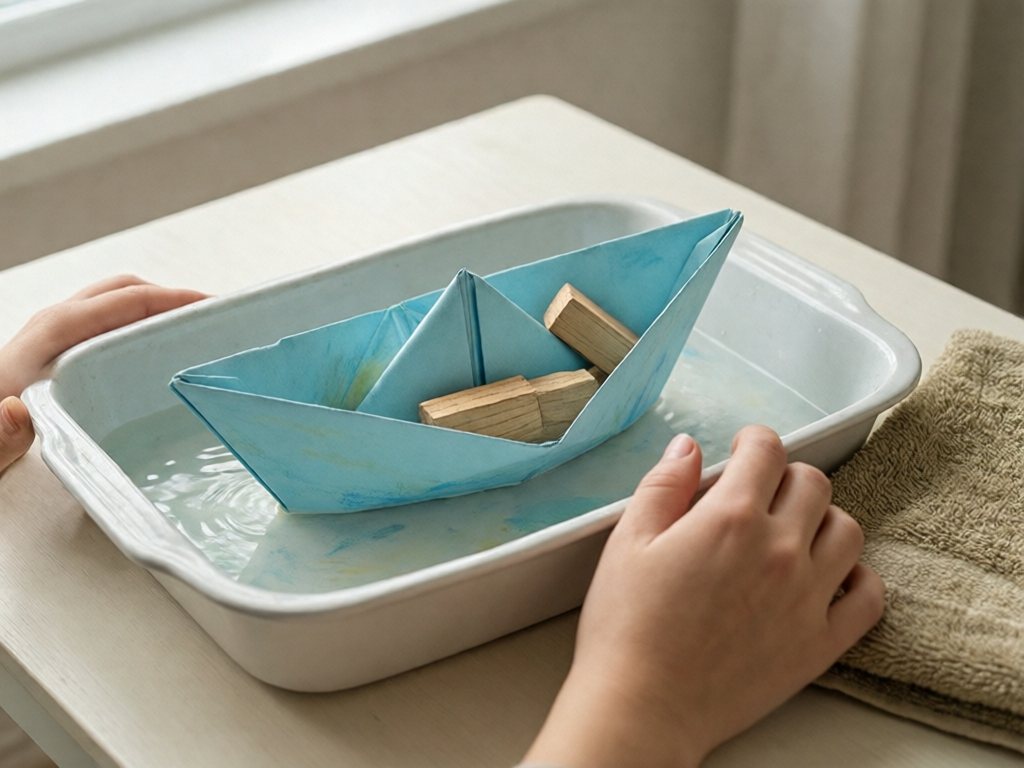
The paper boat is a classic because it floats and is satisfying to make. It uses a rectangular sheet, so you don’t need a square. Use printer paper or wrapping paper.
- Fold in half. Fold a rectangle short edge to short edge, book-style.
- Fold the corners. Fold both top corners down to the center crease to make a hat shape.
- Fold up the front strip. Fold the bottom front strip up.
- Fold up the back strip. Flip and fold the back strip up.
- Make a diamond. Open the hat and flatten it into a diamond, with the seam in the middle.
- Fold the bottom corners up. Fold the bottom front corner up to the top point. Flip and repeat on the back.
- Open the boat. Open the triangle in the middle, gently pull the two top points apart, and flatten the base.
Test your boats in the bathtub, a kiddie pool, or a baking pan of water. Challenge kids to see whose boat holds the most big wooden blocks or a toy figure before sinking.
A plain paper boat floats for a few minutes before it soaks through and sinks. Rub crayon over the paper before folding, or fold one from wax paper, and it lasts longer.
Safety firstStay within arm’s reach of any child near water, even a shallow baking pan, and empty tubs and pools afterward. Keep the blocks and toy figures you use as cargo away from children under 3.
4. The Fortune Teller / Cootie Catcher (Ages 5+)
Every generation rediscovers this playground favorite. Kids fold it, then fill it with colors, numbers, and silly fortunes, so it doubles as writing practice.
- Crease the center. Start with a square. Fold in half both ways, crease, and unfold.
- Corners in. Fold all four corners into the center point.
- Flip. Turn the square over.
- Corners in again. Fold all four new corners into the center point.
- Write it up. While it’s still flat, write two numbers on each of the four triangle flaps, eight in all. Lift each flap and write a fortune under each number. Flip it over and write a color name on each of the four squares.
- Crease it in half. Fold in half one way, crease, and unfold. Repeat the other way.
- Pop it. Slide thumbs and forefingers under the four flaps and push inward to pop it into its 3D shape.
To play, a friend picks a color and you spell it out, opening and closing the fortune teller once per letter. They pick a number and you count it out the same way. Then they pick one more number, and you lift that flap to read the fortune.
If it won’t pop open neatly, the corners in steps 2 and 4 didn’t quite reach the center. Flatten it and refold them.
5. The Jumping Frog (Ages 5+)
Press down on the frog’s back and let go, and it hops across the table. This is the hardest model here, so fold one alongside your child the first time. Use an index card, because stiff paper springs back. Kids can color it green first or go wild with any color they want.
- Start with a card. Turn an index card tall, with a short edge at the top.
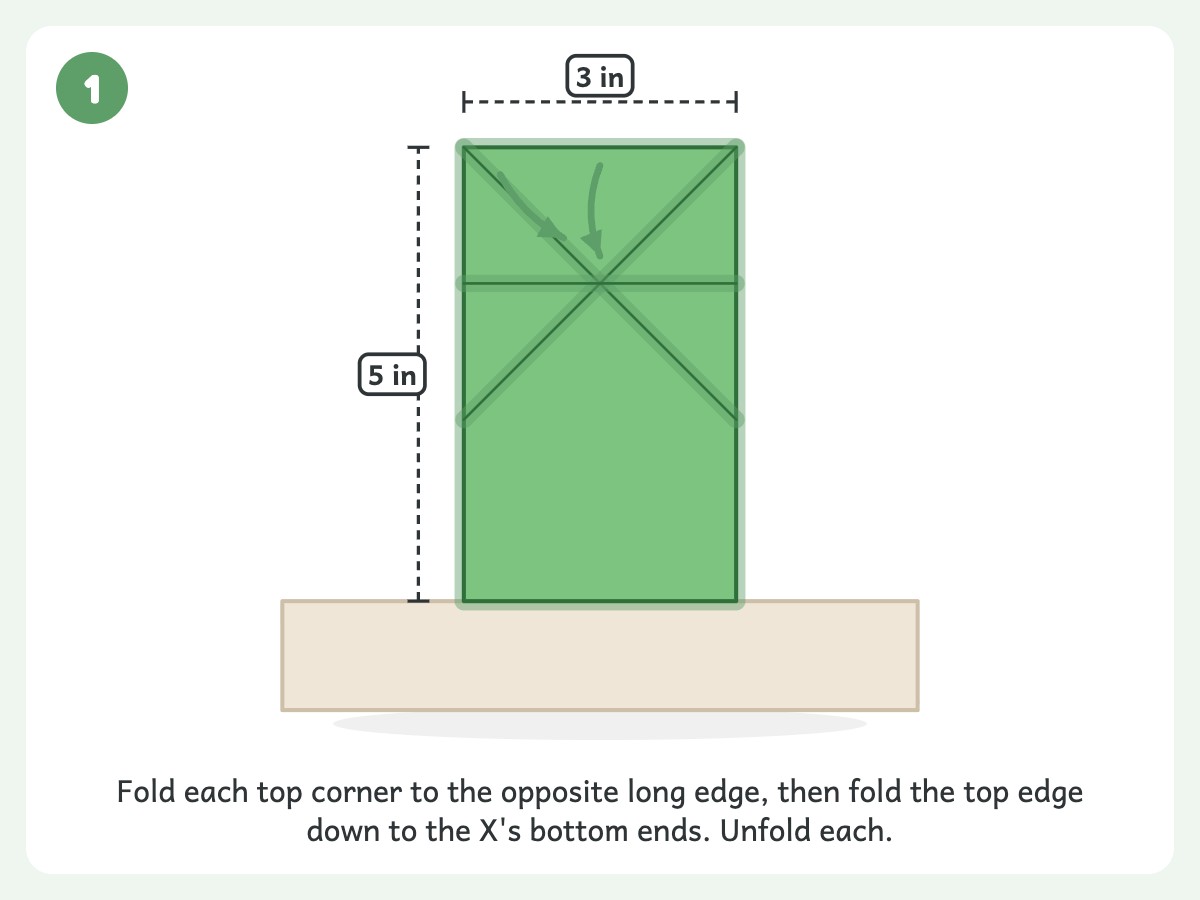
- Crease the first diagonal. Fold the top left corner down and across until the top edge lines up with the right long edge. Crease and unfold.
- Crease the second diagonal. Do the same with the top right corner, lining the top edge up with the left long edge. Crease and unfold. You now have an X.
- Crease straight across. Fold the top edge straight down until it meets the bottom ends of the X, where the diagonal creases touch the long edges. Crease and unfold. The new crease runs side to side through the middle of the X.
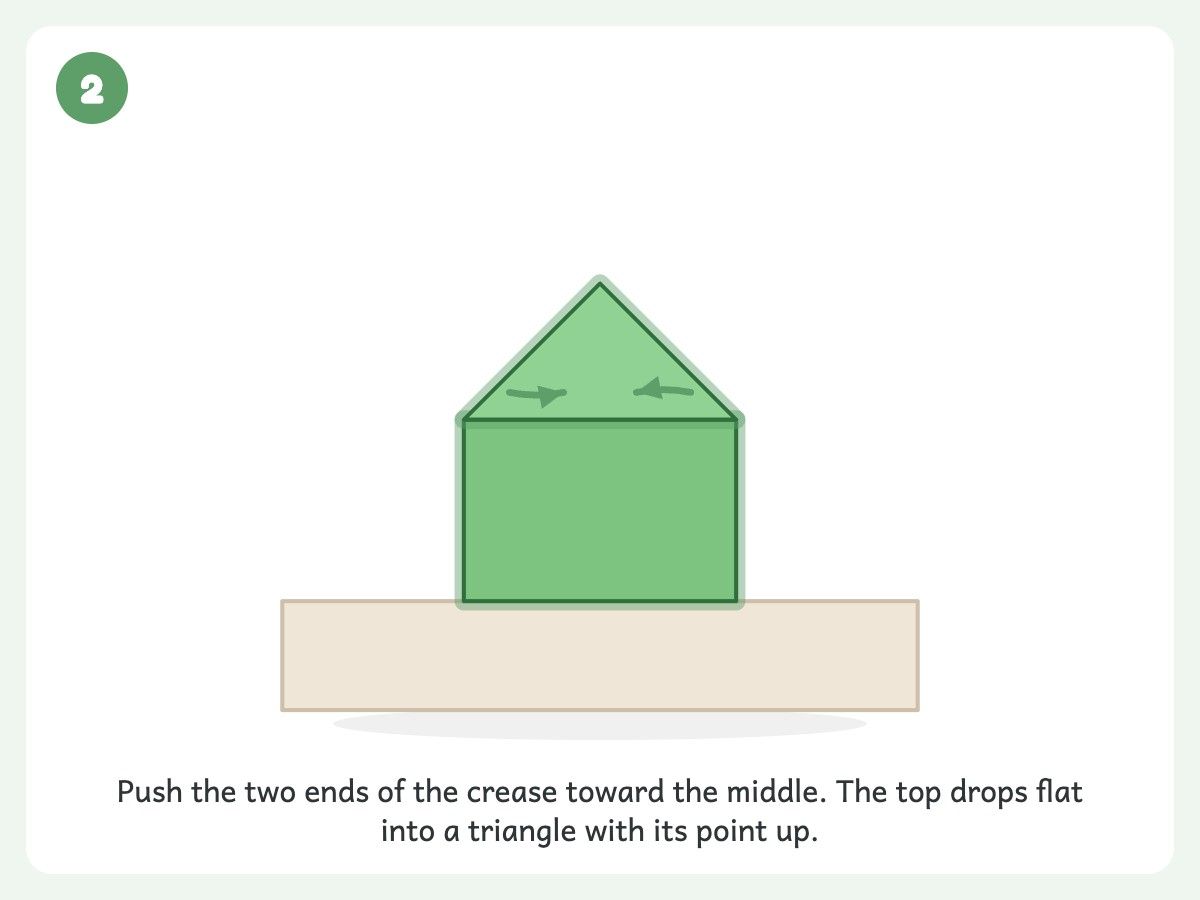
- Collapse the top. Pinch the two ends of that straight-across crease and push them in toward the middle of the X. The top edge drops down and the paper folds flat into a triangle with its point at the top. If it fights you, fold the straight-across crease backward once to loosen it.
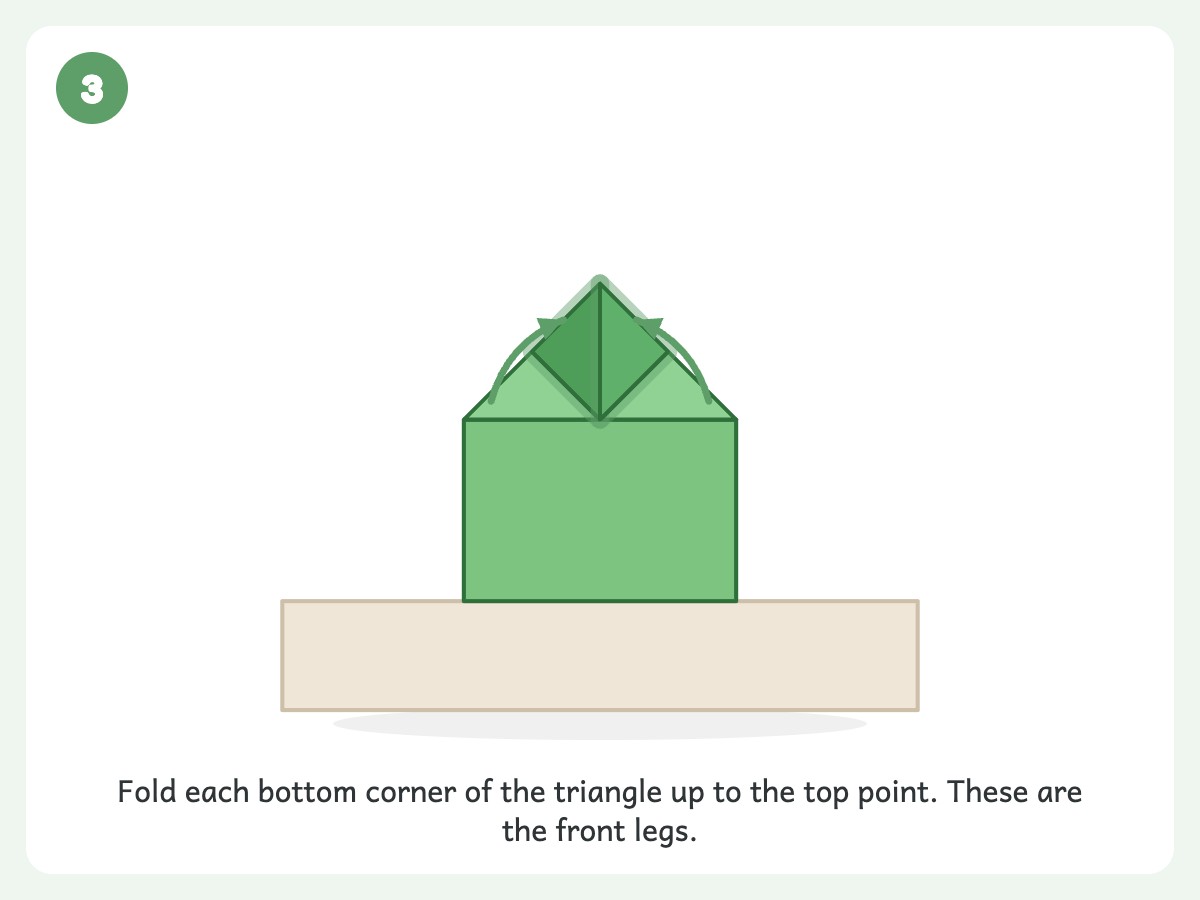
- Make front legs. The triangle has two loose corners at the bottom of its top layer. Fold each one up to the top point.
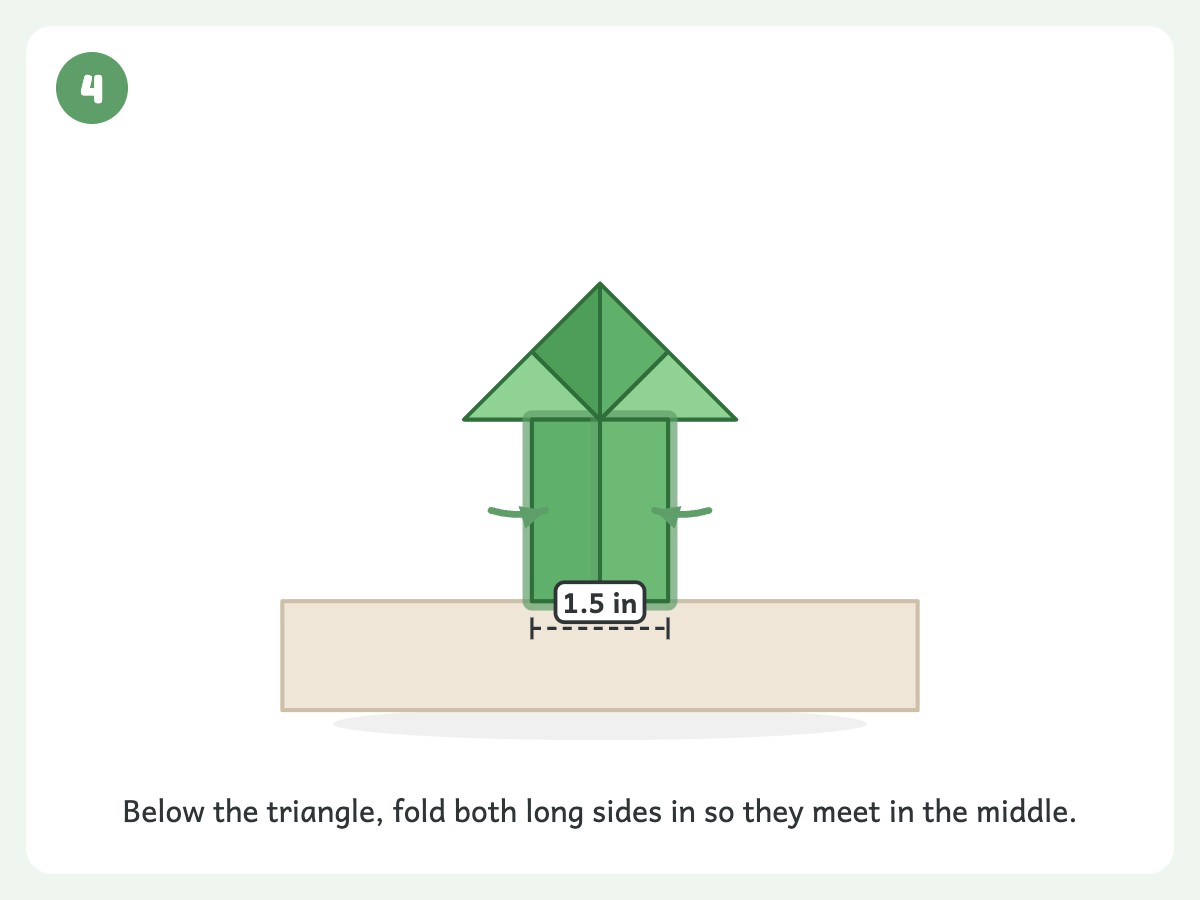
- Fold the sides in. Below the triangle is a rectangle. Fold its two long sides in to meet at the center line.
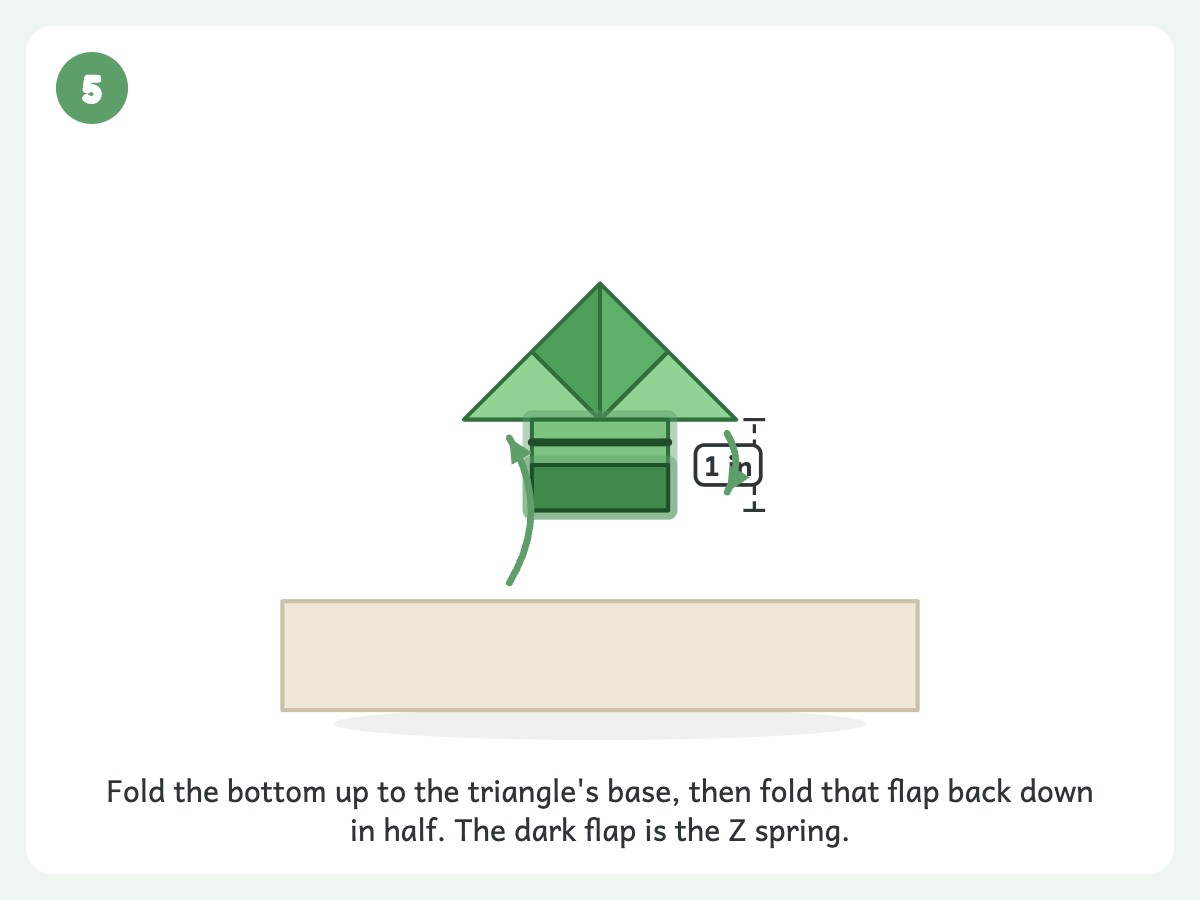
- Fold the bottom up. Fold the bottom end up until its edge reaches the base of the triangle.
- Make the spring. Fold that same flap back down in half, so its edge meets the fold you just made. From the side, the body now zigzags like a Z. Flip the frog over.
Press down on the very back edge of the frog, then slide your finger off fast to make it jump. Expect a few tries, and a few flat frogs, before one hops. Then hold frog races or aim for a bowl target.
Frog won’t jump? Thin paper has no spring, so switch to an index card. Run a fingernail along both folds of the Z to sharpen them. Then press right at the back edge and let your finger slip off quickly.
After Folding: Origami Learning Ideas
- Storytelling: Use finished models as characters, tape them to butcher paper, and have your child draw a scene around them.
- Math: Fold a square into halves, quarters, and eighths, and ask how many layers thick it is each time.
- Nature journal: Glue a folded frog or butterfly next to a drawing of the real one and add a fun fact for each.
- Gift topper: Tape a butterfly to a birthday present instead of a store-bought bow.
Troubleshooting Common Origami Frustrations
Here are fixes for the most common origami problems.
| Problem | Fix |
|---|---|
| “My folds aren’t straight!” | Totally normal for beginners. Keep the paper flat on the table, line up the corners before pressing, and press from the center out. Larger paper gives more room for error, and the back of a spoon or an old plastic card sharpens creases. |
| “I can’t remember the steps!” | Keep large, clear step diagrams at the workspace, such as the Origami Beginner Project Card Pack. Better yet, fold along with your child so they can watch your hands. |
| “It doesn’t look like yours!” | Resist the urge to fix your child’s folds. A lopsided frog that hops is still a triumph. Focus on one fold at a time. |
| “I’m bored of the same projects!” | Try timed folding races or having your child teach a younger sibling a model. Patterned origami paper also keeps things fresh. |
| “My frog won’t jump!” | Use an index card instead of thin paper. Sharpen both folds of the Z-spring with a fingernail. Press at the very back edge and slide your finger off quickly. |
Building an Origami Habit at Home
Origami makes a handy rainy day activity. Here are three ways to keep the folding going once the first frog has hopped.
- Travel origami kit: Keep a small ziplock bag of squares and a few index cards in your car or purse for restaurants, waiting rooms, and car rides. It fits in a pocket.
- Origami challenge jar: Write project names on slips of paper, drop them in a jar, and let your child draw one each week. It pairs well with our boredom busters.
- Quiet time: A pile of squares and a step card make an easy addition to screen-free quiet time.
Origami for Kids FAQ
What age can kids start origami?
Most kids can finish simple models around ages 4-5. Three-year-olds can join in if an adult does the creases and supervises closely with paper.
What paper is best for kids’ origami?
Origami paper (kami) or printer paper cut into squares works best. Both hold creases well. Skip newspaper for anything near the mouth.
What is the easiest origami model for kids?
The classic cup and the accordion butterfly are the simplest. The jumping frog is the most fun but needs the most steps.
Is origami good for fine motor skills?
Yes. Pressing creases, pinching corners, and lining up edges all give little fingers practice with small, controlled movements.
How do I make origami easier for a child who gets frustrated?
Start with the cup or butterfly, use larger paper, and fold one step at a time alongside your child. Stop while it is still fun and try again another day.
Do I need special paper?
No. Printer paper cut into squares works well, and origami paper is a nice extra because the colored and white sides show which side is which.
Crafty Mama
Crafty Mama is a former elementary art teacher turned stay-at-home parent who believes every child is creative — they just need the right invitation. She develops age-appropriate activities, crafts, and projects that spark imagination while keeping mess (and parent stress) to a minimum.