Christmas Activities for 1 Year Olds: 15 Safe, Simple Ideas
Discover 15 quick, mouth-safe Christmas activities for your 1-year-old alongside a seasonal hazard safety checklist.
- Choose taste-safe ingredients or securely sealed sensory containers.
- Use the toilet paper tube test to screen out choking hazards.
- Hang breakable glass ornaments well above your toddler's reach.
- Anchor your Christmas tree securely to avoid tipping risks.
This post contains affiliate links. As an Amazon Associate I earn from qualifying purchases.
The first December my son was mobile, I hung glass ornaments on the bottom branches, where the tree is fullest. He grabbed a mercury-glass ball the size of a plum and had it in his mouth before I’d finished saying “no, no, no, buddy.” Nothing broke. I still spent the month re-hanging ornaments at adult height, feeling like Christmas was one long list of no.
This post is the yes-list. You’ll find 15 safe Christmas activities for 12-to-24-month-olds, each one taste-safe, sealed, or built from large, mouth-safe everyday objects, always with a grown-up right there. You’ll also get a Christmas hazard checklist and a sample week. Every activity takes ten minutes or less to set up, and guided crafts start at age two in our Christmas crafts for 2 year olds.
In this article (12 sections)
- What One-Year-Olds Can Do at Christmas
- The Ground Rules: Keeping Christmas Mouth-Safe
- 15 Christmas Activities for 1 Year Olds at a Glance
- Taste-Safe Christmas Messy Play (Activities 1 to 3)
- Sealed Christmas Sensory Play for Babies (Activities 4 to 6)
- Easy Christmas Play: Unwrapping, Stacking, and Tossing (Activities 7 to 11)
- Christmas Music, Lights, Bath, and Book Time (Activities 12 to 15)
- A Sample Christmas Week for a One-Year-Old
- Christmas Gifts and Overstimulation for 1 Year Olds
- Mess Management for the Holiday Season
- Frequently Asked Questions
- One Last Thing Before You Go
What One-Year-Olds Can Do at Christmas
Most “toddler” Christmas activities online are really written for two-and-a-half to four-year-olds: glitter, small beads, scissors, and a child who will wear a paper reindeer antler for more than four seconds. At 12 to 24 months, a few things shape what works:
- Mouthing is still the main research method. Most things go in the mouth at least once, so plan for it instead of fighting it.
- Attention spans are short and wiggly. Two to five minutes of focus on one activity is a win.
- Cause and effect is the big brain project. Shake it, drop it, push it, and see what happens. December is full of shiny, noisy things to test.
- Fine motor skills are just starting. Pincer grasp is coming in (or already here), and kids are working on banging, stacking, scooping, and poking.
- Language is exploding or about to. December hands you easy first words to name: “light,” “tree,” “star,” “ball,” and “more.”
So the goal isn’t a finished product for the fridge (though a yogurt-painted paper might end up there anyway). It’s holiday-flavored things to explore safely, with you nearby and relaxed.
The Ground Rules: Keeping Christmas Mouth-Safe
Before the activities, a short safety section. It’s what makes the rest of the list low-stress.
The toilet paper tube test
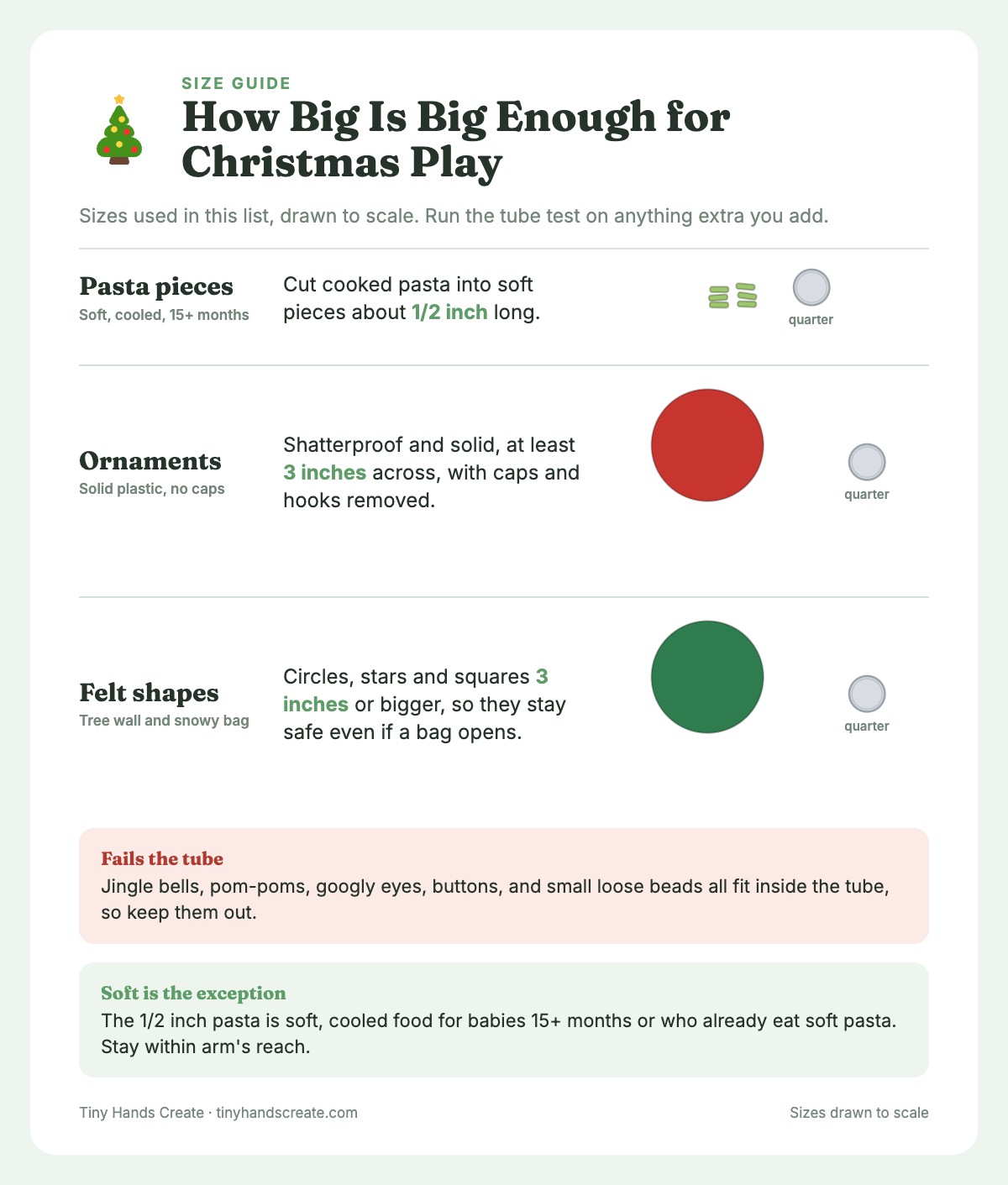
The simplest small-parts check is a toilet paper tube. If an object, or a piece that could break off it, fits completely inside the tube, it’s a choking hazard for a child this age. Everything in the activities below passes the tube test, but run it on anything extra you add. Jingle bells, pom-poms, googly eyes, buttons, and small loose beads all fail.
Taste-safe versus sealed
I use two categories throughout this post:
- Taste-safe means every ingredient is something a baby can eat. It doesn’t mean it tastes good (cooked pasta dyed green is not dinner), but if it all ends up in a mouth, that’s fine. Always consider your child’s allergies. A yogurt activity isn’t taste-safe for a baby with a dairy allergy.
- Sealed means the interesting stuff lives inside something that can’t be opened, chewed through, or burst. Sealed does not mean “I closed the lid.” It means lids glued or taped, bags double-bagged and taped flat, and nothing a determined one-year-old can get into.
Christmas-specific hazards worth knowing
The holidays bring a few hazards that don’t exist the other eleven months of the year. These are the ones I’d check in your own house:
Safety firstIf your baby swallows something they shouldn’t have, call Poison Control (in the US, 1-800-222-1222) or emergency services right away. Button batteries and water beads are emergencies, so go to the ER without waiting for symptoms.
| Hazard | Why it matters | What to do instead |
|---|---|---|
| Glass ornaments | Break into sharp pieces | Hang glass well above reach; only shatterproof ornaments on low branches |
| The tree itself | Can tip over if a baby pulls on a branch | Use a wide, stable stand and anchor the tree to a wall or ceiling hook |
| Light strings and extension cords | Strangulation, pulling, and electrical risk | Keep out of reach, tuck behind furniture or use cord covers, and unplug when you leave the room |
| Button batteries (in light-up toys, musical cards, some candles and ornaments) | Can cause serious internal injury if swallowed | Keep these items out of reach; choose battery doors that screw shut |
| Tinsel, ribbon, and long garlands | Strangulation and choking risk, and tinsel is easy to swallow | Skip tinsel; keep ribbons short and supervised |
| Real tree needles and tree water | Needles are sharp and a choking risk; tree water can hold bacteria and additives | Cover the stand; vacuum needles daily |
| Holly, mistletoe, and certain berries | Toxic if eaten | Keep out of reach or skip. Artificial versions only if large, securely attached, and out of reach. Call Poison Control if any is chewed or swallowed |
| Poinsettias | Generally low toxicity but can upset a stomach | Place high up. Call Poison Control if any is chewed |
| Candy canes, hard candy, nuts, whole grapes, popcorn | Classic choking foods for little kids | Skip popcorn, whole nuts, hard candy, and candy canes entirely under age 4. Quarter grapes lengthwise |
| Ice cubes and frozen decorations | Hard and slippery, a choking risk | Skip |
| Water beads and “snow” crystals | Can swell dangerously if swallowed | Never use at this age |
| Glitter and craft glitter “snow” | Not edible, and gets everywhere including mouths and eyes | Skip it, or choose non-toxic taste-safe alternatives |
For anything medical about your child’s development or allergy history, your pediatrician is the right call. This post is play ideas, not medical advice.
Before you start any activity
- Everything passes the tube test (or is sealed for good)
- Allergies checked
- A grown-up is within arm’s reach
- Tree anchored to a wall or ceiling hook
- Light cords tucked away, covered, or unplugged
- Plugs and batteries are out of reach
- Scraps and shreds are picked up afterward
“Safe by design” lowers the risk, but it doesn’t replace a grown-up. Stay within arm’s reach for every activity here, especially the food bins, the DIY-sealed bottles and gel bags, and the bath. Being nearby while you fold laundry is not the same as watching.
15 Christmas Activities for 1 Year Olds at a Glance
Here’s the whole list in one table. After it, I’ll walk through each activity: what you need, how to do it, and what to expect.
| # | Activity | Set-up time | What it builds | Mouthing-safety note |
|---|---|---|---|---|
| 1 | Yogurt snow painting | 3 min | Grasp, sensory exploration, first words (“cold,” “more”) | Taste-safe; check dairy allergy and only use foods your baby has already eaten; use plain yogurt with a drop of food coloring |
| 2 | Cooked pasta “pine tree” bin | 10 min (mostly cooking) | Grasp, scooping, tactile exploration | Taste-safe; 15+ months or already eats soft pasta; cut into soft 1/2-inch pieces; cool completely |
| 3 | Oatmeal “snow” bin | 5 min | Scooping, pouring, cause and effect | Taste-safe; seated and supervised; small amounts first under 15 months; check grain allergies; no spices |
| 4 | Sealed star shake bottle | 0 min store-bought, 8 min DIY | Cause and effect, tracking, shake-and-watch | Sealed; store-bought sealed bottle first, or DIY with two-part epoxy cured 24 hours and a taped cap; discard if dented or cracked |
| 5 | Squishy “snowy window” bag | 5 min | Poking, pressing, finger strength | Sealed; double-bag, tape every edge at baby’s chest height, within arm’s reach; take down if it peels or leaks |
| 6 | Shatterproof ornament basket | 3 min | Grasping, carrying, dropping, naming | Only large (3+ inch) solid plastic ornaments; caps and hooks removed; no glitter |
| 7 | Empty-box gift unwrapping | 5 min | Pulling, tearing, peek-a-boo, “open” | Sheets bigger than baby’s hand; skip tape-covered scraps; within arm’s reach; stop if baby starts eating the paper; pick up shreds |
| 8 | Santa’s sack scarf pull | 4 min | Pulling, pincer, object permanence | Loose scarves, never tied or looped; supervised |
| 9 | Stacking-cup Christmas tree | 2 min | Stacking, nesting, cause and effect | Standard baby stacking cups pass the tube test |
| 10 | Sock snowball toss | 3 min | Throwing, gross motor, aim | Clean rolled socks only; no loose pom-poms or cotton balls |
| 11 | Sticky-wall felt tree | 8 min | Pressing, peeling, naming shapes and colors | Large (3+ inch) felt shapes only; tape every contact-paper edge; within arm’s reach |
| 12 | Pot-and-spoon jingle band | 2 min | Rhythm, cause and effect, imitation | Short wooden or silicone spoons; baby seated; no loose bells; recheck the shake bottle’s cap first |
| 13 | Light-spotting walk | 0 min | First words (“light,” “wow”), pointing, joint attention | No touching lights or cords; keep cords, plugs, and batteries out of reach |
| 14 | Bubble beard bath | 5 min | Sensory exploration, body parts, first words | Beard on you and bath toys only; keep lather off baby’s face |
| 15 | Touch-and-feel Christmas board books | 3 min | Language, page turning, pointing and naming | Chunky board books; skip anything with flaps small enough to tear off |
A quick note: several of these work any time of year, with a Christmas coat of paint. That’s deliberate. A baby doesn’t need novelty at this age. They need repetition with a twist.
Taste-Safe Christmas Messy Play (Activities 1 to 3)
TipSet up in a warm room with your baby in just a diaper, a shower curtain or old sheet underneath, and a damp towel within reach before you start.
These first three are for the mouthing phase. Everything in them is edible, so a taste or a fistful is part of the plan. Stay within arm’s reach anyway, because babies can still gag on a big mouthful, and save the pasta bin for 15 months and up.
For a bigger library of this kind of play, my guide to edible sensory play for babies has more bases and recipes to rotate through once you’ve tried these.
1. Yogurt Snow Painting
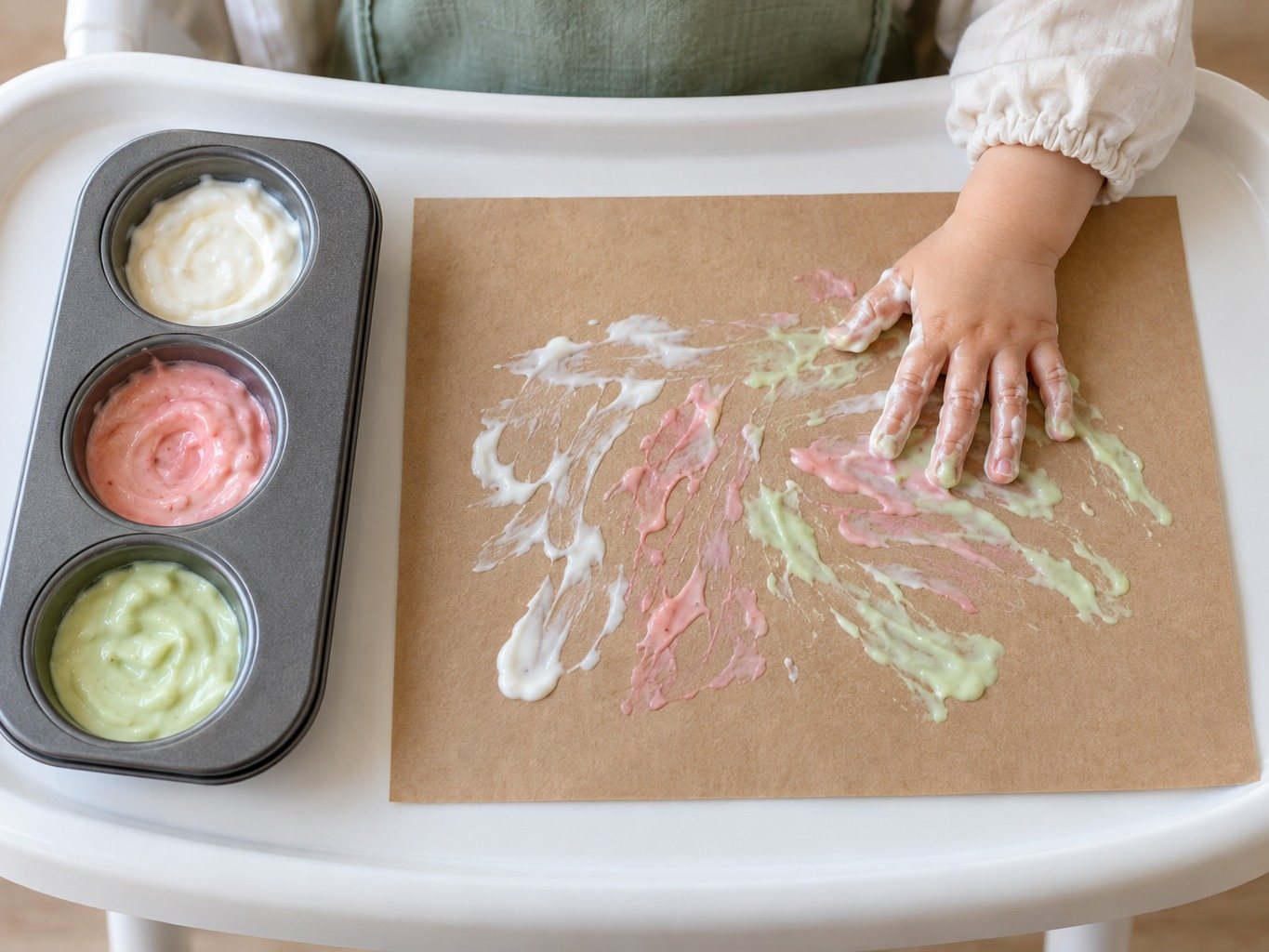
What you need: Plain full-fat yogurt (Greek works nicely and is thicker), a muffin tin or small bowls, food coloring, a high-chair tray or a baking sheet, and some paper or cardboard.
How to do it:
- Scoop yogurt into 3 small bowls or muffin cups.
- Leave one white (that’s your snow). Add 1 to 2 drops of red food coloring to one, green to another.
- Put a big sheet of paper or a cut-open paper grocery bag on the tray.
- Let your baby go to town with their hands.
What to expect: Most of the yogurt ends up on the tray, some in a mouth, and a little on the paper. That’s perfect. A baby painting with yogurt isn’t making a card for Grandma. They’re discovering what cold, slippery stuff does when you slap it.
Talk while they play: “Cold! Snow! Red!” One-word narration is plenty. Babies tend to learn words well when you name what they’re already looking at.
Cleanup: I put the baby in just a diaper (in a warm room) and wash them in the sink or tub afterward. Food coloring can stain fabric and skin lightly. Use a tiny amount, and skip the red on a white shirt.
Allergy note: Only use foods your baby has already eaten. If you haven’t introduced dairy yet, this isn’t the day to do it with a face full of yogurt. Swap in mashed banana or thinned oat-based pudding if dairy is off the menu.
2. Cooked Pasta “Pine Tree” Bin
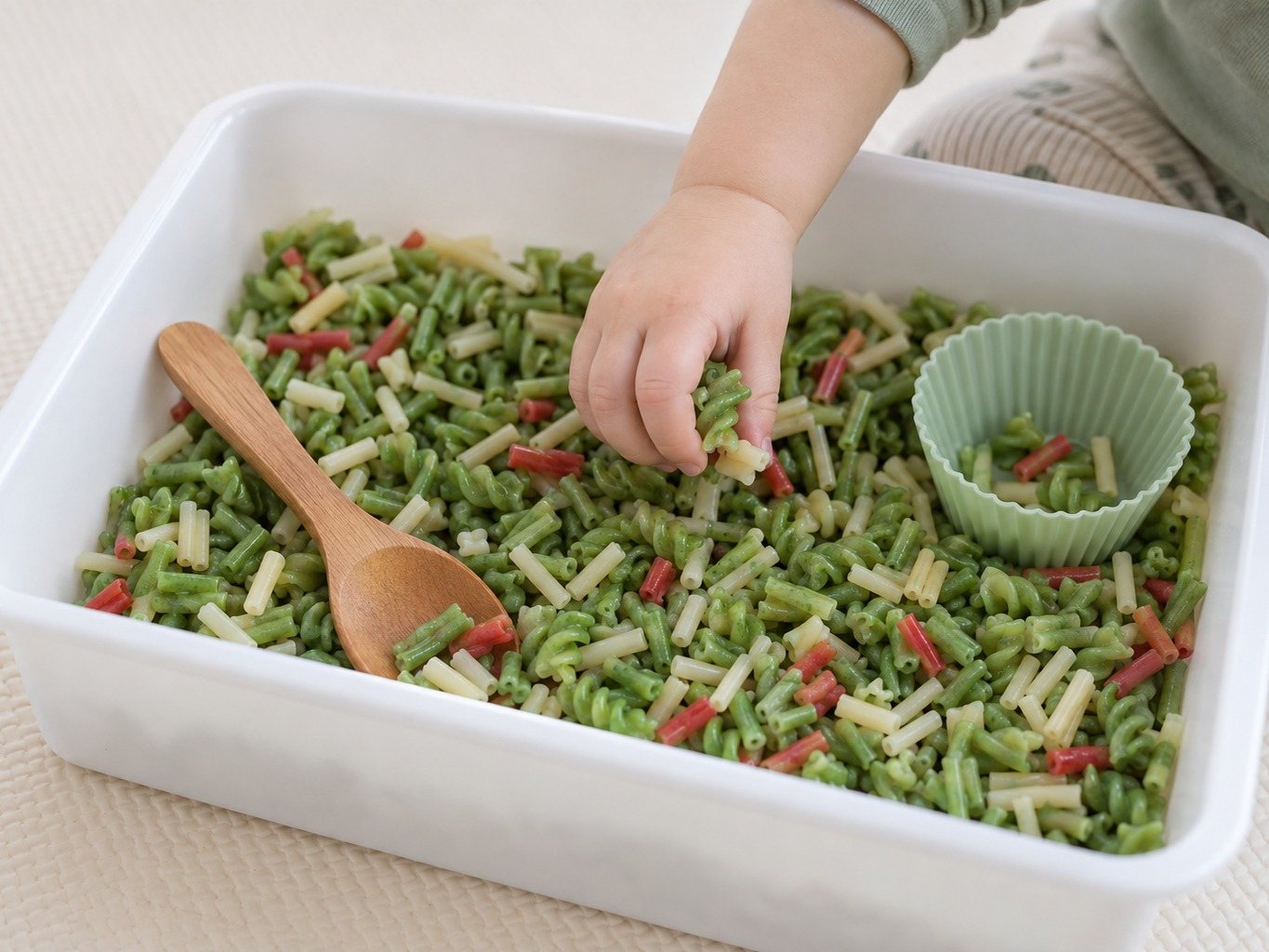
This bin suits babies around 15 months and up, or any baby who already eats soft pasta pieces at meals. Keep your baby seated, and if their cheeks are overfull, gently scoop the extra out of their mouth.
What you need: A box of spaghetti or rotini, a pot, food coloring, and a little olive oil. You’ll also want a shallow bin or baking sheet with sides.
Add a few big kitchen tools: a wooden spoon, a ladle, a silicone muffin cup.
How to do it:
- Cook the pasta until very soft, softer than you’d serve for dinner. Drain and let it cool completely.
- Cut the pasta into soft pieces about 1/2 inch long with kitchen scissors so there’s nothing to wrap or gag on.
- Toss with a teaspoon of oil and a few drops of green food coloring. Keep a handful uncolored or red for variety.
- Pour into the bin and add the kitchen tools.
What it builds: Grasp (slippery pasta is a real workout), scooping, transferring, and the sheer joy of squishing. The green gives it a forest feel, but honestly, your baby won’t care about the theme.
Safety firstCheck that every piece is soft and cool before it goes in the bin. Throw the batch out after one play session, because cooked pasta left out grows bacteria quickly.
This is also a good one for introducing the idea of “gentle” with an adult’s hand over theirs, though don’t expect it to stick yet.
3. Oatmeal “Snow” Bin
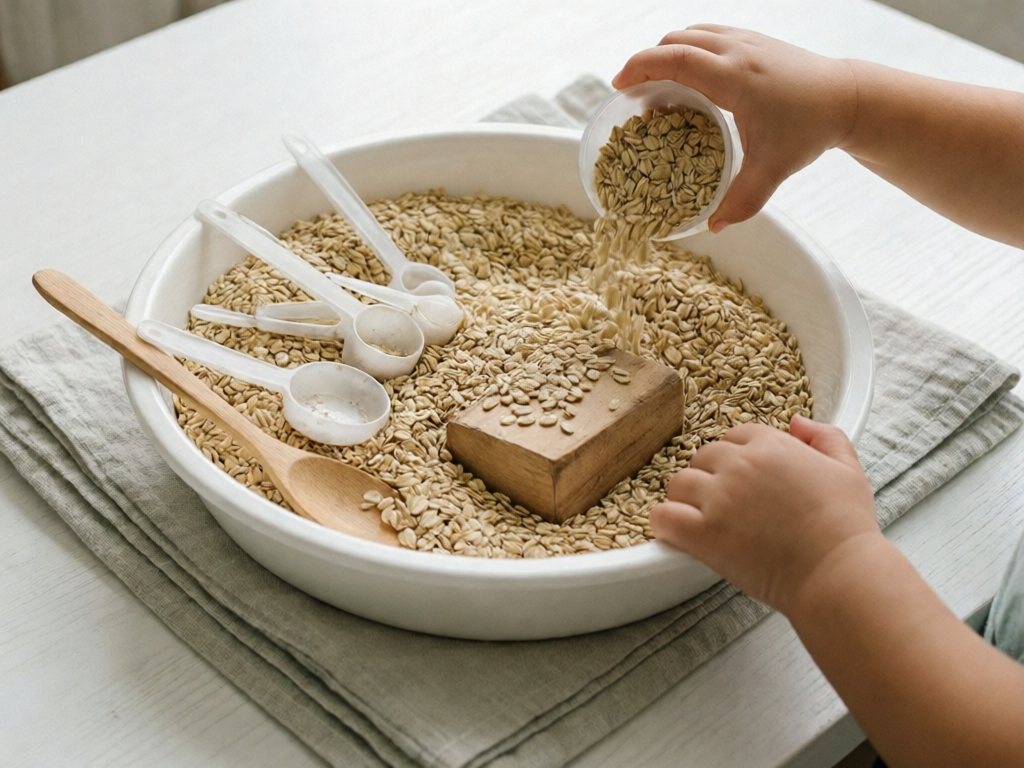
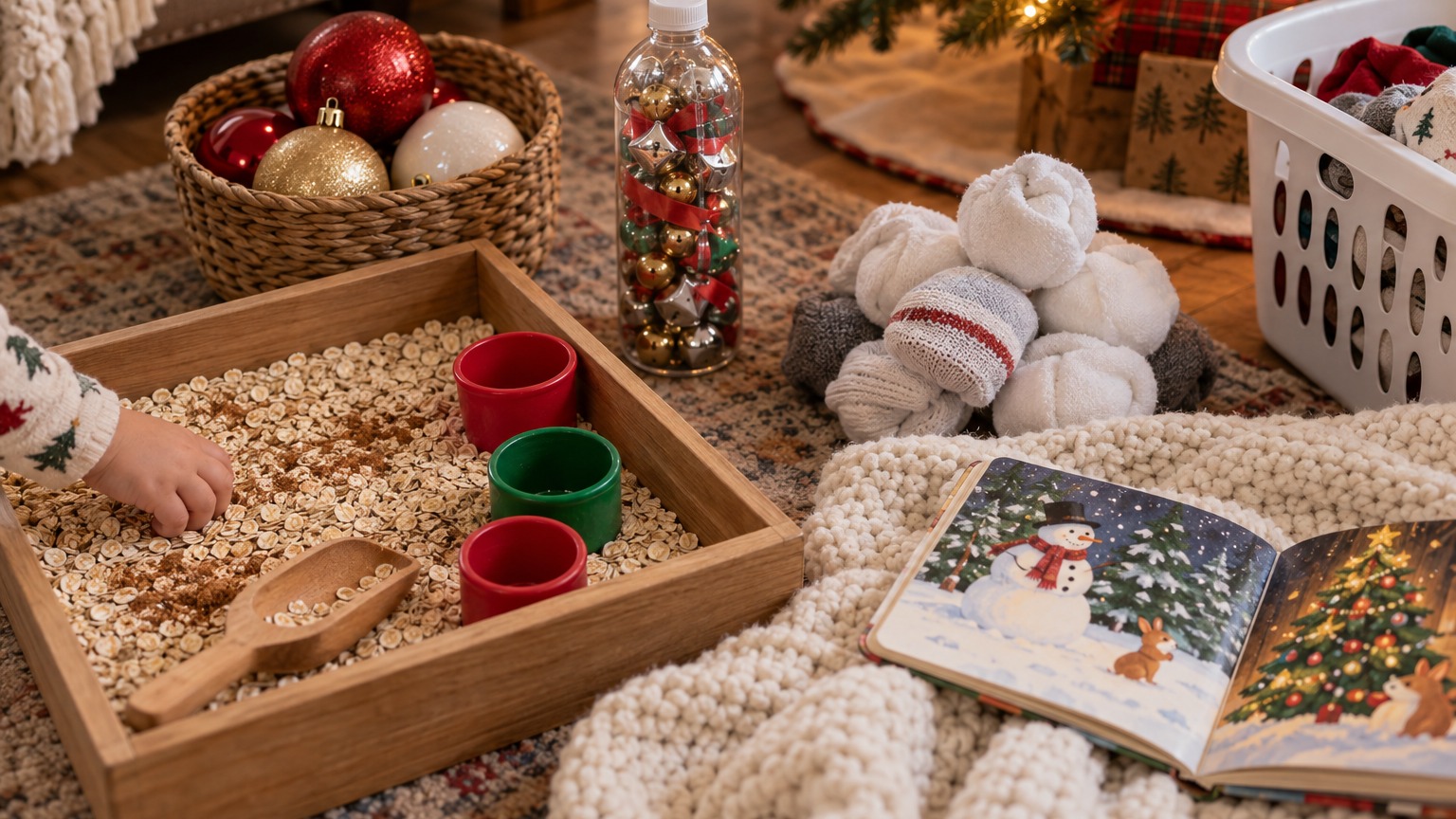
What you need: Plain dry old-fashioned rolled oats (quick oats are dustier), a shallow bin, measuring cups, and a wooden spoon.
Dry oats can be inhaled or cause gagging if a baby grabs a fistful, so keep your baby seated. If your baby is under about 15 months and new to textured solids, offer a small amount at first and watch for gagging. Check allergies first, since oats are often cross-contaminated with other grains.
How to do it:
- Pour about 3 cups of oats into the bin.
- Skip cinnamon and other spices. Fine powders can irritate little lungs, and the oats are cozy enough on their own.
- Add measuring cups and a spoon.
- Sit down and show them how to scoop and pour.
What it builds: Pouring and scooping (which is early math in disguise), hand strength, and cause and effect. Oats are drier and less slippery than pasta, which makes them good for a baby who doesn’t love wet textures.
The fun twist: Hide one or two baby-safe toys, like a big wooden block, in the oats. “Where did it go?” is a great game at this age.
Mess level: Oats fly. I put a bed sheet or shower curtain under the bin. They sweep up easily.
Sealed Christmas Sensory Play for Babies (Activities 4 to 6)
When you can’t use food (or you don’t want the mess), sealed sensory play is the answer. Your baby gets to squish, shake, and stare at the interesting stuff without touching it, as long as the seal holds and you stay within arm’s reach.
4. Sealed Star Shake Bottle
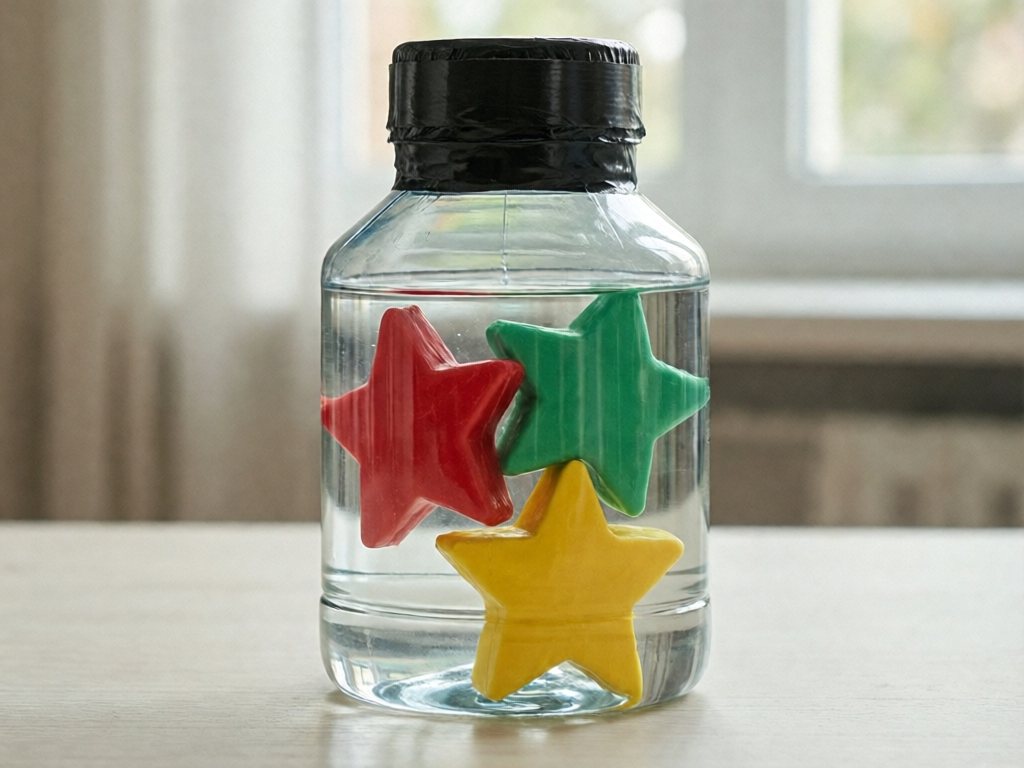
Easiest option: Buy a commercially sealed sensory bottle labeled for your baby’s age. There’s no glue to choose or cure, so it’s my first pick for a baby who mouths everything.
To make your own: Go the DIY route only if you’re confident in your materials. You’ll need a sturdy, clean, wide-mouth plastic bottle or jar, water, and clear glycerin. For fillers, pick two or three chunky solid plastic pieces too big to fit inside a toilet paper tube, like big plastic stars or blocks. The opening has to be wide enough to get them in. You’ll also need two-part epoxy labeled non-toxic once cured, plus waterproof tape.
How to make your own:
- Drop your large fillers into the bottle. Add water and a few drops of clear glycerin for a slow-motion effect. Skip oil-based fillers, which are not appropriate at this age.
- Working in a ventilated room, an adult runs a ring of glue around the cap threads and screws the cap on tight. Use two-part epoxy labeled non-toxic once cured, and skip superglue and solvent-based adhesives. Hot glue is a weaker seal, because it can soften or peel when the cap is chewed or sits in warm water. If you use it anyway, the tape wrap and a recheck before every use are a must. Let the glue cure fully for 24 hours before baby sees it.
- Wrap the cap with waterproof tape or electrical tape, overlapping a few times.
- Test it. Shake it, squeeze it, drop it on the floor, and tug the cap hard.
No bells, pom-poms, or ribbon in this one. They fail the tube test, and a failed seal would turn them into choking hazards.
What it builds: Visual tracking, grasping, and the classic shake-and-watch loop. Babies love the immediate feedback as the stars tumble in slow motion.
If your little one loves this kind of play, calm-down sensory bottle ideas are a whole genre. I wrote about the calm-down versions, and the building steps there apply here too. A Christmas bottle is a calm-down bottle in a festive outfit.
Safety firstBefore every use, store-bought or homemade, tug the cap, squeeze the bottle, and check for dents. If it’s dented, cracked, or the cap is loose, throw it out and replace it.
5. Squishy “Snowy Window” Bag
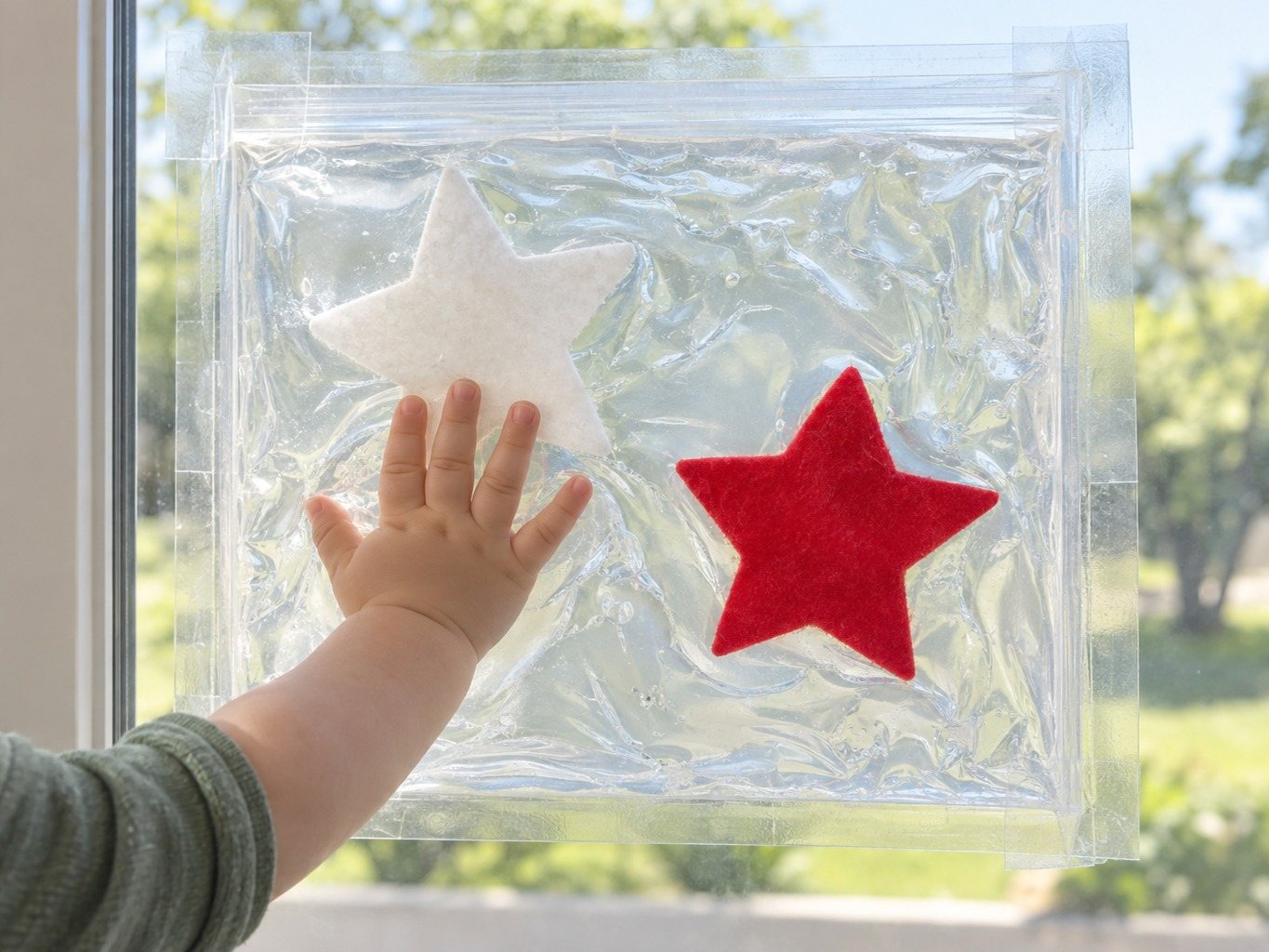
What you need: Two heavy-duty gallon freezer bags and packing tape. For the filling, 1/4 cup cornstarch and 1 cup water, cooked into a gel.
Add a few large felt or foam stars, each at least 3 inches across. They must be bigger than the tube so they stay safe even if the bag ever opens. Or skip the shapes and use gel only.
How to do it:
- Stir the cornstarch and water over medium heat until thick, then cool it completely. Put the gel and large shapes into one bag, squeeze out the air, and seal.
- Slide that bag into the second bag. Seal again and press flat.
- Run packing tape along the whole zip edge.
- Tape it to a wall or window at your baby’s chest height so they can press it with a flat hand. Tape all four edges down firmly.
What it builds: Poking, pressing, and finger strength. Plus a lovely light-through-the-gel effect on a window that babies stare at.
I covered this basic format in my post on no-mess sensory play ideas, including more fillers and fixes if a bag leaks. If you want a color-mixing version, add one drop of blue and one drop of yellow on opposite sides and let your baby figure out where green comes from.
Safety firstThis one needs a grown-up within arm’s reach. A bag that comes open becomes a gel-in-the-mouth situation fast, and a toddler can bite through a zip bag or pull a taped bag off the wall. Take it down whenever you step away or a corner peels, throw it out at any leak, and don’t leave it on the floor with a baby who chews corners.
6. Shatterproof Ornament Basket
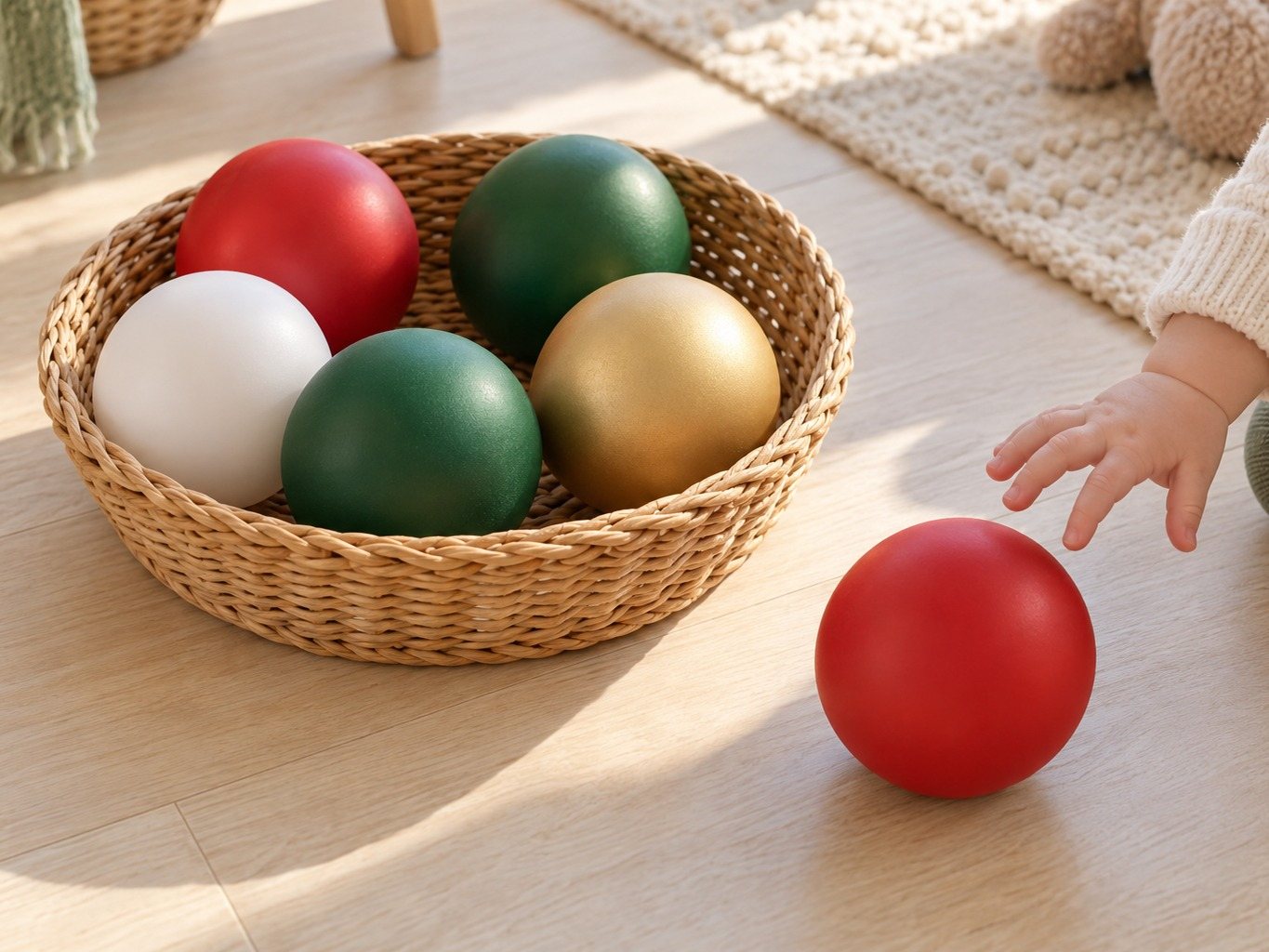
What you need: A shallow basket or box, and a handful of large, plastic, shatterproof ornaments. Look for solid plastic ones at least 3 inches across. Remove every cap and hook, and skip any with glitter that sheds.
How to do it: Set the basket on the floor next to the tree, within sight. That’s it.
I know, I know, the tree is the interesting thing. This gives your baby their own “tree” to rummage through. The idea is that it’s allowed. They get to pick things up, drop them, carry one across the room, hand you one, and put them all back in.
What it builds: Grasping, carrying, naming (“ball,” “red,” “shiny”), and an early sense of “these are mine, those are Mama’s.”
Mouthing note: Large ornaments made of solid plastic that pass the tube test are fine to gum.
Plastic ornaments can crack along the seam into sharp edges. Check each one before play, and retire it if it starts to split.
Bonus: I’ve found that when my baby has a basket of his own, he gets less interested in the real tree. Not zero, but less.
Easy Christmas Play: Unwrapping, Stacking, and Tossing (Activities 7 to 11)
One-year-olds love to take things apart, put them in, and take them out again. These five activities build on that with a holiday flavor.
7. Empty-Box Gift Unwrapping
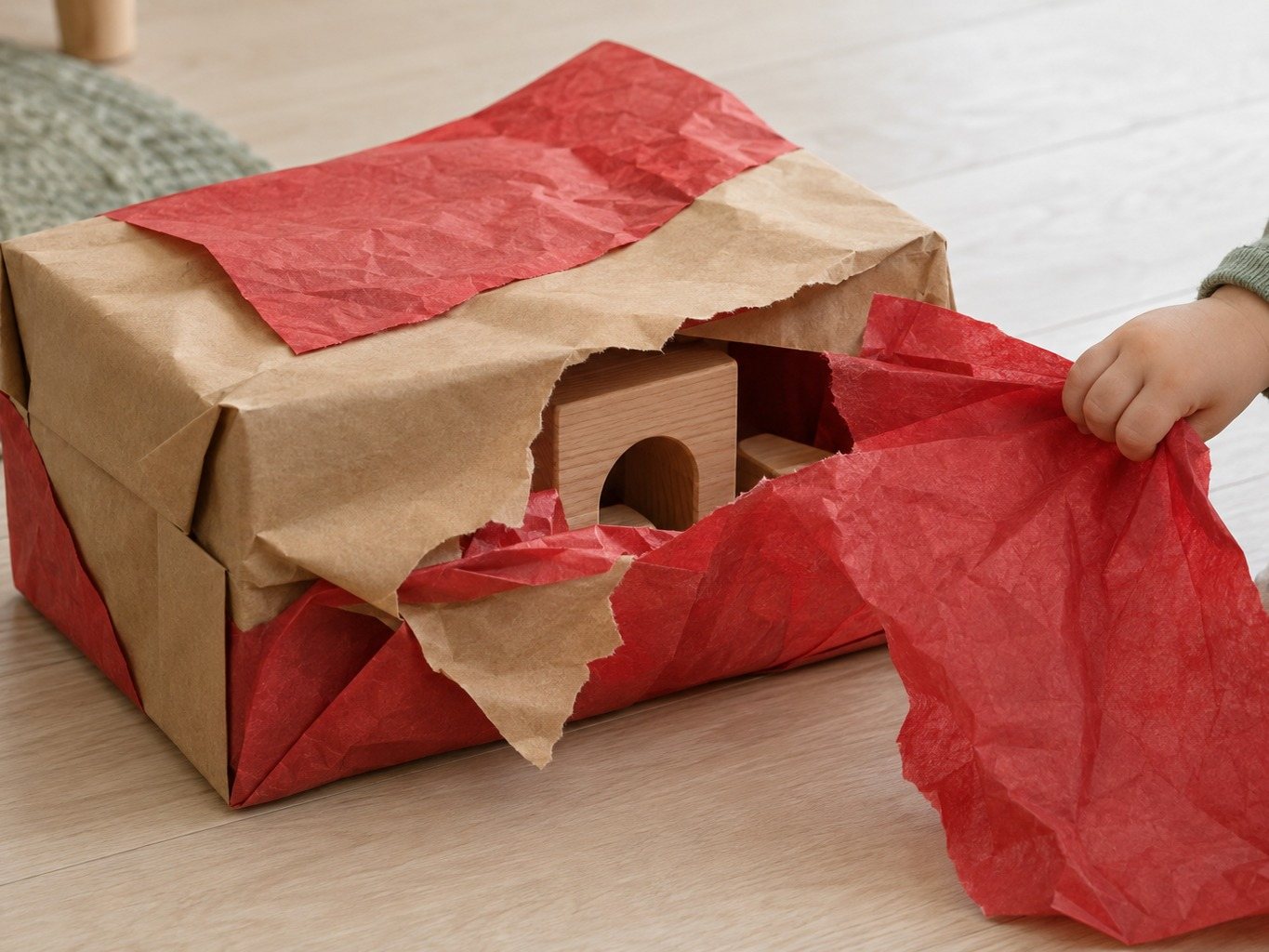
What you need: A small sturdy cardboard box (a shoebox is great) and kraft paper or large sheets of tissue paper.
Add a baby-safe toy or board book as the “gift.”
How to do it:
- Put the toy inside the box.
- Wrap loosely with paper. Do not use tape on the outside where baby can pull it off. Fold and tuck the paper, or use a single piece of tape on the bottom side.
- Let your baby tear and pull the paper off.
What it builds: Pulling, tearing, shape and texture awareness, and the thrill of finding a surprise. It also practices the word “open,” which is often a one-year-old’s favorite word.
Mouthing note: Paper isn’t toxic, but a wad can cause gagging. Skip metallic wrapping paper and anything with ribbon or bows attached.
Safety firstStay within arm’s reach and start with sheets much bigger than your baby’s hand. Pull out any chewed paper and pick up scraps right away. If your baby starts eating the paper instead of tearing it, stop the game and try again another day.
This is also excellent practice for the real Christmas morning, when your baby will quite possibly be more interested in the wrapping paper than anything inside it.
8. Santa’s Sack Scarf Pull
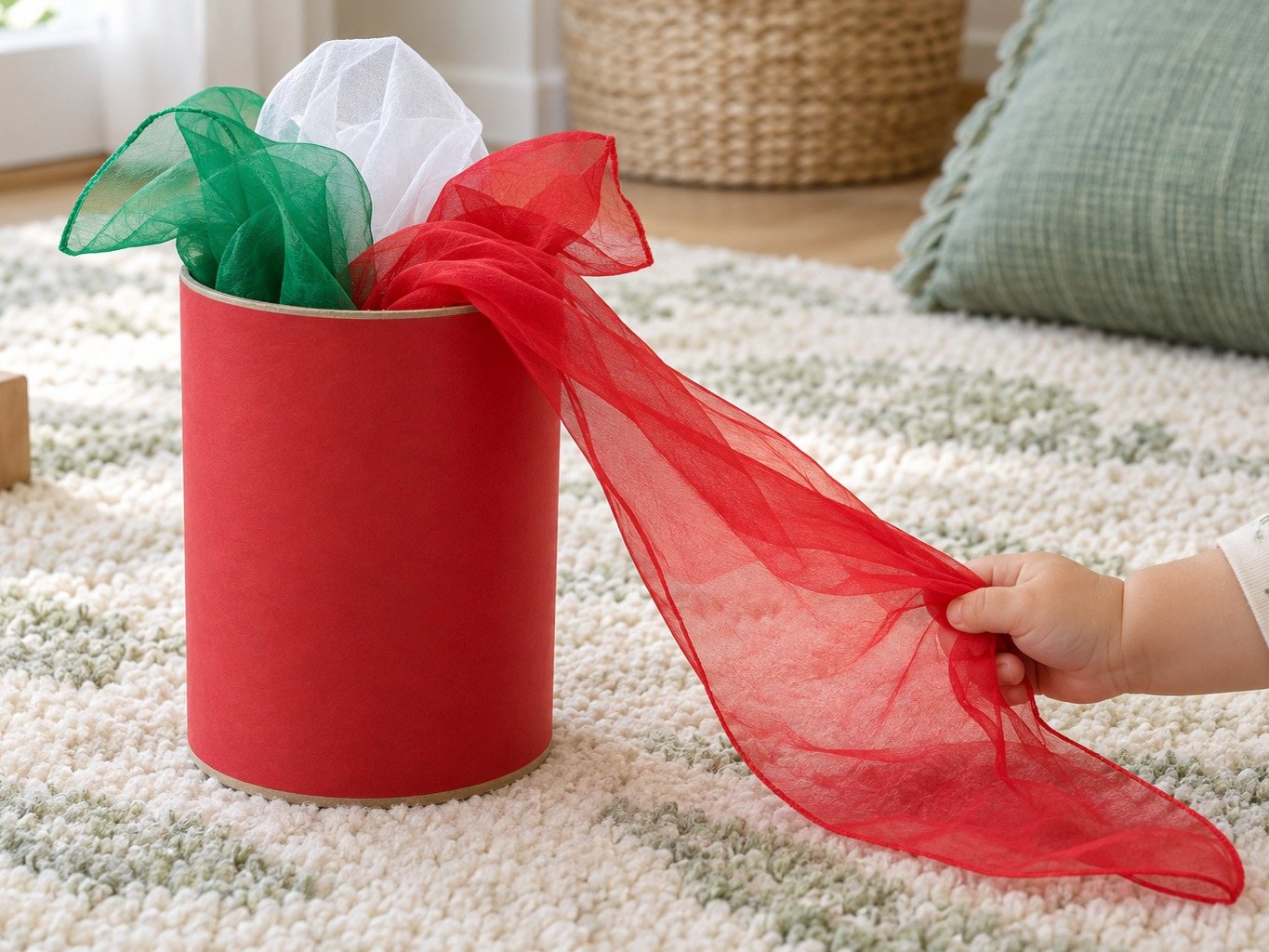
What you need: A tissue box with the plastic film pulled out, an oatmeal canister, or a small cloth bag. Three to five lightweight scarves or fabric squares in red, green, and white.
How to do it:
- Stuff the scarves into the container so one corner of each pokes out.
- Show your baby how to pull. Watch what happens: pull, pull, pull, a scarf appears.
- Stuff them back in and do it again, and again, and again.
What it builds: Pulling, pincer and palmar grasp, and object permanence (the scarf that goes back in still exists). It’s a lovely activity to sit down for, because it holds a one-year-old for a surprising number of repetitions.
Safety firstNever tie the scarves together or leave them looped around a neck or arm. Short, single pieces of lightweight fabric only, and stay in the room. Wash them often because they’ll be well-chewed.
9. Stacking-Cup Christmas Tree
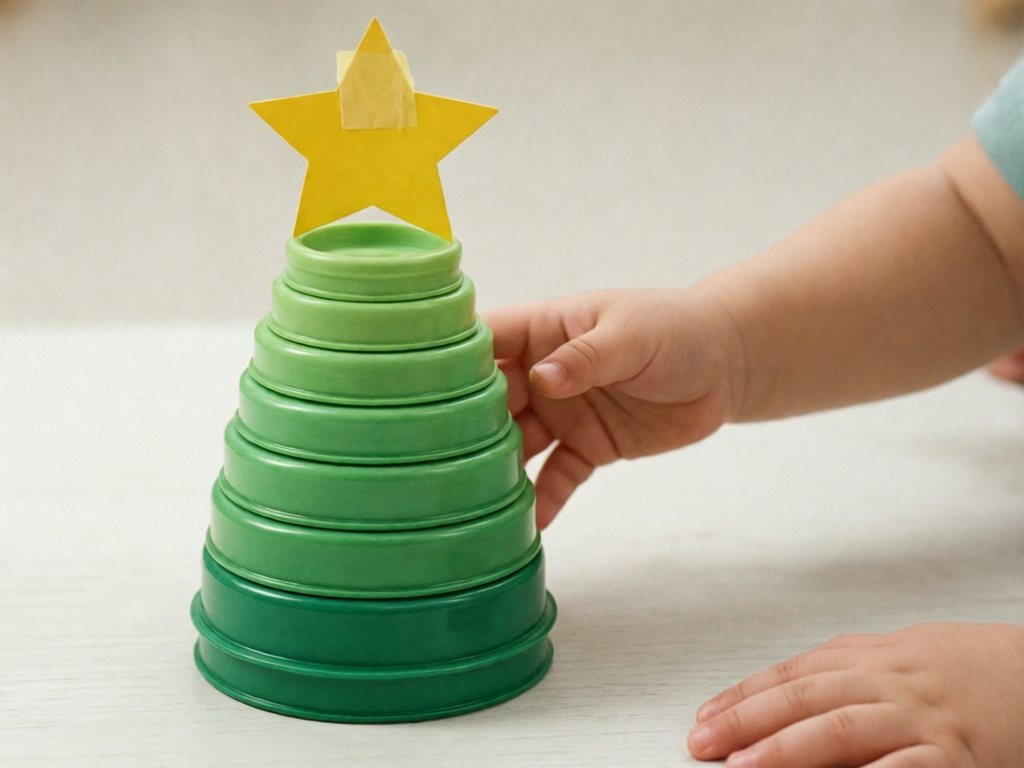
What you need: Regular baby stacking cups. Ideally green, but whatever you have is fine.
How to do it:
- Build a tower with the biggest cup on the bottom, smallest at the top. That’s your Christmas tree.
- Point out the “tree” and say its name.
- Knock it down. This is the main event.
- Build again and let your baby knock it down again.
What it builds: Cause and effect, early stacking, and nesting. Most one-year-olds won’t build the whole tree themselves, and that’s okay. The knocking-down is the activity.
If you want to add a holiday touch, cut a star out of yellow paper and put it on top (taped down firmly, or just held up for show). It’s a two-minute set-up, which makes it one of the lowest-effort activities on this list.
Mouthing note: Standard stacking cups are made to be chewed on. Wash them after play.
10. Sock Snowball Toss
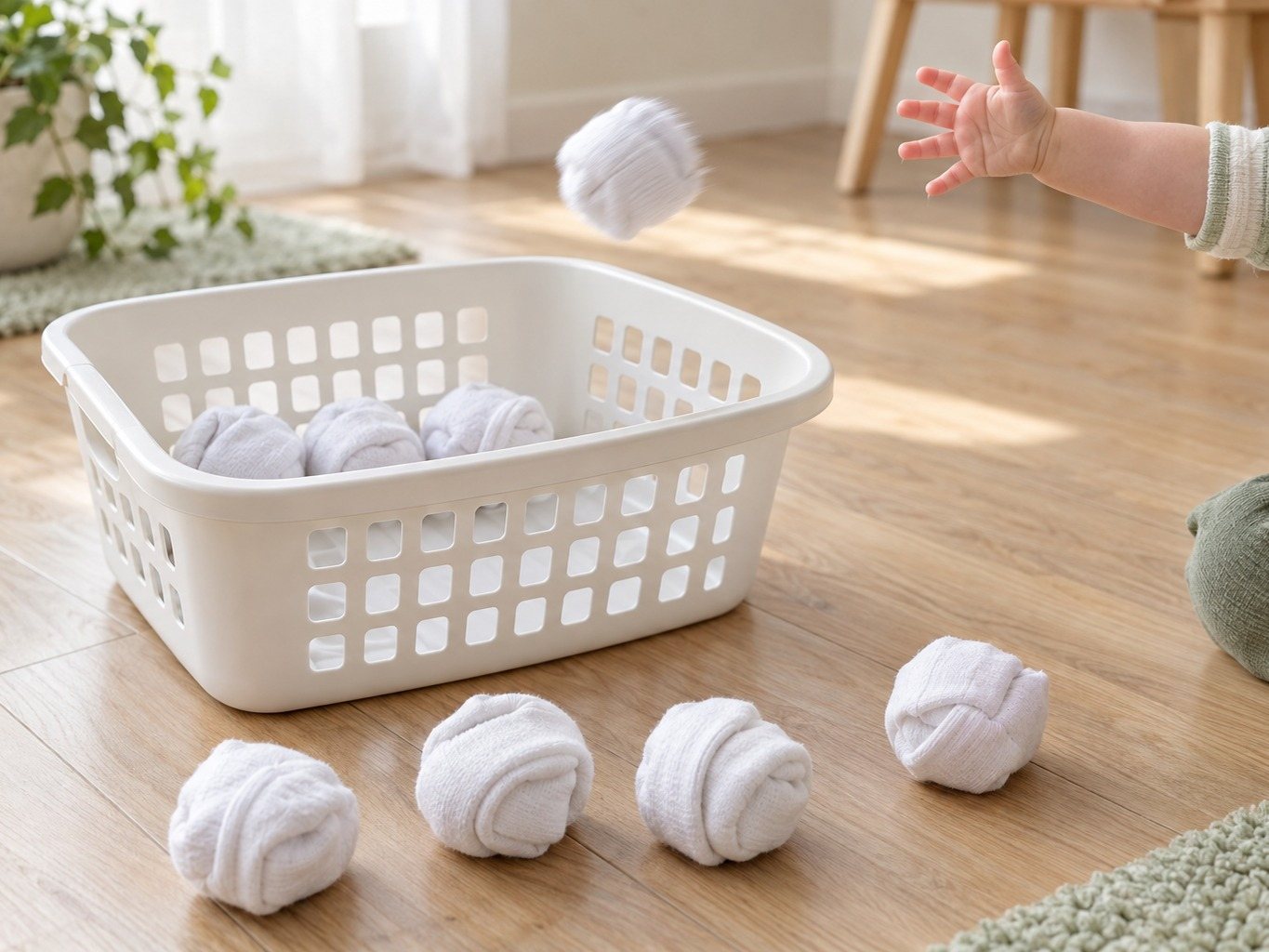
What you need: 6 to 10 clean white or light socks, rolled and tucked into balls, and a laundry basket or a big bowl.
How to do it:
- Roll each pair of socks tightly into a ball. Fold the cuff over to hold it.
- Set the basket a few feet away.
- Show your baby how to toss. Cheer wildly for any attempt, including dropping a sock on the floor.
- When the basket is full, dump it out and start again.
What it builds: Throwing, hand-eye coordination, gross motor skills, and big joyful energy. This is the best burn-off-energy activity on the list, and it works indoors when it’s too cold to be outside.
Mouthing note: Socks are soft and large, so the choking risk is low. Skip anything with tiny pom-poms, loose threads, or sock grippers that can peel.
Why not real cotton balls or pom-poms? They fail the tube test or shed fibers and end up in mouths. The sock version has all of the throwing fun with none of the fluff.
11. Sticky-Wall Felt Tree
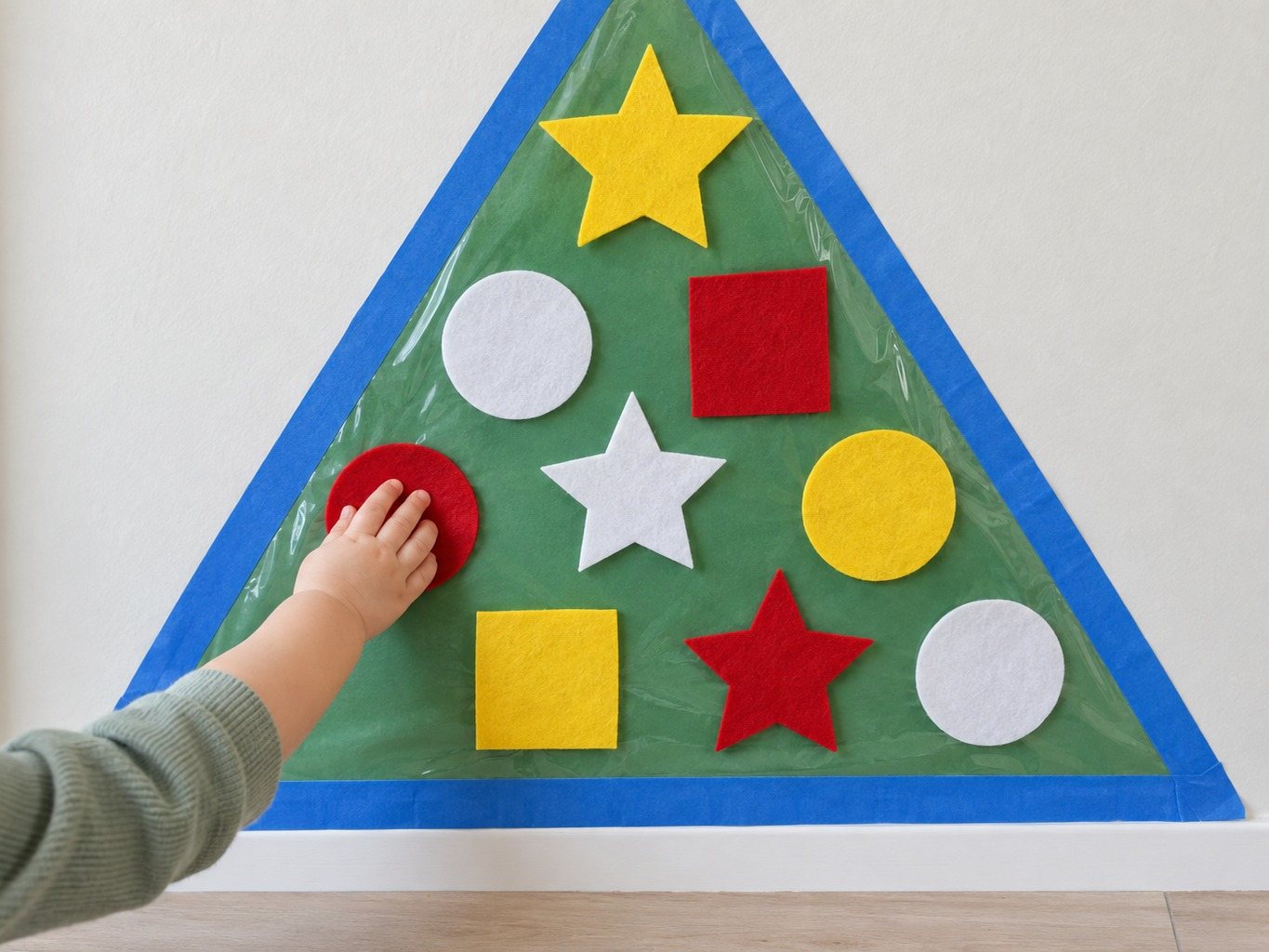
What you need: Clear contact paper, painter’s tape, a sheet of paper or cardboard, and large felt shapes: circles, stars, and squares in holiday colors, each 3 inches or bigger.
How to do it:
- Cut a triangle from green paper and tape it to the wall at toddler height. Or just skip the paper and make the shape right on the contact paper.
- Tape the contact paper on top, sticky side facing out. Tape all four edges down firmly.
- Hand your baby the felt shapes and show them how to press them onto the sticky tree.
- Peel them off and start again.
What it builds: Pressing, peeling, pointing, and naming colors and shapes (“star! red! round!”). Peeling felt off sticky paper is a surprisingly good hand-strength workout.
Mouthing note: The felt shapes are large enough to pass the tube test, but felt can shed fibers. Keep them out of the mouth when you can, and check them after play.
Contact paper isn’t toxic but isn’t food, and a baby can peel off and mouth the film. Tape every edge, stay within arm’s reach, and take the sheet down right away if any corner lifts.
Christmas Music, Lights, Bath, and Book Time (Activities 12 to 15)
The last four are about noise, motion, and language. These are the ones where parents have the most fun.
12. Pot-and-Spoon Jingle Band
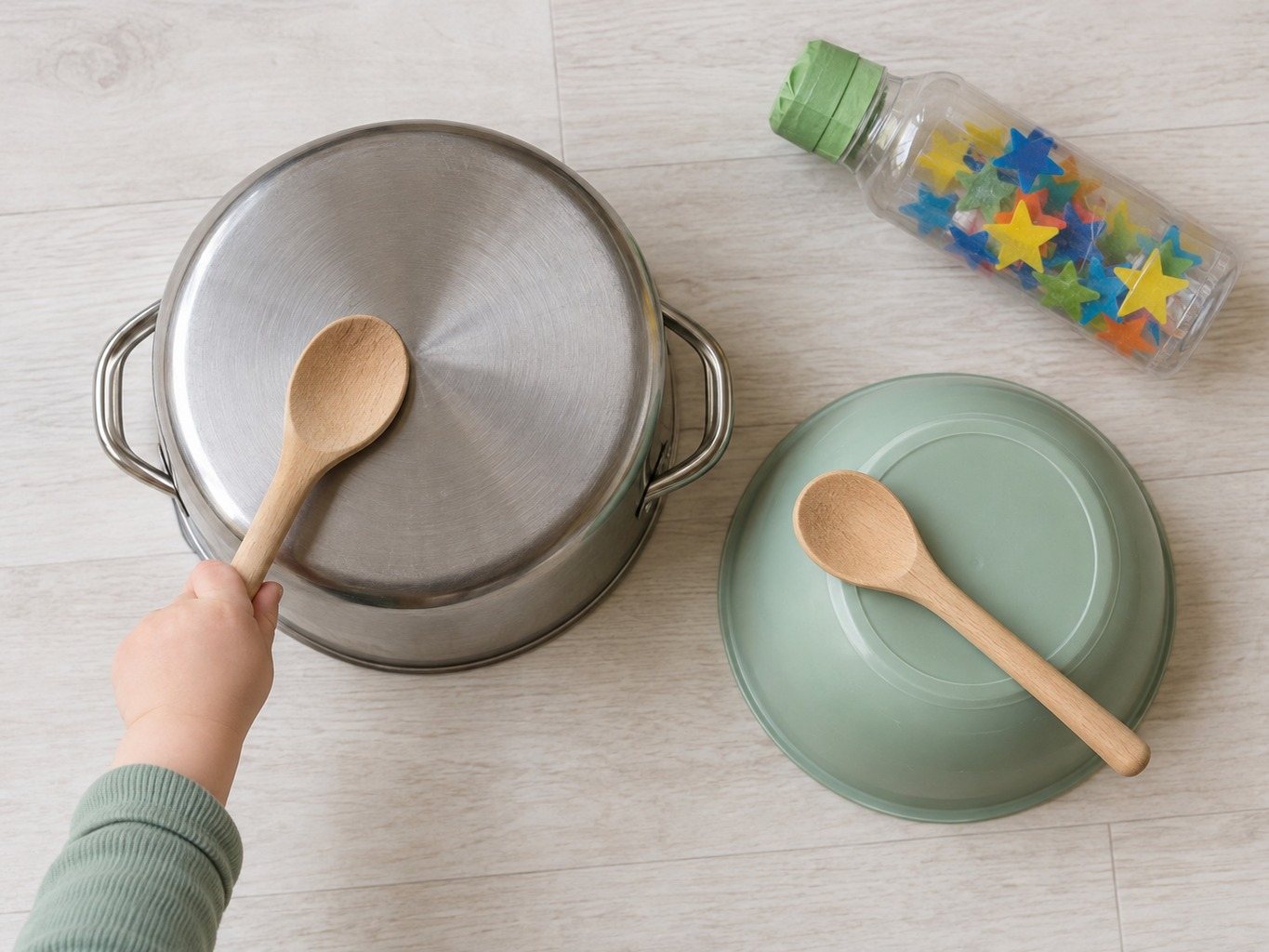
What you need: A pot or two, a plastic bowl, and two short wooden or silicone spoons. A baby-safe shaker or rattle if you have one.
How to do it:
- Turn the pot upside down and give your baby the wooden spoon.
- Put on a Christmas song (the slower ones work well for baby rhythm).
- Bang along. Show them how to tap soft and loud.
- Add the sealed star shake bottle from activity 4 as a shaker. Before it joins the band, tug the cap and check the bottle again for dents or cracks, and let your baby shake it rather than bang it on the pot.
What it builds: Rhythm, cause and effect, imitation (they watch what you do and try to copy it), and a lot of noise. Hand-eye coordination gets a boost too.
Safety firstChoose short, sturdy spoons and keep your baby seated while banging. A long spoon can jab or gag a child who walks with it, and metal spoons are hard on gums and teeth, so leave those in the drawer. No loose bells, and keep any rattle sealed.
Earplugs for parents are only half a joke. Do this one in the kitchen, not the nursery.
13. Light-Spotting Walk

What you need: A stroller or carrier, a warm jacket, and a safe walk around your neighborhood after dark. Or just look out the window.
How to do it:
- Walk or look at holiday lights.
- Point and name: “Light! Look, a light! Red light!”
- Pause long enough for your baby to point back.
- Repeat.
What it builds: First words (“light” is a word many babies pick up when they see lights), pointing, joint attention, and a love of seeing the world. This activity takes no set-up at all, which makes it my favorite for tired evenings.
Safety firstDon’t let your baby touch lights or cords. Keep light strings and cords out of reach, tuck them behind furniture or use cord covers, and unplug them when you leave the room. Skip any string with cracked wires or loose bulbs, and keep plugs and batteries up high.
If you’re staying home, turn off the room lights, put a flashlight inside a red or green cup, and make it glow on the ceiling. It’s a surprisingly good substitute. Keep the flashlight in your own hand, since it holds batteries.
14. Bubble Beard Bath
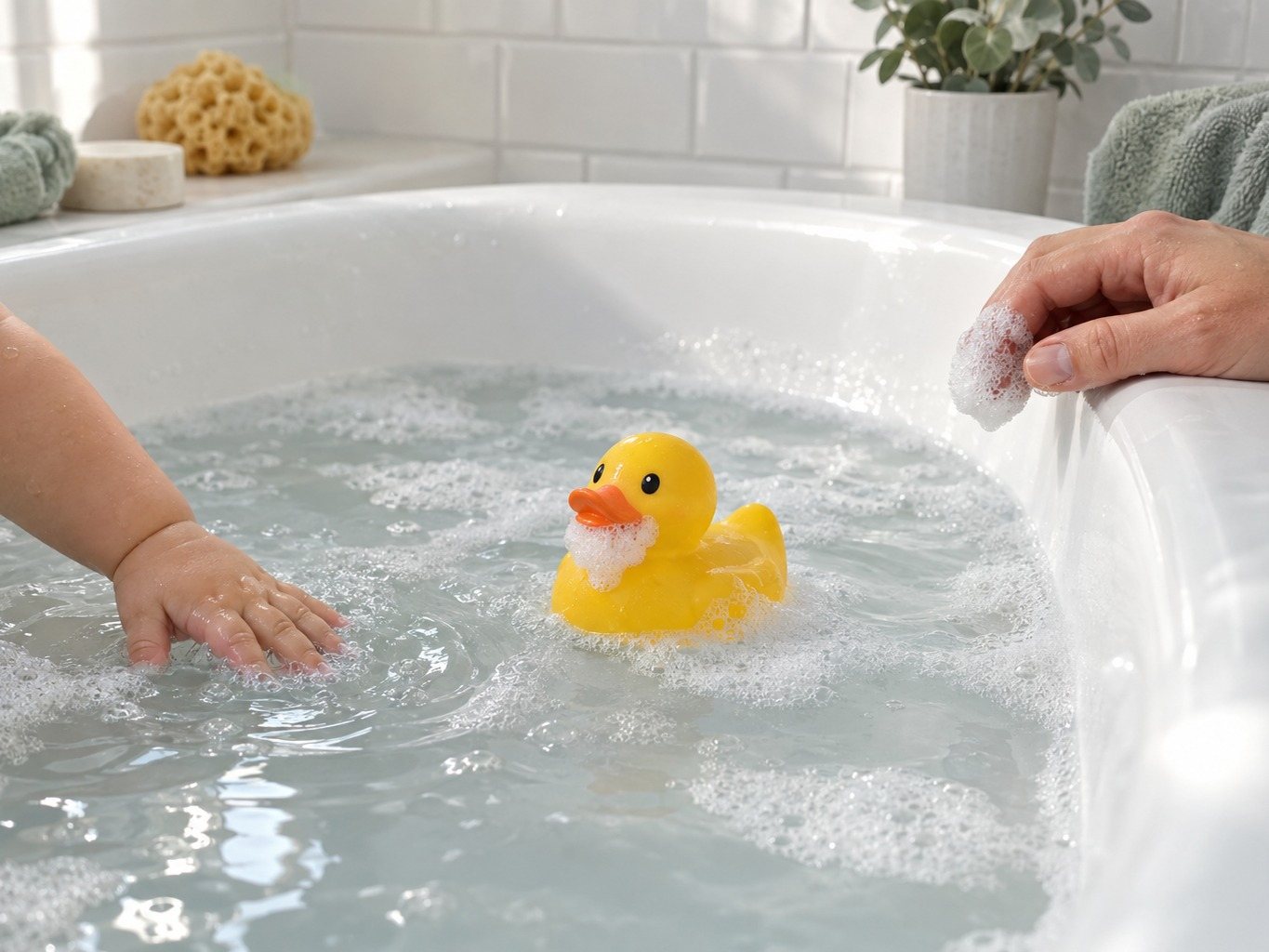
What you need: A tub, warm water, a small amount of baby bubble bath, and a washcloth.
How to do it:
- Fill the tub with a few inches of warm water and just a little bubble bath.
- Make a bubble beard on your own chin and on a rubber duck or bath toys. Keep lather off baby’s face.
- Name body parts and bubbles: “Mama’s Santa beard! Bubbles! Pop!”
What it builds: Sensory exploration, body part naming, imitation, and a calm wind-down before bed. A warm bath is also one of the nicest ways to break up a long, overstimulating holiday afternoon.
Safety firstNever leave a baby alone in the bath, even for a second. Use a baby-safe soap, keep bubbles out of eyes and mouth as best you can, and rinse your baby off afterward. If your baby has sensitive skin, skip the bubble bath and use bath toys instead.
15. Touch-and-Feel Christmas Board Books
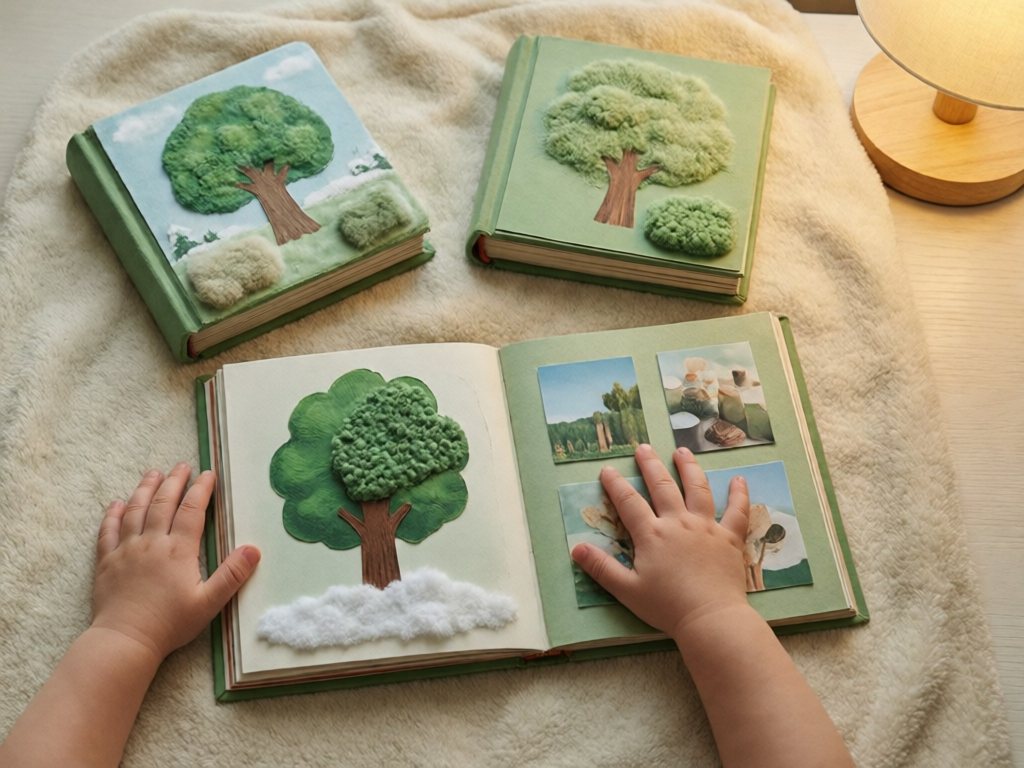
What you need: Two or three sturdy board books about Christmas or winter. Look for chunky pages, bright pictures, and textures like fuzzy snow or bumpy trees.
How to do it:
- Sit on the floor with your baby, ideally with a blanket and a cozy light.
- Let them hold the book, flip pages, and chew a corner. All three are reading.
- Name what you see. Keep it simple: “Tree! Star! Reindeer!”
- Let them touch the textures, then say what it feels like: “Soft. Bumpy.”
- Read the same book every day, because repetition builds language.
What it builds: Language, page turning, pointing, and a love of books.
Mouthing note: Board books are designed to be chewed on. Skip books with tiny flaps, glued-on bits, or paper pop-ups that can tear off. If a texture patch starts peeling, retire the book.
A Sample Christmas Week for a One-Year-Old
You do not need to do all 15 of these. Please don’t. Here’s what a realistic December looks like in my house with a one-year-old, using maybe one activity per day, and often a repeat:
| Day | Activity | Time (set-up to cleanup) |
|---|---|---|
| Monday | Stacking-cup tree and book basket | 10 min |
| Tuesday | Yogurt snow painting | 15 min |
| Wednesday | Light-spotting walk | 20 min |
| Thursday | Sock snowball toss | 10 min |
| Friday | Empty-box gift unwrapping | 10 min |
| Saturday | Oatmeal “snow” bin | 20 min |
| Sunday | Bubble beard bath | 15 min |
Notice that most of these take 10 to 20 minutes from set-up to cleanup, and the play itself is often just a few minutes. That’s about right. A one-year-old’s day is mostly eating, sleeping, and being carried, and everything else is a bonus.
TipSave the messy bins for days you have energy, and lean on books and lights on days you don’t.
Repeat favorites freely. If your baby loves the scarf pull, do it four days in a row. They’re not bored. They’re mastering it.
Rotate the sealed stuff. Put the sealed bottle and squish bag away for a few days and bring them back. They’ll feel brand new.
Christmas Gifts and Overstimulation for 1 Year Olds
Beyond the activities at home, December brings gifts from relatives and a lot of noise. Here’s how I handle both.
The gift question
Grandparents often want to buy something. Having a few ideas ready helps. For a one-year-old, I’d suggest:
- Stacking and nesting toys: knocked down now, stacked for real later, and great in the bath.
- Chunky board books: thick pages small hands can turn (and chew).
- Large soft blocks: easy to grab, and nobody gets hurt when they’re thrown.
- Simple pull toys: a natural fit for brand-new walkers.
- Big soft balls: rolling, chasing, and dropping are peak fun at this age.
- Experiences: a zoo or children’s museum membership gets used all year and adds no clutter.
For a longer list, see my post on stocking stuffers for toddlers that aren’t junk. It’s written for ages 1 to 3, so most of it fits this stage.
Watch for small parts in gifts
Run the tube test on new gifts before handing them over, and check batteries. Toys with battery compartments should have a screw-closed door. Anything with button batteries (including some singing greeting cards) goes up high.
The overstimulation reality
A one-year-old at a big family holiday can look fine, fine, fine, and then fall apart completely. Lights, noise, new faces, and a disrupted nap schedule add up.
What helps:
- A quiet corner. Bring a blanket and a basket of two or three calm toys: the scarf pull, a board book, a sealed bottle.
- Keep naps as close to normal as you can. An overtired baby doesn’t enjoy the party anyway.
- Take breaks. Walk outside, go to another room, or put on a calm song.
- Lower your expectations. Your baby doesn’t need to sit on Santa’s lap. A photo of a screaming baby is also a classic holiday keepsake. I have several.
Mess Management for the Holiday Season
The drop cloth, diaper-only play, and towel tips are in the activities above. These four habits keep the mess from taking over a house already full of decorations. For more low-mess ideas, see our mess-free art activities for toddlers.
- Keep it away from the tree. Oats and yogurt travel, and wrapped presents and tree skirts are hard to clean.
- Set up near the sink or tub. The bath is basically your cleanup tool.
- Use a time limit. Messy play ends when you say it ends, usually after 10 to 15 minutes. Wipe hands and say, “All done!”
- Embrace the not-perfect. Your floor will have oats on it. Your baby will have yogurt in their eyebrows. It will be fine.
Frequently Asked Questions
What are the safest Christmas activities for a 1 year old who puts everything in their mouth?
The safest choices are taste-safe activities, where everything is edible, and sealed activities, where the interesting parts are locked inside a sealed bottle (store-bought is my first pick) or a double-bagged squish bag. Yogurt painting and an oatmeal bin (start with a small amount of oats for younger babies) suit most one-year-olds. Save the soft cooked pasta bin for babies 15+ months or who already eat soft pasta at meals. Add large (3+ inch) solid plastic ornaments with the caps and hooks removed, and you’ve got a full week of play. Stay within arm’s reach for all of them, and skip anything with loose bells, glitter, tinsel, or button batteries.
Are Christmas crafts appropriate for a 1 year old?
Traditional crafts, the kind with a finished product, aren’t a great fit yet. One-year-olds don’t have the fine motor control or attention span for glue, scissors, or following steps, and they still mouth most materials. Process-based activities work much better: yogurt painting, ripping paper, pressing felt onto a sticky wall. These feel like crafts but are really exploration. For guided, step-by-step projects, wait until around age two.
What’s a good Christmas sensory bin for babies?
A plain rolled-oats bin with a couple of big scoops is a classic. It’s taste-safe, cozy, and easy to sweep up. Start with a small amount if your baby is under about 15 months. For babies 15+ months or who already eat soft pasta at meals, cooked, cooled, green-tinted pasta cut into short pieces is another favorite. Avoid dried beans, rice with small decorations, water beads, fake snow, and anything glittery. Keep the bin shallow and the portion small, and stay within arm’s reach. Make a fresh batch each time and throw it out when you’re done.
What can I do for Christmas with a 1 year old if I only have 5 minutes?
Stack the cups into a “tree” and let your baby knock it down. Hand over a basket of large (3+ inch) solid plastic ornaments with the caps and hooks removed. Roll up a few socks and toss them into a laundry basket. Or switch on the tree lights from a switch or outlet baby can’t reach, keep baby away from the cord, and spend a few minutes pointing at lights and saying the words. All four are nearly zero prep, and they work because they follow what a one-year-old is already doing: grabbing, dropping, and looking at shiny things.
Can my 1 year old be near the Christmas tree?
Yes, with some set-up. Use an artificial tree if you can, and check that it isn’t shedding bits of plastic. Either way, choose a wide stable stand and anchor the tree to a wall or ceiling hook with strong cord or wire. Keep breakables and glass ornaments well above reach, and hang only shatterproof ornaments on the lower branches, or leave the bottom third bare.
Skip tinsel, keep light cords tucked and out of reach, and cover any tree water. Real needles are sharp and a choking risk, so sweep or vacuum them daily. A baby gate around the tree is perfectly reasonable. A basket of “baby’s own ornaments” nearby can reduce the pull of the real thing.
What Christmas activities work for a mixed group of 1 and 2 year olds?
Anything open-ended works across both ages: yogurt painting, the oatmeal bin (or the pasta bin once the baby is 15+ months), the sock snowball toss, the sticky-wall tree, and the jingle band. Set up the activity so the younger child’s version is safe (taste-safe, large pieces, no small parts), and the older one can add layers, like sorting colors, naming shapes, or helping scoop.
Keep an eye on what an older sibling brings to the table, because small craft supplies are the biggest risk when a baby is around. Store the older child’s craft supplies, tape, and glue out of the baby’s reach.
How long should a Christmas activity last for a one-year-old?
Plan for 5 to 15 minutes in total, and don’t be surprised if it’s less. A baby’s attention comes in two-to-five-minute bursts, and walking away from an activity after two minutes doesn’t mean it failed. Leave the materials out where they can return to them, or put them away and try again tomorrow. Following their interest, rather than finishing the activity, is the whole point at this age.
One Last Thing Before You Go
If you walk away from this list with just one idea, I hope it’s this: Christmas with a one-year-old doesn’t need to be a month of “no.” Give them a few safe, simple things to grab and shake. Sit down on the floor with them for ten minutes. Say the words out loud. Light. Tree. Star. More.
Some of these will be hits and some will get a shrug. Your baby will probably care more about the box than the thing inside it, and that’s the most ordinary kind of magic. In a year or two, they’ll be gluing, cutting, and demanding glitter, and you’ll miss the yogurt-in-the-eyebrows days. For now, put the glass ornaments up high, grab a spoon, and enjoy it.