
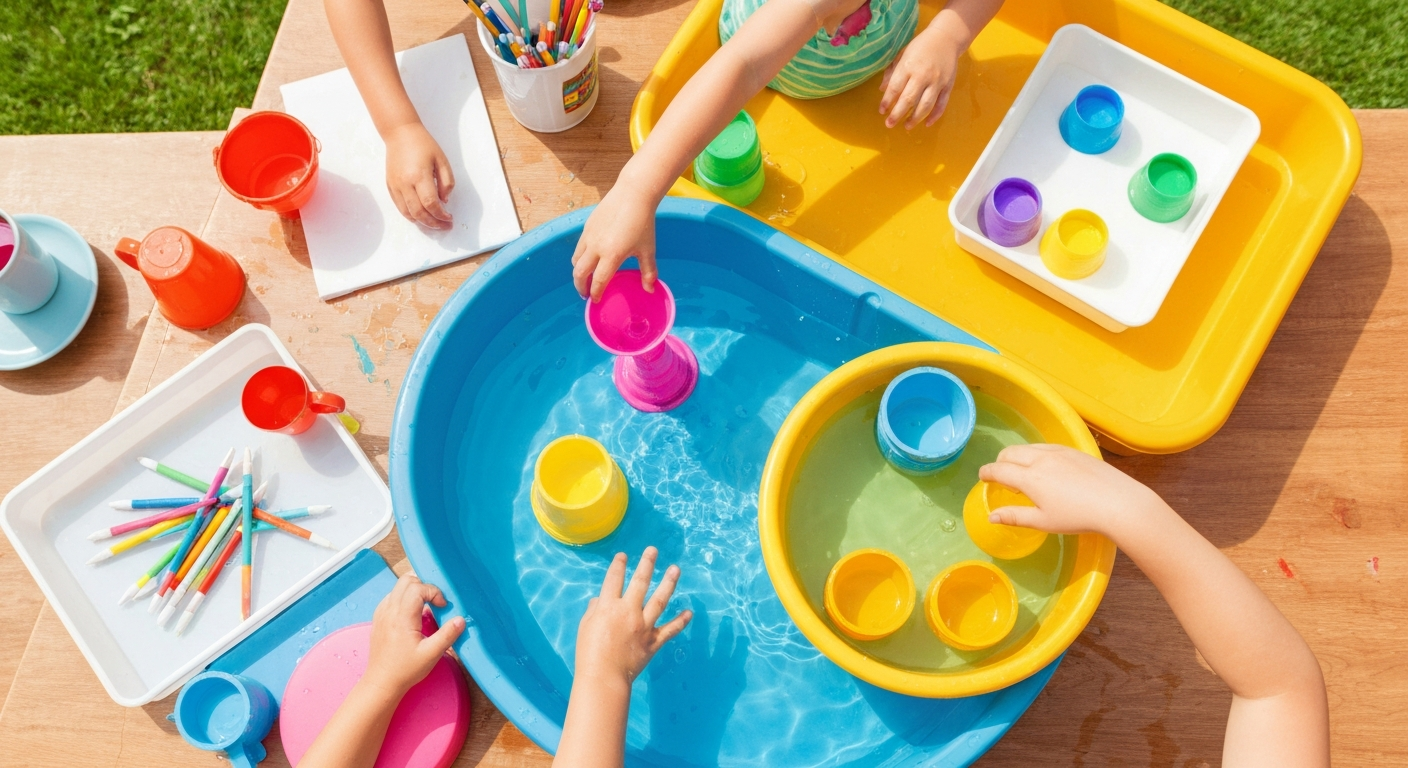
Water Play Activities for Toddlers: 20 Splashy Ideas
Discover 20 engaging water play activities that boost your toddler's sensory, motor, and cognitive skills. Learn how to set up safe indoor or outdoor water play sessions and explore ideas from simple splashing to themed games.
- Always supervise your child closely during water play for safety.
- Boost your toddler's motor, sensory, and cognitive skills with water play.
- Set up engaging water play indoors or outdoors using simple containers.
- Try activities from basic pouring to themed play like a toy car wash.
- Utilize common household items for free, developmental entertainment.
There’s something about water that captivates toddlers. Give them a bowl, a cup, and some water, and they’ll happily play for ages. It’s sensory exploration at its purest—wet, splashy, endlessly fascinating.
Water play isn’t just fun; it’s deeply developmental. It builds fine motor skills, teaches cause and effect, introduces scientific concepts, and provides calming sensory input. Plus, it’s basically free entertainment.
Here are 20 water play activities that range from simple splashing to more elaborate setups—all guaranteed to delight your water-loving little one.
[IMAGE: Toddler happily playing at water table outdoors in summer]
Why Water Play Matters
Sensory development:
Water provides unique tactile input—temperature, texture, weight, and movement all in one.
Fine motor skills:
Pouring, squeezing, scooping, and transferring water strengthens hand muscles.
Cognitive development:
Water teaches concepts like full/empty, sink/float, more/less, and cause and effect.
Language opportunities:
Describing what happens builds vocabulary: splash, pour, drip, float, sink.
Emotional regulation:
Water play is naturally calming—great for winding down or processing big feelings.
Safety First
Never leave children unattended around water—even small amounts.
- Drowning can happen in just inches of water
- Always supervise closely
- Empty containers when play is finished
- Keep water shallow for young toddlers
Water Play Setup Tips
Outdoor Water Play
Benefits: Mess doesn’t matter, can get really wet
Best containers: Water tables, kiddie pools, large storage bins
Tips:
- Set up on grass or patio (not deck—slippery!)
- Have towels ready
- Apply sunscreen
- Provide shade if possible
Indoor Water Play
Benefits: Year-round option, temperature controlled
Best containers: Large bins, bathtub, kitchen sink
Tips:
- Use towels or shower curtain under play area
- Smaller water amounts
- Choose easy-cleanup locations
- Accept some mess will happen
20 Water Play Activities
Simple Water Play
1. Basic Water Table Play
Fill water table or large bin. Add cups, funnels, and containers. Let them explore freely.
What they learn: Pouring, scooping, cause and effect
—
2. Colored Water
Add food coloring or liquid watercolors to water. Mix colors to see what happens.
What they learn: Color mixing, visual tracking
—
3. Ice Exploration
Freeze toys in ice blocks. Let toddler use warm water to “rescue” them.
What they learn: Temperature concepts, patience, problem-solving
—
4. Sink or Float
Gather household items. Predict then test which sink and which float.
What they learn: Scientific observation, prediction, vocabulary
—
5. Bubble Play
Add dish soap to water. Provide whisks and beaters to make bubbles.
What they learn: Cause and effect, fine motor coordination
[IMAGE: Toddler hands whisking bubbles in soapy water]
50 Easy Sensory Bin Ideas for Toddlers (By Season)
Transfer Activities
6. Water Transfer Sponges
Provide sponges and two containers. Soak sponge in one, squeeze into other.
What they learn: Fine motor strength, sequencing
—
7. Turkey Baster Transfer
Use turkey basters to move water between containers.
What they learn: Hand-eye coordination, muscle strength
—
8. Eyedropper Art
Provide eyedroppers and colored water. Drip onto paper towels or coffee filters.
What they learn: Fine motor precision, color mixing, art
—
9. Pouring Station
Set up various sized containers. Practice pouring water from one to another.
What they learn: Volume concepts, motor control, precision
—
10. Cup to Cup Challenge
Line up several cups. Transfer water down the line.
What they learn: Sequencing, patience, motor control
Themed Water Play
11. Car Wash
Set up toy car washing station with soapy water, brushes, and rinse bin.
What they learn: Pretend play, fine motor skills, sequencing
—
12. Baby Doll Bath
Let toddler wash baby dolls with soap, washcloths, and towels.
What they learn: Nurturing play, self-care concepts, sequencing
—
13. Dish Washing Station
Provide play dishes, soapy water, scrub brush, and rinse bin.
What they learn: Practical life skills, pretend play, organization
—
14. Animal Rescue
Hide plastic animals in “mud” (water with cocoa powder or dirt). Wash them clean.
What they learn: Nurturing, cleaning concepts, sensory exploration
—
15. Fishing Game
Float foam shapes or plastic fish. Use nets or slotted spoons to “catch” them.
What they learn: Hand-eye coordination, counting, categorizing
Rainbow Rice Sensory Bin: How to Make and 10 Ways to Play
Science-Focused Water Play
16. Rain Cloud Experiment
Fill jar mostly with water. Add shaving cream “cloud” on top. Drip colored water on cloud. Watch it “rain” through.
What they learn: Basic weather concepts, cause and effect
—
17. Water Volume Experiments
Provide different sized containers. Explore which holds more/less.
What they learn: Volume, measurement, comparison
—
18. Frozen Flower Exploration
Freeze flowers in ice. Explore melting and the flowers inside.
What they learn: Temperature changes, nature appreciation, patience
—
19. Absorption Experiment
Collect items: sponge, paper towel, plastic, fabric. Test which absorb water.
What they learn: Material properties, prediction, observation
—
20. Water Xylophone
Fill glasses with different water levels. Tap with spoon to create sounds.
What they learn: Sound, volume, music, cause and effect
DIY Water Table Options
Budget-Friendly Alternatives
Storage bin: Large plastic bin on a low table or ground
Kiddie pool: Inexpensive and large play area
Dish bins: Multiple smaller bins for various activities
Muffin tin: Perfect for sorting and pouring
Baking dishes: Good size for indoor play
Enhancing a Basic Setup
Add:
- Funnels (all sizes)
- Measuring cups and spoons
- Squeeze bottles
- Spray bottles
- PVC pipe pieces
- Plastic tubing
- Colanders and strainers
- Whisks and ladles
Water Play Add-Ins
Make basic water more interesting:
Sensory additions:
- Ice cubes
- Soap flakes
- Water beads (supervised, older toddlers only)
- Slime (for older toddlers)
Color and scent:
- Food coloring
- Liquid watercolors
- Essential oils (drop only)
- Kool-Aid powder
Found objects:
- Leaves and flowers
- Shells
- Smooth stones
- Corks
FAQ
At what age can toddlers do water play?
Babies can enjoy supervised water play from around 6 months! Keep it simple, shallow, and closely supervised. Complexity increases with age.
How do I contain the mess indoors?
Use under-bed storage bins inside a larger bin or on a shower curtain. Accept that some water will escape—it’s part of the experience.
My toddler just wants to dump water on the floor. Help!
This is normal and developmental! Redirect to dumping water into other containers. Play outside when possible. Limit water amount indoors.
How long should water play last?
As long as they’re engaged! Some toddlers play 10 minutes; others stay an hour. Follow their lead.
Is water play appropriate in winter?
Absolutely! Use warm water, move indoors, and keep play areas temperature-appropriate. Bath time is year-round water play.
Conclusion
Water play is simple, inexpensive, and incredibly valuable for toddler development. From basic pouring to themed activities to science experiments, water offers endless possibilities.
Set up a water station, gather some cups and funnels, and let your toddler splash to their heart’s content. The giggles (and learning!) are worth every drop on the floor.
Mess-Free Painting Activities for Toddlers
—


