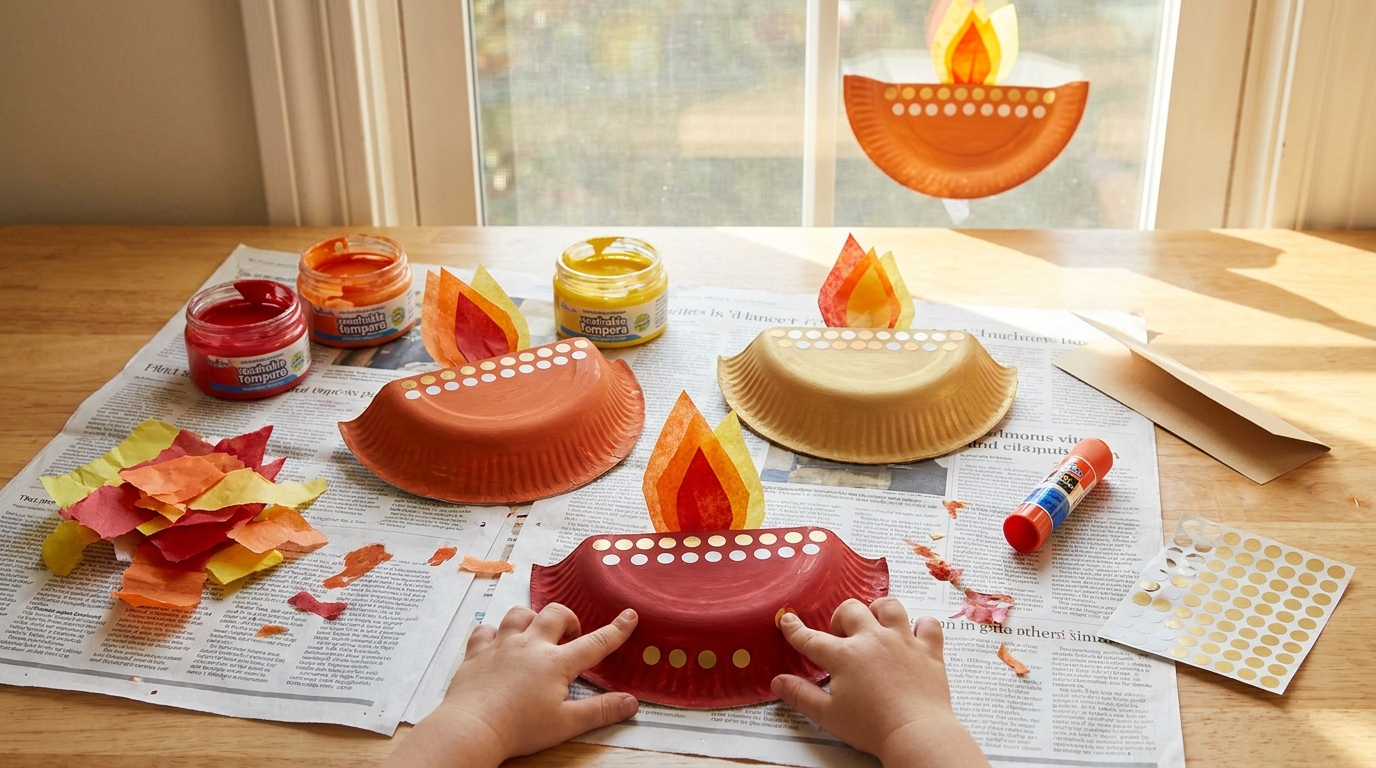
Diwali Diya Craft for Toddlers: Easy Paper Plate Lamps
This post contains affiliate links. As an Amazon Associate I earn from qualifying purchases.
Last October, my daughter came home from a playdate cradling a painted clay diya like a baby bird. She had one very serious question: could we light it?
She was two and a half, so we made a paper plate one instead, and she checked on “my light” every morning for three weeks.
A diya is a small clay oil lamp that families light for Diwali, the festival of lights. This post gives you the paper plate version: no flame, about four minutes of adult cutting, and simple steps for ages 2 to 4. Your toddler does the sticky, painty, tearing parts.
Safety firstNo flame, ever: the flame is paper. Skip small embellishments under age 4, keep scissors adult-only, and stay close while your toddler handles tissue paper and stickers.
In this article (10 sections)
- Why a Paper Plate Diya Works So Well for Toddlers
- Paper Plate Diya Craft: Supplies
- The Four-Minute Adult Prep: Cutting Guide and Setup
- Step-by-Step Paper Plate Diya
- Paper Plate Diya Safety Notes for Toddlers
- Paper Plate Diya Craft Ideas and Variations
- More Easy Diwali Crafts for Toddlers: Garland, Rangoli and Fireworks
- What Diwali Celebrates (A Kid-Friendly Explanation You Can Read Aloud)
- Where to Display Your Paper Plate Diyas
- Paper Plate Diya FAQ
Why a Paper Plate Diya Works So Well for Toddlers
Real diyas hold oil and a lit cotton wick, and families set out rows of them during Diwali. They’re beautiful. They’re also breakable and a fire source, so they’re not for toddler hands.
A paper plate version solves the problems at this age:
- No flame, ever. The “flame” is a scrap of tissue or construction paper. Nothing gets lit, melted, or heated.
- Nothing breakable. Clay chips and cracks, tealight cups split, and glass votives are out of the question. A paper plate survives being dropped, sat on, and carried upside down through the house.
- Toddler-sized jobs. Tearing tissue, pressing stickers, and dabbing paint with a sponge are all things a 2- to 4-year-old can manage. There’s no “wrong” way to decorate a bowl, so scribbles and blobs look intentional.
Love this kind of project? Our roundup of paper plate crafts for every season has more ways to turn a single plate into something worth keeping.
Paper Plate Diya Craft: Supplies
Most of this is already in a craft drawer. Here’s the full list with swap options.
| Supply | What it’s for | Easy swap | Toddler safety note |
|---|---|---|---|
| 2 sturdy paper plates (9-inch) | The diya bowl (one plate makes two bowls) | Any uncoated plate; foam plates work but are harder to glue | Choose plain uncoated plates so paint sticks |
| Washable tempera or kids’ paint | Painting the bowl | Washable markers, crayons, or dot stickers | Use washable, non-toxic paint |
| Sponge pieces or chunky brush | Dabbing paint on | A crumpled paper towel | Skip tiny brushes at this age |
| Orange, yellow, and red tissue paper | The flame | Construction paper, felt, or coffee filters | Paper only, never real flame |
| Glue stick | Sticking tissue and paper pieces | Washable school glue for older toddlers | Glue sticks are the least messy option |
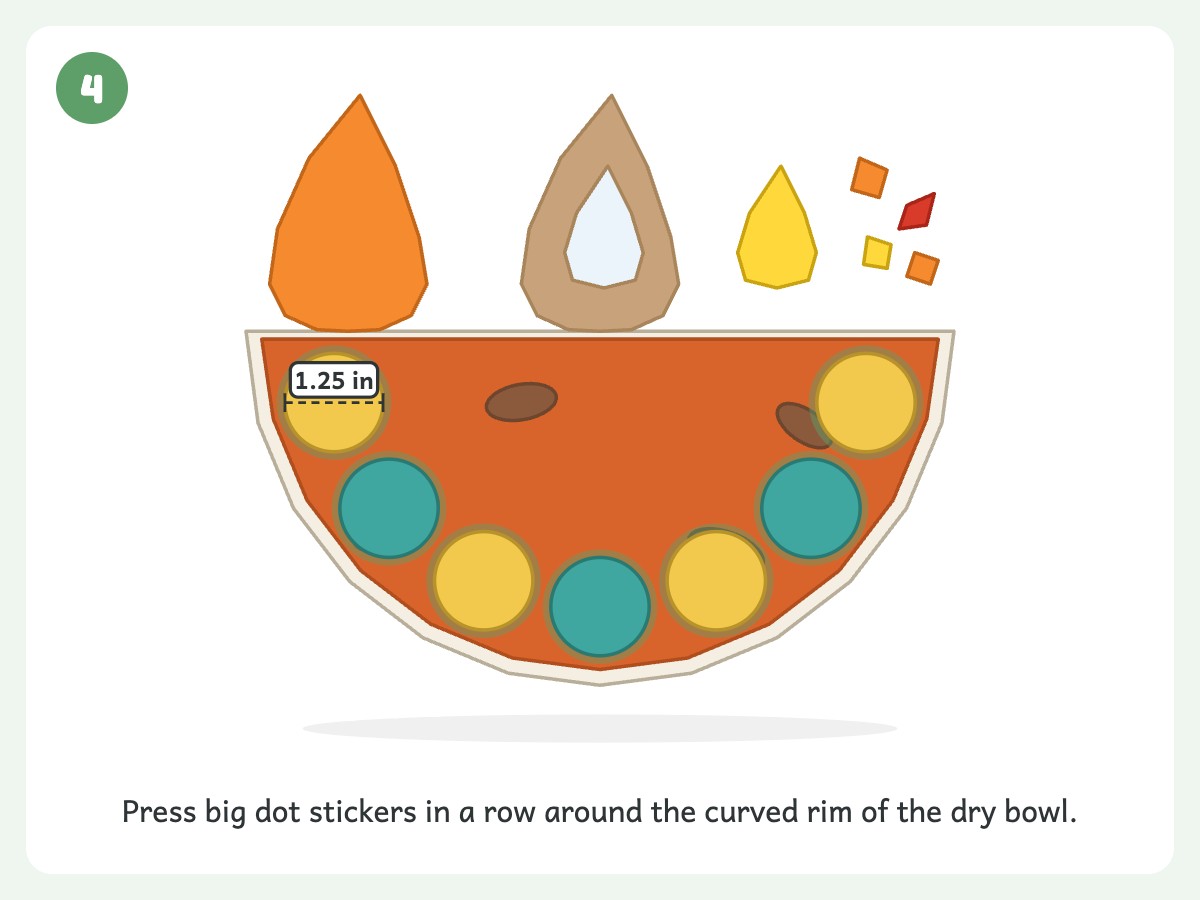
| Dot stickers or star stickers | Decorating the rim | Painted dots with a fingertip | Use large stickers (over 1.25 in across) for under-3s |
| Cardstock or thick paper scraps | Flame base, backing strip, easel prop | A cut-up cereal box | Adult handles the cutting |
| Scissors | Adult prep only | No swap, adult only | Keep out of reach after prep |
| Painter’s tape | Attaching the flame, hanging the finished diya | Masking tape (sticks harder and can leave residue on glass) | Painter’s tape peels off windows cleanly |
| Old shirt or smock, newspaper | Mess protection | An adult’s old T-shirt | A washable smock or old T-shirt protects clothes |
Optional extras for ages 3 to 4:
- Gold crayon or a washable, non-toxic metallic marker for adult-assisted detail work
- Stamp pads for fingerprint patterns
- A torn tissue or felt strip as the “wick”
Leave loose sequins, small beads, and googly eyes off the list. The safety notes below explain why. Do add baby wipes, more than you think you need.
The Four-Minute Adult Prep: Cutting Guide and Setup
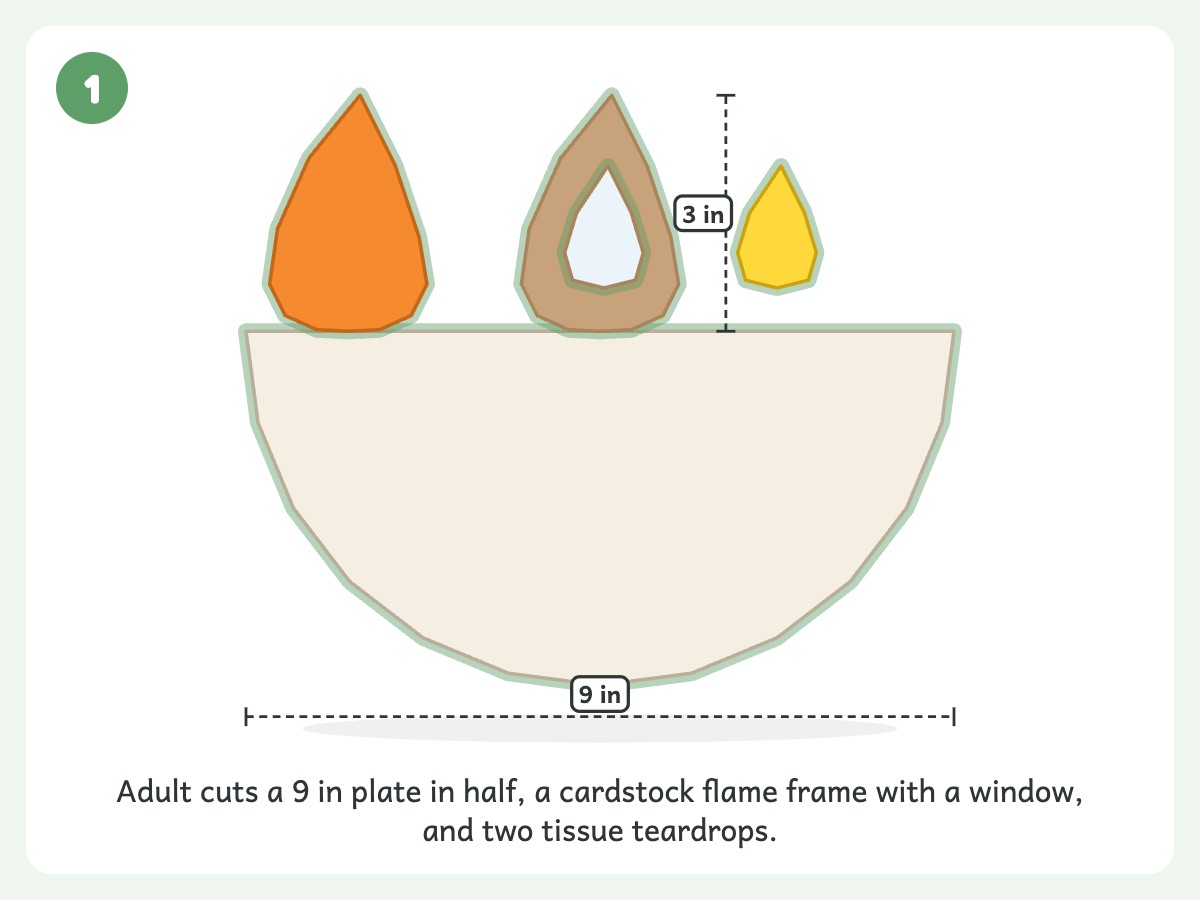
The shape is simple: half a plate for the bowl and a teardrop for the flame. The Paper Plate Diya Craft Card Pack near the top includes a ready-made template. Or use the sizes below.
| Piece | Size | How many per diya | Who cuts it |
|---|---|---|---|
| Diya bowl | Half of a 9-inch paper plate (cut straight across the middle) | 1 (one plate makes 2 bowls) | Adult |
| Flame base | Cardstock teardrop, about 3 in tall × 2 in wide, with a teardrop window about 1.5 in tall × 1 in wide cut from the middle | 1 | Adult |
| Flame (outer) | Tissue teardrop, about 3 in tall × 2 in wide, in orange or red | 1 | Adult |
| Flame (inner) | Smaller tissue teardrop, about 1.5 in tall × 1 in wide, in yellow | 1 | Adult |
| Backing strip | 1 in × 4 in strip of cardstock | 1 | Adult |
| Easel prop (optional) | 2 in × 4 in strip folded in thirds | 1 | Adult |
| Tissue scraps for tearing | Any size | A handful | Toddler tears these |
TipThe window in the flame base is what lets sunlight through the tissue. Keep the cardstock frame around it about half an inch wide so the flame stays stiff.
Cutting the bowls and flames takes about four minutes. Do it while your toddler is occupied with snacks, or the night before.
Cut the pieces in four quick steps
- Halve the plates. Fold each plate in half, crease hard, and cut along the fold. The flat cut edge becomes the top of the bowl.
- Cut the flame window. Fold the cardstock teardrop in half lengthwise and snip a half-teardrop from the fold.
- Stack the tissue. Stack four layers of tissue to cut several flames at once.
- Make extras. Toddlers often want to make “one more,” and siblings will want their own.
Good to knowExpect a few paint dots on the table, glue stick residue on one sleeve, and tissue-paper confetti that turns up under the couch next week. It’s low-mess compared to clay or glitter, but not no-mess. For something cleaner, try mess-free art activities for toddlers.
Set up the table
Do this before your toddler sits down. If you set up while a two-year-old watches, you’ll lose them.
- Cover the table with newspaper or a wipeable mat. Wet tissue paper bleeds dye and can stain a tablecloth.
- Put a coin-sized puddle of each paint color in shallow lids. Jar lids and yogurt-cup lids are perfect.
- Lay out stickers on a plate with the backing already loosened at the corners.
- Put your child in an old shirt with the sleeves rolled up. If they resist smocks, a spare adult T-shirt works as a dress.
- Tape the bowl to the table with painter’s tape so it doesn’t slide while your toddler dabs. Put the flat edge at the top and the curved edge toward your child.
- Keep the tissue paper in a bowl. Otherwise it wafts everywhere.
- Use a glue stick, not a bottle. Bottles invite squeezing, and squeezing invites a puddle.
- Keep wipes where you can grab them one-handed. Wipe hands before the sink, so you don’t get painted handprints on the faucet.
Step-by-Step Paper Plate Diya
Here’s the whole project in one list, in the order that works. Plan on about 25 minutes of hands-on crafting plus a 20-to-30-minute drying break. For 2-year-olds, split it into two short sittings: paint first, everything else after a nap.
- Talk about light (2 min). Before any supplies come out, switch off a lamp or draw the curtains and say, “It’s a little dark in here. What do we need?” Turn the light back on. Then show the half-plate bowl and say, “We’re going to make a little lamp called a diya. Families make them for a holiday called Diwali.” If your child is in a listening mood, read the read-aloud paragraph further down this page.
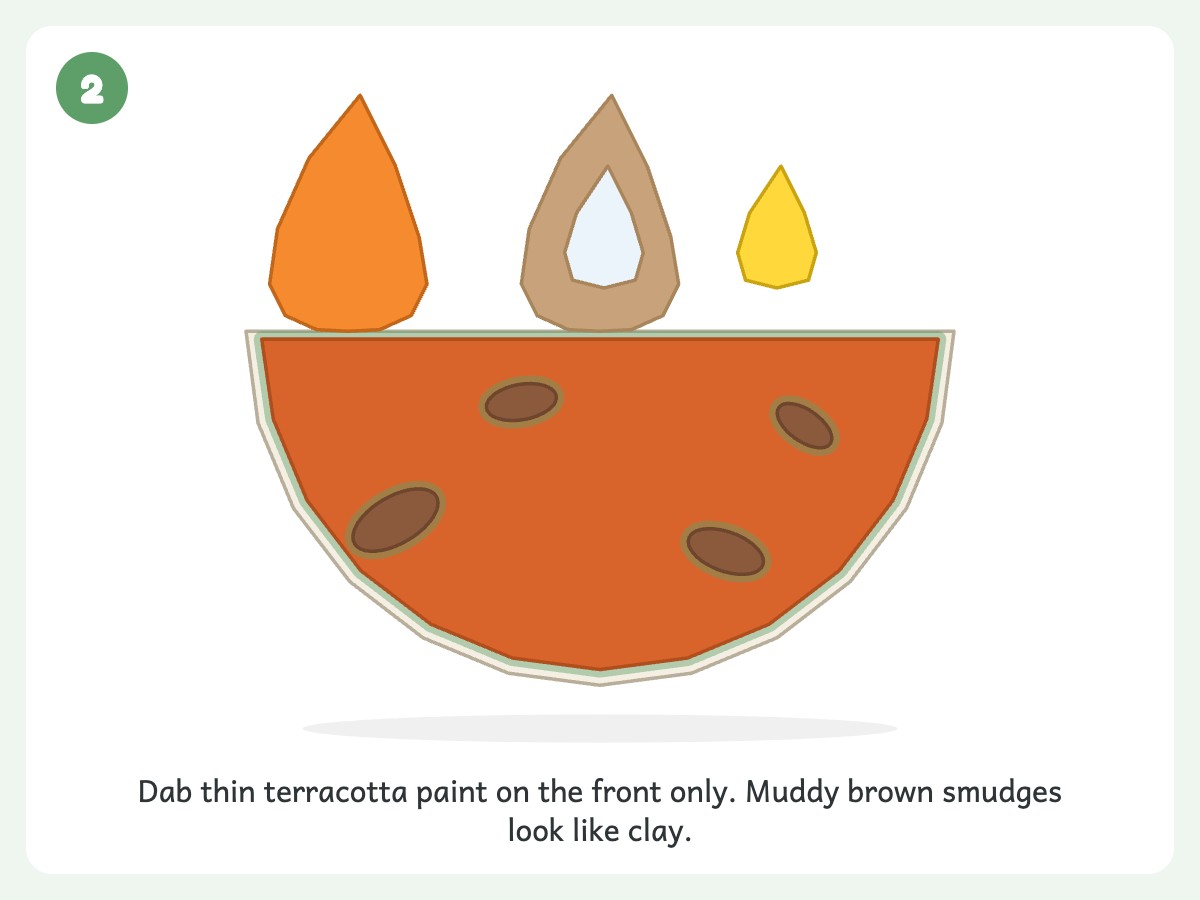
- Paint the bowl (8 min). Hand over a sponge or a fat brush and two or three colors. Toddler job: dab, smear, and swirl thin paint on the front only. Painting both sides doubles the drying time. Our first bowl got such a thick coat that it was still tacky an hour later. Now I pour out only a coin-sized puddle of each color.
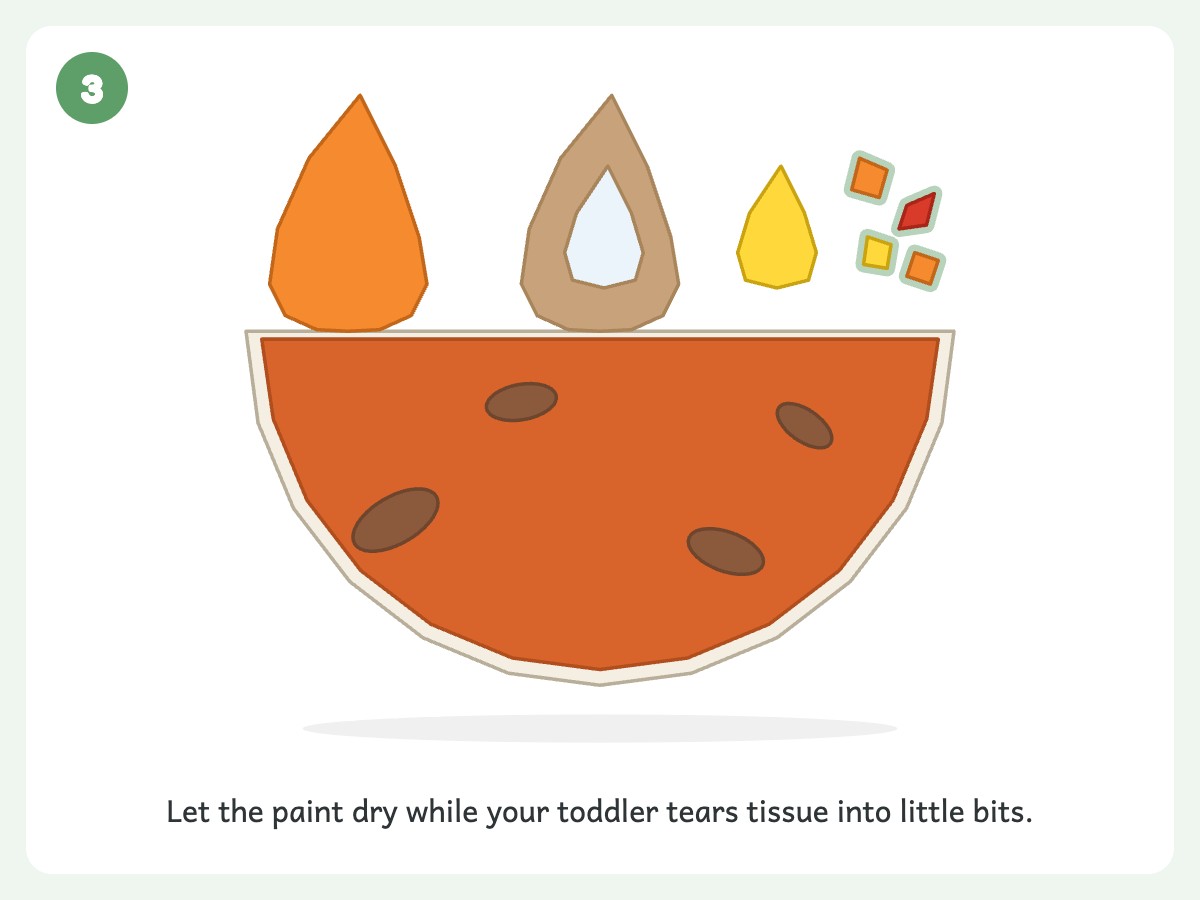
- Take a drying break and tear tissue (20-30 min). Thin, sponge-dabbed paint is usually touch-dry in 20 to 30 minutes. Wipe hands, have a snack, then hand over orange, red, and yellow tissue paper. Toddler job: tear and crumple it into a bowl. There’s no wrong way to do it.
- Stick on decorations (5 min). Stickers won’t stay put on wet paint, so check that the bowl is touch-dry first. Toddler job: press dot or star stickers around the rim. Lots of Diwali decorations use repeating dot and flower patterns, so rows of stickers look right at home. No stickers, or a child who still mouths them? Make fingerprint dots with washable paint instead.
- Glue the flame (6 min).
Adult job: rub glue stick on the cardstock frame only, and keep it off the open window. Swipe a little glue on the yellow teardrop too.
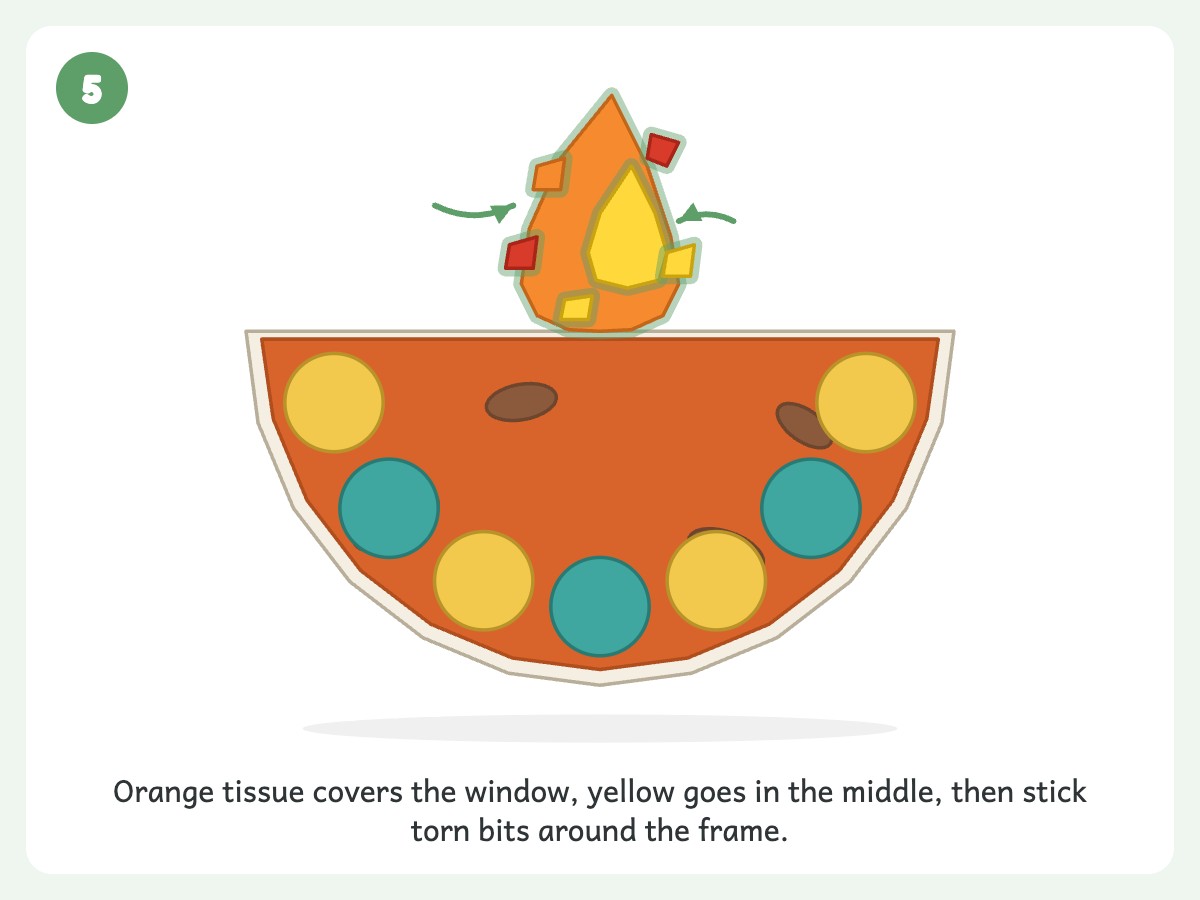
Toddler job: press the orange tissue teardrop over the frame so it covers the window. Press the yellow teardrop onto the middle. Then stick torn tissue bits around the frame.
Keep the window to one or two layers of tissue so light can get through. I glued straight across the window on our first try, and the flame came out cloudy. Now I trace the frame.
- Attach the flame (3 min).
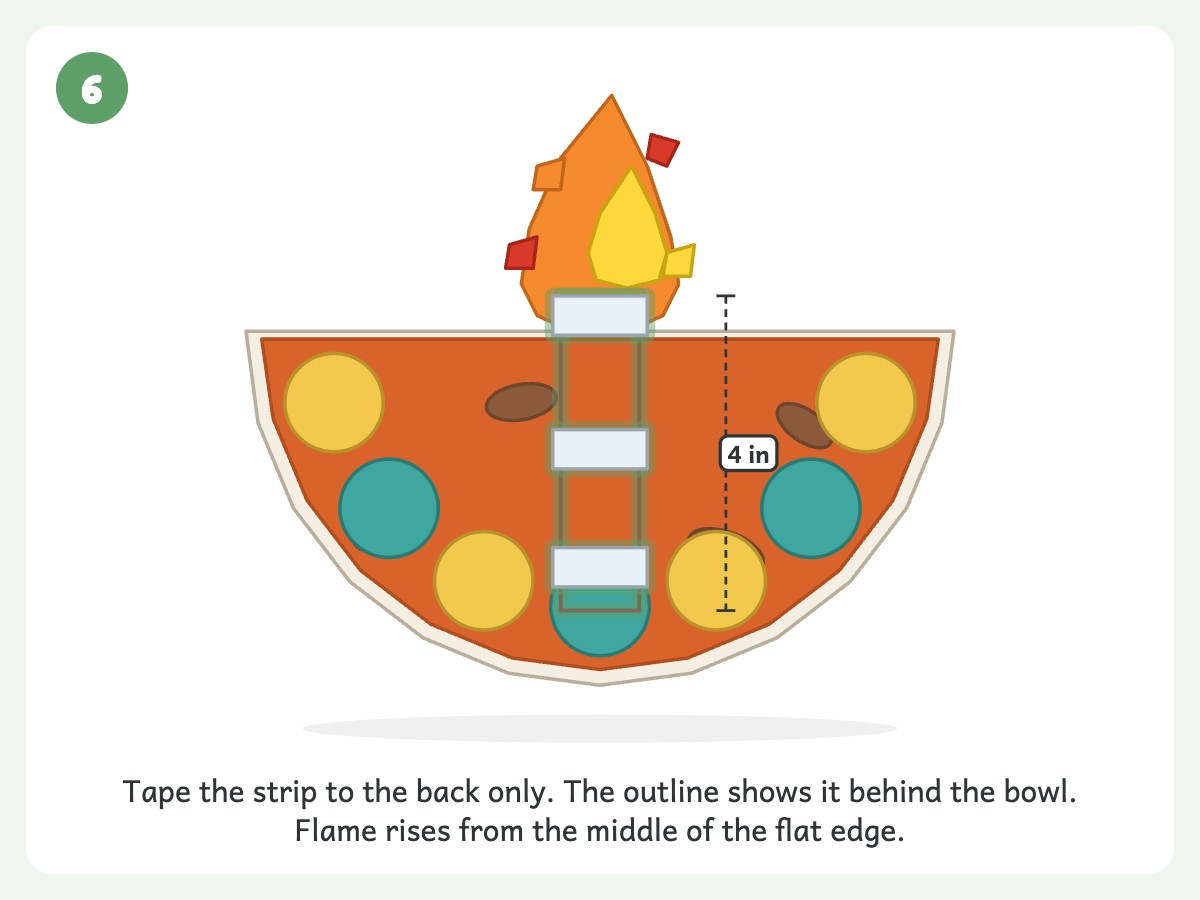
Which way up: the flat cut edge is the top of the bowl and the curved edge is the bottom, so the half plate looks like a smile. The flame stands up from the middle of the flat edge.
Adult job, flame: turn the flame face down. Tape the top half inch of the backing strip to the back of the flame base, just below the window. That keeps the strip from blocking the light.
Adult job, bowl: turn the bowl painted side down too, with the curved edge toward you. Tape the rest of the strip straight down the middle of the unpainted back. The whole teardrop should rise above the flat edge, and all the tape stays on the back.
Toddler job: press the tape down firmly. “Push, push, push!” makes it feel like a job.
- Display it (a few minutes, then up to an hour to dry fully). Lay the diya flat on a tray or newspaper while the glue sets. For a window, hang it with painter’s tape. For a shelf, fold a cardstock strip into a triangle prop and tape it to the back like a tiny picture-frame easel. Sunlight through the tissue window is the payoff.
TipCheck the shape before you hang it: curved edge at the bottom like a smile, flat edge on top, flame pointing up from the middle. If it looks like a dome, flip the bowl over.
Layers from back to front: backing strip, cardstock flame base, orange tissue, yellow tissue. If the flame droops, add a second piece of tape across the strip where it meets the bowl.
Good to knowTerracotta orange and brown nod toward real clay diyas. Red, gold, yellow, bright pink, and teal are all common in Diwali decor. If the paint turns muddy brown, that’s a pretty good clay color.
Want it messier and more process-based? Skip the pre-cut tissue teardrops. Give your child the glued-up flame base and let them cover it entirely with torn tissue scraps. It glows less, and they won’t care.
TipIf your toddler loses interest after the paint, stop. Put the bowl on a high shelf to dry and do the stickers and flame after nap time. Your toddler will probably be thrilled to “find” it again.
Toddler jobs by age
A 2-year-old and a 4-year-old can make the “same” diya at very different skill levels. Here’s how to match tasks to age.
| Age | What they can do | What you do | What to expect |
|---|---|---|---|
| 2 years | Sponge-dab paint, press large stickers, tear tissue, push the flame down | Cut all pieces, peel stickers, assist with glue | Short attention span (10 to 15 minutes), so split the project into two sittings. Messy and delighted. |
| 3 years | Choose colors, pattern stickers in a row, glue stick the flame layers, talk about light | Cut pieces, attach the backing strip | Longer attention span. Starts having opinions about colors. |
| 4 years | Paint with a brush, draw patterns with markers, tear and glue a detailed flame, help set the table | Cut the plate, help fold the easel prop | Can follow a few steps. May ask “why” questions about Diwali. |
For a mixed-age group, give every child the same materials. The 4-year-old will make something more “intentional,” and the 2-year-old will make something more “expressive.” Both are right. If you want to lean into the expressive end, process art for toddlers is a whole philosophy built on exactly this.
Paper Plate Diya Safety Notes for Toddlers
Safety firstNever light anything. The flame is paper. If your child asks to light the diya, say, “This one is a pretend lamp. Grown-ups handle the real ones.” Keep real diyas, lamp oil, ghee, and wicks out of reach, and display paper diyas away from any lit lamp.
Mouth hazards
- Stay close during all sticker, tissue, and paint use. Washable non-toxic paint is generally safe to touch, but it isn’t food.
- For under-3s, use large stickers, bigger than 1.25 inches across. A child who still mouths things can make fingerprint dots with washable paint instead.
- Collect the backing sheets and any stray stickers when you finish.
- Skip loose sequins, small beads, and googly eyes under age 4, and for any child who still mouths objects. They’re choking hazards.
- Watch for tissue paper in mouths. It’s thin and can ball up.
Cutting and skin
- Scissors are adult-only. Cut everything before your toddler sits down, then put the scissors out of reach.
- If your child has eczema or broken skin on their hands, check with your pediatrician before paint play. Stickers and crayons decorate the bowl without any paint.
Yarn and garlands
- If you string diyas into a garland, follow the yarn safety note in the garland section below.
Got a 4-year-old who is itching to use scissors? Our cutting practice sheets are a better place to start than a curved paper plate.
Paper Plate Diya Craft Ideas and Variations
Once your toddler has made one, the next question is always “Can I make another?” Here are ways to vary the project so it doesn’t feel repetitive.
Pattern ideas for the bowl
- Dot border: a row of dot stickers or fingerprint dots along the rim. Dot patterns are common in rangoli and other decorative designs.
- Flower circles: use a round sponge or the bottom of a plastic cup to print circles, then add dot centers.
- Zigzag stripes: crayon first, then paint over for a resist effect. The wax pushes the paint away.
- Color blocking: one color on the left half, another on the right.
- Gold-and-red combo: a nod to the colors you often see around Diwali, with gold marker or crayon for the details.
Flame variations
| Flame type | Materials | Mess level | Hands-on time | Best for |
|---|---|---|---|---|
| Torn tissue flame | Tissue paper, glue stick | Low | About 6 min | All ages |
| Handprint flame | Orange and yellow washable paint, paper | High | About 5 min, plus drying | Ages 2 to 3 (see below) |
| Coffee-filter flame | Coffee filter, washable markers, a little water | Medium | About 10 min, plus drying | Ages 3 to 4 (science-y bonus) |
| Felt flame | Orange and yellow felt, glue | Low | About 5 min | Anyone who wants a reusable decoration |
The handprint flame (a toddler favorite)
This turns your child’s hand into the flame. Paint their palm and fingers orange, then press it onto a sheet of cardstock or thick paper with the fingers pointing up. Fingers spread wide look like leaping flames.
Let it dry, then cut around the handprint (adult job). It replaces the cardstock flame base. Tape the backing strip to the back of the handprint and then to the back of the bowl, as in step 6. Date the back and it doubles as a keepsake. If your little one is a handprint-craft fan already, this is a seasonal cousin of the handprint turkey craft.
The coffee-filter glow flame
Draw on a flat coffee filter with orange, yellow, and red washable markers. Then use a spray bottle or a damp sponge to lightly wet the filter and watch the colors bleed together.
Let it dry fully, then cut a teardrop about 3 inches tall (adult job). Glue it over the window of the cardstock flame base in place of the tissue. The soft blended colors look like a flickering flame, and your toddler gets a mini color-mixing lesson. We have more of these in our coffee filter crafts for kids.
More Easy Diwali Crafts for Toddlers: Garland, Rangoli and Fireworks
One diya might be enough. If you have a toddler who wants more, or a preschooler who needs a bigger project, these extensions use the same materials.
A garland of diyas
Make five or six small diyas using smaller plate pieces or cardstock circles. Punch a hole in each (adult job) and thread them onto a short length of yarn. This is a great group craft for playdates, since every child makes one diya and you string them together.
Safety firstYarn is a strangulation hazard, so stringing and hanging are adult jobs. Use a short length and hang the garland high on a wall, well out of reach and away from cribs and blind or curtain cords. Take it down when you can’t supervise.
Paper plate rangoli
Rangoli is the colorful floor art many families make at the entrance of their homes during Diwali. Traditionally it’s made with colored powder, rice, or flower petals. A toddler version is a whole paper plate decorated with dot stickers in a circular pattern. Start with a small circle in the middle and add rings of dots around it. It’s essentially a sticker mandala, and it’s wonderful for ages 2 to 4.
How to do it:
- Draw a dot in the center of the plate.
- Hand over a sheet of stickers in 2 or 3 colors.
- Say, “Let’s make a ring around the dot.” Let your child work outward in whatever pattern they like.
- Display it by the front door.
While you stick the dots, mention that real rangoli is made on the ground at the entrance to welcome guests. It’s a lovely detail for a preschooler to hear. For more peel-and-press ideas, see our sticker activities for toddlers.
Torn-paper fireworks
Many families set off fireworks around Diwali, but loud noises scare a lot of toddlers. The paper version is quiet: black paper, torn tissue, and a glue stick. Let your child “make fireworks” by gluing colorful scraps in starburst patterns. For shine, add torn pieces of glossy magazine paper or a few gold crayon lines.
Light and dark sensory play
Hold your finished diya in front of a flashlight in a dark room (or under a blanket tent) and watch the tissue glow. For a follow-up, DIY sensory bins with shiny, translucent items work well.
For more fall projects, try our fall leaf crafts for preschoolers and pumpkin crafts for kids.
What Diwali Celebrates (A Kid-Friendly Explanation You Can Read Aloud)
Toddlers don’t need the whole story. They need a sentence or two they can hold onto. Here’s a short explanation written for small ears. Read it aloud, or paraphrase it however you like.
Read aloudWhat is Diwali? Diwali is a happy holiday called the Festival of Lights. Families who celebrate it light up their homes with small lamps called diyas.
Most are Hindu families, and many Jain and Sikh families celebrate in their own special ways too. The lamps remind everyone that light is stronger than darkness and that being kind and good wins in the end.
People clean their houses, wear new clothes, and make colorful patterns on the floor. They also eat yummy sweets and visit family and friends. All those tiny glowing lights together feel like the whole street is giving everyone a big, warm hug.
A few notes for you as the adult, so you feel confident saying more if your child asks:
- Diwali falls on a different date each year because it follows a lunar calendar. In 2026 the main day is November 8, so the weeks before it are perfect for making diyas.
- Different families celebrate for different reasons. It’s not one single story, and you don’t have to cover all of it with a toddler.
- Hindu families. Many connect Diwali with the story of Rama coming home after a long time away. Many also honor Lakshmi, who is associated with good fortune.
- Sikh families. Many mark a related day, Bandi Chhor Divas, around the same time.
- Jain and Buddhist families. Many Jain families observe Diwali in connection with Mahavira. Some Newar Buddhist families celebrate too.
- The festival is often five days long. Day three is usually the main day, with the most lamps and family gatherings. Customs vary by region and family.
- Keep it simple. “Light is stronger than dark, and families get together and share sweets” is plenty for a two-year-old.
If you’re not a family that celebrates Diwali, treat this as learning about a neighbor’s or friend’s holiday rather than adopting it. Talk about it with respect and use the real name (diya, not “candle bowl”).
Talking about Diwali while you craft
Here are some simple prompts that work at toddler level:
- “What does light do? It helps us see!”
- “Which color do you want for your diya?”
- “Who should we show our light to?”
- “Diwali is a happy holiday. People share sweets and spend time together.”
- “A lot of families put lights near their door to say welcome.”
Preschoolers (3 to 4) can handle a little more.
- “Some families clean their house before Diwali to get ready. Should we tidy our play area to get ready too?”
- “Do you know anyone who celebrates Diwali? We could ask them what they like best about it.”
- “Light stays bright even when it’s dark outside. What else makes you feel warm and happy?”
If you have friends or neighbors who celebrate, consider asking whether they’d like to share a favorite family tradition. Many families love to share, but it’s best to ask rather than assume. Hearing about Diwali from someone who lives it is more meaningful than anything a craft can teach.
If your family is in a different holiday season, these paper plate lamps pair nicely with other gentle cultural introductions. For a similar approach, see our Día de los Muertos crafts for preschoolers. It’s a respectful, age-appropriate way to bring another tradition to your craft table.
Where to Display Your Paper Plate Diyas
Three spots that work:
- Window: tape the diya to a sunny window so light shines through the tissue. This is my favorite spot.
- Front door: a row of diyas on or beside the door says “welcome” and nods to the real tradition.
- Shelf or fridge: stand it up with the easel prop, or tape it to the fridge door with painter’s tape.
Let your toddler pick the spot. A craft that lives where they chose it gets noticed every day.
Paper Plate Diya FAQ
What age is this Diwali diya craft best for?
The paper plate diya works well for ages 2 to 4. Two-year-olds can sponge-paint, press stickers, tear tissue paper, and push the flame in place with your help. Three- and four-year-olds can take on more of the decorating and gluing and might want to draw their own patterns. The adult does the cutting at every age, so no scissor skills are needed.
Is this craft safe for toddlers who still put things in their mouths?
It’s much safer than a real diya, but it still needs supervision. Use washable non-toxic paint, skip loose sequins and beads, and keep an eye on the tissue paper since it can ball up if chewed. Larger stickers and glue sticks are the lower-risk decoration options for this age, with close supervision and a check for stray stickers and backing. There’s no flame, wick, oil, or clay involved at any point.
Can we light a real tealight inside the paper plate diya?
No. Paper burns, and a plate with a flame near it is a fire risk. The point of this craft is that the flame is made from paper, so your toddler can make and handle it safely. For a glow effect, hold it up to a sunny window so light shines through the tissue. Or shine a flashlight behind it in a dark room.
What if we don’t celebrate Diwali? Is it okay to make this craft?
Yes, as long as you approach it with respect. Treat it as learning about a holiday that matters to many families rather than just making a decoration. Use the proper names (Diwali, diya), share the kid-friendly explanation honestly, and if you have friends or neighbors who celebrate, ask them about their traditions. Avoid presenting it as a costume or novelty, and let the craft be a starting point for curiosity and kindness.
How do I get the flame to stand up instead of drooping?
Build the flame on a cardstock teardrop, then tape a cardstock strip to the back of it and to the back of the bowl. Cardstock gives the flame structure, while tissue alone will flop once the glue is wet. A second piece of tape on the back usually fixes any remaining droop.
My toddler lost interest halfway through. What should I do?
That’s completely normal. Stop where you are and set the project aside. The bowl can dry on a shelf and the stickers and flame can wait until after a nap or the next day. You can also split the project into two short sessions: paint on day one, flame and stickers on day two. A craft that ends happily is better than one that ends in tears.
What can we do if we have no tissue paper?
Construction paper, felt, coffee filters, or even torn pieces of an orange magazine page all make good flames. Glossy magazine paper or a little gold crayon adds shine. If you only have one color of paper, cut a larger flame. Let your toddler color it with markers or crayons in warm shades of yellow, orange, and red.
You’ll end up with a lopsided paper plate, a crooked flame, and a toddler who made a light. Stick it in a window and let the afternoon sun do the rest.
Happy crafting, and Happy Diwali to everyone who celebrates.