Easter Crafts for Toddlers and Preschoolers: Easy Spring Projects They Can Actually Do
Discover 20 easy Easter crafts for ages 18 months to 5 years, complete with age-specific recommendations, time, mess levels, and safe material swaps so you can craft with your little one.
- Find 20 easy Easter crafts for ages 18 months to 5 years.
- Use age-specific guidance for appropriate activities and materials.
- Check each craft's time, mess level, and adult prep before starting.
- Make safe swaps for small parts, especially for kids under 4.
This post contains affiliate links. As an Amazon Associate I earn from qualifying purchases.
Your two-year-old has found the glue stick, and now a puff of tissue paper is stuck to their forehead like a tiny cloud. They’re beaming. That’s Easter crafting with a toddler, and it’s perfect.
Below are 20 easy Easter crafts for ages 18 months to 5, starting with an age picker. Each craft lists the time, the mess level and safe swaps for small parts. Several skip the brush entirely, like our painting without brushes ideas.
Easter 2027 falls on Sunday, March 28 (in Western churches), so start in early March with a few short sessions. Expect some bunnies and some abstract art, and grab the old t-shirt that already has paint on it.
In this article (12 sections)
- Pick an Easter Craft by Age (18 Months to 5 Years)
- Supplies You Probably Already Have
- Easy Easter Egg Crafts for Toddlers
- Easter Bunny Crafts for Preschoolers and Toddlers
- Easter Chick, Lamb and Butterfly Crafts for Kids
- Easter Flower, Garden and Basket Crafts for Preschoolers
- Why These Crafts Are Worth the Mess
- Tips for Easter Crafts with Toddlers
- Easter Crafts by Age: 18 Months to 5 Years
- How to Display Easter Crafts
- Frequently Asked Questions
- Your Easter Crafting Plan
Pick an Easter Craft by Age (18 Months to 5 Years)
Find your child’s age and start with the crafts in the second column. The full list below shows the time, mess level and adult prep for all 20. Cotton balls, googly eyes, feathers and small pom poms wait until age 4. The under-4 swaps are in the supplies section.
| Age | Start with | What they can do | Skip for now |
|---|---|---|---|
| 18-24 months | #1, #2 | Tear paper with help. Peel and place large stickers. Press paper onto sticky surfaces. Finger paint with an adult beside them. | Scissors, paint bags and anything small enough to fit inside a toilet paper tube. Expect some taste-testing. |
| 2-year-olds | #1-#4 (daubers or fingertips for #4), #7, #11-#13, #15-#18 | Use a glue stick alone. Press tissue paper onto glue. Peel large stickers. Draw eyes with marker. Make handprints, fingerprints and stamps. | Cotton balls, googly eyes, feathers, small pom poms, cotton swabs and the paint bag (#5). |
| 3-year-olds | Any craft except #20, with the under-4 swaps. New at 3: Paint Bag Eggs (#5, with you hands-on the whole time) and Crayon Resist Eggs (#6). | Snip with kid-safe scissors, supervised. Follow 2-3 step instructions. Make simple patterns. | The pasta bracelet (#20), the same small parts as age 2, and staples (use tape for #10 and #19). |
| 4- and 5-year-olds | Any of the 20, including the 4+ extras. The mask, headband and basket (#8, #10, #19) give them the most room for detail. | Thread large pasta, adult-dyed and supervised. Paint with some color control. Tell you exactly how the craft should look (deep breaths when it doesn’t match). | Nothing here is off-limits, but keep small parts in a bowl on your side of the table. |
All 20 Crafts at a Glance
| Craft | Ages | Time | Mess | Adult prep |
|---|---|---|---|---|
| 1. Torn Paper Easter Eggs | 18 mo-3 yr | 15 min | Low | Cut a big card stock egg. |
| 2. Sticker Eggs (Dot and Mosaic) | 18 mo-5 yr | 10-15 min | None | Cut large paper eggs. |
| 3. Pom Pom Stamped Eggs | 2-4 yr | 15 min | Medium | Clip big pom poms into clothespins. |
| 4. Dotted Eggs | 2-5 yr | 15 min | Medium | Draw egg outlines. |
| 5. Mess-Free Paint Bag Eggs | 3-5 yr | 10 min | Low | Double-bag and tape the paint. |
| 6. Crayon Resist Eggs | 3-5 yr | 15 min | Low | Cut card stock eggs. |
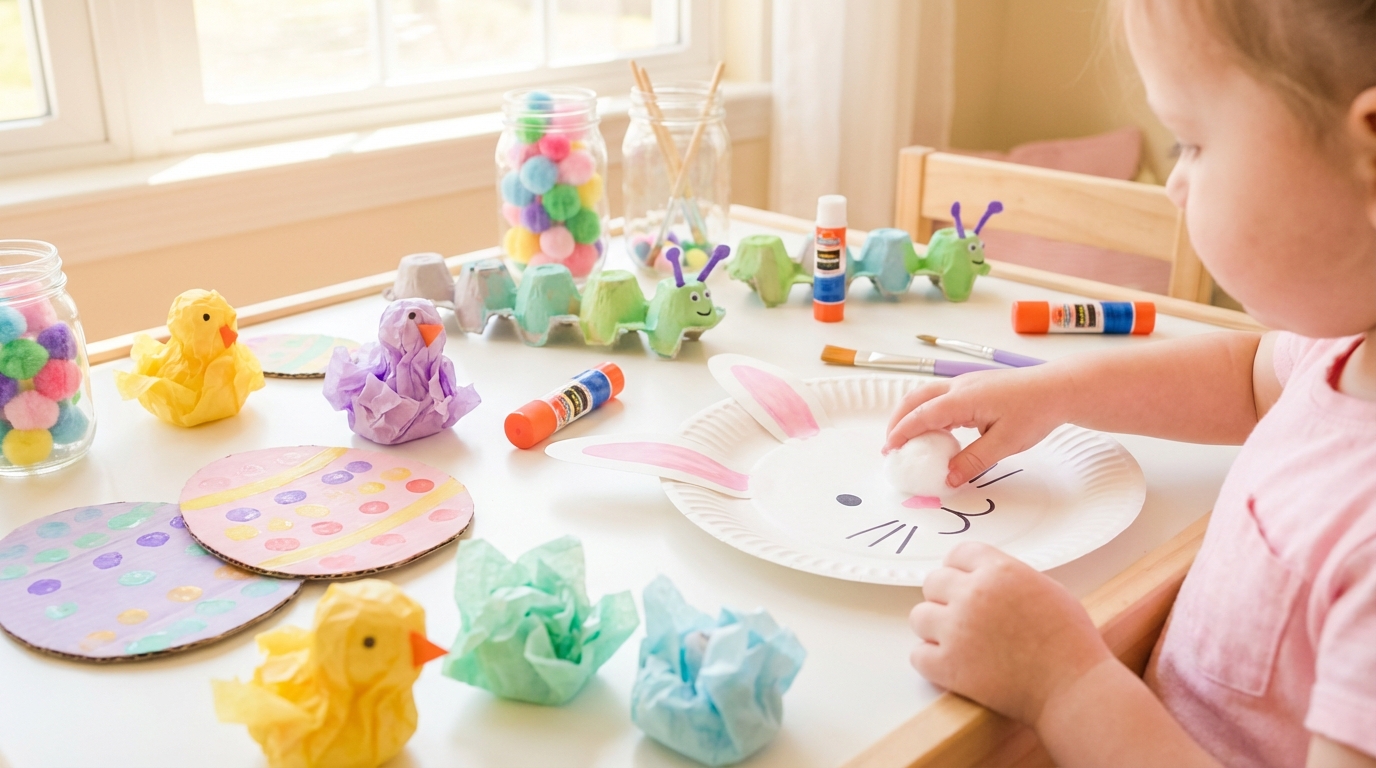
| 7. Fluffy Tissue Paper Bunny | 2-4 yr | 15 min | Low | Draw a large bunny. |
| 8. Paper Plate Bunny Mask | 3-5 yr | 20 min | Low | Cut eye holes and ears. |
| 9. Cardboard Tube Bunny | 3-5 yr | 25 min | Medium | Cut ears and pinch the tube top. |
| 10. Bunny Ears Headband | 3-5 yr | 20 min | Low | Cut ears and size the band. |
| 11. Handprint Chick | 2-5 yr | 15 min | Medium | Cut the beak and feet. |
| 12. Egg Carton Chicks | 2-5 yr | 20 min | Medium | Cut a new, unused carton into cups. |
| 13. Fork-Printed Chicks | 2-4 yr | 15 min | Medium | Pour a thin layer of paint. |
| 14. Coffee Filter Butterflies | 3-5 yr | 20 min + drying | Medium | Twist on the pipe cleaner body. |
| 15. Fluffy Tissue Paper Sheep | 2-4 yr | 15 min | Low | Cut the body, head and legs. |
| 16. Tissue Paper Sun Catchers | 2-5 yr | 20 min | Low | Cut and tape the contact paper. |
| 17. Cupcake Liner Flowers | 2-5 yr | 15 min | Low | Cut leaf shapes. |
| 18. Fingerprint Carrot Garden | 2-4 yr | 15 min | Medium | Draw the ground line. |
| 19. Paper Plate Easter Basket | 3-5 yr | 25 min | Medium | Tape or staple the plates and handle. |
| 20. Pasta Bracelet | 4-5 yr | 20 min + 1 hr drying | Low | Dye and dry the pasta ahead. |
Supplies You Probably Already Have
You don’t need a craft store run for these projects. I’d bet you have most of this at home already.
Safety firstAnything that fits inside a toilet paper tube is a choking hazard for children under 4. Stay within arm’s reach the whole time. Use only paints, glues and markers labeled non-toxic, ideally with the ACMI AP (Approved Product) seal. Cutting, stapling and plastic bags are adult-only, and staple ends always get covered with tape.
Under-4 Safe Swaps
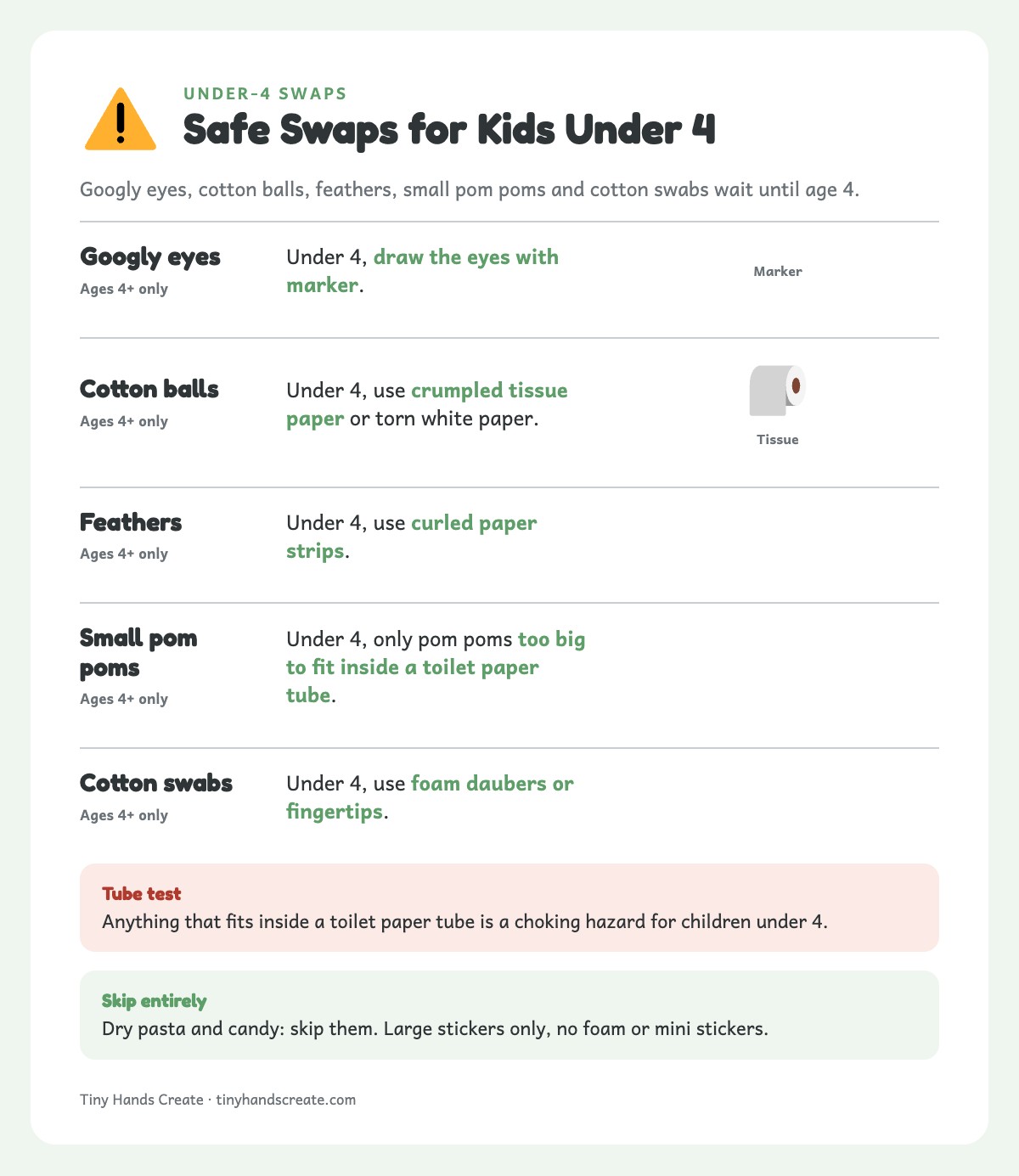
| Instead of (ages 4+ only) | Under 4, use |
|---|---|
| Googly eyes | Eyes drawn with marker. |
| Cotton balls | Crumpled tissue paper or torn white paper. |
| Feathers | Curled paper strips. |
| Small pom poms | Pom poms too big to fit inside a toilet paper tube. |
| Cotton swabs | Foam daubers or fingertips. |
| Foam and mini stickers | Large stickers only. |
| Dry pasta and candy | Skip them. |
The Master Supply List
| Category | What to grab |
|---|---|
| Paper and cardboard | Pastel construction paper. Thin, cheap paper plates (not wax-coated party plates). Toilet paper and paper towel tubes. Tissue paper, white card stock and coffee filters. Clear contact paper. Newspaper to protect surfaces. |
| Adhesives and tools | Washable white school glue. Non-toxic glue sticks, which are easier for toddlers than liquid glue. Kid-safe scissors for preschoolers. Masking tape, which is easier for little hands than clear tape. Clothespins or binder clips to hold things while glue dries (adults open and close them). |
| Paint and color | Non-toxic washable tempera paint in spring colors. Non-toxic washable watercolors. Washable markers and crayons, including a white crayon. Foam daubers or large sponge pieces for dotting. Ages 4-5 only: paper-stick cotton swabs, with an adult right beside them. |
| Texture | Large dot stickers (toddlers are obsessed with them). Pipe cleaners. Ribbon or yarn scraps. Ages 4+ only: cotton balls, googly eyes, small pom poms and craft feathers. |
| From your kitchen | Pastel cupcake liners. Popsicle sticks. Sturdy plastic forks. Heavy-duty freezer bags, kept out of reach when not in use. Egg cartons only if new and unused (or paper-pulp trays bought for crafts), never cartons that held eggs. |
Easy Easter Egg Crafts for Toddlers
Let’s start with eggs, the craft category with the widest age range. These work for everyone from the 18-month-old who just discovered “sticky” to the preschooler who wants everything symmetrical.
1. Torn Paper Easter Eggs
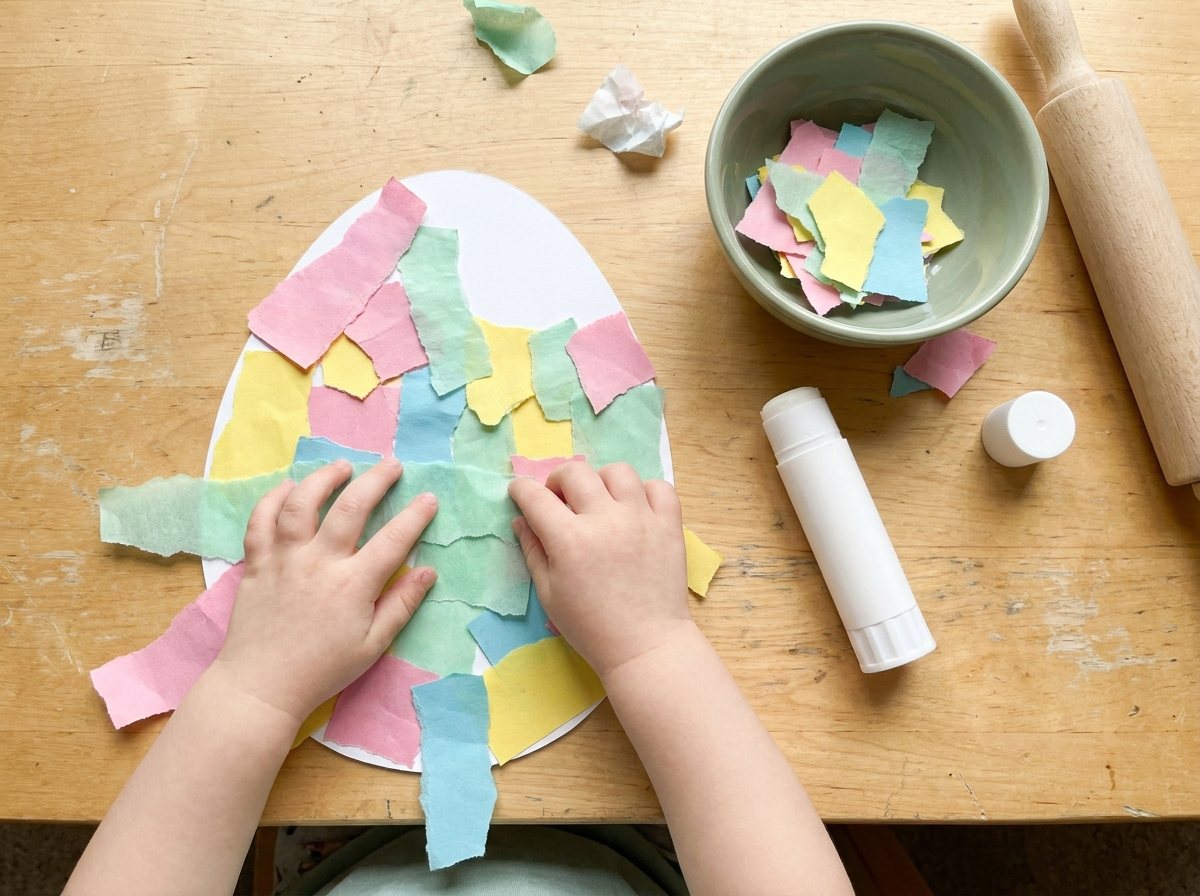
Age: 18 months to 3 years | Time: 15 minutes | Mess Level: Low
This is my top pick for the youngest crafters. Tearing paper helps build hand strength and two-handed coordination. It’s also satisfying long before scissors are an option.
Supplies:
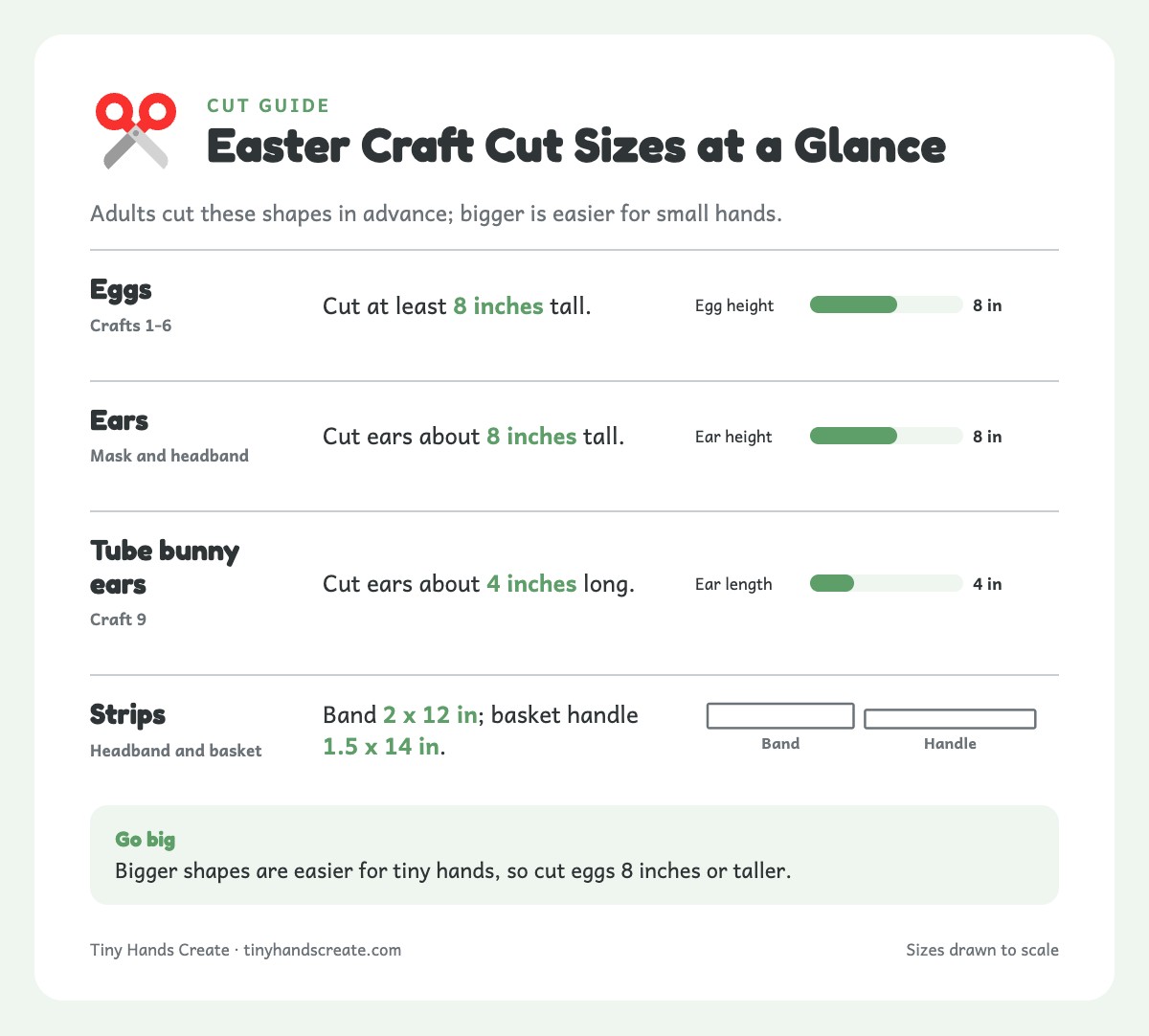
- Large egg shape cut from white card stock, at least 8 inches tall (you cut this in advance).
- Strips of colorful construction paper or tissue paper.
- Glue stick.
Instructions:
- Cut a big egg. Use white card stock or cardboard, at least 8 inches tall. Bigger is easier for tiny hands.
- Prep the paper. For 18-month-olds, pre-tear the strips and let them do the gluing. For 2- and 3-year-olds, show them how to tear and let them go wild.
- Glue and press. Show your child how to swipe the glue stick on the egg and press paper pieces down.
- Cover everything. Overlap colors and go off the edges. It all looks gorgeous.
Toddler tip: If your child just wants to peel and apply the glue stick without actually adding paper, let them. That’s fine. They’re exploring. The glue itself is the craft today.
2. Sticker Eggs (Dot and Mosaic)
Age: 18 months to 5 years | Time: 10-15 minutes | Mess Level: None
Zero mess. This is the craft you pull out when you need ten minutes of calm and can’t face a single drop of paint. If your child loves sticker activities, this one’s a guaranteed hit. Toddlers stick dots anywhere, and preschoolers can turn the same egg into a mosaic.
Supplies:
- Large egg shapes cut from white paper, at least 8 inches tall for younger kids (one per child, or five, because they’ll want more).
- Large round dot stickers or big shape stickers from the dollar store or office supply aisle (no foam or mini stickers for under 4).
- A marker for drawing sections (preschool version).
Instructions:
- Prep the eggs. Cut out the egg shapes in advance.
- Hand it over. Give your child the sheet of dot stickers and the egg.
- Stay close. They peel and stick while you stay within arm’s reach with your coffee.
Safety firstUnder 4, use large stickers only and supervise constantly. Throw away the backing sheet right away.
Why it works: Peeling stickers off a sheet is great fine motor practice. It takes a pincer grasp, hand-eye coordination and patience.
Preschooler mosaic: Draw lines across the egg to make sections, like a decorated Easter egg. Ask your child to fill each section with a different color or sticker shape. Or try a pattern challenge: “Can you make a line of all blue dots across the middle?”
3. Pom Pom Stamped Eggs
Age: 2 to 4 years | Time: 15 minutes | Mess Level: Medium
This is one of my all-time favorite painting techniques for little ones because it sidesteps the brush entirely. If your child struggles with brush control (which is totally normal under age 3), pom pom crafts give them a tool that’s easier to grip and makes beautiful prints.
Safety firstFor under 4, use only pom poms too big to fit inside a toilet paper tube. An adult clips each pom pom in and tugs it to check it can’t pull loose. Clothespins pinch, so you open and close them, not your child.
Supplies:
- Large egg shape cut from white paper or card stock.
- 3-4 clothespins and 3-4 large pom poms (too big to fit inside a toilet paper tube).
- Washable paint in several pastel colors, poured into a muffin tin or small cups.
Instructions:
- Make the stampers. An adult clips one large pom pom firmly into each clothespin and checks that it holds. Make 3-4, one per color.
- Pour the paint. Put a small amount of each color in its own muffin tin well.
- Dip and stamp. Show your child how to hold the clothespin, dip the pom pom and stamp it onto the egg.
- Stamp freely. Encourage switching colors and admire the overlapping circles.
Preschooler extension: Challenge them to create patterns — stripes of stamps across the egg, or a border of one color around the edge.
4. Dotted Eggs
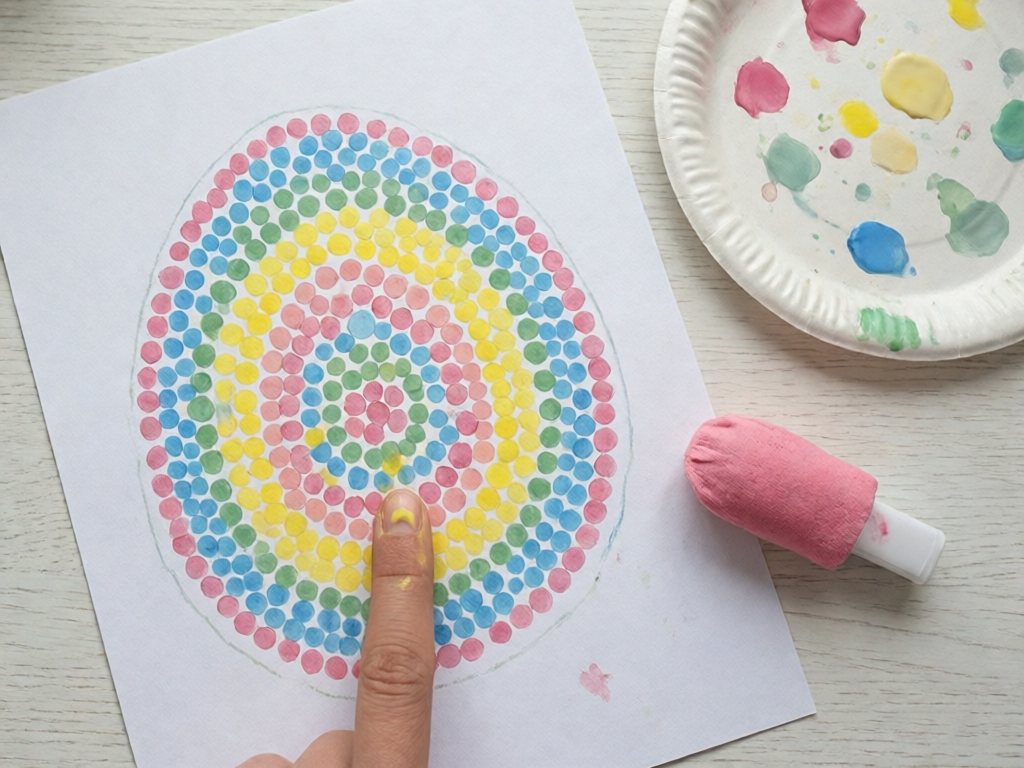
Age: 2 to 5 years | Time: 15 minutes | Mess Level: Medium
Pointillism for toddlers. Sounds fancy, looks adorable, and a foam dauber or fingertip is easier for little hands than a paintbrush.
Supplies:
- Egg outlines printed or drawn on white paper.
- Foam daubers, large sponge pieces or fingertips.
- Ages 4-5 only: paper-stick cotton swabs, with an adult right beside your child.
- Washable paint in spring colors.
Instructions:
- Prep the eggs. Draw or print egg shapes with clear outlines.
- Set out paint. Put one small blob of each color on a paper plate.
- Dip and dot. Show your child how to dip the dauber (or a fingertip) into paint and dot it onto the egg.
- Fill the egg. Keep dotting until the egg is covered. It ends up looking like stained glass or confetti.
Toddler tip: A fingertip makes the biggest dots and needs no tool at all. Keep cotton swabs away from children under 4: the heads can come off, and swabs should never go near mouths, noses or ears.
5. Mess-Free Paint Bag Eggs
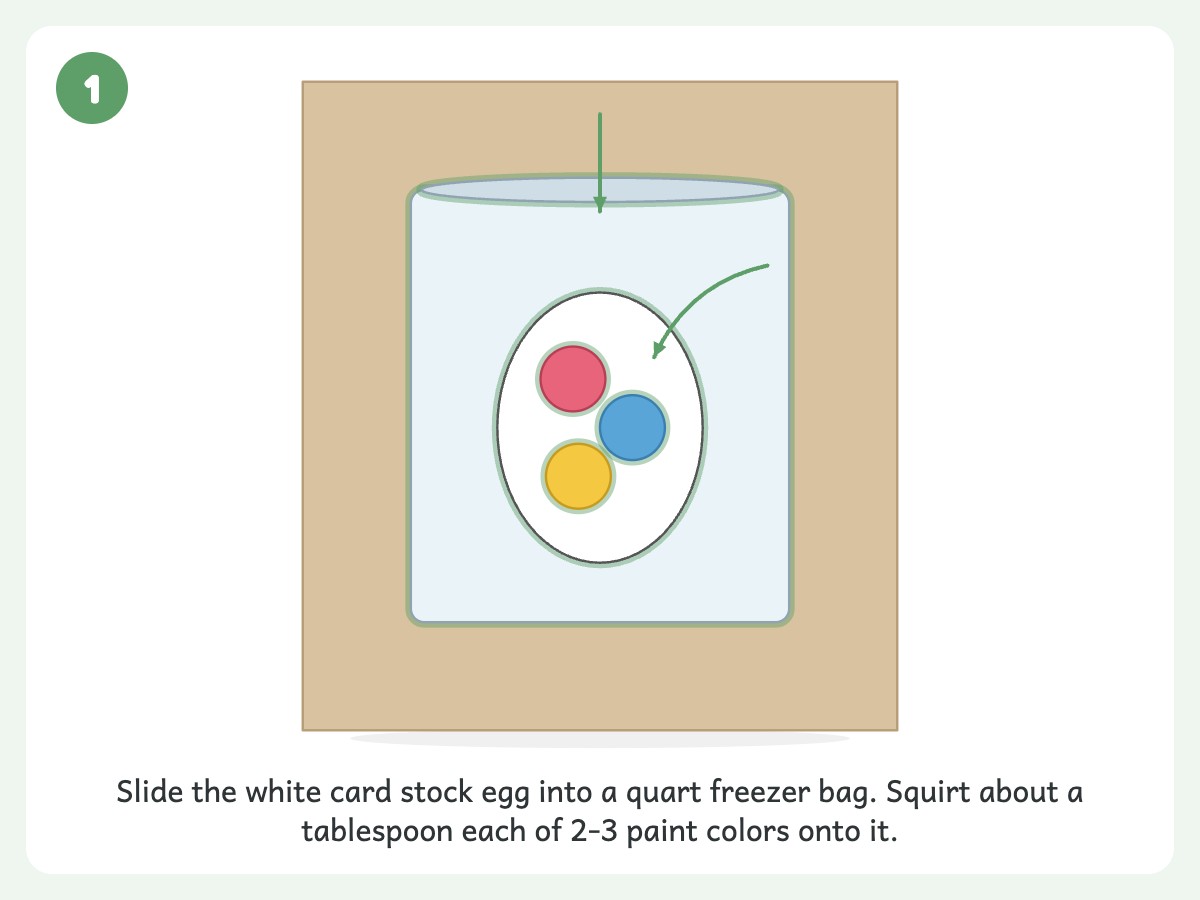
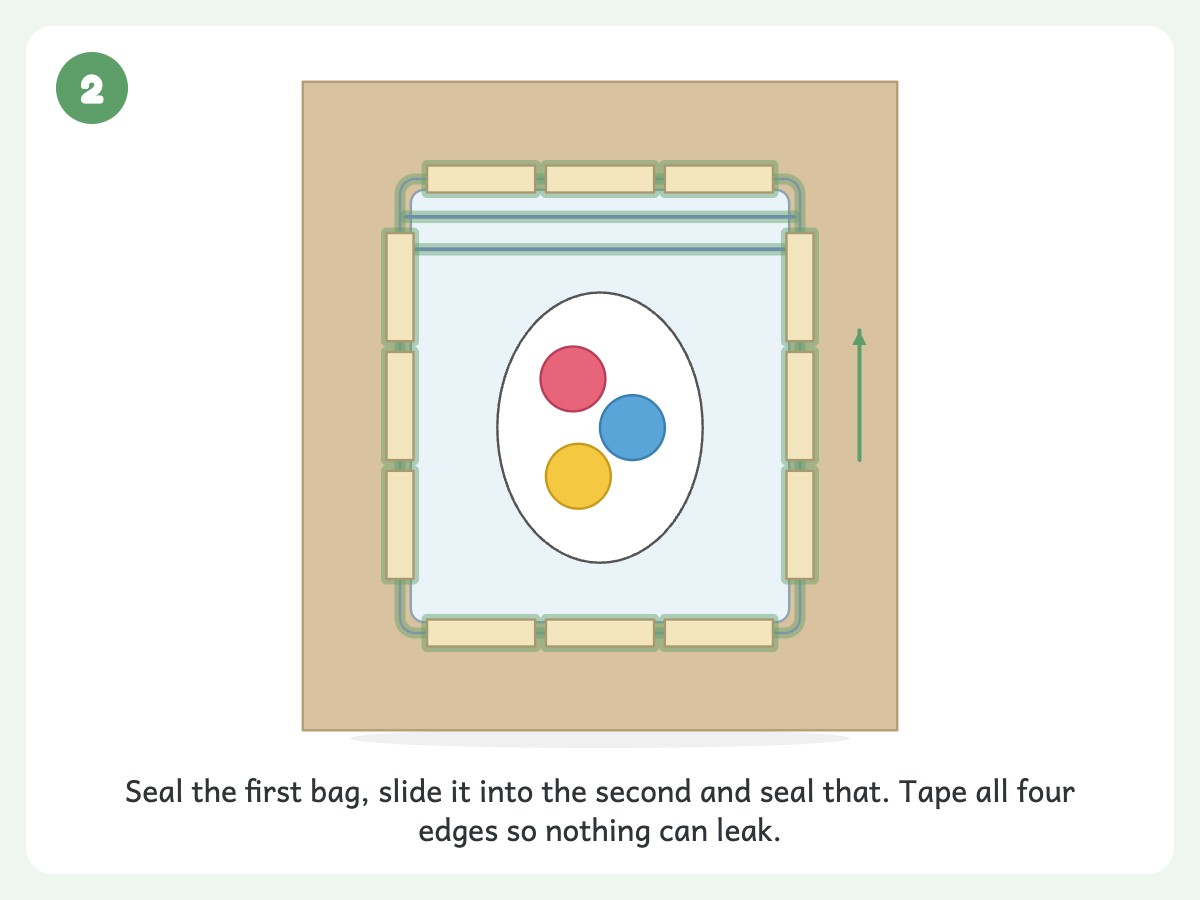
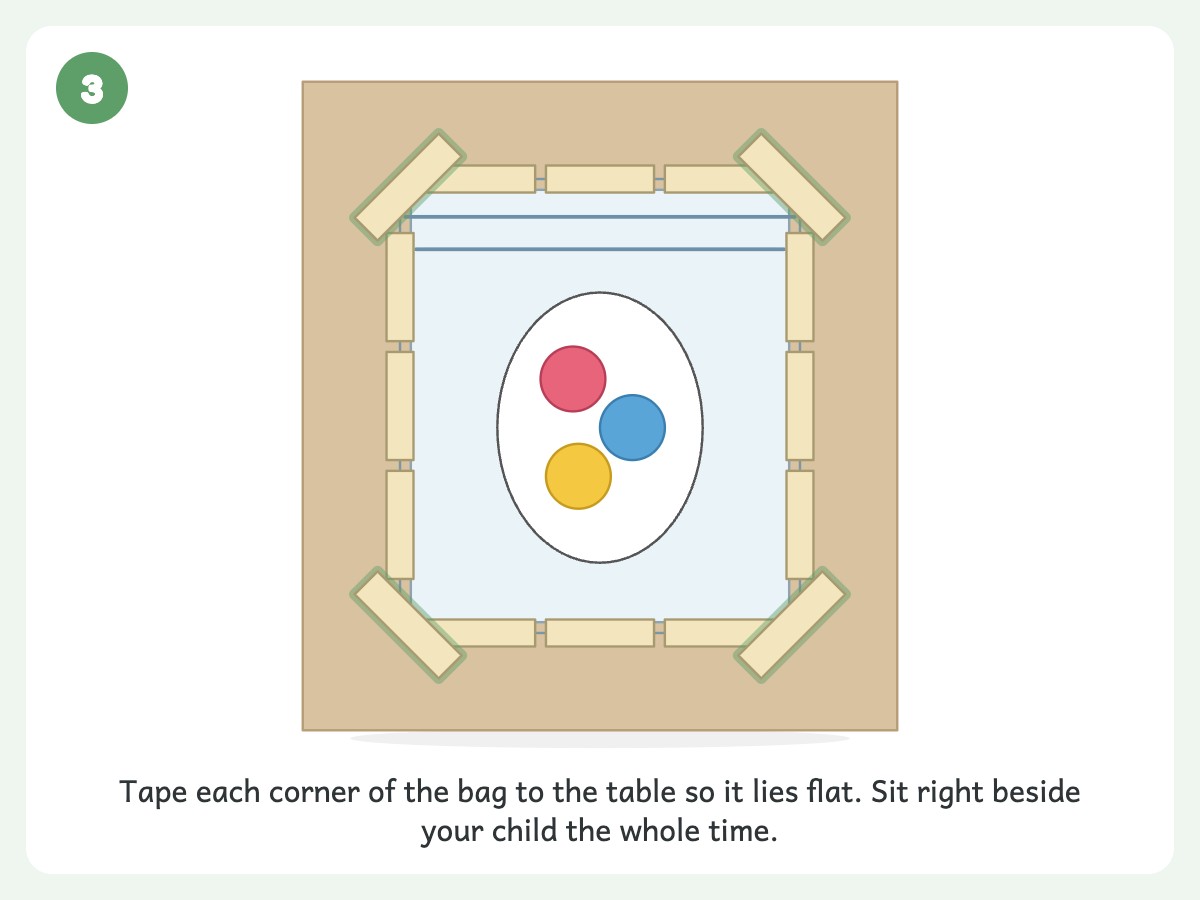
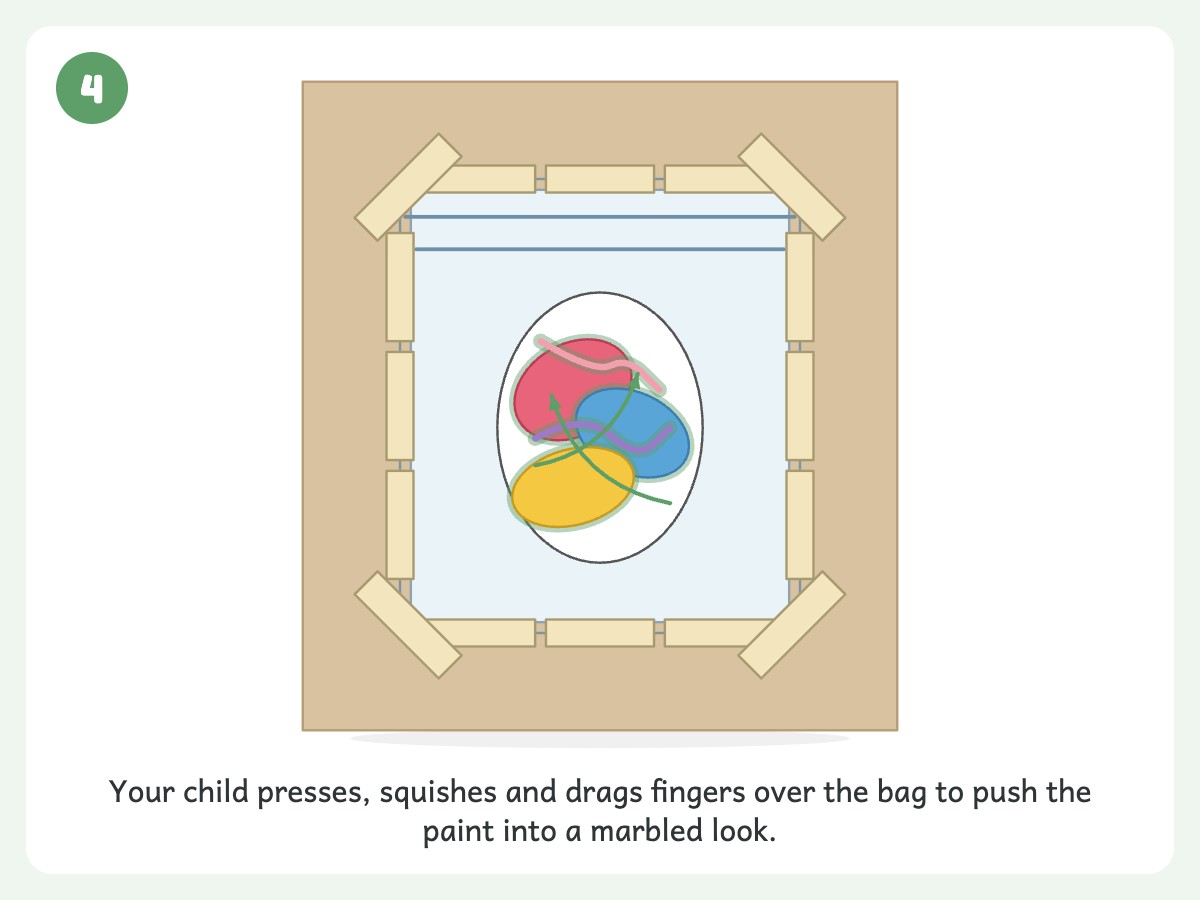
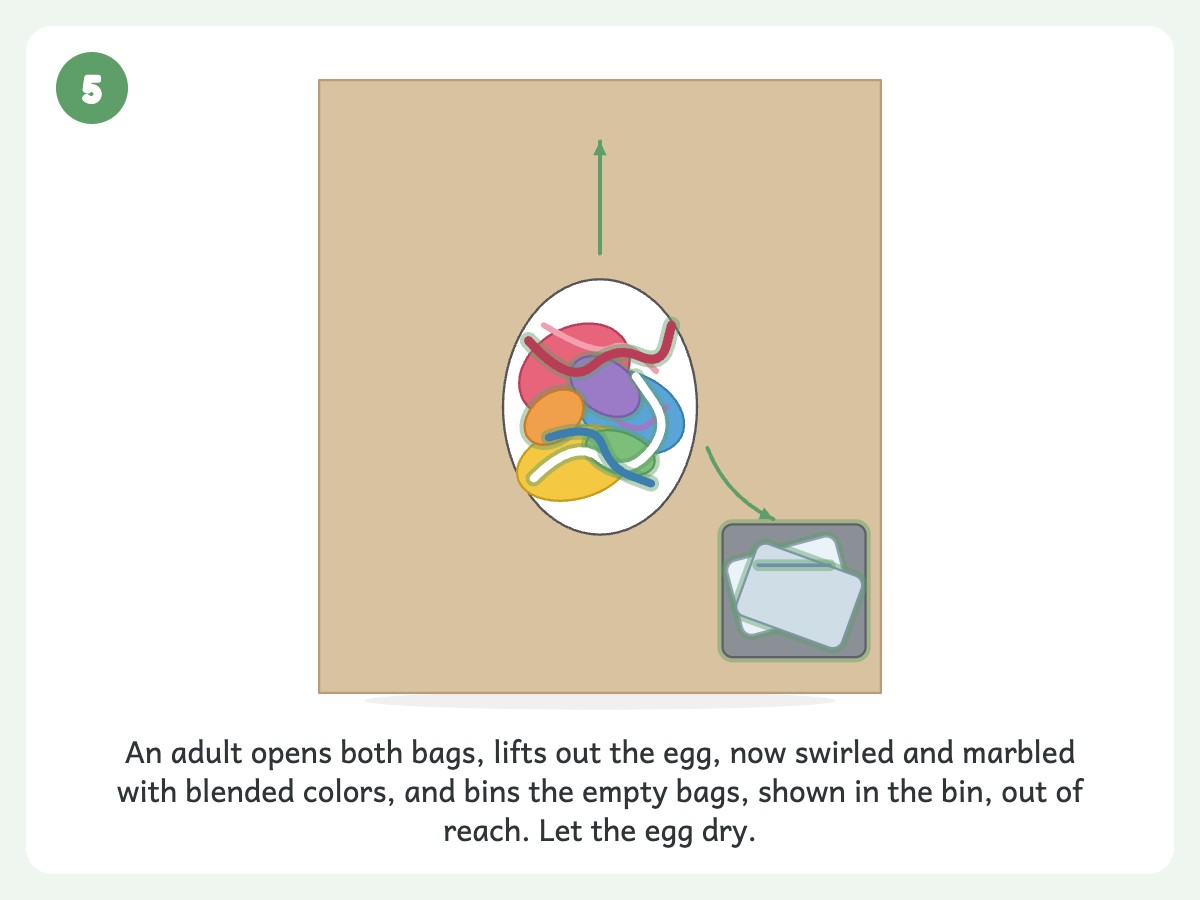
Age: 3 to 5 years | Time: 10 minutes | Mess Level: Low
This is the “I can’t face paint cleanup today” craft. The paint stays sealed and your table stays clean, but your child still gets to squish paint. It’s a staple of mess-free painting for toddlers, and it works beautifully for Easter.
Safety firstAges 3 and up only, because plastic bags are a suffocation risk. Stay hands-on the whole session, keep the bag away from your child’s face and never leave them alone with it. Double-bag, tape every edge and keep bags out of reach before and after; throw them away if either one tears.
Supplies:
- Two quart-size heavy-duty freezer bags.
- Washable paint in 2-3 colors, about a tablespoon of each.
- White card stock cut in an egg shape.
- Tape.
Instructions:
- Load the bag. Slide the card stock egg into one bag and squirt the paint onto it.
- Seal it twice. Seal the bag, slide it into the second bag and seal that too. Tape every edge.
- Tape it flat. Tape the bag to the table and sit right beside your child.
- Squish. Let your child press, squish and drag their fingers to push the paint around.
- Clean up right away. When they’re done, an adult opens the bags, pulls out the egg and throws the bags away out of reach. Let the egg dry; it looks like marbled watercolor.
6. Crayon Resist Eggs
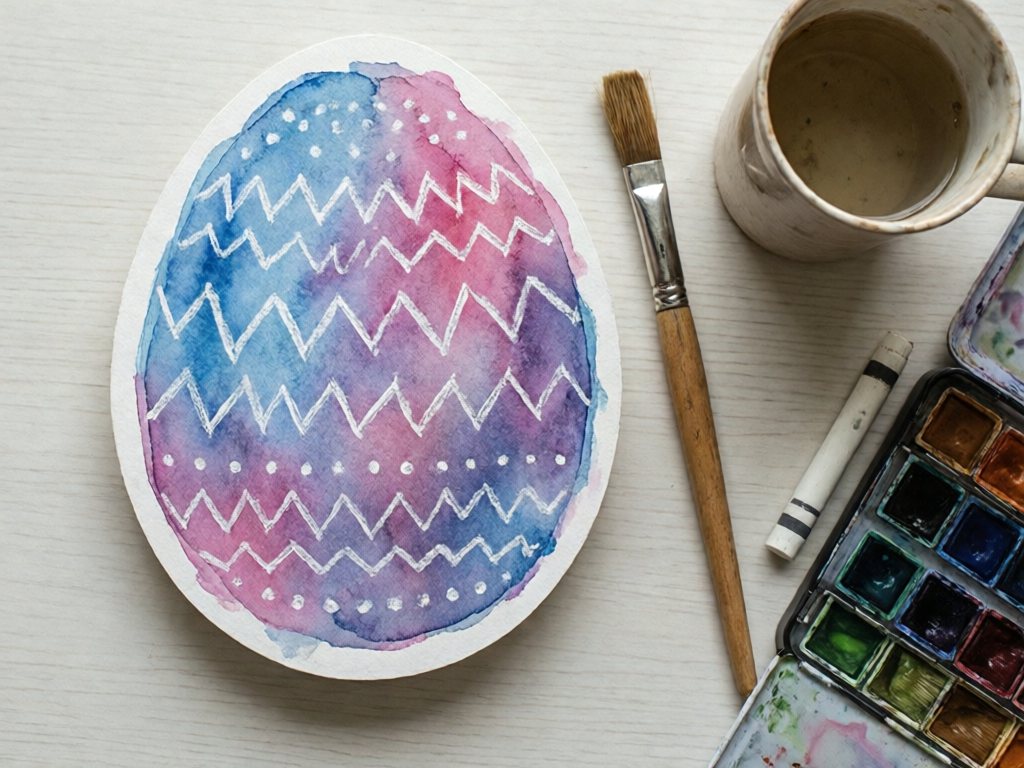
Age: 3 to 5 years | Time: 15 minutes | Mess Level: Low
This one feels like a magic trick. Your child draws on a white egg with a white crayon and sees almost nothing. Then they paint over it, and the hidden design pops out. For more ideas, see our guide to watercolor painting for kids.
Supplies:
- Large egg shape cut from white card stock, which holds up to wet paint better than printer paper.
- White crayon.
- Non-toxic washable watercolors and a chunky brush.
- Cup of water and a paper towel.
Instructions:
- Prep the egg. Cut a large egg from card stock in advance.
- Draw the secret design. Your child draws zigzags, dots and stripes with the white crayon, pressing hard.
- Paint over it. Brush watery paint across the whole egg.
- Watch it appear. The wax keeps the paint off, so the crayon lines show up white.
- Let it dry. Lay the egg flat until the paint is dry.
If nothing shows up: The crayon was probably too light, or the paint too thick. Go over the lines again, pressing harder, and use more water on the brush.
Easter Bunny Crafts for Preschoolers and Toddlers
Toddlers love bunnies, preschoolers love bunnies, and so do I. Here are four bunny crafts, from dead simple to a little more involved, all doable by small humans.
7. Fluffy Tissue Paper Bunny
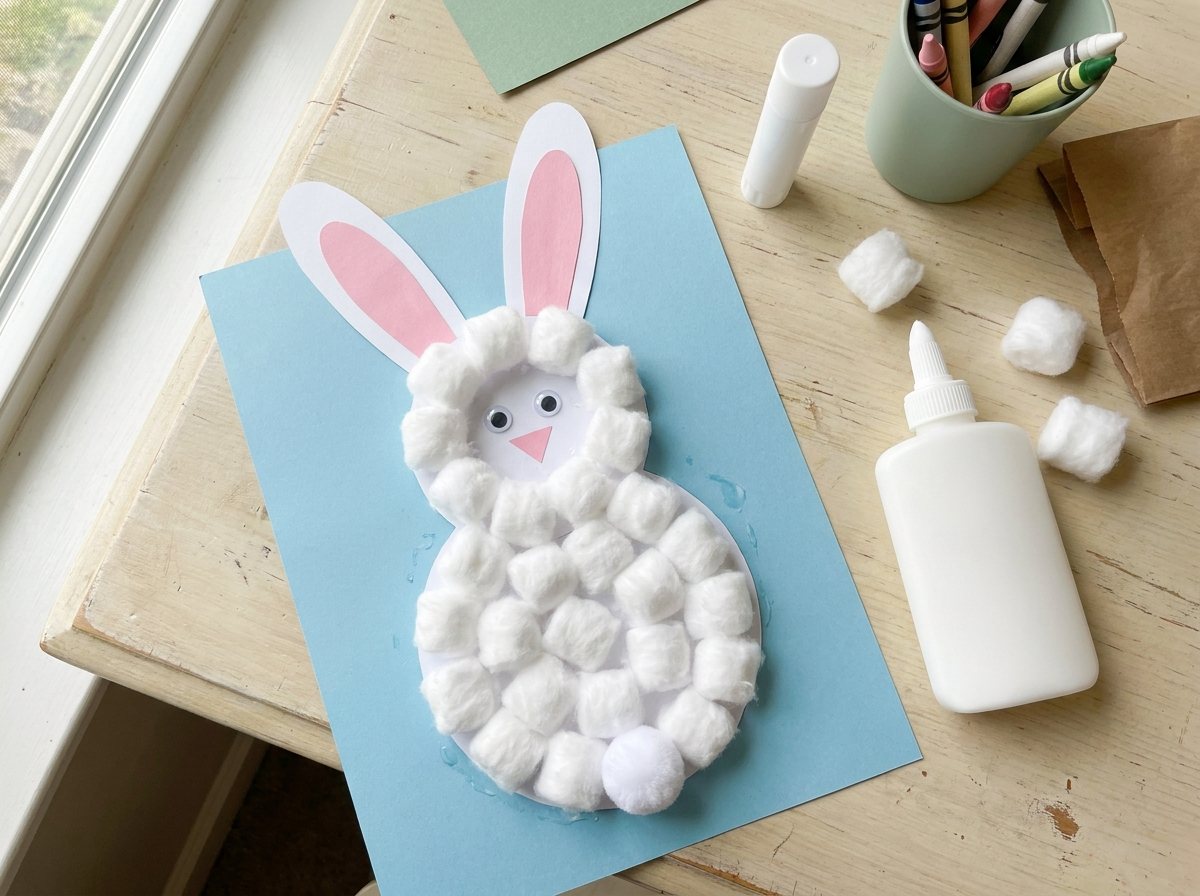
Age: 2 to 4 years | Time: 15 minutes | Mess Level: Low
This is the classic cotton ball bunny, made toddler-safe. Crumpled tissue paper is soft, squeezable and sticks to glue beautifully, and kids 4 and up can switch to cotton balls.
Safety firstCotton balls and googly eyes are for ages 4 and up. For ages 2-3, press crumpled tissue paper or torn white paper onto the glue, draw the eyes with marker, and skip the pom pom tail.
Supplies:
- Large bunny shape drawn or printed on construction paper (or cut from a paper plate).
- White school glue.
- Pink paper scraps for the nose and inner ears.
- Marker for the eyes.
- Ages 2-3: crumpled tissue paper or torn white paper for the fur.
- Ages 4+ only: 15-20 cotton balls, googly eyes and an optional large pom pom tail.
Instructions:
- Draw the bunny. Make a round body, a round head and two long ears. Keep it simple and large.
- Add glue. Squeeze glue generously over the body and head. Leave the ears flat for the pink inner ear pieces.
- Press on the fur. Your child presses crumpled tissue (or cotton balls at 4+) onto the glue until the body is covered.
- Make the face. Draw the eyes with marker (googly eyes for ages 4+ only) and add a small pink triangle nose.
- Add a tail. Ages 4+ can glue a cotton ball or large pom pom on the back. Younger kids can skip it or add one more tissue puff.
Heads up: Your toddler may pull the fluff back off right after sticking it on. That’s normal, and it’s good two-handed practice. Just add more glue.
8. Paper Plate Bunny Mask
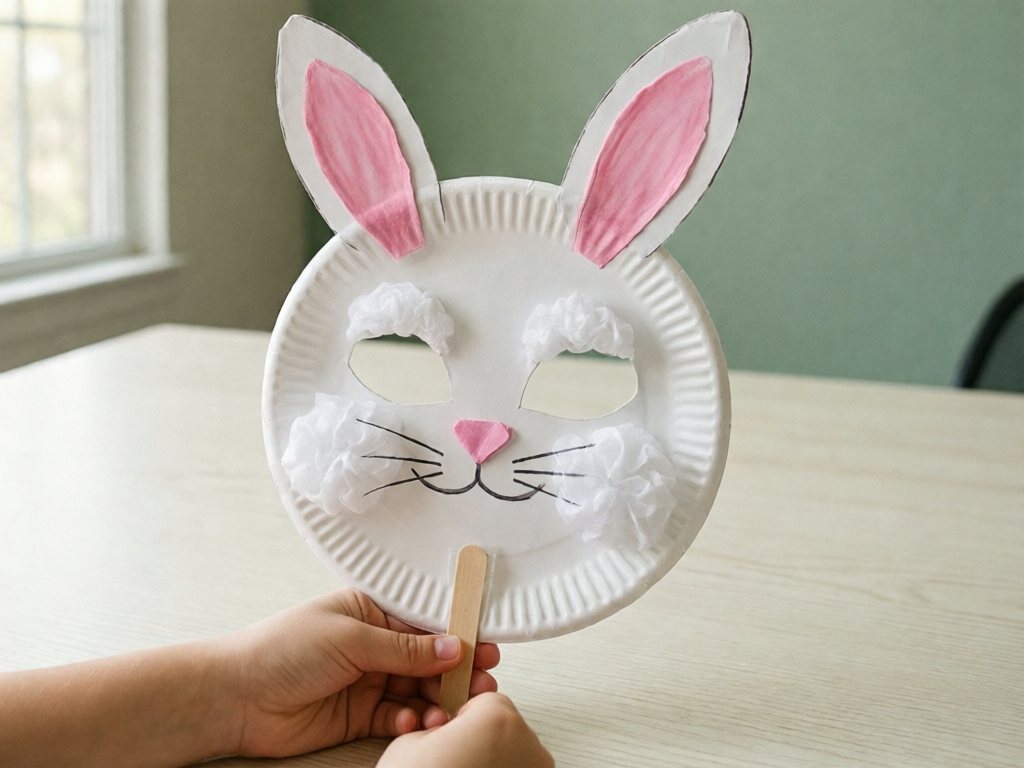
Age: 3 to 5 years | Time: 20 minutes | Mess Level: Low
This bunny mask is one of my simplest paper plate crafts for every season. Your child will want to hold it up all afternoon.
Safety firstCotton balls are for age 4 and up; for 3-year-olds, use crumpled tissue paper for the cheeks. Whiskers are drawn or cut from paper, never pipe cleaners near the face. Use a popsicle stick handle only, with no elastic or string.
Supplies:
- 1 white paper plate.
- Pink and white construction paper.
- Crumpled tissue paper for the cheeks (or 3-4 cotton balls for ages 4+).
- Glue stick and tape.
- Scissors (adult use).
- 1 popsicle stick for the handle.
- Markers.
Instructions:
- Cut eye holes. Hold the plate up to your child’s face and gently mark the eyes. An adult cuts the holes, making them generously large.
- Make the ears. Cut two white ear shapes about 8 inches tall. Glue slightly smaller pink inner ears on top.
- Attach the ears. Tape or glue them to the back of the plate at the top.
- Add fluffy cheeks. Your child glues a cluster of tissue puffs (cotton balls at 4+) at the bottom center.
- Add the nose. Draw or glue a pink paper triangle between the cheeks.
- Add whiskers. Draw three whiskers on each side with marker, or glue on thin paper strips.
- Add the handle. Tape a popsicle stick to the bottom so your child can hold the mask up.
Preschooler extension: Let them paint the plate pink or add glitter glue details before assembly.
9. Cardboard Tube Bunny
Age: 3 to 5 years | Time: 25 minutes | Mess Level: Medium
The toilet paper roll transforms yet again. This standing bunny makes a great table decoration or Easter basket addition.
Safety firstFor under 4, draw the eyes with marker and make the tail from a scrap of white paper instead of a cotton ball.
Supplies:
- 1 toilet paper roll.
- White or pink paint.
- White and pink construction paper.
- Markers and glue.
- Ages 4+ only: googly eyes and a cotton ball for the tail.
Instructions:
- Paint the tube. White, pink or brown all work. Let it dry.
- Cut the ears. While it dries, cut two white ear shapes about 4 inches long. Glue smaller pink inner ears on top.
- Flatten the top. Once the roll is dry, an adult pinches the top flat so the two sides meet, like a closed envelope.
- Attach the ears. Glue them to the back of the flattened top so they stick up.
- Make the face. Draw the eyes with marker (googly eyes for ages 4+ only), then add a small pink nose and mouth.
- Add whiskers. Draw them with a fine marker or glue on thin paper strips.
- Add a tail. Glue a scrap of white paper to the back (a cotton ball at 4+).
Toddler version: Skip the folding and the ears. Let your toddler paint the tube, then draw the eyes on together. That’s a bunny.
10. Bunny Ears Headband
Age: 3 to 5 years | Time: 20 minutes | Mess Level: Low
Your child will not take this off. Plan accordingly.
Safety firstCotton balls are for age 4 and up. For 3-year-olds, glue pink tissue paper or draw fur with crayon on the inner ears.
Supplies:
- 2 strips of white card stock, about 2 inches wide and 12 inches long, for the band.
- 2 ear shapes cut from white card stock, about 8 inches tall.
- Pink paper for the inner ears.
- Pink tissue paper or crayons (or cotton balls for ages 4+).
- Glue and tape (a stapler for adult use only).
Instructions:
- Size the band. Fit the two strips around your child’s head and tape them into a circle. If you staple instead, an adult does it and tapes over the staple ends.
- Make the ears. Cut two large ear shapes from card stock and glue slightly smaller pink inner ears on top.
- Add fluff. Your child glues pink tissue onto the inner ears or colors in fur with crayon (cotton balls at 4+).
- Attach the ears. Tape them to the inside of the band so they stand up tall. Any stapling is an adult job, with the ends taped over.
- Hop. Watch your child hop around the house for the next two hours.
Preschooler extension: Let them decorate the headband strip with stickers, stamps, or drawings before assembling.
Easter Chick, Lamb and Butterfly Crafts for Kids
Bunnies get most of the attention, but chicks, lambs and butterflies are just as fun to make. The three chick crafts all use paint, so cover the table before anyone sits down.
11. Handprint Chick
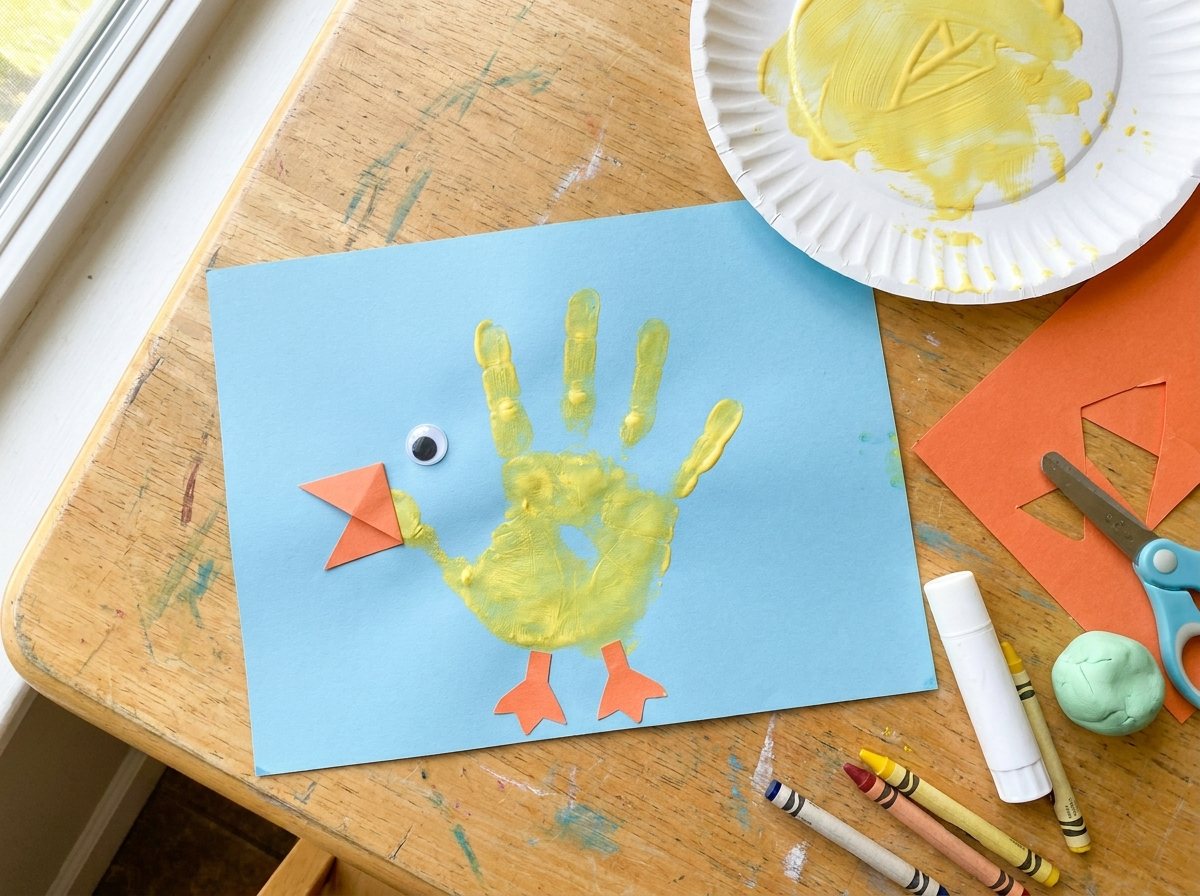
Age: 2 to 5 years | Time: 15 minutes | Mess Level: Medium
Handprint art is the great equalizer of toddler crafts: every child can make a handprint, and tiny hands don’t stay tiny. In my house the print takes seconds and the hand-washing takes the rest of the session, so park the wet wipes next to the paper before you paint that palm.
Safety firstGoogly eyes and feathers are for ages 4 and up. For under 4, draw the eye and the head tuft with marker.
Supplies:
- Non-toxic yellow washable paint.
- White or light blue paper.
- Orange paper scraps for the beak and feet.
- Glue stick and a marker.
- Ages 4+ only: one googly eye and a small yellow feather.
Instructions:
- Paint the hand. Brush your child’s hand yellow, or let them press it into a thin layer of paint on a plate.
- Print the body. Press the hand firmly onto the paper with fingers spread. The palm is the body and the fingers are the tail feathers.
- Let it dry. Give it a few minutes.
- Add the beak. Cut a small orange diamond, fold it in half and glue it on the thumb side.
- Add the eye. Draw one eye with marker above the beak (a googly eye for ages 4+ only). Chicks in profile only need one.
- Add the feet. Cut two small orange feet and glue them at the bottom.
- Optional fluff. Draw a little tuft on top of the head, or glue on a small feather for ages 4+.
Keepsake tip: Write your child’s name and the date on the back before it goes on the fridge.
12. Egg Carton Chicks
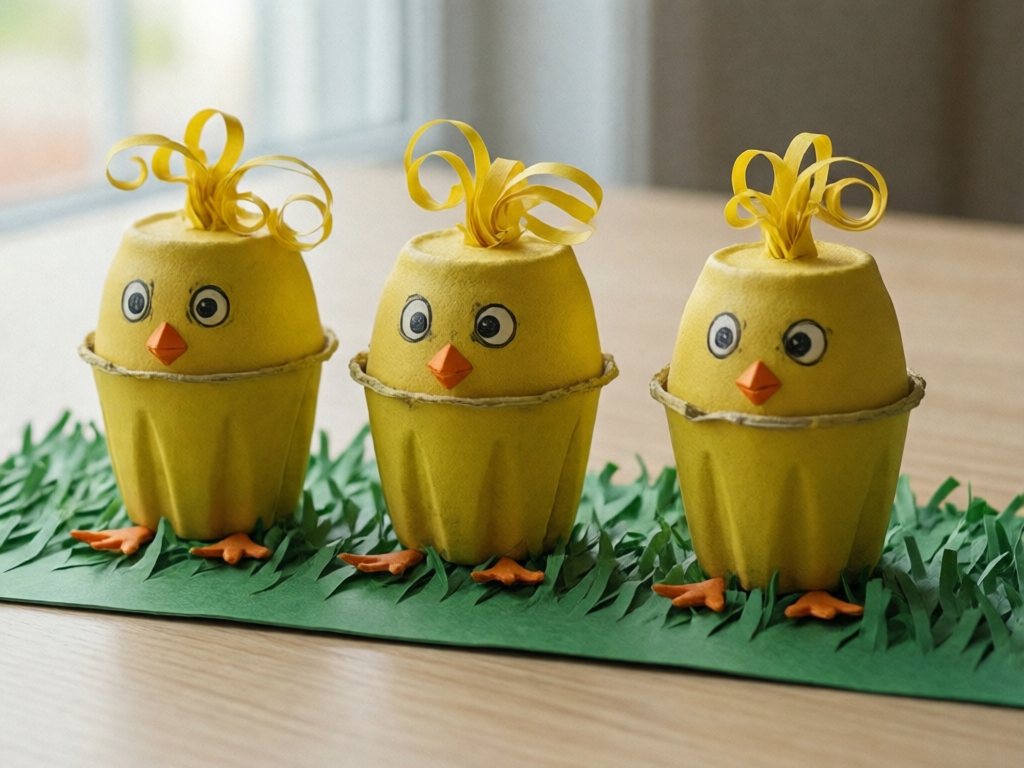
Age: 2 to 5 years | Time: 20 minutes | Mess Level: Medium
Egg cartons practically beg to be turned into chicks. Each cup is already the perfect round-body shape.
Safety firstUse a new, unused carton or paper-pulp trays bought for crafts. Cartons that held raw eggs can carry Salmonella, and toddlers put crafts and painty fingers in their mouths, so everyone washes hands afterward. Feathers and googly eyes are for ages 4 and up. For under 4, draw the eyes with marker and tuck in strips of yellow paper for head fluff.
Supplies:
- New, unused cardboard egg carton (never one that held eggs), cut into individual cups.
- Thick yellow washable paint.
- Orange paper scraps for the beaks and feet.
- Strips of yellow paper for head fluff.
- Glue and a marker.
- Ages 4+ only: googly eyes and small yellow or orange feathers.
Instructions:
- Cut the cups. An adult cuts the carton into individual cups.
- Paint them yellow. Use thick paint, since cardboard soaks it up. Two coats may be needed. Let dry.
- Add the eyes. Draw two eyes with marker near the top of the cup (googly eyes for ages 4+ only).
- Add a beak. Cut a tiny orange triangle and glue it below the eyes.
- Add head fluff. Tuck a few curled paper strips into the top with a dab of glue. Ages 4+ can use a small feather instead.
- Optional feet. Cut small orange feet from paper and glue them to the bottom.
Make it a scene: Line several chicks up on a strip of green paper “grass.” Add a mama hen (a bigger cup, painted brown or red). Display on a windowsill.
13. Fork-Printed Chicks
Age: 2 to 4 years | Time: 15 minutes | Mess Level: Medium
This one always surprises parents. A plastic fork dipped in paint creates the most perfect feathery, fluffy texture. It looks like a real fuzzy chick, and your toddler will be amazed at what they made.
Safety firstGoogly eyes are for ages 4 and up. For under 4, draw the eyes with marker.
Supplies:
- Sturdy plastic fork.
- Yellow paint, in a thin layer on a paper plate.
- White or blue paper.
- Markers, including orange for the beak and legs.
- Ages 4+ only: googly eyes and glue.
Instructions:
- Load the fork. Dip the tines of the fork into the yellow paint.
- Print the body. Press and slightly drag the fork onto the paper in a circle. Repeat, overlapping, until you have a fluffy yellow ball.
- Print the head. Make a slightly smaller cluster above the body.
- Let it dry. A few minutes is enough.
- Add the face. Draw the eyes with marker (googly eyes for ages 4+ only) and add an orange triangle beak.
- Add legs. Draw two orange stick legs and feet below.
Why forks work: The tines create natural separations in the paint that look like feathers or fuzz. It’s one of those happy accidents of craft engineering.
14. Coffee Filter Butterflies
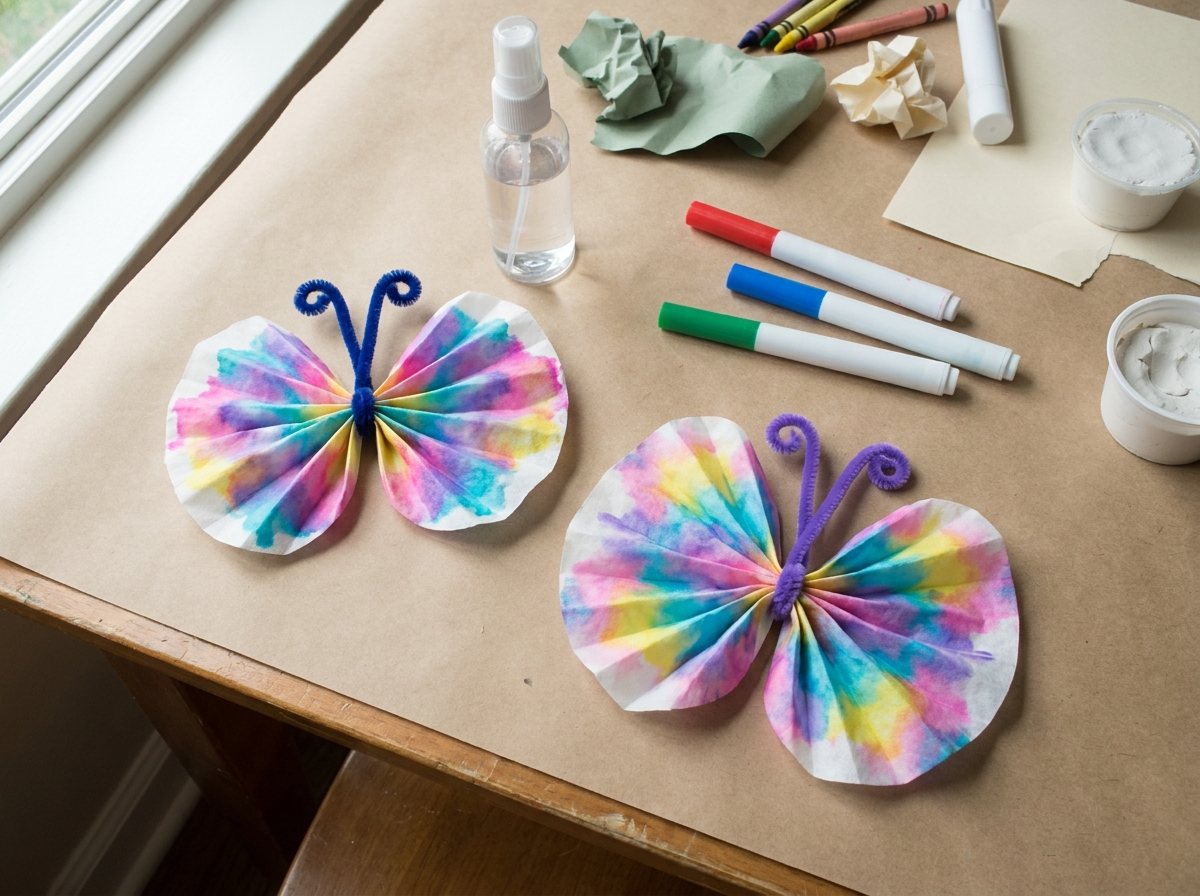
Age: 3 to 5 years | Time: 20 minutes (plus drying time) | Mess Level: Medium
This craft has a real “wow” moment built in. When the water hits the marker ink, the colors bloom and spread like watercolor, and your child will gasp.
Supplies:
- Flat-bottom or round coffee filters.
- Washable markers (the brighter the better).
- Spray bottle of water or a dropper.
- Pipe cleaner.
- Clothespin for the body (optional).
Instructions:
- Flatten the filter. Lay it on a protected surface.
- Color heavily. Let your child load it up with washable marker. Scribbles are perfect and no pattern is needed.
- Add water. Lightly spray the filter or drip water on with a dropper. Watch the colors bleed and blend.
- Let it dry. Allow 30-60 minutes, or an adult can speed it up with a hair dryer on low.
- Make the body. Pinch the filter in the center while an adult twists a pipe cleaner around it. Curl the ends into loops for antennae so no sharp tips poke out.
- Optional clothespin body. An adult clips a painted clothespin over the center.
Display idea: Tape several to a window for a “butterfly garden” that catches the light.
15. Fluffy Tissue Paper Sheep
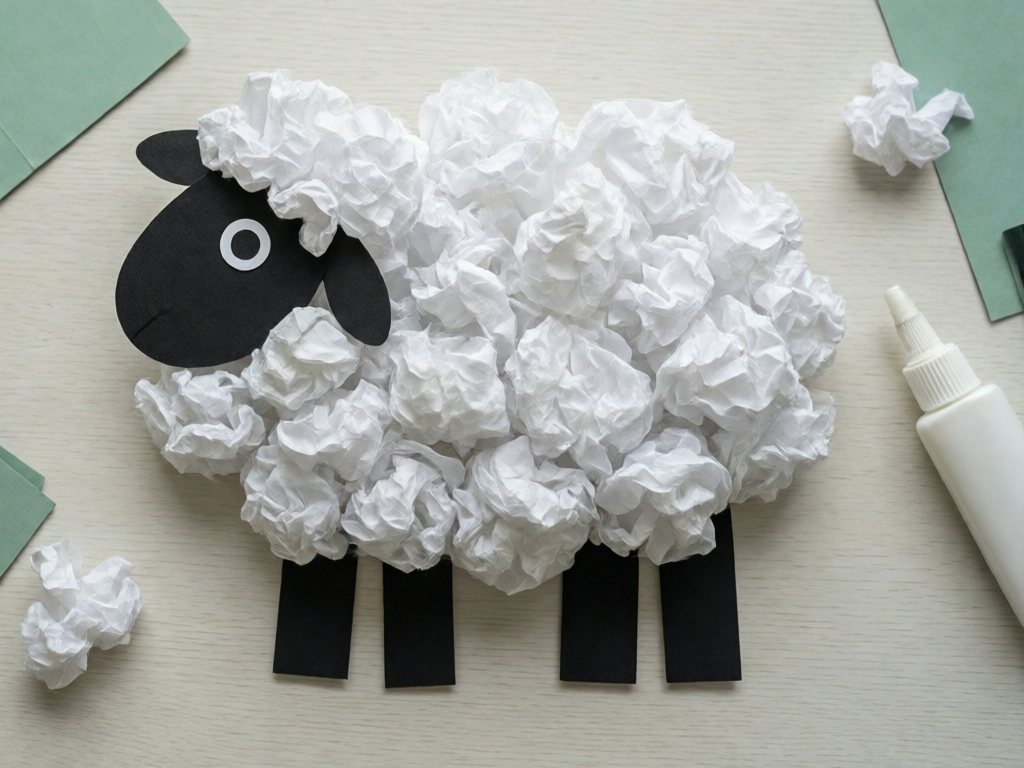
Age: 2 to 4 years | Time: 15 minutes | Mess Level: Low
Spring means lambs, and lambs need fleece. Toddlers make it from tissue puffs, and kids 4 and up can switch to cotton balls. This is almost too easy, and that’s exactly why it belongs here.
Safety firstCotton balls and googly eyes are for ages 4 and up. For ages 2-3, use torn white tissue paper or crumpled white paper for the fleece and draw the eye with marker.
Supplies:
- Sheep body shape cut from white or light gray paper.
- Black construction paper for the head and legs.
- White glue.
- White crayon or a small white paper circle for the eye.
- Ages 2-3: torn white tissue or crumpled white paper for the fleece.
- Ages 4+ only: 10-15 cotton balls and a googly eye.
Instructions:
- Cut the pieces. Cut a cloud-like oval from white paper for the body, a smaller black oval for the head and four black rectangles for legs.
- Assemble the sheep. Glue the head to one end of the body and the legs to the bottom.
- Add glue. Squeeze white glue all over the body.
- Add the fleece. Your child presses tissue puffs (cotton balls at 4+) onto the glue until the body is fluffy.
- Add the eye. Draw it with white crayon or glue on a white paper circle (a googly eye for ages 4+ only).
Variation: Use the same approach for a cloud, a snowball or a polar bear. Fluffy crafts are endlessly adaptable.
Easter Flower, Garden and Basket Crafts for Preschoolers
Easter lands just as the first flowers show up, so these crafts lean into gardens, carrots and a basket to carry it all. Most work from age 2; the basket and pasta bracelet are for older preschoolers.
16. Tissue Paper Sun Catchers
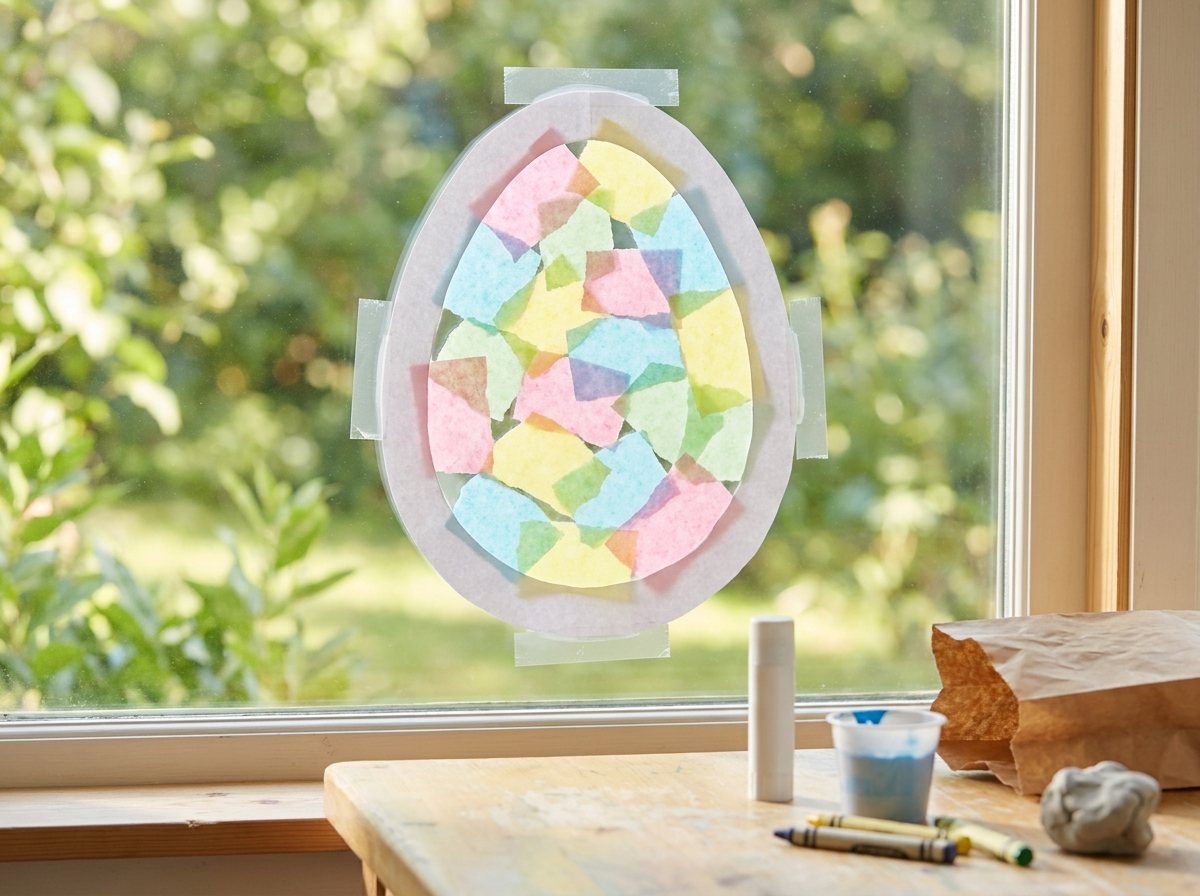
Age: 2 to 5 years | Time: 20 minutes | Mess Level: Low
These look absolutely stunning on a window, and they’re one of the most forgiving crafts for young children. There’s truly no wrong way to do this.
Supplies:
- Clear contact paper (an adult cuts and handles it).
- Tissue paper in spring colors, torn or cut into pieces.
- Egg, bunny or flower frame cut from construction paper (optional).
- Tape.
Instructions:
- Set up the sticky side. Cut a piece of contact paper and tape it sticky-side-up to the table.
- Add a frame (optional). Cut the center out of a paper egg, leaving the border, and lay it on the contact paper.
- Stick on tissue. Let your child place tissue paper pieces on the sticky surface. They stick on contact, no glue needed.
- Seal it. Lay a second piece of contact paper on top, sticky side down.
- Hang it. Trim the edges and tape it to a sunny window.
Why toddlers love this: The instant stick is deeply gratifying. Unlike glue, which takes time and coordination, contact paper gives them immediate results. Place, press, done.
17. Cupcake Liner Flowers
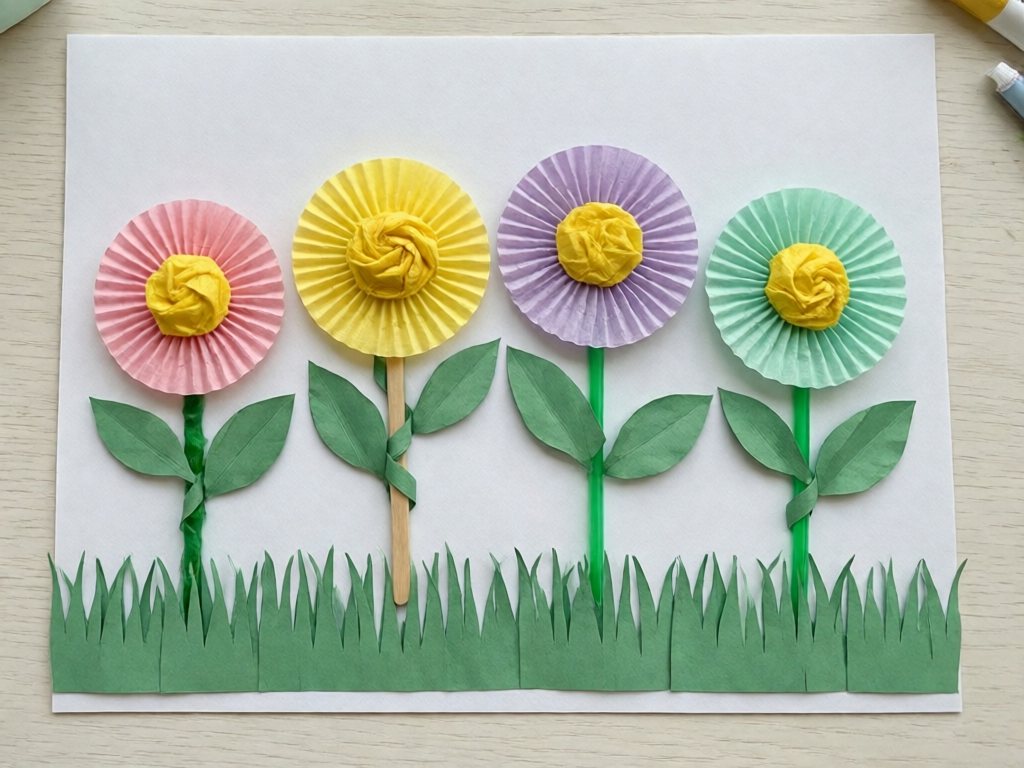
Age: 2 to 5 years | Time: 15 minutes | Mess Level: Low
If you have cupcake liners, you have flower petals. This is one of those crafts where the material does most of the visual work for you.
Supplies:
- Cupcake liners in mixed colors and sizes (mini and regular).
- Popsicle sticks or green pipe cleaners for stems (an adult folds the pipe cleaner tips back).
- Green paper for leaves.
- Glue.
- Crumpled yellow tissue paper for the centers (or pom poms too big to fit inside a toilet paper tube).
- Paper or card stock base.
Instructions:
- Glue the flowers. Flatten the liners and glue them to the paper in a row or cluster.
- Add stems. Glue a popsicle stick or pipe cleaner running down from each flower.
- Add leaves. Cut simple leaf shapes from green paper and glue them along the stems.
- Fill the centers. Glue a ball of crumpled yellow tissue (or a large pom pom) in the middle of each flower.
- Layer for depth (optional). Glue a mini liner inside a regular one.
Make a whole garden: Add a strip of green paper at the bottom for grass, a yellow circle and triangle rays for a sun, and a blue sky background.
18. Fingerprint Carrot Garden
Age: 2 to 4 years | Time: 15 minutes | Mess Level: Medium
What does the Easter bunny eat? Carrots. So let’s make a whole garden of them using nothing but fingers and paint.
Supplies:
- White paper.
- Non-toxic orange and green washable paint.
- Brown marker or crayon for the ground line (optional).
- Wet wipes nearby (you’ll need them).
Instructions:
- Draw the ground. Draw a brown line across the paper, about a third of the way down.
- Print the carrots. Below the line, make orange fingerprints in an upside-down triangle: 3 just under the line, 2 below them and 1 at the tip. Orange blobs work too.
- Add the greens. Above the line, add green fingerprints on top of each carrot for the leafy tops.
- Fill the garden. Repeat until the row is full of carrots.
Toddler reality check: Your toddler will likely make one carrot, then start fingerpainting freely all over the paper. This is fine. The paper is now a “carrot garden after a rainstorm.” Roll with it.
19. Paper Plate Easter Basket
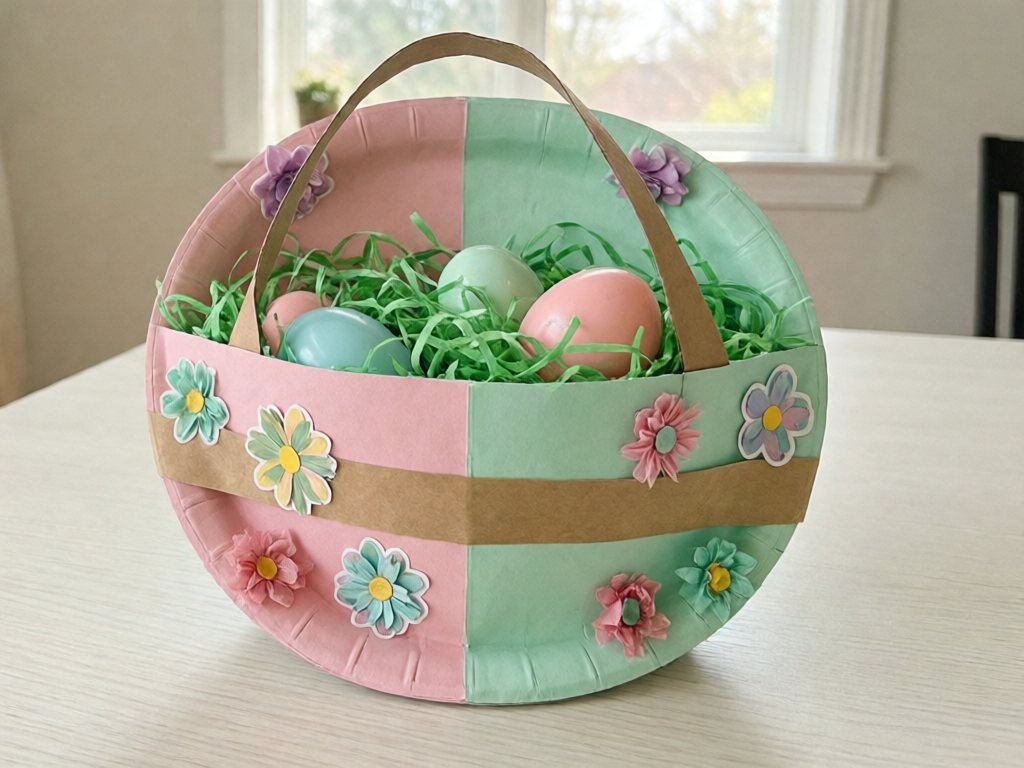
Age: 3 to 5 years | Time: 25 minutes | Mess Level: Medium
A (mostly) functional craft, and your preschooler will be extremely proud of it. For 3-year-olds, hold it together with tape; staples are for ages 4-5, and only an adult uses the stapler.
Safety firstFill it only with age-appropriate treats. For children under 4, skip hard candy, jelly beans and small toys, and use the tape-only version with no staples. For ages 4-5, tape over every staple end.
Supplies:
- 2 paper plates.
- Paint or markers in spring colors.
- Card stock strip for the handle.
- Stickers, tissue paper or other decorations.
- Wide masking or packing tape (plus a stapler for adult use, ages 4-5 only).
Instructions:
- Decorate the plates. Your child paints or colors the bottom side of both plates. Let dry.
- Make the pocket. Place the plates together, decorated sides facing out. Tape around the bottom half with wide tape, leaving the top open. For ages 4-5, an adult can staple instead and tape over the staple ends.
- Add a handle. Cut a card stock strip about 1.5 inches wide and 14 inches long. Tape each end firmly to opposite sides of the opening. For ages 4-5, an adult can staple it and tape over the staples.
- Decorate more. Add stickers, tissue paper flowers, drawn eggs or a crumpled tissue bunny tail.
- Fill it. Add shredded green paper grass and a few age-appropriate treats.
20. Pasta Bracelet (Spring Edition)
Age: 4 to 5 years | Time: 20 minutes + 1 hour drying | Mess Level: Low
Threading pasta is outstanding fine motor practice. Spring colors turn it into a festive Easter bracelet.
Safety firstAges 4-5 only, closely supervised. Dry pasta is a choking hazard, so this craft is not for children under 4. The pasta is craft material, not food, and must not go in mouths. It’s not a wear-to-bed item: take the bracelet off for sleep and active play, and right away if your child chews it.
Supplies:
- Tubular pasta with a hole through the center, such as penne, rigatoni or ziti.
- Food coloring and white vinegar (adult job).
- Ziplock bags for dyeing and wax paper for drying.
- Pipe cleaners (easiest) or stretchy cord.
- Tape, if you use cord.
Good to knowFood coloring stains hands, clothes and counters. Wear old clothes, dye the pasta over a tray and let it dry completely before kids touch it.
Preparing the pasta (adult job, do this ahead of time):
- Bag it. Put 1 cup of dry pasta in a ziplock bag.
- Add color. Add 1 teaspoon of white vinegar and several drops of food coloring.
- Shake. Seal the bag and shake until the pasta is evenly coated.
- Dry. Spread the pasta on wax paper for about an hour, until fully dry.
- Repeat. Make more batches in pink, yellow, purple, green and blue.
Assembly:
- Prep the base. A pipe cleaner is stiff and easy for younger preschoolers to thread. If you use cord, wrap tape around one end to make a stiff needle.
- Stop the end. Bend the far end of the pipe cleaner (or tie a piece of pasta to the end of the cord) so the pasta doesn’t slide off.
- Thread. Let your child thread pasta on in whatever color order they choose.
- Close it loosely. Twist the pipe cleaner ends together and fold the tips back, or size stretchy cord so the bracelet slides off easily. Skip necklaces.
- Check it. Look it over when you finish, and take it off if your child chews the pasta.
Why These Crafts Are Worth the Mess
Tearing paper, squeezing glue and peeling stickers help build fine motor control and the hand strength kids use later to hold a pencil. Kids think they’re making a bunny, but they’re really practicing fine motor skills.
The sensory side counts too: cool paint, soft tissue and the rip of torn paper. Process art for toddlers works the same way, because the doing matters more than the result.
Tips for Easter Crafts with Toddlers
Here’s what has worked for me. Tape this list inside your craft cabinet.
Set Up Before They Sit Down
Toddlers have very little patience once they ask for a craft, so have everything ready. Pre-cut the shapes, pre-pour the paint and open the glue. Keep any small pieces for ages 4+ in a bowl on your side of the table.
Let Go of the Pinterest Version
A 2-year-old’s bunny will look like a white blob with maybe one marker eye. That’s right on track developmentally. If your toddler stamps three prints, announces “all done” and leaves, the craft is finished, so don’t coax them back.
Time It Right
- After breakfast or a morning snack. They’re fed, rested and alert.
- After nap. They’re refreshed and looking for something to do.
- Not right before a meal. A hungry toddler plus glue equals catastrophe.
- Not right before bed. An overtired toddler plus paint equals tears.
Dress for Disaster
In warm weather, strip them down to a diaper. In cold weather, an old adult t-shirt worn backward makes a smock that covers them to the knees. Do not put them in that cute outfit your mom bought and then hand them paint.
Contain the Chaos
- Highchair tray. Built-in edges keep the mess in one easy-to-wipe zone.
- Sheet pan or baking tray. Raised edges catch paint drips.
- Plastic tablecloth taped to the table. It’s cheap and saves your sanity.
- Outside. Tape paper to the patio table and let them go.
Offer Two Choices
“Do you want the blue or the pink?” works far better than “What color do you want?” with toddlers. Two choices prevent overwhelm, while five cause paralysis. Use it for colors, stickers, shapes and which craft comes first.
Easter Crafts by Age: 18 Months to 5 Years
Not sure which crafts to try first? Here’s a breakdown by age:
18 Months to 2 Years
Best crafts from this list: Torn Paper Easter Eggs (#1) and Sticker Eggs (#2).
What they can do:
- Tear paper (with help)
- Peel and place large stickers (stay within arm’s reach and bin the backing)
- Squish and press with hands
- Place items on sticky surfaces
- Finger paint (on paper, with an adult beside them)
What they can’t do yet:
- Cut with scissors
- Draw recognizable shapes
- Follow multi-step instructions
- Resist eating the supplies (keep pom poms, googly eyes and cotton balls out of reach under 4)
2 to 3 Years
Best crafts from this list: Egg crafts #1-#4 (daubers or fingertips for #4), Fluffy Tissue Paper Bunny (#7) and the chicks (#11-#13). Then try the Sheep (#15), Sun Catchers (#16), Cupcake Liner Flowers (#17) and Carrot Garden (#18).
Once they turn 3: Add the Mess-Free Paint Bag Eggs (#5), with you hands-on the whole time, and the Crayon Resist Eggs (#6).
What they can do:
- All of the above, plus:
- Use a glue stick independently
- Press crumpled tissue paper or torn paper onto glue
- Make handprints and fingerprints with paint
- Draw eyes with a marker (approximately where they should go)
- Tear paper independently
- Use dot markers and stampers
3 to 5 Years
Best crafts from this list: At 3, everything except the pasta bracelet (#20), which is for ages 4-5 only, with the under-4 swaps. At 4 and 5, all 20 are fair game. They’ll get more detail from the mask, headband and basket crafts.
What they can do:
- All of the above, plus:
- Use kid-safe scissors (with supervision)
- Follow 2-3 step instructions
- Create intentional patterns
- Thread large pasta onto string (4 and up, adult-dyed, supervised)
- Paint with some color control
- Tell you exactly how the craft should look (and get frustrated when it doesn’t match their vision — deep breaths, everyone)
How to Display Easter Crafts
Your child worked hard on these. Don’t let them disappear into the craft graveyard (that drawer we all have). Here’s how to show them off:
Easter Craft Clothesline: String twine across a wall or window, above your child’s reach, and use mini clothespins to clip up each finished craft. Instant gallery.
Window Display: Sun catchers, coffee filter butterflies, and tissue paper crafts all look stunning taped to windows where light comes through.
Easter Table Centerpiece: Stand the cardboard tube bunnies and egg carton chicks on the dining table around a plate of plastic eggs. Homemade Easter decoration, done.
Cards and Basket Toppers: Put photos of the crafts on Easter cards for grandparents, or tape small crafts directly to Easter baskets as toppers.
Craft Photo Album: Take a photo of each craft with your child holding it. At the end of the season, you have a portfolio of their spring art. These make beautiful grandparent gifts when printed.
Crafty Mama
Crafty Mama is a former elementary art teacher turned stay-at-home parent who believes every child is creative — they just need the right invitation. She develops age-appropriate activities, crafts, and projects that spark imagination while keeping mess (and parent stress) to a minimum.
Frequently Asked Questions
What age can toddlers start doing Easter crafts?
You can start simple Easter crafts around 18 months. At this age, stick to close-supervision sensory activities like peeling large stickers and tearing paper. Save sealed paint bags for age 3 and up. For babies under 12 months, skip paint crafts and ask your pediatrician about safe sensory play, especially around food allergens. By 2, most toddlers can do glue-and-stick crafts, fingerpainting, and stamping activities. The age picker at the top matches each craft to your child’s age. Keep the steps minimal and the materials chunky and easy to grasp.
How do I keep my toddler from eating craft supplies?
First, the reality check: most toddlers under 2 will attempt to taste craft supplies at some point. Use only non-toxic, washable materials — this is non-negotiable for this age group.
Googly eyes, small pom poms, cotton balls, feathers, foam stickers, dry pasta and beads are choking hazards under 4. Skip them, or swap in marker-drawn eyes, crumpled tissue paper and pom poms too big to fit inside a toilet paper tube. Supervise constantly and redirect calmly: “Paint goes on the paper, not in your mouth.” Offer a snack before you start so they’re not hungry while crafting. If mouthing is still a big issue, stick to large-sticker and torn-paper activities with nothing loose to grab.
My toddler won’t follow the craft instructions. Is that normal?
Yes, completely normal. Toddlers treat a craft as an experiment, not a tutorial. If you set up a bunny and your child just wants to squeeze glue for 10 minutes, that is the craft. At this age, the process matters far more than the product. If you want a craft that looks like the picture, make it yourself after bedtime.
What’s the best type of paint for toddler Easter crafts?
Washable tempera paint is the gold standard for toddler crafts. Look for paint labeled non-toxic with the ACMI AP (Approved Product) seal. It comes in bright colors and is thicker than watercolor, so it drips less. Most of it washes out, but some colors can stain, so dress kids in old clothes. For low-mess painting, try dot markers (like Do A Dot markers) or an adult-watched paint bag for ages 3 and up. Dot markers are essentially paint in a self-contained stamper.
How long should I expect a toddler craft session to last?
For 18-month to 2-year-olds: 5-10 minutes is a great session. Do not expect more. For 2-3 year-olds: 10-15 minutes is typical. For 3-5 year-olds: 15-25 minutes is common, though some kids will keep going longer if they’re into it. The key is following your child’s lead. When they’re done, they’re done — even if you think the craft needs more tissue puffs. It doesn’t. It’s perfect.
Can I adapt these crafts for a group or Easter party?
Absolutely. The best group crafts here are Sticker Eggs (#2), Torn Paper Eggs (#1), Fluffy Tissue Paper Bunnies (#7) and Tissue Paper Sun Catchers (#16). They’re easy to prep in bulk, need little adult help per child and clean up fast. If any child in the group is under 4, use the tissue paper and marker-eye swaps for everyone. Set up stations with pre-cut shapes and pre-portioned supplies, and let kids rotate. For painting stations, use one muffin tin per station with 2-3 colors to prevent muddy mixing.
What do I do with all the finished Easter crafts?
Display your favorites (see the display ideas above), photograph everything, and then recycle most of it after a week or two. You can’t keep every craft, or your house will be knee-deep in cotton ball bunnies by June. Keep one or two special pieces per season in a memory box. Making it was the point, not keeping it.
Your Easter Crafting Plan
Pick two or three crafts from the age picker and do the adult cutting after bedtime. Then run one short session a week through March, so the window is full of chicks by Easter Sunday, March 28, 2027. In later years, Easter falls between March 22 and April 25, so check the date in January.
You don’t have to do all twenty, and you don’t have to do any of them perfectly. Just show up with a glue stick, some paper and a willingness to let a tiny human put eyes in unexpected places. Let them lead, and clean up later.
Happy Easter crafting, friends. May your cotton balls stick and your paint stay washable.