
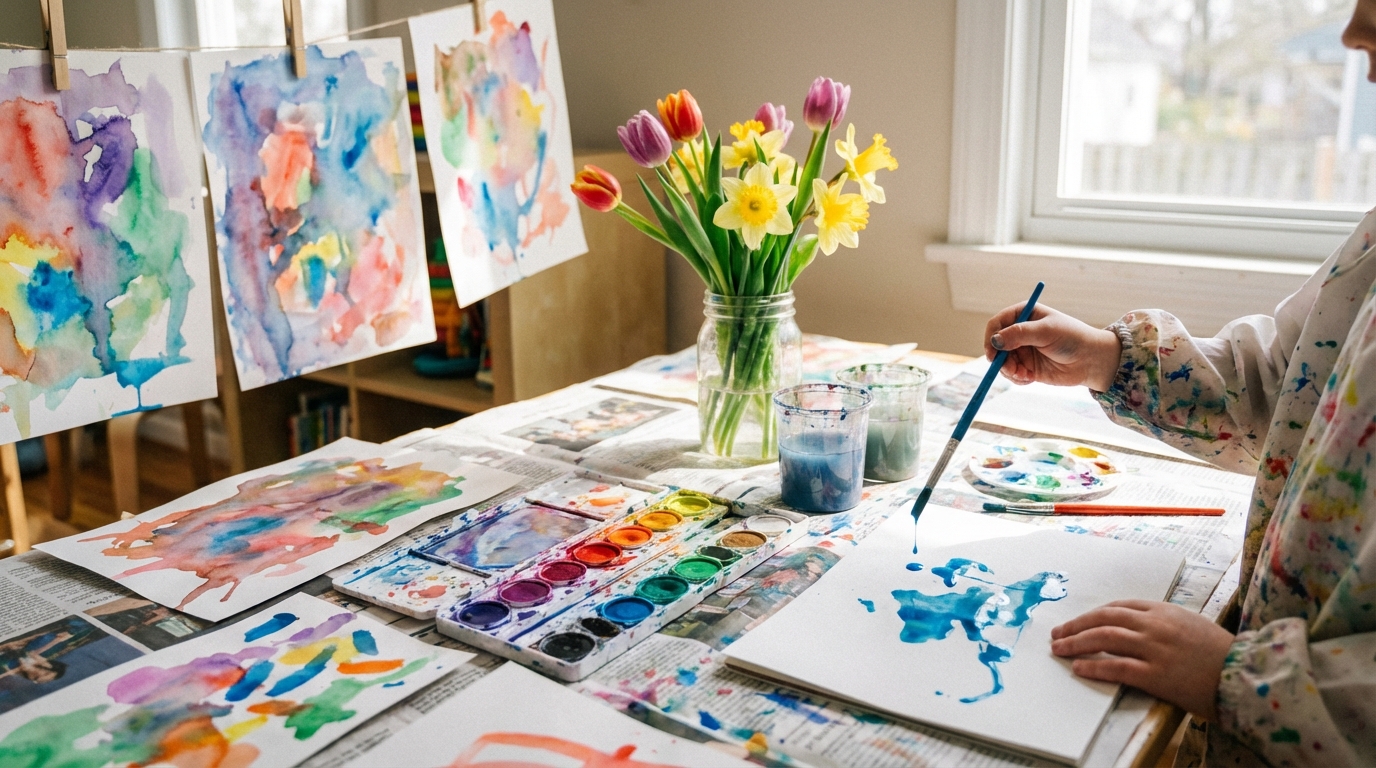
Watercolor Painting for Kids: Easy Techniques and Projects for Every Age
This guide helps you introduce watercolor painting to your kids, covering easy techniques, budget supplies, and projects for ages 18 months to 10 years, along with tips for managing mess.
- Discover why watercolor is a forgiving, beautiful, and skill-building first art medium for your child.
- Get started with essential, budget-friendly supplies for $14-$36, including specific paint and paper.
- Learn easy techniques and projects suitable for kids aged 18 months to 10 years.
- Implement a simple mess plan to keep cleanup fast and contained.
This post contains affiliate links. As an Amazon Associate I earn from qualifying purchases.
Watercolor lets kids put wet paint on paper and watch the color bloom on its own, with no perfect circles required. This guide covers budget supplies, techniques for toddlers through age 10, 15 step-by-step projects, and a mess plan that keeps cleanup fast.
Start hereTape a sheet of paper to the table, wet it with a sponge, and let your child touch a loaded brush to it. That five-minute first painting is the whole point. Rainbow Wash Bookmarks (project 1) is the easiest next step.
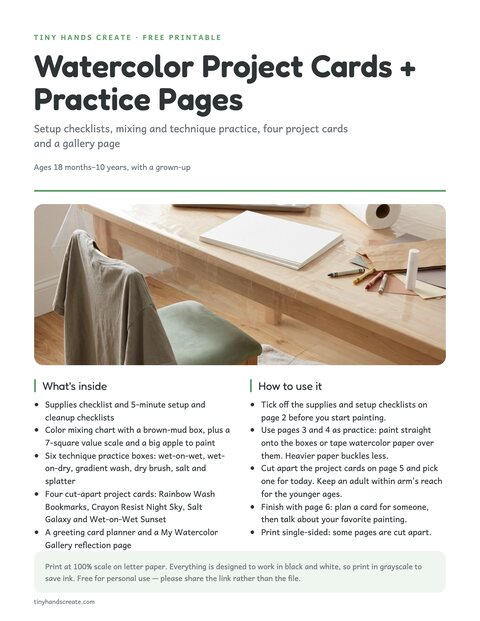
Free printable · 6 pages
Watercolor Project Cards + Practice Pages
A supplies and 5-minute setup checklist, a color mixing chart, a value scale, six technique practice boxes, four watercolor project cards, and a greeting card and gallery page.
Free. Your download link appears right here. You'll also join the Daily Printable Drop. Unsubscribe anytime. Privacy
I switched to watercolors because I was tired of the tempera cycle: the setup, primary colors on every surface, the bath afterward. Watercolors are still messy, but the mess is more contained.
In this article (13 sections)
- Why Watercolor Is the Best First Medium for Kids
- Best Watercolor Supplies for Kids (Budget Picks)
- Watercolor Techniques for Kids by Age
- 15 Easy Watercolor Painting Ideas for Kids
- Beginner Watercolor Projects for Toddlers (18 Months–3)
- Intermediate Watercolor Projects for Preschoolers (Ages 4–5)
- Advanced Watercolor Projects for Kids 6+
- Watercolor Setup and Cleanup Tips for Kids
- Watercolor Problems and Fixes
- How Watercolor Painting Builds Developmental Skills
- Seasonal Watercolor Ideas for Kids
- Frequently Asked Questions
- Start Your First Watercolor Session
Why Watercolor Is the Best First Medium for Kids
It’s forgiving. Unlike acrylics or markers, watercolor lets kids layer, blend, and even lift color back off the paper. There’s no “I messed up and now it’s ruined.” There’s just “now it looks different.”
It teaches patience and observation. Watercolor behaves differently depending on how much water you use, how wet the paper is, and how long you wait between layers. Kids learn to slow down and watch what’s happening.
It’s genuinely beautiful. Even a toddler’s random washes of color look lovely in watercolor. The medium does half the work. This matters because children are more likely to keep creating when they like what they produce.
It builds fine motor skills. Brush control, water management, and the delicate touch required for watercolor techniques can help build the hand strength and control kids use for writing. If you’ve been working on fine motor activities with your toddler, watercolor painting is a natural next step.
It’s affordable and lasts forever. A single set of watercolor cakes can last months — even years — because you’re reactivating dried pigment with water each time. Compare that to tempera, which dries out in open containers, or markers that die after being left uncapped for eleven seconds.
It’s screen-free. Just pigment, water, paper, and whatever your child dreams up.
Best Watercolor Supplies for Kids (Budget Picks)
You don’t need to spend a lot. Here’s what actually matters, what’s nice to have, and what’s a waste of money when your artists are under ten.
Essential Supplies
| Item | What to Get | Price Range | Why It Matters |
|---|---|---|---|
| Watercolor paint set | Crayola or Prang 16-color oval pan set | $3–$8 | Bright colors, easy to activate, replaceable |
| Brushes | Variety pack with round brushes, sizes 4–12 | $5–$10 | Different sizes = different techniques |
| Paper | 90lb (about 190 gsm) mixed media pad for practice; 140lb (about 300 gsm) watercolor paper for finished pieces | $5–$12 | Heavier paper won’t buckle and warp |
| Water cups | Two sturdy, wide-mouth plastic cups | Free (from your kitchen) | One for rinsing, one for clean water |
| Palette | White plate or plastic palette | Free–$3 | For mixing colors |
| Table covering | Plastic tablecloth or garbage bags | $1–$3 | Protects your table (non-negotiable) |
Total starter cost: $14–$36. Prices are approximate and change often. Before you buy, check every paint set, liquid watercolor, and watercolor pencil for the AP (Approved Product) seal from the Art & Creative Materials Institute (ACMI).
- Watercolor pan set ($3–$8)
- Round brushes, sizes 4–12 ($5–$10)
- Mixed media or watercolor paper pad ($5–$12)
- Two wide-mouth cups (free)
- White plate or palette (free–$3)
- Plastic tablecloth or garbage bags ($1–$3)
Nice-to-Have Upgrades
- Liquid watercolors (like Colorations brand): Concentrated color in a bottle that you dilute following the label. More vibrant than pan sets and amazing for process art, but they stain more easily. Worth it if your child paints frequently.
- Watercolor pencils: Draw like colored pencils, then add water to blend. Great for school-age kids who want more control.
- Spray bottles: For wet-on-wet techniques and splatter effects. Keep them for ages 4 and up, in a ventilated space, aimed away from faces.
- Salt and plastic wrap: Household items that create texture effects (see below).
- Painter’s tape or washi tape: For masking/resist techniques.
- Round watercolor paper: A fun shape change that makes kids feel like “real artists.”
What NOT to Buy
- Expensive artist-grade paints. Your four-year-old will mix them all into brown within three minutes. Student grade is perfect.
- Tiny detail brushes. Young kids need big brushes for big movements. Don’t hand a toddler a size 0 liner brush.
- Cheap copier paper. This is the one place I’ll tell you not to skimp. Regular printer paper buckles immediately under water and tears easily. Even the cheapest watercolor paper pad transforms the experience.
- Watercolor “kits” with stamps and stencils. They look cute in the store. In practice, kids use the stamps once and then just paint, and you’ve paid $20 for a $5 paint set with packaging.
Watercolor Techniques for Kids by Age
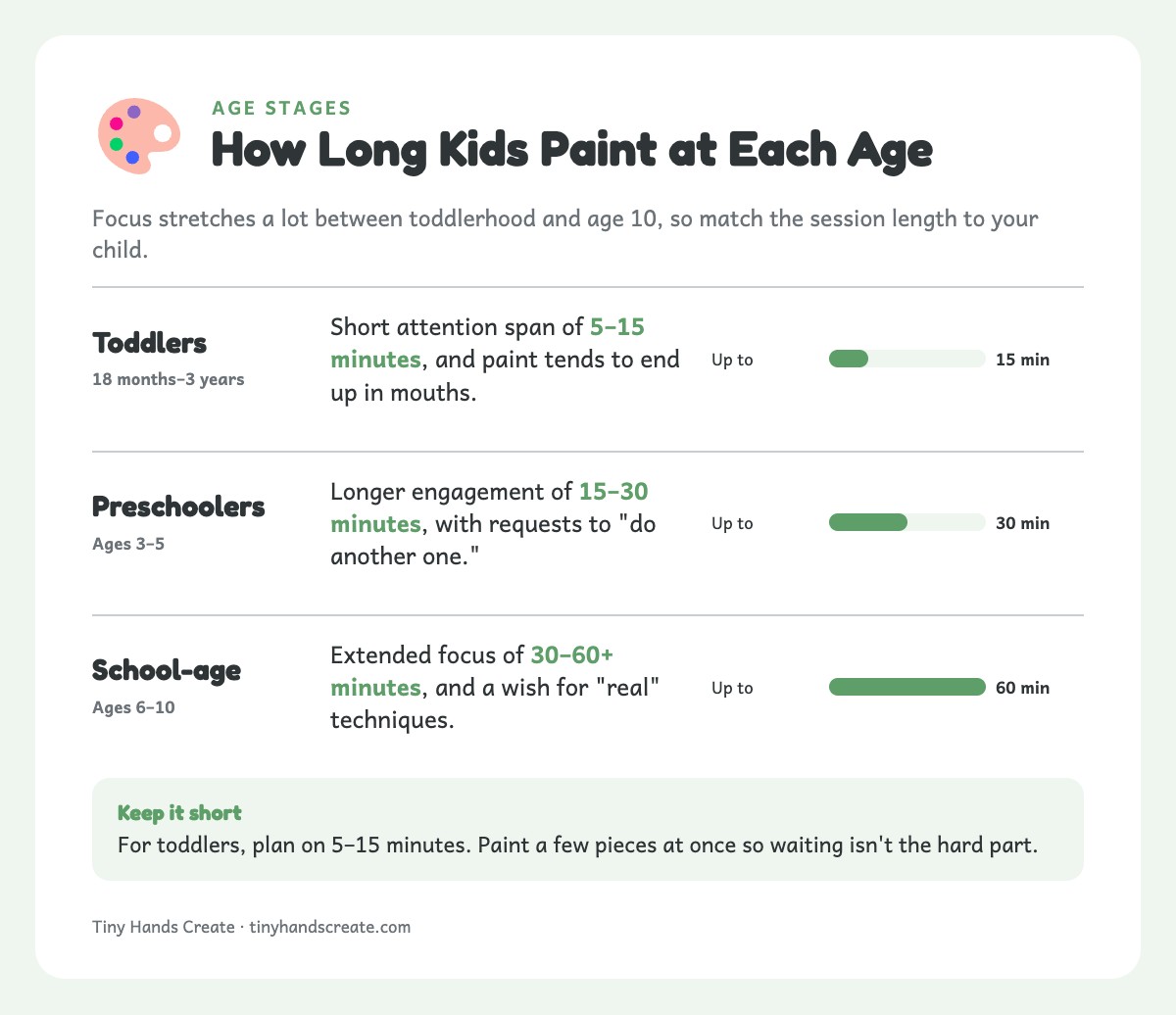
Not every technique works at every age. Here’s what I’ve found actually succeeds, and the quick comparison below shows the options side by side.
| Technique | Best age | Water level | Mess | What you need |
|---|---|---|---|---|
| Big washes | 18 months+ | High | Medium | Fat brush, big paper |
| Wet-on-wet | 18 months+ | High | Medium | Sponge or wide brush |
| Wet-on-dry | 3+ | Low | Low | Round brush |
| Crayon resist | 2+ | Medium | Low | White crayon |
| Salt texture | 4+ (adult sprinkles under 4) | High | Medium | Coarse salt |
| Plastic wrap texture | 4+ | High | Medium | Plastic wrap |
| Masking | 4+ | Medium | Low | Painter’s tape |
| Gradient wash, layering, lifting | 6+ | Medium | Low | Two brushes |
| Dry brush | 6+ | Very low | Low | Textured paper |
| Splatter | 6+ | Medium | High | Craft-only toothbrush |
Good to knowBig washes, wet-on-wet, and crayon resist are the gentlest starts for toddlers. Salt, plastic wrap, and splatter need the most adult help, so save them for older kids and stay close. Safety notes sit with the projects that need them.
Toddlers (Ages 18 Months – 3 Years)
At this age, watercolor painting is 100% about the process, not the product. Your toddler is exploring cause and effect: “I put the brush in the water. The water turns colors. I touch it to the paper. Color appears.” That’s the entire curriculum, and it’s plenty.
Techniques that work:
- Big washes of color. Give them a fat brush and let them cover the whole page. That’s the activity.
- Water-first method. Wet the entire paper with a sponge, then let them touch paint to it and watch it spread. The “wow” factor is high.
- Dot painting. Dab diluted paint with a chunky sponge dauber or the blunt end of a fat brush. Skip cotton swabs for under 3, since the heads can come off. Simple, satisfying, and good for hand-eye coordination. For circles to aim at, print our Do-a-Dot printables on cardstock.
What to expect: Short attention spans (5–15 minutes) and paint in their mouths. You’ll also see one favorite color used exclusively, brown paintings from mixing everything, and attempts to drink the rinse water. All normal.
Safety firstNon-toxic does not mean edible. Discourage tasting and supervise closely. A small taste of non-toxic paint is unlikely to cause serious harm, but call Poison Control (1-800-222-1222 in the US) if a child swallows a large amount or seems unwell.
Setup tip: If the mess factor feels like too much, check out these mess-free painting ideas for toddlers — ziplock bag painting and similar techniques can ease you both into watercolor work.
Crafty Mama tipPut the paint cups on a cookie sheet or in a shallow baking pan. When (not if) they get knocked over, the water stays on the tray instead of flooding the table.
Preschoolers (Ages 3 – 5)
This is where it gets fun. Preschoolers have enough brush control to try real techniques, and they’re old enough to follow simple multi-step instructions. They’re also endlessly curious about “what happens if I…” — which is exactly the right mindset for watercolor.
Techniques that work:
- Wet-on-dry. Paint on dry paper for more controlled lines and shapes. They can “draw” with their brush — flowers, houses, suns, people.
- Wet-on-wet. Wet the paper first, then add color. The bleeding and blending produces gorgeous effects and teaches kids about how water behaves.
- Color mixing. Give them only red, yellow, and blue and challenge them to make as many colors as possible. This never gets old. Our color mixing experiments have more ideas.
- Crayon resist. Draw with a white crayon on white paper (invisible drawing!), then paint over it with watercolor. The crayon resists the paint and the drawing appears.
- Salt texture (4+). Paint a wet wash, then sprinkle coarse salt on top. As it dries, the salt absorbs pigment and leaves starburst patterns.
- Masking (4+). Press painter’s tape into shapes or patterns before painting. Peel it off once dry to reveal crisp white shapes.
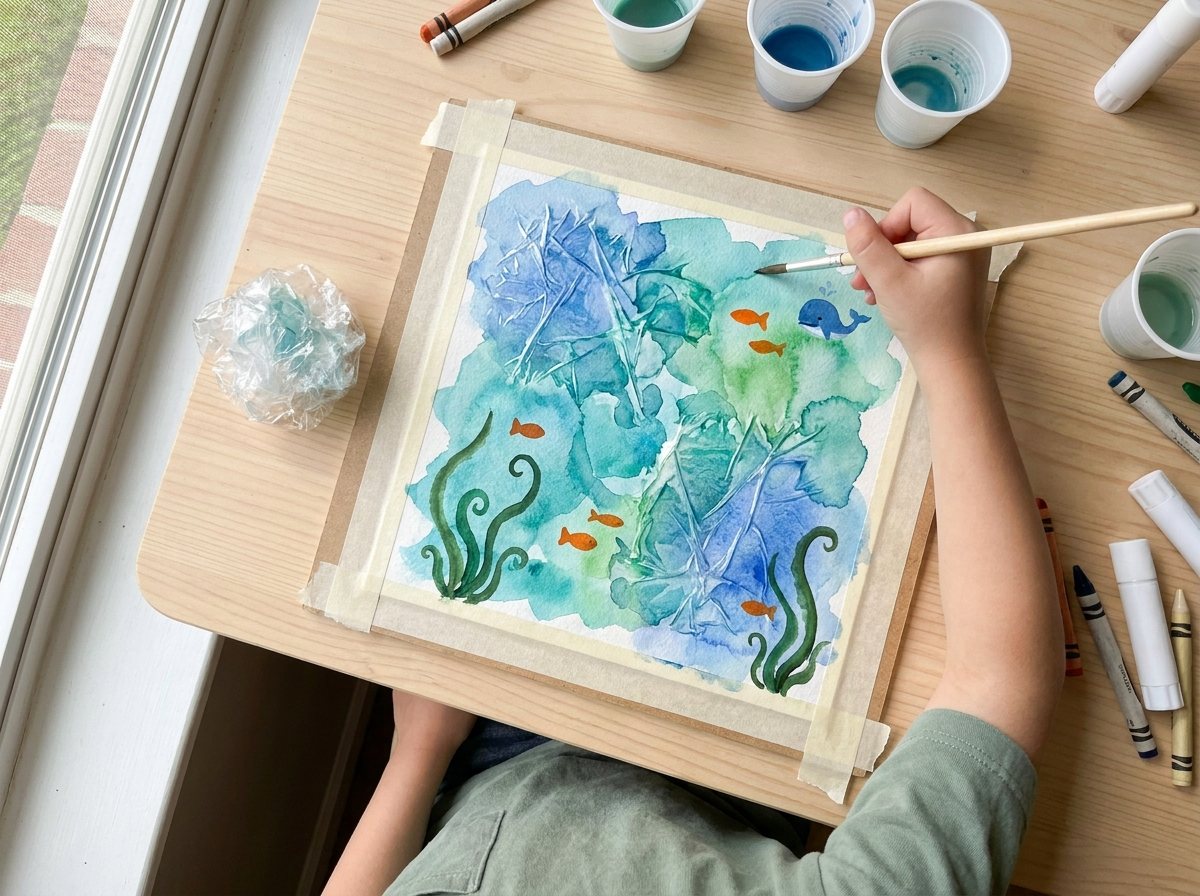
- Plastic wrap texture (4+). Lay crumpled plastic wrap on a wet wash and let it dry completely. Peel it away to reveal a rippled texture.
What to expect: Longer engagement (15–30 minutes), strong opinions about colors, requests to “do another one,” and occasionally, real recognizable images emerging from the paint.
School-Age Kids (Ages 6 – 10)
School-age kids can learn real watercolor techniques and make work they’re proud of. This is the age when art can go from “fun activity” to lifelong hobby. Treat them like real artists: teach them the vocabulary, show them the techniques, and let them make their own choices.
Techniques that work:
- Gradient washes. Load the brush with one color, paint a stripe, add water, paint another stripe slightly overlapping. Repeat until the color fades to white. This is a foundational skill that looks impressive.
- Layering/glazing. Paint a wash, let it dry completely, then paint another color on top. The first color shows through, creating depth. This teaches patience — you genuinely have to wait.
- Lifting. Use a clean, damp brush to lift color off the paper. It works best while the paint is damp, and re-wetting a dry area can lift some color too. Great for clouds, highlights, or fixing mistakes.
- Dry brush. Load a brush with pigment but very little water, then drag it across textured paper. Creates a scratchy, organic texture perfect for grass, fur, or tree bark.
- Splatter. Load a dedicated craft toothbrush with diluted paint and hold it close to the paper, angled down and away from faces. Run your thumb across the bristles for an instant galaxy or snow effect.
What to expect: Extended focus (30–60+ minutes), desire for “real” techniques, frustration when results don’t match their vision (good opportunity to talk about process), and paintings you genuinely want to display.
15 Easy Watercolor Painting Ideas for Kids
Here are 15 projects organized by age. Adults help at the younger end of each tier, and times vary by child.
| # | Project | Age | Time | Supervision |
|---|---|---|---|---|
| 1 | Rainbow Wash Bookmarks | 18 mo+ | 10–15 min | Close |
| 2 | Coffee Filter Butterflies | 18 mo+ (adult clips; pipe cleaner antennae for 3+ only) | 15–20 min | Close |
| 3 | Crayon Resist Night Sky | 2+ | 15–20 min | Close |
| 4 | Blow Painting Trees | 4+ | 15 min | Close |
| 5 | Salt and Watercolor Galaxy | 4+ (adult splatters for ages 4–5) | 20–30 min | Yes |
| 6 | Tape Resist Abstract Art | 4+ | 20 min | Some |
| 7 | Wet-on-Wet Sunset Landscape | 4+ | 20–25 min | Some |
| 8 | Nature Journal Page | 4+ | 25–30 min | Yes |
| 9 | Plastic Wrap Texture Ocean | 4+ | 20 min + drying | Yes |
| 10 | Watercolor Greeting Cards | 4+ | 15–25 min | Some |
| 11 | Layered Landscape | 6+ | 30–45 min | Light |
| 12 | Galaxy with Silhouette | 6+ | 30–40 min | Light |
| 13 | Monochrome Value Study | 6+ | 25–30 min | Light |
| 14 | Watercolor and Ink Nature Illustration | 6+ | 30–45 min | Light |
| 15 | Collaborative Family Mural | 4+ (with family) | 45–60 min | Some |
Beginner Watercolor Projects for Toddlers (18 Months–3)
Safety firstUnder-3s need an adult within arm’s reach the whole time:
- Use only AP-labeled non-toxic paints, and skip cotton swabs.
- Follow the bottle label to dilute liquid watercolors. Pour them into shallow cups and let the adult hold the dropper.
- Adults handle the hole punch, clothespins (pinch risk), salt, and stickers.
- No ribbon or yarn tassels and no pipe cleaners under age 3.
- Save straw blowing for age 4 and up.
- Spray bottles are for ages 4 and up, in a ventilated space, aimed away from faces.
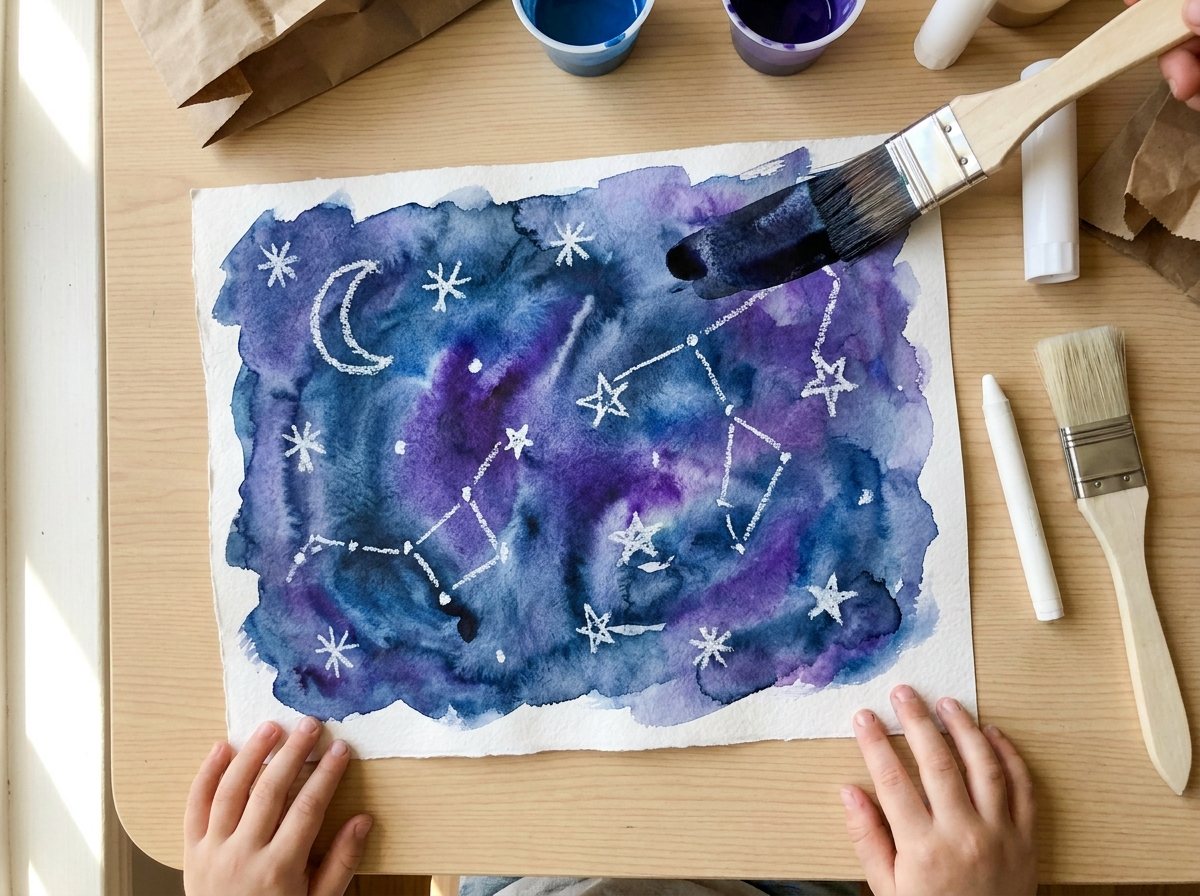
1. Rainbow Wash Bookmarks
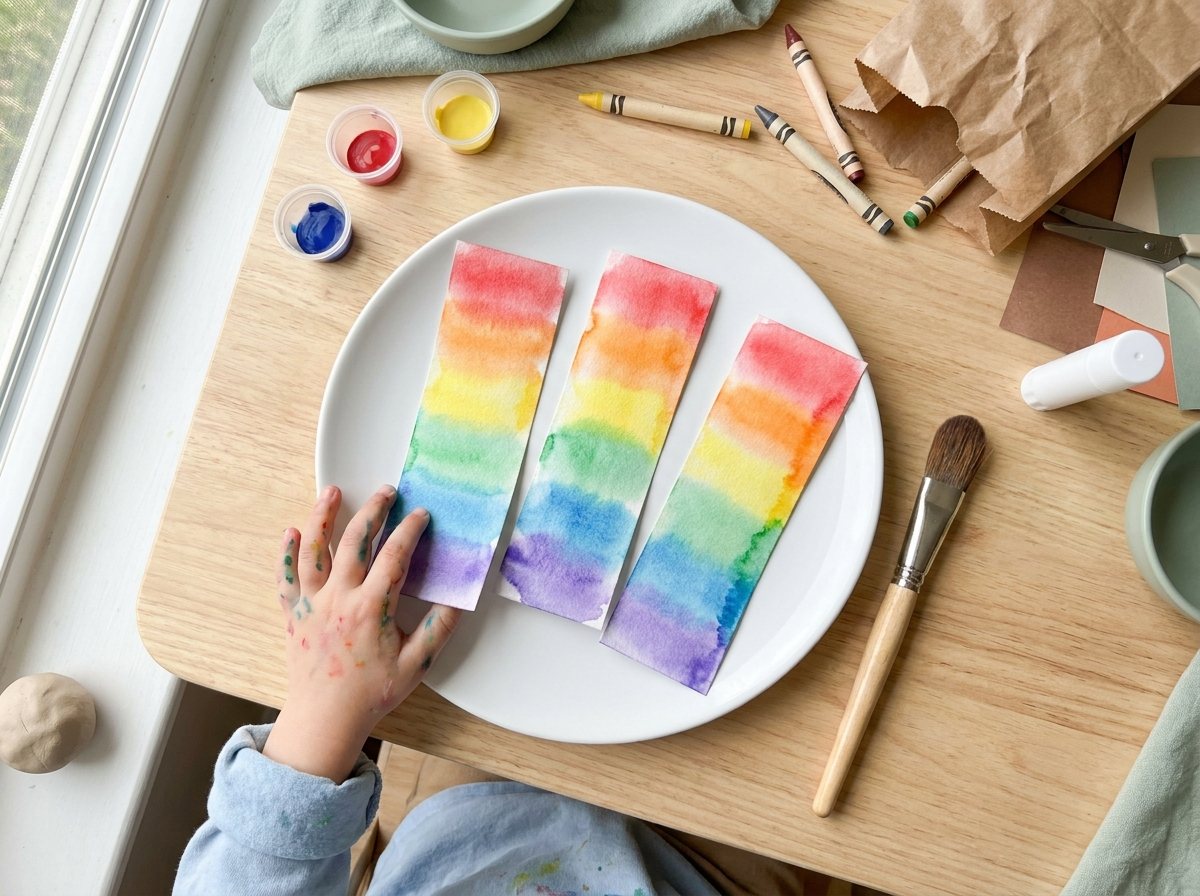
Materials: Watercolor paper cut into bookmark strips (about 2″ x 7″), watercolor paints, wide brush, water. Optional for ages 3 and up: a ribbon or yarn tassel no longer than 2 inches (adult attaches).
- Wet the strip. Brush clean water over the whole bookmark strip with a wide brush.
- Start with red. Paint a stripe of red across the top.
- Work down the rainbow. Add orange, yellow, green, blue, and purple below it. Let each color touch the last so they bleed together.
- Let it dry. Leave the strip flat until it’s completely dry.
- Finish it (adult step). For under-3s, skip the tassel and leave the bookmark plain, or punch a hole with no ribbon. For ages 3 and up, an adult can tie on a tassel no longer than 2 inches.
Why kids love it: Instant gratification. The wet-on-wet bleeding looks beautiful no matter what. And they made something useful — every kid wants to use a bookmark they painted themselves.
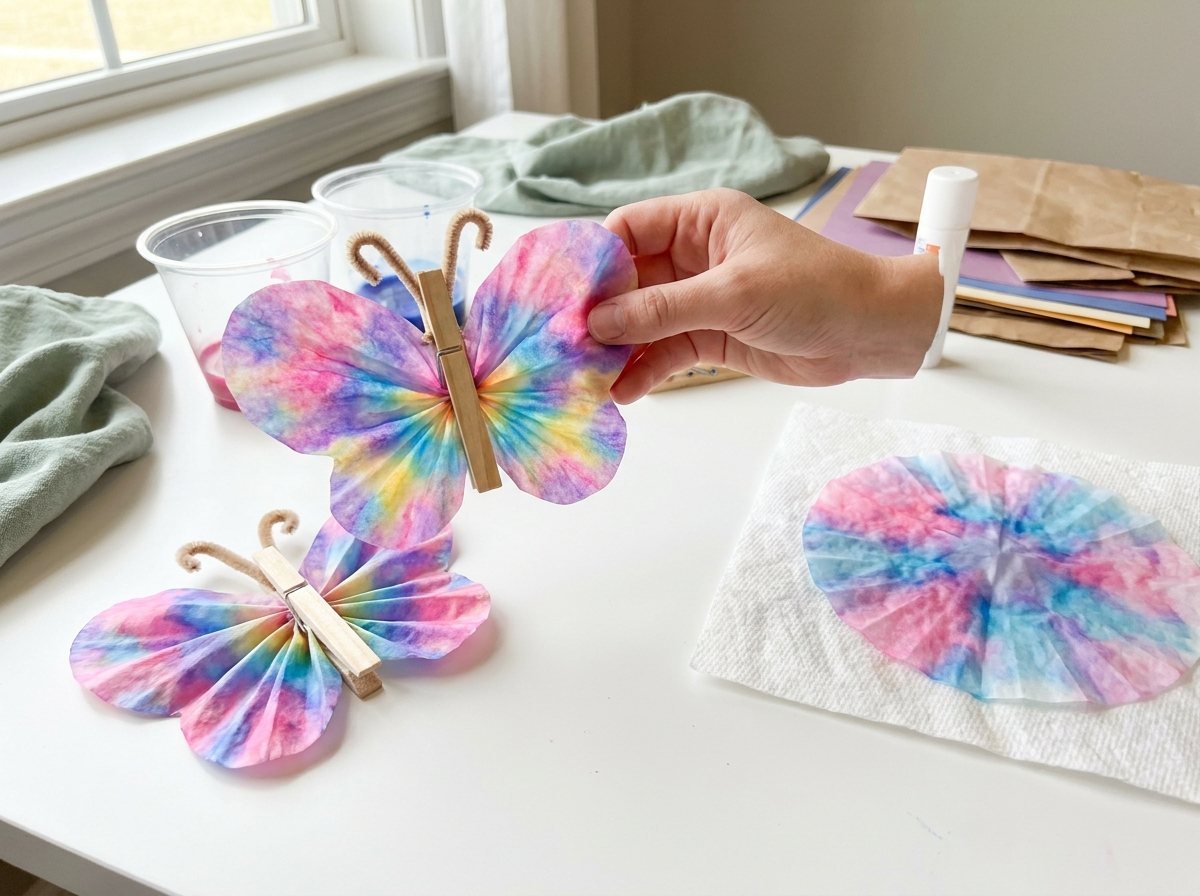
2. Coffee Filter Butterflies
Materials: Basket-style coffee filters, AP-labeled liquid watercolors (diluted per the bottle label), large dropper or loaded brush (adult holds the dropper for under-3s), clothespin, pipe cleaner (ages 3 and up only). Optional for ages 4 and up: a spray bottle.
- Flatten a filter. Lay a coffee filter flat on a protected surface.
- Add color. Drop or brush liquid watercolor onto the filter and watch it spread through the absorbent paper. Kids 4 and up can mist it with a spray bottle instead, aimed down at the filter and away from faces.
- Layer more colors. Add two or three more colors and let them merge.
- Let it dry. Wait until the filter is completely dry. Waiting is the hard part for toddlers, so paint a few at once.
- Clip the body (adult step). The adult pinches the center of the dry filter and clips it with a clothespin, keeping the butterfly in hand for under-3s.
- Add antennae (ages 3+ only). Wrap a pipe cleaner around the top of the clothespin, then bend and tuck the wire ends. For under-3s, skip the pipe cleaner or use a paper strip.
Why kids love it: The color spreading is mesmerizing, and the final butterfly looks impressive. If your kids enjoyed this, they’ll love these more coffee filter craft ideas for kids we’ve done.
3. Crayon Resist Night Sky
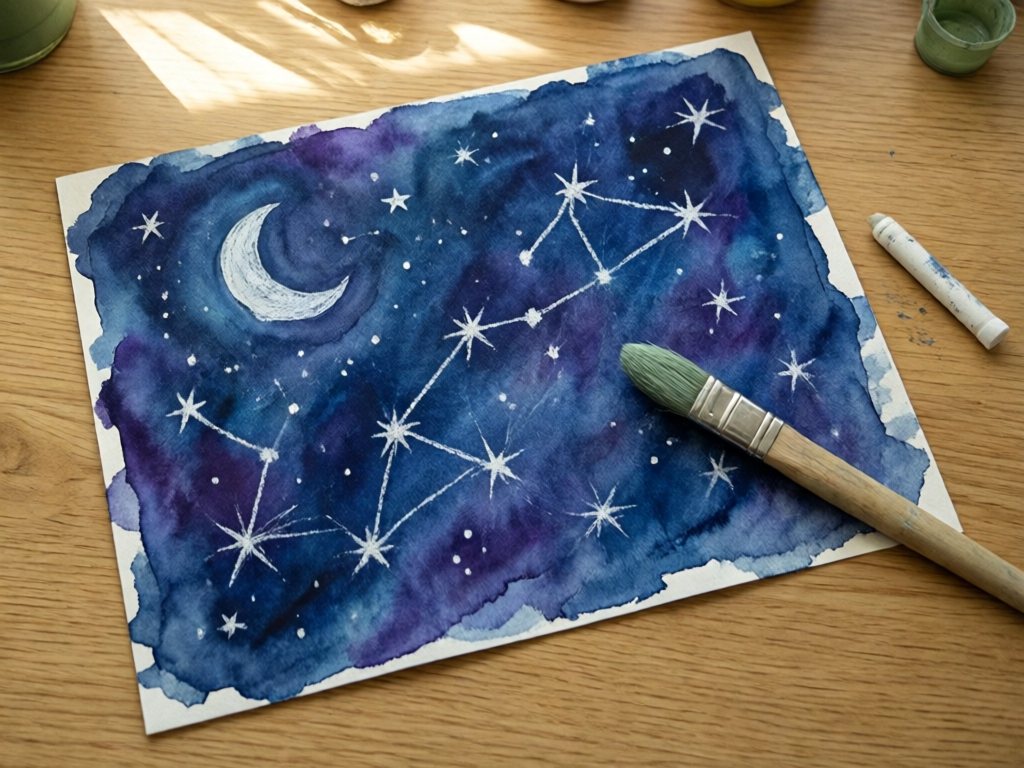
Materials: White watercolor paper, white crayon, watercolor paints (dark blue, purple, black), big brush, optional coarse salt and star stickers.
- Draw in white. Use a white crayon on white paper to draw stars, a moon, or constellations. Anything you want to “hide” works.
- Press hard. Light marks won’t resist the paint, so adults can help toddlers press firmly.
- Paint over it. Cover the whole page with dark blue and purple washes.
- Watch the reveal. The crayon drawing appears as the paint rolls off the wax.
- Add salt (optional). While the paint is still wet, sprinkle a tiny pinch of salt for a starry texture. For kids under 4, an adult does the sprinkling.
- Add stickers (optional). Once it’s dry, add star stickers. For under-3s, skip them or have an adult place them.
Why kids love it: The reveal is thrilling every single time. It feels like a magic trick. Toddlers love it because they get to paint over the whole page (their favorite thing). Older kids love it because they can plan elaborate hidden drawings.
Intermediate Watercolor Projects for Preschoolers (Ages 4–5)
4. Blow Painting Trees
Safety firstPractice blowing with plain water first. Use a short straw and stay within arm’s reach. Blow out only, never suck in. Never let a child walk or run with a straw in the mouth. If blowing out only is hard for your child, tilt the paper to move the paint instead.
Materials: Watercolor paper, brown and green liquid watercolors (diluted following the bottle label), short straw, thin brush.
- Drop the paint. Put a blob of brown paint near the bottom center of the paper.
- Blow the trunk. Blow through the straw to push the paint upward and outward into a trunk and branches.
- Grow the branches. Keep blowing in different directions to stretch the branches.
- Add leaves. Once you like the tree shape, dab green paint along the branch ends with a brush or fingertip.
- Add blossoms (optional). For a spring tree, add tiny dots of pink and white.
Why kids love it: Blowing through a straw is hilarious to children, and the tree shapes look surprisingly realistic. It’s one of our favorite ways to paint without brushes.
5. Salt and Watercolor Galaxy
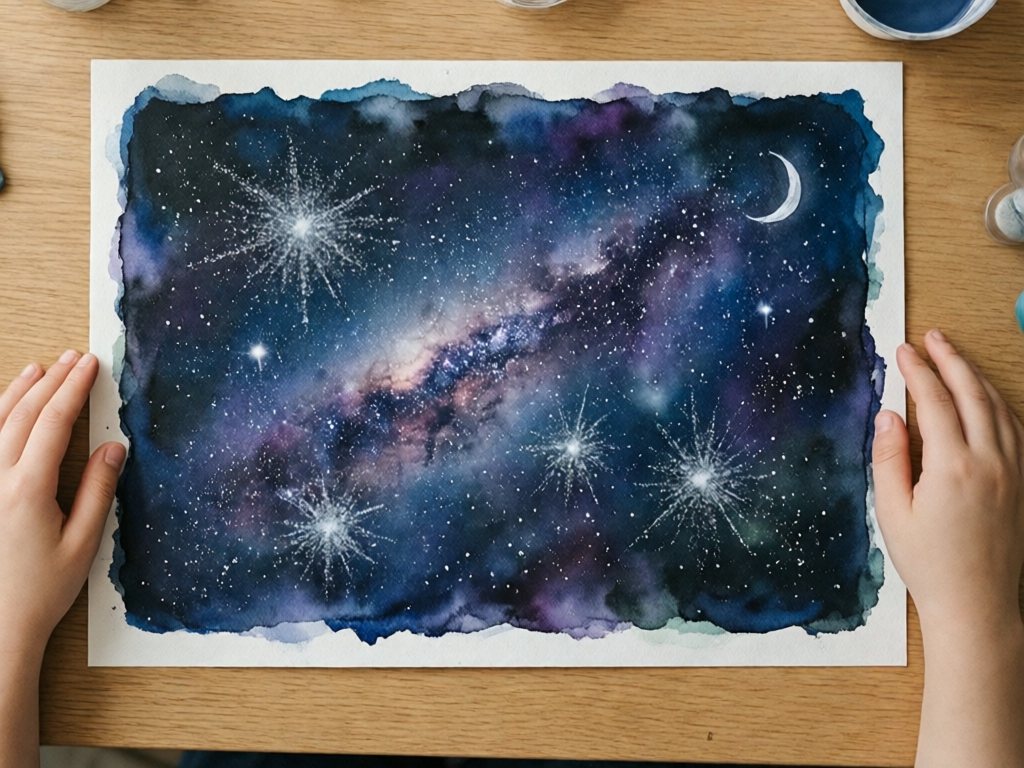
Materials: Watercolor paper, watercolor paints (dark blue, purple, black), coarse salt (kosher or sea salt), AP-labeled white paint, craft-only toothbrush, big brush, spray bottle, white gel pen (optional; adult handles it for ages 4–5).
- Wet the paper. Wet the whole sheet with a spray bottle or wide brush.
- Sweep in blue. Paint dark blue in sweeping strokes, leaving some areas lighter.
- Add purple and black. Drop in patches of deep purple and black. Don’t aim for even; galaxies aren’t even.
- Sprinkle the salt. While the paint is still very wet, sprinkle about 1 tablespoon of coarse salt across the surface.
- Wait. The salt takes 10–20 minutes to soak up pigment. Then let the painting dry completely without touching or moving it.
- Brush off the salt. Once it’s dry, gently brush the salt away with your hand.
- Splatter the stars. Dip the toothbrush in white paint, hold it close to the paper, and flick the bristles with your thumb. For ages 4–5, an adult does the flicking.
- Add a moon (optional). Draw bigger stars or a crescent moon with the white gel pen.
Why kids love it: The salt effect looks genuinely cosmic. Every single one turns out different, and they all look spectacular. This is a project where kids say “wait, I made that?”
Safety firstSupervise the salt and keep it away from eyes and mouths. Use a toothbrush that is only for crafts, and flick splatter away from faces.
If it goes wrong: If the salt leaves no texture, the paint was too dry. Add more water and try again.
6. Tape Resist Abstract Art
Materials: Watercolor paper, painter’s tape or washi tape, watercolor paints, brush, water.
- Tape a design. Stick tape strips across the paper in any pattern: straight lines, shapes, random angles, or the letters of their name.
- Seal the edges. Press the tape edges down firmly so paint can’t seep under.
- Paint everything. Cover the whole surface, using different colors in different sections and letting them blend where they meet.
- Let it dry. Wait until the paper is dry to the touch, but don’t leave the tape on for days. Pulling tape off wet paper tears it.
- Peel the tape. Slowly peel the tape away to reveal crisp white lines against the color.
Why kids love it: The peel-off reveal is deeply satisfying.
If it goes wrong: If the tape tears the paper, it came off while wet or the paper is thin. Peel once the paper is dry to the touch, pull slowly at a low angle, and use low-tack painter’s tape on 140lb paper.
7. Wet-on-Wet Sunset Landscape
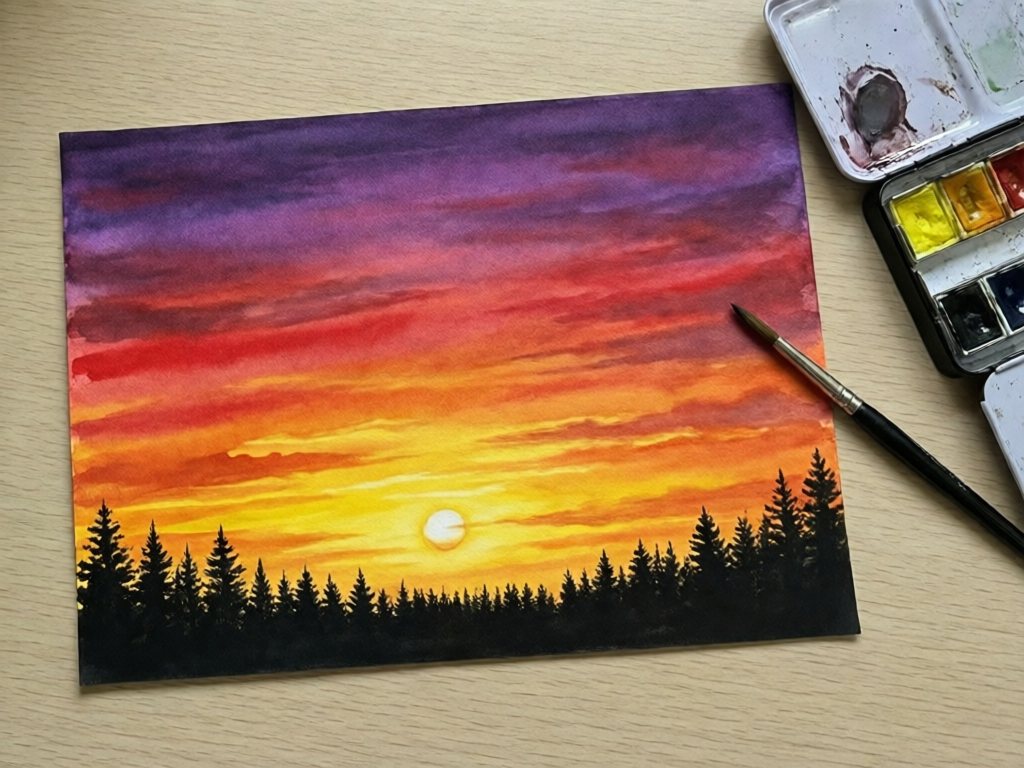
Materials: Watercolor paper, watercolor paints (yellow, orange, red, purple or dark blue, black), wide brush, thin brush.
- Wet the sky. Brush clean water over the top two-thirds of the paper.
- Paint the top band. Start at the top with a band of purple or dark blue.
- Add red. Paint red below it and let it bleed into the purple.
- Add orange. Paint orange below the red and let the two blend.
- Finish with yellow. Paint yellow at the horizon line, the lightest color at the bottom of the sky.
- Add a sun (optional). While the sky is still wet, dab a circle of yellow or orange near the horizon.
- Let it half-dry. Wait until the sky is at least halfway dry.
- Paint the silhouette. With black paint and a thin brush, paint a simple shape along the bottom: a tree line, a city skyline, rolling hills, or just grass.
Why kids love it: Sunsets are universally beautiful, and the wet-on-wet technique makes even a first attempt look gorgeous. The silhouette at the end gives them a “real painting” feeling.
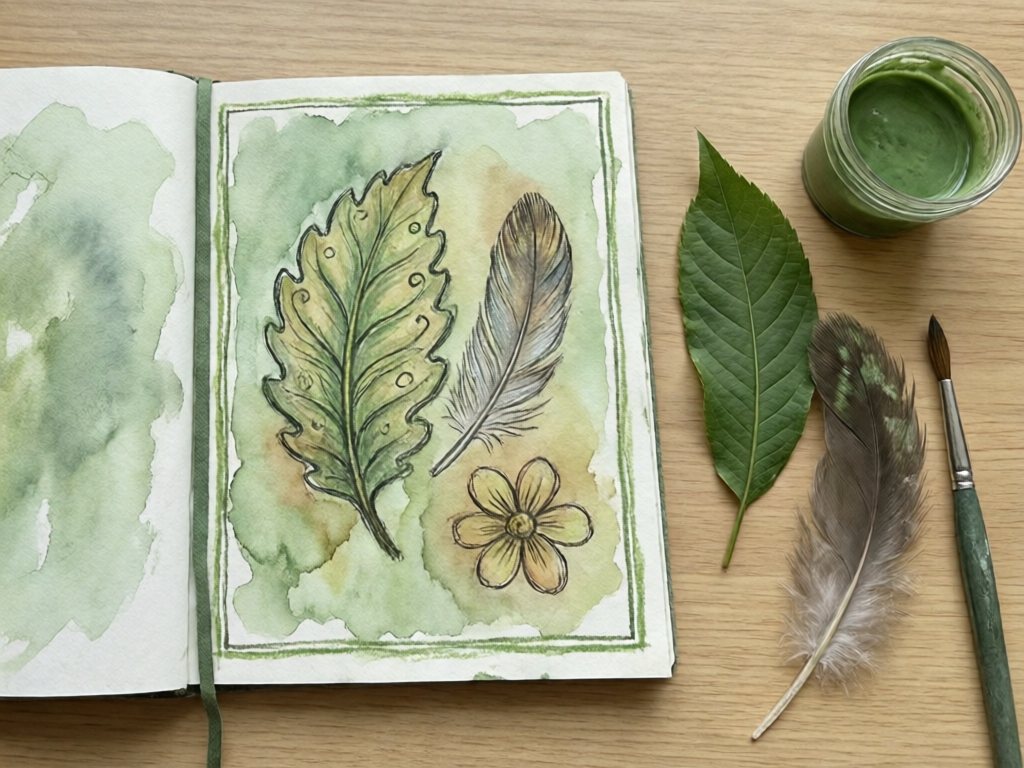
8. Nature Journal Page
Safety firstAn adult checks every collected item. Skip berries, mushrooms, and unknown plants, and wash hands afterward.
Materials: Watercolor paper, crayons, watercolor paints, brush, water, collected nature items for reference (optional).
- Collect. Go outside for 10 minutes and gather a few natural items, like a leaf, flower, feather, or interesting stick. Or just sit outside and observe. This is a great add-on to any outdoor nature activity.
- Draw in crayon. Back inside, draw the items on watercolor paper, pressing firmly for a good wax resist.
- Add notes. Add labels, the date, observations (“this leaf was curly at the edges”), or a decorative border.
- Paint over it. Brush watercolor washes over the whole page. Greens and earth tones work beautifully, and the crayon drawings pop through the paint.
- File it. Let it dry and add it to a growing nature journal.
Why kids love it: A “real journal” makes them feel like scientists and artists at once.
9. Plastic Wrap Texture Ocean
Materials: Watercolor paper, watercolor paints (blues, greens, teals), plastic wrap, wide brush, thin brush.
- Paint the water. Cover the paper with overlapping washes of blue, teal, and green. Vary the strength and let the colors mingle.
- Tear the wrap. While the paint is still wet, tear a piece of plastic wrap slightly larger than the paper.
- Scrunch it on. Crumple the wrap loosely, lay it on the wet paint, and push the wrinkles into the surface.
- Leave it alone. Let it dry completely with the wrap in place, at least 1–2 hours or overnight.
- Peel and reveal. Peel the wrap away to find the wave texture underneath.
- Add sea creatures. Use a thin brush to paint fish, seaweed, a whale, or jellyfish.
Why kids love it: Peeling off the wrap to find rippled water is the best part.
Safety firstKeep plastic wrap away from faces and out of reach of babies and toddlers while it dries, and bin the scraps right away.
10. Watercolor Greeting Cards
Materials: A 5″ x 7″ sheet of watercolor paper, watercolor paints, brushes, thin markers.
- Fold the card. Fold the watercolor paper in half.
- Paint the front. Paint any design: abstract washes, a flower, a heart, a rainbow, or an animal. Younger kids can do a free-form color wash, which still looks amazing. Older kids can combine techniques, like a wet-on-wet background with dry-brush details on top.
- Let it dry. Wait until the paint is completely dry before writing.
- Write the message. Use markers to add “Happy Birthday,” “Thank You,” or “Sorry I broke your toy” on the front, then write a note inside.
Why kids love it: They made something for someone else. The pride of handing over a handmade card is enormous, especially when the recipient’s reaction is genuine because watercolors actually look beautiful.
Advanced Watercolor Projects for Kids 6+
These projects suit ages 6 and up. The family mural (project 15) works for everyone 4 and older.
11. Layered Landscape
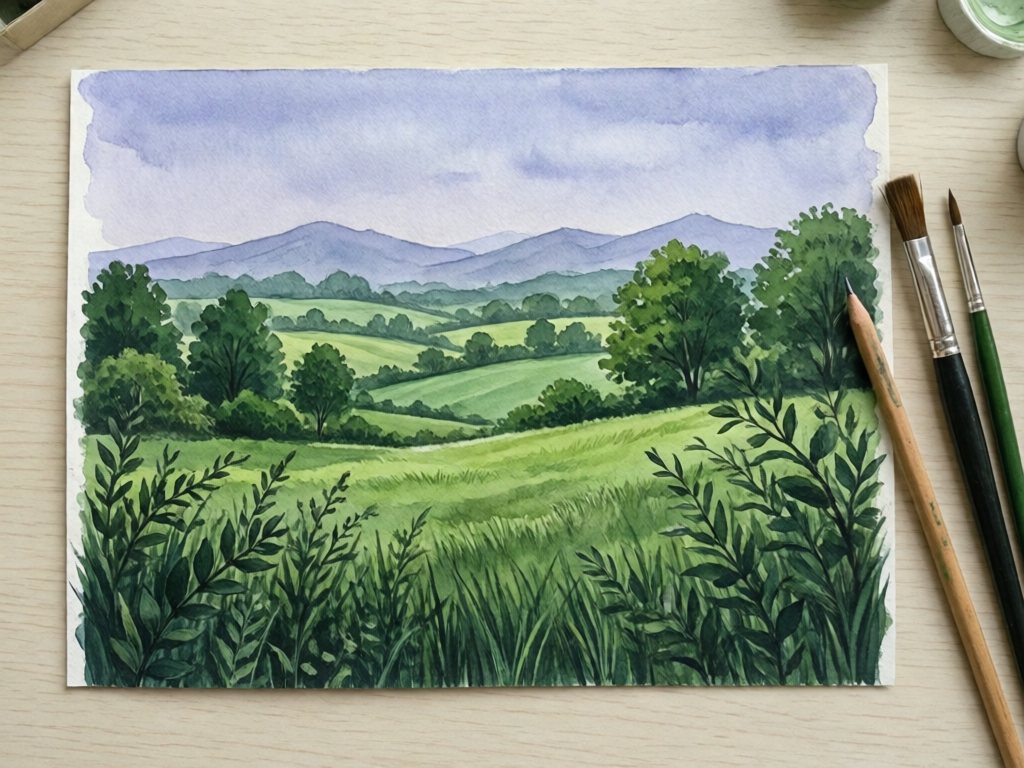
Materials: Watercolor paper, watercolor paints, multiple brush sizes, pencil.
- Sketch three zones. Lightly pencil in a background (sky and distant hills), a middle ground (fields, trees, buildings), and a foreground (close-up details).
- Paint the background. Start with sky washes and pale blue-purple mountains, kept light and simple.
- Let it partly dry. Wait until the background is no longer shiny-wet.
- Paint the middle ground. Use greener colors, medium values, and a little more detail.
- Let it dry. Wait until the middle ground is dry to the touch.
- Paint the foreground. Save the most detail, darkest colors, and sharpest edges for last.
Why it works: This teaches atmospheric perspective. Things far away look lighter, bluer, and less detailed.
Why kids love it: They learn a real art concept and end up with a painting that has genuine depth. It looks like something from an art class, not a kitchen table.
12. Galaxy with Silhouette
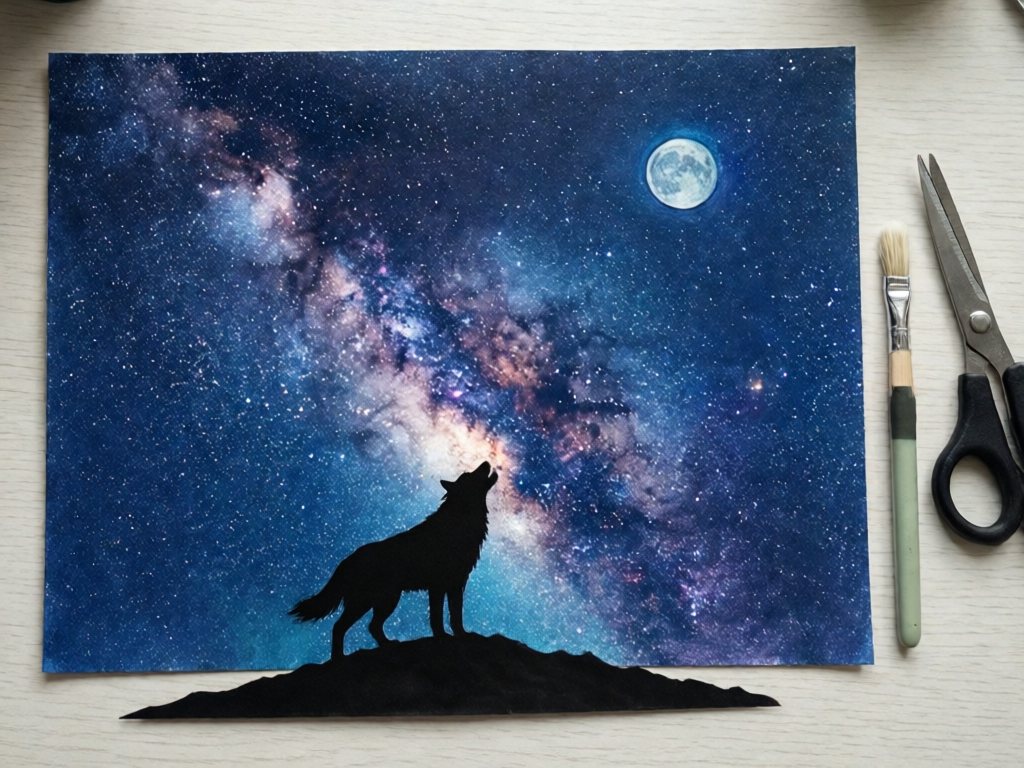
Materials: Watercolor paper, watercolor paints (blues, purples, teal, black), AP-labeled white gouache or white tempera, black construction paper or black paint, scissors, glue, craft-only toothbrush.
- Paint the galaxy. Wet the paper, then layer dark blues, purples, and touches of teal wet-on-wet. It’s the salt galaxy from project 5, minus the salt.
- Deepen the dark areas. While it’s still wet, drop in concentrated color and let it merge.
- Let it dry. Wait until the paper is completely dry.
- Splatter the stars. Flick white paint from the toothbrush, pointed down and away from faces.
- Make a silhouette. Cut a shape from black paper, or paint one on in black: a person with a telescope, a wolf howling on a hill, a child on a swing, or a jar of fireflies. Kids still building scissor skills can warm up with our cutting practice sheets.
- Glue it down. Glue a paper silhouette onto the galaxy.
- Finish the sky (optional). Add small white dots or a painted moon.
Why kids love it: The combination of the swirly galaxy background and the crisp black silhouette creates an incredibly dramatic finished piece. This is “frame it for the bedroom” quality.
13. Monochrome Value Study
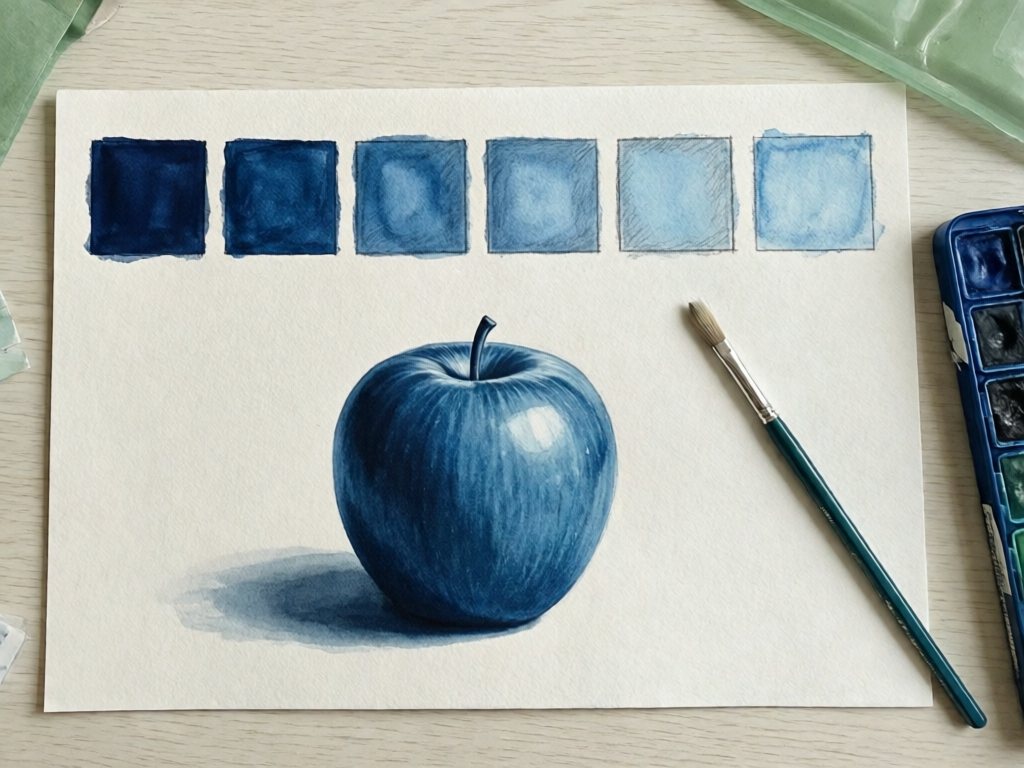
Materials: Watercolor paper, ONE color of watercolor paint (blue works great), brush, water, pencil.
- Draw the boxes. Pencil 5–7 squares or rectangles in a row.
- Paint full strength. Fill the first square with the color as dark as the pigment will go.
- Step lighter. In each next square, add a little more water, until the last one is barely tinted.
- Paint an object. Below the scale, paint a simple object (an apple, a mug, a ball) in the same color. Use dark for shadows, medium for the body, and light for highlights.
Why kids love it: It shows how much work one color can do.
14. Watercolor and Ink Nature Illustration
Materials: Watercolor paper, watercolor paints, pencil, thin black waterproof marker or fine-tip pen (like a Micron). Keep ink pens for ages 6+ or supervised use.
- Sketch. Lightly pencil a natural subject: a flower, bird, insect, tree, or mushroom.
- Ink the lines. Trace over the pencil with the black pen. Waterproof ink won’t bleed when you paint.
- Let the ink dry. Give it a few minutes.
- Add color. Fill the drawing with loose watercolor washes, letting colors drift slightly outside the lines.
Why kids love it: Crisp ink lines plus loose color look like a real nature guide.
15. Collaborative Family Mural
Materials: Large watercolor paper (tape several sheets together or use a roll), painter’s tape, watercolor paints, a brush and water cup for each painter.
- Tape down the paper. Tape the sheet to the table, the floor, or a wall you’ve covered with a plastic drop cloth.
- Pick a theme. Choose one together, like “underwater world,” “our neighborhood,” “magical forest,” or “outer space.”
- Find your spot. Give each painter a loose zone to start in, or skip zones and just start painting.
- Match jobs to ages. Younger kids paint washes and big shapes, older kids add details, and adults paint too or run the water cups.
- Blend the borders. Where sections meet, let the colors run together. No one “owns” any part of the mural.
- Dry and display. Let it dry, then hang it where everyone will see it.
Why kids love it: The mural captures a moment: how old everyone was, what they were into, which colors they chose. It’s the kind of thing you photograph and save.
Watercolor Setup and Cleanup Tips for Kids
Watercolor is less catastrophic than tempera or finger paint, but “less catastrophic” still means you need a plan. Here’s what works.
Before You Start
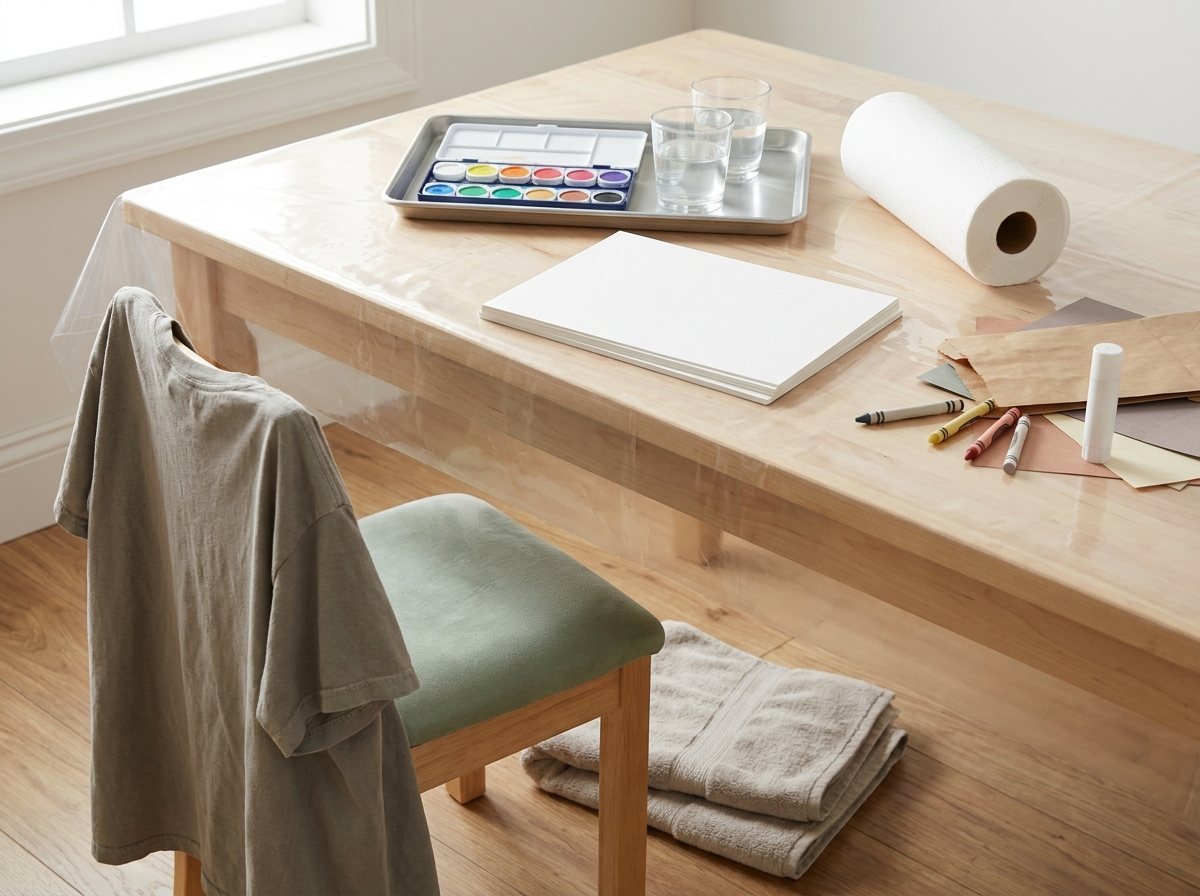
| Task | Why | Time |
|---|---|---|
| Cover the table with a plastic tablecloth or cut-open garbage bag | Paint + water WILL get on the table | 1 minute |
| Put a towel on the floor under the chair | Drips happen, especially with younger kids | 30 seconds |
| Fill two water cups (one for rinsing, one for clean water) | Dirty water = muddy colors. Two cups solves this. | 30 seconds |
| Have a rag or paper towels within arm’s reach | For blotting brushes, wiping spills, dabbing away excess water | 30 seconds |
| Dress kids in old clothes or a smock (an old adult t-shirt works great) | Watercolor does stain some fabrics, especially liquid watercolors | 1 minute |
| Pre-cut paper to size | Avoids the “can you cut this for me” interruption mid-painting | 2 minutes |
Total setup time: about 5 minutes. Setup is the part parents dread most, and it takes five minutes. Future you will be grateful.
- Cover the table
- Towel under the chair
- Two water cups
- Rag or paper towels
- Smock or old shirt
- Pre-cut paper
- Cookie sheet or tray under the cups
During Painting
- Refresh the rinse water if it turns opaque. Muddy rinse water = muddy paintings = frustrated kids.
- Keep the paint set on a separate plate or tray — not directly on the tablecloth, where it’ll slide around.
- Have extra paper ready. Kids who are enjoying themselves will want to do multiple paintings. Don’t break the flow by having to hunt for more paper.
- Resist the urge to direct. This is a big one. If your child is painting the sky green and the grass purple, that’s their painting. The surest way to kill a kid’s enthusiasm for art is to correct their creative choices. If you’re looking for more on this philosophy, our guide to process art for toddlers goes deep on why the process matters more than the product.
After Painting
- Lay paintings flat to dry on a drying rack, newspaper, or the counter. Don’t stack them — they’ll stick together.
- Rinse brushes in clean water and reshape the tips. Store upright (bristle-end up) in a cup to dry. This is the single biggest thing you can do to extend brush life.
- Let the paint set dry open for a few minutes so the cakes aren’t sopping when you close the lid.
- Wipe the table covering — don’t throw it away. A reusable plastic tablecloth lasts months.
- Have kids wash hands with soap and warm water. Liquid watercolors especially can temporarily stain fingers — this is normal and fades within a day.
Crafty Mama tipSet up a dedicated “art station,” even if it’s just one end of the kitchen table with the plastic cloth pre-spread. Setup stops feeling like a chore, and you start saying “hey, want to paint?”
Still feeling overwhelmed by the mess? Start with some mess-free art activities and gradually introduce watercolors as your comfort level (and your child’s focus) increases.
Watercolor Problems and Fixes
Every young painter hits these. Here’s what usually causes each one and the quickest fix.
| Problem | Likely cause | Quick fix |
|---|---|---|
| Paper wrinkles and buckles | Paper too thin for the water | Use at least 90lb mixed media paper, ideally 140lb watercolor paper. Tape all four edges to a board before painting. |
| Colors turn brown or gray | Dirty brush or too many colors | Rinse in the dirty cup, then dip in the clean cup. Offer only 3–4 colors. |
| Paint looks pale and washed out | Too much water, not enough pigment | Scrub the brush gently on the cake to load it, and use less water. Liquid watercolors stay vivid. |
| Salt leaves no texture | Paint was too dry | Sprinkle while the wash is still very wet. Add more water and try again. |
| Tape tears the paper | Tape came off while wet, or the paper is thin | Peel once the paper is dry to the touch, pull slowly at a low angle, and use low-tack painter’s tape on 140lb paper. |
| Paint pools and puddles | Too much water on the brush | Blot the puddle with the corner of a paper towel. |
| Paper tears when lifting color | Paper too thin, or scrubbed while wet | Blot gently with a damp brush and switch to 140lb paper. |
| Toddler tastes paint or drinks rinse water | Normal toddler curiosity | Follow the bottle label to dilute liquid watercolors, keep cups out of reach, and hand over a preloaded brush. See the toddler safety box above. |
When the Painting Doesn’t Match What They Pictured
This is the most important frustration to handle well. Watercolor is unpredictable, and even professional artists are surprised by their results. Tell your child that.
Then swap “it should look like X” for open questions. Ask what they notice happening. Ask what they like about what they made.
Praise specific choices rather than accuracy. Try “I love how you let those two colors blend together.”
How Watercolor Painting Builds Developmental Skills
Fine motor control. Holding a brush, controlling pressure, dipping into cups, and opening paint sets all work the small muscles in the hands. Every brush stroke is practice.
Color sense. Kids learn by doing that red and yellow make orange and that water lightens a color. Repeated small experiments show them which colors pop side by side and which fade back.
Patience. Watercolor makes you wait: for layers to dry, for tape and plastic wrap to come off, and for the right moment to add salt. Learning that the wait pays off is valuable.
Emotional expression. Art gives children a nonverbal way to express feelings they can’t name yet. Many find slow, rhythmic brushwork calming, and choosing their own colors can give them a sense of control. If painting settles your child, pair it with our calm-down activities.
Scientific thinking. Watercolor is full of science: water carrying pigment, colors blending, salt soaking up paint, and capillary action pulling color through a coffee filter. A child asking “what if I add more water?” is forming a hypothesis and testing it.
Planning and vocabulary. Choosing a subject, gathering materials, and judging when a layer is dry enough may give planning skills a workout. Kids also pick up real art words like wash, gradient, resist, pigment, and value.
Seasonal Watercolor Ideas for Kids
Tie painting to whatever’s happening outside your window. Here’s a year of ideas.
Spring (March – May)
- Cherry blossom branches: brown ink branches with pink watercolor dabs.
- Rain puddle reflections in wet-on-wet blue-gray washes.
- Flower gardens, great for color mixing practice.
- A butterfly life cycle illustration.
- Rainbow washes after a spring rainstorm.
- Easter egg resist: draw patterns in white crayon, then wash over them with color.
Summer (June – August)
- Sunset or sunrise scenes for warm gradient practice.
- Ocean waves with plastic wrap texture.
- Popsicles and ice cream, bright and fun subjects.
- An outdoor painting session: bring supplies to the park.
- Fireworks: splatter white and bright colors onto paper pre-painted navy.
Fall (September – November)
- Leaf prints: paint a real leaf and press it onto paper. Our fall leaf crafts have more ideas.
- Warm-toned trees in wet-on-wet autumn colors.
- Halloween silhouettes: a galaxy background with black paper cutouts.
- Pumpkin studies for teaching value and shading.
Winter (December – February)
- Snowflake salt paintings: blue washes plus salt make crystal-like patterns.
- Cold-palette studies in only blues, purples, whites, and silvers.
- Holiday cards with painted fronts and handwritten messages inside.
- Arctic animals: polar bears, penguins, and snowy owls.
Crafty Mama
Crafty Mama is a former elementary art teacher turned stay-at-home parent who believes every child is creative — they just need the right invitation. She develops age-appropriate activities, crafts, and projects that spark imagination while keeping mess (and parent stress) to a minimum.
Frequently Asked Questions
What age can kids start watercolor painting?
Most children can begin exploring watercolors around 18 months, with full adult supervision. At this age, it’s purely sensory exploration — they’re feeling the wet brush, watching color appear on paper, and experiencing cause and effect. Use large paper, fat brushes, and non-toxic pan watercolors. Keep sessions short (5–15 minutes) and expect more mess than masterpiece. By age 3, most kids can paint with moderate independence and try simple techniques like wet-on-dry.
Are watercolor paints safe for toddlers?
Yes, as long as you use paints labeled “non-toxic” and bearing the AP (Approved Product) seal from the Art & Creative Materials Institute (ACMI). The AP seal means non-toxic when used as intended, not edible, so check each product’s label. If your toddler is in a heavy “everything goes in my mouth” phase, start with mess-free painting alternatives. Switch to open watercolors once the mouthing phase settles down.
What’s the difference between pan watercolors, tube watercolors, and liquid watercolors?
- Pan watercolors are dry cakes in a tray. Scrub a wet brush on the cake to pick up color. They’re affordable, long-lasting, and low-mess.
- Tube watercolors are richer, pricier, and messier. They suit older kids and adults.
- Liquid watercolors are concentrated, so dilute them following the label. They’re vivid and great for coffee filter butterflies, but they stain more easily.
For most families, start with a pan set and add liquid watercolors later.
How do I keep watercolor paintings from wrinkling?
- Use heavier paper. 140lb watercolor paper barely buckles, so it’s the pick for wet-on-wet projects like the sunset and galaxy. Mixed media paper handles light washes only.
- Tape the edges. Tape all four edges to a board or the table with painter’s tape before painting. You also get a clean white border.
- Flatten a dried painting. Lay it face-down on a clean towel, mist the back, cover with another towel, and press under heavy books overnight.
Can watercolors stain clothes, furniture, or skin?
Standard pan watercolors (Crayola, Prang) usually wash out of most fabrics with soap and warm water if treated promptly. Liquid watercolors are more concentrated. They can tint skin for up to a day and can leave stubborn, sometimes permanent stains on fabric, so pre-treat with stain remover before washing. For furniture, a plastic tablecloth and quick wipe-ups prevent problems. For clothes, use a smock or old shirt.
How do I display or preserve kids’ watercolor art?
Watercolors are actually among the most display-worthy kids’ art — they look genuinely beautiful. Frame favorites in inexpensive dollar-store frames (a white mat helps). Clip them to a string with mini clothespins for a rotating gallery wall. Photograph or scan them for a digital album. Or use them functionally — as gift wrap, bookmarks, card fronts, or book covers. For long-term preservation, keep paintings away from direct sunlight, which fades watercolor pigments over time.
My child says “I can’t draw” or “I’m bad at art.” What should I do?
It’s common, and it often starts in the early school years, when kids notice the gap between what they imagine and what they can make.
Three things help. First, emphasize process over product — “tell me about what you’re making” instead of “what is that?” Second, provide techniques that produce beautiful results regardless of drawing ability (wet-on-wet washes, salt textures, tape resist) so they experience success. Third, model imperfection yourself — paint alongside them, make “mistakes,” and talk about how you like the unexpected results. Never say “I can’t draw either” — say “I’m still learning too, and look what happened when I tried this.”
Start Your First Watercolor Session
You don’t need an art room, a fine art background, or a high tolerance for chaos. You need watercolor cakes, paper, water, and a willingness to let your kid explore.
Start small: one project, one afternoon. Tape some paper to the table, hand them a wet brush, and step back. Watch them discover that the pigment moves and blooms and does things they didn’t plan. Watch them lean in and try again.
If the first session ends in gray-brown water and a painting that looks like nothing recognizable, that’s exactly right. They showed up, experimented, and made something that didn’t exist before. For an easy next session, add a “paint something” card to your boredom buster jar.
Happy painting, friends.