Backyard Scavenger Hunt Ideas for Kids
Discover how backyard scavenger hunts transform your yard into an adventure, fostering observation, curiosity, and a connection to nature. You'll learn various low-prep formats and themed ideas to engage kids of all ages.
- Choose from diverse scavenger hunt formats like Checklist, Collection, Photo, or Sensory to suit any age.
- Engage kids with themed hunts, such as a Color Rainbow or ABC Nature challenge.
- Foster observation, classification, and a genuine connection to the natural world.
- Adapt hunts for pre-readers with picture lists or older kids with open-ended photo prompts.
This post contains affiliate links. As an Amazon Associate I earn from qualifying purchases.
In this article (6 sections)
The Activity That Turns Any Yard Into an Adventure
My five-year-old nephew once spent forty-five minutes searching our completely ordinary suburban backyard for “something that makes a sound when you shake it.” He tried shaking rocks (nope), sticks (slight rattle), a pinecone (nothing), and finally a dried seed pod from the garden that made a satisfying chk-chk-chk when he shook it. He held it up like a trophy and yelled across the yard: “I FOUND NATURE’S MARACA!” That single moment captured everything I love about scavenger hunts—they transform mundane spaces into discovery zones and turn children into curious, observant explorers.
Scavenger hunts are the ultimate low-prep, high-reward activity. You need a list, a yard (or park or neighborhood), and willing participants. That’s it. No special supplies, no expensive materials, no screens. And the learning that happens is extraordinary: observation skills, classification, physical activity, teamwork, and a genuine connection to the natural world. Whether you’re entertaining one child or a whole birthday party, there’s a scavenger hunt format that will work perfectly.
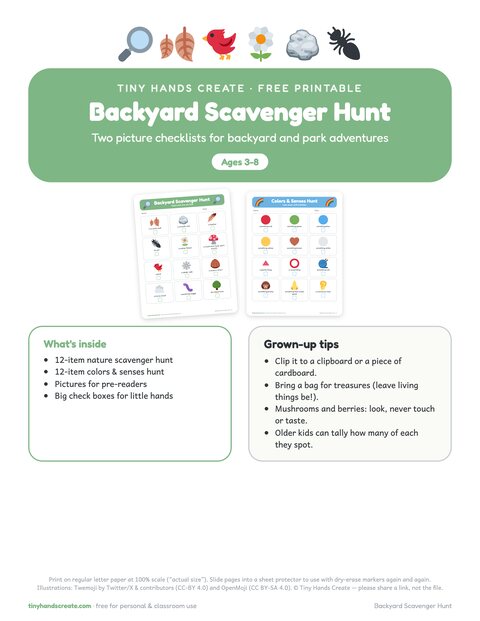
Free printable · 3 pages
Backyard Scavenger Hunt
Two picture checklists: a nature hunt and a colors-and-senses hunt.
Free. Your download link appears right here. You'll also join the Daily Printable Drop. Unsubscribe anytime. Privacy
Classic Scavenger Hunt Formats
Different formats work for different ages, group sizes, and settings. Here are the main types and when to use each.
Checklist Hunt
The most straightforward format: a list of specific items to find. “Find a smooth rock. Find a yellow flower. Find a feather. Find something red.” Children check items off as they find them. This works best for ages 3 and up and can be done solo or in teams. For pre-readers, use picture-based checklists with simple drawings or photos next to each item. Print on cardstock and attach to a clipboard with a pencil on a string for the full explorer effect.
Collection Hunt
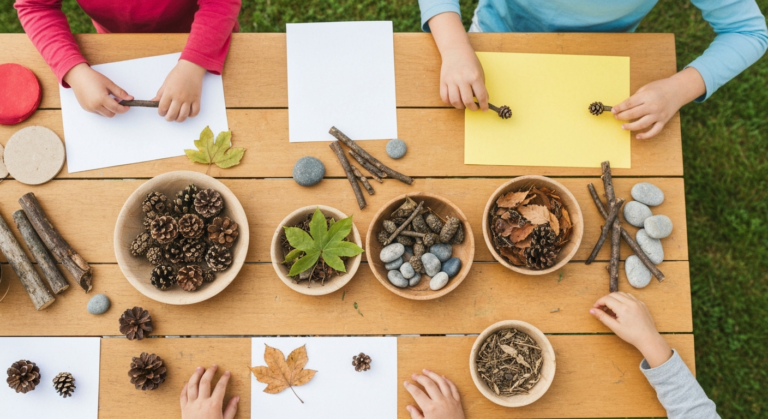
Instead of just finding items, children collect them in a bag, bucket, or egg carton. This adds a hands-on, tactile element—they’re not just spotting a pinecone, they’re picking it up, carrying it, and adding it to their collection. Egg cartons are especially great because each compartment holds one item, providing a natural limit and organization system. At the end, lay out all the collections and compare what different children found.
Photo Hunt
Give older children (or supervised younger ones) a camera, phone, or kid-friendly digital camera and a list of things to photograph rather than collect. “Take a picture of something growing, something with wings, something rough, something beautiful.” The open-ended prompts encourage creative interpretation—one child’s “something beautiful” might be a flower, another’s might be a cloud formation. Print favorite photos afterward for a nature journal or display.
Sensory Hunt
Prompts focus on the five senses rather than specific objects: “Find something soft. Find something that smells nice. Find something that makes a sound. Find something rough. Find something smooth. Find something cold.” This format is wonderfully inclusive for all ages and encourages children to engage with nature through touch, smell, hearing, and careful observation rather than just visual identification.
Themed Scavenger Hunt Ideas
Themed hunts add narrative excitement and can tie into seasons, interests, or learning goals.
Color Rainbow Hunt
Challenge children to find one natural item for every color of the rainbow: red, orange, yellow, green, blue, indigo, violet. Provide a strip of paper with color swatches and tape or glue found items next to the matching color. This is harder than it sounds—blue and purple are surprisingly tough to find in nature. The resulting rainbow strip makes a beautiful keepsake and a great color recognition activity for younger children.
ABC Nature Hunt
Find something in nature that starts with each letter of the alphabet. A = acorn, B = bark, C = clover, D = dirt. Some letters require creative thinking (X might be “extra-long stick”). For younger children, focus on letters A through J. For older kids, require the full alphabet. This combines outdoor exploration with phonics practice and often produces hilarious creative solutions.
Bug and Creature Hunt
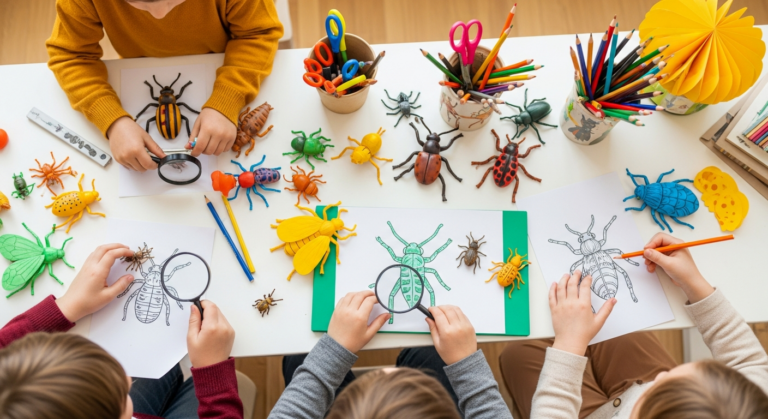
Search specifically for living creatures: an ant, a spider, a worm, a flying insect, a crawling insect, something with more than six legs, a bird, a squirrel. Provide magnifying glasses and observation jars (with air holes) for close-up examination. Emphasize look-but-don’t-touch for unfamiliar creatures, and always release anything captured. This hunt naturally leads into conversations about habitats, food chains, and animal adaptations.
Shape Hunt
Find shapes in the natural world: a circle (a rock, a flower center), a triangle (a leaf, a roof peak), a line (a stick, a blade of grass), a spiral (a snail shell, a fern frond), a star (a starfish shape in a flower). This is a fantastic way to bridge math concepts with outdoor exploration and works beautifully for preschoolers learning shape recognition.
Seasonal Hunts
Spring: a budding flower, a worm, a bird’s nest, a puddle, something sprouting, a robin. Summer: a buzzing bee, a ripe berry, a warm rock, something casting a shadow, a butterfly. Fall: a red leaf, a yellow leaf, an acorn, a spiderweb, something crunchy underfoot. Winter: an evergreen branch, a bare tree, an icicle, animal tracks, something frozen. Seasonal hunts teach children to notice environmental changes and build awareness of natural cycles.
Making Hunts Work for Different Ages
A well-designed hunt keeps everyone engaged, regardless of where they are developmentally.
Toddlers (18 Months to 3 Years)
Keep it to five to eight items, all common and easy to spot. Use picture-based lists—no reading required. Stay together as a group and point things out if needed: “I see something green over there! Can you find it?” Use a small bucket or bag for collecting. Celebrate every single find enthusiastically. The goal isn’t completion—it’s engagement, vocabulary building, and outdoor time.
Preschoolers (3 to 5 Years)
Aim for ten to fifteen items with a mix of easy finds and mild challenges. Include one or two open-ended items (“something interesting” or “something you’ve never noticed before”). Provide a clipboard and pencil for checking items off—children love the official feeling of a clipboard. Allow them to hunt with a partner for social skill practice.
School-Age Kids (5 to 8 Years)
Increase to fifteen to twenty items and include riddle-style clues rather than direct names: “Find nature’s umbrella” (a large leaf), “Find a home no human built” (a bird’s nest or ant hill). Add a competitive element with timed races or point values. Allow independent exploration within defined boundaries. Encourage journaling, sketching, or photographing finds rather than just collecting.
Hosting a Scavenger Hunt for Groups and Parties
Scavenger hunts are brilliant birthday party activities because they’re active, inclusive, and require minimal setup.
- Divide into teams of two to four and give each team a different colored bag or bucket to collect items in
- Set clear boundaries for the search area—visible landmarks work better than verbal descriptions for young children
- Assign an adult spotter for each team if children are young or the area is large
- Award points creatively—one point per item found, bonus points for the most unusual find, extra points for the team that finishes first, and a special prize for the most creative interpretation of an open-ended clue
- End with a share-and-tell circle where each team shows off their favorite find and explains why they chose it
- Provide small prizes for all participants—stickers, small magnifying glasses, nature journals, or bags of trail mix
After the Hunt: Extending the Learning
The best scavenger hunts don’t end when the last item is found. Here are ways to deepen the experience.
Nature collection display: Arrange found items on a tray, in a shadow box, or glued onto a large piece of cardboard to create a nature collage. Label each item. This becomes a reference piece the child returns to and talks about for days afterward.
Nature journal entry: Have children draw their three favorite finds and dictate or write a sentence about each one. Where did they find it? What does it feel like? What do they wonder about it? This builds observation, description, and early writing skills.
Classification activity: Sort collected items into categories: things that were alive, things that were never alive, things from a plant, things from the ground, things that are hard, things that are soft. This introduces scientific classification in a hands-on, meaningful way.
The beauty of a scavenger hunt is its infinite adaptability. You can run one in five minutes with a verbal list while waiting for the bus, or plan an elaborate two-hour adventure for a birthday party. You can do it in a city park, a rural field, or a tiny apartment balcony with potted plants. The setting doesn’t matter nearly as much as the mindset: slow down, look carefully, and notice what’s right in front of you. That’s a skill that will serve children far beyond the backyard.
Crafty Mama
Crafty Mama is a former elementary art teacher turned stay-at-home parent who believes every child is creative — they just need the right invitation. She develops age-appropriate activities, crafts, and projects that spark imagination while keeping mess (and parent stress) to a minimum.