
Pipe Cleaner Crafts for Kids: 20+ Ideas for Every Age
Discover 22 pipe cleaner craft ideas for kids aged 3 and up, complete with age-specific instructions, material lists, and safety tips. You'll learn how to create everything from simple shapes to articulated figures with minimal mess.
- Prioritize safety: supervise kids 3+, avoid small parts for under 5.
- Choose from 22 age-specific crafts, from simple shapes to complex figures.
- Select appropriate pipe cleaner types and know stem counts for each project.
- Enjoy low-mess crafting and learn how to reuse stems to reduce waste.
This post contains affiliate links. As an Amazon Associate I earn from qualifying purchases.
In this article (12 sections)
- Pipe Cleaner Crafts by Age: Start Here
- Pipe Cleaner Crafts at a Glance
- Pipe Cleaner Basics and Supplies
- Easy Pipe Cleaner Crafts for Ages 3-5
- Pipe Cleaner Crafts for Ages 5-7
- Pipe Cleaner Crafts for Ages 7+
- 10 More Quick Pipe Cleaner Ideas
- Pipe Cleaners for Open-Ended Creative Play
- Pipe Cleaners for School Projects and Classroom Use
- Pipe Cleaner Birthday Party Ideas and Quantities
- Tips for Pipe Cleaner Crafting
- Frequently Asked Questions
Pipe Cleaner Crafts by Age: Start Here
A child can twist a pipe cleaner into a ring, crown, flower or snake in minutes, with no glue and no drying time. This guide has 22 ideas sorted by age (3 and up): 12 step-by-step crafts plus 10 quick ideas. You also get stem counts, safety rules and party and classroom quantities.
The mess is the mild kind. Fuzz ends up on the carpet and in the vacuum, glitter stems shed more, and a bead will roll under the couch. I will take that over wet paint.
Pipe cleaners (also called chenille stems) are bendable wires wrapped in soft fiber. They come in every color and are cheap in bulk.
Safety firstPipe cleaners are for ages 3 and up with an adult close by, and not for children under 3. The wire tips can scratch skin and eyes, and stems should never go in the mouth. Small beads, pom-poms and googly eyes are choking hazards, so they are for ages 5 and up only. For ages 3-4, use only parts too big to fit through a toilet-paper tube, or none at all.
Pipe Cleaner Crafts at a Glance
This table covers the 12 step-by-step crafts. The animals row counts as three: dog, spider and butterfly. Stem counts are for one finished craft per child.
The 10 quick ideas have their own table further down, each with a best age. That brings the total to 22.
| Activity | Best Age | Stems per child | Materials | Prep Time | Ages 3-4 swap |
|---|---|---|---|---|---|
| Bead threading bracelets | 4-5 | 1 | Pipe cleaners, large beads | Adult folds ends (2 min) | Age 3: no beads, just shape the stem. Age 4: large beads only |
| Pipe cleaner flowers | 3-5 | 2 | Green + colored pipe cleaners, large pom-poms or large beads | 5 min, adult pre-cuts | Half-length petal pieces (about 6 inches), never shorter. Large pom-pom centers, no beads at 3 |
| Finger puppets | 3-5 | 1 | Pipe cleaners, marker, large pom-pom (age 5 only, adult glues) | 5 min | No glue: twist the head shape, marker face |
| Shape practice | 3-5 | 1 per shape | Pipe cleaners only | Adult folds ends | None needed |
| Pipe cleaner animals | 5-7 | 2-4 | Pipe cleaners, googly eyes (ages 5+, adult glues) | 5-10 min, adult cuts | Marker eyes |
| Crowns and tiaras | 5-7 | 5-6 | Pipe cleaners, large beads | 5 min | Skip beads |
| Eyeglasses | 5-7 | 3 | Pipe cleaners | Adult folds ends | None needed |
| Articulated figures | 7+ | 5 | Pipe cleaners | 10 min | Not for ages 3-4 |
| Miniature furniture | 7+ | 3 per chair | Pipe cleaners | 10-15 min | Not for ages 3-4 |
| Trees and landscapes | 7+ | 8-10 per tree | Brown/green pipe cleaners, pom-poms | 10 min | Not for ages 3-4 |
Pipe Cleaner Basics and Supplies
Choosing the Right Pipe Cleaners
- Standard chenille stems (6mm): The classic size, perfect for most kid projects. Buy an assorted color pack of 100 or more for the best value.
- Jumbo or extra-thick chenille stems (12mm): Easier for young children (3+) to grip and bend, with adult supervision. Great for first-time pipe cleaner crafters.
- Glitter and metallic pipe cleaners: Add sparkle to crowns, wands, and holiday crafts. These are stiffer and slightly harder to bend, so they work better for older children.
- Bump chenille stems: These have raised bumpy sections that add texture and look like caterpillar bodies or flower centers without any extra shaping needed.
Are There Eco-Friendly Pipe Cleaner Options?
Not really. Classic chenille stems are a wire core wrapped in synthetic fiber, usually rayon, nylon, or polyester. That mixed material cannot go in a curbside recycling bin and is not biodegradable.
That is true of nearly every pipe cleaner on the market, including ones marketed as “eco” versions. I would not promise a fully green swap here.
Two things do cut down on waste. Buy one assorted bulk pack instead of several small single-color packs (less packaging per stem). Then treat pipe cleaners as a reusable material, not a one-project supply.
Stems can be reshaped many times, so one can become a bracelet, then a flower, then a spider leg over a month. Retire any stem once the wire kinks, frays or breaks. To stretch the low-waste angle further, pair a pipe cleaner session with cardboard, bottle caps, and other recycled materials crafts pulled straight from your bin.
Safety Notes
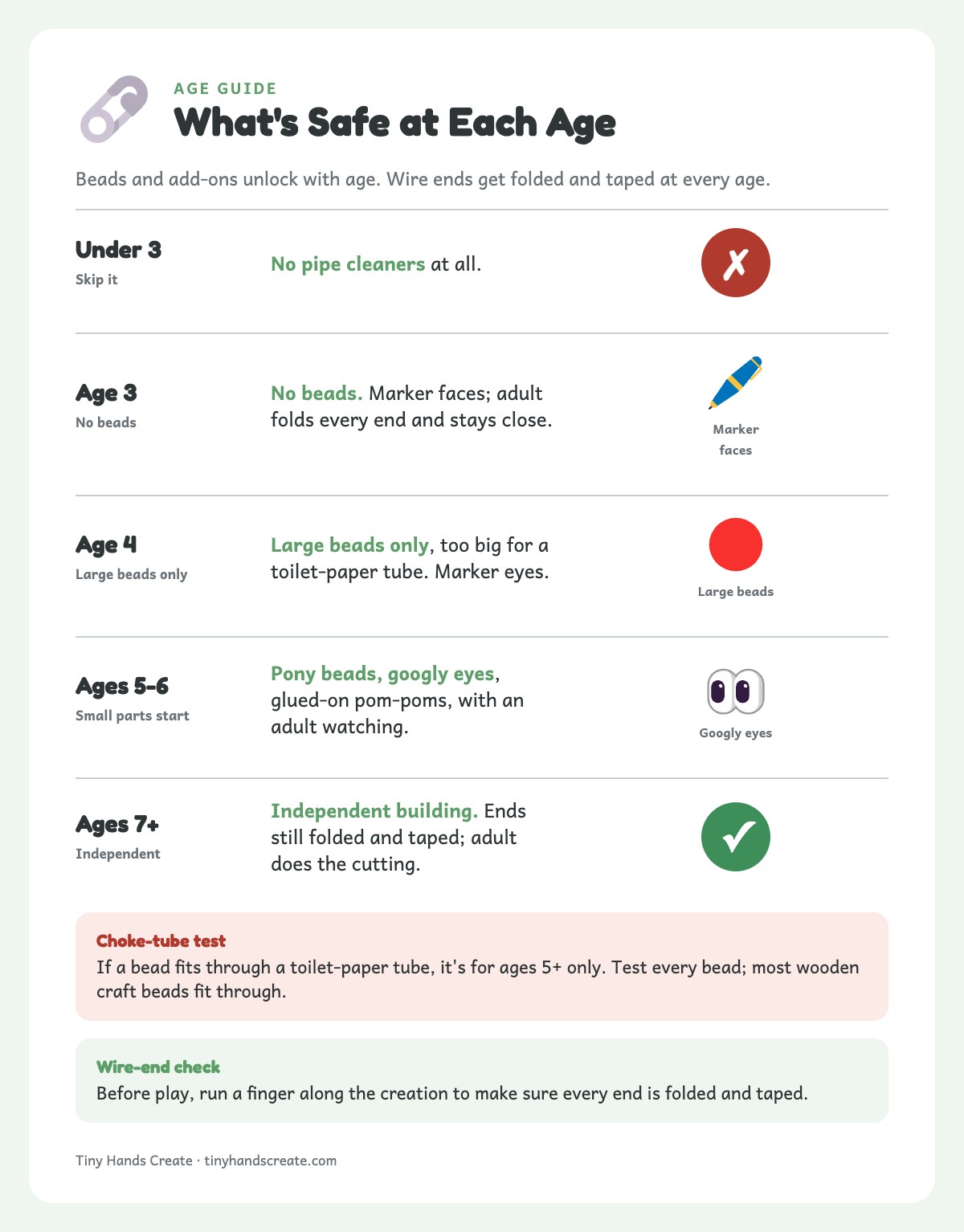
Safety firstPipe cleaners have a thin wire core under the fuzzy coating, and the tips can be sharp even on full-length stems. Avoid them for children under 3. For ages 3-4, stay close the whole time.
| Age | The rule |
|---|---|
| Under 3 | No pipe cleaners. |
| 3 | No beads. Marker faces instead of glued-on parts. Adult folds every end and stays close. |
| 4 | Large beads only (too big to fit through a toilet-paper tube), with an adult right there. Marker eyes and faces. No googly eyes and no glued-on parts. |
| 5-6 | Pony beads, googly eyes and glued-on pom-poms start at age 5. They are small parts, so an adult watches. Keep them off the table, or at a separate adult-run station, whenever anyone under 5 is crafting. An adult does the gluing, lets it dry fully and tugs each part before play. |
| 7+ | Independent building. Ends are still folded and taped, and an adult still does the cutting. |
- Adult folds over both ends of every stem by at least half an inch, or caps them with tape or a large bead, before handing them out.
- Small beads, pom-poms, googly eyes, buttons and bottle caps are choking hazards and are for ages 5 and up only. Keep them off the table, or at a separate adult-run station, whenever anyone under 5 is crafting.
- Ages 3-4 use only parts too big to fit through a toilet-paper tube, or none at all.
- Short cut pieces count as small parts too. Ages 3-4 get only full-length or half-length stems (about 6 inches or more), never a loose piece shorter than a toilet-paper tube is long.
- Shorter pieces and scraps are for ages 5 and up only, with the ends folded and an adult watching. Keep them in a lidded container, off the table, whenever anyone under 5 is crafting.
- Glued-on googly eyes and pom-poms are for ages 5 and up. An adult glues them, lets the glue dry fully and tugs each part firmly before play. Ages 3-4 draw eyes with marker.
- Adults do all cutting (wire cutters or old scissors) and all hot glue, away from young children.
- Wrap rings, bracelets and finger coils loosely so they slide off easily. Remove one right away if a finger looks pale or the child complains. If a ring will not slide off, an adult snips it off with wire cutters rather than pulling.
- For glasses, crowns and wands, fold every end back and cover it with tape, and keep wire ends well away from eyes.
- Check stems as you go and throw out any that are kinked, frayed or have exposed or broken wire.
- Stems, fuzz and beads stay out of mouths. If a wire pokes an eye or a child swallows a piece, get medical help right away.
Safety firstChoke-tube test: drop the bead or add-on through a toilet-paper tube. If it fits through, it is a small part: ages 5 and up only, with an adult watching. Keep it off the table whenever anyone under 5 is crafting. Test every bead, because most craft-store wooden beads do fit through. In this post, “large” always means too big to fit through the tube.
Wire-end check: before a child wears or plays with a creation, run a finger along it to make sure every end is folded and taped.
Essential Companion Supplies
Stock your pipe cleaner bin with these. Anything that fits through a toilet-paper tube is for ages 5 and up only, so store those parts in a separate lidded container.
- Jumbo wooden beads for age 4: about 1.75 inches across or bigger. Each one must be too big to fit through a toilet-paper tube
- Smaller wooden beads with large holes (ages 5 and up only)
- Pony beads
- Googly eyes in assorted sizes (ages 5 and up only, adult glues)
- Pom-poms in assorted sizes
- Small foam shapes
- Craft glue, or a low-temp glue gun (an adult applies all hot glue, away from young children)
- Blunt child scissors (paper only)
- Adult wire cutters or old scissors for cutting stems
Easy Pipe Cleaner Crafts for Ages 3-5
Each of these takes about 5-15 minutes and only a stem or two.
Good to knowWhen it goes wrong: if a stem springs open, twist it three times instead of once. If a twist unravels, fold the end over the join. If small hands tire out, switch to jumbo stems. Glitter stems shed, so expect sparkle on the table.
Bead Threading Bracelets
Thread beads onto one pipe cleaner. At age 4, use large beads only, meaning too big to fit through a toilet-paper tube. Pony beads are for ages 5 and up with an adult watching and no younger siblings nearby.
When the stem is full, twist the two ends together and fold the twisted tips flat. Have an adult check the join before it is worn.
A pipe cleaner is stiff enough to push through bead holes without flopping around like string does. Children who cannot yet thread beads on yarn can often manage a pipe cleaner on the first try. Picking up beads and sliding them on is good pincer-grip practice. For more of it, try these threading activities.
Three-year-olds skip the beads and simply bend and twist a stem into a bracelet shape. For more wearable crafts, try friendship bracelets kids can make.
Safety firstAge 3: no beads. Age 4: large beads only, too big to fit through a toilet-paper tube, with constant adult supervision. Ages 5 and up: pony beads with an adult watching and no younger siblings nearby.
Pipe Cleaner Flowers
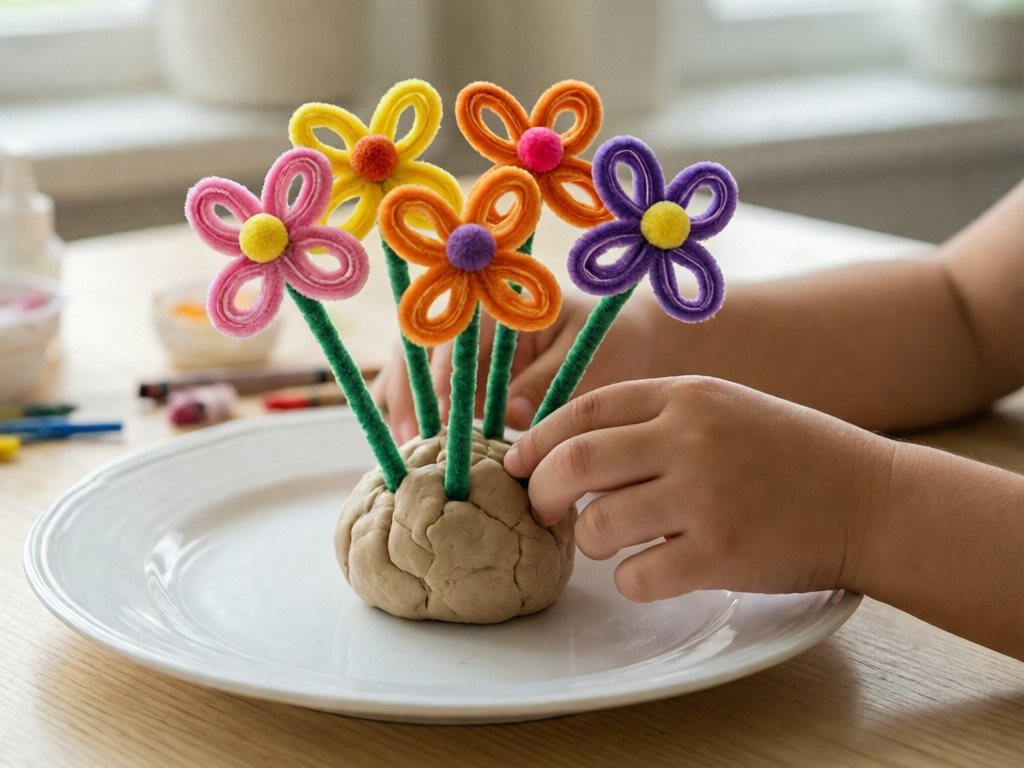
- Prep (adult). Each flower takes one colored stem and one green stem. For ages 3-4, cut the colored stem in half only, so each piece is about 6 inches long. For ages 5 and up, you can cut it into four equal pieces instead. Fold over every cut end and both ends of the green stem.
- Make petals. Ages 3-4 bend each half into a figure-eight and twist the middle, which gives two petals per piece. Ages 5 and up bend each short piece into a loop and twist the ends together.
- Gather. Hold the four petals around the top of the green stem and twist them all together.
- Add a center. Tuck a large pom-pom into the middle or, for ages 4 and up, a large wooden bead. Either one must be too big to fit through a toilet-paper tube.
With the pieces prepped ahead, a child can make a small bouquet in about fifteen minutes. Stand the flowers in a lump of homemade playdough, a jar of dry rice, or an upside-down egg carton. Remember that homemade playdough is salty and not edible.
Finger Puppets
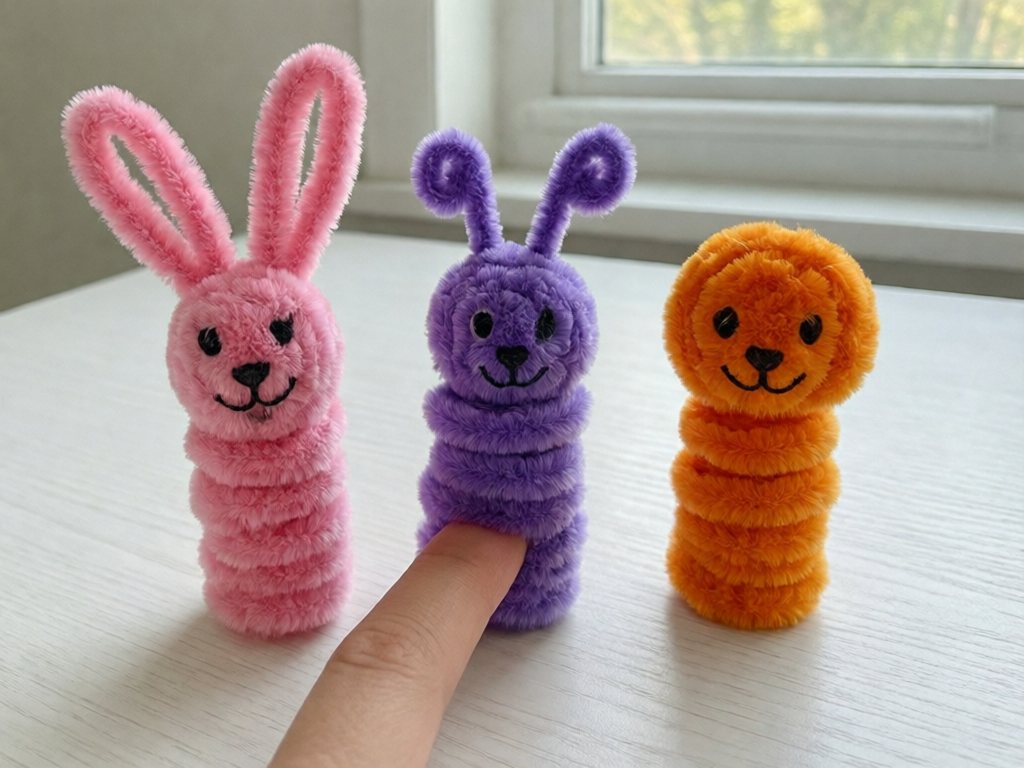
- Prep (adult). Each puppet takes one stem. Fold over both ends. Adults handle any hot glue.
- Coil loosely. Wrap the stem around a child’s finger two or three times, leaving two inches sticking up. It should slide on and off easily, never tight.
- Shape the top. Bend it into ears, antennae, or a head shape.
- Add a face. For ages 3-4, skip the glue: twist the top into a head shape and draw the face with marker. For ages 5 and up, an adult glues on a large pom-pom, lets it dry fully, and tugs it firmly before the puppet is worn.
Then put on an instant puppet show. Make a whole cast: a bunny with long bent ears, a snail with spiral antennae, a person with pipe-cleaner arms out to the sides.
Shape Practice
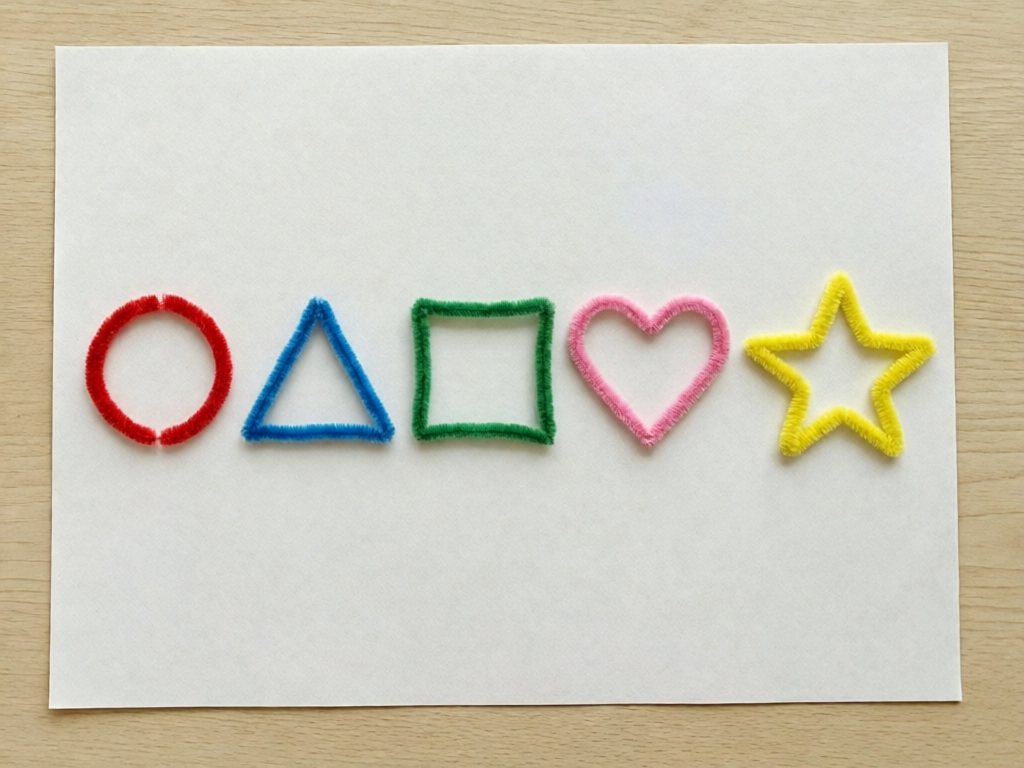
Call out shapes and have children bend pipe cleaners to match: a circle, a triangle, a square, a heart, a star. Each shape takes one stem. For a star, bend the stem into a zig-zag and connect the ends.
Kids get to see the shape and feel it in their hands at the same time. Display finished shapes on a poster board labeled with shape names, or pair them with these shape recognition activities.
Pipe Cleaner Crafts for Ages 5-7
These take more steps and a bit more patience. Plan on 10-15 minutes each.
Pipe Cleaner Animals
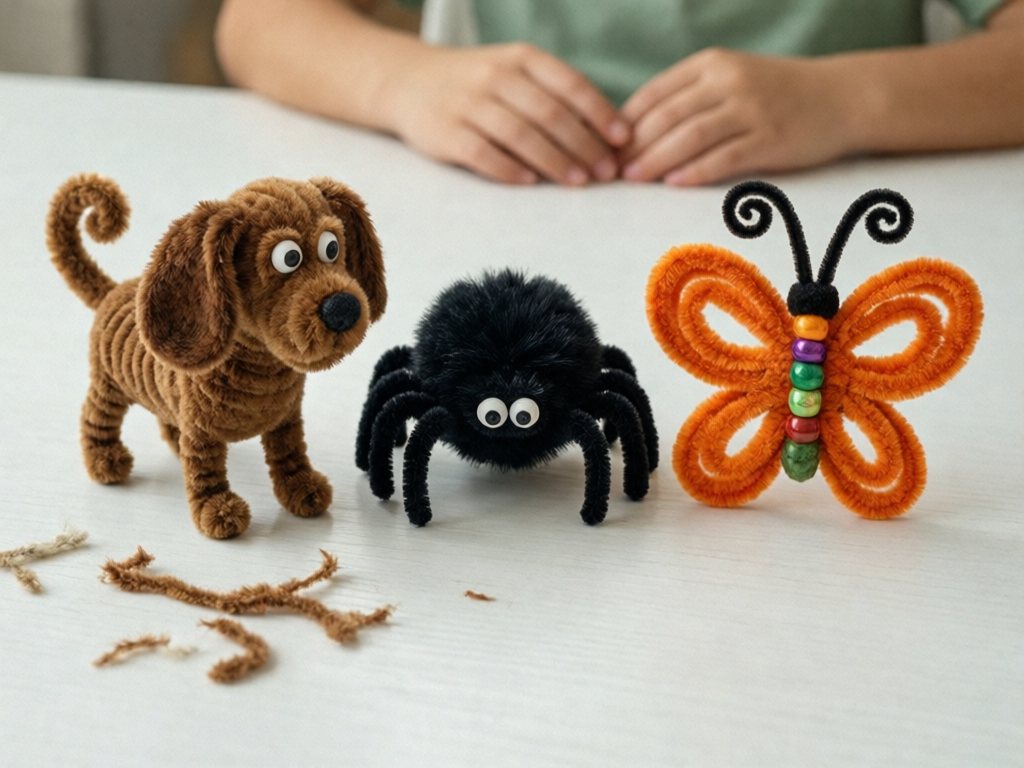
Once children understand basic bending and twisting, they can create recognizable animals. Here are step-by-step guides for three favorites:
Safety firstGoogly eyes and beads are small parts, so these animals are for ages 5 and up with an adult watching. An adult glues on the eyes, lets them dry fully and tugs each one before play. For a 3- or 4-year-old helper, draw marker eyes and skip the beads.
Dog
Materials: 3 pipe cleaners, a scrap piece, googly eyes.
- Body. Fold one pipe cleaner in half.
- Head. Twist a second pipe cleaner around the fold, then bend its tips down for floppy ears.
- Legs. An adult cuts the third pipe cleaner into four equal pieces and folds the ends over. Twist each piece around the body as a leg.
- Finish. Curl a scrap piece into a tail. An adult glues on googly eyes, lets them dry fully and tugs each one. Or draw the eyes with marker.
Spider
Materials: 3 pipe cleaners (or 2 plus a large pom-pom), googly eyes.
- Body. Crumple one pipe cleaner into a tight ball, or use a large pom-pom.
- Legs. An adult cuts two pipe cleaners in half to make four pieces and folds the ends over.
- Attach. Twist the middle of each piece around the body, giving you eight legs.
- Stand it up. Bend the legs into zigzags. An adult glues on googly eyes, lets them dry fully and tugs each one. Or draw the eyes with marker.
Perfect for a Halloween craft table.
Butterfly
Materials: 2 pipe cleaners, a few beads.
- Wings. Bend one pipe cleaner into a figure-eight.
- Body. Lay the second pipe cleaner down the center and twist it around the middle of the figure-eight.
- Antennae. Curl the top ends into spirals.
- Decorate. Thread beads onto the body for a segmented look, then fold the bottom end over.
Pipe Cleaner Crowns and Tiaras
- Prep (adult). Each crown takes 5-6 stems: three for the band and two or three for the peaks. Fold over both ends of every stem.
- Make the band. Twist three pipe cleaners end to end into one long piece.
- Size it. Curve it into a circle that fits the child’s head and twist the ends together.
- Add peaks. Use more stems to make points, hearts or stars across the top.
- Jewels (ages 5+). Thread beads onto the peaks if you like, with an adult watching, and tape every join.
Glitter pipe cleaners make these look especially regal, and a handmade crown tends to get worn with pride.
Safety firstFold all wire ends inward and tape every join so no wire touches the scalp or face. Check that nothing pokes toward the eyes.
Pipe Cleaner Eyeglasses
- Prep (adult). Fold over the ends of three stems.
- Lenses. Bend one pipe cleaner into two side-by-side circles, twisting where they meet for the nose bridge.
- Arms. Twist two more stems onto the outer edges and curve them back over the ears.
- Check. Fold the arm tips back and tape them so nothing points toward the eyes.
Kids can personalize them with heart, star or oversized round lenses. They make instant dress-up props and photo booth accessories.
Pipe Cleaner Crafts for Ages 7+
These builds stand up on their own and use more stems. An adult still folds and tapes the ends.
Pipe Cleaner Sculptures and Figures
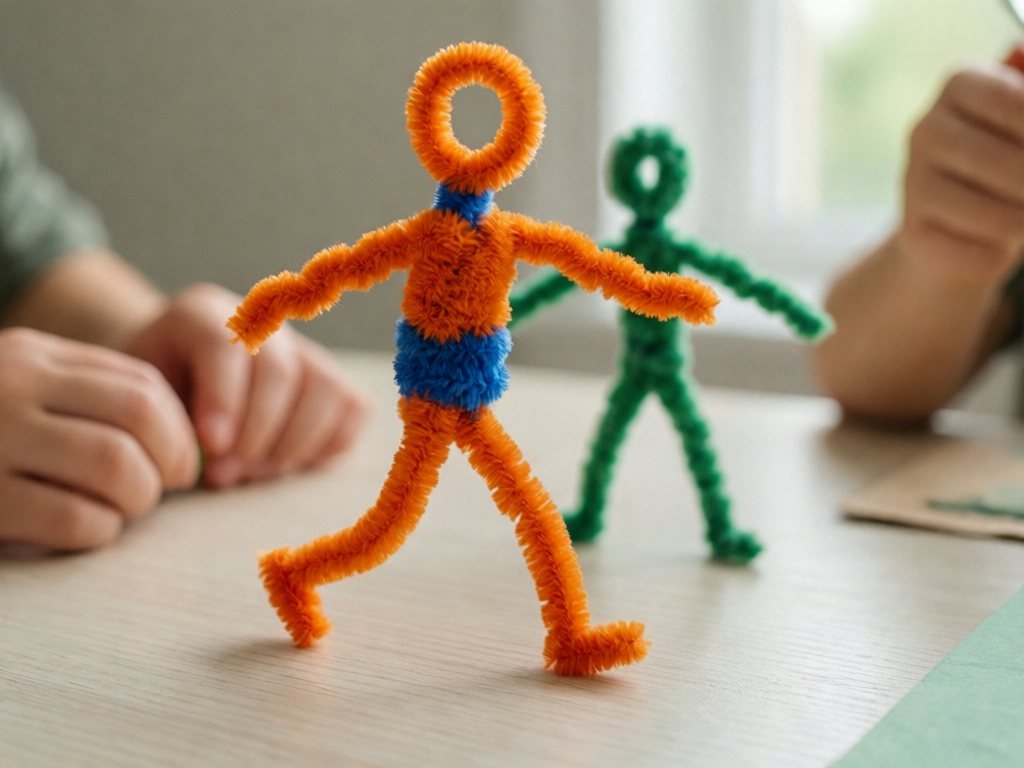
- Prep (adult). Fold over the ends of five stems.
- Torso and head. Use one stem for the torso, with a loop at the top for the head.
- Arms and legs. Twist one stem around the chest for arms and one at the hip for legs.
- Add bulk. Wrap extra stems around the frame for clothing.
- Pose it. Bend the figure into action positions.
Children can build entire scenes with multiple characters. Getting a figure to stand on its own takes some trial and error, and that is half the fun.
Miniature Furniture and Scenes
Start with a chair, which takes three stems.
- Prep (adult). Cut one stem in half and fold over every end.
- Seat. Bend one full stem into a small square, going around twice, and twist the end to hold it.
- Legs. Bend each half stem into a U. Twist the middle of one U onto the front edge of the seat and the other onto the back edge, so the four tips point down.
- Back. Fold the last stem into a tall arch and twist both ends onto the back edge of the seat.
- Level it. Stand the chair up and bend the legs until it stops wobbling.
A table is the same build without the back, and a bed is a longer seat with a low arch at each end. Kids can furnish a whole miniature room for small dolls or action figures.
Pipe Cleaner Trees and Landscapes
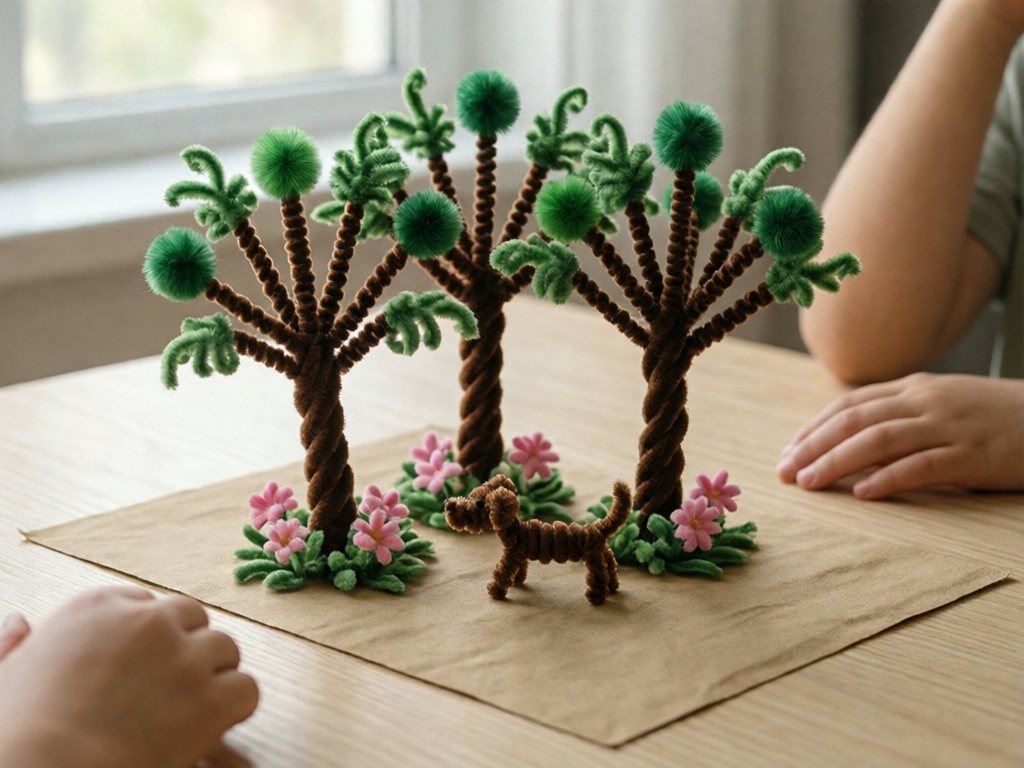
- Trunk. Twist six to eight brown pipe cleaners together at the base, with the ends folded over.
- Branches. Separate the top portions and fan them out.
- Leaves. Curl green pipe cleaners or attach small green pom-poms to the branch tips.
- Build a forest. Add pipe cleaner flowers at the base and animals among the trees.
The finished landscape becomes a play scene or display piece.
10 More Quick Pipe Cleaner Ideas
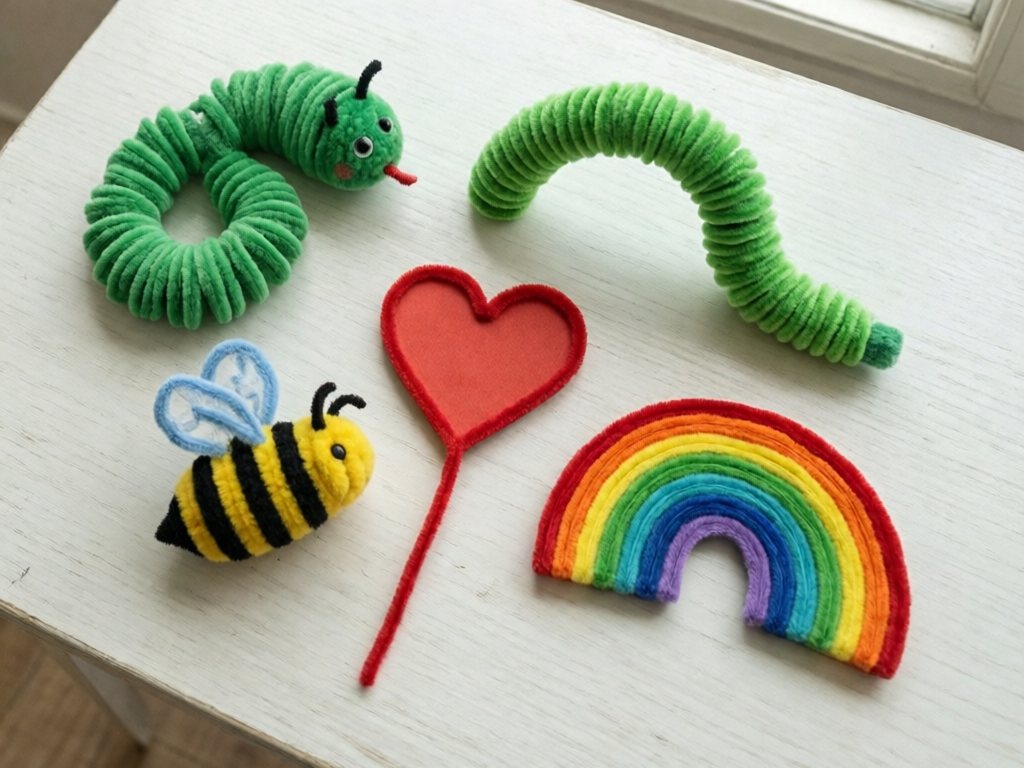
Fold over every stem end first. Small beads are for ages 5 and up only. For more fuzzy-craft ideas, see these pom-pom crafts.
| Idea | Best age | How to make it |
|---|---|---|
| Spiral snake | 3-5 | Wrap a stem around a pencil, slide it off and stretch it out. Draw on eyes with marker. |
| Bump caterpillar | 3-5 | Fold the ends of a bump chenille stem, curve it into an arch and draw a marker face. |
| Bookmark | 5-7 | Bend a stem into a heart or star shape with a long tail that slips over the page edge. |
| Pencil topper | 5-7 | Coil a stem around the pencil end and shape a flower or spiral on top. |
| Wand | 5-7 | Wrap stems around a craft stick and shape a star at the top. Tape all ends. |
| Ring | 5-7 | Wrap a stem loosely around a finger once or twice. It must slide off easily. |
| Snowflake | 5-7 | Twist three stems together at the center and fan out six arms. Fold the tips. |
| Bumble bee | 5-7 | Wrap black and yellow stems into stripes around a short core and add two loop wings. |
| Rainbow | 5-7 | Bend six colors into nested arcs and twist the ends together at each side. |
| Headband | 7+ | Twist stems into a band, add ears or antennae and tape every join. |
Pipe Cleaners for Open-Ended Creative Play
Not every pipe cleaner session needs to end in a finished “thing.” Pipe cleaners make a great loose-parts material because a child can change their mind mid-project. Set out a bucket of stems next to a colander, a pegboard, a muffin tin, or a laundry basket. Then let kids weave, poke, and thread them through the holes with no goal in mind.
For ages 5 and up, add pom-poms, buttons, and bottle caps to the bin and let a child sort, build, and rebuild a small world. For 3- and 4-year-olds, stick to add-ons too big to fit through a toilet-paper tube.
With no glue, no drying time, and no “wrong” way to bend a stem, pipe cleaners pair well with other loose parts play materials for kids who want to invent their own rules.
Pipe Cleaners for School Projects and Classroom Use
Teachers and homeschool parents reach for pipe cleaners constantly, and for good reason: they store flat, they do not spill or dry out, and cleanup takes about ninety seconds.
Letter and Name Crafts
Have children bend a pipe cleaner into each letter of their name, then glue the letters onto a sentence strip to make a name banner for a cubby or desk. This is a favorite back-to-school activity because it pairs letter formation practice with a keepsake the child can take home. If you are stocking up for the first weeks of school, it pairs naturally with other back-to-school crafts like backpack tags and pencil toppers.
STEM and Science Models
Pipe cleaners are handy stand-ins for simple molecule models (pom-pom “atoms” connected by pipe cleaner bonds) and plant or insect life cycle diagrams. They also work for bridge-building challenges where kids test how many stems it takes to hold a weight. Kids can test a design, see it fail, and adjust without starting over. Throw out any stem whose wire has kinked or broken.
Classroom Management Tips
- Buy a class-size bulk pack. A 350-count assorted bag gives a class of 25 about 14 stems each, or a class of 20 about 17 (see the table below). Bulk bags often cost much less per stem than small packs. Aim for about 20% spare, since some stems kink.
- Sort by color into small bins or cups so students can grab what they need without dumping the whole supply out.
- Pre-cut for early finishers (ages 5 and up). Keep a lidded container of shorter pieces, cut by an adult with the ends folded over, for quick five-minute fillers between activities. An adult hands them out. Children under 5 get full-length or half-length stems instead.
- No water, no drying rack. Unlike paint or glue projects, finished pipe cleaner work can go straight into a backpack or cubby the same day.
| Class size | Stems per child | Total stems |
|---|---|---|
| 15 | 10-15 | 150-225 |
| 20 | 10-15 | 200-300 |
| 25 | 10-15 | 250-375 |
Pipe Cleaner Birthday Party Ideas and Quantities
Pipe cleaners make an easy, low-cost party craft station. There is no drying time to manage between arrival and cake.
Set out bowls of pipe cleaners and let guests 3 and up build a crown, wand, or bracelet to wear at the party and take home as a favor. That also solves the “what do I send home in the goodie bag” question.
For a more structured station, set out one finished sample of each craft and let kids copy at their own pace. Plan about 15 minutes per craft.
| Group size | Pipe cleaners (10-15 per child) | Beads (guests 5+ only) |
|---|---|---|
| 10 kids | 100-150 | One bag of pony beads |
| 15 kids | 150-225 | One bag of pony beads |
Pony beads are for guests 5 and up only, with an adult watching. If any guest or sibling is under 5, keep pony beads off the main table and run them at a separate adult-supervised station. For 4-year-old guests, set out large beads only (too big to fit through a toilet-paper tube). Three-year-olds get no beads.
Safety firstCheck every favor before it goes home. Each wire end must be folded and taped. Beaded favors and favors with glued-on parts go home only with guests 5 and up. For guests under 5, slide the beads off first.
Tell parents at pickup that pipe cleaner crafts are not for children under 3, and to keep the favor away from younger siblings.
- Fold over every stem end before the party starts.
- Buy about 20% extra stems for bent or kinked ones.
- Make one finished sample of each craft.
- Put beads in bowls on a tray with raised edges, at a separate adult-run station if anyone under 5 is there.
- Check every favor for folded, taped ends before it goes home, and take beads off favors for guests under 5.
- Keep wire cutters out of reach.
- Set a timer for 15 minutes per craft.
Still shopping for the guest of honor? Browse birthday gift ideas kids actually want.
Tips for Pipe Cleaner Crafting
- Buy in bulk: Large assorted packs from craft supply websites or wholesale stores often cost much less per stem than small packs. Buy about 20% more than the project needs, since some stems kink.
- Pre-cut ahead of time: If a project needs short pieces, an adult cuts them in advance and folds the ends over so children can focus on creating. Short pieces are for ages 5 and up only. For ages 3-4, cut no shorter than half a stem (about 6 inches).
- Save the scraps (ages 5 and up): Even 2-inch leftover pieces are useful for details like antennae, tails, and small accessories. Scraps are small parts with wire inside, so fold the ends and store them in a lidded container that an adult hands out. Keep it off the table whenever anyone under 5 is crafting.
- Use a bead tray: When threading beads, work on a tray with raised edges. Beads roll and bounce everywhere otherwise, and cleanup becomes a scavenger hunt.
- Display and celebrate: Pipe cleaner creations look great on shelves and windowsills or hanging from strings. Kids tend to take more care when they know the work is going on display.
- Encourage experimentation: Unlike paint or glue, pipe cleaners can be unbent and reshaped many times. If something does not turn out right, straighten the stem and try again. Toss any stem whose wire has kinked or broken. That makes them a kind choice for kids who get frustrated by mistakes.
Pipe cleaners are an easy step from flat art into sculpture. Twist open a pack and start with a flower.
Frequently Asked Questions
What age is best for pipe cleaner crafts?
Ages 3 and up, with adult supervision. Even full-length stems can have poky wire at both ends, so an adult folds over or tapes both tips before handing them out. Save cutting for an adult.
What can kids make with pipe cleaners for art projects?
Beyond jewelry and animals, pipe cleaners work well for shape and letter practice, flower bouquets, finger puppets, crowns, eyeglasses, and three-dimensional sculptures for older kids. They are also a strong open-ended material for loose-parts style creative play with no set project in mind.
How do teachers use pipe cleaners for school projects?
Common classroom uses include name-letter banners, STEM molecule or bridge-building models, and quick five-minute fillers for early finishers. Buying a bulk assorted pack and sorting it into color bins makes distribution and cleanup fast for a whole class.
What pipe cleaner crafts work well for a birthday party?
Crowns, wands, and bead bracelets are the best party options because they have no drying time, guests can wear them immediately, and they double as a take-home favor. Plan on about 10-15 stems per child, which is 100-225 stems for 10-15 kids. With about 20% extra for kinked stems, that is two to three 100-count assorted packs. Pony beads are for guests 5 and up only. Four-year-olds get large beads only (too big to fit through a toilet-paper tube), and children under 4 get none. Check that every wire end is folded and taped before favors go home, and remind parents to keep them away from siblings under 3.
Are there eco-friendly pipe cleaner options?
Most pipe cleaners, including those marketed as eco-friendly, are a wire core wrapped in synthetic fiber and are not recyclable or biodegradable. The lowest-waste approach is buying one large assorted bulk pack instead of several small ones and reusing stems across multiple projects, since they can be unbent and reshaped many times.
Are pipe cleaners safe for toddlers?
No. Skip pipe cleaners entirely until age 3 because of the wire core and small-part hazards. For toddlers, offer chunky crayons or playdough with an adult instead.
Crafty Mama
Crafty Mama is a former elementary art teacher turned stay-at-home parent who believes every child is creative — they just need the right invitation. She develops age-appropriate activities, crafts, and projects that spark imagination while keeping mess (and parent stress) to a minimum.