Free Printable Farm Animal Bingo Cards for Preschoolers
This post contains affiliate links. As an Amazon Associate I earn from qualifying purchases.
My sister showed up with her three kids on a Sunday that was supposed to be “low-key.” I’d printed exactly one farm bingo board off Pinterest the night before, feeling very prepared. Within about four minutes of the cousins sitting down at the kitchen table, it became clear that one board and four preschoolers is not a game — it’s a hostage negotiation. My niece wanted the board because she called the cow first. My nephew wanted it because he’s older and “should go first.” My own daughter wanted it because it was, in her words, “my house, my bingo.” I ended up making them take turns with a single sheet of laminated paper while the other two sat there peeling stickers off the table out of boredom, which is its own kind of chaos.
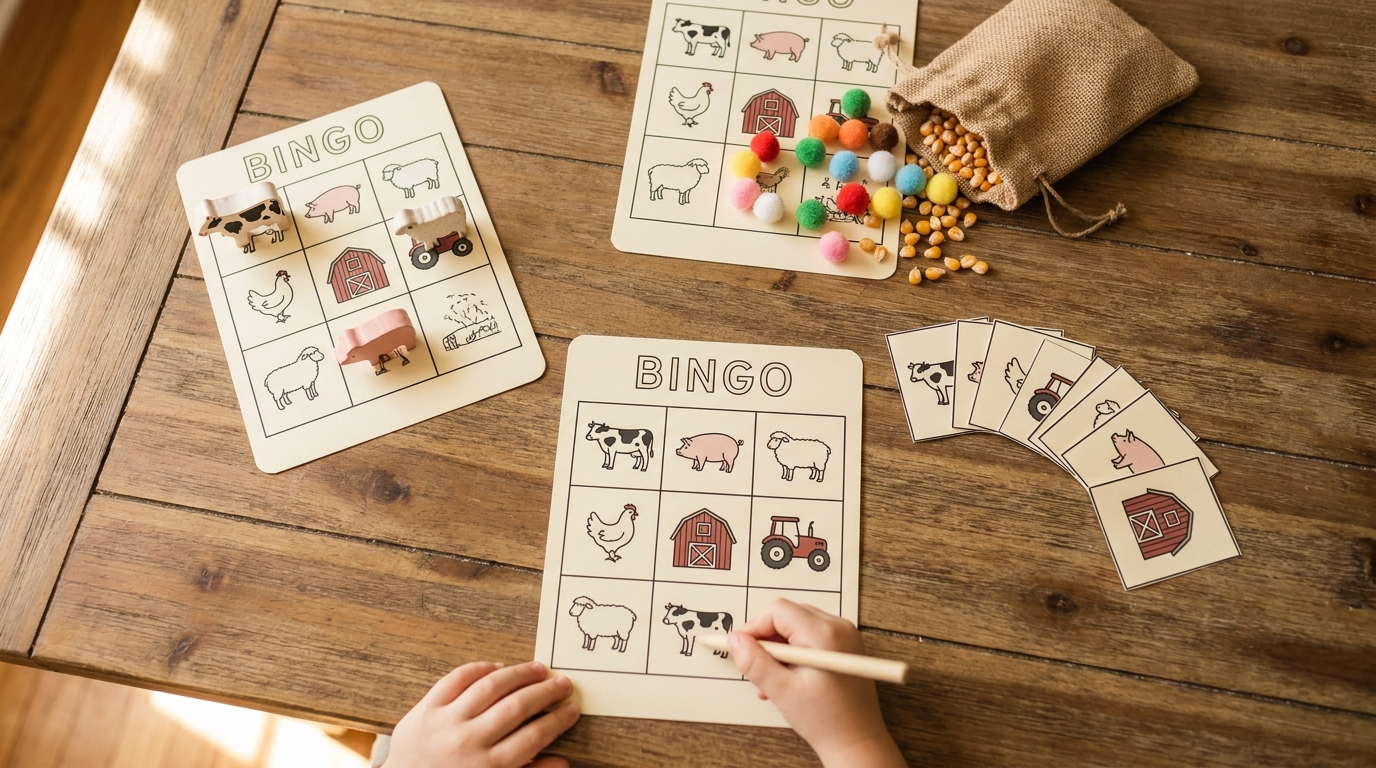
That afternoon I sat down and built exactly what I’d needed that morning: a set of farm bingo boards where every kid gets their own card, nobody’s boards match, and there’s still only one caller reading off the animals. It turned a squabble into an actual group game. That’s the printable set below — six different 3×3 boards plus a caller card, all in one free 8-page PDF, so the next time you’ve got a pile of preschoolers (yours, a cousin’s, a whole preschool classroom) you can hand out real, different boards instead of photocopying the same one six times and hoping nobody notices they’re identical.
Free printable · 8 pages
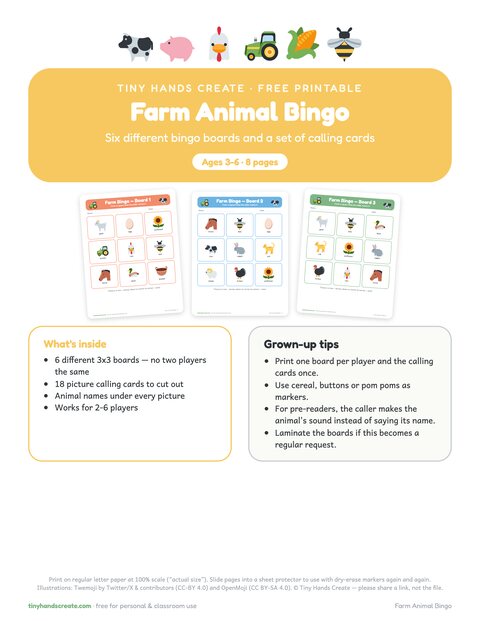
Farm Animal Bingo
Six different 3x3 bingo boards and 18 picture calling cards — no two players get the same board.
Free. Your download link appears right here. You'll also join the Daily Printable Drop. Unsubscribe anytime. Privacy
This one’s built specifically for the 3-5 age range — big enough images to recognize at a glance, no reading required, and simple enough rules that a three-year-old can play alongside a kindergarten-bound five-year-old without either of them getting bored or lost.
In this article (12 sections)
- Why Farm Animal Bingo Works So Well for This Age Group
- What’s in the Free Printable Farm Bingo Set
- How to Download and Print Your Cards
- Prepping the Cards So They Survive Sticky Fingers
- How to Play: Basic Farm Animal Bingo Rules
- Fun Twists: More Ways to Play Farm Bingo
- Turning Bingo into a Full Farm Theme Day
- Playing with Mixed Ages (Toddlers Through Kindergarten)
- Storage Tips So You’re Not Reprinting Every Time
- Pair It with These Farm and Learning Activities
- Frequently Asked Questions
- One Last Thing
Why Farm Animal Bingo Works So Well for This Age Group
Bingo gets recommended constantly for preschoolers, and it’s not just because it’s easy to print. There’s a real reason it lands so well with the 3-5 crowd specifically, and it comes down to what’s developmentally happening at that age.
Visual matching before letter recognition. Most preschoolers can match a picture of a pig to another picture of a pig well before they can read the word “pig.” Farm animal bingo uses pictures instead of words, so it works as a legitimate learning game for a three-year-old who doesn’t know their letters yet, while still holding a five-year-old’s attention because the animals, sounds, and categories (which ones live in the barn, which ones live in the pond) give them something to think about.
Listening and waiting are the actual skill being built. The game looks like it’s about farm animals, but what it’s actually training is: listen for your turn, scan your own board, find the match, wait for the next call. That’s a genuinely hard set of skills for a three-year-old and still useful practice for a five-year-old headed into a kindergarten classroom full of listen-and-respond routines.
Short round length matches preschool attention spans. A 3×3 board only needs nine calls to fill, so a round takes two to four minutes. That’s long enough to be satisfying and short enough that nobody melts down halfway through. You can play three or four rounds back to back and still be done before naptime.
Built-in turn-taking without anyone “losing” hard. Bingo doesn’t have a dramatic loser the way some games do — everyone’s filling their board at roughly the same pace, and when someone calls “Bingo!” the game resets fast enough that the kid who didn’t win isn’t sitting there stewing about it for the next twenty minutes.
If you’ve done other preschool printables before, this will feel familiar — it’s the same logic behind color-by-number worksheets: pair a skill they’re building (numbers there, matching and listening here) with something that feels like play, not practice.
What’s in the Free Printable Farm Bingo Set
Here’s exactly what you’re downloading, so there are no surprises when the PDF opens.
| Page | Contents |
|---|---|
| Page 1 | Quick-start instructions (how to prep, how to play, printable on one page so you’re not hunting through a blog post mid-game) |
| Pages 2-7 | Six unique 3×3 bingo boards — no two boards have the same layout |
| Page 8 | One caller card with all the farm animal images in a grid, for whoever’s reading the calls |
The six boards are genuinely different from each other, not just the same nine images shuffled into different corners with the middle square swapped. Each board pulls from a pool of farm animal images so that the combination and placement is unique board to board — which means six kids (or six kids across two smaller games of three) can play at the same time with zero chance of two people shouting “Bingo!” off the exact same board.
The full image pool used across the boards includes:
- Cow
- Pig
- Sheep
- Horse
- Goat
- Chicken
- Rooster
- Duck
- Barn
- Tractor
- Scarecrow
- Farm dog
That’s twelve images pulled into six different 3×3 grids (nine squares each), so every board is a different subset and arrangement. A few animals repeat across boards — the cow shows up on more than one, for instance — but never in the same position, and no single board is a duplicate of another.
Printing note: this is a black-and-white line-art style printable, which sounds less exciting than full color but is actually the better choice for a game that’s going to get colored in, marked up with crayon, and shoved into a diaper bag between uses. If your printer runs low on color ink (mine always seems to at the worst moment), this won’t be affected at all.
How to Download and Print Your Cards
The download link for the full 8-page PDF is at the top of this post. Here’s how to get from download to game-ready in under ten minutes.
- Print on cardstock if you have it. Regular printer paper works fine for a single use, but cardstock (even the cheap 65 lb. stuff from the craft aisle) holds up to preschool hands, spilled juice, and getting sat on.
- Print at “actual size” or 100%, not “fit to page.” Some printer settings will shrink the PDF slightly to fit your printer’s margins, which is usually fine for bingo, but if you want the images at their intended size, double-check the print dialog before you commit to all eight pages.
- You need one board per player, plus the caller card. If you’ve got four kids playing, print four of the six boards (any four — they’re all unique) and one caller card for whoever’s running the game.
- Cut the caller card into individual squares if you want to draw calls out of a bowl or bag instead of reading straight down the page. This adds a nice bit of suspense for the slightly older preschoolers, who enjoy the ritual of pulling a card out of a container more than you’d expect.
Prepping the Cards So They Survive Sticky Fingers
A bingo board that only survives one play session isn’t much of a “free printable” — it’s a one-and-done craft. A few minutes of prep turns this into something you can pull out for months.
Laminate if you have access to a laminator or laminating pouches. This is the single best upgrade you can make. Laminated boards wipe clean after snack-time fingerprints, survive a toddler’s grip, and let you use dry-erase markers or wet-erase markers to mark squares instead of needing separate tokens.
No laminator? Page protectors do almost the same job. Slide each board into a plain plastic page protector (the kind meant for a three-ring binder) and you get a wipeable surface for a fraction of the cost. This is the option I actually use most, because I never remember to buy laminating sheets until I need them.
Marking method matters more than you’d think. Here’s a quick comparison of what to use to mark called squares:
| Marker Type | Best For | Watch Out For |
|---|---|---|
| Mini erasers or farm-themed counters | Ages 3-5, tactile play | Small parts — supervise under-4s closely |
| Large pom-poms or cotton balls | Toddlers on the younger end of 3 | Can roll off the table and hide under furniture |
| Dry-erase marker (on laminated boards) | Ages 4-5, quick cleanup | Needs supervision so it doesn’t end up on the table |
| Dot markers / bingo daubers | Ages 4-5, satisfying “stamp” feeling | Permanent — use on paper copies you’re okay losing |
| Buttons from the craft bin | Any age, zero cost | Choking hazard for younger siblings in the room |
For my own kids I landed on mini plastic farm animal erasers I already had in a sensory bin — it doubles as a “match the marker to the picture” mini-challenge, since they have to find the eraser cow to put on the picture cow.
Store loose pieces in a snack-size bag taped to the back of the caller card or tucked into the same folder as the boards, so you’re not hunting for bingo chips every time you want to play a five-minute round before dinner.
How to Play: Basic Farm Animal Bingo Rules
If you’ve played bingo before, this won’t be a surprise, but here’s the exact version that works best for 3-5-year-olds, including the small adjustments that make a real difference at this age.
Setup:
- Give each player one unique board and a small pile of markers (roughly nine, one per square, with a few extra in case of fumbles).
- One adult or older sibling acts as the caller and holds the caller card.
Play:
- The caller announces one animal at a time — either by naming it (“Pig!”) or, for a fun variation, by just making the sound (“Oink oink!”) and letting the kids identify it themselves.
- Every player checks their own board. If they have that animal, they cover it with a marker.
- Play continues until someone has a full row — horizontal, vertical, or diagonal — and calls out “Bingo!”
- That round ends, boards get cleared, and you start again (this is where laminated boards or page protectors earn their keep — wiping down and resetting takes ten seconds instead of finding a fresh printout).
A few adjustments that matter specifically for this age group:
- Skip strict “diagonal doesn’t count” rules. At 3-5, the goal is engagement, not competitive rigor. If a kid gets three in a shape you didn’t officially count, let them have the win anyway. This is not the age to introduce them to the concept of a technicality.
- Call slowly and repeat once. “Sheep… does anyone have the sheep?” gives kids time to scan a 3×3 grid, which is genuinely still a visual search task for a three-year-old.
- Let the youngest player go first when there’s a tie. Preschoolers care about fairness in a very literal, very loud way. Deciding this in advance (“youngest goes first on ties today”) heads off an argument before it starts.
- Play for “whole board” as a bonus round for older kids. Once a five-year-old has mastered the single-line win, try a “blackout” round where they need to cover every square — it takes longer and adds a bit more challenge for the kids who’ve outgrown the quick version.
Fun Twists: More Ways to Play Farm Bingo
Once the basic version has been played a handful of times, these variations keep it fresh without needing a new printable.
Animal Sounds Only
Instead of naming the animal, the caller only makes its sound. This is a favorite in my house because it makes the caller job fun too — you’ll have four-year-olds fighting over who gets to be caller just so they can do the rooster.
| Animal | Sound Cue |
|---|---|
| Cow | “Moo!” |
| Pig | “Oink oink!” |
| Sheep | “Baa!” |
| Horse | “Neigh!” |
| Goat | “Meh-eh-eh!” |
| Rooster | “Cock-a-doodle-doo!” |
| Duck | “Quack quack!” |
“Farmer Says” (a farm-themed Simon Says hybrid)
Before calling the next animal, the caller adds an action: “Farmer says find the pig… and oink like a pig while you look!” It’s silly, it’s loud, and it works off some wiggles between rounds — genuinely useful if you’re squeezing this in between more structured activities.
Speed Round for Older Preschoolers
For kids on the older end of the range (closer to 5), call animals faster and skip the repeat. This turns a calm matching game into something closer to a race, which tends to be a hit with kids who’ve started asking to make everything “a competition.”
Memory Match Warm-Up
Before playing bingo, flip the caller card face-down (if you’ve cut it into individual squares) and let kids take turns flipping two at a time to find a match, à la a simple memory game. It’s a nice five-minute warm-up that reinforces the same images they’ll be scanning for during bingo.
Turning Bingo into a Full Farm Theme Day
Bingo on its own is a solid 15-20 minute activity, but it stretches into a full afternoon if you build a small farm theme around it — genuinely useful if you’re hosting a playdate, running a preschool classroom center, or just trying to fill a rainy Saturday.
Morning: a farm animal sensory bin. Dried corn kernels or rice as a base, plastic farm animals hidden inside, mini shovels or scoops for digging. It’s a natural pairing since the tactile “find the animal” hunt mirrors the visual “find the animal” hunt they’ll do later in bingo. If you haven’t built one before, our DIY sensory bins guide walks through fill options and themes that hold up to repeat play.
Midday: bingo, played in two or three short rounds rather than one long marathon — preschool attention spans do better with several short bursts than one extended session.
Afternoon: a related craft or outdoor moment. If the weather’s decent, a short walk to look for real animals (even just neighborhood dogs, birds, or a nearby farm stand) reinforces the theme in a way a printable alone can’t. Our outdoor nature activities roundup has ideas that scale from a five-minute yard scavenger hunt to a longer outing.
Snack time: keep it simple and farm-adjacent. Animal crackers, a cheese-and-cracker “barnyard” plate, or apple slices (if you’re already deep into fall activities, our apple crafts and activities roundup has ideas that pair naturally with a farm theme in September and October).
None of this is required — the bingo set stands completely on its own for a quick 20-minute game — but if you’re building out a full unit or a classroom day, these pieces slot together without much extra planning.
Playing with Mixed Ages (Toddlers Through Kindergarten)
Here’s the honest answer to a question I get a lot: can a two-year-old play this alongside a five-year-old? Sort of, with adjustments.
For toddlers under 3: They can participate, but expect them to need help identifying the animal and physically placing the marker. The easiest fix is to pair a toddler with an older sibling or an adult as a “team,” so the toddler still gets the fun of finding and placing the marker without needing to independently scan a 3×3 grid, which is a genuinely tricky visual task at that age.
For the 3-4 range: This is the sweet spot the printable is built for. Most kids in this range can scan their own board, identify the called animal, and place a marker with minimal help. Expect some “wait, which one was called again?” moments, which is completely normal — a quick repeat from the caller usually solves it.
For 5-year-olds and up: They’ll likely find the basic version too easy after a round or two. This is where the speed round or blackout variation (covered above) keeps things interesting without needing a different printable.
Mixed-age groups, practically speaking: Give the oldest kid the caller job for at least one round. Kids this age love being in charge of something, and it naturally slows the pace to match whatever’s needed for the youngest player still on the board.
Storage Tips So You’re Not Reprinting Every Time
The whole point of laminating or using page protectors is that you shouldn’t need to print this more than once. Here’s how to keep it that way.
- A cheap three-ring binder with page protectors keeps all six boards and the caller card together, in order, and easy to grab. This is genuinely the lowest-effort option and works well if you’re also collecting other printables over time.
- A gallon zip-top bag works fine too if you’re not the binder type — toss the laminated boards, the marker bag, and the caller card all in one bag and it becomes a grab-and-go activity kit.
- Label the outside (“Farm Bingo — ages 3-5”) if you’re building a small library of printables, especially if this lives in a shared classroom or childcare space where more than one adult might reach for it.
- Wipe boards down after every use, especially if snacks were involved during play (they usually are). A quick wipe with a damp cloth after laminating keeps the images from smearing or peeling over repeated uses.
If this ends up being a hit in your house, it’s worth building out a small rotation — a seasonal bingo set, a shapes-and-colors set, a numbers set — using the same lamination-and-binder system so setup for “next” game night takes thirty seconds, not another trip to the printer.
Pair It with These Farm and Learning Activities
A few of our other posts pair naturally with this one if you’re building out a broader activity rotation:
- DIY sensory bins for kids — a farm-themed dig-and-find bin is the easiest companion activity to bingo, and reuses several of the same physical farm animal toys.
- Growing plants with kids: garden activities — if the farm theme sparks questions about where food actually comes from, this is a natural next step, especially for the slightly older end of your 3-5 crowd.
- Color-by-number worksheets — another no-mess, no-prep printable that works well on the same “quiet afternoon, low setup” days as bingo.
- Rainy day indoor activities for kids — if you’re stuck inside and need three or four activities to rotate through, farm bingo slots right into that list.
- Outdoor nature activities for kids — if the weather cooperates, a short outdoor animal hunt is the perfect bookend to an indoor bingo round.
Frequently Asked Questions
What ages is this farm animal bingo game best for?
It’s built specifically for ages 3-5. Three-year-olds can play with light help identifying animals and placing markers, while four- and five-year-olds can typically play independently and enjoy the faster-paced variations like the speed round. Toddlers under 3 can join if paired with an older sibling or adult as a team.
How many kids can play at once with six different boards?
Up to six players at a time, each with a unique board, plus one caller reading from the caller card. That’s the whole reason this set includes six layouts instead of one — a single-board printable only works for one player before you’re stuck photocopying duplicates, which defeats the purpose of everyone playing together.
Do I need special markers or bingo chips to play?
No — anything small and flat works. Mini erasers, pom-poms, buttons, dried beans, or dot markers/bingo daubers all do the job. If you’ve laminated the boards, a dry-erase marker works too and wipes clean between rounds. See the marker comparison table above for age-specific recommendations.
Can I use this in a preschool classroom, not just at home?
Yes — this was built with exactly that use case in mind. Six unique boards mean an entire small-group table can play simultaneously without duplicate boards, and the picture-based format means kids who aren’t reading yet can still play independently once they understand the matching concept.
What makes this different from other free farm bingo printables online?
Most free farm bingo printables give you one board, meant to be reprinted or photocopied for multiple players — which means everyone’s board is identical, so several kids can call “Bingo!” on the exact same line at the exact same time. This set includes six genuinely unique 3×3 layouts pulled from a shared pool of farm images, so a full group can play together with real variety, not copies of the same sheet.
How do I make the cards reusable instead of printing new ones every time?
Laminate the boards (or slide them into plastic page protectors if you don’t have a laminator) and use wipeable markers like dry-erase markers or physical tokens instead of crayon or dot markers. A laminated set with a bag of mini erasers can be wiped clean and replayed dozens of times without reprinting.
Can toddlers younger than 3 play too?
They can participate, but expect to pair them with an older sibling or adult rather than having them play a board solo. Independently scanning a 3×3 grid and matching it to a called animal is a genuinely tricky visual task before age 3, so a “team” approach keeps it fun instead of frustrating for everyone involved.
One Last Thing
Print it, laminate it if you can, and toss it in whatever bag or bin you reach for on the days you need something ready in under two minutes. Whether it’s four cousins at your kitchen table or a full circle-time group at preschool, having six real boards instead of one photocopied sheet turns “everyone wants the same board” into everyone actually playing together — which, honestly, was the whole point of a group game in the first place.