Color Sorting Activities for Toddlers: 20 Easy Learning Ideas
Discover why color sorting is crucial for your toddler's cognitive, language, and fine motor development, and learn 20 easy, engaging activities using common household items to teach colors through play.
- Boost your toddler's cognitive, language, and fine motor skills through simple color sorting.
- Start with primary, high-contrast colors and just two categories, gradually adding more as they learn.
- Make sorting playful and follow your child's interests to keep them engaged and learning.
- Utilize everyday items like pom poms, blocks, or even laundry socks for fun, practical activities.
- Always supervise closely, especially with small items like buttons, to ensure your child's safety.
Sorting by color is one of the first categorization skills children develop. It builds foundation for math concepts, strengthens visual discrimination, and happens to be deeply satisfying for the toddler brain. These activities use items you already have to teach colors through play.
Why Color Sorting Matters
Color sorting seems simple, but it exercises multiple developmental skills:
Cognitive development: Categorizing objects requires recognizing similarities and differences—early mathematical thinking.
Language development: Sorting provides natural opportunities to name colors repeatedly.
Fine motor skills: Picking up, placing, and manipulating small objects builds hand strength and coordination.
Focus and attention: Completing a sorting task requires sustained concentration.
Visual discrimination: Distinguishing between similar shades trains the eye.
Children typically recognize colors between 18 months and 3 years, with full color identification usually developing by age 4. Sorting activities support this natural development.
Setting Up for Success
Start with primary colors: Red, blue, and yellow are easiest to distinguish. Add secondary colors (green, orange, purple) as skills develop.
Use high-contrast items: Bright, saturated colors are easier to identify than pastels or muted tones.
Begin with two colors: Sorting everything into two categories is manageable. Add more colors gradually.
Make it playful: Sorting should feel like play, not work. Stop before frustration sets in.
Follow their interest: If your toddler loves cars, sort cars by color. Match the activity to what they already enjoy.
Sorting with Household Items
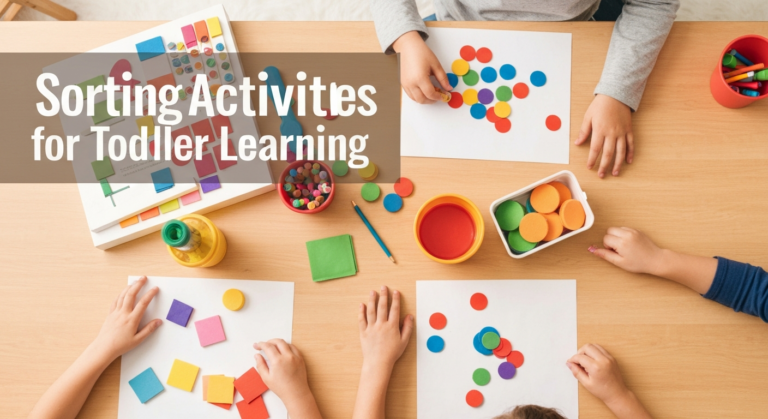
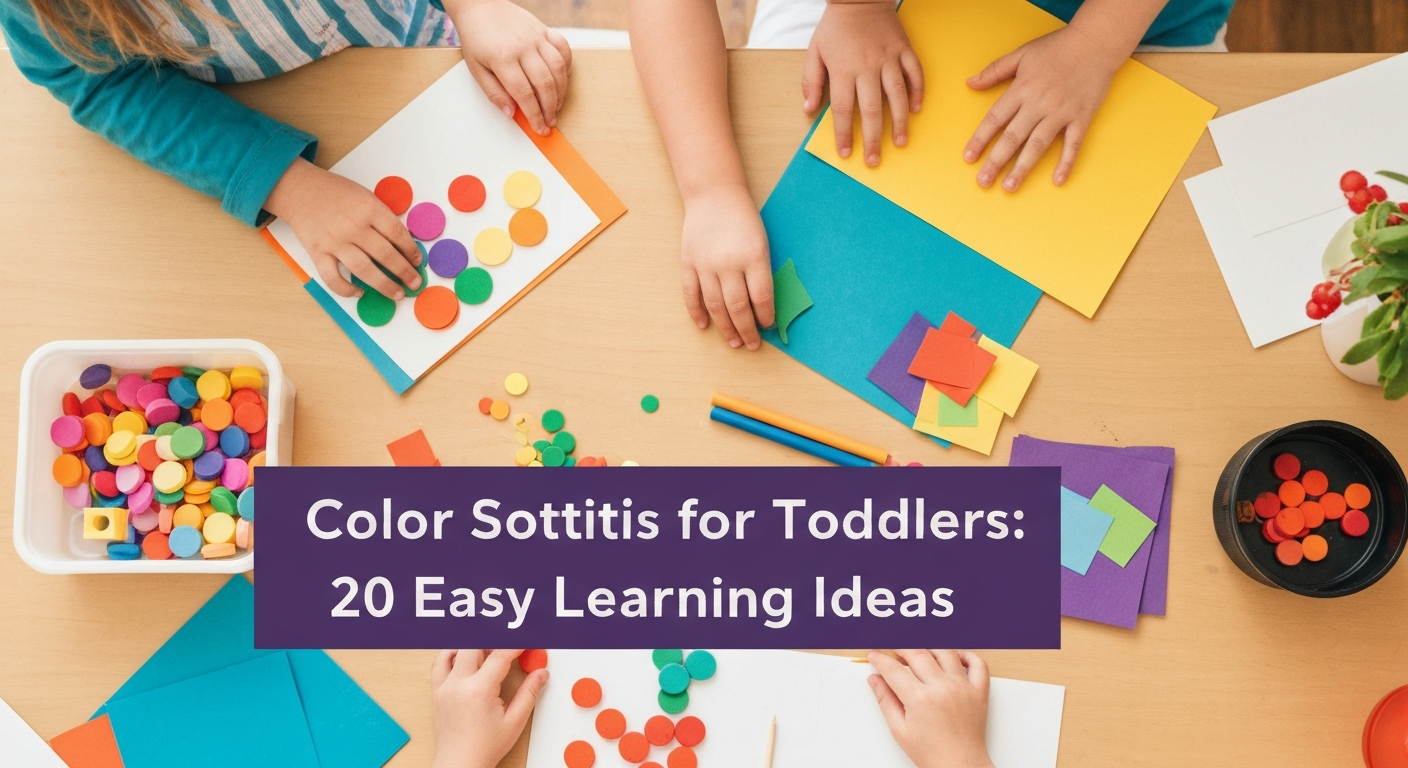
Pom Pom Sorting
Materials: Pom poms in various colors, muffin tin or small containers, tongs or spoon
Setup: Place colored paper circles in muffin tin cups to indicate sorting destinations. Mix pom poms in a bowl.
Activity: Sort pom poms by color into matching cups. Using tongs adds fine motor challenge.
Variations:
- Use ice cube trays for smaller pom poms
- Sort into matching colored cups or bowls
- Add a timer for older toddlers
Button Sorting
Materials: Large buttons in various colors, containers
Setup: Mix buttons together. Provide containers for each color.
Activity: Sort buttons by color. Talk about colors as you work together.
Safety: Buttons are choking hazards. Supervise closely with children under 3.
Block Sorting
Materials: Colored building blocks (Duplo, Mega Bloks, wooden blocks)
Setup: Mix blocks together in a pile.
Activity: Build towers or structures using only one color at a time. Compare tower heights.
Clothespin Matching
Materials: Clothespins, paper plate with colored sections
Setup: Divide paper plate into sections, color each section. Paint or tape matching colors to clothespins.
Activity: Clip clothespins to matching colored sections.
Skills bonus: Clothespin squeezing builds hand strength for writing.
For more fine motor activities, see our fine motor activities guide.
Sock Matching
Materials: Colorful socks from laundry
Setup: Mix single socks together.
Activity: Match pairs by color. This is a practical life skill too.
Food Sorting
Materials: Colorful cereal (Fruit Loops), candy (M&Ms, Skittles), or snacks
Setup: Small bowl of mixed items, sorting containers
Activity: Sort by color. Eat when done (built-in reward).
Options: Use goldfish crackers, colored pasta, or fruit by color.
DIY Sorting Activities
Color Sorting Bins
Materials: Containers or boxes, colored paper or paint, small objects
Setup: Cover or label each container with a different color. Gather small objects in matching colors from around the house.
Activity: Sort objects into matching bins. Hunt for new items to add.
Egg Carton Sorting
Materials: Egg carton, paint or paper, small items to sort
Setup: Paint or line each egg cup with different colors.
Activity: Sort items into matching cups. The defined spaces help toddlers place items precisely.
Rainbow Rice Sorting
Materials: Colored rice (dye rice with food coloring and vinegar), tweezers or spoon, containers
Setup: Mix colored rice together in a bin.
Activity: Sort rice by color using tweezers or fingers. This provides sensory play alongside sorting.
For more sensory activities, check our sensory bin ideas.
Paper Plate Sorting Mat
Materials: Large paper or poster board, colored paper, items to sort
Setup: Glue colored paper circles onto the board as sorting zones.
Activity: Place items on matching colored circles. The visual mat helps organize the activity.
Nature-Based Sorting
Leaf Sorting
Materials: Collected leaves in various shades
Activity: Sort by color (green, yellow, orange, red, brown). Discuss how leaves change colors seasonally.
Rock Painting and Sorting
Materials: Smooth rocks, paint
Setup: Paint rocks in different colors. Let dry completely.
Activity: Sort painted rocks by color. Use for building or games afterward.
Flower Sorting
Materials: Collected flowers or flower petals
Activity: Sort by color. Make color-sorted nature collages.
Active Color Sorting Games
Color Hunt
Activity: Call out a color. Child finds and brings back something that color. Great for learning colors throughout the house.
Variation: Set a timer. How many blue things can you find in one minute?
Colored Hoop Toss
Materials: Hula hoops in different colors, bean bags or soft balls
Setup: Lay hoops on ground. Assign points or simply sort.
Activity: Toss items into matching colored hoops.
Color Relay
Materials: Colored items scattered across a room, matching containers at “home base”
Activity: Race to collect items and sort into correct containers. Works great for multiple children.
Color Freeze Dance
Activity: Play music. When music stops, call a color. Everyone must touch something that color.
For more movement activities, see our gross motor activities guide.
Art-Based Color Sorting
Crayon Sorting
Materials: Mixed crayons, containers or color-coded cups
Activity: Sort crayons by color family. Then use organized crayons for coloring.
Collage Sorting
Materials: Magazine clippings, construction paper in matching colors, glue
Activity: Sort clippings by color. Glue onto matching colored paper to create color collages.
Paint Chip Matching
Materials: Paint sample cards from hardware store (free!), matching objects
Activity: Match objects to paint chips. Discuss shades—light blue vs. dark blue.
Technology-Free Color Learning
Color Books
Read books focused on colors:
- “Brown Bear, Brown Bear, What Do You See?”
- “Mouse Paint”
- “The Color Monster”
After reading, find objects matching colors from the story.
Color Songs
Sing color-focused songs while sorting:
- “I Can Sing a Rainbow”
- Make up songs: “Red, red, red, I found something red…”
Color of the Day
Choose a daily color. Wear it, eat it, look for it, sort it. Immersion builds recognition.
Progression of Skills
Stage 1 (18-24 months):
- Match identical objects (red block to red block)
- Sort into two piles (red vs. not red)
- Name 1-2 colors with help
Stage 2 (2-3 years):
- Sort multiple colors independently
- Match colors across different objects
- Name basic colors
Stage 3 (3-4 years):
- Sort by shades (light blue vs. dark blue)
- Follow multi-step sorting instructions
- Create own sorting categories
Common Challenges and Solutions
Child dumps sorted items immediately:
Normal toddler behavior. The process matters more than the end result. Let them dump and start again.
Consistently confuses two colors:
Often red/orange or blue/green. Use only the confusing colors together for practice, removing other options.
Loses interest quickly:
Keep activities short (5-10 minutes). Rotate activities to maintain novelty.
Gets frustrated with mistakes:
Remove pressure. Sort alongside them without correcting. They’ll self-correct as skills develop.
Knows colors but won’t name them:
Receptive language (understanding) develops before expressive language (speaking). Keep naming colors yourself; they’ll speak when ready.
Extending the Learning
Once basic color sorting is mastered, extend the concept:
Sort by two attributes: Find items that are red AND round.
Create patterns: Red, blue, red, blue…
Introduce shades: Sort light colors vs. dark colors.
Predict and check: “If we sort these, which pile will be biggest?”
Graph results: Which color do we have most of? Make a simple bar graph.
Making It Part of Daily Life
Laundry: Sort clothes by color before washing.
Putting away toys: “Let’s put all the blue toys in this bin.”
Setting table: “Find the red plate.”
Getting dressed: “Can you find your blue shirt?”
Grocery shopping: “Help me find something orange.”
The more color sorting becomes part of routine, the more natural color recognition becomes.
Materials to Gather
Start a color sorting supply kit:
- Pom poms (multi-color pack)
- Colored cups or bowls
- Muffin tin
- Tongs, tweezers, spoons
- Buttons (for supervised play)
- Colored paper
- Paint chips
Having materials ready means you can set up sorting activities in minutes.
Color sorting is one of those magical activities where learning looks exactly like play. With these ideas, you can offer endless variations that grow with your child’s developing skills—all while building the foundation for more complex thinking later.