
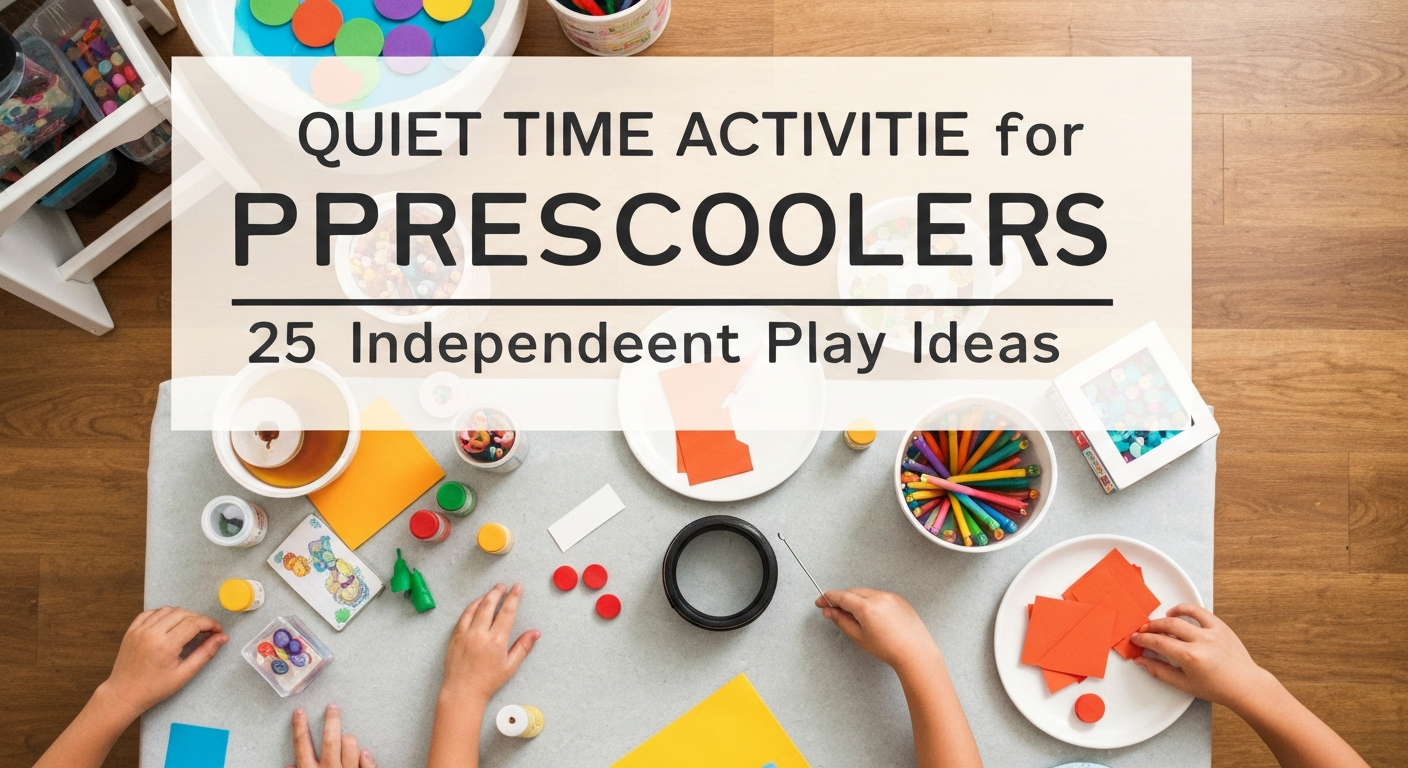
Quiet Time Activities for Preschoolers: 25 Independent Play Ideas
Discover how to establish a successful quiet time routine for your preschooler, even if they've outgrown naps. You'll learn the benefits, setup tips, and 25 independent play ideas to keep them engaged.
- Establish quiet time daily to reduce meltdowns and foster independent play.
- Set up a dedicated, comfortable space with clear rules and a visual timer.
- Limit activity choices to 3-5 and rotate them weekly to maintain novelty.
- Offer a variety of independent activities like books, puzzles, and art supplies.
- Ensure all quiet time materials are easily accessible for your child.
When naps phase out but the need for rest remains, quiet time fills the gap. This protected period lets preschoolers recharge while giving parents a desperately needed break. The key is engaging activities that children can do independently without constant supervision or noise.
Why Quiet Time Matters
Even children who’ve outgrown naps need downtime. The preschool brain processes enormous amounts of information daily. Rest—even without sleep—allows consolidation of learning and emotional regulation.
Benefits of quiet time:
- Reduces afternoon meltdowns
- Develops independent play skills
- Provides parent respite
- Teaches self-entertainment
- Builds attention span
- Creates predictable daily rhythm
Most preschoolers benefit from 60-90 minutes of quiet time daily, though some may need more or less.
Setting Up Successful Quiet Time
Location Matters
Bedroom: Natural boundary, access to toys and books. May trigger sleep resistance if associated with bedtime struggles.
Playroom: Dedicated play space works well if it can be made quiet-time specific.
Living room corner: Works if you need proximity. Create visual boundaries with a rug or tent.
Wherever works: The “right” location is wherever quiet time actually happens.
Establishing Expectations
Start gradually: Begin with 15-20 minutes, extending as the habit develops.
Use visual timers: Digital timers, sand timers, or “Time Timer” clocks help children see time passing.
Clear rules:
- Stay in designated space
- Play quietly
- Come out when timer signals
- If you need something, call once (not repeatedly)
Consistent timing: Same time each day builds routine. Post-lunch works well for most families.
Preparing the Space
Rotate activities: Keep quiet time novel by rotating available activities weekly.
Limit choices: Too many options overwhelm. Offer 3-5 activities maximum.
Everything accessible: Children should be able to get what they need independently.
Comfortable seating: Bean bag, floor cushions, cozy corner.
For more on independent play, see our Montessori activities guide.
Quiet Time Activity Ideas
Books and Literacy
Picture books: Even non-readers enjoy looking at pictures and “reading” stories they know.
Seek-and-find books: “Where’s Waldo,” “I Spy,” hidden picture books occupy attention.
Lift-the-flap books: Interactive elements extend engagement.
Magnetic letters: Spell words on a cookie sheet or magnetic board.
Alphabet puzzles: Letter recognition practice.
Audiobooks with picture books: Listening while following along builds literacy.
Puzzles and Building
Jigsaw puzzles: Age-appropriate puzzles (12-50 pieces for preschoolers).
Tangrams: Shape puzzles that build spatial reasoning.
Pattern blocks: Create designs with geometric shapes.
LEGO or Duplo: Free building or following simple instruction cards.
Magna-Tiles: Quiet magnetic building with endless possibilities.
Lincoln Logs or building sets: Constructive play without noise.
Art and Creativity
Coloring books: Provide quality colored pencils (quieter than crayons).
Sticker books: Placing stickers develops fine motor skills.
Dot marker pages: Stamping is satisfying and relatively contained.
Play-Doh or modeling clay: Quiet, open-ended play.
Water painting books: Water-activated pages that dry and reset.
Drawing prompts: Simple cards with drawing ideas.
For more art ideas, see our mess-free painting guide.
Sorting and Organizing
Bead stringing: Large beads on chenille stems or shoelaces.
Lacing cards: Threading practice with shaped cards.
Sorting trays: Small items sorted by color, size, or type.
Coin sorting: Real or play coins into slots.
Matching games: Memory or matching cards played solo.
Sensory Activities
Kinetic sand: Moldable sand that stays contained.
Sensory bottles: Calming glitter bottles to watch.
Fidget toys: Quiet fidgets for tactile stimulation.
Playdough with tools: Rolling, cutting, shaping.
Water beads: Squishing and scooping (supervised for younger children).
Pretend Play
Dollhouse play: Quiet imaginative scenarios.
Action figures or small toys: Independent storytelling.
Dress-up basket: Quiet costume exploration.
Stuffed animal care: “Caring for” stuffed animals with blankets and pretend food.
Play kitchen: Pretend cooking without the noise of real pots.
Learning Activities
Workbooks: Age-appropriate tracing, matching, or early math pages.
Flashcards: Self-quizzing or sorting games.
Educational apps: Tablet time with learning apps (if screens are allowed).
Quiet board games: Simple games playable solo or with stuffed animals.
For printable learning activities, check our alphabet worksheets.
Calming Activities
Yoga cards: Simple pose cards for child-led stretching.
Breathing exercises: Stuffed animal on belly for deep breathing practice.
Guided meditation apps: Children’s meditation designed for quiet time.
Cloud watching: Near a window with cushions.
Listening games: Sound identification recordings.
Quiet Time Bins
Create themed bins that rotate weekly. Each bin contains everything needed for one activity.
Sample Bin Ideas
Puzzle Bin:
- 2-3 puzzles
- Pattern blocks with design cards
- Tangram set
Art Bin:
- Coloring book
- Colored pencils
- Sticker sheets
- Blank paper
Building Bin:
- LEGO set with simple instructions
- Small building blocks
- Challenge cards
Literacy Bin:
- 5-6 books
- Magnetic letters and board
- Letter matching game
Sensory Bin:
- Kinetic sand with molds
- Play-Doh with tools
- Sensory bottles
Pretend Play Bin:
- Small figurines
- Fabric scraps for backgrounds
- Props (tiny furniture, vehicles)
Troubleshooting Common Problems
Child Won’t Stay in Space
Solutions:
- Start with shorter periods, building gradually
- Stay nearby initially, increasing distance over time
- Use visual timer so they see time passing
- Offer highly engaging activities
- Avoid making quiet time feel like punishment
Constant Interruptions
Solutions:
- Address common needs before quiet time (bathroom, water, snack)
- Create a “quiet time basket” with allowed interruption items
- Establish “one call” rule—they can call once, then must wait
- Praise uninterrupted quiet time afterward
Gets Bored Quickly
Solutions:
- Rotate activities more frequently
- Offer more complex activities
- Let child help choose activities
- Add novelty (new stickers, different books)
- Consider if activities match interests
Falls Asleep
If that’s okay: Let them sleep. They clearly needed it.
If it disrupts bedtime: Move quiet time earlier in the day, ensure activities are engaging not sleep-inducing, keep room bright.
Refuses Quiet Time Entirely
Solutions:
- Rename it (“special play time,” “rest and relax time”)
- Start with parent in room, gradually withdrawing
- Connect it to something desirable (“after quiet time we can…”)
- Examine timing—maybe earlier or later works better
- Consider if they’re developmentally ready (most are by 3)
Age-Appropriate Expectations
3-year-olds:
- 30-60 minutes
- May need parent nearby initially
- Simpler activities
- Frequent check-ins okay
4-year-olds:
- 60-90 minutes
- More independent
- Complex activities
- Can follow rules consistently
5-year-olds:
- 60-90 minutes
- Fully independent
- Can choose and manage own activities
- Understand timer and expectations
Making Quiet Time Special
Quiet time works best when children look forward to it rather than resisting.
Special quiet-time-only items: Some toys only come out during quiet time, making it appealing.
Comfortable space: Cozy cushions, soft lighting, beloved stuffed animals.
Positive framing: “This is your special time to play however you want.”
Choice within structure: Let them choose from prepared options.
Celebration afterward: “You did great at quiet time! Now we can [activity they enjoy].”
Quiet Time Without a Dedicated Room
Small spaces work:
- Corner of living room with visual boundaries
- Tent or canopy for defined space
- Blanket on floor marking “quiet time zone”
- Closet converted to cozy nook
Apartment living:
- Same space, different setup
- Headphones for audiobooks (supervised)
- Extra-quiet activities only
- Visual barriers (room divider, curtain)
Shared rooms:
- Different quiet time locations for each child
- Staggered timing
- Very clear personal space boundaries
Transitioning from Naps
If your child recently dropped naps:
Weeks 1-2: Keep in dark room with books. Sleep may still happen.
Weeks 3-4: Add quiet activities while maintaining rest expectation.
Month 2+: Fully transition to activity-based quiet time.
Watch for signs they still need sleep: If they frequently fall asleep or are extra cranky, they may need the nap back or an earlier bedtime.
The Parent Break
Quiet time isn’t just for children—it’s essential parent respite. Use this time for:
- Your own rest
- Tasks that require concentration
- Self-care
- Quiet productivity
Protecting this time benefits everyone. A rested parent is a better parent. A child who can self-entertain is building crucial skills.
Quiet time may take effort to establish, but once the habit forms, it becomes a treasured part of the daily rhythm—for children and parents alike.