Boredom Busters: 50 Things to Do When Kids Say They’re Bored
This article offers 50 boredom-busting activities, adapted from a teacher's list, to help your kids engage in creative, independent play. You'll find categorized ideas for arts, crafts, and active games using common household items.
- View your child's boredom as a chance for creativity and independence.
- Access 50 categorized activities to combat boredom instantly.
- Utilize common household items for engaging arts, crafts, and games.
- Channel pent-up energy with active play and movement games.
This post contains affiliate links. As an Amazon Associate I earn from qualifying purchases.
In this article (6 sections)
The Two Words Every Parent Dreads Hearing
“I’m booooored.” There it is. The whine that can derail a perfectly good Saturday morning. Your child is standing in a room full of toys, books, art supplies, and games, and somehow none of it registers as interesting. Before you reach for the tablet or lose your patience, take a breath. That moment of boredom is actually a golden opportunity for creativity, independence, and problem-solving to kick in.
During my years teaching preschool and kindergarten, I kept a laminated list taped inside my supply closet: fifty activities I could pull out at a moment’s notice when energy shifted and attention wandered. That list saved me on rainy days, post-recess slumps, and those unpredictable stretches when nothing on the lesson plan was landing. I have adapted that list for families, and it has become the most-requested resource I have ever shared. Here are fifty boredom busters organized by category so you can find the perfect activity in seconds.
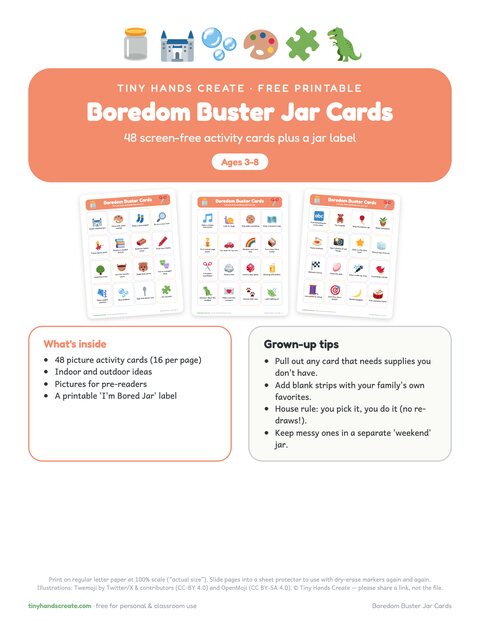
Free printable · 5 pages
Boredom Buster Jar Cards
48 screen-free picture activity cards and an 'I'm Bored Jar' label.
Free. Your download link appears right here. You'll also join the Daily Printable Drop. Unsubscribe anytime. Privacy
Creative Arts and Crafts (Activities 1-12)
When boredom strikes, putting something in a child’s hands is the fastest way to shift their energy. These projects use supplies you likely already own.
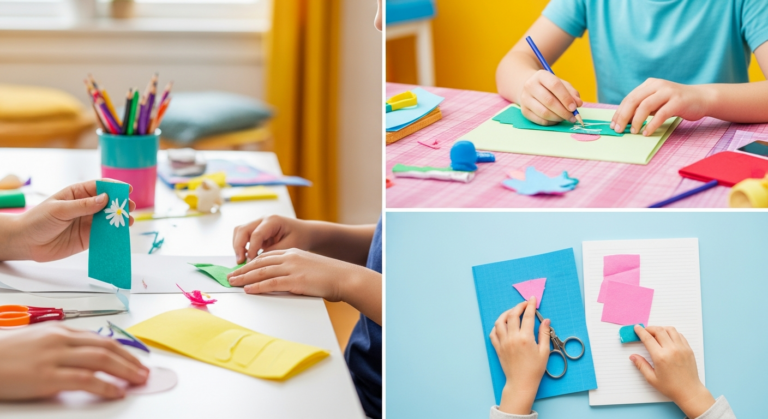
- Paper bag puppets: Grab brown paper lunch bags, markers, googly eyes, yarn scraps, and construction paper. Each child creates a character, then put on a puppet show using the back of a couch as a stage.
- Collage art: Pull out old magazines, junk mail, catalogs, scissors, and glue sticks. Challenge kids to create a collage around a theme: their dream bedroom, a fantasy animal, or a pretend restaurant menu.
- Toilet paper roll sculptures: Save cardboard tubes and let kids cut, fold, paint, and tape them into animals, rockets, buildings, or robots. Add pipe cleaners and pom-poms for details.
- Tape resist watercolor painting: Press strips of painter’s tape onto watercolor paper in patterns, stripes, letters, or shapes. Paint over the entire page with watercolors. Peel the tape when dry to reveal white patterns underneath.
- Homemade playdough: Mix 1 cup flour, half cup salt, 2 tablespoons cream of tartar, 1 cup water, and 1 tablespoon vegetable oil in a pot. Cook over medium heat, stirring constantly until it forms a ball. Add food coloring. Five minutes of cooking yields hours of play.
- Nature art: Go outside and collect leaves, sticks, petals, and pebbles. Arrange them on cardboard and glue them into a picture or pattern. This combines outdoor exploration with art.
- Friendship bracelets: Cut yarn or embroidery floss into 12-inch lengths. Teach basic braiding or knotting techniques. Even simple twisted yarn bracelets make kids feel like they have created jewelry.
- Tin foil sculptures: Hand each child a large sheet of aluminum foil and challenge them to sculpt an animal, a person, or an object. Foil is surprisingly forgiving and easy to shape for little hands.
- Sticker scene creation: Give children a blank sheet of paper and a large collection of stickers. They create an entire scene, a park, an underwater world, a space adventure, using only stickers and drawn details.
- Cardboard box creations: A large box becomes a car, spaceship, house, or boat. Smaller boxes become dollhouses, garages, or treasure chests. Keep markers, tape, and scissors nearby and let imagination lead.
- Coffee filter butterflies: Flatten a coffee filter, color it with washable markers, then spritz with water to create a tie-dye effect. Pinch the center with a clothespin for the body and spread the sides as wings.
- Salt painting: Draw a design with white glue on cardstock, pour salt over the glue and shake off the excess. Use a paintbrush to touch liquid watercolor or diluted food coloring to the salt lines and watch the color spread and bloom.
Active Play and Movement Games (Activities 13-24)
Sometimes boredom is really pent-up physical energy in disguise. These activities get bodies moving and burn off that restless energy.
- Indoor obstacle course: Use couch cushions to climb over, chairs to crawl under, tape lines on the floor to balance walk, and pillows to hop between. Time each run and challenge kids to beat their own record.
- Dance party freeze: Play music and dance wildly. When the music stops, everyone freezes. Anyone who moves is out. Last one standing picks the next song.
- Balloon volleyball: Stretch a string or streamer across the room at child height. Use a blown-up balloon as the ball. It moves slowly enough for even young children to play and it will not break anything.
- Yoga animal poses: Look up simple kids yoga poses: downward dog, cobra, butterfly, flamingo, and tree. Call out animal names and see who can hold the pose longest. This builds balance, flexibility, and body awareness.
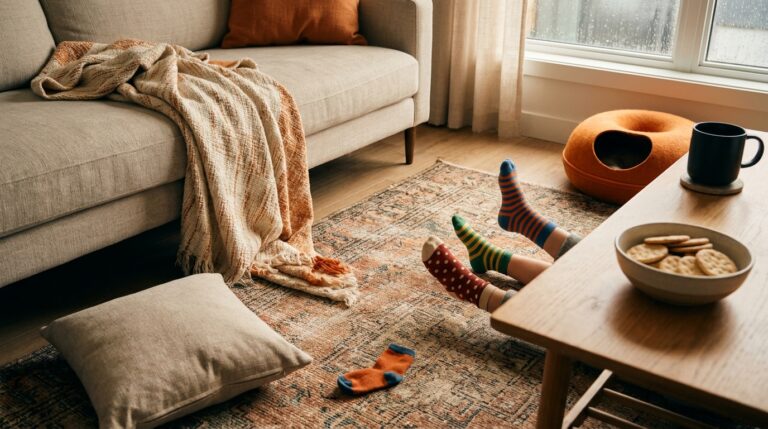
- Sock skating: On hardwood or tile floors, put on fuzzy socks and slide around like ice skaters. Set up a simple course with tape on the floor to skate through.
- Treasure hunt: Hide 15 to 20 small objects around the house and create a picture-based clue list for younger kids or a written clue list for readers. Small toys, coins, stickers, or wrapped candies make great treasures.
- Pillow fight arena: Set boundaries, establish rules like no hitting faces, and let the pillow feathers fly. Sometimes controlled chaos is exactly what kids need.
- Hallway bowling: Stack empty water bottles or toilet paper rolls at the end of a hallway. Roll a soft ball to knock them down. Keep score for a math bonus.
- Simon Says workout edition: Play Simon Says but use only exercise moves: do five jumping jacks, touch your toes, crab walk to the wall, bear crawl back. Everyone gets a workout and the giggles flow.
- Blanket fort building: Provide chairs, blankets, pillows, clothespins, and a flashlight. Children design and build their own cozy hideout. Pack snacks and books inside for a quiet retreat afterward.
- Paper airplane contest: Fold paper airplanes using different designs and test which flies farthest, highest, and straightest. Mark a launch line with tape and measure distances. This is sneaky STEM learning.
- Indoor hopscotch: Use painter’s tape to create a hopscotch grid on the floor. Toss a beanbag or balled sock to determine your starting square.
Learning Through Play (Activities 25-36)
These activities feel like pure fun but they are quietly building math, literacy, science, and critical thinking skills.
- Kitchen science experiments: Mix baking soda and vinegar for a fizzing volcano. Drop food coloring into milk with dish soap for swirling color magic. Grow a celery stalk in colored water to watch it change color overnight.
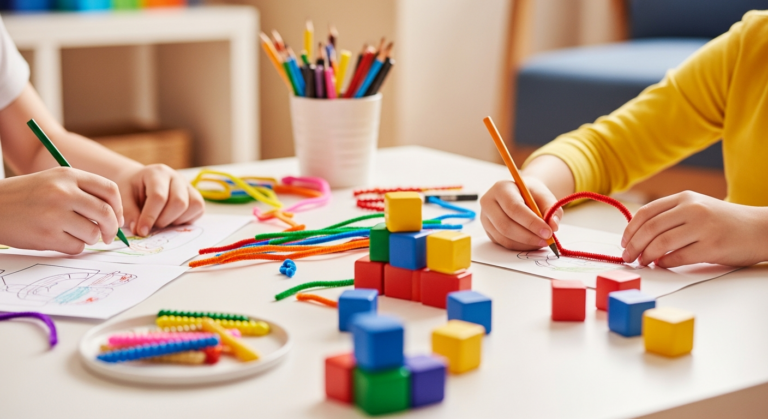
- Sorting challenges: Dump out a container of mixed items, buttons, beads, LEGO bricks, dry pasta shapes, and challenge kids to sort by color, size, shape, or type. Sorting is foundational math thinking.
- Letter and number hunts: Give children a clipboard and pencil. Challenge them to find every letter of the alphabet somewhere in the house on packaging, books, signs, or clothing tags.
- DIY board game: Help children create their own board game on poster board with a winding path, colored spaces, and rule cards they write themselves. Use small toys as game pieces and a homemade spinner.
- Measurement scavenger hunt: Give kids a ruler or measuring tape and a list: find something exactly 6 inches long, something taller than 2 feet, something wider than your hand span. This builds real-world measurement skills.
- Story dictation: Have your child tell you a story while you write it down word for word. Then they illustrate each page. Staple the pages together for a homemade book they authored themselves.
- Pattern block designs: If you have pattern blocks or tangrams, set out challenge cards showing a design to replicate. No pattern blocks? Cut shapes from construction paper as a DIY version.
- Coin counting practice: Dump a jar of coins on the table. Sort them by type, stack them in groups, and practice counting totals. Set up a pretend store where items have price tags and children pay with real coins.
- Shadow tracing: Place a toy or object in direct sunlight or flashlight beam and trace its shadow on paper. Move the light source and trace again to see how the shadow changes. Discuss why this happens.
- Map drawing: Challenge kids to draw a map of their house, bedroom, or yard from a birds-eye view. Add labels, a compass rose, and a map key. This builds spatial thinking and early geography skills.
- Sink or float experiments: Fill a large bowl with water and gather 15 to 20 household items. Before testing each one, have children predict whether it will sink or float. Record results on a chart.
- Secret code messages: Create a simple cipher where each letter equals a number or symbol. Write coded messages for children to decode, then let them write coded messages back to you.
Imaginative and Pretend Play (Activities 37-44)
Pretend play is where children process their world, build empathy, and develop language skills. These setups spark extended imaginative play sessions.
- Restaurant play: Set up a pretend restaurant with a menu written on paper, a notepad for taking orders, play food or pictures of food, and a table set with real plates and cups. Children take turns being the chef, server, and customer.
- Vet clinic: Gather all the stuffed animals, set up a check-in desk with paper and pencils, use a toy stethoscope or pretend one, and wrap bandages on injured stuffed patients. Add a waiting room with books.
- Post office: Children write letters or draw pictures, place them in homemade envelopes, add sticker stamps, and deliver them to family members in different rooms of the house. Set up a mail sorting station with labeled bins.
- Construction site: Use building blocks, toy trucks, playdough, and sand or rice in a bin. Children plan and build a structure, using the trucks to haul materials. Add hard hats if you have dress-up supplies.
- Space mission: Build a spaceship cockpit from a large box with drawn-on controls, buttons, and screens. Create a mission checklist and count down from ten for launch. Explore the house as different planets.
- Grocery store: Label empty food containers with price stickers. Set up shelves, provide bags and a toy cash register or a calculator. Children shop with a list, pay at the register, and bag their groceries.
- Hair salon: Use dolls or willing family members as clients. Provide brushes, hair clips, spray bottles with water, and towels. Children style hair, check clients in, and provide pretend salon services.
- Camping adventure: Set up a tent or blanket fort indoors, use a flashlight as a campfire, tell stories, sing songs, and make pretend s’mores from graham crackers, marshmallows, and chocolate.
Quiet and Independent Activities (Activities 45-50)
Sometimes bored children actually need calm, focused activities rather than high-energy options. These work beautifully for winding down or when you need a peaceful stretch.
- Audiobook and drawing: Play an age-appropriate audiobook while children draw whatever the story inspires. This combines literacy with creative expression and can occupy 30 to 60 minutes easily.
- Jigsaw puzzles: Keep a rotation of puzzles at your child’s level. The satisfaction of placing that final piece is a powerful reward that builds persistence and spatial reasoning.
- Window art: Washable window markers or window clings let children turn sliding glass doors and windows into art canvases. Draw scenes, trace shadows, or create stained glass effects that clean up with a damp cloth.
- Journaling and drawing: Provide a special notebook and colored pencils. Offer a prompt like “draw your dream treehouse” or “write about your favorite day ever.” Older kids often get absorbed in journals for long stretches.
- Building card houses: Use a standard deck of playing cards and challenge children to build the tallest card house they can. This teaches patience, steady hands, and engineering thinking through trial and error.
- Sensory bin exploration: Fill a bin with dried rice, dried beans, kinetic sand, or water beads. Add scoops, cups, funnels, small figurines, and let children explore freely. Sensory bins are self-directing and deeply calming.
Print this list, stick it on the refrigerator, and the next time you hear those dreaded words, point your child right to it. Better yet, let them pick three options and choose their favorite. When children have agency in selecting their activity, the boredom dissolves almost instantly, and you get to watch them rediscover just how creative and capable they truly are.
Crafty Mama
Crafty Mama is a former elementary art teacher turned stay-at-home parent who believes every child is creative — they just need the right invitation. She develops age-appropriate activities, crafts, and projects that spark imagination while keeping mess (and parent stress) to a minimum.