Independent Play Ideas for Toddlers
Discover how to foster independent play in your toddler, a crucial skill for their development. Learn to create an engaging environment with activity stations and curated toy selections to boost their self-regulation, creativity, and focus.
- Understand independent play boosts your toddler's self-regulation & focus.
- Create 3-4 distinct activity stations in your home for varied play.
- Use low, open shelving for easy toy access and to foster autonomy.
- Limit available toys to 8-12 to encourage deeper, sustained engagement.
This post contains affiliate links. As an Amazon Associate I earn from qualifying purchases.
In this article (6 sections)
- She Played Alone for Forty Minutes and I Almost Cried
- Why Independent Play Matters for Toddler Development
- Setting Up for Success: The Independent Play Environment
- The Best Independent Play Activities for Toddlers
- How to Build Independent Play Skills Gradually
- Troubleshooting Common Independent Play Challenges
She Played Alone for Forty Minutes and I Almost Cried
My friend texted me a photo last month. Her 22-month-old was sitting on the kitchen floor, deeply absorbed in transferring dried pasta from one bowl to another using a large wooden spoon. The text read: “She has been doing this for FORTY MINUTES. I took a shower, made coffee, AND replied to emails. Is this real life?” Yes, my friend. That is the beautiful, life-changing reality of independent play, and it does not happen by accident.
Independent play is one of the most important developmental skills a toddler can build, and one of the most misunderstood. It is not about ignoring your child or leaving them alone. It is about creating an environment so rich with appropriate, engaging options that your toddler becomes absorbed in self-directed exploration. After years of setting up independent play systems in my preschool classroom and coaching parents through the process at home, I can tell you that every toddler is capable of independent play. They just need the right setup, the right expectations, and a little patience during the learning curve.
Why Independent Play Matters for Toddler Development
Before we get to the activities, it helps to understand why independent play is so much more than a parenting convenience. When toddlers play independently, they are developing critical life skills:
- Self-regulation: Choosing an activity, sticking with it, and managing frustration when something does not work as expected teaches emotional control that no adult-directed activity can replicate.
- Creativity and problem-solving: Without an adult directing every move, children discover their own solutions. They figure out how to stack blocks so they do not fall, how to fit shapes into sorters, and how to scoop without spilling.
- Concentration: Independent play is where attention span grows. Each time a toddler stays engaged with an activity for a few minutes longer than before, their ability to focus deepens.
- Confidence: A child who can entertain themselves knows, on a deep level, that they are capable and resourceful. This self-assurance carries into every area of development.
- Executive function: Planning what to play with, initiating an activity, and transitioning between activities are all executive function skills that independent play exercises daily.
The research is clear: children who develop strong independent play skills in toddlerhood show better focus, greater emotional resilience, and stronger creative thinking throughout childhood. This is not a nice-to-have. It is a foundational skill.
Setting Up for Success: The Independent Play Environment
Independent play does not just happen when you set a toddler down and walk away. The environment needs to be designed to invite exploration and sustain interest. Here is how to set it up:
Create Activity Stations
Designate 3 to 4 spots in your home as play stations, each with a different type of activity. Rotate materials every few days. Stations might include:
- A sensory station: a bin with rice, dried pasta, or water beads plus scoops and containers
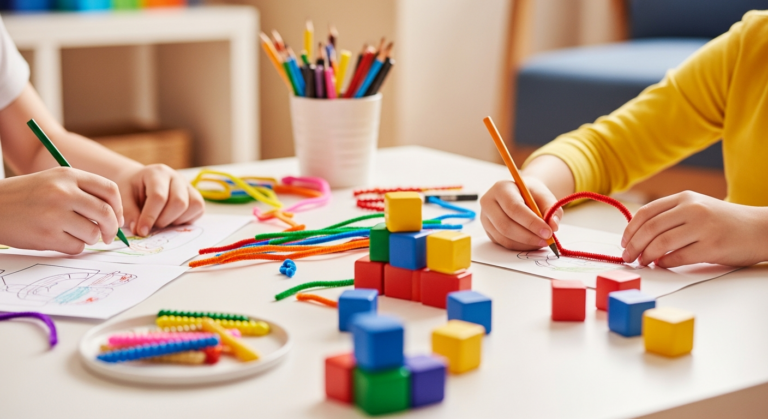
- A building station: wooden blocks, stacking cups, or magnetic tiles on a low shelf
- A art station: large crayons, paper, and stickers on a toddler-height table
- A pretend play station: a play kitchen, baby dolls, or stuffed animals with blankets
Use Open Shelving at Toddler Height
Store activities on low, open shelves where your toddler can see and access everything without help. Use small baskets or trays to contain each activity. When a child can choose what to play with independently, they feel a sense of autonomy that fuels longer engagement. Avoid toy boxes where everything gets jumbled together because toddlers get overwhelmed by visual chaos and play less, not more.
Reduce the Number of Available Toys
This is counterintuitive but critical. Having too many options actually reduces independent play. Toddlers move rapidly from toy to toy without settling into deep play. Keep 8 to 12 activities available at a time and store the rest in a closet. Rotate new items in every week. When a familiar toy reappears after a few weeks in storage, it feels brand new and captures attention all over again.
The Best Independent Play Activities for Toddlers
These activities have been tested with hundreds of toddlers in my classroom and consistently produce the longest stretches of engaged, self-directed play.
Transfer Activities
Toddlers are wired to move things from one container to another. It is a fundamental motor drive, and setting up transfer activities channels that drive into focused play.
- Spoon transfer: Two bowls and a large spoon. Fill one bowl with dried beans, large pom-poms, or cotton balls. The toddler scoops and transfers to the empty bowl. Once one bowl is empty, they transfer back.
- Pouring practice: A small pitcher and two cups on a tray. Fill the pitcher with dry rice or water (if you are feeling brave). The toddler pours into one cup, then the other.
- Tong transfer: Provide child-sized tongs or large tweezers with pom-poms or cotton balls. Squeezing the tongs builds the exact muscles needed for scissors and pencil grip.
- Funnel play: A funnel, a bottle, and a scoop with dried rice or sand. Toddlers scoop material and pour it through the funnel into the bottle. The visual reward of watching material flow through the funnel is endlessly satisfying.
Sensory Bins
Sensory bins are independent play gold. Fill a large, shallow plastic bin with a base material and add tools and treasures for exploration.
Favorite base materials:
- Dried rice (plain or dyed with food coloring and vinegar)
- Dried pasta in various shapes
- Kinetic sand
- Water with a few drops of dish soap for bubbles
- Shredded paper
- Dried oatmeal
Tools to include: measuring cups, small funnels, plastic animals, scoops, containers with lids, large spoons, and sieves. Place the bin on a towel or inside a larger under-bed storage container to catch spillover. Sensory bins can occupy toddlers for 20 to 45 minutes once they are familiar with the concept.
Stacking and Building
Simple stacking toys provide extended independent play because the challenge naturally adjusts to the child’s skill level. As they get better, they stack higher, which means more dramatic crashes, which means more motivation to try again.
- Wooden blocks: Start with large, lightweight blocks and progress to smaller ones as coordination improves.
- Stacking cups: These can be nested, stacked into towers, used as scoops, or turned into a ball-drop game.
- Cardboard boxes: Save small shipping boxes. Toddlers stack them, knock them over, put things inside, carry them around, and sit in them. Boxes are endlessly versatile.
- Magnetic tiles: Even young toddlers can stick magnetic tiles together on a refrigerator or metal baking sheet. The satisfying click of magnets connecting holds attention beautifully.
Water Play
Set up a small tub of water on the kitchen floor (on top of a towel) with cups, funnels, a turkey baster, a whisk, and a sponge. Water play is inherently calming and deeply absorbing for toddlers. The sensory input from warm water soothes the nervous system while the pouring and squeezing actions build motor skills. Add a few drops of food coloring or a squirt of dish soap for variation.
Books and Quiet Exploration
Create a cozy book nook with a small basket of 8 to 10 board books, a soft pillow or cushion, and good lighting. Even toddlers who cannot read will sit and turn pages, point at pictures, and babble to themselves about the images. Rotate books weekly. Include books with textured pages, lift-the-flap features, and simple repetitive text for maximum engagement.
How to Build Independent Play Skills Gradually
If your toddler currently will not play alone for more than 30 seconds, do not despair. Independent play is a skill that builds over time with consistent practice. Here is a proven gradual approach:
- Week 1 – Play alongside: Sit next to your child at the activity station. Play with your own set of materials without directing their play. Simply model focused, calm engagement. Do this for 15 to 20 minutes daily.
- Week 2 – Create small distance: Move a few feet away. Stay in the same room but occupy yourself with something quiet like reading or folding laundry. If your child comes to you, gently redirect: “I see you are playing with the blocks. Can you show me how high you can stack them?” then return to your activity.
- Week 3 – Step away briefly: After your child is engaged, step into the next room for 2 to 3 minutes, then return. Gradually extend the time away. Always come back before your child gets distressed.
- Week 4 – Extend the window: By now, your child has experienced repeated success with independent play. Extend the duration by 5 minutes each session. Celebrate their engagement when you return: “You played with those cups for so long! Tell me about what you made.”
Be patient with this process. Some toddlers take two weeks to build independent play habits, others take six. Both timelines are completely normal. The key is consistency: same time each day, same environment, same calm energy from you.
Troubleshooting Common Independent Play Challenges
Even with the perfect setup, bumps happen. Here are solutions to the most common obstacles:
- “My toddler just dumps everything and moves on.” This is actually a developmental stage, not a problem. Dumping IS the play for young toddlers. Provide activities where dumping is the point: bins to dump and refill, baskets to empty and reload, cups to pour. As they mature, the play will evolve from dump-and-move to dump-and-explore.
- “They only want to play with me.” This is normal attachment behavior. Use the gradual approach above. Also, start independent play at a time when your child is well-rested and fed. Hunger and tiredness make children clingy.
- “The activities only hold attention for five minutes.” Five minutes IS independent play for a 12 to 18 month old. At this age, that is a win. Have multiple stations ready so they can rotate naturally. Attention span grows with age and practice.
- “They make a huge mess.” Contain the mess rather than preventing it. Use trays under sensory bins, put a shower curtain under water play, and keep a small broom accessible so cleanup can be part of the routine. Mess is evidence of exploration, and exploration is learning.
Independent play is not a luxury or a selfish parenting wish. It is a developmental necessity that benefits your child profoundly. Set up the environment, trust the process, and give your toddler the gift of discovering what they can do all on their own.
Crafty Mama
Crafty Mama is a former elementary art teacher turned stay-at-home parent who believes every child is creative — they just need the right invitation. She develops age-appropriate activities, crafts, and projects that spark imagination while keeping mess (and parent stress) to a minimum.