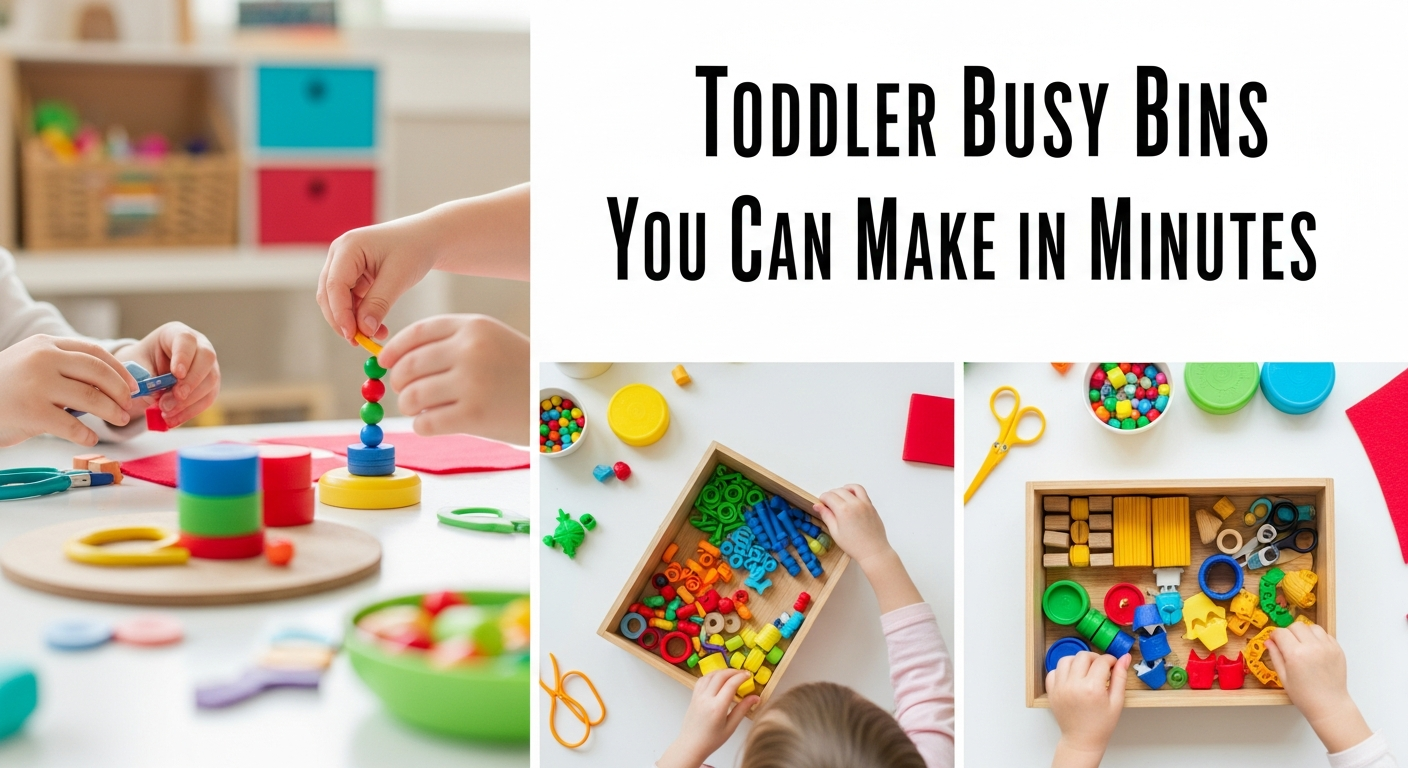
Toddler Busy Bins You Can Make in Minutes
Learn how to create simple, self-contained "busy bins" for your toddler in minutes using common household items. These activities provide independent play, boost development, and give you much-needed breaks.
- Discover your simple formula for creating effective busy bins.
- Use common household items like muffin tins and pom poms.
- Focus on one implied action for intuitive toddler play.
- Boost your toddler's fine motor skills and concentration.
- Prepare 5-10 bins for quick sanity-saving activities.
This post contains affiliate links. As an Amazon Associate I earn from qualifying purchases.
It was 4:47 PM on a Tuesday — that brutal no-man’s-land between the end of nap time and when dinner would be ready — and my toddler was systematically pulling every single book off the shelf for the third time that day. I was exhausted, dinner was still frozen, and I needed ten uninterrupted minutes. That’s when I grabbed a muffin tin, filled each cup with something different from the junk drawer (rubber bands, paper clips, wine corks, buttons, and hair ties), set it on the floor, and watched my 22-month-old sit down and quietly explore every single cup for the next twenty minutes. Twenty. Minutes. That accidental muffin tin was my first busy bin, and it completely changed how I survived the toddler years.
In this article (5 sections)
What Are Busy Bins and Why Do They Work So Well?
A busy bin (sometimes called a busy bag, activity tray, or invitation to play) is simply a self-contained, portable activity that’s pre-assembled and ready to go the moment you need it. Think of it as a grab-and-go engagement kit for toddlers. The best busy bins require zero setup, minimal supervision, and no instructions — you hand it to the child and they figure out what to do.
Busy bins work because they tap into what toddlers are naturally driven to do: explore, sort, dump, fill, open, close, stack, and manipulate small objects. Instead of fighting these impulses (“stop taking everything out of the drawer!”), busy bins channel them into purposeful play.
The developmental benefits are significant:
- Fine motor development: Grasping, pinching, twisting, and transferring small objects strengthen hand muscles
- Focus and concentration: Self-directed exploration builds attention span naturally
- Independent play skills: Busy bins teach children to entertain themselves — a crucial life skill
- Cognitive development: Sorting, matching, and problem-solving happen organically
- Sensory processing: Different textures, weights, and shapes provide rich sensory input
And from a parent survival standpoint, having 5-10 pre-assembled busy bins in rotation means you always have a sanity-saving activity ready for that time of day — whether it’s the late afternoon meltdown hour, a doctor’s waiting room, a work-from-home call, or a long car ride.
The Five-Minute Busy Bin Formula
Every effective busy bin follows the same basic formula: a container + a collection of objects + one implied action. That’s it. You don’t need to spend hours on Pinterest or buy specialized materials. Here’s how to assemble them in minutes using things you already own.
Choosing Your Container
- Muffin tins: Perfect for sorting activities — 6 or 12 cups provide natural compartments
- Plastic shoe boxes: Sturdy, stackable, and the right size for toddler laps
- Cookie sheets with raised edges: Great for activities with small pieces that might roll
- Ziplock bags: Ideal for portable busy bags you can toss in a diaper bag
- Tackle boxes or bead organizers: The snap-open compartments are irresistible to toddlers
The One-Action Rule
The best busy bins have one clear implied action that the child figures out themselves. Push pom poms through a hole. Drop clothespins into a bottle. Match lids to containers. Sort colored buttons into muffin cups. When the action is intuitive, you don’t need to explain anything — you just set it down and walk away.
15 Busy Bins You Can Make Right Now
These are organized by the primary skill they develop. Every single one takes under five minutes to assemble using common household items. I’ve noted age recommendations, but always supervise and adjust for your child’s developmental level and mouthing habits.
Fine Motor Busy Bins
1. Pom Pom Push (12+ months): Cut a slit in the lid of a plastic container (like a parmesan cheese container or coffee can). Provide a pile of large pom poms. Toddlers push them through the slit one at a time. The pincer grasp required is the exact same motion needed for holding a pencil later. Use jumbo pom poms for younger toddlers and smaller ones as their dexterity improves.
2. Clothespin Drop (15+ months): Fill a small container with wooden spring clothespins and provide a tall, narrow container (a Pringles can is perfect). Toddlers practice gripping, aiming, and releasing — three separate motor skills in one simple action. The satisfying clatter when the clothespin hits the bottom provides auditory feedback that keeps them coming back for more.
3. Pipe Cleaner Poke (18+ months): Turn a colander upside down on a tray and provide a handful of pipe cleaners. Toddlers poke the pipe cleaners through the colander holes, which requires precise hand-eye coordination and bilateral coordination (one hand holds the colander steady while the other pokes). The finished product looks like a colorful sculpture, which adds a sense of accomplishment.
4. Sticker Peel Board (18+ months): Place large dot stickers or foam stickers on a piece of wax paper. The stickers peel off the wax paper more easily than from a standard sticker sheet, making this accessible for younger toddlers. Provide a blank piece of paper for them to stick them onto. Peeling stickers develops the pincer grasp and finger isolation that are precursors to writing.
Sorting and Matching Bins
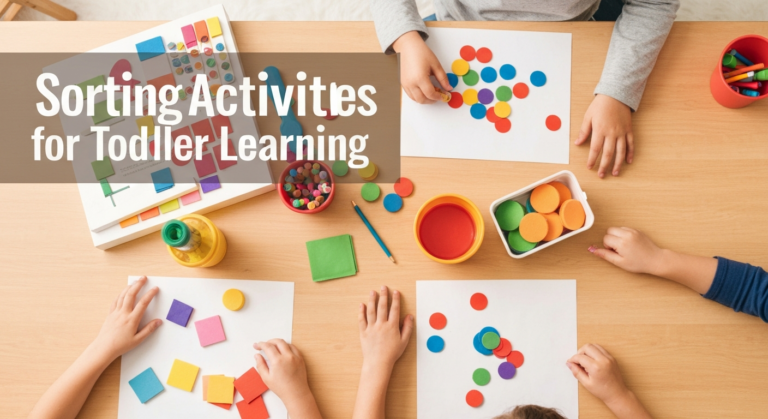
5. Color Sort Muffin Tin (18+ months): Place a different colored circle of construction paper in the bottom of each muffin cup. Provide a bowl of colored pom poms, buttons, or small toys that match the colors. Toddlers sort items into the matching cups. This builds color recognition, classification skills, and one-to-one correspondence. Start with 3 colors and add more as your child masters the concept.
6. Lid Matching (15+ months): Collect 5-8 different containers with lids — yogurt cups, mason jars, plastic food storage containers, water bottles, spice jars. Separate all the lids from the bases and present them in a bin. Toddlers match each lid to its container, practicing size discrimination, spatial reasoning, and trial-and-error problem-solving. This is one of the most engaging busy bins because there’s a clear “correct” answer that provides a satisfying click or snap when achieved.
7. Shape Sorter Remix (18+ months): Cut shapes (circle, square, triangle) out of the lid of a shoe box. Make the holes just slightly larger than the shape pieces (cut from foam sheets or sturdy cardboard). This homemade shape sorter works exactly like the store-bought version but can be customized to your child’s level and refreshed with new shapes as they master the originals.
Sensory Exploration Bins
8. Texture Touch Board (12+ months): Glue squares of different textured materials to a piece of cardboard: sandpaper, cotton balls, bubble wrap, aluminum foil, felt, corrugated cardboard, velvet fabric, and a piece of sponge. Toddlers run their hands over each square, experiencing different textures. Narrate the textures: “That one is rough! This one is smooth and soft.” This builds tactile awareness and descriptive vocabulary.
9. Rice Scoop and Pour (15+ months): Fill a shallow bin with uncooked rice. Add measuring cups, small funnels, spoons, and a few small containers. The simple act of scooping and pouring rice develops wrist rotation, grip strength, and early math concepts like full, empty, more, and less. Add small plastic animals or alphabet letters buried in the rice for a seek-and-find element. Place the bin on a towel or inside a larger tray to contain spills.
10. Water Bead Squish Bag (12+ months): Fill a gallon ziplock bag with hydrated water beads and a small amount of water. Double-bag it for safety and seal the edges with duct tape. Lay it flat and let toddlers squish, poke, and press the beads through the plastic. They get the sensory experience of the squishy texture without any mess or mouthing risk. Add a few drops of food coloring for visual appeal, or toss in some glitter for a galaxy effect.
Transfer and Dumping Bins
11. Spoon Transfer (18+ months): Set up two bowls side by side — one filled with dried beans, large pasta, or cotton balls, the other empty. Provide a large serving spoon. The goal is to transfer items from one bowl to the other using only the spoon. This is a classic Montessori practical life activity that develops concentration, hand control, and the scooping motion used in self-feeding.
12. Tong Transfer (24+ months): Same setup as the spoon transfer, but use child-sized tongs or large tweezers instead. Tongs require a much more sophisticated hand grip and controlled squeeze-and-release that strengthens the exact muscles used for scissors and writing tools. Start with large, lightweight objects (pom poms, cotton balls) and graduate to smaller, heavier items (wooden beads, marbles) as skill develops.
13. Turkey Baster Dropper (24+ months): Fill a small bowl with colored water. Provide a turkey baster and an empty ice cube tray. Toddlers squeeze the baster to suck up water, then squeeze again to release drops into the ice cube tray compartments. This develops hand strength, cause-and-effect understanding, and the squeeze-release coordination needed for many tools.
Open-Ended Creative Bins
14. Stacking Bin (12+ months): Fill a bin with a variety of stackable objects: wooden blocks, plastic cups, small boxes, corks, spools, and jar lids. No instructions, no right or wrong way — just an invitation to stack, balance, and inevitably knock over. The crash is part of the fun and teaches cause and effect. Toddlers will naturally experiment with which items stack well and which don’t, building early engineering intuition.
15. Tape Rescue (18+ months): Stick small toys or pom poms to a piece of cardboard using painter’s tape (one strip over each item). Toddlers peel back the tape to “rescue” the trapped objects. This develops pinch strength, persistence, and the satisfying feeling of problem-solving. It’s a particularly great busy bin for car rides because everything stays attached to the board until freed.
How to Organize and Rotate Busy Bins
The key to keeping busy bins effective is rotation. Even the most engaging activity loses its appeal after a child has seen it every day for two weeks. Here’s a system that works.
- Assemble 10-12 bins at once during a single prep session (most parents find Sunday evening works well)
- Put out 3-4 bins at a time on a low shelf or in a basket your toddler can access independently
- Rotate every 3-5 days — swap out the current bins for fresh ones from your stash
- When a bin comes back into rotation after 2-3 weeks away, it feels brand new again
- Label each bin with a sticky note listing the contents so you can quickly reassemble if pieces get mixed up
- Store bins stacked in a closet or on a high shelf so toddlers can’t access the entire collection at once
Safety First: Busy Bin Guidelines for Toddlers
Safety is paramount with busy bins, especially for children under 3 who still explore with their mouths. Follow these guidelines to keep play safe.
Choking hazards: Any item that fits through a toilet paper roll is a potential choking hazard for children under 3. For younger toddlers, stick to large pom poms, jumbo clothespins, and objects too big to swallow. Save small items like buttons, beads, and coins for children who have reliably stopped mouthing objects.
Supervision levels: Even “independent play” busy bins require a present adult. You can be doing dishes or folding laundry in the same room, but keep the child in your line of sight. Bins with water, rice, or small parts need closer attention than bins with large, mouthable items.
Inspect regularly: Check bins for broken pieces, torn materials, or items that have become loose. Replace worn-out elements promptly. A pipe cleaner that’s been bent many times can develop sharp ends — swap it for a fresh one.
Busy bins aren’t about creating elaborate, Instagram-worthy activities. They’re about having a simple, effective tool ready for the moments when you need your toddler engaged, learning, and — let’s be honest — not dismantling the living room. Ten minutes of assembly on a quiet evening gives you days of purposeful play that supports your child’s development while preserving your sanity. And in the wild, wonderful, exhausting world of raising a toddler, that’s worth its weight in pom poms.
Crafty Mama
Crafty Mama is a former elementary art teacher turned stay-at-home parent who believes every child is creative — they just need the right invitation. She develops age-appropriate activities, crafts, and projects that spark imagination while keeping mess (and parent stress) to a minimum.