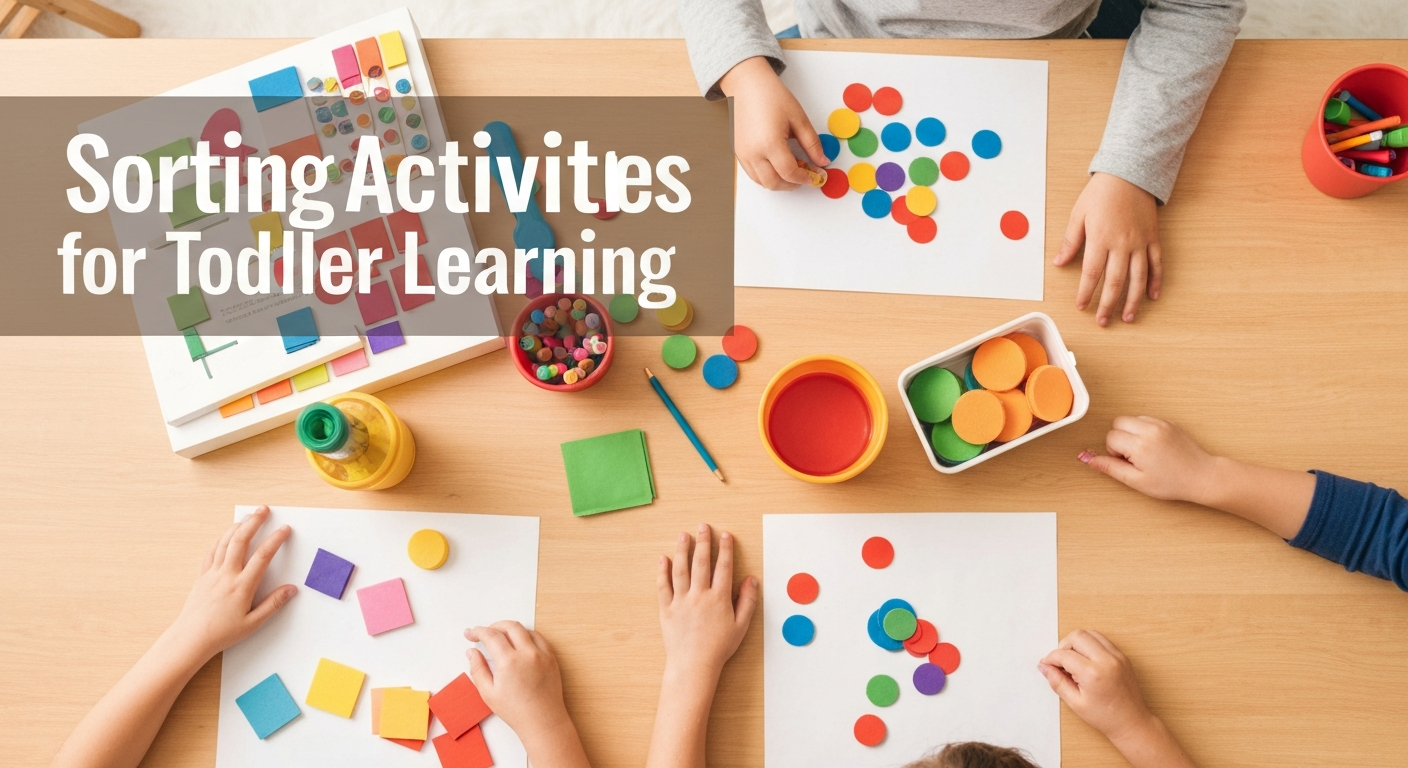
Sorting Activities for Toddler Learning
Discover why sorting is a vital cognitive skill for your toddler's development, building foundations for math, science, and logical thinking. Learn about the developmental progression of sorting and find actionable activities to support their natural instinct to organize.
- Your toddler's sorting builds vital cognitive skills for math, science, and logic.
- Understand sorting developmental stages to provide appropriate challenges.
- Feed their natural instinct to sort with simple objects and opportunities.
- Start with color-based activities like a muffin tin sort.
- Utilize household items like muffin tins or rice bins for engaging play.
This post contains affiliate links. As an Amazon Associate I earn from qualifying purchases.
I was watching my 20-month-old organize her goldfish crackers into two groups — the broken ones and the whole ones — completely unprompted, with the focused intensity of a lab technician classifying specimens. She didn’t know she was doing math. She didn’t know she was building the cognitive foundation for categorization, data analysis, and logical thinking. She was just a toddler who noticed that some crackers looked different from others and felt compelled to do something about it. That instinct to sort, separate, and organize is hardwired into the toddler brain, and it’s one of the most important cognitive skills developing during the first three years of life. Our job is simply to feed that instinct with materials and opportunities.
In this article (6 sections)
The Science Behind Why Sorting Matters So Much
Sorting might look like a simple, almost mindless activity, but it’s actually one of the most cognitively demanding tasks a toddler performs. When a child sorts objects, their brain is simultaneously executing multiple complex operations:
- Observation: Examining each object to identify its attributes (color, size, shape, texture)
- Comparison: Holding two or more attributes in working memory and comparing them
- Classification: Assigning each object to a group based on shared characteristics
- Rule formation: Creating and maintaining an internal rule (“red ones go here, blue ones go there”)
- Flexibility: Adjusting the rule when an object doesn’t fit neatly into existing categories
This process is the foundation of mathematical thinking, scientific reasoning, and logical analysis. Children who practice sorting extensively in toddlerhood show stronger skills in classification, pattern recognition, and early algebra when they reach elementary school. Sorting also builds vocabulary (big, small, same, different, more, less), develops fine motor skills through manipulating small objects, and strengthens executive function — the ability to hold a rule in mind and follow it consistently.
Sorting Developmental Progression
Understanding where your child falls on the sorting development timeline helps you choose appropriately challenging activities:
- 12-18 months: Separating objects into “like” and “not like” groups with one obvious attribute (big vs. small)
- 18-24 months: Sorting by one attribute at a time — color OR size OR shape
- 24-30 months: Sorting by one attribute with more categories (sorting into 3-4 color groups instead of just 2)
- 30-36 months: Beginning to sort by two attributes (red AND big vs. red AND small)
- 3-4 years: Sorting by multiple attributes, re-sorting the same objects by different criteria, and explaining their sorting rule
Color Sorting Activities
Color is usually the first attribute children sort by because it’s visually striking and doesn’t require understanding abstract concepts like size or weight.
Muffin Tin Color Sort
Materials:
- A 6-cup muffin tin
- Colored paper circles placed in each cup (red, blue, yellow, green, orange, purple)
- A mixed bowl of small colorful objects: pom poms, buttons, beads, LEGO bricks, or colored pasta
- Optional: tongs or tweezers for an added fine motor challenge
Place one colored paper circle in each muffin cup. Pour the mixed objects into a central bowl and let your toddler sort them into matching cups. Start with just 2-3 colors for younger toddlers and increase to 6 as they master the concept. The muffin tin provides satisfying physical compartments that make the sorting groups visually clear and prevent sorted items from mixing back together. For older toddlers, replace the color circles with paint swatches from the hardware store for more nuanced shades.
Rainbow Sorting Sensory Bin
Materials:
- A large bin filled with white rice or dried pasta as a base
- Colored objects buried in the rice: colored counting bears, pom poms, bottle caps, colored clips
- 6 small containers or cups labeled with colored dots
Children dig through the rice to find colored objects, then sort them into the matching containers. The sensory bin element adds a treasure-hunt excitement that turns sorting from a structured task into an adventure. The tactile experience of the rice base also provides calming sensory input. This activity can occupy toddlers for 15-20 minutes — far longer than a basic sorting tray — because the discovery element maintains engagement.
Laundry Basket Color Sort
Materials:
- A basket of clean laundry (yes, really)
- Colored bins, bags, or piles designated for each color
Sort real laundry by color with your toddler. Socks work especially well — matching sock pairs is sorting AND matching simultaneously. This is a Montessori-inspired practical life activity that accomplishes a real household task while building cognitive skills. Toddlers are deeply motivated by activities that they see adults doing, so the “real work” element adds engagement that toy-based sorting can’t match.
Shape Sorting Activities
Shape sorting builds spatial reasoning and geometric vocabulary — skills that directly support later math learning.
DIY Shape Sorter Box
Materials:
- A sturdy cardboard box with a lid
- Shape templates traced and cut from the lid (circle, square, triangle)
- Foam shapes, wooden blocks, or cardboard shapes that match the cutouts
Cut shape holes in the box lid using a craft knife (adult prep). Make the holes slightly larger than the shapes so they drop through easily — frustration-free success is important for toddlers. Children match each shape to its hole and push it through. The satisfying thunk of the shape landing inside the box provides auditory feedback that reinforces the correct match. Start with just a circle and square (the easiest to distinguish) and add triangle, rectangle, and diamond as your child masters each shape.
Shape Hunt and Sort
Materials:
- A clipboard with paper showing pictures of basic shapes
- Dot stickers
- Various rooms of your house
Walk through your home with your toddler on a “shape hunt.” Point out circles (clocks, plates, door knobs), squares (windows, picture frames, couch cushions), rectangles (doors, books, phones), and triangles (roof shapes, pizza slices, hangers). Place a dot sticker next to each shape on the clipboard when you find it. This transfers sorting from a table activity to real-world observation and classification, which is where these skills ultimately need to function.
Size Sorting Activities
Sorting by size introduces the mathematical concepts of measurement, comparison, and seriation (ordering from smallest to largest).
Nesting and Stacking
Materials:
- Nesting cups, bowls, or boxes of graduated sizes
- Alternatively: mixing bowls, plastic food containers, or any set of objects that nest inside each other
Nesting containers inside each other is one of the earliest size-sorting activities toddlers can do. The physical feedback is immediate — the large cup won’t fit inside the small one, which teaches size relationships through direct experience rather than abstract instruction. Expand this by challenging older toddlers to line up the cups from smallest to largest (seriation) or to find which cup fits inside which by trial and error.
Big and Small Sort
Materials:
- A collection of paired objects in two sizes: big spoon/small spoon, big ball/small ball, big book/small book, big sock/small sock
- Two containers labeled BIG (with a large circle) and SMALL (with a small circle)
Start with a mixed pile of big and small versions of familiar objects. Have your toddler pick up each item and place it in the correct container. Use exaggerated language: “That’s a BIIIIIG spoon! It goes in the big basket. And that’s a tiny little spoon! Where does it go?” The paired objects (same item, different sizes) help children isolate the attribute of size because everything else about the two spoons is identical.
Multi-Attribute and Advanced Sorting
Once children have mastered single-attribute sorting, they’re ready for activities that challenge them to sort by multiple criteria or to re-sort the same objects in different ways.
Farm and Ocean Animal Sort
Materials:
- A collection of plastic animals (farm and ocean animals mixed together)
- Two bins or areas: one with blue paper/fabric (ocean) and one with green paper/fabric and a small red barn or fence (farm)
Mix all the animals together and challenge your child to sort them into their correct habitats. This requires conceptual categorization rather than perceptual sorting — the child must know that a cow lives on a farm and a whale lives in the ocean, not just match visible attributes. This is a more advanced cognitive task because the sorting rule is based on knowledge rather than appearance. Extend by adding a third habitat (jungle, desert, or forest) for more challenge.
Re-Sort Challenge (Ages 3+)
Materials:
- A collection of colored counting bears (or similar objects that have both color and size variations)
- Multiple containers
First, ask your child to sort the bears by color. Once sorted, dump them all back together and ask them to re-sort — this time by size. This cognitive flexibility exercise requires children to abandon their first sorting rule and adopt a new one, which is a high-level executive function skill. Many children initially resist re-sorting because their brain has committed to the first rule. Gently encourage them and celebrate when they successfully shift their thinking.
Sorting Real Objects in Daily Life
The most powerful sorting practice happens during everyday routines, not during structured activity time. Look for these natural sorting opportunities:
- Groceries: Sort produce by color, sort cans on the shelf, put cold items together and dry items together
- Toys: Sort blocks by shape, sort cars by size, put dolls in one bin and animals in another
- Nature: Sort collected leaves by color or size, sort rocks by smooth vs. rough, sort sticks by length
- Laundry: Sort by family member, by color, or by garment type (socks together, shirts together)
- Silverware: Toddlers love putting forks, spoons, and butter knives in the correct silverware tray sections
Setting Up for Sorting Success
A few practical strategies make sorting activities more effective and enjoyable for both toddlers and parents.
Start with two groups, not six. The most common mistake is offering too many sorting categories at once. For toddlers new to sorting, start with just two categories (red vs. blue, big vs. small, animals vs. vehicles). Master two before moving to three, then four, then more.
Use clear containers. Clear bins or bowls let children see the growing collection in each group, providing visual feedback about their sorting progress. Opaque containers hide the sorted items, which reduces the satisfying visual payoff.
Narrate the sorting rule. As your child sorts, verbalize the rule they’re following: “You put the red one with the other red ones! They’re the same color.” This builds the vocabulary of classification (same, different, group, match, sort, belong) and reinforces the cognitive process.
Let them sort “wrong.” If your child creates their own sorting rule that doesn’t match what you intended, ask them about it before correcting. A child who puts all the round objects together regardless of color isn’t wrong — they’ve just found a different valid attribute. This kind of independent rule creation is actually a higher-level cognitive skill than following your predetermined rule.
Keep sorting materials accessible. Store sorting collections in labeled bins on a low shelf so children can choose to sort independently during free play. When sorting is available as a self-selected activity rather than an assigned task, children engage with it more deeply and more frequently.
Sorting is one of those rare activities that is simultaneously one of the simplest to set up and one of the most powerful for cognitive development. Every time a toddler drops a red pom pom into a red cup, they’re laying another brick in the foundation of mathematical thinking, scientific reasoning, and logical analysis. The goldfish crackers were just the beginning.
Crafty Mama
Crafty Mama is a former elementary art teacher turned stay-at-home parent who believes every child is creative — they just need the right invitation. She develops age-appropriate activities, crafts, and projects that spark imagination while keeping mess (and parent stress) to a minimum.