
Printable Shape Recognition Activities
Discover how to effectively teach your child shape recognition using printable activities, following a clear age-based progression and engaging activity types that build foundational math skills.
- Follow a staged progression: Circle/Square/Triangle (2-3), then Rectangle/Oval/Diamond (3-4).
- Introduce complex shapes like Star/Heart/Hexagon (4-5) by connecting them to real objects.
- Use shape sorting pages to develop classification skills beyond simple identification.
- Practice tracing and drawing shapes to build visual-motor integration and spatial planning.
- Connect shapes to real-world objects to enhance your child's understanding.
This post contains affiliate links. As an Amazon Associate I earn from qualifying purchases.
In this article (6 sections)
Shapes Are Everywhere (Once You Teach a Child to See Them)
There’s a moment I wait for every school year, and it always happens within the first two weeks of our shapes unit. A child will be eating lunch, pause mid-bite, hold up a triangular sandwich half, and announce to the entire table: “My sandwich is a TRIANGLE.” Cue the domino effect—suddenly every kid at the table is examining their food for shapes. The cracker is a square. The orange slice is a half-circle. The plate is a circle. The world has just opened up for them in a completely new way.
Shape recognition is one of the earliest and most important math skills children develop. It forms the foundation for geometry, spatial reasoning, pattern recognition, and even early reading (letters are made of shapes, after all). Printable activities are an incredibly effective way to reinforce shape knowledge because they provide focused, repeated practice in a format children can do independently. Let me share the activities and approaches that have worked best in over a decade of teaching.
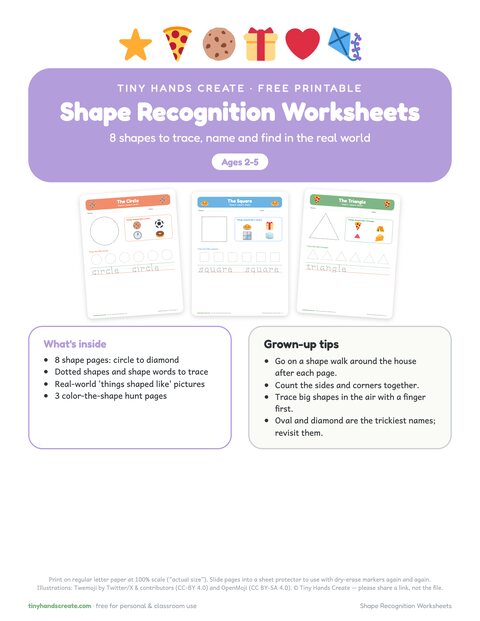
Free printable · 12 pages
Shape Recognition Worksheets
8 shapes to trace, name and find in the real world, plus 3 shape-hunt pages.
Free. Your download link appears right here. You'll also join the Daily Printable Drop. Unsubscribe anytime. Privacy
The Basic Shapes Progression: What to Teach and When
Rushing through shapes leads to confusion. A clear, staged progression builds confident, thorough understanding.
Level 1: Circle, Square, Triangle (Ages 2-3)
Start with these three because they are visually distinct and easy to name. Begin with solid, filled shapes on printables rather than outlines—toddlers recognize filled shapes more easily. Activities at this level include simple matching (draw a line from the circle to the circle), sorting pages (color all the circles red), and pointing tasks (find all the triangles on this page). Use chunky crayons or do-a-dot markers since fine motor skills are still developing.
Level 2: Rectangle, Oval, Diamond (Ages 3-4)
Once the first three are solid, add shapes that are variations of the originals. A rectangle is like a stretched square. An oval is like a stretched circle. A diamond (rhombus) is like a tilted square. Making these connections explicitly helps children categorize rather than memorize. Printables at this stage can include shape-sorting worksheets, trace-and-color pages, and matching games where children draw lines between identical shapes.
Level 3: Star, Heart, Hexagon, Pentagon, Octagon (Ages 4-5)
Complex shapes fascinate this age group. Connect them to real objects: a stop sign is an octagon, a honeycomb cell is a hexagon, a baseball home plate is a pentagon. Printables can now include shape hunts (how many hexagons can you find in this picture?), shape building (which shapes combine to make this house?), and shape attribute charts (how many sides? how many corners?).
Printable Activities That Actually Build Understanding
The best shape printables go beyond simple identification. They ask children to think about shapes in multiple ways.
Shape Sorting Pages
Present a jumbled collection of different shapes at the top of the page and labeled boxes (one for each shape) at the bottom. Children cut out the shapes and glue them into the correct box, or draw lines connecting each shape to its category. This requires classification skills—seeing past differences in size, color, and orientation to identify the essential features that make a triangle a triangle regardless of whether it’s big or small, red or green, pointing up or pointing sideways.
Shape Tracing and Drawing Pages
Provide dotted-line shapes for children to trace, starting with large shapes and gradually reducing the size. After tracing practice, include empty boxes where children draw the shape independently. This progression from tracing to independent drawing develops visual-motor integration and spatial planning. Supply thick pencils or markers for tracing, and encourage children to start at the top and move in a consistent direction.
Real-World Shape Matching
Print pages showing real objects alongside their corresponding geometric shapes. A clock matches with a circle. A door matches with a rectangle. A slice of pizza matches with a triangle. Children draw lines connecting each object to its shape. This critical transfer step teaches children that shapes aren’t just abstract outlines on paper—they’re the building blocks of the physical world around them.
Shape Counting Worksheets
Present a picture composed of many overlapping shapes (a simple house made of a triangle roof, square walls, rectangle door, and circle windows). Ask children to count how many of each shape they can find and write the number. This requires visual discrimination—picking out individual shapes from a complex image—which is the same skill needed for reading letters in words and finding information in busy visual environments.
Hands-On Extensions for Printable Activities
Pairing printables with physical manipulatives deepens learning significantly. Here are combinations that work beautifully.
Playdough Shape Mats
Print shape outlines on cardstock and laminate them. Children roll playdough into snakes and lay the snakes along the shape outlines, building each shape with their hands. This adds a powerful tactile and kinesthetic dimension to shape learning. The physical act of forming each corner and side builds motor memory that reinforces visual recognition. Keep a set of shape mats with your playdough supplies for repeated use.
Sticker Shape Fill
Print large outlined shapes and let children fill them entirely with small round dot stickers. A triangle covered in colorful dots is a satisfying project that practices spatial awareness (fitting stickers inside the boundaries) and fine motor precision (peeling and placing small stickers). For an added challenge, assign specific colors to specific shapes—all triangles get blue stickers, all circles get red.
Craft Stick Shape Building
Print a worksheet showing shapes with numbered sides (triangle = 3 sides, square = 4 sides, pentagon = 5 sides). Provide craft sticks, pipe cleaners, or toothpicks and have children build each shape on top of the printed version. Then build them independently on the table. This transitions children from two-dimensional shape recognition to three-dimensional construction and introduces the concept that shapes are defined by their number of sides and corners.
Common Mistakes and How to Avoid Them
After years of teaching shapes, I’ve identified the pitfalls that trip up both children and well-meaning parents.
- Always showing shapes in the same orientation — Children need to see triangles pointing up, down, and sideways; squares sitting flat and tilted into diamonds. Otherwise they develop rigid, orientation-dependent definitions
- Only using regular shapes — Show tall skinny triangles alongside equilateral ones, long thin rectangles alongside nearly-square ones; this builds flexible, accurate understanding
- Skipping the “why” — Don’t just name shapes; discuss attributes: “This is a triangle because it has three sides and three corners” gives children a rule they can apply to new examples
- Moving too fast — Master three shapes thoroughly before adding more; breadth without depth leads to confusion
- Ignoring 3D shapes — Introduce sphere, cube, cone, and cylinder alongside their 2D counterparts to build a complete shape vocabulary
Bringing Shapes Off the Page and Into the World
The ultimate goal of shape printables is to build a skill that transfers everywhere. Here are ways to make that bridge.
Shape walks: Print a checklist of shapes and take it on a walk around the neighborhood. Check off each shape as you spot it in the environment—window rectangles, manhole cover circles, roof triangles, stop sign octagons. Children who do this regularly develop a permanent “shape awareness” that enriches how they see the world.
Shape snack time: Serve crackers (squares), orange slices (half-circles), cheese triangles, and banana coins (circles). Name the shapes as you eat them. Let children arrange their snack into shape patterns before eating.
Shape building challenges: Provide toothpicks and mini marshmallows, craft sticks and playdough balls, or straws and connectors and challenge children to build specific shapes or free-form structures. Ask them to name every shape they can find in their creation.
When a child can look at a complex building facade, a piece of artwork, or a natural landscape and point out the geometric shapes hidden within it, they’ve developed a mathematical lens that will serve them for years to come. It all starts with those first printable pages where a little hand draws a careful line from a picture of a cookie to the word circle—and something clicks.
Crafty Mama
Crafty Mama is a former elementary art teacher turned stay-at-home parent who believes every child is creative — they just need the right invitation. She develops age-appropriate activities, crafts, and projects that spark imagination while keeping mess (and parent stress) to a minimum.