
Free Printable Sight Words Flashcards: Kindergarten
Unlock reading confidence and speed for your kindergartener with these free printable sight words flashcards. You'll get sets for Pre-Primer, Primer, and First Grade words, plus actionable tips and fun game ideas to make learning engaging.
- Download free printable flashcards covering Pre-Primer, Primer, and First Grade sight words.
- Use daily practice ideas like quick reviews or new word introductions for consistent learning.
- Engage your child with fun games like Memory Match, Bingo, or Word Hunt to make practice fun.
- Apply multi-sensory techniques: say, see, trace, write, and use each word for deeper learning.
- Start with 5-10 words, practice daily, and celebrate progress to build your child's confidence.
This post contains affiliate links. As an Amazon Associate I earn from qualifying purchases.
Sight words are the building blocks of reading. These common words—like “the,” “and,” “is,” and “you”—appear so frequently that fluent readers recognize them instantly, without sounding them out. For beginning readers, mastering sight words unlocks confidence and speed.
These free printable sight words flashcards cover the essential words your kindergartener needs to know. Use them for daily practice, games, or on-the-go learning. Print, cut, and start building your little reader’s word bank.
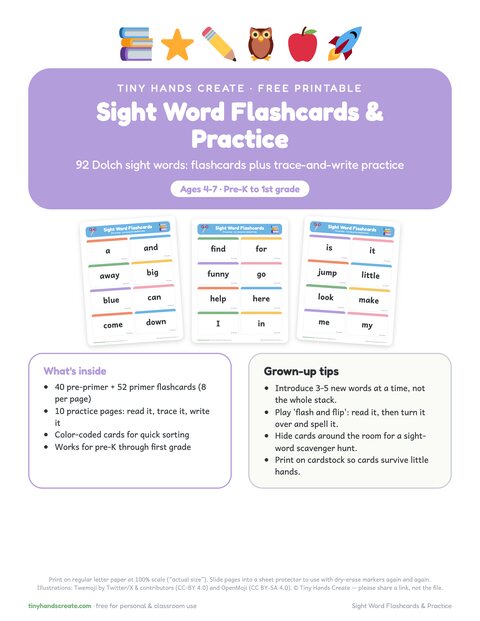
Free printable · 23 pages
Sight Word Flashcards + Practice Pages
92 Dolch pre-primer and primer flashcards plus read-it, trace-it, write-it practice pages.
Free. Your download link appears right here. You'll also join the Daily Printable Drop. Unsubscribe anytime. Privacy
[IMAGE: Colorful sight words flashcards spread on table with child’s hands]
In this article (10 sections)
What Are Sight Words?
Sight words are high-frequency words that readers recognize instantly “by sight.” They include:
Tricky phonics words: Words that don’t follow typical phonics rules (the, said, was)
Common words: Words that appear frequently in text (and, the, is, it)
Service words: Words that connect ideas (but, or, because)
Learning these words by sight—rather than sounding them out each time—speeds up reading dramatically.
What’s Included
Pre-Primer Sight Words (40 words):
The most basic sight words for early readers
a, and, away, big, blue, can, come, down, find, for, funny, go, help, here, I, in, is, it, jump, little, look, make, me, my, not, one, play, red, run, said, see, the, three, to, two, up, we, where, yellow, you
Primer Sight Words (52 words):
Building on pre-primer foundations
all, am, are, at, ate, be, black, brown, but, came, did, do, eat, four, get, good, have, he, into, like, must, new, no, now, on, our, out, please, pretty, ran, ride, saw, say, she, so, soon, that, there, they, this, too, under, want, was, well, went, what, white, who, will, with, yes
First Grade Sight Words (41 words):
More advanced words for growing readers
after, again, an, any, as, ask, by, could, every, fly, from, give, going, had, has, her, him, his, how, just, know, let, live, may, of, old, once, open, over, put, round, some, stop, take, thank, them, then, think, walk, were, when
How to Use These Flashcards
Print and Prepare
- Print on cardstock for durability (or laminate for repeated use)
- Cut carefully along the lines
- Organize by set (pre-primer, primer, first grade)
- Store in bags or boxes for easy access
Daily Practice Ideas
Quick Review (5 minutes):
Flash through 10-15 cards. If they know it, it goes in the “known” pile. Unknown words go in the “practice” pile.
New Word Introduction (5 minutes):
Introduce 2-3 new words at a time. Use them in sentences. Point them out in books.
Game Time (10+ minutes):
Use the games below to make practice fun!
Free Printable Alphabet Worksheets for Preschoolers
Games to Play with Sight Words Flashcards
Memory Match
Print two copies of a set. Turn face down. Take turns finding matching pairs.
Best for: 2-10 words at a time
Go Fish
Deal 5 cards each. Ask for matches. “Do you have ‘the’?”
Best for: Practicing multiple words
Sight Word Bingo
Create bingo boards with sight words. Call out words; cover with chips.
Best for: Groups or siblings
Word Hunt
Hide flashcards around the room. Child finds them and reads each word aloud.
Best for: Active learners
Beat the Timer
See how many cards they can read correctly in 60 seconds. Try to beat their score!
Best for: Building speed
Word Slap
Spread cards face up. Call out a word. Child “slaps” the correct card.
Best for: Quick recognition practice
Word Building Sentences
After learning several words, arrange flashcards into simple sentences.
Best for: Older kindergarteners
Tips for Teaching Sight Words
Start Small
Begin with 5-10 words. Master these before adding more. Overwhelm kills motivation.
Practice Daily
Short, consistent practice beats long, sporadic sessions. 5-10 minutes daily is enough.
Make It Multi-Sensory
Say it: Pronounce the word clearly
See it: Look at the word
Trace it: Use finger to trace letters
Write it: Practice writing the word
Use it: Put the word in a sentence
Celebrate Progress
Track known words visually. Celebrate milestones. Make them feel like readers!
Exposure, Exposure, Exposure
Point out sight words everywhere:
- In books during read-aloud
- On signs while driving
- In junk mail and packages
- On cereal boxes
[IMAGE: Child playing sight word memory game on floor]
Troubleshooting Common Challenges
“My child guesses based on first letter”
Solution: Cover the word, reveal one letter at a time. Or show similar words together (the, they, that) and compare.
“They know it one day but forget the next”
Solution: This is normal! Keep reviewing “known” words periodically. Use spaced repetition.
“They get frustrated and want to quit”
Solution: Shorten practice time. Focus on games over drills. End on a success—always finish with words they know.
“They’re memorizing by the card, not the word”
Solution: Print multiple versions in different fonts or colors. Write words on a whiteboard to test.
“My child reverses letters”
Solution: Normal through age 7! Gently correct but don’t stress. Practice tracing the word correctly.
Sight Words Beyond Flashcards
In Books
While reading together, point out sight words. “Look, there’s ‘the!’ You know that word!”
Writing Practice
Encourage using sight words in their own writing (even if spelling isn’t perfect yet).
Environmental Print
Notice sight words on:
- Stop signs
- Store names
- Food packaging
- Screen titles
Digital Practice
Many free apps reinforce sight words:
- Starfall
- Sight Words by Photo Touch
- Endless Reader
Tracking Progress
Word Wall
Create a wall of mastered words. Add new words as they learn them. Watch the wall grow!
Checklist
Print a master list. Check off words as they’re mastered. Celebrate milestones (25 words, 50 words, etc.)
Fluency Timing
Periodically time how many words they can read in one minute. Track improvement over time.
Crafty Mama
Crafty Mama is a former elementary art teacher turned stay-at-home parent who believes every child is creative — they just need the right invitation. She develops age-appropriate activities, crafts, and projects that spark imagination while keeping mess (and parent stress) to a minimum.
Frequently Asked Questions
When should my child start learning sight words?
Most children begin in preschool or kindergarten (ages 4-6). Start when they show interest in letters and reading.
How many sight words should a kindergartener know?
By end of kindergarten, most curricula expect 25-50 sight words. Some children learn more; some are still building—both are normal.
Should I teach sight words or phonics first?
Both! Teach them together. Phonics gives decoding skills; sight words give fluency. They work hand in hand.
My child can read the words but not spell them. Is that okay?
Yes! Reading recognition comes before spelling for most children. They’ll learn to spell these words with more practice.
What if my child isn’t learning sight words?
Learning pace varies dramatically. If there are persistent struggles, consult with their teacher. Some children benefit from additional support or different approaches.
Conclusion
Sight words are the express lane to reading fluency. With regular practice using these flashcards—plus games, books, and real-world exposure—your kindergartener will build a strong foundation of instant word recognition.
Print these free flashcards, make it fun, and watch your little reader blossom. Every word mastered is a step toward confident, independent reading.
Free Printable Number Tracing Worksheets 1-20
—
DOWNLOAD SECTION:
[PDF DOWNLOAD: Pre-Primer Sight Words Flashcards]
[PDF DOWNLOAD: Primer Sight Words Flashcards]
[PDF DOWNLOAD: First Grade Sight Words Flashcards]
—