Quiet Time Activities for Preschoolers: 25 Independent Play Ideas
Discover 25 independent quiet time activities for preschoolers (ages 3-6) to help your child recharge when naps fade. You'll learn age-appropriate ideas, how long quiet time should last, and tips for setting up successful independent play.
- Adjust quiet time from 15-20 minutes for 3-year-olds up to 90 minutes for 5-6 year olds.
- Offer age-appropriate activities like books, blocks, puzzles, and art supplies for independent play.
- Prioritize safety by checking for small parts or magnets if your child still mouths items.
- Start quiet time with 15-20 minutes and gradually increase as your child adjusts.
- Utilize the free printable activity card pack and bin planner to organize quiet time.
This post contains affiliate links. As an Amazon Associate I earn from qualifying purchases.
When naps fade but kids still need a reset, quiet time fills the gap. Kids who have dropped their nap are often at their crankiest around 3-5pm, and a predictable stretch of quiet play lets them recharge while you get a breather.
Below are 25 independent play ideas for ages 3-6 and an age-by-age guide to how long quiet time should last. After the ideas you’ll find a safety check, a first-week plan, rotating bin setups and fixes for the days it falls apart.
Fair warning: our first week lasted about ten minutes a day, and most of that was my kid popping out to show me a block tower. That’s normal, and it gets longer.
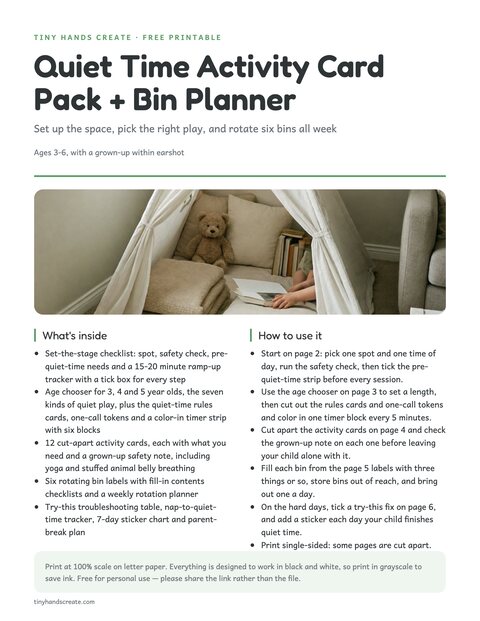
Free printable · 6 pages
Quiet Time Activity Card Pack + Bin Planner
A set-the-stage and safety checklist with a ramp-up tracker, an age-by-age chooser, quiet-time rules cards, one-call tokens, a color-in timer strip, 12 cut-apart activity cards, six bin labels with a weekly rotation planner, a fix-it table, and a nap-to-quiet-time tracker with a sticker chart and parent-break plan.
Free. Your download link appears right here. You'll also join the Daily Printable Drop. Unsubscribe anytime. Privacy
In this article (10 sections)
How Long Should Quiet Time Last?
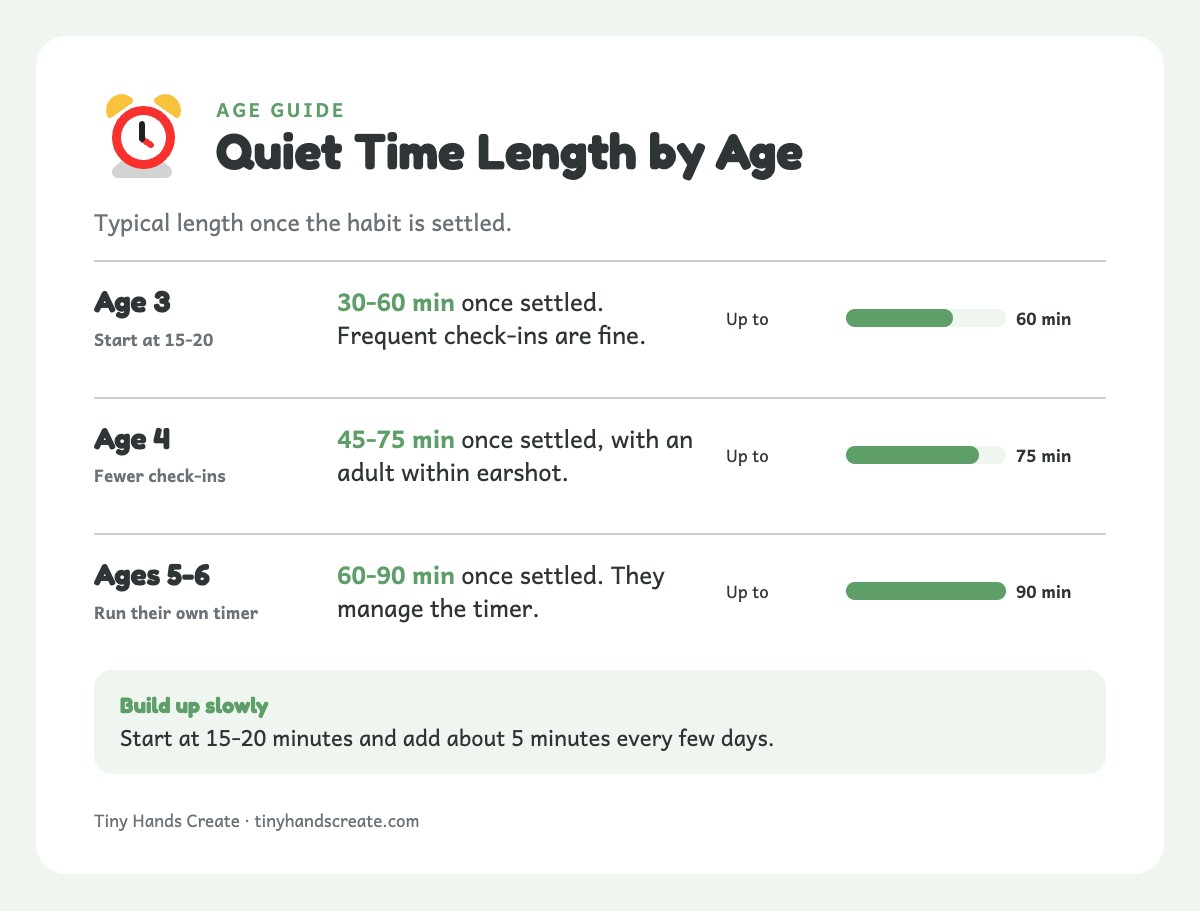
Most families land on 30-90 minutes once the habit is settled, depending on age. Use the table as a starting point, then adjust to your child.
| Age | Typical length once settled | Parent nearby? | Good independent picks | Adult present only |
|---|---|---|---|---|
| 3 | 30-60 min. Start at 15-20. | Within earshot. Frequent check-ins are fine. | Picture books, Duplo or large blocks, dot markers, sticker books, big-piece puzzles. | Beads, lacing, small figures and coins. Magna-Tiles and magnets if they still mouth things. |
| 4 | 45-75 min. | Within earshot. Fewer check-ins. | Lacing cards, pattern blocks, intact Magna-Tiles, colored pencils, dough. | Anything with small parts or magnets if they still mouth things. |
| 5-6 | 60-90 min. | Within earshot. They manage the timer. | Workbooks, board games, dollhouse play, choosing their own bin. | Real coins and loose magnets if they still mouth things. |
For more on independent play, see our Montessori activities guide.
25 Quiet Time Activities for Preschoolers
Each idea lists the best age for independent play, plus a setup tip and a realistic mess note. If an idea says 4+, keep it for adult-present play with younger kids.
Anything marked adult present is one to do together. Run the safety check after the list before you leave a child alone with any of these.
TipBest first picks for a 3-year-old: books, dot markers, Duplo, a sticker book and a big-piece puzzle. Start with those and add the rest later.
Books and Literacy
| Activity | Best age | Setup, mess and safety |
|---|---|---|
| 1. Picture and lift-the-flap books | 3+ | Pile up 5-6. Non-readers “read” stories they know. Pick sturdy board books, since flaps tear. Mess: none. |
| 2. Seek-and-find books | 4+ | I Spy or Where’s Waldo style hunts keep eyes busy for a long stretch. Mess: none. |
| 3. Audiobook with a picture book | 3+ | Follow along page by page. Volume-limiting kids’ headphones (many cap at 85 dB) are an option for short sessions. Keep the volume low and take breaks, or use a small speaker at low volume. |
Magnetic letters: A cookie sheet of letters is a good 4+ activity. Choose large letters labeled for your child’s age with fully enclosed magnets, and skip them for independent play if your child still mouths things. More ideas in our magnetic play guide.
Puzzles and Building
| Activity | Best age | Setup, mess and safety |
|---|---|---|
| 4. Jigsaw puzzles | 3+ | 12-24 pieces around age 3, up to 48-50 pieces by 5. Check for chipped or loose pieces. Mess: low. |
| 5. Pattern blocks and tangrams | 4+ | Add design cards to copy. For under 4, choose chunky pieces that don’t fit through a toilet paper tube. |
| 6. Duplo or large blocks | 3+ | Use Duplo or large wooden blocks under 4. Standard LEGO is for 4+ once they no longer mouth things. Add simple instruction cards. |
| 7. Magna-Tiles | 3+ if they no longer mouth things; otherwise adult present | Intact tiles only. Check for cracks and discard damaged ones, since cracked tiles can release magnets. A swallowed magnet means immediate medical care. More in our magnetic play guide. |
Art and Creativity
| Activity | Best age | Setup, mess and safety |
|---|---|---|
| 8. Coloring with pencils or crayons | 3+ | Chunky pencils or crayons both work. Keep pencils short and blunt-tipped for 3s, and have them seated while they draw. Mess: low. |
| 9. Sticker books | 3+ | Good fine motor practice. Hand over one sheet at a time, or expect stickers on the couch. Mess: sticky. |
| 10. Dot marker pages | 3+ | Satisfying and mostly contained. Cap the markers and use a tray. See our do-a-dot printables. |
| 11. Water painting books | 3+ | Water-only pages dry and reset. Expect a few drips on the rug. Mess: low. |
For more art ideas, see our mess-free painting guide.
Sorting and Organizing
| Activity | Best age | Setup, mess and safety |
|---|---|---|
| 12. Lacing cards and bead stringing | 4+ (adult present under 4) | “Large” means too big to fit through a toilet paper tube. Keep strings under about 12 inches. More in our threading guide. |
| 13. Sorting trays | 3+ | Sort large blocks, chunky toy animals or big pom-poms by color or size. Every piece should be too big to fit through a toilet paper tube. See sorting activities for little hands. Wooden pegs and small animal figures are 4+ or adult present. Under 4, skip buttons, beads, batteries and real coins. A swallowed coin needs medical care. |
Sensory Activities
| Activity | Best age | Setup, mess and safety |
|---|---|---|
| 14. Kinetic sand | 3+ (4+ if they taste things) | Less messy than loose sand, so use it on a tray. It’s non-toxic but not for eating. See kinetic sand activities. |
| 15. Sealed sensory bottles | 3+ | Fill with water, glycerin and glitter. An adult seals the lid with hot glue or strong adhesive. Re-check it each week, and bin the bottle if it leaks or cracks. See sensory bottles for calm-down time. |
| 16. Playdough with tools | 3+ | Rolling, cutting and shaping. Dough is non-toxic but not for eating, and most contains wheat, so check allergies. Mess: crumbs on the carpet. |
| 17. Dry sensory tub | 3+ (if no mouthing) | Big pom-poms, scoops and wooden spoons in a bin on a towel. Mess: after 20 minutes, expect pom-poms under the couch. I still find them there. |
Pretend Play
| Activity | Best age | Setup, mess and safety |
|---|---|---|
| 18. Dollhouse and small-figure play | 4+ | For under 4, choose pieces that don’t fit through a toilet paper tube. Tiny furniture and vehicles are 4+ or adult-present. |
| 19. Dress-up basket | 3+ | Soft costumes only, with no long ties or cords. Mess: clothes everywhere. |
| 20. Stuffed animal care | 3+ | Line up 4-5 animals with a small blanket each, some pretend food and a cloth check-up kit. Usually holds attention for 15-20 minutes. |
Learning Activities
| Activity | Best age | Setup, mess and safety |
|---|---|---|
| 21. Workbooks and tracing pages | 4+ | Tracing, matching or early math pages with a pencil. Mess: none. |
| 22. Quiet board games | 4+ | Pick simple games with few pieces and play solo or against a stuffed animal. Keep the dice and tokens in a zipped pouch so nothing wanders off. |
About screens: Screens shouldn’t be the default quiet-time activity. The AAP suggests about an hour a day of high-quality content for ages 2-5, ideally watched together, and any app use counts toward that. If you use one, pick ad-free apps with no in-app purchases. More in our screen-free quiet time guide.
For printable learning activities, check our alphabet worksheets.
Calming Activities
| Activity | Best age | Setup, mess and safety |
|---|---|---|
| 23. Yoga pose cards | 3+ | Child-led stretching with a few simple cards. Mess: none. More in our calm-down activities. |
| 24. Belly breathing with a stuffed animal | 3+, adult present | Do this one together, as the wind-down before or after independent play. Your child sits or leans back on a cushion and holds one small, light stuffed animal on their belly. Watch it rise and fall for about 5 breaths, then put the animal back in the basket. |
| 25. Sound-matching game | 4+ | Seal pairs of opaque containers with rice, bells or beans, then shake and match the pairs. |
Safety Check and First-Week Plan
Safety firstQuiet time means less direct watching, so set the space up before you walk away. Run through this list first.
- Small parts: anything that fits through a toilet paper tube stays out for under 4s and for any child who still mouths things.
- Magnets: Magna-Tiles are for kids who no longer mouth things, and only with intact tiles. Otherwise an adult stays present. Toss cracked tiles or letters. A swallowed magnet needs immediate medical care.
- Cords and furniture: remove blind cords, long strings and dangling chargers. Anchor furniture and TVs, and use a stable tent without loose poles.
- Keep the door open so a grown-up can always hear the child.
- A child who falls asleep goes on a flat, firm surface, never in cushions, a bean bag, a tent or a closet.
- Water beads: keep them out of the house entirely if any child still mouths things or there is a younger sibling around. They expand if swallowed and can cause a blockage that needs surgery.
- If you think a water bead was swallowed, get medical care right away. Don’t wait for vomiting or belly pain, because the beads usually don’t show on a normal X-ray.
Your First-Week Plan
- Pick the spot and the time. Choose one place and one time of day, and stick to both. After lunch works well for most families, and a daily routine chart helps kids see where quiet time fits.
- Set a 15-20 minute timer. Use a visual one, like a sand timer or a Time Timer clock, so they can see time passing.
- Offer three bin choices. Let them pick one to start, so they get a say without a free-for-all.
- Explain the rules. Go through the four below, including the one-call rule. Frame it as a treat: “This is your special time to play however you want.”
- Praise afterward. Name what went well, even if it was ten minutes.
- Add 5 minutes every few days. Stretch it slowly as the habit builds.
The rules fit on one sticky note:
- Stay in your spot.
- Play quietly.
- Come out when the timer goes.
- Need something? Call once, then wait.
Pick the Right Spot and Stock It
The best spot is the one you will actually use every day. Here is how the usual options compare.
| Place | Pros | Watch-outs |
|---|---|---|
| Bedroom | Natural boundary, with toys and books close by. | Can trigger sleep resistance if it is tied to bedtime struggles. |
| Playroom | Dedicated play space. | Needs to feel quiet-time specific. Rotate a few bins in and the rest out. |
| Living room corner | You stay close by. | Mark the boundary with a rug or stable tent. Anchor furniture and TVs. Tie up or remove window cords. |
Then keep the setup simple. Put out 3-5 activities at most, all within your child’s reach, and rotate them weekly so the spot stays interesting. I learned the hard way that a full toy shelf gets dumped, not played with.
Floor cushions and a rug work best for seating. If you use a bean bag, choose one with a zipped, locked cover, and never let a child sleep in it.
For more on independent play, see our Montessori activities guide and independent play ideas.
Quiet Time Bins
Create themed bins that rotate weekly. Each bin holds everything needed for one activity, and the Quiet Time Activity Card Pack + Bin Planner below helps you plan the rotation.
TipStore the bins out of reach and bring out one a day. Save a few toys that only come out at quiet time, too. The novelty does half the work.
Sample Bin Ideas
| Bin | What’s inside | Best age |
|---|---|---|
| Puzzle | 2-3 puzzles at the right piece count. Chunky pattern blocks with design cards. A tangram set. | 3+ (tangrams 4+) |
| Art | Coloring book, pencils or crayons, sticker sheets, blank paper. | 3+ |
| Building | Duplo or large wooden blocks with challenge cards. Standard LEGO only for 4+. | 3+ (LEGO 4+) |
| Literacy | 5-6 books and a letter matching game. Large magnetic letters with fully enclosed magnets and a cookie sheet. | 3+ (magnetic letters 4+, and only if they no longer mouth things) |
| Sensory | Kinetic sand with molds on a tray. Dough with tools. Sealed sensory bottles. | 3+ (4+ if they taste things) |
| Pretend play | Figurines, plus fabric scraps for backgrounds and props. Everything is too big to fit through a toilet paper tube. | 4+ or adult present |
TipLabel each bin by weekday and tape a card inside listing what belongs there. Reset then takes about two minutes.
The bin that flopped at our house was the one I overstuffed. Three things in a bin beats ten, and it makes the reset quick:
- Check the card. Put back anything that wandered off, and pull anything cracked or chewed.
- Swap one thing. A new sticker sheet or a different puzzle is enough novelty.
- Lid on, shelf up. Store the bin out of reach until its day comes round again.
For more sensory setups, see our no-mess sensory play ideas.
Troubleshooting Common Problems
| Problem | Why it happens | Try this |
|---|---|---|
| Won’t stay in the space | It’s a new habit, or it feels like punishment | Start with shorter periods. Stay nearby at first, then move farther away. Use a visual timer, offer engaging activities and never use quiet time as a punishment. |
| Constant interruptions | Unmet needs, or they want company | Do the bathroom, water and snack first. Keep a quiet-time basket of allowed interruption items. Use the one-call rule and praise uninterrupted stretches afterward. |
| Gets bored quickly | Same toys too long, or the activity is too easy | Rotate bins more often, offer something more complex, let them choose and add novelty like new stickers or different books. Our boredom busters help too. |
| Falls asleep | They may still need the rest | If that’s okay, let them sleep on a flat, firm surface, not in cushions, a bean bag, a tent or a closet. If it affects bedtime, shorten or move quiet time and wake them after 30-45 minutes. |
| Refuses entirely | Timing is off, or they’re not ready yet | Rename it (“special play time”). Start with you in the room, then withdraw gradually. Try a different time of day. Readiness varies: many children are ready between 3 and 5, and some still nap. |
Quiet Time Without a Dedicated Room
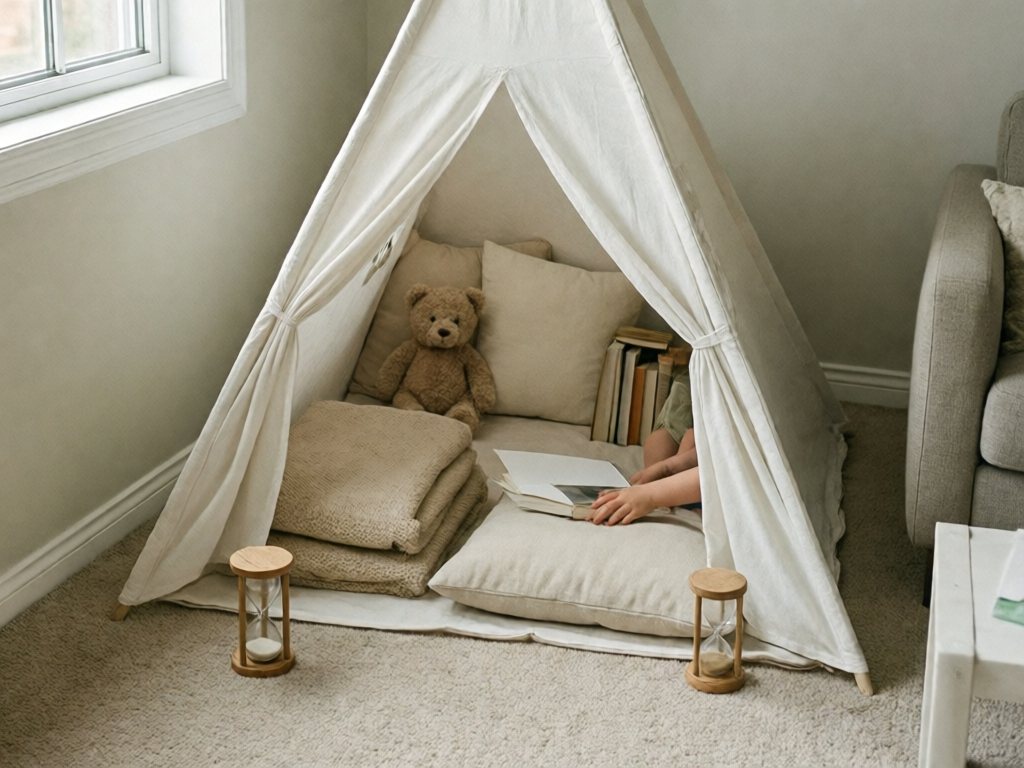
Small spaces work:
- A stable tent or canopy with no loose poles.
- A blanket on the floor marking the “quiet time zone.”
- A closet nook, but only with the door open or removed. Clear out cords, chemicals and tippable shelves, and stay where you can see or hear your child.
Apartment living:
- Use the same spot every day, but change which bin is out so it still feels fresh.
- Stick to extra-quiet activities like books, dot markers and puzzles.
- Block sightlines with a room divider or curtain so they are less tempted to pop out.
- For audiobooks, volume-limiting kids’ headphones (many cap at 85 dB) are an option for short sessions. Keep the volume low and take breaks, or use a small speaker at low volume. Skip long cords, and stay within earshot.
Shared rooms:
- Give each child a different quiet-time spot.
- Stagger the start by 10 minutes so each child settles before the other begins.
- Mark each child’s space with their own rug or blanket, and agree that nobody crosses into the other’s spot.
Quiet Time Without a Nap: Easing the Transition
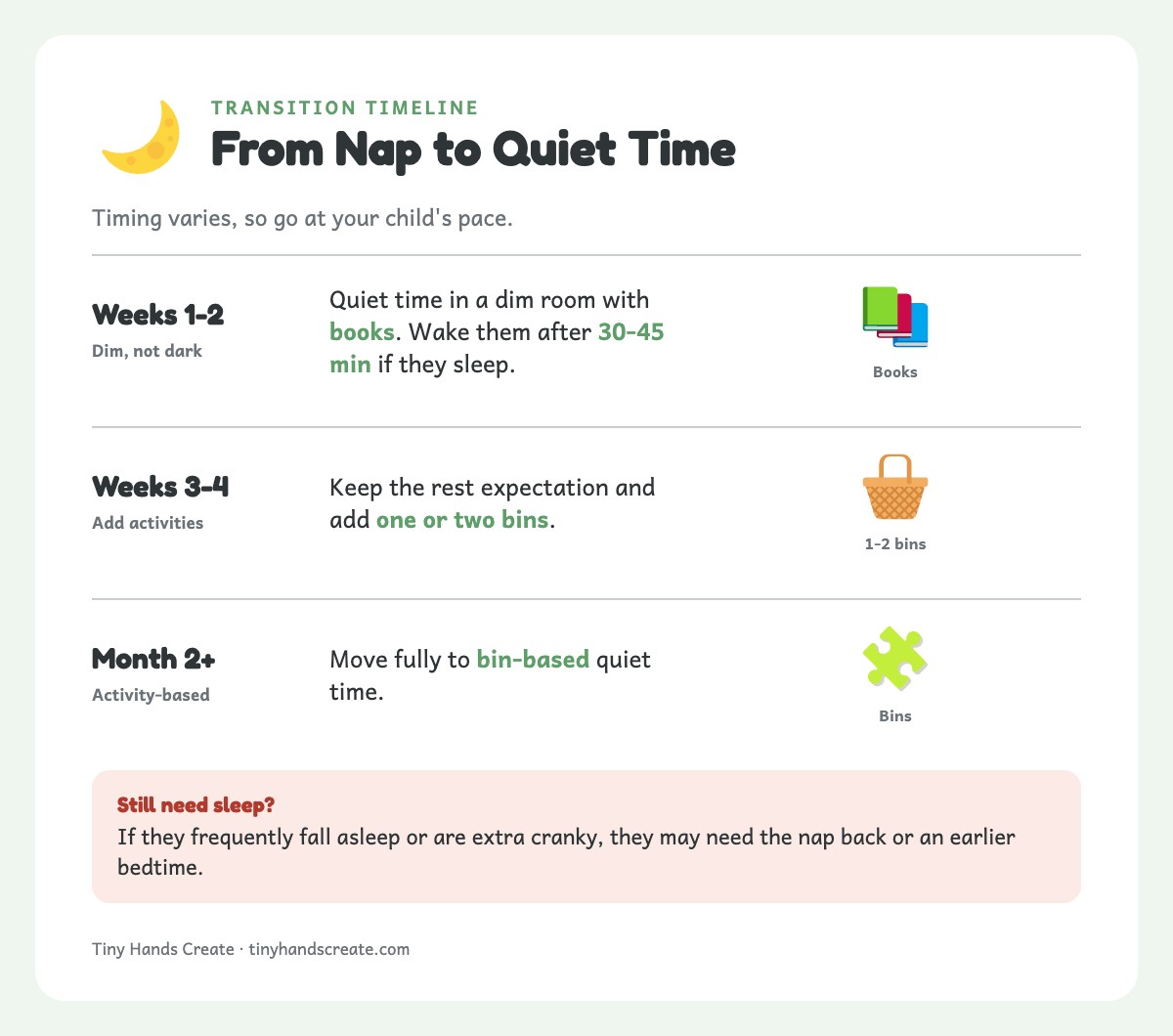
If your child recently dropped naps, here is one example timeline. Timing varies, so go at your child’s pace.
- Weeks 1-2: dim, not dark. Quiet time in a dim room with books. Sleep may still happen, so give a clear wake-up cue after 30-45 minutes.
- Weeks 3-4: add quiet activities. Keep the rest expectation and add one or two bins.
- Month 2+: activity-based. Move fully to bin-based quiet time.
Watch for signs they still need sleep: If they frequently fall asleep or are extra cranky, they may need the nap back or an earlier bedtime. Overtired children can also seem hyperactive instead of sleepy. If sleepiness, poor sleep or behavior concerns persist, check with your pediatrician.
The Parent Break
Quiet time is your break too. Decide what you’ll do with it before the timer starts, or it disappears into tidying. A hot coffee you actually finish counts.
Stay within earshot the whole time, and protect the slot like any other appointment.
Quiet Time FAQ
How long should quiet time be for a 4 year old?
Most 4-year-olds manage 45-75 minutes once the habit is settled. Start at 15-20 minutes and add about 5 minutes every few days.
What if my child stops napping?
Move to quiet time in a dim room with books, then add bins over a few weeks. If they often fall asleep or are very cranky, they may need the nap back or an earlier bedtime.
What if my child won’t stay in the space?
Shorten the time, stay nearby at first, and use a visual timer with the one-call rule. Never use quiet time as a punishment.
Is it okay to use a screen?
Screens shouldn’t be the default. If you use one, count it toward your daily screen limit and pick ad-free apps.
Is quiet time the same as nap time?
No. Quiet time is awake rest, so your child plays calmly instead of sleeping. If they do fall asleep, that’s fine as long as bedtime still works.
How do I do quiet time with a younger sibling napping?
Run both at the same time, in separate rooms if you can. Give your preschooler the quietest bins, like books, puzzles and dot markers, and save anything noisy for later.
Crafty Mama
Crafty Mama is a former elementary art teacher turned stay-at-home parent who believes every child is creative — they just need the right invitation. She develops age-appropriate activities, crafts, and projects that spark imagination while keeping mess (and parent stress) to a minimum.