Music and Movement Activities for Kids: Fun Ways to Learn Through Rhythm
Discover fun music and movement activities for kids aged 0-8, from action songs to homemade instruments. You'll learn how to support your child's language, coordination, and social skills with easy, low-cost ideas and a free activity card pack.
- Engage kids 0-8 in short music sessions (5-20 min) to boost development.
- Use your voice, phone, and open space; no special talent or cost needed.
- Download the free activity card pack for age-specific ideas and instrument guides.
- Support language, movement, and social skills through rhythm and dance.
- Adapt activities and instruments safely for your child's age (0-8 years).
This post contains affiliate links. As an Amazon Associate I earn from qualifying purchases.
The music comes on and suddenly the couch is a trampoline and the rug is a dance floor. Expect a little chaos, and expect it to be worth it.
This guide is for kids 0-8 and covers action songs, dance games, safe homemade instruments, playlists and age-by-age ideas. Sessions can be short: 5-10 minutes for toddlers and 15-20 for preschoolers and school-age kids. Grab the free activity cards to keep the best ideas handy.
In this article (14 sections)
- Why Music and Movement Matter for Development
- What You Need for Music and Movement at Home
- Age-by-Age Activity Guide
- Your First Music and Movement Session: A 10-Minute Plan
- Action Songs and Fingerplays
- Free Movement and Dance Activities
- Rhythm and Beat Activities
- Musical Games
- Playlists for Kids: Dance, Calm-Down and Silly Songs
- Music Throughout the Day
- Making Your Own Songs
- When a Child Won’t Participate
- Start With One Song
- Frequently Asked Questions
Why Music and Movement Matter for Development
Music time is fun first. It may also support a few things along the way.
- Language and listening. Songs repeat the same words and rhythms, so kids get to practice them over and over. That may help them pick up vocabulary, and it is partly why toddlers ask for the same song again.
- Movement. Dancing may support balance, coordination and body awareness.
- Feelings and social skills. Fast songs can burn off energy, slow ones may help kids settle, and group play practices turn-taking.
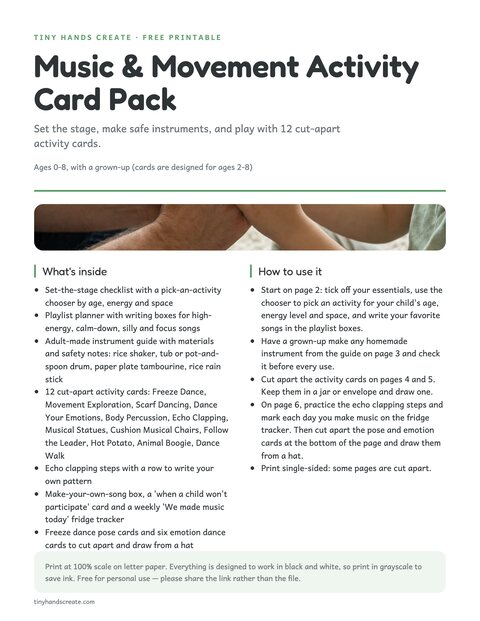
Free printable · 6 pages
Music & Movement Activity Card Pack
Inside: a set-the-stage checklist with an age-by-energy chooser, a playlist planner, an adult-made instrument guide (rice shakers, tub drums, paper plate tambourines, rice rain sticks), 12 cut-apart activity cards, echo clapping steps, a 'when a child won't participate' card, a weekly fridge tracker, plus freeze dance pose cards and emotion dance cards to cut apart.
Free. Your download link appears right here. You'll also join the Daily Printable Drop. Unsubscribe anytime. Privacy
What You Need for Music and Movement at Home
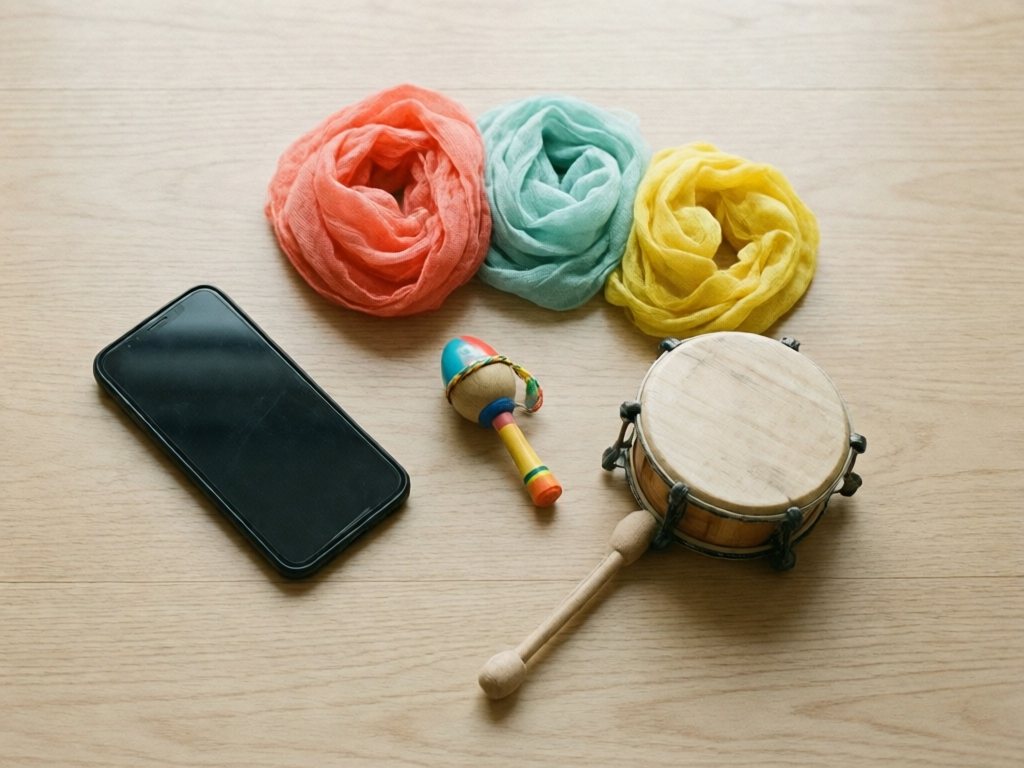
You need almost nothing to start.
Essential (free). You already have all three.
- Your voice.
- Your phone or device for playing music.
- Open space to move.
Helpful but not required. Add these when you are ready.
- Simple instruments. Homemade ones need the adult-made safety steps below.
- Lightweight scarves for movement. Kids 3 and up can also use short ribbons, no longer than about 7 inches.
- A playlist organized by tempo and mood.
You don’t need to be musically talented. Children don’t care if you sing off-key. They care that you’re engaged and joining in.
Age-by-Age Activity Guide
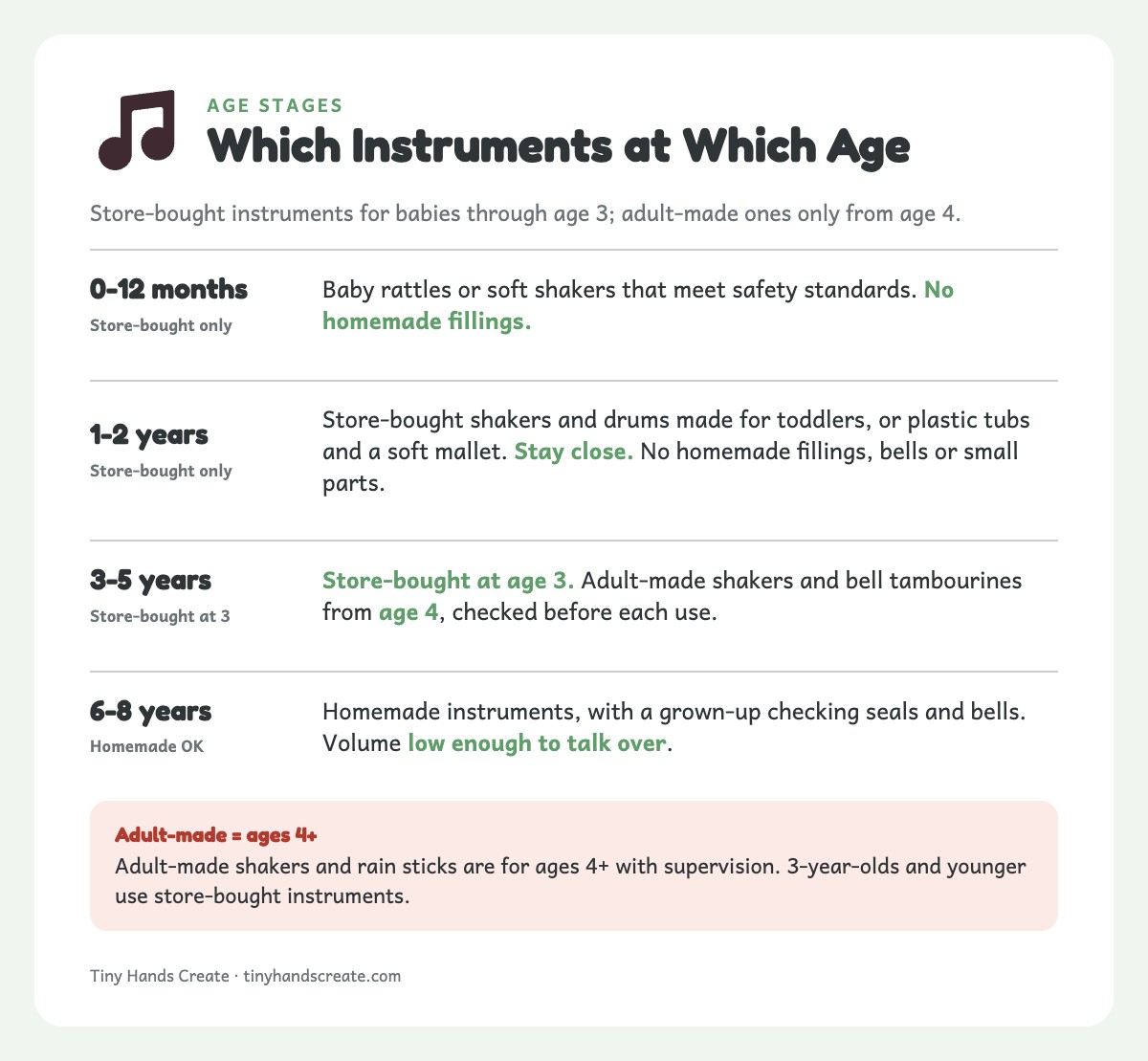
Start with the row that matches your child, then borrow from the rows above and below. Got a two-year-old? These play-based learning activities for 2-year-olds pair well with the 1-2 years row.
| Age | Good activities | Instruments | Safety note |
|---|---|---|---|
| 0-12 months | Gentle bouncing, patty-cake and dancing while holding baby. Sing during diaper changes and baths. | Commercially made baby rattles or soft shakers that meet safety standards. No homemade fillings. | Check toys for damage and loose parts. |
| 1-2 years | Action songs with simple motions, free dancing with scarves, brief freeze dance, simple echo clapping | Store-bought shakers and drums made for toddlers, or plastic tubs and a soft mallet | Stay close. No homemade fillings, bells or small parts. |
| 3-5 years | Longer action songs, following dance steps, making up moves, rhythm patterns, musical games with rules | Store-bought shakers, tambourines and sturdy drums at age 3. Adult-made shakers and bell tambourines from age 4, checked before each use. | Supervise all instruments and keep drumming away from ears. |
| 6-8 years | Simple choreography, rhythm games with written beats, call-and-response songs, leading the dance | Homemade instruments, with a grown-up checking seals and bells | Keep volume low enough to talk over, and avoid headphones at high volume. |
Your First Music and Movement Session: A 10-Minute Plan
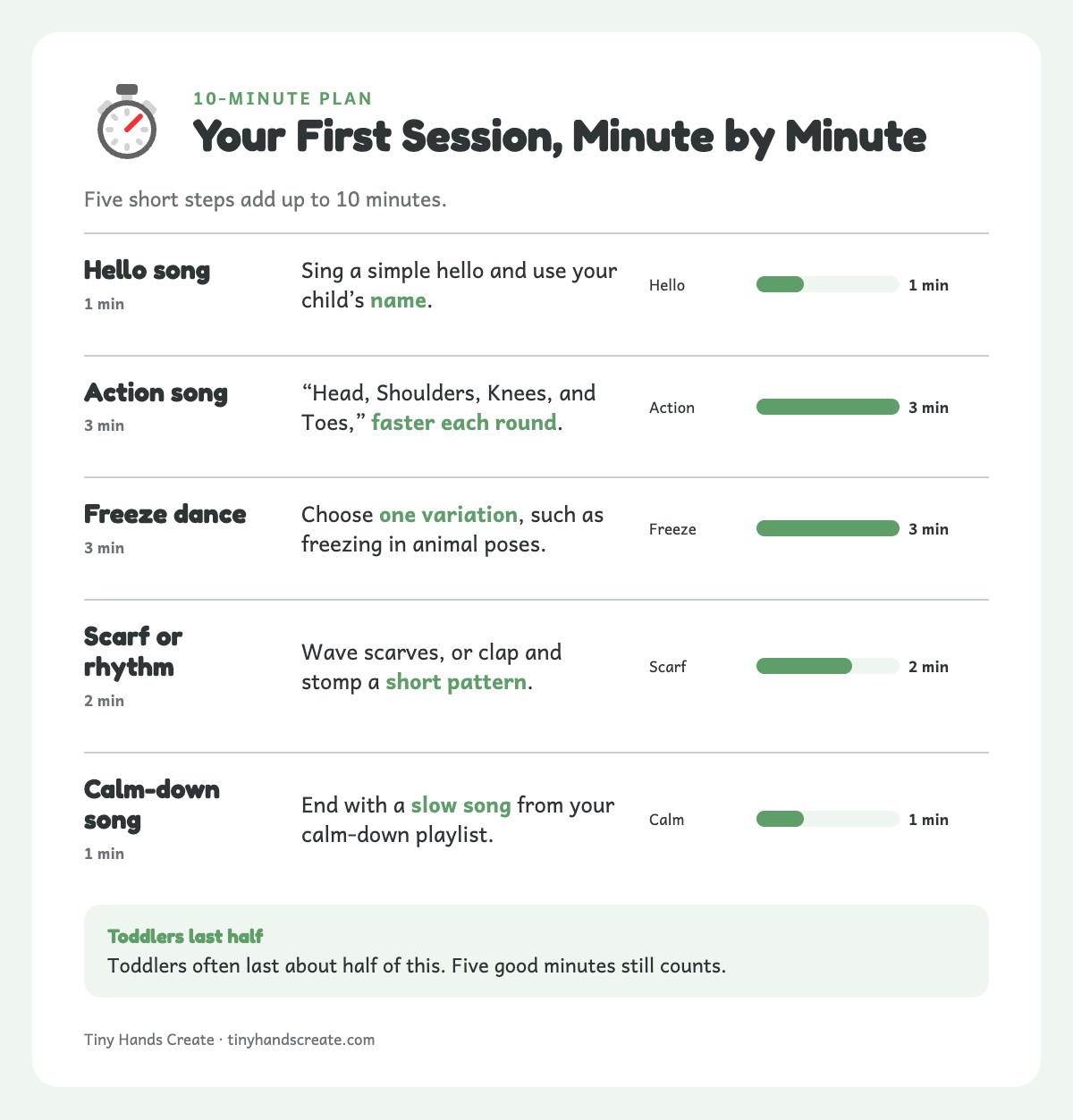
New to this? Run this plan once, then swap in ideas from the sections below. Quit early if your child loses interest.
- Hello song (1 min). Sing a simple hello and use your child’s name.
- Action song (3 min). Sing “Head, Shoulders, Knees, and Toes” and get faster each round.
- Freeze dance (3 min). Choose one variation, such as freezing in animal poses.
- Scarf or rhythm play (2 min). Wave scarves, or clap and stomp a short pattern.
- Calm-down song (1 min). End with a slow song from your calm-down playlist.
Fair warning: toddlers often last about half of this. Five good minutes still counts.
Action Songs and Fingerplays
Action songs combine singing with specific movements, perfect for toddlers and preschoolers.
Classic Action Songs
| Song | Ages | Motions | Tip |
|---|---|---|---|
| Head, Shoulders, Knees, and Toes | 2-6 | Touch each body part as you sing. | Start slow, then speed up each repeat. Kids love racing to keep up. |
| If You’re Happy and You Know It | 1-6 | Clap, stomp, shout hooray, then do all three. Add spin around, jump up high, wave goodbye. | Let your child pick the next verse. |
| The Wheels on the Bus | 1-5 | Circle arms for wheels. Swish arms side to side for wipers. Open and close arms for doors. Rub eyes for babies. Finger to lips for mamas. | One motion per verse is plenty for toddlers. |
| Itsy Bitsy Spider | 1-5 | Fingers walk up, wiggle down for rain, arms circle overhead for sun. | A fingerplay that builds fine motor coordination. |
| Old MacDonald | 2-6 | Cow: fingers as horns. Pig: push nose up. Chicken: flap elbows. Horse: gallop in place. | Let your child choose the next animal. |
Free Movement and Dance Activities
Action songs come with steps to follow. Free movement is where kids invent their own.
Freeze Dance
Play music and dance freely. When the music stops, everyone freezes. The pause builds a little suspense, and freezing is good body-control practice.
Fair warning: toddlers often freeze for half a second and then keep wiggling. We count that as a win and cheer anyway.
Variations. Call one out before you press play.
- Freeze in an animal pose from the prompt table below.
- Freeze in a shape: tall, small, wide or twisted.
- Freeze touching something red, then something blue.
- Freeze with a partner.
Movement Exploration
Put on any song and call out a prompt. Start with the animals, which even two-year-olds can copy. Save the pretend ones for kids who can picture them. The ages are a rough guide.
| Prompt | How kids move | Good for ages |
|---|---|---|
| “Shake it like a monkey” | Shake the whole body. | 2-8. |
| “Stomp it like an elephant” | Stomp slow and heavy. | 2-8. |
| “Slither like a snake” | Wave both arms like a snake. | 2-8. |
| “Snap it like a crocodile” | Snap straight arms together like jaws. | 2-8. |
| “Move like you’re stuck in peanut butter” | Take slow, sticky steps. | 3-8. |
| “Move like you’re floating on a cloud” | Tiptoe with light, drifting arms. | 3-8. |
| “Move like you’re a robot” | Keep arms and legs stiff and turn in jerks. | 3-8. |
| “Move like you’re made of jelly” | Wobble everything at once. | 3-8. |
| “Dance happy, then dance sleepy” | Bounce big, then droop and slow down. | 3-8. |
Change prompts as the music plays. Expect plenty of giggling, and one child who insists on being the peanut butter.
Scarves and Ribbons Dancing
Light scarves make movement easy to see. Kids 3 and up can use short ribbons too, no longer than about 7 inches. Hand one to each child and try these.
- Wave them high at the ceiling, then low at your toes.
- Draw big circles and figure eights in the air.
- Toss them up and catch them.
- Hide under a sheer scarf and pop out.
Scarves slow movement down. Kids can watch what their bodies are doing and steer it. A tossed scarf also falls slowly, so little hands get time to catch it.
Fair warning: throw-and-catch ends with at least one scarf on the ceiling fan. Turn the fan off first.
Safety firstUse lightweight, breathable scarves with no cords or ties, and stay close while kids play. Keep ribbons no longer than about 7 inches. Ribbons are for ages 3 and up only. No ribbons for babies or kids under 3, even with an adult close by. Give them a lightweight scarf instead. Never tie anything on or around the neck. Hide-underneath play is for sheer scarves only, with you right there.
Dance Different Emotions
“How does happy dance?” Let children explore. Then sad, angry, scared, excited, sleepy. It gives kids words and moves for feelings they already have.
When big feelings need a slower outlet, try these calm-down activities for kids.
Still have energy to burn? These indoor gross motor activities for toddlers pick up where the dancing leaves off.
Rhythm and Beat Activities
Rhythm games are mostly clapping, stomping and counting. Patterns and timing come along for the ride.
Body Percussion

Make music with your body:
- Clap hands.
- Pat thighs.
- Stomp feet.
- Snap fingers (often easier from ages 5-6).
- Click tongue.
Create patterns: clap-clap-stomp, clap-clap-stomp. Children follow along, then create their own.
Echo Clapping
Clap a short pattern and have your child clap it back. It is good practice for listening and remembering. Build up in small steps.
- Two claps. Clap-clap. Repeat until the echo comes back easily.
- Add a stomp. Clap-clap-stomp.
- Add a rest. Try four beats with a silent one: clap, clap, rest, clap. Open your hands wide on the rest so kids can see it.
If your child can’t copy a pattern, go back one step and slow down. Clap it together a few times before you ask for an echo. Toddlers may only manage step one, and that is plenty.
Rhythm Instruments
Simple instruments help children feel the beat. Pots and pans are the loudest option by far, so expect the neighbors to hear it.
Good to knowKeep the volume loud enough to enjoy and quiet enough to talk over. That goes for the speaker and the drums. If you have to raise your voice, turn it down or switch to softer instruments.
Safety firstAdult-made shakers and rain sticks are for ages 4+ with supervision. Babies and toddlers (and 3-year-olds) should use store-bought instruments made for their age. Keep homemade instruments away from younger siblings, and store them out of reach between sessions. A failed seal releases small pieces, so throw out any shaker that gets wet, cracked, dented or leaky.
- An adult makes every homemade instrument.
- Seal with glue and strong tape. Never use nails or pins.
- Check lids and bells for loosening before each use.
- Keep drums away from ears, and play on a rug or other soft surface.
- Take a break if your child covers their ears.
Homemade options:
- Shakers: use dry rice in a glued and taped-shut container, adult-made, for ages 4+ with supervision. Skip dried beans: they are a choking hazard, and raw kidney beans are toxic if eaten.
- Drums: plastic tubs with a soft mallet for little ones. Wooden spoons from age 4, with kids seated on a rug.
- Tambourines: adult-made, for ages 4+ under supervision. Use paper plates and large jingle bells, each one too big to fit through a toilet paper tube. Sew each bell on with knotted thread, or thread it onto a pipe cleaner and twist the ends shut. Tug every bell to check it before each use. Use a sturdy store-bought tambourine for younger children.
- Rain sticks: adult-made, for ages 4+ with supervision. Twist a long strip of aluminum foil into a tight spiral and fold the ends flat so nothing pokes out. Slide it into a cardboard tube with about 2 tablespoons of dry rice, then seal both ends with strong tape and glue.
Make a safe shaker (adult-made, ages 4+):
- Fill it. Fill an empty oatmeal canister or small tub about 1/4 cup deep with dry rice.
- Seal it. Put the lid on, then glue it down.
- Tape it. Wrap strong tape around the lid seam several times.
- Test it. Shake it hard and squeeze it. If anything leaks or gives, redo the seal. Our lid popped on the first hard shake, so the tape is not optional.
- Decorate. Add stickers or paper, and expect a few stray grains of rice on the floor anyway.
Playing together. Once everyone has an instrument, try these.
- March to a steady beat.
- Play loud, play soft.
- Play fast, play slow.
- Play the rhythm of words. Tap out your child’s name or a favorite food, one tap per syllable.
For more DIY sensory activities, check our sensory bin ideas. Short on supplies? Our recycled art projects have more ways to use up the recycling bin.
Musical Games
Safety firstClear furniture and sharp edges before any running or freezing game, and play on a non-slippery surface.
| Game | Ages | Space needed | How it works |
|---|---|---|---|
| Cushion Chairs (toddler musical chairs) | 2-5 | Small | Scatter cushions. When the music stops, everyone finds a spot. No one is “out,” so no one melts down. |
| Musical Statues | 2-8 | Medium | Dance while the music plays and freeze into a statue when it stops. Cheer for the silliest, most creative or most balanced one. |
| Follow the Leader Dance | 3-8 | Medium | One person leads the moves and everyone copies. Rotate leaders. |
| Hot Potato | 3-8 | Circle on the floor | Pass a soft ball or beanbag (too big to swallow) while the music plays. Whoever holds it when the music stops does a silly dance or makes an animal sound. |
| Dance Walk | 2-8 | Large | Change how you move when the music changes. Take quick steps for fast music. Go slow motion for slow music. Try ballet moves for classical, and jump and bob your head for rock. Try world music to explore other dance styles. |
Playlists for Kids: Dance, Calm-Down and Silly Songs
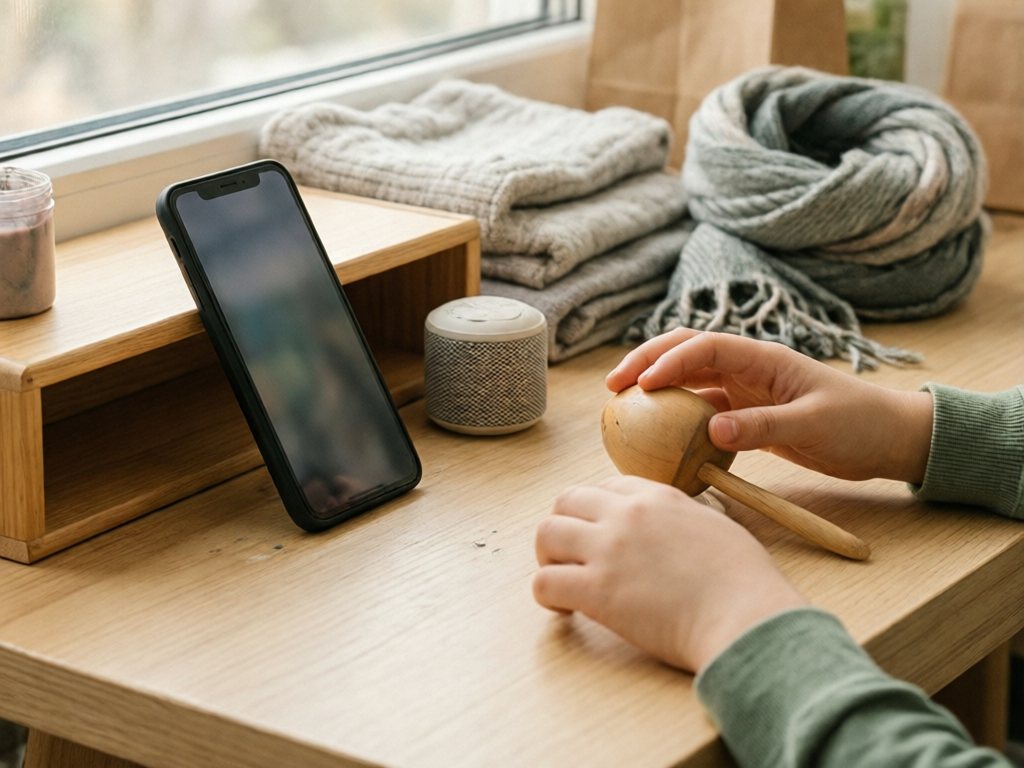
Build a few playlists of 10-15 songs so you can press play instead of scrolling. As a rule of thumb, brisk and bouncy suits dancing, and slow and soft suits winding down.
| Playlist | What to include | Use it when |
|---|---|---|
| High-energy | Brisk, bouncy songs with a steady beat. Try “Twist and Shout,” “Walking on Sunshine,” “Can’t Stop the Feeling!” and “Wheels on the Bus” sped up | Mornings, rainy days, or before a transition that needs energy released |
| Calm-down | Slow, soft songs you can sing or sway to. Try “Twinkle, Twinkle, Little Star,” “Brahms’ Lullaby,” “You Are My Sunshine” and “Clair de Lune” | Wind-down time, before nap, after high-energy play |
| Silly | Any tempo. Try “The Hokey Pokey,” “Down by the Bay,” “Baby Shark” and “Five Little Monkeys” | Pure fun and lifting a grumpy mood |
| Focus | Quiet instrumentals with no words to sing along to. Try Satie’s “Gymnopédie No. 1,” soft piano, nature sounds or lo-fi instrumentals. | Background for quiet play and table activities. The calm-down list is for stopping to rest, and this one is for staying busy quietly. |
Music Throughout the Day
Music slots into routines you already have:
| Routine moment | Song idea |
|---|---|
| Wake-up | An upbeat song from your high-energy playlist. |
| Clean-up | The classic clean-up song, sung until the floor is clear. |
| Quiet time | Soft instrumental music from your focus playlist. |
| Bedtime | The same lullaby each night. |
Transition songs. Create simple songs for routine transitions:
- “Clean up, clean up, everybody everywhere…”
- “This is the way we brush our teeth…”
- Your own version for shoes, coats or hand-washing. Same tune, new job.
Movement breaks. When energy is high or focus is low, a quick dance break resets everyone. On a rainy day, stack a few breaks together with ideas from our rainy day activities.
Bedtime routine. The same lullabies or gentle songs each night can become a cue that sleep is coming. For babies, follow AAP safe sleep guidance: a firm, flat surface with nothing else in the crib, and music played from a device placed out of reach.
Screen-free listening. Audio-only streaming, CDs, the radio and your own singing all keep eyes on each other instead of a screen. Pair the music with these screen-free quiet time activities.
Making Your Own Songs
You don’t need to be a songwriter. Use familiar tunes with new words.
To the tune of Twinkle, Twinkle.
Time to get our jammies on,
Jammies on, jammies on,
Time to get our jammies on,
Ready for bed.
To the tune of Row, Row, Row Your Boat.
Brush, brush, brush your teeth,
Up and down they go,
Brushing, brushing, brushing, brushing,
Now your teeth will glow.
TipSwap your child’s name into any verse, like “Time for Mia to get jammies on.” A reluctant kid will often start listening the moment they hear their own name.
When a Child Won’t Participate
Some children are observers before they’re participants. This is normal and okay.
What helps. Try these one at a time.
- Invite, don’t require. Say “come dance when you’re ready” and carry on.
- Go first. Dance and sing yourself, and let them watch from the couch.
- Change the music or the time. A child who sits out before dinner may jump in after breakfast.
- Shrink it. Try one song with one scarf, or a clapping game on your lap.
Children often absorb through observation before joining, then surprise you by knowing all the words and moves.
TipFor sound-sensitive kids, lower the volume, offer ear defenders, or start with soft music.
If a child is distressed by everyday sounds, or doesn’t seem to respond to sound at all, mention it to your pediatrician.
Start With One Song
Pick one action song and one round of freeze dance from the 10-minute plan near the top of this page, and press play today.
Keep age-appropriate instruments within reach, play music often, and follow your child’s lead.
Put on a song, dance badly and sing loudly. That is the whole trick.
Frequently Asked Questions
What are good music activities for a 2-year-old?
Action songs with simple motions, free dancing with scarves, short freeze dance rounds and echo clapping all work well. Keep sessions to about 5-10 minutes.
How do you make homemade instruments for kids?
An adult can make a shaker from an empty tub with about 1/4 cup of dry rice, glued and taped shut. Adult-made instruments are for ages 4+ with supervision. Never use nails, pins or loose bells, and use store-bought instruments for babies, toddlers and 3-year-olds.
How long should music time last?
Aim for 5-10 minutes for toddlers and 15-20 minutes for preschoolers and school-age kids. Stop while it’s still fun.
What if my child won’t join in?
Keep inviting without pressure and model the fun yourself. Watching counts as participating for many kids.
What are the benefits of music and movement for toddlers?
Songs and dancing may support vocabulary, listening, balance and coordination. They also give toddlers a fun way to burn off energy and practice taking turns.
What music works best for preschool movement?
Pick brisk, bouncy songs with a steady beat for dancing and slow, soft ones for winding down. Familiar action songs like “Head, Shoulders, Knees, and Toes” are easy wins.
Crafty Mama
Crafty Mama is a former elementary art teacher turned stay-at-home parent who believes every child is creative — they just need the right invitation. She develops age-appropriate activities, crafts, and projects that spark imagination while keeping mess (and parent stress) to a minimum.