
Free Printable Alphabet Worksheets for Preschoolers
Discover free printable alphabet worksheets designed for preschoolers to build foundational reading skills. You'll find activities for letter recognition, formation, and beginning sounds, along with tips for effective teaching.
- Utilize free printable worksheets for uppercase, lowercase, recognition, and beginning sounds.
- Guide tracing with finger practice, proper grip, and numbered stroke order for proper formation.
- Integrate multi-sensory activities like writing in sand or forming letters with playdough.
- Teach letters in an order meaningful to your child, such as their name or by frequency.
- Focus on letter recognition before writing and always celebrate your child's effort.
This post contains affiliate links. As an Amazon Associate I earn from qualifying purchases.
Learning letters is one of the most exciting milestones of the preschool years. Watching your child recognize their first letters and eventually write their name never gets old. But teaching the alphabet doesn’t require expensive curricula or fancy programs—sometimes simple worksheets are exactly what you need.
These free printable alphabet worksheets are designed for preschoolers who are just beginning their letter journey. They focus on letter recognition, proper formation, and beginning sounds—all foundational skills for reading readiness.
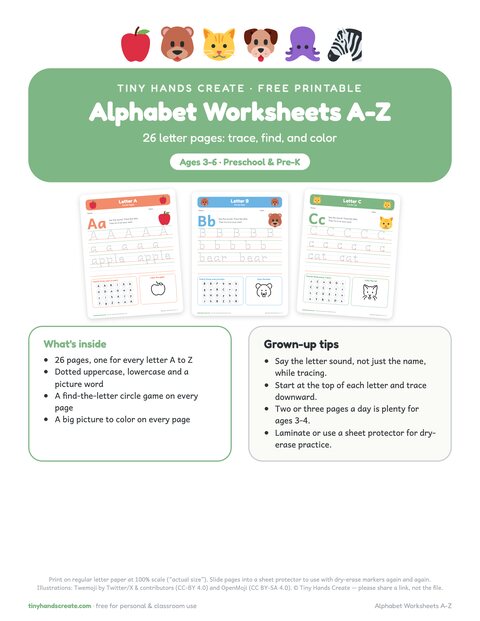
Free printable · 27 pages
Alphabet Worksheets A-Z
26 letter pages with dotted tracing, a find-the-letter game and a picture to color on every page.
Free. Your download link appears right here. You'll also join the Daily Printable Drop. Unsubscribe anytime. Privacy
[IMAGE: Preschooler working on letter tracing worksheet at table]
In this article (8 sections)
What’s Included in These Free Alphabet Printables
Our alphabet worksheet pack includes multiple activities to support letter learning:
Uppercase Letter Tracing (26 pages)
Each page features one uppercase letter with:
- Large traceable letter with numbered stroke order
- Multiple practice lines for independent writing
- Picture of an object beginning with that letter
- Simple coloring element
Lowercase Letter Tracing (26 pages)
Matching pages for lowercase letters with:
- Proper formation guides
- Practice lines
- Corresponding picture
- Connection to uppercase partner
Letter Recognition Pages (26 pages)
Find and identify activities including:
- Circle the matching letter
- Color the correct letter
- Find the letter in a group of similar shapes
Beginning Sounds Matching (13 pages)
Two letters per page with:
- Pictures to match to beginning sounds
- Draw a line activities
- Cut and paste options
Free Printable Number Tracing Worksheets 1-20
How to Use These Alphabet Worksheets
For Letter Tracing Pages
Start with finger tracing: Before giving your child a pencil, have them trace the letter with their finger. This builds muscle memory without the added challenge of pencil grip.
Use the right grip: Encourage a proper tripod grip (thumb, pointer, and middle finger) but don’t stress perfection at this age.
Follow the arrows: Each letter has numbered arrows showing stroke order. Proper formation now prevents bad habits later.
Less is more: One or two letters per day is plenty. Overwhelming kids with too much practice backfires.
Celebrate effort: Praise the work, not perfection. “You worked really hard on that A!” beats “That’s perfect!”
For Recognition Activities
Say the letter name: As they complete recognition activities, say the letter name aloud together.
Make connections: “That’s the letter S—like in YOUR name, Sofia!”
Don’t rush: Recognition comes before writing for most children. It’s okay to spend extra time here.
For Beginning Sounds
Emphasize the sound: “Apple—/a/—Apple starts with A. Hear that /a/ sound?”
Make it physical: Have kids look in a mirror while making letter sounds. Feel where tongue and lips go.
Play games: “I spy something that starts with /b/…” makes beginning sounds practice fun.
[IMAGE: Letter recognition worksheet with circled correct letters]
Tips for Teaching the Alphabet to Preschoolers
Order of Teaching Letters
There’s no single “right” order, but here are common approaches:
By name first: Many parents teach letters in their child’s name first. It’s personally meaningful.
Alphabetical: Simple and systematic. How most alphabet books are organized.
By frequency: Start with letters used most often in reading (s, a, t, m, i, p) to enable word-building sooner.
By formation: Group letters by similar strokes (l, t, i = straight lines; c, o, a = curves).
Mixed approach: A combination based on your child’s interests and needs.
Make It Multi-Sensory
Worksheets are great, but learning letters should be multi-sensory:
- Write letters in sand or salt trays
- Form letters with playdough
- Trace letters in shaving cream
- Build letters with sticks or blocks
- Make letters with their body
- Find letters in the environment
Worksheets reinforce what you’re teaching through play and hands-on activities.
Signs of Readiness
Your child is ready for alphabet worksheets when they:
- Can hold a crayon or pencil
- Show interest in letters and writing
- Can focus on an activity for 5-10 minutes
- Are around 3-4 years old (varies by child)
If worksheets lead to frustration, back off and return to playful alphabet activities. There’s no rush.
Fine Motor Activities for Toddlers: Strengthen Little Hands
Printable Worksheet Descriptions
Uppercase Letter Tracing Worksheets
Each uppercase letter page features:
Large demonstration letter with numbered strokes showing exactly how to form the letter. Arrows indicate direction.
Guided practice row with dotted letters to trace. Usually 4-5 traceable letters.
Independent practice row with starting dots to guide placement.
Related picture of an object beginning with that letter (A = apple, B = ball, etc.) that kids can color.
Pro tip: Laminate these pages and use dry-erase markers for unlimited practice.
Lowercase Letter Tracing Worksheets
Similar format to uppercase with special attention to:
Proper starting points for lowercase letters (many start in the middle, not the top).
Line placement showing where letters sit on writing lines—important for letters like g, j, p that dip below.
Visual pairing with uppercase partner for connection.
Letter Recognition Worksheets
Activities include:
Circle the letter: A target letter shown, child circles all matching letters among distractors.
Color the boxes: Only color boxes containing the target letter to reveal a picture.
Letter sorting: Cut and paste letters into uppercase and lowercase columns.
Find and dot: Use a dot marker to stamp all instances of a letter.
Beginning Sounds Worksheets
Each page covers two letters with:
Picture identification: 6-8 pictures per letter, child identifies which start with each letter sound.
Draw lines to match: Connect pictures to their beginning letter.
Sort and paste: Cut out pictures, paste under the correct beginning letter.
[IMAGE: Beginning sounds matching worksheet]
Common Letter Learning Challenges
Letter Reversals (b/d, p/q)
Extremely common in preschool and early elementary. Don’t panic!
Strategies that help:
- Make a “bed” with hands (fists together, thumbs up make the word b-e-d)
- Teach b first, establish it well before introducing d
- Use tactile letters they can feel the orientation of
- Mnemonics: “b has a belly in front, d has a backpack behind”
Most children outgrow reversals by age 7.
Won’t Hold Pencil Correctly
Focus on strengthening hand muscles before correcting grip:
- Playdough play
- Tearing paper
- Using tongs and tweezers
- Lacing activities
- Squeezing spray bottles
A strong hand naturally develops better grip.
Gets Bored Quickly
- Shorten practice sessions (5 minutes is fine!)
- Rotate between worksheet types
- Balance with hands-on letter activities
- Let them choose which letter to work on
- Add variety (different colors, stickers as rewards)
Knows Uppercase But Not Lowercase
This is normal—uppercase are typically easier. They’re more visually distinct and what kids see in their name first.
Keep presenting both together. Many worksheets pair them. The connection will click.
How to Print These Worksheets
Printing Tips
Paper choice: Regular printer paper works fine. Cardstock is sturdier for repeated use.
Laminating: Consider laminating a set for dry-erase marker use. Unlimited practice!
Two-sided printing: Save paper by printing recognition on back of tracing pages.
Binding: Punch holes and create a workbook with binder rings for easy page turning.
Organization Ideas
- Print one week’s letters at a time
- Use a folder or binder to collect completed work
- Date worksheets to track progress
- Create a “done” envelope for finished pages
Crafty Mama
Crafty Mama is a former elementary art teacher turned stay-at-home parent who believes every child is creative — they just need the right invitation. She develops age-appropriate activities, crafts, and projects that spark imagination while keeping mess (and parent stress) to a minimum.
Frequently Asked Questions
At what age should my child know all their letters?
Most children know the alphabet by the end of kindergarten (age 5-6). By age 4, knowing 10-20 letters is typical. There’s wide variation, and that’s okay.
Should I teach letter names or sounds first?
Both! Teach the name while introducing the sound. “This is the letter B. B says /b/ like in ball.”
My child can recite the alphabet but doesn’t recognize individual letters. Is that normal?
Very normal. The alphabet song is memorization; letter recognition is a separate skill. Keep working on both.
How many times should we practice each letter?
Until they know it! Some letters are learned in a day, others take weeks. Follow your child’s pace.
Are worksheets bad for preschoolers?
Not when used appropriately. Short sessions, no pressure, balanced with play-based learning. Worksheets can be one helpful tool among many.
Conclusion
These free alphabet worksheets give your preschooler structured practice with letter recognition, formation, and beginning sounds. Combined with playful, hands-on alphabet activities, they build a strong foundation for reading.
Download the pack, print a few pages, and see how your child responds. Remember: keep sessions short, make it fun, and celebrate every little victory on the path to literacy.
Happy letter learning!
Free Printable Sight Words Flashcards: Kindergarten
—