Fine Motor Activities for Toddlers: Strengthen Little Hands
Fine Motor Activities for Toddlers: Strengthen Little Hands
Those little hands that grab everything in sight are building crucial skills every time they pick up a cheerio or stack a block. Fine motor development—the coordination of small muscles in the hands and fingers—is foundational for everything from eating independently to eventually writing their name.
The good news? Fine motor activities don’t require special equipment or dedicated “practice time.” Many are simply play activities your toddler will love that happen to build important skills.
Here are dozens of fine motor activities organized by type, plus tips for supporting your toddler’s hand development naturally.
[Image placeholder: Toddler hands working with playdough and small tools]
What Are Fine Motor Skills?
Fine motor skills involve the small muscles in the hands, fingers, and wrists working together with the eyes. These skills allow children to:
- Pick up small objects
- Hold utensils and crayons
- Button and zip clothing
- Turn pages in a book
- Build with blocks
- Eventually write and draw
Gross motor vs. fine motor: Gross motor involves large muscles (running, jumping). Fine motor involves small, precise movements.
Why Fine Motor Development Matters
Strong fine motor skills are linked to:
Self-care independence: Feeding themselves, dressing, brushing teeth
Academic readiness: Holding a pencil, cutting with scissors, writing letters
Cognitive development: Many fine motor activities also build problem-solving and focus
Confidence: Being able to do things independently feels good
Children develop at different rates, but supporting fine motor development through play helps them build a strong foundation.
Picking and Pinching Activities (10 Ideas)
These activities develop the pincer grasp—the thumb and forefinger grip essential for holding pencils later.
1. Pom Pom Sorting
Activity: Sort pom poms by color into muffin tin cups or small bowls.
Add challenge: Use tongs or tweezers instead of fingers.
Ages: 18 months+ | Mess: Low
2. Sticker Peeling
Activity: Peel stickers off a sheet and place onto paper.
Skills: Pincer grasp, hand-eye coordination.
Ages: 15 months+ | Mess: None
3. Cheerio Threading
Activity: Thread Cheerios (or large beads) onto pipe cleaners or uncooked spaghetti stuck in playdough.
Skills: Pincer grasp, bilateral coordination.
Ages: 18 months+ | Mess: Low
4. Cotton Ball Transfer
Activity: Use tongs or fingers to transfer cotton balls from one container to another.
Add challenge: Time it! Or pick up cotton balls with clothespins.
Ages: 18 months+ | Mess: None
5. Peg Board Play
Activity: Push pegs into a pegboard. Remove pegs. Sort by color.
Skills: Pincer grasp, color recognition.
Ages: 2 years+ | Mess: None
6. Dot Sticker Art
Activity: Peel and place dot stickers to create pictures or fill in printed templates.
Skills: Peeling, precision placement.
Ages: 2 years+ | Mess: None
7. Pompom Push
Activity: Push pom poms through holes cut in a container lid.
Skills: Pinching, pushing, hand-eye coordination.
Ages: 12 months+ | Mess: None
8. Water Dropper Play
Activity: Use a medicine dropper or pipette to transfer colored water between cups.
Skills: Squeezing, controlled release.
Ages: 2 years+ | Mess: Medium (water)
9. Clothespin Activities
Activity: Clip clothespins onto cardboard edges, rims of containers, or strings.
Skills: Pinching, hand strength.
Ages: 2 years+ | Mess: None
10. Tweezers and Tongs Games
Activity: Pick up small items (pom poms, erasers, small toys) with kid-sized tweezers or tongs.
Skills: Strengthens pincer grasp muscles.
Ages: 2 years+ | Mess: None
[Image placeholder: Child using tweezers to pick up pom poms]
Squeezing and Strengthening Activities (8 Ideas)
These build the hand strength needed for tasks like cutting and writing.
11. Playdough Play
Activity: Squish, roll, pinch, poke, and manipulate playdough.
Skills: Overall hand strength, finger isolation.
Ages: 18 months+ | Mess: Low
12. Spray Bottle Fun
Activity: Spray water to “paint” the sidewalk, clean windows, or water plants.
Skills: Hand strength, finger isolation.
Ages: 2 years+ | Mess: Low (water)
13. Squeeze Ball Play
Activity: Squeeze stress balls or soft balls of various resistances.
Skills: Hand and grip strength.
Ages: 18 months+ | Mess: None
14. Sponge Squeezing
Activity: Transfer water by squeezing wet sponges from one container to another.
Skills: Bilateral coordination, hand strength.
Ages: 2 years+ | Mess: Medium (water)
15. Hole Punching
Activity: Use a single hole punch to punch holes in paper.
Skills: Hand strength, pressure application.
Ages: 3 years+ | Mess: Low
16. Tearing Paper
Activity: Tear paper into strips or pieces for collages.
Skills: Bilateral coordination, finger strength.
Ages: 18 months+ | Mess: Low
17. Kneading Dough
Activity: Help make bread, pizza, or cookie dough. Push, fold, knead.
Skills: Hand and arm strength.
Ages: 2 years+ | Mess: Medium
18. Glue Bottles
Activity: Squeeze glue from a bottle for art projects.
Skills: Hand strength, controlled squeezing.
Ages: 3 years+ | Mess: Medium
Threading and Lacing Activities (6 Ideas)
These develop coordination and the ability to manipulate objects precisely.
19. Basic Lacing Cards
Activity: Lace a shoelace through holes in cardboard shapes.
Skills: Hand-eye coordination, pattern following.
Ages: 2.5 years+ | Mess: None
20. Pasta Necklaces
Activity: String large pasta shapes onto yarn or string.
Skills: Threading, pattern making.
Ages: 2 years+ | Mess: Low
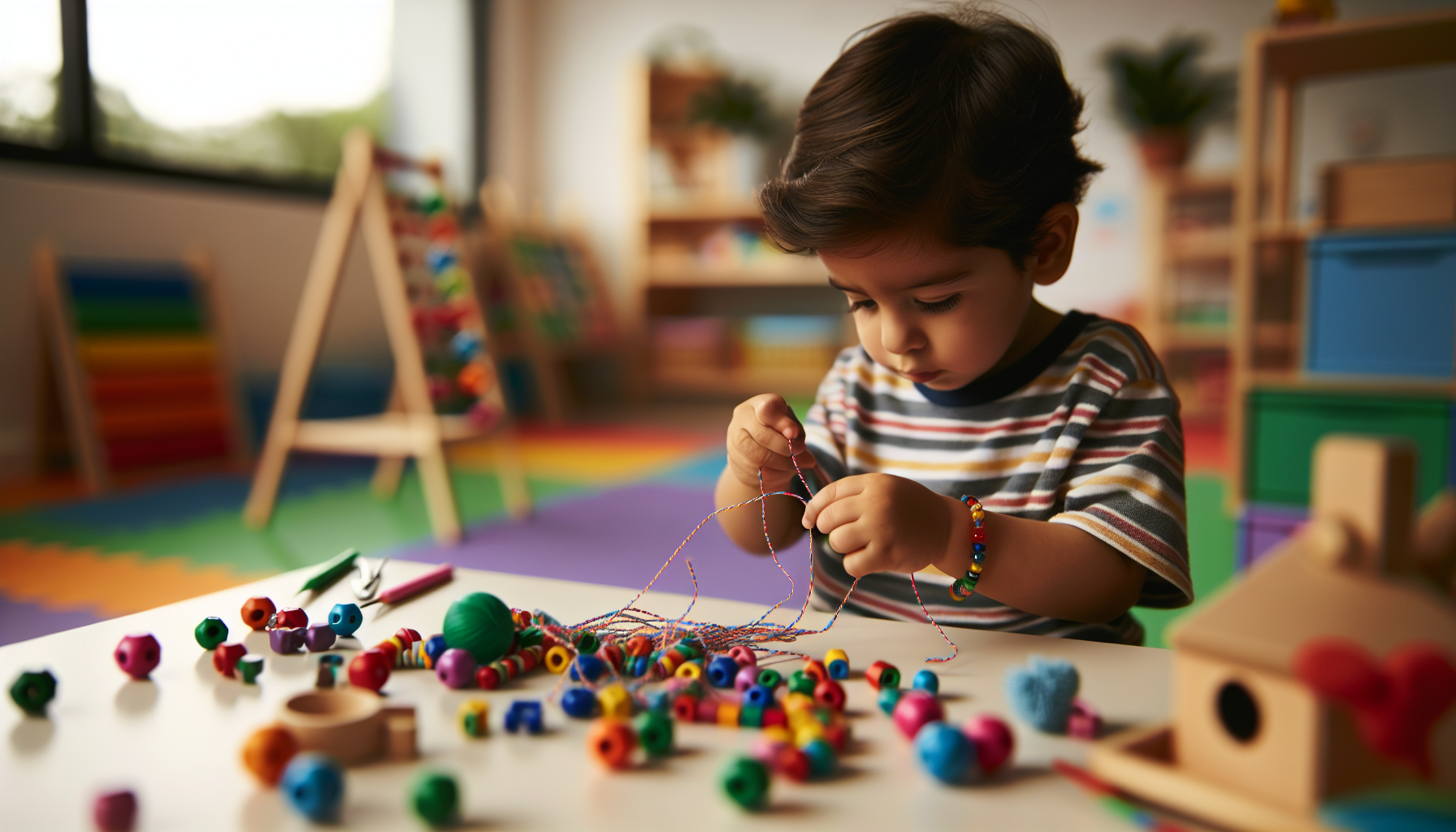
21. Bead Threading
Activity: Thread beads onto laces, pipe cleaners, or string.
Start large: Large beads first, smaller as skills develop.
Ages: 2 years+ | Mess: None
22. Button Snakes
Activity: Thread buttons onto a felt strip, buttoning and unbuttoning.
Skills: Buttoning, threading.
Ages: 3 years+ | Mess: None
23. Weaving
Activity: Weave paper strips through slotted paper, or yarn through a plastic canvas.
Skills: Over-under pattern, bilateral coordination.
Ages: 3 years+ | Mess: Low
24. Sewing Cards
Activity: Simple sewing motions on thick cards with large holes and blunt needles.
Skills: In-out motion, precision.
Ages: 4 years+ | Mess: None
[Image placeholder: Toddler threading large beads onto string]
Pouring and Transferring Activities (6 Ideas)
Practical life skills that also build coordination.
25. Rice or Bean Scooping
Activity: Scoop dry rice or beans from one container to another.
Skills: Scooping, pouring, controlled movements.
Ages: 18 months+ | Mess: Medium
26. Water Pouring
Activity: Pour water between small pitchers or cups.
Skills: Controlled pouring, wrist rotation.
Ages: 2 years+ | Mess: Medium (water)
27. Spoon Transfer
Activity: Use a spoon to move items between containers.
Skills: Spoon control, steadiness.
Ages: 18 months+ | Mess: Low-Medium
28. Funnel Play
Activity: Pour rice, sand, or water through funnels into bottles.
Skills: Pouring precision, understanding of flow.
Ages: 2 years+ | Mess: Medium
29. Spooning Cotton Balls
Activity: Balance cotton balls on a spoon and transport to a container.
Skills: Steadiness, controlled movement.
Ages: 2 years+ | Mess: None
30. Sand or Rice Sifting
Activity: Use sifters and strainers with sensory materials.
Skills: Wrist rotation, controlled shaking.
Ages: 2 years+ | Mess: Medium
Pre-Writing Activities (6 Ideas)
Preparing hands for eventual pencil holding and writing.
31. Tracing with Finger
Activity: Trace shapes, letters, or patterns with finger on sand, salt, or shaving cream.
Skills: Pre-writing shapes, controlled finger movement.
Ages: 2 years+ | Mess: Low-Medium
32. Painting with Small Brushes
Activity: Paint with small brushes requiring controlled grip.
Skills: Tool grip, controlled strokes.
Ages: 2 years+ | Mess: Medium-High
33. Drawing in Sand/Salt
Activity: Draw pictures, letters, or designs in a tray of sand or salt.
Skills: Writing movements without pencil pressure.
Ages: 2 years+ | Mess: Low
34. Dot Markers
Activity: Use dot markers to make pictures, fill in templates, or trace.
Skills: Controlled pressing, tool grip.
Ages: 2 years+ | Mess: Low
35. Magna Doodle/Etch-a-Sketch
Activity: Draw on magnetic drawing boards.
Skills: Drawing movements, line control.
Ages: 18 months+ | Mess: None
36. Chalk Drawing
Activity: Draw with chalk on sidewalks or chalkboards.
Skills: Grip, pressure control (different from crayons).
Ages: 18 months+ | Mess: Low
Supporting Fine Motor Development at Home
Make activities accessible: Keep playdough, crayons, and manipulatives within reach.
Let them try: Resist the urge to do tasks for them. Struggle builds strength.
Follow their lead: If they love sorting, provide more sorting opportunities.
Integrate into daily life: Buttoning clothes, opening containers, helping cook.
Limit screens: Screen time doesn’t build hand skills. Active play does.
When to Be Concerned
Talk to your pediatrician if your child:
- Avoids activities using hands
- Has significantly weaker hand skills than peers
- Shows frustration or gives up quickly with all hand activities
- Can’t do age-appropriate self-care tasks
Most delays are minor and improve with focused practice. Early intervention can help if needed.
FAQ
My toddler won’t sit still for fine motor activities. What do I do?
Keep activities short (5-10 minutes). Choose activities that match their interests. Movement activities count too—squishing playdough while standing, spraying a water bottle outdoors.
How often should we do fine motor activities?
Daily, but naturally. Fine motor is built into life—eating, playing, exploring. You don’t need formal “practice sessions.”
My child only wants to play with big toys. Is that okay?
Gross motor play is important too! But sneak in fine motor: offer stickers during free play, playdough alongside trucks, small blocks with large ones.
What’s the best toy for fine motor development?
Playdough is hard to beat. It’s versatile, engaging, and works multiple hand muscles. Stickers, blocks, and crayons are close seconds.
Conclusion
Fine motor development happens naturally through play, but intentional activities can support and accelerate growth. The key is making it fun—when kids enjoy what they’re doing, they practice longer and build skills faster.
Try a few activities from this list this week. Your toddler won’t even know they’re “working”—they’ll just know they’re having fun.